
Sociology Optional · UPSC Notes
Politics and Society in India — UPSC Sociology Optional Notes
Free, exam-focused notes for UPSC Prelims and Mains, with Prelims tips and Mains points for every topic. 4 topics.
Open in the interactive reader: bookmarks, progress tracking and read-aloud.
Nation, Democracy and Citizenship in India
India is a civic, plural nation built on the Constitution rather than on one language, religion or ethnicity, and its democracy has survived poverty and diversity, which Western theory did not expect. Sociologists study how caste, religion and region shape voting (Rajni Kothari, Yogendra Yadav), how citizenship has moved from a legal status to a contested field of rights (T.H. Marshall, Niraja Gopal Jayal), and recent debates over the CAA, NRC and voter-roll revision.
In simple words
A nation is a large group of people who feel they belong together; democracy lets them choose their rulers; citizenship is the membership card that gives rights and duties.
India is like a big joint family with many languages and religions, held together by a shared rulebook, the Constitution, rather than by one culture.
Sociologists ask how caste, religion and poverty affect who votes, who wins and who is treated as a full citizen.
UPSC asks about nation-building, the social basis of democracy and debates on citizenship.
1. Concepts and definitions
Nation: Benedict Anderson (Imagined Communities, 1983) defined it as an imagined political community, imagined as both limited and sovereign, made possible by print capitalism.
Nationalism and industry: Ernest Gellner (Nations and Nationalism, 1983) argued that industrial society needs a shared literate high culture, so nationalism creates nations rather than the reverse.
Indian critique: Partha Chatterjee (Nationalist Thought and the Colonial World, 1986; The Nation and Its Fragments, 1993) argued that Indian nationalism created its own 'inner', spiritual domain of culture and family before contesting the colonial State.
Civic and ethnic nationalism: civic nationalism bases membership on shared citizenship and law; ethnic nationalism on common descent, religion or language; the debate on India's character turns on this distinction.
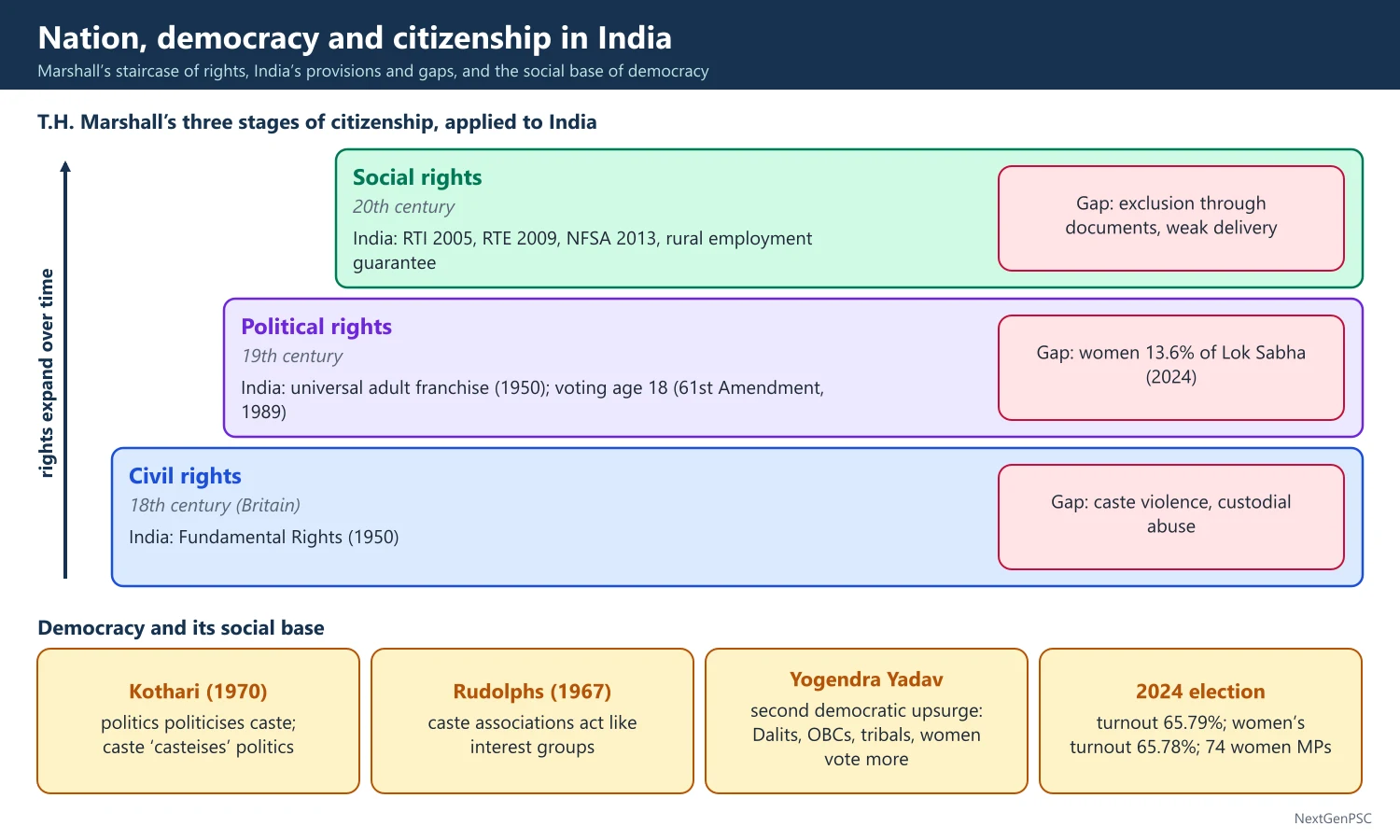
Citizenship: T.H. Marshall (Citizenship and Social Class, 1950) described the historical growth of civil rights (18th century), political rights (19th century) and social rights (20th century) in Britain.
Oommen's triad: T.K. Oommen (Citizenship, Nationality and Ethnicity, 1997) distinguished citizenship (legal equality), nationality (identification with a territory) and ethnicity (cultural identity without territory), arguing that confusing them causes conflict.
Democracy: Joseph Schumpeter defined it procedurally as competition for votes among elites; Robert Dahl's polyarchy adds participation and contestation; sociologists add substantive equality and social democracy, as Ambedkar did.
2. Nation-building in India
Unity in diversity: the Constitution recognised linguistic diversity (Eighth Schedule, now 22 languages), religious freedom (Articles 25–30) and federalism, rejecting a single-culture nation.
Challenges: Partition (1947), integration of princely states, linguistic reorganisation (1956), insurgencies in the North-East, Punjab and Kashmir, and communal conflict tested the nation-state.
Nehru and Gandhi: Nehru's The Discovery of India (1946) imagined India as a palimpsest of layers of culture; Gandhi linked nationalism to moral and village self-rule.
Competing nationalisms: Hindu nationalism (Savarkar's Hindutva, 1923) defines the nation culturally; secular-composite nationalism defines it constitutionally; scholars such as Christophe Jaffrelot (The Hindu Nationalist Movement in India, 1996) study the rise of the former.
Kashmir: Article 370 was effectively abrogated on 5 August 2019 and the state was reorganised into two Union Territories; the Supreme Court upheld this on 11 December 2023, a key moment in debates on federalism and integration.
3. Democracy and its social base
India as an anomaly: Lipset (1959) linked democracy to wealth, literacy and a middle class; India became a stable democracy without these, which scholars call the 'Indian puzzle'.
Caste and politics: Rajni Kothari (Caste in Indian Politics, 1970) argued that politics 'politicised caste' while caste 'casteised politics', turning caste into a vehicle of democratic participation.
Modernity of tradition: Lloyd and Susanne Rudolph (The Modernity of Tradition, 1967) showed how caste associations, such as the Nadars of Tamil Nadu, acted like interest groups in democracy.
Vote banks: Srinivas coined 'vote bank' for blocs of votes delivered by dominant-caste leaders; in Rampura the dominant caste mediated villagers' votes.
Second democratic upsurge: Yogendra Yadav argued that from the 1990s turnout rose among Dalits, OBCs, tribals and women, making the poor more active voters than the rich, unlike in the West.
Silent revolution: Christophe Jaffrelot (India's Silent Revolution, 2003) described the rise of lower castes in North Indian politics after Mandal.
2024 general election: the Election Commission recorded a turnout of 65.79%, with women's turnout (65.78%) slightly above men's; 74 women were elected to the 543-member Lok Sabha, about 13.6%.
Concerns: money power, criminalisation of politics, dynastic parties, polarisation and pressure on institutions; scholars such as Suhas Palshikar debate whether India is moving towards a majoritarian or 'electoral' democracy, a debated point.
4. Citizenship: law and contestation
Legal framework: Part II of the Constitution (Articles 5–11) and the Citizenship Act 1955 give citizenship by birth, descent, registration and naturalisation; the 1986 and 2003 amendments moved birthright citizenship from pure jus soli towards descent.
Citizenship (Amendment) Act 2019: offers faster citizenship to Hindu, Sikh, Buddhist, Jain, Parsi and Christian migrants from Afghanistan, Bangladesh and Pakistan who entered before 31 December 2014; its rules were notified on 11 March 2024.
Debate on the CAA: supporters see it as humanitarian protection for persecuted minorities; critics, including the protesters at Shaheen Bagh (2019–20), argue that excluding Muslims makes religion a criterion of citizenship, contrary to Article 14; challenges are pending in the Supreme Court.
NRC in Assam: the National Register of Citizens, updated under Supreme Court supervision, published its final list on 31 August 2019, leaving out about 19.06 lakh people; the exercise is rooted in the Assam Accord (1985) and anti-immigrant mobilisation.
Voter-roll revision: the Election Commission's Special Intensive Revision of electoral rolls in Bihar (2025) and its second phase in 12 states and union territories (from November 2025) required documents from voters; critics argued it could disenfranchise the poor and migrants, while the Commission defended it as cleaning the rolls.
Differentiated citizenship: Niraja Gopal Jayal (Citizenship and Its Discontents, 2013) showed that Indian citizenship combines universal rights with group-differentiated rights (reservations, personal laws), and that social citizenship remains weak.
Social citizenship in India: rights to food (2013), education (2009), information (2005) and work guarantees expanded Marshall's third stage, but delivery depends on documents such as Aadhaar and ration cards, which can exclude the poorest.
Statelessness and the Rohingya: India is not a party to the 1951 Refugee Convention, so refugees such as the Rohingya, Tibetans and Sri Lankan Tamils hold different, discretionary statuses, showing the gap between humanitarian norms and national citizenship law.
Overseas citizenship: the Overseas Citizen of India card (2005) gives the diaspora a partial, non-political membership, an example of 'flexible citizenship' (Aihwa Ong, 1999) in a globalised world.
Everyday citizenship: ethnographies of slum dwellers and tribal villagers show that people experience citizenship through ration shops, police stations and documents, so the State is met at its 'margins' (Veena Das and Deborah Poole, 2004).
5. Linking thinkers
Link to Marshall's stages of citizenship and to Ambedkar's distinction between political and social democracy.
Link to Weber: the nation as a community of sentiment that seeks its own State, and legitimate authority in democratic elections (legal-rational) mixed with charisma of leaders.
Link to caste (Srinivas's dominant caste and vote bank), to social movements (Chapter 25) and to communalism (Chapter 27).
Link to Habermas's public sphere: Indian democracy's public sphere now includes vernacular media and social media, which both widen participation and spread polarisation.
6. Using it in the exam
10 marks: define nation (Anderson), name India's civic model, and give one challenge with a recent example.
15–20 marks on democracy: the Indian puzzle, caste and democracy (Kothari, Rudolphs, Srinivas), the second upsurge (Yadav), 2024 data, concerns, and a conclusion on deepening social democracy.
On citizenship: Marshall's stages, Oommen's triad, constitutional law, CAA, NRC and voter-roll debates presented on both sides, and Jayal's idea of differentiated citizenship.
Thinkers to cite: Anderson, Marshall, Oommen, Kothari, Yogendra Yadav, Jayal.
Diagram idea: Marshall's ladder (civil → political → social rights) with Indian examples at each rung (Article 19, universal franchise 1950, RTE 2009 and NFSA 2013).
Quotation to use: Kothari's paraphrased thesis that democracy politicised caste as much as caste shaped politics.
| Type of right | Marshall's period (Britain) | Indian provision | Gap observed |
|---|---|---|---|
| Civil | 18th century | Fundamental Rights (1950) | Caste violence, custodial abuse |
| Political | 19th century | Universal adult franchise (1950); 61st Amendment lowered voting age to 18 (1989) | Women 13.6% of Lok Sabha (2024) |
| Social | 20th century | RTI 2005, RTE 2009, NFSA 2013, rural employment guarantee | Exclusion through documents and weak delivery |
Mains points
- Questions include 'Is caste a threat to or a resource for Indian democracy?' and 'Discuss emerging debates on citizenship in India'.
- Present CAA, NRC and voter-roll revision in a balanced, sourced way; state both the government's and critics' positions.
- Use Indian scholars (Kothari, Oommen, Jayal, Yadav, Chatterjee) along with Anderson and Marshall.
- Quote 2024 election data with source (Election Commission) to show participation trends, especially women's turnout.
- A common mistake is to treat nation and State as the same; use Oommen's distinction.
- Conclude with Ambedkar's warning that political democracy must rest on social democracy.
Did you know?
- In 2024, for the second general election running, women voted at a slightly higher rate than men, reversing the old gender gap in turnout.
Political Parties, Pressure Groups and Elites
Political parties link society to the State; in India they moved from the 'Congress system' (Rajni Kothari) to coalition politics and, since 2014, a new dominant-party phase. Pressure groups, from business chambers and farmers' unions to caste associations and NGOs, press demands without seeking office. Elite theory (Pareto, Mosca, Michels, Mills) helps explain how social and political elites in India have changed from Brahmin-English-educated to more plural, regional and backward-caste leaderships.
In simple words
A political party is a team that tries to win elections and run the government; a pressure group is a team that tries to influence the government without contesting elections.
Think of a cricket match: parties are the players, pressure groups are the loud supporters and sponsors trying to change the rules.
An elite is the small group at the top that holds power; sociologists ask who they are and whether they change.
UPSC asks about the social base of parties, the role of pressure groups and changes in India's elite.
1. Concepts and definitions
Political party: Weber defined parties as associations aimed at securing power within an organisation for their leaders, to attain ideal or material advantages for members; parties belong to the sphere of power, alongside class and status.
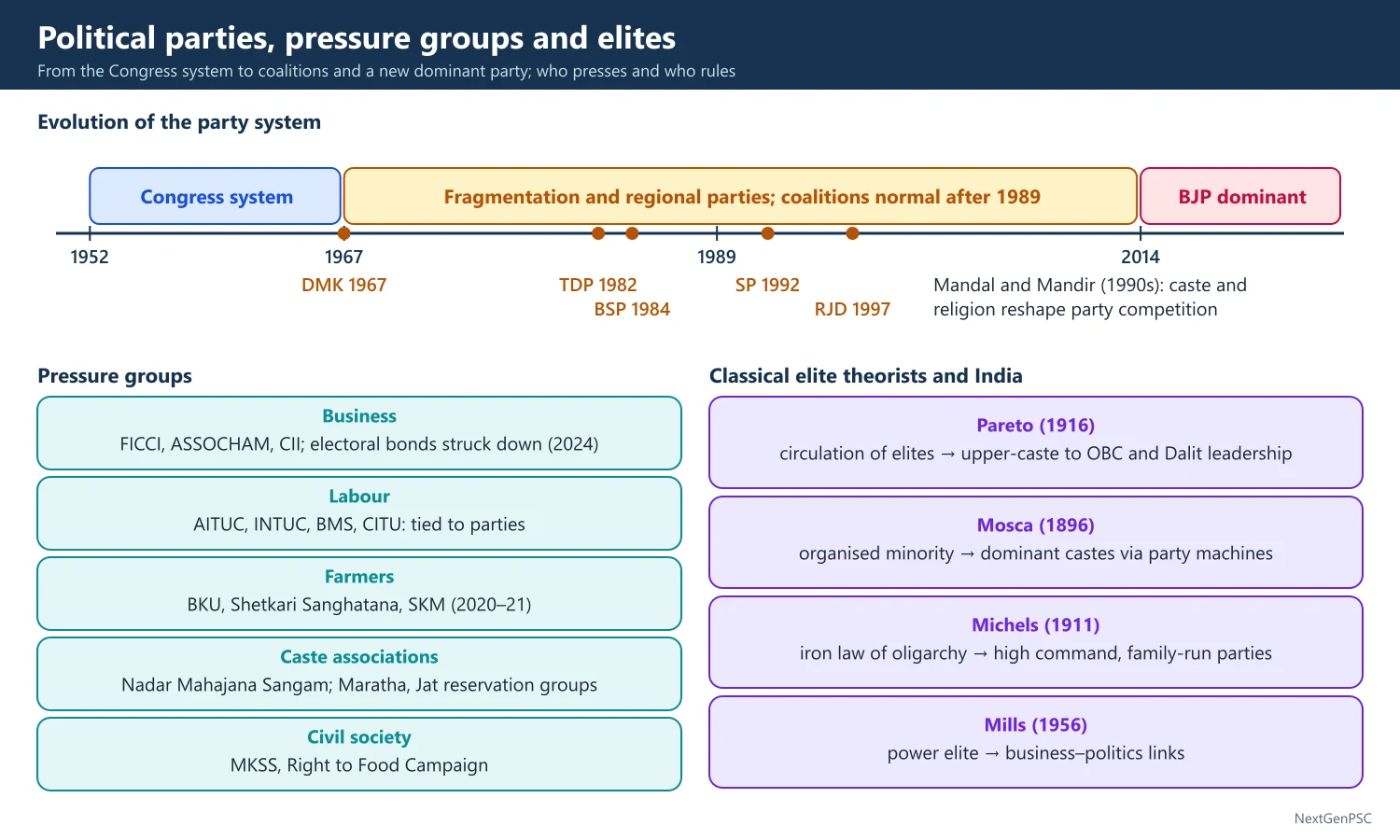
Iron law of oligarchy: Robert Michels (Political Parties, 1911), studying the German Social Democratic Party, argued that 'who says organisation, says oligarchy': all large organisations come under the control of a small leadership.
Circulation of elites: Vilfredo Pareto (The Mind and Society, 1916) divided elites into 'lions' (who rule by force) and 'foxes' (who rule by cunning), and said history is a 'graveyard of aristocracies' as elites replace each other.
Ruling class: Gaetano Mosca (The Ruling Class, 1896) argued that an organised minority always rules a disorganised majority, using a 'political formula' to justify its rule.
Power elite: C. Wright Mills (The Power Elite, 1956) described the interlocking military, corporate and political leaders of the USA; pluralists such as Robert Dahl (Who Governs?, 1961) argued that power is dispersed among competing groups.
Pressure group: an organised group that seeks to influence public policy without seeking to form the government; interest groups (sectional) and promotional or cause groups are the two main types.
Demand groups: the Rudolphs (In Pursuit of Lakshmi, 1987) used this term for India's loosely organised, agitational groups (students, farmers) that mobilise episodically, unlike formal Western interest groups.
2. Party system: evolution and social base
Congress system (1952–1967): Rajni Kothari ('The Congress System in India', 1964) described one dominant party that absorbed factions and interests (a party of consensus) surrounded by parties of pressure.
Social base of Congress: a coalition of upper castes, Dalits and Muslims in the north, and dominant landowning castes in the states, held together by patronage networks.
Fragmentation (1967–2014): regional and caste-based parties rose: DMK (1967), Akali Dal, Telugu Desam (1982), BSP (1984, Kanshi Ram), Samajwadi Party (1992), RJD (1997); coalition governments became normal after 1989.
Mandal and Mandir: the implementation of OBC reservation (1990) and the Ram temple movement reshaped party competition along caste and religious lines from the 1990s.
Since 2014: the BJP became the dominant party, winning majorities in 2014 and 2019 and leading the NDA coalition government in 2024; scholars debate whether this is a 'fourth party system' built on Hindu nationalism, welfare delivery and cross-caste support among OBCs and Dalits.
Internal democracy: Michels's iron law fits Indian parties: high command culture, family control of many regional parties, and ticket distribution by leaders show oligarchy.
Welfare and the 'labharthi' voter: recent studies (Lokniti–CSDS surveys) show that direct benefits such as free grain, housing and cash transfers create a new beneficiary-based loyalty cutting across caste, a debated trend.
3. Pressure groups in India
Business: FICCI (1927), ASSOCHAM (1920) and CII influence economic policy through lobbying and consultation; electoral bonds (2018) were struck down by the Supreme Court on 15 February 2024 as violating the voters' right to information, which raised the question of corporate influence on parties.
Labour: trade union federations (AITUC, INTUC, BMS, CITU) are linked to parties, which limits their autonomy.
Farmers: Bharatiya Kisan Union (Mahendra Singh Tikait), Shetkari Sanghatana (Sharad Joshi) and the Samyukt Kisan Morcha (2020–21 protest) show the strength of agrarian pressure.
Caste and community associations: caste sabhas, such as the Nadar Mahajana Sangam and Maratha and Jat organisations demanding reservation, act as pressure groups; the Rudolphs saw them as a modern form of caste.
Civil society and NGOs: MKSS (right to information), the Right to Food Campaign and environmental groups use protest, litigation and media; Neera Chandhoke and Partha Chatterjee debate whether this 'civil society' represents the poor.
Religious and cultural organisations: the RSS and its affiliates, Jamiat Ulama-i-Hind and church bodies influence policy on education, conversion and personal law.
4. Social and political elites in India
Colonial and nationalist elite: English-educated professionals, mostly upper caste (Brahmins, Kayasthas, Bhadralok in Bengal), led the Congress; B.B. Misra (The Indian Middle Classes, 1961) traced their rise.
Elite circulation after 1947: rich peasant and dominant castes (Jats, Yadavs, Reddys, Marathas, Vokkaligas, Lingayats) entered state legislatures; Yogendra Singh and Béteille noted this shift from a 'traditional' to a 'modern' elite.
Lower caste and Dalit leaders: Kanshi Ram and Mayawati, Lalu Prasad, Mulayam Singh Yadav and others represent Pareto's circulation in democratic form, though critics say new elites also become oligarchic.
Bureaucratic elite: the IAS remains a key elite; reservations have diversified its social composition, though the upper levels are still dominated by upper castes, as several studies show.
Economic elite: the World Inequality Lab study by Nitin Kumar Bharti, Lucas Chancel, Thomas Piketty and Anmol Somanchi (2024) estimated that the top 1% held about 22.6% of national income and 40.1% of wealth in 2022–23, which they called the 'billionaire raj'.
Women in the elite: women remain under-represented: about 13.6% of Lok Sabha MPs in 2024, while the Women's Reservation Act 2023 will reserve one-third of seats after the next delimitation.
5. Debates and world examples
Marxist critique of elite theory: Marxists such as Ralph Miliband (The State in Capitalist Society, 1969) argued that elites are not a separate stratum but represent the capitalist class; in India, A.R. Desai saw the post-colonial State as serving the bourgeoisie and landlords.
Pluralist view in India: Myron Weiner (The Politics of Scarcity, 1962) described Indian politics as many competing organised interests making demands on a scarce State, an early pressure-group study of India.
Party and caste in the village: F.G. Bailey's study of Bisipara, Odisha (Politics and Social Change, 1963) showed how party politics opened new routes to power for lower castes, breaking the old village hierarchy.
Dynasties: Kanchan Chandra (ed., Democratic Dynasties, 2016) found that a significant share of Lok Sabha MPs come from political families, a modern form of ascribed elite status within democracy.
Media and digital campaigning: social media, data-driven targeting and party IT cells have changed how parties mobilise voters, raising concerns about misinformation and polarisation.
World examples: Duverger's law (single-member plurality favours two parties) fits India only partly, because regional parties dominate state-level contests, producing a multi-party national system.
6. Linking thinkers
Link Weber's class, status and party to India: caste (status) often decides party support more than class.
Link Gramsci's hegemony: dominant parties win consent through culture and welfare, not only coercion.
Link to Srinivas's dominant caste and to the agrarian classes of Chapter 22, since rich peasant castes became political elites.
7. Using it in the exam
10 marks: distinguish party and pressure group with two Indian examples each.
15–20 marks on elites: elite theory (Pareto, Mosca, Michels, Mills), its critics (pluralists, Marxists), circulation of elites in India (from upper caste to OBC and Dalit leaders), and a conclusion on democracy as a channel of elite circulation.
Thinkers to cite: Michels, Pareto, Mosca, Mills, Rajni Kothari, the Rudolphs.
Diagram idea: a timeline of the Indian party system: Congress system (1952–67) → fragmentation and coalitions (1967–2014) → new dominant-party phase (2014–).
Quotation to use: Michels: 'Who says organisation, says oligarchy'.
| Thinker | Work (year) | Key idea | Indian application |
|---|---|---|---|
| Pareto | The Mind and Society (1916) | Circulation of elites; lions and foxes | Upper-caste to OBC and Dalit leadership |
| Mosca | The Ruling Class (1896) | Organised minority, political formula | Dominant castes ruling through party machines |
| Michels | Political Parties (1911) | Iron law of oligarchy | High command culture, family-run parties |
| Mills | The Power Elite (1956) | Interlocking military, corporate, political elite | Business–politics links (electoral bonds debate) |
Mains points
- Questions ask about the changing social base of parties, the role of pressure groups, or elite circulation in India.
- Use Kothari's Congress system and its decline as the backbone of answers on the party system.
- Connect elite theory to caste: circulation in India often means caste circulation.
- Cite recent facts with dates: electoral bonds struck down (15 February 2024), 2024 election results, Women's Reservation Act 2023.
- Avoid partisan language; describe parties' strategies and social bases neutrally.
- Show that Indian pressure groups are often agitational 'demand groups' (Rudolphs), not only formal lobbies.
Did you know?
- Memory trick for elite theorists: 'P-M-M-M' — Pareto circulates, Mosca organises, Michels oligarchises, Mills interlocks.
Regionalism, Decentralisation and Secularisation
Regionalism is attachment to a region's language, culture and economic interests; in India it produced linguistic states (1956), regional parties and demands for new states such as Telangana (2014). Decentralisation through the 73rd and 74th Amendments (1992) gave constitutional status to panchayats and municipalities and brought over a million women into local office. Secularisation, the declining social role of religion, is uneven in India, and the meaning of Indian secularism is fiercely debated.
In simple words
Regionalism is pride in and demands for one's own region, like Tamil pride in Tamil or demands for a separate state.
Decentralisation is like a school letting each class elect monitors and spend part of the budget, instead of the principal deciding everything.
Secularisation means religion losing control over public life, law and education, though people may stay religious privately.
UPSC asks whether these processes strengthen or weaken Indian unity and democracy.
1. Concepts and definitions
Region: a territory with shared language, history, culture or economy that people identify with; regionalism is the political assertion of that identity for autonomy, statehood or resources.
Sons of the soil: Myron Weiner (Sons of the Soil, 1978) described nativist movements in Assam, Maharashtra and Andhra in which locals demanded jobs against migrants.
Decentralisation: transfer of power, functions and resources from central to lower levels; it can be administrative (deconcentration), fiscal or political (devolution to elected bodies).
Secularisation: Bryan Wilson (Religion in Secular Society, 1966) defined it as the process by which religious thinking, practice and institutions lose social significance; Peter Berger (The Sacred Canopy, 1967) linked it to pluralism, though he later revised his view (1999) and spoke of desecularisation.
Secularism: a State policy separating religion from State power; Indian secularism, in Rajeev Bhargava's phrase, follows 'principled distance', allowing the State to intervene in or support religions for equality, unlike strict French laïcité.
Srinivas on secularisation: in Social Change in Modern India (1966) Srinivas described secularisation as the spread of rationalism and the decline of purity–pollution ideas, especially among urban, educated groups.
2. Regionalism in India
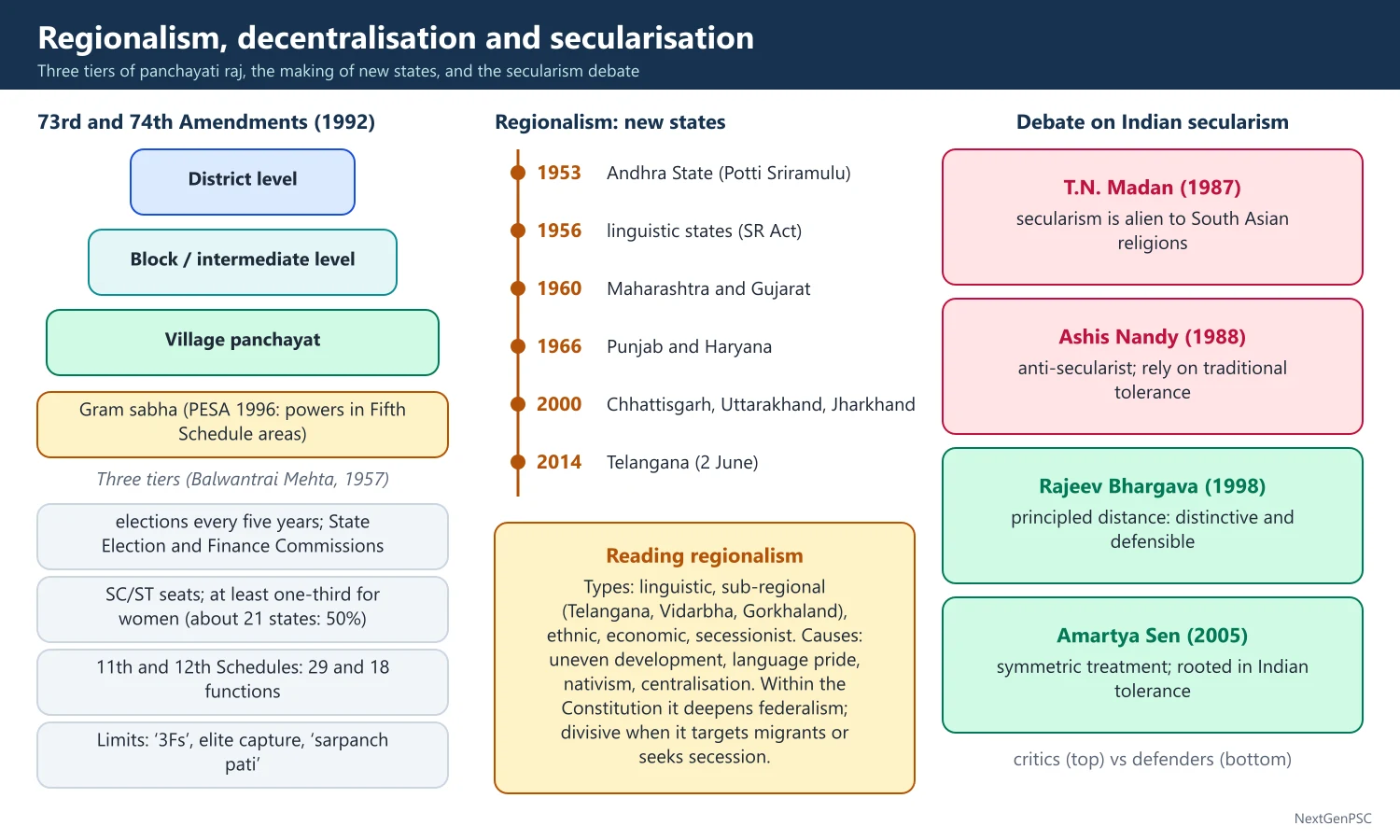
Linguistic states: Potti Sriramulu's fast and death (1952) led to Andhra State (1953); the States Reorganisation Commission (Fazl Ali, 1955) and the States Reorganisation Act 1956 created linguistic states, later followed by Maharashtra and Gujarat (1960) and Punjab and Haryana (1966).
Types of regionalism: linguistic (Dravidian movement, anti-Hindi agitation of 1965), sub-regional (Telangana, Vidarbha, Gorkhaland, Bundelkhand), ethnic (North-East), economic (backwardness claims), and secessionist (Khalistan, Naga and earlier Mizo insurgency).
New states: Chhattisgarh, Uttarakhand and Jharkhand (2000) and Telangana (2 June 2014) were created after long movements based on tribal identity, hill identity and regional neglect.
Causes: uneven development (relative deprivation), linguistic and cultural pride, migration and nativism, centralisation of power, and political entrepreneurs who mobilise regional identity.
Positive or negative: scholars such as Rasheeduddin Khan and Iqbal Narain argued that regionalism within the Constitution deepens democracy and federalism; it becomes divisive when it turns against migrants or seeks secession.
Current issues: the North–South debate over delimitation after the next census (since southern states controlled population growth), language policy in NEP 2020, and fiscal transfers under the Finance Commission.
3. Decentralisation of power
History: Balwantrai Mehta Committee (1957) recommended three-tier Panchayati Raj; Ashok Mehta Committee (1977) suggested two tiers; the bodies lost vitality in many states until the constitutional amendments.
73rd and 74th Amendments (1992): in force from April and June 1993; mandatory elections every five years, State Election Commissions and Finance Commissions, reservation for SCs and STs and at least one-third for women, and the Eleventh and Twelfth Schedules listing 29 and 18 functions.
PESA 1996: extended panchayats to Fifth Schedule areas, recognising gram sabha powers over minor forest produce, land alienation and community resources; the Niyamgiri gram sabhas' rejection of bauxite mining (2013) showed its potential.
Women in local government: about 21 states have raised women's reservation in panchayats to 50%; the Ministry of Panchayati Raj reports around 14.5 lakh elected women representatives, the largest number of women in elected office anywhere.
Evidence: Raghabendra Chattopadhyay and Esther Duflo (Econometrica, 2004) found that women pradhans in West Bengal and Rajasthan invested more in drinking water, a good the women had asked for; the 'sarpanch pati' (proxy husband) problem shows the limits.
Dalit sarpanches: studies report that reserved Dalit sarpanches face obstruction and violence from dominant castes, showing that formal power does not easily overturn caste power.
Kerala's People's Plan Campaign (1996): devolved about 35–40% of the state plan funds to local bodies with participatory planning, cited as the best Indian model of decentralisation.
Limits: the '3Fs' problem (functions, funds, functionaries not fully devolved), elite capture, and parallel bodies; the new rural employment law, VB-G RAM G (from 1 July 2026), keeps planning at gram panchayat level, but critics fear more central control.
4. Secularisation and secularism in India
Evidence of secularisation: the Hindu Code, decline of untouchability in public places, inter-caste marriage in cities, and rational-legal law replacing religious law in many areas.
Counter-evidence: rising pilgrimage, religious television, godmen and festivals, and the use of religion in politics suggest desecularisation or 'religious resurgence'; José Casanova (1994) called this the deprivatisation of religion.
Madan's critique: in 'Secularism in its Place' (1987), T.N. Madan argued that secularism is a 'gift of Christianity' unsuited to South Asia, where religions are totalising, so it can be imposed only by a minority.
Ashis Nandy: argued for tolerance rooted in everyday faith rather than State secularism, which he saw as producing its own violence.
Defence of Indian secularism: Rajeev Bhargava and Amartya Sen argue that principled distance and equal respect are indigenous and workable; the Supreme Court declared secularism part of the basic structure in S.R. Bommai (1994), and the word was added to the Preamble by the 42nd Amendment (1976).
Recent debates: the Ram temple consecration at Ayodhya (22 January 2024), the Places of Worship Act 1991 challenges, the Waqf (Amendment) Act 2025, anti-conversion laws in several states and Uttarakhand's Uniform Civil Code (2025) are read differently as either correcting 'pseudo-secularism' or eroding minority rights.
Caste and secularisation: Srinivas noted that secularisation weakened the ritual basis of caste while caste grew stronger as a political and associational identity, so declining ritual does not mean declining caste.
Middle class religiosity: studies of urban India show new forms of religion (gurus, televised discourses, temple tourism) among the educated middle class, which fits Berger's later view that modernity produces pluralism, not irreligion.
Survey evidence: the Pew Research Center survey 'Religion in India: Tolerance and Segregation' (2021) found that most Indians value religious tolerance but also prefer to keep their own communities separate in marriage and friendship.
Fiscal decentralisation: local bodies still receive a small share of public spending; Finance Commission grants to panchayats and municipalities are the main channel, and own-revenue raising remains weak.
Urban decentralisation: the 74th Amendment is weaker in practice than the 73rd: mayors in most cities have little executive power, and parastatal bodies (development authorities) control planning.
5. Linking thinkers
Link secularisation to Weber's disenchantment of the world and Durkheim's sacred and profane; in India, ritual continues while its social control over caste declines.
Link decentralisation to Tocqueville on local self-government as a school of democracy, and to Gandhi's gram swaraj.
Link regionalism to relative deprivation theory and to ethnic movements (Chapter 25).
6. Using it in the exam
10 marks: define regionalism or secularisation with one thinker and two Indian examples.
15–20 marks on decentralisation: history, 73rd and 74th Amendments, PESA, impact on women and Dalits with evidence, limits, and a conclusion on deepening democracy.
On secularisation: Wilson and Berger, Srinivas's Indian account, Madan–Nandy vs Bhargava debate, and current examples on both sides.
Thinkers to cite: Myron Weiner, Srinivas, T.N. Madan, Rajeev Bhargava, Bryan Wilson, Chattopadhyay and Duflo.
Diagram idea: a three-tier pyramid: Zila Parishad → Panchayat Samiti → Gram Panchayat with the gram sabha at the base.
Quotation to use: Wilson's definition of secularisation as the process by which religion loses social significance.
| Scholar | Work (year) | Position |
|---|---|---|
| T.N. Madan | Secularism in its Place (1987) | Secularism is alien to South Asian religions |
| Ashis Nandy | The Politics of Secularism and the Recovery of Religious Tolerance (1988) | Anti-secularist; rely on traditional tolerance |
| Rajeev Bhargava | Secularism and its Critics (ed., 1998) | Principled distance; Indian secularism is distinctive and defensible |
| Amartya Sen | The Argumentative Indian (2005) | Secularism as symmetric treatment; rooted in Indian traditions of tolerance |
Mains points
- Expect questions such as 'Is regionalism a threat to national integration?', 'Assess the impact of Panchayati Raj on women and Dalits' and 'Is India secularising?'.
- Treat regionalism as both a democratic demand and a potential threat; give examples of each.
- Distinguish secularisation (social process) from secularism (State policy); many answers confuse them.
- Use evidence on women in panchayats (Chattopadhyay and Duflo, 2004) and note proxy representation.
- Present recent religious-political events neutrally with dates; examiners reward balance.
- Mention delimitation and the North–South debate as a current form of regional politics.
Did you know?
- India has more elected women in local government (about 14.5 lakh) than the total population of many countries.
UPSC Previous Year Questions: Politics and Society in India
From 2014 to 2026 UPSC asked 26 question parts (330 marks) from this chapter, all in Paper II. Nation, democracy and citizenship (9 parts) and political parties, pressure groups and elites (9 parts) are asked equally often, closely followed by regionalism, decentralisation and secularisation (8 parts). Caste in politics, elites and secularisation recur almost every other year. Every question below has a model answer written to the UPSC word limit.
In simple words
Write your own answer first within the time limit: about 7 minutes for 10 marks and 11 minutes for 20 marks.
Then compare it with the model answer: check the thinkers (Kothari, Srinivas, Rudolphs, Madan, Nandy, Bhargava, Pareto, Mills), the Indian examples and the recent data you used.
Write down what you missed and revise it in this chapter's notes before attempting the next question.
1. Nation, Democracy and Citizenship in India
Example 1 (UPSC 2025, 20 marks): What do you mean by nation building? What is the role of religion in nation building? Elaborate your answer.
Paper and question: Paper II, Q3(a)
Approach: Two parts: define nation building (Anderson, Deutsch, Indian thinkers), then elaborate religion's dual role, integrative and divisive, with Indian history and examples; conclude with the constitutional path.
Nation building is the process of creating a shared national identity, loyalty and institutions among diverse peoples within a State. Benedict Anderson (Imagined Communities, 1983) described the nation as an imagined political community, and Karl Deutsch stressed social communication. In India, Nehru's 'unity in diversity' and the Constitution sought a civic nation built on citizenship rather than one religion, language or race.
Religion as an integrative force: pilgrimage networks (Char Dham, Kumbh, Sufi dargahs) created a sense of sacred geography across regions long before modern nationalism; reform movements and figures such as Vivekananda used religion to build self-respect against colonial rule; Gandhi drew on religious symbols (Ram Rajya, prayer meetings, satyagraha) to mobilise the masses and preached sarva dharma samabhava. Durkheim's view that religion binds people through shared beliefs and rituals helps explain this.
Religion as a divisive force: the same mobilisation fed communal politics, separate electorates (1909) and Partition in 1947; Bipan Chandra traced how communal ideology treated religious communities as political units. Religious nationalism (Savarkar's Hindutva, 1923, and the Muslim League's two-nation theory) defined the nation by faith. Since independence, riots (Delhi 1984, Mumbai 1992–93, Gujarat 2002) and controversies over conversion and places of worship show religion straining national unity.
Constitutional approach: Indian secularism, as Rajeev Bhargava argues, keeps a 'principled distance' from all religions, protecting freedom of religion (Articles 25–28) and minority rights (Articles 29–30), while T.N. Madan and Ashis Nandy argue that tolerance must come from within religious traditions.
Religion can therefore build the nation when it supplies ethics, pluralism and solidarity, and can break it when used as the boundary of citizenship; India's nation building rests on keeping religion a source of values rather than a test of belonging.
Example 2 (UPSC 2023, 10 marks): Examine the concept of 'Cultural Pluralism' in the context of India's Unity in Diversity.
Paper and question: Paper II, Q5(b)
Approach: Examine the concept: define cultural pluralism (Kallen), show how India's diversity is accommodated (constitutional and social mechanisms), and note tensions.
Cultural pluralism, a term associated with Horace Kallen (1915), is a condition in which distinct cultural groups keep their identities while sharing a common political community, unlike the 'melting pot' of assimilation.
India's 'unity in diversity' is a model of it: 22 languages in the Eighth Schedule, many religions, thousands of castes and over 700 Scheduled Tribes. The Constitution accommodates this through Articles 29 and 30 (minority cultural and educational rights), linguistic reorganisation of states (1956), the Fifth and Sixth Schedules for tribal self-rule, personal laws and federalism. Socially, syncretic traditions such as Bhakti and Sufi movements and shared festivals sustain it, and Srinivas's idea of an all-India Sanskritic layer alongside regional cultures explains unity at a deeper level.
Tensions remain: demands for uniformity, linguistic and ethnic conflicts, and communalism challenge pluralism.
Cultural pluralism in India is therefore both a social fact and a constitutional commitment that must be renewed through dialogue and equal citizenship.
Example 3 (UPSC 2021, 10 marks): Is social democracy a precondition for political democracy? Comment.
Paper and question: Paper II, Q7(c)
Approach: Comment using Ambedkar's argument: define both, explain why social democracy sustains political democracy, with Indian evidence, and a nuanced conclusion.
Political democracy means equal political rights, such as universal franchise and elections; social democracy, in Ambedkar's words, is a way of life that recognises liberty, equality and fraternity as principles of life.
In his speech of 25 November 1949, Ambedkar warned that political democracy cannot last unless it rests on social democracy, since India was entering a 'life of contradictions', with equality in politics and inequality in social and economic life. Tocqueville had similarly linked American democracy to social equality. Indian evidence supports this: caste hierarchy produces vote-buying, booth capturing in the past, atrocities when Dalits assert, and proxy representation of women.
Yet India also shows that political democracy can build social democracy: universal franchise empowered lower castes, as in Yadav's 'second democratic upsurge', and reservation in panchayats raised Dalit and women leaders.
Social democracy is therefore less a precondition than a necessary partner; each deepens the other.
Example 4 (UPSC 2020, 10 marks): Analyze the issues related to the citizenship in contemporary India. Give suitable illustrations.
Paper and question: Paper II, Q5(b)
Approach: Analyse issues with illustrations: legal (CAA, NRC), documentary (voter rolls, Aadhaar), social citizenship, and differentiated citizenship, using Marshall and Jayal.
T.H. Marshall described citizenship as full membership of a community, with civil, political and social rights; Niraja Gopal Jayal (Citizenship and Its Discontents, 2013) shows Indian citizenship combining universal and group-differentiated rights.
Legal membership: the Citizenship (Amendment) Act 2019, whose rules were notified in March 2024, offers faster citizenship to non-Muslim migrants from Afghanistan, Bangladesh and Pakistan; supporters see humanitarian protection, while critics, including the Shaheen Bagh protesters, see religion becoming a criterion. Assam's NRC (August 2019) left out about 19.06 lakh people, raising fears of statelessness. Documentary citizenship: access to rights increasingly depends on Aadhaar, ration cards and voter rolls; migrants, the homeless and women without papers risk exclusion, a concern raised again during the 2025 revision of electoral rolls.
Social citizenship: rights to education (2009) and food (2013) expanded Marshall's third stage, but delivery is uneven.
Indian citizenship is thus formally universal but substantively unequal, and its inclusiveness remains contested.
Example 5 (UPSC 2019, 10 marks): Comment on the changing democratic profile of India.
Paper and question: Paper II, Q5(d)
Approach: Comment on how the profile of Indian democracy has changed: participation, social composition of the elected, party system, women voters, and concerns, with data.
India's democratic profile has changed from an elite-led, Congress-dominated system to a mass, competitive democracy.
Participation: turnout has risen, reaching 65.79% in 2024, and women's turnout now equals or exceeds men's. Social composition: Yogendra Yadav's 'second democratic upsurge' of the 1990s brought OBCs, Dalits and Adivasis into power, and Jaffrelot called it a 'silent revolution'. Party system: Rajni Kothari's 'Congress system' (1952–67) gave way to coalitions and regional parties, and since 2014 to a new dominant-party phase. Local democracy: the 73rd and 74th Amendments (1992) created about 14.5 lakh women local representatives.
Concerns: money power (ADR reported that most 2024 MPs are crorepatis), MPs with criminal cases, dynastic politics, polarisation and debates over institutional autonomy.
Indian democracy is thus broader and deeper in participation, though the quality of representation remains a challenge.
Example 6 (UPSC 2018, 10 marks): Media is the fourth pillar of democracy. Discuss.
Paper and question: Paper II, Q1(c)
Approach: Discuss the media's role as the fourth pillar with Habermas's public sphere, Indian examples of its democratic role, and the threats to it (ownership, paid news, regulation).
The media is called the fourth pillar of democracy, after the legislature, executive and judiciary, because it informs citizens and holds power to account; Jürgen Habermas saw a free press as the core of the public sphere where citizens form opinion through rational debate.
In India, the press played a nationalist role from Tilak's Kesari to Gandhi's Young India; after independence it exposed scandals (Bofors, 2G), resisted the Emergency censorship of 1975–77, and gave voice to movements such as RTI and the anti-corruption campaign. Robin Jeffrey showed how the regional-language newspaper revolution drew rural and lower-caste readers into politics, and social media now amplifies citizen voices.
Threats exist: concentrated corporate ownership and dependence on advertising, which Herman and Chomsky called the 'manufacturing of consent'; paid news; polarised television; misinformation; and pressure on journalists, as India's low rank in press-freedom indices suggests.
The media remains a pillar only when it is independent, plural and accountable.
Example 7 (UPSC 2018, 20 marks): Has caste system hindered democracy and adult franchise in India? Discuss.
Paper and question: Paper II, Q7(a)
Approach: Discuss both sides: how caste hindered democracy (vote banks, dominance, violence, proxy) and how democracy transformed caste and empowered lower castes (Kothari, Rudolphs, Yadav), with examples; give a balanced verdict.
Many feared that caste, a hierarchy based on birth, would make adult franchise (adopted in 1950) unworkable; Ambedkar warned of a 'life of contradictions' between political equality and social inequality.
How caste hindered democracy: early elections often saw dominant castes control the votes of dependent labourers, and Srinivas described how dominant castes such as Okkaligas and Lingayats in Mysore commanded 'vote banks'. Booth capturing and intimidation of Dalit voters occurred in parts of Bihar and Uttar Pradesh; parties distribute tickets by caste arithmetic, which can sideline merit and issues; caste mobilisation sometimes produces violence, as in caste massacres in Bihar in the 1990s; and caste panchayats and proxy leaders limit the agency of women and Dalit representatives.
How democracy changed caste: Rajni Kothari (Caste in Indian Politics, 1970) argued that politics politicised caste, turning ritual hierarchy into competing interest groups and secularising it; the Rudolphs (The Modernity of Tradition, 1967) showed caste associations acting as democratic vehicles. Universal franchise allowed lower castes to convert numbers into power: the DMK in Tamil Nadu, the BSP under Kanshi Ram and Mayawati, and OBC-led parties after Mandal (1990), what Yogendra Yadav called the 'second democratic upsurge' and Jaffrelot a 'silent revolution'. Reservation of seats and panchayat quotas created Dalit and Adivasi leaders.
Verdict: caste has distorted democracy by encouraging identity-based mobilisation and patronage, but democracy has also eroded hierarchy and empowered the lower castes. Caste and democracy have transformed each other: caste now functions less as a ritual order and more as a political community.
Deepening democracy therefore requires reducing the social inequality behind caste politics, through education, land and dignity, rather than wishing caste away.
Example 8 (UPSC 2017, 20 marks): To what extent does nation building depend on strengthening of pluralities in Indian society?
Paper and question: Paper II, Q7(b)
Approach: To what extent: define nation building and pluralities, show how recognising pluralities strengthened the nation (language, federalism, tribal autonomy, minority rights) and where limits lie (fragmentation, need for common citizenship); conclude 'to a large extent, with a shared civic core'.
Nation building creates shared identity and loyalty among diverse groups; pluralities are India's many languages, religions, castes, tribes and regional cultures. Two models compete: assimilation into one culture, or unity through recognition of diversity, which Nehru called 'unity in diversity'.
Strengthening pluralities built the nation: the linguistic reorganisation of states (1956) was feared to break India but in fact defused linguistic separatism and deepened loyalty, as Paul Brass and others argue; the three-language formula and the Eighth Schedule (22 languages) gave recognition; the Sixth Schedule and autonomous councils (for example in Mizoram after the 1986 accord and the Bodoland Territorial Council, 2003) turned insurgency into participation; Articles 25–30 assured religious minorities; and federalism and reservations gave regions and lower castes a stake in the State. T.K. Oommen argues that India is best understood as a multi-national State in which nations and ethnies coexist.
Failures of recognition weakened it: the imposition of Hindi provoked the Tamil anti-Hindi agitation (1965); neglect of the North-East and Kashmir fuelled insurgencies; and communal violence against minorities eroded trust.
Limits: pluralities alone can fragment if they become exclusive, as in nativist 'sons of the soil' movements described by Myron Weiner; a common civic core of constitutional values, equal citizenship and shared development is also needed.
Nation building in India therefore depends to a large extent on strengthening pluralities, provided recognition is joined with equal citizenship and fraternity, which Ambedkar saw as the foundation of nationhood.
Example 9 (UPSC 2015, 10 marks): Write a brief note on the Freedom of Press.
Paper and question: Paper II, Q8(c)
Approach: Write a brief note: the constitutional basis and key judgments, the sociological role of press freedom, and current threats.
Freedom of the press is not mentioned separately in the Constitution but is part of freedom of speech and expression under Article 19(1)(a), subject to reasonable restrictions under Article 19(2).
The Supreme Court affirmed it in Romesh Thappar (1950), Sakal Papers (1962) and Bennett Coleman (1973), and in Shreya Singhal (2015) struck down Section 66A of the IT Act for chilling speech. Sociologically, a free press sustains Habermas's public sphere, exposes abuse of power and gives voice to marginal groups; the Emergency's censorship of 1975–77 showed how its loss weakens democracy.
Today threats include concentrated ownership, paid news, defamation and sedition-type cases against journalists, internet shutdowns and misinformation, and India ranks low in global press-freedom indices.
Press freedom therefore needs legal safeguards, plural ownership and professional ethics to serve democracy.
2. Political Parties, Pressure Groups and Elites
Example 10 (UPSC 2025, 10 marks): Discuss the social bases of political mobilization in Independent India. Has some change occurred in these during the last 60-70 years?
Paper and question: Paper II, Q5(c)
Approach: Two parts: list the social bases of mobilisation (caste, class, religion, language and region, tribe, gender), then show how they have changed over 60–70 years with phases and examples.
Political mobilisation is the process by which parties and movements draw people into political action; in India its social bases have been caste, class, religion, language and region, tribe and, increasingly, gender.
Change over time: in the Congress system (1952–67), which Rajni Kothari described, upper-caste leaders mobilised through dominant-caste intermediaries and vertical patron–client ties. From the late 1960s, linguistic and regional mobilisation (DMK, Akali Dal, Telugu Desam) and rich peasants (Charan Singh) rose. After Mandal (1990), OBC and Dalit parties such as the SP, RJD and BSP made caste identity the main axis, Yadav's 'second democratic upsurge', while the Ram Janmabhoomi movement made religion a powerful base. Since 2014, mobilisation combines Hindu nationalism, cross-caste coalitions including non-dominant OBCs and Dalits, and welfare beneficiaries (the 'labharthi'), while women now vote in equal or larger numbers.
Class-based mobilisation of workers and peasants has weakened relative to identity, though farmers' protests (2020–21) revived it.
The bases have thus shifted from vertical to horizontal and from local to national appeals.
Example 11 (UPSC 2024, 10 marks): Discuss the changing nature of political elites in India.
Paper and question: Paper II, Q5(d)
Approach: Discuss the changing nature of political elites: define (Pareto, Mosca), trace phases of change in social background, and note current features with data.
Political elites are the small group who hold decisive political power; Pareto spoke of the 'circulation of elites' and Mosca of a ruling minority in every society.
In India, the first generation was upper-caste, urban, English-educated and often trained in law, the leaders of the national movement. From the 1960s, rural and middle-caste leaders from the rich peasantry rose, such as Charan Singh and Devi Lal. After 1990, OBC, Dalit and regional leaders such as Lalu Prasad, Mulayam Singh, Mayawati and Karunanidhi transformed the composition of legislatures, a circulation of elites through democracy that Jaffrelot called a 'silent revolution'.
Current features include wealth (ADR found most 2024 Lok Sabha MPs to be crorepatis), dynasties (Kanchan Chandra, Democratic Dynasties, 2016), under-representation of women (about 13.6% in 2024) and of Muslims.
Elites have thus become socially broader but economically narrower.
Example 12 (UPSC 2024, 10 marks): What are pressure groups? Discuss their role in decision-making in democracy.
Paper and question: Paper II, Q8(c)
Approach: Define pressure groups, classify them with Indian examples, and discuss how they influence decisions, with a critical note.
Pressure groups are organised groups that seek to influence public policy without contesting elections to form government; unlike parties, they aim at influence rather than power.
In India they include business associations (FICCI, CII, ASSOCHAM), trade unions (INTUC, BMS, CITU), farmers' bodies (Bharatiya Kisan Union, Samyukt Kisan Morcha), professional bodies (Indian Medical Association, bar councils), caste and religious associations, and civil-society movements (MKSS, NAPM). They influence decisions through lobbying ministers and officials, submissions to parliamentary committees, public campaigns, litigation and protest. MKSS's campaign led to the RTI Act 2005, and the farmers' protest of 2020–21 led to the repeal of the three farm laws in 2021. The Rudolphs described India as a 'demand polity' shaped by such groups.
But powerful business lobbies can capture policy, as debates over the electoral bonds scheme, struck down in February 2024, showed.
Pressure groups enrich democracy when access to the State is open to the weak as well as the strong.
Example 13 (UPSC 2022, 10 marks): Discuss the role of pressure groups in strengthening democracy.
Paper and question: Paper II, Q5(d)
Approach: Discuss how pressure groups strengthen democracy (participation, representation of interests, accountability, information) with Indian examples, and their limits.
Pressure groups organise citizens around shared interests to influence policy; pluralist theorists such as Robert Dahl see competition among such groups as the essence of democracy between elections.
They strengthen democracy by widening participation beyond voting, representing interests that parties ignore, supplying expertise to policymakers and holding governments accountable. Indian examples include MKSS, whose campaign led to the RTI Act 2005; the Right to Food Campaign, which shaped the National Food Security Act 2013; women's groups whose pressure after the 2012 Delhi gang rape produced the Criminal Law (Amendment) Act 2013; SEWA for informal women workers; and farmers' unions in 2020–21.
Their limits are unequal access, since business lobbies have more resources than the poor, as C. Wright Mills's power elite thesis warns, and occasional use of coercive protest.
Pressure groups strengthen democracy most when they are open, plural and transparent in funding.
Example 14 (UPSC 2022, 10 marks): Discuss the changing nature of structure of political elites.
Paper and question: Paper II, Q6(c)
Approach: Discuss the changing structure of political elites by dimension (caste, class, region, gender, education and occupation), with theory and data.
The structure of political elites refers to their social composition and recruitment; Pareto's 'circulation of elites' helps explain how new groups replace old ones.
Caste: from Brahmin and upper-caste dominance in the early Lok Sabhas to a large share of OBC, SC and ST legislators, especially in the Hindi belt after the 1990s, as Christophe Jaffrelot and Sanjay Kumar documented. Region: regional parties made state leaders powerful nationally. Occupation and education: lawyers and freedom fighters gave way to agriculturists, businesspeople and professional politicians. Class: elites are increasingly wealthy; ADR found most 2024 MPs to be crorepatis, and political families form a significant share (Kanchan Chandra, 2016). Gender: women rose to about 13.6% of Lok Sabha MPs in 2024, and the Women's Reservation Act 2023 will raise this to one-third after delimitation.
This shows broader social representation alongside a concentration of money and dynastic advantage, which Robert Michels's 'iron law of oligarchy' would predict inside parties.
The structure is more democratic in caste terms but remains oligarchic in class terms.
Example 15 (UPSC 2019, 20 marks): What is caste politics? Substantiate your answer with examples of how identities are defined by caste dynamics.
Paper and question: Paper II, Q2(b)
Approach: Define caste politics, explain its mechanisms with theory (Kothari, Rudolphs, Srinivas), then substantiate with regional examples of how caste dynamics define identities (OBC, Dalit, dominant castes, sub-caste assertion), and conclude.
Caste politics is the use of caste as a basis of political mobilisation, representation and bargaining. Rajni Kothari (Caste in Indian Politics, 1970) argued that it is not that politics gets caste-ridden but that caste gets politicised; the Rudolphs showed caste associations becoming interest groups; and M.N. Srinivas linked it to dominant castes and vote banks.
Mechanisms: parties choose candidates by caste arithmetic, build social coalitions, and promise reservations or representation; caste associations (sabhas) bargain with the State; and caste census and sub-classification debates turn numbers into claims.
How caste dynamics define identities: (i) the Mandal Commission's implementation (1990) created a broad 'OBC' political identity out of many jatis, carried by the SP and RJD; (ii) the BSP under Kanshi Ram forged a 'Bahujan' identity uniting Dalits and other backward groups against the 'manuwadi' order; (iii) in Tamil Nadu, the Dravidian movement defined a non-Brahmin Tamil identity; (iv) dominant castes such as Jats, Patidars and Marathas redefined themselves as 'backward' in quota agitations (2015–16), showing that identity follows political interest; (v) within categories, sub-caste assertion produced 'Maha Dalit' (Bihar, 2007) and non-Yadav OBC identities, and the Supreme Court allowed SC sub-classification in Davinder Singh (2024); (vi) Bihar's caste survey (2023) made numbers central to identity claims.
Caste politics has thus democratised representation and dignity for lower castes, though critics such as Dipankar Gupta argue it can harden identities and sideline class and gender issues.
Caste identities in politics are therefore constructed and changing, not fixed survivals of tradition.
Example 16 (UPSC 2017, 20 marks): Explain the concepts of 'dominant caste' and 'vote bank', giving examples from specific regions.
Paper and question: Paper II, Q4(a)
Approach: Explain both concepts precisely (Srinivas), give regional examples of each (Karnataka, UP, Bihar, Gujarat, Maharashtra, Andhra), show how they connect, and note recent changes.
Dominant caste, a concept M.N. Srinivas developed from his study of Rampura (1955), is a caste that is numerically strong in a village or region, owns a large share of land and wields economic and political power; Western education, administrative jobs and ritual rank add to dominance. In Rampura, the peasant Okkaligas, not the Brahmins, were dominant.
Regional examples: Vokkaligas (Okkaligas) and Lingayats in Karnataka; Jats in Haryana, western Uttar Pradesh and Punjab; Marathas in Maharashtra; Patidars in Gujarat; Reddys and Kammas in Andhra Pradesh; Yadavs in parts of Bihar and Uttar Pradesh after the 1970s. Their dominance rests on land, cooperatives and local institutions, and they shape village justice and panchayats.
Vote bank, a term also used by Srinivas, refers to a bloc of voters who vote together on the instruction of leaders or according to group loyalty, usually caste or community. Examples include the Yadav–Muslim ('MY') base of the RJD in Bihar and the SP in Uttar Pradesh; the Jatav base of the BSP; the KHAM coalition (Kshatriya, Harijan, Adivasi, Muslim) built by the Congress in Gujarat in the 1980s; and the Lingayat vote in Karnataka.
Connection: in early elections dominant castes delivered the votes of dependent castes through patron–client ties, so vote banks were vertical. As lower castes became politically conscious, vote banks became horizontal, with each caste voting as a bloc for its own leaders.
Recent change: economic diversification, welfare politics, Hindutva's cross-caste appeal and the assertion of non-dominant OBCs and Dalits have loosened rigid vote banks, while quota agitations by Jats, Patidars and Marathas show that dominant castes feel their dominance slipping. Both concepts remain useful but must be applied with attention to change.
Example 17 (UPSC 2016, 10 marks): Comment on the increasing significance of caste in politics.
Paper and question: Paper II, Q3(c)
Approach: Comment on why caste's political significance has increased: democratic mobilisation, reservation, coalition politics, sub-caste assertion and caste surveys, with a critical line.
Modernisation theorists expected caste to fade with democracy, but caste's significance in politics has grown, as Rajni Kothari's thesis of the politicisation of caste anticipated.
Reasons: universal franchise rewards numbers, so castes act as voting blocs; reservation in legislatures, jobs and education gives caste categories material value, and the Mandal Commission's implementation (1990) made OBC identity central; coalition and regional parties built on caste bases (SP, RJD, BSP); demands for inclusion in reserved categories by Jats, Patidars and Marathas; sub-classification debates and Bihar's caste survey (2023); and caste associations and social media that mobilise identity.
This has empowered lower castes, what Yogendra Yadav called the 'second democratic upsurge', but it can harden boundaries and crowd out class and gender issues.
Caste's political role is now less about ritual hierarchy and more about competing claims for power and resources.
Example 18 (UPSC 2014, 10 marks): Who are the elites? Discuss their roles in bringing social transformation.
Paper and question: Paper II, Q8(c)
Approach: Define elites (Pareto, Mosca, Mills), identify types in India, and discuss their roles in social transformation with examples, including limits.
Elites are small groups who hold superior positions of power, wealth or prestige; Pareto and Mosca saw every society ruled by a minority, and C. Wright Mills described a 'power elite' of political, economic and military leaders.
In India, the types include political, bureaucratic, economic, intellectual, religious and caste elites. Their roles in transformation have been significant: the English-educated reform elite (Raja Ram Mohan Roy, Phule, Ambedkar) challenged sati, caste and gender inequality; the nationalist elite (Gandhi, Nehru) built a democratic, secular constitution; the planning and bureaucratic elite drove industrialisation and land reform; new Dalit and OBC elites led social assertion; and entrepreneurs and technocrats shaped the post-1991 economy. Yogendra Singh saw such elites as carriers of modernisation.
But elites can also block change by capturing benefits, as with the creamy layer and dominant castes, and Michels warned of oligarchy.
Elites transform society when they remain open and accountable to the masses.
3. Regionalism, Decentralisation and Secularisation
Example 19 (UPSC 2026, 10 marks): How does the concept 'secular' go beyond any religion in plural society like India? Analyse.
Paper and question: Paper II, Q1(e)
Approach: Analyse how Indian secularism goes beyond any one religion: define, contrast with Western separation, explain principled distance and equal respect, with constitutional provisions and examples.
In a plural society like India, secular does not mean anti-religious or the privileging of one faith; it means that the State belongs equally to citizens of all faiths and of none.
Unlike the Western model of a strict wall of separation, Indian secularism, as Rajeev Bhargava argues, keeps a principled distance from all religions: the State may intervene to reform religious practices that violate equality, such as untouchability (Article 17) and temple entry, while protecting freedom of conscience (Article 25) and minority institutions (Articles 29–30). Gandhi's sarva dharma samabhava, equal respect for all religions, and Nehru's insistence on equal citizenship go beyond any single tradition. The Supreme Court in S.R. Bommai (1994) held secularism to be part of the basic structure.
T.N. Madan and Ashis Nandy argue that tolerance must draw on the pluralism within religious traditions themselves, such as Bhakti, Sufi and Sikh teachings.
Secularism therefore transcends any religion by making equal citizenship, not faith, the basis of belonging.
Example 20 (UPSC 2024, 20 marks): What do you understand by decentralisation of power? What is its role in strengthening the roots of democracy in India? Elaborate.
Paper and question: Paper II, Q4(b)
Approach: Two parts: define decentralisation (political, administrative, fiscal) with its Indian framework, then elaborate its role in deepening democracy (participation, representation of women and marginalised, accountability), with examples and limits.
Decentralisation of power is the transfer of authority, functions and resources from the central government to lower levels, especially elected local bodies; it can be political, administrative and fiscal. Gandhi's idea of village republics inspired it, and the Balwantrai Mehta Committee (1957) recommended three-tier Panchayati Raj, first adopted at Nagaur, Rajasthan, in 1959.
Framework: the 73rd and 74th Amendments (1992) gave constitutional status to panchayats and municipalities, with regular elections, state finance commissions, gram sabhas, and reservation for SCs, STs and one-third for women (raised to 50% in about 21 states). PESA 1996 extended self-rule to Fifth Schedule areas.
Role in strengthening democracy: (i) Participation: around 31 lakh elected representatives bring democracy to the doorstep. (ii) Inclusion: about 14.5 lakh women representatives, the largest number anywhere, and many Dalit and Adivasi leaders; Chattopadhyay and Duflo (2004) found that women-led panchayats invested more in drinking water. (iii) Accountability: gram sabhas and social audits, pioneered by MKSS, make officials answerable. (iv) Participatory planning: Kerala's People's Plan Campaign (1996) devolved 35–40% of plan funds. (v) Tribal self-rule: the Niyamgiri gram sabhas' rejection of bauxite mining (2013) under PESA and the Forest Rights Act.
Limits: incomplete devolution of funds, functions and functionaries (the '3Fs'), elite capture by dominant castes, proxy representation by 'sarpanch-patis', and parallel bodies controlled by MPs and MLAs.
Decentralisation has deepened Indian democracy by making it participatory and socially inclusive, but its roots will be strong only with real fiscal autonomy and empowered gram sabhas.
Example 21 (UPSC 2023, 20 marks): How do you account for the increasing significance of religion in public and personal spheres in the context of secularization thesis in India? Explain.
Paper and question: Paper II, Q6(a)
Approach: Explain the secularisation thesis and its Indian versions, then account for religion's growing public and personal significance (politics, media and market, middle class, identity, insecurity), using Berger, Casanova, Madan, Nandy and Indian data; conclude on revising the thesis.
The secularisation thesis, drawn from Weber's 'disenchantment of the world' and Durkheim, predicted that modernisation, science and urbanisation would reduce the social significance of religion. In India, M.N. Srinivas described secularisation as a process of desacralisation, differentiation and rationalisation, and modernisation theorists expected religion to retreat to private life.
Evidence of increasing significance: in the personal sphere, the Pew Research Center survey (2021) found that 97% of Indians believe in God and most consider religion very important; pilgrimages have grown, the Maha Kumbh at Prayagraj (2025) drew record crowds, and online religion thrives. In the public sphere, the Ram Janmabhoomi movement culminating in the Ayodhya temple consecration (January 2024), debates on conversion, cow protection and the Waqf (Amendment) Act 2025 show religion at the centre of politics.
Explanations: (i) Identity politics: religion becomes a marker of community in electoral competition (Christophe Jaffrelot). (ii) Market and media: Meera Nanda (The God Market, 2009) links the neoliberal State, temple economies and religious tourism to rising religiosity. (iii) Middle class and uncertainty: the new middle class uses ritual and gurus for meaning and status amid competition and insecurity. (iv) Critiques of secularism: T.N. Madan argued that secularism is an alien Western idea in a society where religion is total, and Ashis Nandy saw state secularism as a source of violence.
Globally, Peter Berger revised his own thesis to speak of 'desecularisation' (1999), and José Casanova (Public Religions in the Modern World, 1994) showed religion returning to the public sphere.
India thus shows modernisation transforming religion rather than eliminating it: rituals are reorganised, commercialised and politicised. The secularisation thesis must be revised to distinguish secularisation of institutions, which has partly occurred, from decline of belief, which has not.
Example 22 (UPSC 2022, 10 marks): Examine different understandings of secularisation in India.
Paper and question: Paper II, Q5(b)
Approach: Examine the different understandings: Srinivas, the Nehruvian State view, Madan, Nandy, Bhargava, and the Hindu nationalist critique, in a compact comparison.
Secularisation refers to the declining role of religion in social life, while secularism refers to the State's policy towards religion; Indian scholars understand both differently.
M.N. Srinivas saw secularisation as a social process of desacralisation, differentiation of religion from other spheres, and rationalisation, visible in changing purity rules and in Sanskritisation itself becoming less ritual. The Nehruvian view treated secularism as State neutrality and equal citizenship, with reform of religious practices. T.N. Madan ('Secularism in Its Place', 1987) argued that secularisation is impossible and secularism alien in South Asia, where religion is a total way of life. Ashis Nandy, an 'anti-secularist', argued that tolerance should come from religious traditions rather than a modern State ideology. Rajeev Bhargava defended Indian secularism as 'principled distance', contextual and different from Western separation. Hindu nationalists criticise it as 'pseudo-secularism' that appeases minorities.
These views differ on whether India needs less religion or a different relation between religion and State.
The debate shows that Indian secularisation is selective: institutions differentiate while belief persists.
Example 23 (UPSC 2021, 10 marks): Does regionalism essentially lead to decentralization of power? Substantiate your answer with relevant examples.
Paper and question: Paper II, Q5(d)
Approach: Substantiate with examples: show cases where regionalism produced decentralisation (states, councils, federal reforms) and cases where it did not (centralised regional parties, sub-regional neglect); conclude 'not essentially'.
Regionalism is loyalty to a region and the demand for its cultural, economic or political interests; decentralisation is the transfer of power downward.
Regionalism often produced decentralisation: linguistic movements led to the reorganisation of states (1956); the DMK's demand led to the Rajamannar Committee (1969) on Centre–state relations, and the Akali Dal's Anandpur Sahib Resolution (1973) pressed for autonomy, which contributed to the Sarkaria Commission (1983–88); movements created Jharkhand, Chhattisgarh and Uttarakhand (2000) and Telangana (2014); and ethnic regionalism produced autonomous councils such as the Bodoland Territorial Council (2003) and the Gorkhaland Territorial Administration (2012).
But it does not essentially do so: many regional parties centralise power in a single leader or family and resist devolution to panchayats, and new states can neglect their own sub-regions.
Regionalism thus decentralises power between Centre and states, but not necessarily below the state level.
Example 24 (UPSC 2020, 10 marks): “Secularism was an outcome of 20th century humanistic radicalism.” Comment on this statement.
Paper and question: Paper II, Q1(e)
Approach: Comment on the statement: accept that 20th-century humanist radicals (Nehru, Ambedkar, Roy, Periyar) shaped Indian secularism, but show older roots (Enlightenment, Indian traditions) and its constitutional and social sources; conclude.
Humanistic radicalism refers to rationalist, anti-dogmatic movements that placed human reason and dignity above religious authority; in India, M.N. Roy's Radical Humanism, Nehru's scientific temper, Ambedkar's critique of caste-based religion and Periyar's Self-Respect Movement shaped the secular vision of the twentieth century.
There is truth in the statement: the Constitution's secular provisions (Articles 14, 15, 17, 25–28), the reform of Hindu personal law through the Hindu Code bills of the 1950s and the idea of equal citizenship came from this radical humanist and liberal current, and 'secular' was formally added to the Preamble in 1976.
But secularism is older and broader. The term itself was coined by George Holyoake in 1851, and its roots lie in the European Enlightenment and Reformation. In India, Ashoka's edicts of tolerance, Akbar's sulh-i-kul and the Bhakti and Sufi traditions offered indigenous resources, as Ashis Nandy and Amartya Sen stress, and Gandhi's sarva dharma samabhava was religious, not radical.
Indian secularism is therefore a blend of twentieth-century radical humanism with older traditions of tolerance.
Example 25 (UPSC 2020, 10 marks): What do you understand by democratic federalism? How does it promote decentralization of power in India?
Paper and question: Paper II, Q5(e)
Approach: Define democratic federalism, show its Indian features, and explain how it promotes decentralisation from Centre to states and below, with examples and limits.
Democratic federalism is a system in which power is constitutionally divided between the Union and the states, each accountable to its own electorate, so that federal arrangements rest on democratic consent rather than administrative convenience.
India's Constitution creates a 'Union of States' with three lists of subjects, elected state governments, a Finance Commission for sharing revenue and independent courts; the Supreme Court in S.R. Bommai (1994) treated federalism as part of the basic structure and limited misuse of Article 356. It promotes decentralisation by letting states govern linguistic and regional diversity (states reorganisation, 1956), by giving tribal areas autonomy under the Fifth and Sixth Schedules, by the third tier of panchayats and municipalities (73rd and 74th Amendments, 1992), and through cooperative bodies such as the GST Council (2017) and NITI Aayog.
Limits include a strong Centre, governors' role, centrally sponsored schemes and fiscal dependence of states and local bodies.
Democratic federalism thus decentralises power to the extent that democratic politics, regional parties and courts keep it alive.
Example 26 (UPSC 2018, 10 marks): With increase in education and economic development is Indian society becoming more secular?
Paper and question: Paper II, Q7(c)
Approach: Answer with evidence on both sides: secularising effects of education and development (rationality, decline of purity rules) and evidence of persistent or rising religiosity among the educated; conclude.
Modernisation theory, following Weber's 'disenchantment', expected education and economic development to make society more secular.
Secularising trends: M.N. Srinivas noted the decline of purity–pollution rules in cities, travel and commensality; educated Indians accept science, inter-caste marriage is slowly rising, and religion has lost control over law, education and occupation, the institutional differentiation that defines secularisation.
Counter-trends: religiosity has not declined among the educated middle class: the Pew survey (2021) found 97% of Indians believing in God, new gurus and televised religion attract professionals, temple economies and pilgrimages boom with prosperity, and Meera Nanda (The God Market, 2009) links this to globalisation. Religion has also become more important in politics, often led by educated activists.
Indian society is thus becoming secular in institutions but not in belief; religion is changing form rather than disappearing.
Mains points
- Caste-and-democracy questions want both sides: Rajni Kothari's politicisation of caste, the Rudolphs' modernity of tradition, Srinivas's dominant caste and vote bank, and Yogendra Yadav's second democratic upsurge.
- Secularisation questions reward the Indian debate: Srinivas (desacralisation), T.N. Madan and Ashis Nandy (critiques), Rajeev Bhargava (principled distance), and the global rethinking by Berger and Casanova.
- Elite questions should trace change from upper-caste, English-educated nationalists to rural, OBC, Dalit and regional leaders, with Pareto, Mosca and Mills and data on wealthy MPs, dynasties and women's representation.
- Decentralisation answers must give the 73rd and 74th Amendments (1992), PESA 1996, about 14.5 lakh women representatives, Kerala's People's Plan and the problem of the '3Fs'.
- Use current illustrations with care and balance: CAA rules (2024), Assam NRC (2019), the 2024 election data, electoral bonds verdict (2024) and the Women's Reservation Act 2023.
Did you know?
- M.N. Srinivas first used the term 'vote bank' in the 1950s while writing about Rampura village in Karnataka; it is now everyday political vocabulary in India.
Sociology Optional: All chapters
- Exam Pattern, Syllabus and Strategy
- Sociology: The Discipline
- Sociology as Science
- Research Methods and Analysis
- Sociological Thinkers: Marx and Durkheim
- Sociological Thinkers: Max Weber
- Sociological Thinkers: Parsons, Merton and Mead
- Stratification and Mobility
- Works and Economic Life
- Politics and Society
- Religion and Society
- Systems of Kinship
- Social Change in Modern Society
- Perspectives on the Study of Indian Society
- Impact of Colonial Rule on Indian Society
- Rural and Agrarian Social Structure
- Caste System
- Tribal Communities in India
- Social Classes in India
- Kinship, Family and Religion in India
- Visions of Social Change in India
- Rural and Agrarian Transformation in India
- Industrialisation and Urbanisation in India
- Politics and Society in India
- Social Movements in Modern India
- Population Dynamics
- Challenges of Social Transformation