
Sociology Optional · UPSC Notes
Population Dynamics — UPSC Sociology Optional Notes
Free, exam-focused notes for UPSC Prelims and Mains, with Prelims tips and Mains points for every topic. 4 topics.
Open in the interactive reader: bookmarks, progress tracking and read-aloud.
Population Size, Growth, Composition and Distribution
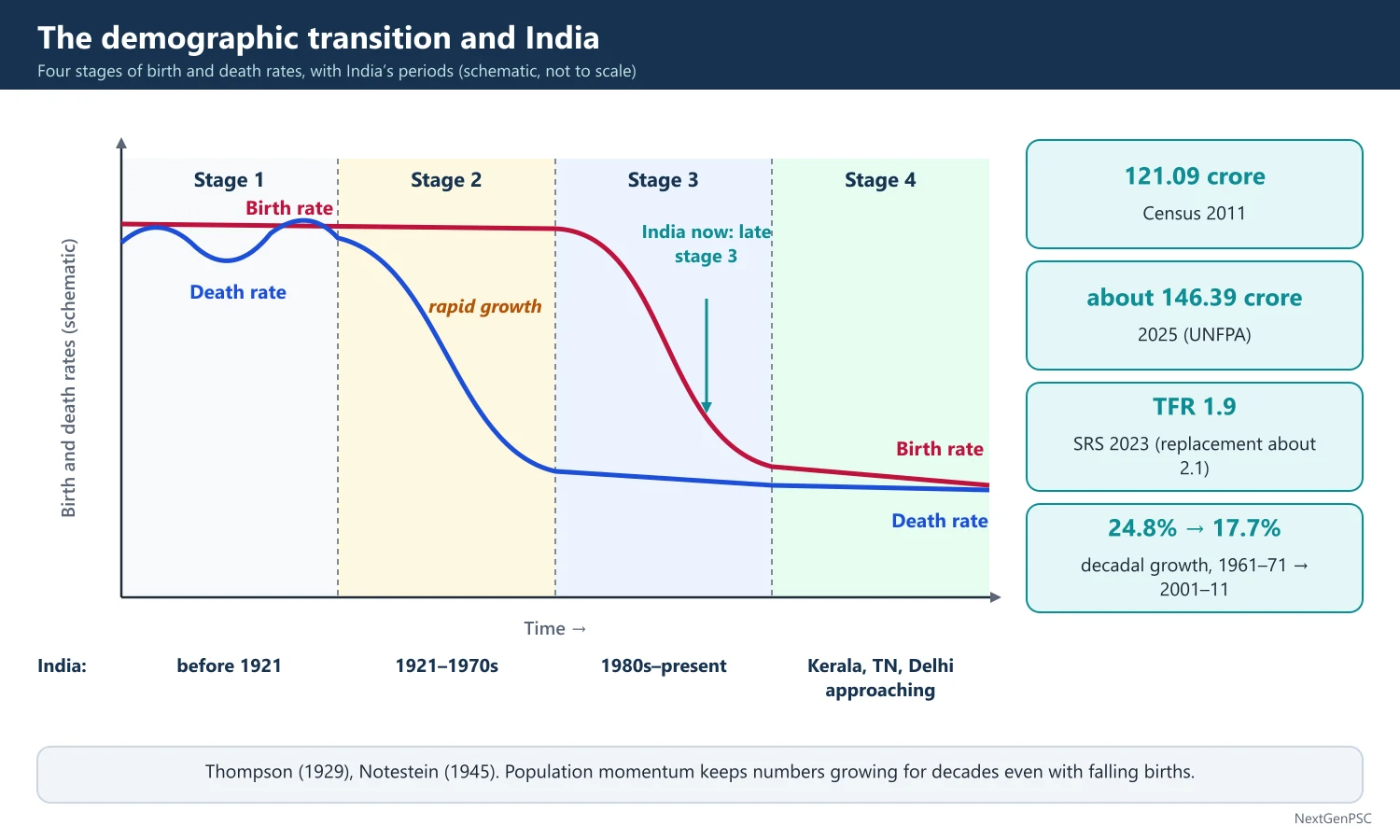
India had 121.09 crore people in Census 2011 and, by UN estimates, about 146 crore in 2025, making it the world's most populous country since 2023. Growth has slowed as India moves through the demographic transition: the total fertility rate fell to 1.9 (SRS 2023), below replacement. Sociologists study the composition (age, sex, caste, religion, literacy, rural–urban) and uneven distribution of population, and the social meaning of the 'demographic dividend'.
In simple words
Population dynamics means how the number of people changes and who they are: how many, how fast they grow, their age, sex, religion and where they live.
Think of a train: earlier many passengers boarded (high births) and many got off early (high deaths); now fewer board and most travel longer, so the train fills with older passengers.
This change, the demographic transition, shapes jobs, schools, family size and pensions.
UPSC asks you to explain trends with data and their social causes and consequences.
1. Concepts and definitions
Demography: the scientific study of population size, structure and change through births, deaths and migration; social demography links these to institutions such as family, caste and gender.
Growth rate: the change in population over a period, equal to (births − deaths) + (in-migrants − out-migrants); India's decadal growth fell from 24.8% (1961–71) to 17.7% (2001–11), the lowest since independence.
Total fertility rate (TFR): the average number of children a woman would have over her reproductive life at current age-specific rates; replacement level is about 2.1.
Malthusian theory: Thomas Malthus (An Essay on the Principle of Population, 1798) argued that population grows geometrically and food arithmetically, so positive checks (famine, disease) or preventive checks (late marriage, moral restraint) must follow.
Marx's critique: Marx rejected a universal law of population; under capitalism, a 'relative surplus population' (reserve army of labour) is produced by capital itself, not by nature (Capital, Vol. 1, 1867).
Demographic transition theory: Warren Thompson (1929) and Frank Notestein (1945) described a shift from high birth and death rates (stage 1), through falling death rates with high births (stage 2, rapid growth), to falling births (stage 3) and low births and deaths (stage 4).
Wealth flows theory: John Caldwell (1976) argued that fertility falls when the net flow of wealth reverses from children to parents into parents to children, as with schooling and the nuclear family.
Demographic dividend: the growth potential created when the working-age share (15–64) rises relative to dependants; it is realised only with jobs, health and education.
2. Size and growth: the Indian record
Phases (Census): 1901–21 stagnant (famine, plague, 1918 influenza; 1921 is the 'great divide'); 1921–51 steady growth; 1951–81 rapid growth ('population explosion'); 1981–2011 high but slowing growth.
Census 2011: 121.09 crore people (17.5% of the world), density 382 per sq km, sex ratio 943 and child sex ratio (0–6) 918.
Recent estimates: UNFPA's State of World Population 2025 put India at about 146.39 crore; the UN estimated that India overtook China as the most populous country in April 2023, and UN projections show a peak of about 170 crore around the early 2060s.
Fertility decline: the SRS 2023 report (released September 2025) shows TFR at 1.9, ranging from 2.8 in Bihar to about 1.2 in Delhi; NFHS-5 (2019–21) showed TFR at 2.0.
Next census: Census 2027 has a reference date of 1 March 2027 (1 October 2026 for snow-bound areas), with houselisting from April 2026, population enumeration in February 2027, self-enumeration online and, for the first time since 1931, caste enumeration.
Stage of transition: India is in the late third stage: death rates are low, birth rates falling fast, but population momentum (a large young cohort entering reproductive age) keeps numbers growing for decades.
3. Composition
Age: in Census 2011, about 31% were aged 0–14, 60% were 15–59 and 8.6% were 60 and above; the median age is rising, and the working-age share is expected to peak around the 2040s.
Sex: the overall sex ratio was 943 in 2011; NFHS-5 (2019–21) found 1,020 women per 1,000 men among the usual household population, but the sex ratio at birth remained skewed (929 in NFHS-5; 917 in SRS 2021–23).
Caste and tribe: Scheduled Castes were 16.6% and Scheduled Tribes 8.6% of the population in 2011; there is no national OBC count since 1931, which Census 2027 will provide.
Religion (2011): Hindus 79.8%, Muslims 14.2%, Christians 2.3%, Sikhs 1.7%, Buddhists 0.7% and Jains 0.4%; NFHS data show fertility falling in all groups, with Muslim TFR falling fastest (2.36 in NFHS-5 against 1.94 for Hindus), which counters alarmist claims.
Literacy: 74.04% in 2011 (men 82.1%, women 65.5%), with wide gaps by state, caste and gender.
Rural–urban and work: 31.1% urban in 2011; agriculture still employs the largest share of workers (about 46% in PLFS 2023–24).
4. Distribution
Uneven spread: Uttar Pradesh had about 19.98 crore people (16.5%) in 2011, followed by Maharashtra and Bihar; Sikkim had the smallest population.
Density: Bihar had the highest density among states (1,106 per sq km) and Arunachal Pradesh the lowest (17) in 2011; the Indo-Gangetic plains and coasts are dense, mountains, deserts and forests sparse.
North–South divide: Ashish Bose coined 'BIMARU' (Bihar, Madhya Pradesh, Rajasthan, Uttar Pradesh) in the 1980s for states with high fertility and poor social indicators; southern states completed the transition earlier.
Political consequence: seats in the Lok Sabha were frozen on the 1971 population by the 42nd Amendment (1976) and the freeze extended by the 84th Amendment (2001) until the first census after 2026; delimitation after Census 2027 could shift seats north, a debated issue for federalism.
5. Sociological explanation of fertility change
Kerala and Tamil Nadu: fertility fell to replacement by the early 1990s through female education, health services, public action and later age at marriage, not mainly through income growth.
Women's autonomy: Tim Dyson and Mick Moore (1983) linked lower fertility in the south to kinship systems that give women more autonomy (cross-cousin marriage, closer natal ties) than in the north.
Son preference: where families want at least one son, small family norms combine with sex selection, so fertility decline can worsen the sex ratio, as Monica Das Gupta showed for Punjab (1987).
Second demographic transition: Ron Lesthaeghe and Dirk van de Kaa (1986) described below-replacement fertility linked to individualism, later marriage and cohabitation; urban Indian middle classes show early signs, which is debated.
World comparison: China's one-child policy (1980–2015) forced rapid decline and an ageing crisis; South Korea now has a TFR below 1; India's decline has been slower and more voluntary.
Tribal demography: Scheduled Tribes are concentrated in central India and the North-East (they form the majority in Mizoram, Nagaland, Meghalaya and Lakshadweep), and many still have higher fertility and mortality than the national average, linked to poor health access.
Youth bulge and employment: PLFS Annual Report 2025 put youth (15–29) unemployment at about 9.9%, much above the overall 3.1%, which shows that the demographic dividend depends on job creation.
Data politics: the delay of the census from 2021 to 2027 left policy relying on projections and sample surveys; scholars note that counting itself is political, as caste enumeration and delimitation debates show.
6. Linking thinkers
Link Malthus and Marx as two opposite Paper I views; neo-Malthusians (Paul Ehrlich, The Population Bomb, 1968) influenced India's coercive phase.
Link to family and kinship (nuclearisation, age at marriage), gender (son preference) and education (female schooling) in Paper II.
Link to Durkheim: population volume and density drive the division of labour (The Division of Labour in Society, 1893).
7. Using it in the exam
10 marks: define demographic transition, place India in stage 3 with TFR 1.9 (SRS 2023), and one social cause of decline.
15–20 marks: size and growth phases, composition (age, sex, caste, religion), distribution and the North–South divide, explanations (Caldwell, Dyson–Moore), and consequences (dividend, ageing, delimitation).
Thinkers to cite: Malthus, Marx, Notestein, Caldwell, Dyson and Moore, Ashish Bose.
Diagram idea: the four-stage demographic transition curve with birth and death rate lines, marking India's position in stage 3.
Quotation to use: the slogan of the 1974 Bucharest World Population Conference attributed to India's delegation, 'Development is the best contraceptive'.
| Indicator | Value | Year | Source |
|---|---|---|---|
| Population | 121.09 crore | 2011 | Census of India |
| Population (estimate) | about 146.39 crore | 2025 | UNFPA, State of World Population 2025 |
| Decadal growth | 17.7% | 2001–11 | Census of India |
| Total fertility rate | 1.9 | 2023 | SRS Statistical Report 2023 |
| Sex ratio (overall) | 943 | 2011 | Census of India |
| Sex ratio at birth | 917 | 2021–23 | SRS |
| Urban share | 31.1% | 2011 | Census of India |
| Stage | Birth rate | Death rate | India's period |
|---|---|---|---|
| 1 | High | High, fluctuating | Before 1921 |
| 2 | High | Falling | 1921–1970s |
| 3 | Falling | Low | 1980s–present |
| 4 | Low | Low | Kerala, Tamil Nadu, Delhi approaching |
Mains points
- Questions ask about trends, the demographic dividend or the North–South demographic divide; always give data with year and source.
- Explain demographic change sociologically (women's education, kinship, son preference), not only economically.
- Use the latest sources correctly: Census 2011 for composition, SRS 2023 for TFR, UNFPA 2025 for current size, and note Census 2027 is under way.
- Handle religion and fertility with data (NFHS-5) and avoid stereotypes.
- Mention the delimitation debate as a political consequence of uneven demographic transition.
- Link the dividend to jobs and skills: without them it becomes a 'demographic burden'.
Did you know?
- 1921 is called India's 'year of the great divide': after it, population never declined again in a census.
- Census 2027 will be India's first digital census, with mobile-app enumeration and online self-enumeration.
Components of Population Growth and Population Policy
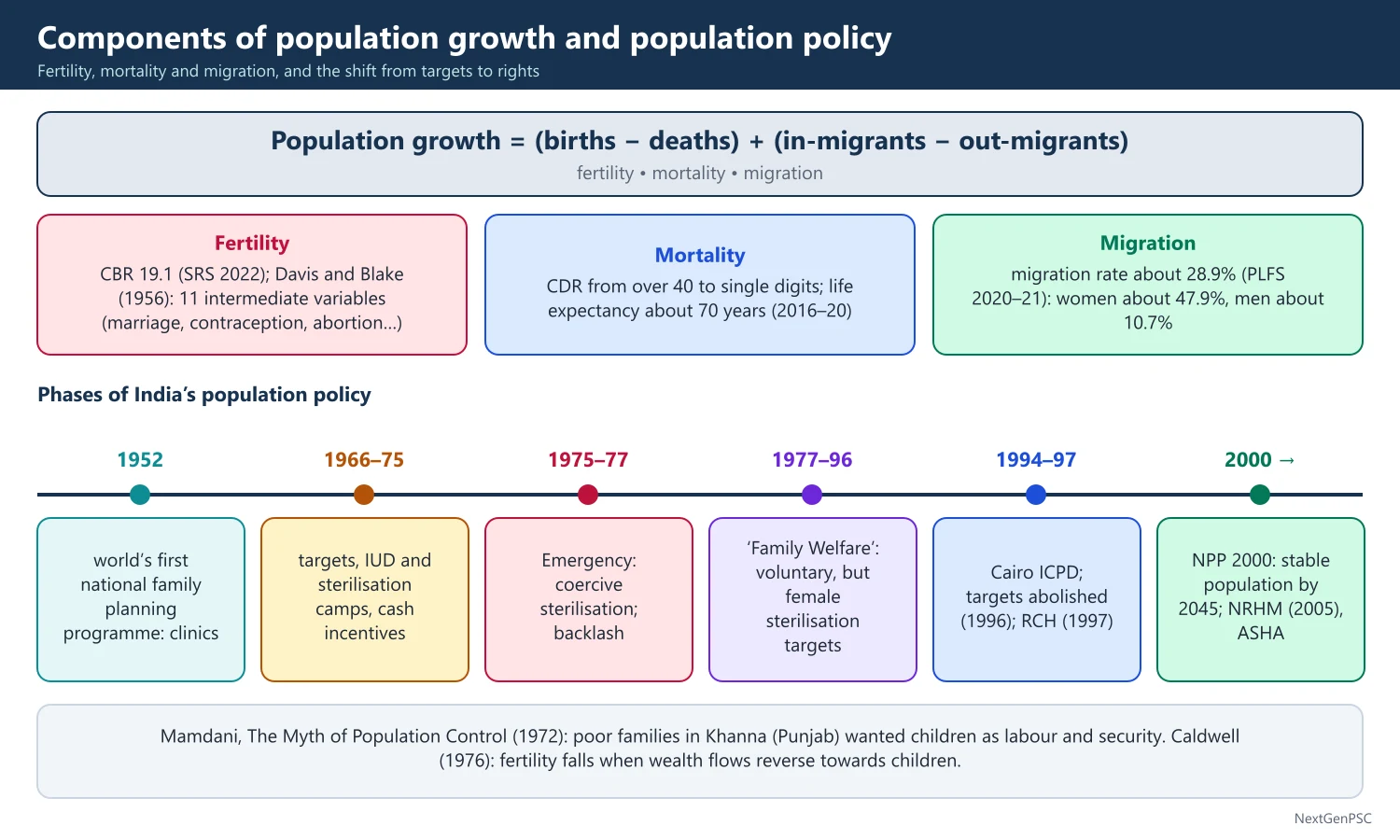
Population changes through three components: fertility (births), mortality (deaths) and migration. India was the first country to adopt a national family planning programme (1952); it moved from clinic-based to target-driven and, during the Emergency (1975–77), coercive sterilisation, then to the target-free, rights-based approach after the Cairo conference (1994) and the National Population Policy 2000. Today fertility is below replacement, and debates focus on choice, quality of care, two-child norms and regional imbalance.
In simple words
Population grows when more people are born or arrive than die or leave; these are the three components: births, deaths and migration.
Think of a water tank with a tap (births), a drain (deaths) and pipes to other tanks (migration).
Population policy is the government's attempt to adjust the tap, through family planning, health and education.
UPSC asks how India's policy changed and what sociological lessons it holds.
1. Concepts and definitions
Crude birth rate (CBR): live births per 1,000 population in a year; SRS 2022 put India's CBR at 19.1.
Crude death rate (CDR): deaths per 1,000 population in a year; India's CDR fell from over 40 in the early 20th century to single digits today.
Fertility and fecundity: fertility is actual childbearing; fecundity is the biological capacity; Kingsley Davis and Judith Blake (1956) listed 11 intermediate variables (marriage, contraception, abortion and others) through which social factors affect fertility.
Life expectancy at birth: the average years a newborn would live at current mortality rates; SRS abridged life tables put it at about 70 years for 2016–20, higher for women than men.
Migration rate: the share of people whose last usual residence differs from the present one; PLFS 2020–21 found an all-India migration rate of about 28.9%, much higher for women (about 47.9%) than men (about 10.7%), mostly due to marriage.
Population policy: deliberate State measures to influence size, growth, distribution or composition of population, including family planning, health, migration and incentives.
2. Fertility: social determinants
Age at marriage: early marriage lengthens exposure to childbearing; NFHS-5 found 23.3% of women aged 20–24 married before 18, down from 47.4% in NFHS-3 (2005–06).
Female education: women with 12 or more years of schooling have far lower fertility than women with none (NFHS-5), through later marriage, contraceptive knowledge and bargaining power.
Son preference and child mortality: parents have more children when child deaths are common or until a son is born; falling infant mortality reduces the 'insurance' motive.
Contraception: NFHS-5 found modern method use at 56.5% and any method at 66.7% among currently married women; female sterilisation (37.9%) dominates, and male sterilisation is very low, showing the gendered burden of family planning.
Caste, class and religion: differences in fertility across groups shrink when education and income are controlled, which shows that socio-economic status matters more than religion as such.
3. Mortality and migration
Mortality decline: control of famine, malaria (National Malaria Eradication Programme, 1958), smallpox eradication (India declared free in 1977), vaccines and antibiotics cut death rates after 1921 and especially after 1951.
Inequality in death: infant and maternal mortality remain higher among the poor, rural, SC and ST groups and in states such as Uttar Pradesh, Madhya Pradesh and Assam (Chapter 26, next topic).
COVID-19: excess deaths in 2020–21 were much higher than reported COVID deaths according to several studies; estimates differ widely and are debated.
Migration as a component: internal migration redistributes population (to cities and southern and western states) rather than adding to the national total; international emigration (to the Gulf, the USA, Europe) is small relative to population but large in remittances (India is the world's largest remittance recipient).
Theories of migration: Ravenstein's laws (1885: most migrants move short distances, women migrate more within the country), Lee's push–pull (1966) and the new economics of migration (household risk-spreading) all fit Indian patterns.
4. Population policy and family planning: phases
Clinic approach (1952–1960s): India launched the world's first national family planning programme in 1952, relying on clinics and the rhythm method; uptake was low.
Extension and targets (1960s–1975): a separate Department of Family Planning (1966), the IUD and sterilisation camps, cash incentives and method-specific targets for health workers.
Emergency (1975–77): the National Population Policy of April 1976 and coercive sterilisation drives, especially in north India, produced millions of sterilisations in 1976–77 and violent resistance (Muzaffarnagar, Turkman Gate in Delhi); the backlash contributed to the Congress defeat in 1977.
Family Welfare (1977–1996): the programme was renamed Family Welfare and made voluntary, but targets for female sterilisation continued; Mahmood Mamdani's The Myth of Population Control (1972), on Khanna in Punjab, had already shown that poor families wanted children as labour and security.
Cairo and target-free approach (1994–2000): the International Conference on Population and Development (Cairo, 1994) shifted the focus to reproductive rights and women's empowerment; India abolished method-specific targets in 1996 and adopted the Reproductive and Child Health programme (1997).
National Population Policy 2000: immediate objective of meeting unmet need for contraception and health infrastructure, medium-term goal of replacement TFR by 2010, and long-term goal of a stable population by 2045; it set up the National Commission on Population.
National Health Mission era: the National Rural Health Mission (2005) with ASHA workers, Janani Suraksha Yojana (2005), and Mission Parivar Vikas (2016) for high-fertility districts; injectable contraceptives (Antara) and new choices were added from 2017.
5. Current debates
Two-child norms: several states bar people with more than two children from local elections or government jobs; the Supreme Court upheld Haryana's rule in Javed v. State of Haryana (2003); critics say such rules hit women, Dalits and the poor and encourage sex selection.
Sterilisation deaths: the death of 13 women after a sterilisation camp in Bilaspur, Chhattisgarh (November 2014) led the Supreme Court in Devika Biswas (2016) to order an end to camp-based mass sterilisation.
Pro-natalist turn: with TFR below replacement in most southern states, some leaders have spoken of encouraging larger families, while northern states still have higher fertility, a debated policy question.
Feminist critique: scholars such as Mohan Rao (From Population Control to Reproductive Health, 2004) argue that Indian policy treated women's bodies as targets and neglected health systems.
NFHS-6: the fact sheets for NFHS-6 (2023–24) were released on 29 May 2026 but omitted several indicators; reports on its national TFR differ (about 1.9–2.0), so the full report is awaited.
Male participation: male sterilisation (vasectomy) fell sharply after the Emergency and remains well below 1% of couples in NFHS-5, reflecting both the memory of coercion and norms of masculinity.
ASHA workers: about one accredited social health activist per 1,000 rural population link women to services; they are women from the community paid by incentives, a case of gendered, informal State labour.
World comparison: China's one-child policy, Iran's rapid voluntary decline after 1989 and Bangladesh's fall in fertility through doorstep services and women's groups show different routes; Bangladesh is often cited as proof that services and women's agency matter more than income.
Migration policy: India has no single migration policy; the Emigration Act 1983, the e-Shram portal and inter-state portability of rations (One Nation One Ration Card) are piecemeal responses.
6. Linking thinkers
Link to Foucault's 'biopower' (The History of Sexuality, Vol. 1, 1976): the State's management of births and bodies, seen in India's sterilisation targets.
Link to Malthus (justification for control) and Marx and Sen ('development is the best contraceptive') for the debate on means.
Link to patriarchy and gender (Chapter on gender, Chapter 27), since the burden of family planning falls on women.
7. Using it in the exam
10 marks: list the three components with one Indian data point each.
15–20 marks on policy: phases (1952 → targets → Emergency → Family Welfare → Cairo → NPP 2000 → NHM), sociological critique (Mamdani, feminist, biopower), current debates, and a conclusion on rights-based policy.
Thinkers and studies: Malthus, Davis and Blake, Mahmood Mamdani, Foucault, Amartya Sen, Mohan Rao.
Diagram idea: the population balancing equation: P(t2) = P(t1) + births − deaths + in-migrants − out-migrants.
Quotation to use: the Cairo consensus, in paraphrase, that population policy should rest on reproductive rights and women's empowerment, not on demographic targets.
| Phase | Years | Approach | Sociological comment |
|---|---|---|---|
| Clinic-based | 1952–1960s | Voluntary, clinics | Low reach; ignored social reasons for large families |
| Target-oriented | 1966–1975 | Camps, incentives, targets | Bureaucratic, women-focused |
| Coercive | 1975–77 | Compulsory sterilisation drives | Backlash; lasting distrust |
| Family Welfare | 1977–1996 | Voluntary, but targets continue | Female sterilisation dominant |
| Rights-based | 1996 onwards; NPP 2000 | Target-free, RCH, NHM | Focus on choice and quality of care |
Mains points
- The core question is 'Critically evaluate India's population policy'; answer through its phases and sociological lessons.
- Explain fertility through social determinants (marriage age, education, son preference), with NFHS-5 data.
- Cite Mamdani's Khanna study and the Emergency as warnings against coercion.
- Show the gender bias: female sterilisation far exceeds male sterilisation.
- Bring current issues: below-replacement fertility, two-child norms, regional imbalance and NFHS-6.
- Do not forget migration as the third component; examiners note its absence.
Did you know?
- India launched the world's first national family planning programme in 1952, decades before most countries.
Emerging Issues: Ageing, Sex Ratio, Mortality and Reproductive Health
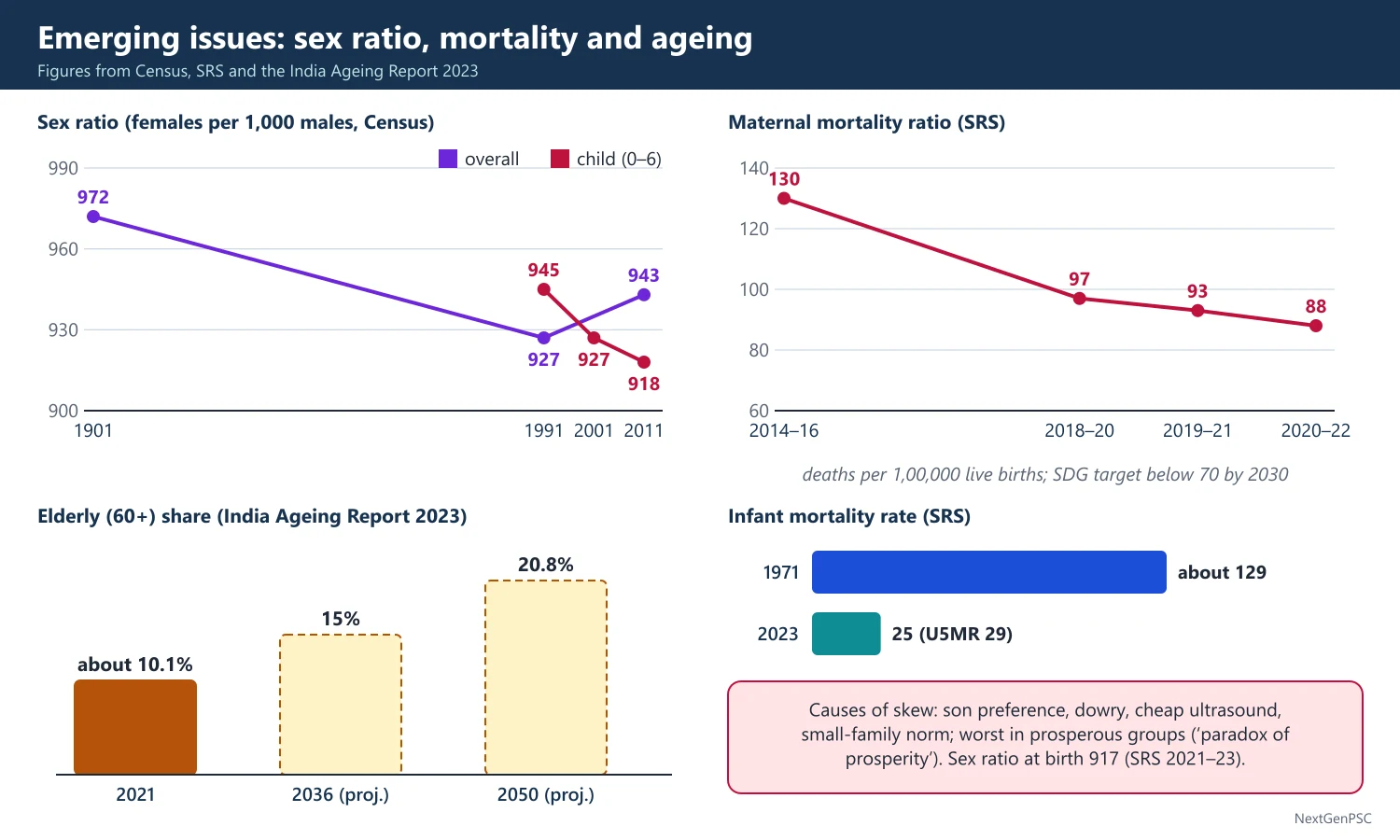
As fertility falls and life lengthens, India faces population ageing: the elderly share (60+) is projected to rise from about 10% in 2021 to about 21% by 2050 (India Ageing Report 2023). A skewed sex ratio at birth (917 in SRS 2021–23) reflects son preference and sex selection. Infant mortality has fallen to 25 and maternal mortality to 88 per lakh live births, but gaps by region, caste and class remain, and reproductive health is now framed as a matter of rights and choice.
In simple words
These are the new population problems India faces now that families are smaller and people live longer.
Ageing is like a joint family where grandparents are many and grandchildren few, so who will care for the elders?
A falling number of girls compared with boys shows son preference, and mother and baby deaths show gaps in health care.
UPSC asks about the social causes of these issues and policy responses, with data.
1. Concepts and definitions
Population ageing: the rise in the share of older people (60+ in Indian usage) due to falling fertility and rising longevity; the old-age dependency ratio measures elderly per 100 working-age people.
Sex ratio: in India, females per 1,000 males; the child sex ratio covers ages 0–6 and the sex ratio at birth (SRB) covers newborns, the most direct indicator of sex selection.
Missing women: Amartya Sen ('More Than 100 Million Women Are Missing', New York Review of Books, 1990) estimated the number of women who would be alive if not for discrimination in care and nutrition and sex-selective abortion.
Infant mortality rate (IMR): deaths of infants under one year per 1,000 live births; under-five mortality (U5MR) per 1,000 live births; maternal mortality ratio (MMR): maternal deaths per 1,00,000 live births.
Reproductive health: defined at Cairo (ICPD, 1994) as complete physical, mental and social well-being in all matters relating to the reproductive system, including the right to decide freely the number and spacing of children.
2. Ageing
Data: Census 2011 counted about 10.4 crore elderly (8.6%); the India Ageing Report 2023 (UNFPA and IIPS) projected the 60+ share to rise from about 10.1% in 2021 to 15% in 2036 and 20.8% in 2050, with the elderly outnumbering children (0–14) around 2046.
Regional variation: Kerala, Tamil Nadu, Himachal Pradesh and Punjab are ageing fastest; Bihar and Uttar Pradesh remain young.
Feminisation of ageing: older women outnumber older men, and many are widows with little income or property, which makes ageing a gender issue.
Family change: migration of children, nuclearisation and women's employment reduce family care; Sarah Lamb (Aging and the Indian Diaspora, 2009) and studies of old-age homes show a shift from the joint family to institutional and paid care, especially among the middle class.
LASI: the Longitudinal Ageing Study in India (Wave 1, 2017–18) found high levels of chronic disease and disability among older adults, and low pension coverage outside formal-sector retirees.
Policy: the Maintenance and Welfare of Parents and Senior Citizens Act 2007, the Indira Gandhi National Old Age Pension Scheme (under NSAP), the National Programme for Health Care of the Elderly (2010), and the extension of Ayushman Bharat PM-JAY health cover to all people aged 70 and above regardless of income (October 2024).
Theories: disengagement theory (Cumming and Henry, 1961) saw withdrawal of the old as functional; activity theory and Indian ideas of vanaprastha differ; modernisation theory of ageing (Cowgill and Holmes, 1972) predicted loss of status of the elderly with modernisation.
3. Sex ratio and sex selection
Trend: the overall sex ratio fell from 972 in 1901 to 927 in 1991 and rose to 943 in 2011; the child sex ratio fell from 945 (1991) to 927 (2001) and 918 (2011), the lowest since independence.
Regional pattern: Haryana (834) and Punjab (846) had the lowest child sex ratios in 2011; SRS 2021–23 shows SRB ranging from about 974 in Chhattisgarh to 868 in Uttarakhand.
Causes: son preference rooted in patriliny, dowry, old-age support and ritual roles; cheap ultrasound from the 1980s; and small-family norms that squeeze the number of daughters ('daughter deficit').
Paradox of prosperity: sex ratios are worst among richer, educated, landowning groups in prosperous regions, contradicting the idea that development alone ends discrimination (Mary John and others, Planning Families, Planning Gender, 2008).
Consequences: a marriage squeeze, bride trafficking and cross-region marriages (brides from Assam, Bengal and Odisha in Haryana), studied by Ravinder Kaur; and links to violence against women.
Policy: the Pre-Conception and Pre-Natal Diagnostic Techniques (PCPNDT) Act 1994 (amended 2003), Beti Bachao Beti Padhao (launched at Panipat on 22 January 2015) and conditional cash transfers such as Ladli schemes; enforcement remains weak.
4. Infant, child and maternal mortality
IMR: fell from about 129 in 1971 (SRS) to 25 in 2023 (SRS 2023), and U5MR fell to 29 in 2023; neonatal deaths now form the bulk of infant deaths.
MMR: fell from 130 (2014–16) to 97 (2018–20), 93 (2019–21) and 88 (2020–22), according to SRS special bulletins; the SDG target is below 70 by 2030; Assam, Madhya Pradesh and Uttar Pradesh remain high.
Social determinants: mother's education, age at first birth, anaemia (57% of women aged 15–49 in NFHS-5), caste and tribe, rural residence and access to institutional delivery (88.6% in NFHS-5).
Programmes: Janani Suraksha Yojana (2005) cash for institutional delivery, Janani Shishu Suraksha Karyakram (2011), Mission Indradhanush (2014) for immunisation, PM Surakshit Matritva Abhiyan (2016), LaQshya (2017) for labour rooms and POSHAN Abhiyaan (2018) for nutrition.
Female child disadvantage: girls historically had higher child mortality than boys in north India due to neglect; SRS 2023 shows a near-equal IMR (male 26, female 25), a sign of change.
5. Reproductive health and rights
Abortion: the Medical Termination of Pregnancy Act 1971, amended in 2021, allows abortion up to 20 weeks on one doctor's opinion and up to 24 weeks for special categories (such as rape survivors and minors); in X v. Principal Secretary (2022) the Supreme Court extended the 20–24 week provision to unmarried women.
Assisted reproduction: the Surrogacy (Regulation) Act 2021 banned commercial surrogacy and the Assisted Reproductive Technology (Regulation) Act 2021 regulated clinics, after debates on the exploitation of poor women in 'surrogacy hubs' such as Anand, Gujarat (Amrita Pande, Wombs in Labor, 2014).
Adolescent and menstrual health: early marriage and adolescent pregnancy remain concerns; the Rashtriya Kishor Swasthya Karyakram (2014) and menstrual hygiene schemes address them, and NFHS-5 found hygienic menstrual protection use at about 77% among women aged 15–24.
Unmet need and choice: NFHS-5 found unmet need for family planning at 9.4%; the method mix is narrow, and men's participation is low.
6. Further evidence and debates
Elder abuse and loneliness: surveys by HelpAge India report neglect and abuse of older people within families, often by sons and daughters-in-law, which challenges the ideal of filial care.
Unequal ageing: retired formal-sector workers have pensions, while most informal workers rely on small State pensions and family support, so old age reproduces lifelong class and caste inequality.
Shift in son preference: NFHS rounds show a fall in the share of women wanting more sons than daughters, and SRB has improved slightly in recent SRS rounds, but scholars caution that 'last-birth' sex ratios still reveal selection.
Caste and tribe gaps in mortality: NFHS-5 shows higher infant and under-five mortality among Scheduled Tribes and Scheduled Castes than among others, linked to nutrition, distance to facilities and discrimination in services.
Medicalisation of birth: the rise of institutional delivery reduced deaths but also increased caesarean sections, especially in private hospitals, which feminist scholars discuss as over-medicalisation.
7. Linking thinkers
Link ageing to Parsons's isolated nuclear family and to Indian studies of the joint family (I.P. Desai, A.M. Shah) that show continuing support across households.
Link sex ratio to patriarchy (Walby, Kandiyoti's patriarchal bargain), to Leela Dube on kinship, and to Bourdieu's idea of strategies of social reproduction.
Link mortality inequality to stratification: caste and class gradients in health show that life chances (Weber) are socially distributed.
8. Using it in the exam
10 marks: pick one issue (for example, declining child sex ratio), give data with source, two causes and one policy.
15–20 marks: cover all four issues with data (India Ageing Report 2023, SRS 2023, SRS MMR 2020–22, NFHS-5), social causes, policy responses and a conclusion on gender and inequality as the common thread.
Thinkers and studies: Amartya Sen, Monica Das Gupta, Mary John, Ravinder Kaur, Sarah Lamb, Amrita Pande.
Diagram idea: two population pyramids, 2011 (wide base) and 2050 projected (narrow base, wide top), to show ageing.
Quotation to use: Sen's phrase 'missing women' for the deficit of women caused by discrimination.
| Indicator | Value | Year | Source |
|---|---|---|---|
| Elderly (60+) share | 10.1% → 20.8% (projected) | 2021 → 2050 | India Ageing Report 2023 |
| Sex ratio at birth | 917 | 2021–23 | SRS |
| Child sex ratio (0–6) | 918 | 2011 | Census of India |
| Infant mortality rate | 25 | 2023 | SRS 2023 |
| Under-five mortality rate | 29 | 2023 | SRS 2023 |
| Maternal mortality ratio | 88 | 2020–22 | SRS special bulletin |
| Women 20–24 married before 18 | 23.3% | 2019–21 | NFHS-5 |
Mains points
- Questions ask about ageing as a social problem, the declining child sex ratio, or maternal mortality; always give the latest data with source.
- Explain the 'paradox of prosperity' in sex ratios; it shows sociological depth.
- Treat ageing through family change, gender (widows) and class (pension gaps), not only as a health issue.
- Present reproductive health as rights (Cairo 1994, MTP amendment 2021, X v. Principal Secretary 2022).
- Note data limits: NFHS-6 fact sheets (May 2026) omitted some indicators, so cite NFHS-5 and SRS for sex ratio and mortality.
- Conclude that all four issues are linked through gender and inequality.
Did you know?
- By around 2046, India is projected to have more people aged 60+ than children aged 0–14, for the first time in its history.
UPSC Previous Year Questions: Population Dynamics
From 2014 to 2026 UPSC asked 21 question parts (300 marks) from this chapter, all in Paper II. Emerging issues dominate (16 parts): ageing and elder care (8 parts), sex ratio and PCPNDT (5 parts) and reproductive and child health (3 parts); population policy and migration follow (4 parts), with one recent question on the population pyramid. Every question below has a model answer written to the UPSC word limit.
In simple words
Try each question on your own first, within about 7 minutes for 10 marks and 11 minutes for 20 marks.
Then compare with the model answer: check your data (Census 2011, SRS 2023, NFHS-5, India Ageing Report 2023, PLFS) with year and source, and the social explanation behind each number.
Note what you missed and revise it in this chapter's notes before the next question.
1. Population Size, Growth, Composition and Distribution
Example 1 (UPSC 2026, 20 marks): Draw the current population pyramid of India. What policy measures would you recommend for population dynamics to achieve sustainability?
Paper and question: Paper II, Q4(b)
Approach: Two parts: describe the current population pyramid in words (with a Flow chart line for the drawing) and its demographic meaning, then recommend policy measures for sustainable population dynamics (dividend, ageing, gender, regional balance, environment); conclude.
A population pyramid shows the age and sex structure of a population, with males on one side and females on the other, younger ages at the base. India's pyramid has changed from the broad-based, triangular shape of Census 2011 (about 31% aged 0–14) to a 'barrel' or 'bulging-middle' shape today, because fertility has fallen to a TFR of 1.9 (SRS 2023), below replacement.
Flow chart: draw a pyramid with a narrowing base (0–14 shrinking), the widest bars in the 15–39 age groups (the youth bulge), a gradually widening top (60+ about 10% in 2021, rising to 15% by 2036, India Ageing Report 2023), and slightly more women than men in the oldest bars.
Meaning: India is in the third stage of the demographic transition, with a large working-age population that offers a demographic dividend until about the 2040s, followed by rapid ageing. The pyramid also hides imbalances: a skewed sex ratio at birth (929 in NFHS-5), and regional contrasts, as Bihar (TFR 2.8) has a younger pyramid than Kerala or Tamil Nadu.
Policy measures for sustainability: (i) Harvest the dividend: skills, quality education and labour-intensive jobs, since youth unemployment was about 9.9% in PLFS 2025; raise women's labour force participation. (ii) Prepare for ageing: universal pensions, geriatric health care (Ayushman Vay Vandana, 2024) and long-term care. (iii) Gender balance: enforce the PCPNDT Act and change son preference. (iv) Regional balance: focus on high-fertility states through girls' education and contraceptive choice, and manage migration from young to ageing states. (v) Environment: link population with sustainable consumption, urban planning and climate adaptation.
Sustainable population dynamics now depend less on reducing numbers and more on improving the quality of life of each age group; coercive measures and communal readings of fertility must be avoided.
2. Components of Population Growth and Population Policy
Example 2 (UPSC 2026, 10 marks): Clarify how the family planning programmes have taken a political 'U'-turn in present India.
Paper and question: Paper II, Q5(c)
Approach: Clarify the 'U-turn': from the small-family and population-control discourse (two-child norms) to recent pronatalist rhetoric and policy in some states, explain the causes (falling TFR, ageing, delimitation, identity politics) and assess.
For decades Indian family planning stressed the small family: from the 1952 programme and the coercive sterilisations of the Emergency (1975–77) to two-child norms for local elections in several states and population-control bills proposed as late as 2021.
The political 'U-turn' is the recent shift towards encouraging larger families. In 2024 Andhra Pradesh's Chief Minister urged families to have more children and the state removed its two-child restriction for local body elections; Tamil Nadu's leaders linked fertility to the loss of Lok Sabha seats in delimitation; and in December 2024 the RSS chief said families should have at least three children. Some states, such as Sikkim, offer incentives for more births.
Causes: TFR has fallen to 1.9 (SRS 2023), with southern states near 1.5 and ageing fast; delimitation after Census 2027 may shift seats to high-fertility northern states; and fertility is drawn into identity politics.
Demographers warn that both coercion and pronatalist pressure ignore women's reproductive choice; the goal should be rights-based family planning and support for working parents.
Example 3 (UPSC 2022, 20 marks): Discuss recent trends in the structure of migration.
Paper and question: Paper II, Q7(b)
Approach: Discuss recent trends in the structure of migration: volume and data sources, then trends by stream, gender, duration, distance and destination (internal and international), causes, and social implications.
Migration is the movement of people across a boundary involving a change of usual residence. Census 2011 counted about 45.6 crore migrants by last residence (about 37% of the population), and PLFS 2020–21 found a migration rate of 28.9%, about 47.9% for women and 10.7% for men.
Trends in structure: (i) Streams: rural–rural migration, mostly of women for marriage, remains the largest stream, but rural–urban and urban–urban flows are growing with urbanisation. (ii) Gender: marriage dominates female migration, yet women's labour migration for domestic work, garments, nursing and services is rising. (iii) Duration: short-term, seasonal and circular migration has grown, what Jan Breman calls 'footloose labour'; the Economic Survey 2016–17 estimated about 90 lakh inter-state migrants a year.
(iv) Distance and direction: inter-state migration flows from Uttar Pradesh, Bihar, Odisha, Jharkhand and West Bengal to Delhi, Maharashtra, Gujarat, Kerala and the southern states, reflecting uneven development. (v) International: India is the world's largest recipient of remittances (World Bank) and its emigrants have shifted from Gulf labour to skilled professionals and students in the West. (vi) New forces: distress and climate migration, reverse migration during the COVID-19 lockdown (2020), and education migration to cities.
Implications: remittance-driven change in villages, left-behind wives and elderly, the feminisation of agriculture, nativist hostility, and exclusion from welfare at destination; responses include One Nation One Ration Card and e-Shram (2021).
Migration is thus becoming more urban, temporary, gendered and transnational, and social policy must follow people rather than places.
Example 4 (UPSC 2020, 20 marks): What were the salient features of the India's Population Policy (2000)? How far its goals have been achieved?
Paper and question: Paper II, Q8(b)
Approach: Two parts: salient features of NPP 2000 (approach, objectives, goals, institutions), then assess achievement goal by goal with current data, and explain the gaps sociologically.
The National Population Policy 2000 marked a shift from target-driven sterilisation, discredited after the Emergency, to a voluntary, rights-based approach influenced by the Cairo International Conference on Population and Development (1994), which stressed reproductive health and women's empowerment.
Salient features: an immediate objective of meeting the unmet need for contraception and building health infrastructure; a medium-term objective of bringing TFR to the replacement level of 2.1 by 2010; and a long-term objective of a stable population by 2045. Its socio-demographic goals included reducing IMR below 30 and MMR below 100 per 1,00,000 live births, universal immunisation, 80% institutional deliveries, raising the age at marriage of girls (to 18, preferably 20), universal schooling up to 14 and containing communicable diseases. It created the National Commission on Population (2000) chaired by the Prime Minister, and promoted decentralised planning through panchayats.
Achievement: most goals were met, but late. TFR reached 2.0 in NFHS-5 (2019–21) and 1.9 in SRS 2023, a decade after the target; IMR fell to 25 (SRS 2023) and MMR to 88 (SRS 2020–22); institutional deliveries reached 88.6% (NFHS-5). But 23.3% of women aged 20–24 were married before 18 (NFHS-5), female sterilisation (37.9%) still dominates the method mix, unmet need was 9.4%, and Bihar's TFR remains 2.8.
Sociological reading: the gaps reflect patriarchy, women's low autonomy, regional inequality and weak health systems in the Hindi belt, while Kerala and Tamil Nadu show that education and women's agency lower fertility, the view Amartya Sen and Jean Drèze stress.
NPP 2000 thus succeeded in moving India towards replacement fertility through development rather than coercion, but its reproductive-rights and gender goals remain unfinished.
Example 5 (UPSC 2018, 20 marks): What are the issues relating to male migration and its impact on birthrate? Does it necessarily result in skewed sex ratio?
Paper and question: Paper II, Q8(a)
Approach: Two parts: issues of male migration and its effect on birth rate (spousal separation, left-behind wives, changing norms), then whether it necessarily skews the sex ratio, distinguishing the population sex ratio of origin and destination areas from the sex ratio at birth; conclude.
Male migration, in which men move alone for work while wives, children and parents stay behind, is common from Bihar, eastern Uttar Pradesh, Odisha, the Uttarakhand hills and, internationally, Kerala to the Gulf. PLFS 2020–21 shows that men migrate mainly for employment, while women migrate mainly for marriage.
Issues: left-behind wives manage farms and households, which can increase their autonomy but also their workload and dependence on in-laws, as studies of Kerala's 'Gulf wives' show; children grow up without fathers; the elderly lack care; and migrants face poor living conditions and health risks, including the spread of HIV along migration routes, which led to targeted prevention programmes.
Impact on birth rate: long spousal separation reduces the frequency of conception and lengthens birth intervals, so male out-migration tends to lower fertility in origin areas; remittances also raise women's education and aspirations for smaller families. However, in some areas migrants' families continue high fertility because of son preference and low female autonomy, so the effect is not uniform.
Does it skew the sex ratio? It skews the population sex ratio of places: origin districts such as Ratnagiri in Maharashtra or Almora in Uttarakhand show more women than men, while destinations show very few women, for example Daman and Diu (618) and Delhi (868) in Census 2011. But it does not by itself skew the sex ratio at birth, which depends on son preference and sex-selective abortion, as in Haryana and Punjab.
Male migration therefore changes the age–sex composition of regions and lowers fertility, but a skewed sex ratio at birth is a product of gender discrimination, not of migration as such.
3. Emerging Issues: Ageing, Sex Ratio, Mortality and Reproductive Health
Example 6 (UPSC 2026, 10 marks): Discuss the challenges faced by the aged people in receiving 'elder care'.
Paper and question: Paper II, Q5(a)
Approach: Discuss the challenges in receiving elder care under heads (family change, health system, finance, gender of care, institutions and law), with data.
Elder care means the support older people need for health, daily living, income and emotional well-being; India's 60+ population, about 10% in 2021, is projected to reach 15% by 2036 (India Ageing Report 2023).
Challenges: (i) Family change: migration of children and smaller households weaken the joint-family care that Indian norms assume. (ii) Health system: LASI Wave 1 (2017–18) found high levels of chronic disease and disability, but geriatric services are thin. (iii) Finance: most elderly worked informally and lack pensions; social pensions under IGNOAPS are small. (iv) Gendered care: care is unpaid work done by daughters-in-law and wives, and elderly widows are the most vulnerable, the 'feminisation of ageing'. (v) Institutions: old age homes and trained caregivers are few and stigmatised, and the Maintenance and Welfare of Parents and Senior Citizens Act 2007 is rarely enforced.
Ayushman Vay Vandana (2024), which covers everyone aged 70 and above, is a step forward.
Elder care needs a mix of family support, community services and a public care system.
Example 7 (UPSC 2025, 20 marks): What are the Private and Public network and support systems operative in Indian society for the aged? Suggest measures to curb down the challenges before care givers of the aged.
Paper and question: Paper II, Q7(a)
Approach: Two parts: describe private networks (family, kin, community, religious and caste bodies, market) and public systems (laws, pensions, health, institutions) for the aged, then suggest measures to address caregivers' challenges (gender burden, skills, stress, finance); conclude.
With about 10% of India's population aged 60 and above in 2021, projected to rise to 15% by 2036 (India Ageing Report 2023), the support of the aged rests on a combination of private and public networks.
Private networks: (i) the family, especially co-resident sons and daughters-in-law, remains the main source of care, rooted in the norm of filial duty (seva); (ii) kin and neighbours give help in villages; (iii) community, religious and caste bodies, such as temple trusts, gurdwaras, church-run homes and caste associations, run old age homes and support; (iv) NGOs such as HelpAge India; (v) the market offers paid caregivers, assisted living and senior housing for the urban middle class.
Public systems: the Maintenance and Welfare of Parents and Senior Citizens Act 2007 (maintenance tribunals); the Indira Gandhi National Old Age Pension Scheme under NSAP; the National Programme for Health Care of the Elderly (2010); Ayushman Vay Vandana (2024) for all aged 70 and above; the Atal Vayo Abhyuday Yojana (2021); and Elderline (14567).
Challenges of caregivers: care falls mostly on women, who give up paid work; caregivers lack training for dementia and chronic illness; they face stress and burnout; costs of medicines and hospital stays push families into debt; and paid caregivers, often migrant women, work informally without rights.
Measures: recognise care work through caregiver allowances and pension credits; train community caregivers and ASHA-type geriatric workers; provide respite care, day-care centres and home-based palliative services; extend leave policies for family care; regulate and protect paid care workers under the Social Security Code 2020; and encourage men's share in care.
A sustainable model combines family support with public services, so that care for the aged does not depend on the unpaid labour of women alone.
Example 8 (UPSC 2024, 20 marks): Discuss the major challenges related to women's reproductive health in India. What measures would you suggest to overcome these challenges?
Paper and question: Paper II, Q6(a)
Approach: Two parts: major challenges of women's reproductive health (maternal mortality, anaemia, early marriage, contraception burden and unmet need, unsafe abortion, sex selection, cancers and menstrual health), with data and social causes, then measures; conclude with a rights-based approach.
Reproductive health, as defined at the Cairo conference (1994), is complete physical, mental and social well-being in all matters relating to the reproductive system, including the right to decide freely about having children.
Challenges: (i) Maternal mortality: MMR fell to 88 per 1,00,000 live births (SRS 2020–22) but remains high in Assam, Madhya Pradesh and Uttar Pradesh. (ii) Anaemia: 57% of women aged 15–49 were anaemic in NFHS-5 (2019–21), a product of poor nutrition and low status within the household. (iii) Early marriage and adolescent pregnancy: 23.3% of women aged 20–24 married before 18. (iv) Gendered contraception: female sterilisation (37.9%) dominates while male sterilisation is negligible, and unmet need is 9.4%; camp sterilisations caused deaths in Bilaspur (2014). (v) Unsafe abortion and sex selection despite the MTP Act (amended 2021) and the PCPNDT Act. (vi) Cancers and menstrual health: cervical and breast cancer are often detected late, and hysterectomies among women sugarcane cutters in Beed, Maharashtra, revealed coercive labour practices.
Social causes: patriarchy, son preference, low female autonomy in decisions, poverty, caste and tribal marginalisation, and a health system that treats women as targets of population control, a critique made by feminist scholars such as Mohan Rao.
Measures: strengthen primary care and emergency obstetric care (JSY 2005, PMSMA 2016, LaQshya 2017); tackle anaemia through nutrition and POSHAN Abhiyaan; enforce the Prohibition of Child Marriage Act 2006 and keep girls in school; widen contraceptive choice and involve men; ensure safe, confidential abortion services; expand HPV vaccination and cancer screening; and improve menstrual hygiene and adolescent services (RKSK, 2014).
Women's reproductive health will improve only when it is treated as a matter of rights, autonomy and gender equality rather than population targets.
Example 9 (UPSC 2023, 10 marks): Discuss the nature of regional variations in sex ratio in India, stating reasons thereof.
Paper and question: Paper II, Q5(e)
Approach: Discuss the nature of regional variation with data (north-west vs south, east and tribal; rural-urban), then the reasons (kinship systems, dowry, prosperity and technology, migration).
India's sex ratio (females per 1,000 males) was 943 in Census 2011, with a child sex ratio of 918, but it varies sharply by region.
Nature of variation: the north-western states have the lowest ratios: Haryana's child sex ratio was 834 and Punjab's 846 in 2011. Kerala had an overall ratio of 1,084, and the southern states, the North-East and tribal regions such as Chhattisgarh and Jharkhand have more balanced ratios; SRS 2021–23 shows the sex ratio at birth ranging from about 974 in Chhattisgarh to 868 in Uttarakhand.
Reasons: Tim Dyson and Mick Moore (1983) linked the north–south contrast to kinship systems: northern patrilineal, exogamous kinship isolates women from their natal families and values sons, while southern kinship allows closer ties and more female autonomy. Dowry, land inheritance through sons and the 'prosperity effect' of access to ultrasound in richer states make sex selection worse; tribal societies, with bride price and higher female work participation, value daughters more.
Regional variation thus reflects culture and kinship more than income.
Example 10 (UPSC 2023, 10 marks): What is 'Ageing'? Discuss the major problems of aged people in India.
Paper and question: Paper II, Q8(c)
Approach: Define ageing (biological, social, demographic), give India's numbers briefly, and discuss the major problems of the aged (health, economic, social, psychological, abuse, gender).
Ageing is the biological process of growing old, the social process by which roles and status change with age, and, demographically, the rise in the share of older people in a population. In India, those aged 60 and above formed about 10% of the population in 2021, projected at 15% by 2036 (India Ageing Report 2023).
Problems: (i) Health: chronic diseases, disability and dementia, with high out-of-pocket costs, as LASI (2017–18) showed. (ii) Economic: most elderly worked informally and lack pensions. (iii) Social: migration of children and nuclear households weaken support, and the modernisation theory of ageing (Cowgill and Holmes) predicts a loss of status as knowledge and property lose value. (iv) Psychological: loneliness and depression. (v) Abuse and neglect within families, despite the Maintenance and Welfare of Parents and Senior Citizens Act 2007. (vi) Gender: elderly women, often widowed and without assets, face the greatest insecurity.
Pensions, geriatric health care (Ayushman Vay Vandana, 2024) and community support can address these problems.
Ageing is a social issue, not merely a family matter.
Example 11 (UPSC 2021, 20 marks): Is 'ageing' an emerging issue in Indian society? Discuss the major problems of the old age people in India.
Paper and question: Paper II, Q6(b)
Approach: Two parts: establish ageing as an emerging issue (demographic data, social change, theory), then discuss the major problems of the elderly in India with data and examples; conclude with policy.
Yes, ageing is an emerging issue. Falling fertility (TFR 1.9, SRS 2023) and rising life expectancy (about 70 years, SRS 2016–20) are changing India's age structure: the 60+ population was about 10.4 crore (8.6%) in Census 2011, about 10.1% in 2021, and is projected at 15% by 2036 and 20.8% by 2050, when the elderly will outnumber children (India Ageing Report 2023).
Why it is emerging as a social issue: the joint family, which Indian norms rely on for elder care, is weakening through migration, urbanisation and women's employment; Kerala, Tamil Nadu and Himachal Pradesh are already ageing fast. The modernisation theory of ageing (Cowgill and Holmes, 1972) predicts declining status of the old as technology and education devalue their knowledge.
Major problems: (i) Health: LASI Wave 1 (2017–18) found high levels of chronic disease, multimorbidity and disability; geriatric care is scarce. (ii) Economic insecurity: most elderly lack pensions because they worked informally; social pensions under IGNOAPS are small. (iii) Living arrangements: a rising share live alone or only with a spouse. (iv) Neglect and abuse: property disputes and neglect lead parents to maintenance tribunals under the 2007 Act. (v) Feminisation of ageing: women live longer, are more often widowed and own fewer assets. (vi) Digital and social exclusion: difficulties with digital services and loss of social roles, which disengagement theory (Cumming and Henry, 1961) describes, though activity theory stresses continued participation.
Policy: universal pensions, Ayushman Vay Vandana (2024) for all aged 70 and above, geriatric wards under NPHCE, community day-care, age-friendly cities and support for family caregivers.
Ageing is therefore an emerging structural issue that requires India to move from relying on the family alone to a shared family–State model of care.
Example 12 (UPSC 2021, 10 marks): Underline the socio-cultural factors responsible for India's skewed sex-ratio.
Paper and question: Paper II, Q6(c)
Approach: Underline the socio-cultural factors: son preference and patriliny, dowry, religious and ritual roles, small-family norm with technology, low status of women, with data and scholars.
India's skewed sex ratio, a child sex ratio of 918 in Census 2011 and a sex ratio at birth of 929 in NFHS-5 (2019–21), is rooted in socio-cultural factors more than in biology or poverty.
Son preference and patriliny: sons carry the lineage, inherit land and care for parents in old age, while daughters leave on marriage, the 'paraya dhan' idea. Dowry: daughters are seen as an economic burden because of rising dowry, which spread with Sanskritisation and prosperity. Religious and ritual roles: sons perform funeral rites (shraddha) in Hindu tradition. Small-family norm with technology: as families want fewer children, they use ultrasound and sex-selective abortion to ensure a son, as Monica Das Gupta showed in Punjab. Low status and safety of women: concern over daughters' sexuality and 'honour' adds to the burden. Leela Dube and Dyson and Moore link these to northern kinship systems.
UNFPA (2020) estimated about 45.8 million 'missing' women in India.
Laws such as the PCPNDT Act help, but changing inheritance, dowry and care norms is essential.
Example 13 (UPSC 2019, 20 marks): Why has 'active aging' become a glocal goal? Do you agree that the role of elderly care-giving is disproportionately gendered in developing countries? Why?
Paper and question: Paper II, Q8(a)
Approach: Two parts: explain active ageing (WHO 2002) and why it is a 'glocal' goal (global frameworks, local implementation in India); then agree that care-giving is disproportionately gendered in developing countries, with reasons and evidence; conclude.
Active ageing, defined by the World Health Organization's policy framework (2002), is the process of optimising opportunities for health, participation and security to enhance quality of life as people age. It rejects the view of the elderly as dependants, in line with activity theory and against disengagement theory.
Why a glocal goal: it is global because populations everywhere are ageing; the Madrid International Plan of Action on Ageing (2002), the SDGs and the UN Decade of Healthy Ageing (2021–2030) set common goals. It is local because its meaning depends on culture, family systems and economies: in India it is pursued through senior citizens' associations, elder self-help groups promoted by HelpAge India, Kerala's Vayomithram, re-employment of retired professionals and digital literacy for the old. With the 60+ share projected to rise from about 10% (2021) to 15% (2036), active ageing reduces dependency and health costs and uses the experience of the old.
Is care-giving disproportionately gendered? Yes. In developing countries, care for the elderly is mostly unpaid work by women, especially daughters-in-law under patrilocal norms; India's Time Use Survey 2024 found women spending far more time than men on unpaid care and domestic work. Weak public care systems shift the burden to families and therefore to women, who give up paid work, lowering female labour participation. Paid care is also feminised: domestic workers and nurses, many of them migrant women, provide care with low pay and little protection, forming global 'care chains' as Arlie Hochschild describes. Elderly women themselves face the 'feminisation of ageing', living longer with fewer assets.
Way forward: recognise, reduce and redistribute care work through public services, caregiver support and men's participation.
Active ageing is thus achievable only if care is socialised and de-gendered.
Example 14 (UPSC 2017, 10 marks): What are the emerging concerns on women's reproductive health?
Paper and question: Paper II, Q5(e)
Approach: Discuss emerging concerns in women's reproductive health beyond the classic ones: anaemia and nutrition, adolescent health, contraceptive burden, abortion access, ART and surrogacy, NCDs and cancers, menstrual health, with data.
Reproductive health, defined at the Cairo conference (1994), includes safe motherhood and the freedom to decide whether and when to have children. As maternal mortality falls (MMR 88 in SRS 2020–22), new concerns are emerging.
Anaemia and nutrition: 57% of women aged 15–49 were anaemic in NFHS-5 (2019–21), worse than in NFHS-4. Adolescent health: 23.3% of women aged 20–24 married before 18, with risks of early pregnancy. Contraceptive burden: female sterilisation (37.9%) dominates and male participation is negligible. Abortion access: the MTP (Amendment) Act 2021 extended limits to 24 weeks for special categories, but unsafe abortions and stigma persist, especially for unmarried women. Assisted reproduction: exploitation of poor women in commercial surrogacy led to the Surrogacy (Regulation) Act 2021 and the ART Act 2021. Cancers and lifestyle diseases: cervical and breast cancer, PCOS and infertility. Menstrual health: hygiene, stigma and unnecessary hysterectomies among poor women.
These concerns reflect gender inequality and a health system focused on fertility control rather than women's well-being.
A rights-based, life-cycle approach to women's health is needed.
Example 15 (UPSC 2017, 10 marks): What are the causes and solutions for the low female sex-ratio in the DEMARU States of Punjab, Haryana, Himachal and Gujarat?
Paper and question: Paper II, Q6(c)
Approach: Give causes and solutions for low female sex ratio in the four 'DEMARU' states, with 2011 child sex ratio data, social causes (son preference, dowry, prosperity and technology) and multi-level solutions.
DEMARU is a term coined by demographer Ashish Bose for states where daughters are eliminated through sex selection. In Census 2011 the child sex ratio was 846 in Punjab, 834 in Haryana, 890 in Gujarat and 909 in Himachal Pradesh, against the national 918.
Causes: strong son preference in patrilineal, land-owning communities; dowry and rising wedding costs; the 'prosperity effect', as relatively rich and educated families in these states could afford ultrasound and sex-selective abortion; the small-family norm, which, combined with son preference, intensified elimination of second and third daughters, as Monica Das Gupta showed in Punjab; and weak enforcement of the PCPNDT Act 1994 against doctors and clinics.
Solutions: strict enforcement of the PCPNDT Act with sting operations and registration of machines, as Haryana did after 2015; Beti Bachao Beti Padhao (launched at Panipat in 2015) and Ladli-type cash incentives; equal inheritance and action against dowry; women's education and employment; and community campaigns.
Haryana's sex ratio at birth improved after 2015, showing that combined legal and social action works.
Example 16 (UPSC 2016, 10 marks): Differential sex-ratio and its implications
Paper and question: Paper II, Q5(e)
Approach: Explain the differential sex ratio (overall, child, at birth; regional and social differences) and its implications (marriage squeeze, trafficking, violence, demographic).
India's sex ratio differs by measure and by group: the overall ratio was 943 in Census 2011 and 1,020 among the usual household population in NFHS-5 (2019–21), but the child sex ratio was 918 (2011) and the sex ratio at birth 929 (NFHS-5), which shows that discrimination begins before or at birth.
It also differs by region and community: the north-western states (Haryana 834 and Punjab 846 child sex ratio in 2011) contrast with Kerala, the North-East and tribal areas; Scheduled Tribes have more balanced ratios than upper castes, and urban, prosperous groups often show worse ratios.
Implications: a 'marriage squeeze' leaves many men unmarried in Haryana and Punjab, leading to the purchase of brides from Assam, West Bengal and Odisha and to trafficking; it can increase violence and control over women; it reinforces the low value of daughters; and it distorts future population composition. Yet scarcity has not raised women's status, contrary to simple market reasoning.
Correcting it requires enforcement of the PCPNDT Act and change in son preference.
Example 17 (UPSC 2016, 10 marks): How is ageing becoming an emerging issue in Indian society?
Paper and question: Paper II, Q8(c)
Approach: Explain how ageing is emerging as an issue: demographic trend, regional pattern, social change in family, and key problems, with data and a policy line.
Ageing is emerging as an issue because India's demographic transition is ageing its population: the 60+ share rose from 5.6% in 1961 to 8.6% (10.4 crore) in Census 2011 and is projected at 15% by 2036 (India Ageing Report 2023).
Regional pattern: Kerala, Tamil Nadu, Himachal Pradesh and Punjab are ageing fastest, while Bihar and Uttar Pradesh remain young. Social change: migration of children, smaller households and women's employment weaken traditional family care, and the modernisation theory of ageing (Cowgill and Holmes) predicts declining status of the old. Problems: chronic illness and disability (LASI, 2017–18), lack of pensions for informal workers, loneliness, abuse and neglect, and the feminisation of ageing, as widows live longer with fewer assets.
The Maintenance and Welfare of Parents and Senior Citizens Act 2007, social pensions and Ayushman Vay Vandana (2024) are responses, but coverage is limited.
Ageing thus turns from a private family matter into a public policy issue.
Example 18 (UPSC 2015, 10 marks): Discuss the problems of elderly in India. What are the different perspectives to solve their problems?
Paper and question: Paper II, Q3(c)
Approach: Two parts: problems of the elderly briefly, then the different perspectives for solving them (family/community, welfare State, rights-based, active ageing, market), each with Indian examples.
The elderly in India, 8.6% of the population in Census 2011, face chronic illness, lack of pensions, loneliness as children migrate, neglect and abuse, and, for widows, deep insecurity.
Perspectives: (i) Family and community: strengthen filial care through values and law, as the Maintenance and Welfare of Parents and Senior Citizens Act 2007 obliges children to maintain parents. (ii) Welfare State: social pensions (IGNOAPS), geriatric care (NPHCE, 2010) and health insurance (Ayushman Vay Vandana, 2024). (iii) Rights-based: the UN Principles for Older Persons (1991) treat independence, participation, care, self-fulfilment and dignity as rights, which the National Policy on Older Persons (1999) echoed. (iv) Active ageing: the WHO framework (2002) and activity theory stress continued participation through elder self-help groups and re-employment. (v) Market: private old age homes, assisted living and insurance for those who can pay.
Each perspective has limits: families are shrinking, State schemes are thin, and markets exclude the poor.
A mixed approach combining family, community and State is most suited to India.
Example 19 (UPSC 2015, 10 marks): Why is it necessary to implement PCPNDT Act in India?
Paper and question: Paper II, Q4(c)
Approach: Explain why the PCPNDT Act must be implemented: the problem it addresses (data), its provisions, the enforcement gap, and the social reasons it is necessary but not sufficient.
The Pre-Conception and Pre-Natal Diagnostic Techniques Act, passed in 1994 and amended in 2003 to cover pre-conception sex selection, bans sex determination and regulates ultrasound and genetic clinics.
It is necessary because the child sex ratio fell from 945 (1991) to 927 (2001) and 918 (2011), the lowest since independence, mainly through sex-selective abortion; Haryana (834) and Punjab (846) were worst in 2011. Without enforcement, technology turns son preference into daughter elimination, violating women's right to life and equality and producing a marriage squeeze and trafficking of brides.
The Act requires registration of all machines, records of every scan (Form F) and punishment for doctors and families; the Supreme Court in CEHAT (2001) and Voluntary Health Association of Punjab (2016) directed strict implementation. Yet convictions have been few, and illegal practices moved to mobile and unregistered clinics.
Strict implementation, combined with Beti Bachao Beti Padhao (2015) and change in inheritance and dowry norms, is essential to restore the balance.
Example 20 (UPSC 2014, 10 marks): Trends of Infant Mortality Rate among females
Paper and question: Paper II, Q5(a)
Approach: Describe trends in female IMR (relative to male, over time, by region) with SRS data, explain the social causes of excess female mortality, and note recent change.
The infant mortality rate (IMR) is the number of deaths of infants under one year per 1,000 live births. Biologically, female infants have a survival advantage, so in most societies female IMR is lower than male IMR.
In India, IMR fell from about 129 in 1971 to 25 in 2023 (SRS). For decades, however, female IMR was close to or higher than male IMR, especially in the post-neonatal period and in north Indian states such as Uttar Pradesh, Bihar, Rajasthan, Punjab and Haryana, and female under-five mortality was clearly higher. This reveals social disadvantage: daughters received less breastfeeding, nutrition and medical care, and Monica Das Gupta (1987) found discrimination concentrated on higher-birth-order girls in rural Punjab.
Recent data show improvement: SRS 2023 puts male IMR at 26 and female IMR at 25, as institutional delivery, immunisation (Mission Indradhanush, 2014), JSY and girls' schemes reduced the gap.
The remaining excess female deaths after infancy show that son preference still shapes survival.
Example 21 (UPSC 2014, 20 marks): What are the demographic projections for the ageing population (60+) for the next decade? What are the implications for formulating policy for them?
Paper and question: Paper II, Q7(a)
Approach: Two parts: projections for the 60+ population for the next decade (and beyond, using the latest projections), with features (feminisation, old-old, regional, rural); then implications for policy (income, health, care, housing, rights, workforce); conclude.
Demographic projections show India ageing rapidly. Census 2011 counted about 10.4 crore people aged 60 and above (8.6%); official projections at the time expected the number to rise to about 14 crore by the early 2020s, and the India Ageing Report 2023 (UNFPA and IIPS) estimates the 60+ share at about 10.1% in 2021, rising to 15% by 2036 and 20.8% by 2050, when the elderly will outnumber children aged 0–14.
Features of the projected elderly population: (i) Feminisation: women outnumber men at older ages and many are widows. (ii) Growth of the 'oldest old': those above 80 are the fastest-growing group, with high needs for care. (iii) Rural concentration: most elderly live in villages, often left behind by migrant children. (iv) Regional variation: southern states and Himachal Pradesh age first, while Bihar and Uttar Pradesh remain younger. (v) Poverty and informality: most will lack formal pensions.
Implications for policy: (i) Income security: universal, adequate social pensions and inclusion of informal workers in contributory schemes. (ii) Health: geriatric care in primary health centres, coverage for chronic diseases and dementia, as LASI (2017–18) shows high morbidity; Ayushman Vay Vandana (2024) is a step. (iii) Care: support for family caregivers, mostly women, and regulated long-term care, day-care and palliative services. (iv) Rights and protection: enforcement of the Maintenance and Welfare of Parents and Senior Citizens Act 2007 against abuse and neglect. (v) Productive ageing: flexible work and lifelong learning, following the WHO's active ageing framework.
Policy must also address gender and regional differences, since widows and fast-ageing states need support first.
The coming decades require India to build an ageing policy before it grows old, shifting from family-dependent care to a shared system of family, community and State.
Mains points
- Ageing is the most repeated theme: use the India Ageing Report 2023 (60+ rising from about 10% in 2021 to 15% by 2036), LASI, the feminisation of ageing, the 2007 Maintenance Act and Ayushman Vay Vandana, with disengagement, activity and modernisation theories of ageing.
- Sex-ratio answers must explain the social causes (son preference, dowry, patriliny, technology) with regional data (Haryana 834 and Punjab 846 child sex ratio in 2011) and the PCPNDT Act 1994 with its enforcement gap.
- Policy questions reward evaluation against targets: NPP 2000 goals versus SRS 2023 (TFR 1.9, IMR 25) and SRS MMR 88 (2020–22).
- Treat demography sociologically: link numbers to gender, caste, class and region, and avoid communal readings of fertility; NFHS data show fertility falling in all groups.
- Note recent debates: Census 2027, delimitation and the southern states, and the shift in some leaders' rhetoric from population control to encouraging larger families.
Did you know?
- India launched the world's first national family planning programme in 1952, and seventy years later its total fertility rate fell below the replacement level of 2.1.
Sociology Optional: All chapters
- Exam Pattern, Syllabus and Strategy
- Sociology: The Discipline
- Sociology as Science
- Research Methods and Analysis
- Sociological Thinkers: Marx and Durkheim
- Sociological Thinkers: Max Weber
- Sociological Thinkers: Parsons, Merton and Mead
- Stratification and Mobility
- Works and Economic Life
- Politics and Society
- Religion and Society
- Systems of Kinship
- Social Change in Modern Society
- Perspectives on the Study of Indian Society
- Impact of Colonial Rule on Indian Society
- Rural and Agrarian Social Structure
- Caste System
- Tribal Communities in India
- Social Classes in India
- Kinship, Family and Religion in India
- Visions of Social Change in India
- Rural and Agrarian Transformation in India
- Industrialisation and Urbanisation in India
- Politics and Society in India
- Social Movements in Modern India
- Population Dynamics
- Challenges of Social Transformation