
Sociology Optional · UPSC Notes
Challenges of Social Transformation — UPSC Sociology Optional Notes
Free, exam-focused notes for UPSC Prelims and Mains, with Prelims tips and Mains points for every topic. 6 topics.
Open in the interactive reader: bookmarks, progress tracking and read-aloud.
Crisis of Development: Displacement, Environment and Sustainability
Development projects such as dams, mines, industries and highways have displaced tens of millions of people in India, a large share of them Adivasis and Dalits, often without adequate rehabilitation. Growth has also brought environmental crises: polluted air and rivers, falling groundwater, deforestation and climate risk. Sociologists call this the crisis of development and ask who bears its costs; the answer shapes debates on the Land Acquisition Act 2013, the Forest Rights Act 2006 and sustainable development.
In simple words
The crisis of development means that progress for some, like electricity from a dam, can mean loss for others, like the villagers whose homes the dam floods.
It is like widening a road by cutting into the poorest families' courtyards while the cars belong to others.
Development also harms air, water and forests; sustainability means meeting today's needs without ruining the future.
UPSC asks who bears the costs of development and how displacement and environmental damage can be reduced.
1. Concepts and definitions
Development-induced displacement: forced movement of people from their land and homes because of development projects; displaced persons lose homes, while project-affected persons may lose land or livelihood without moving.
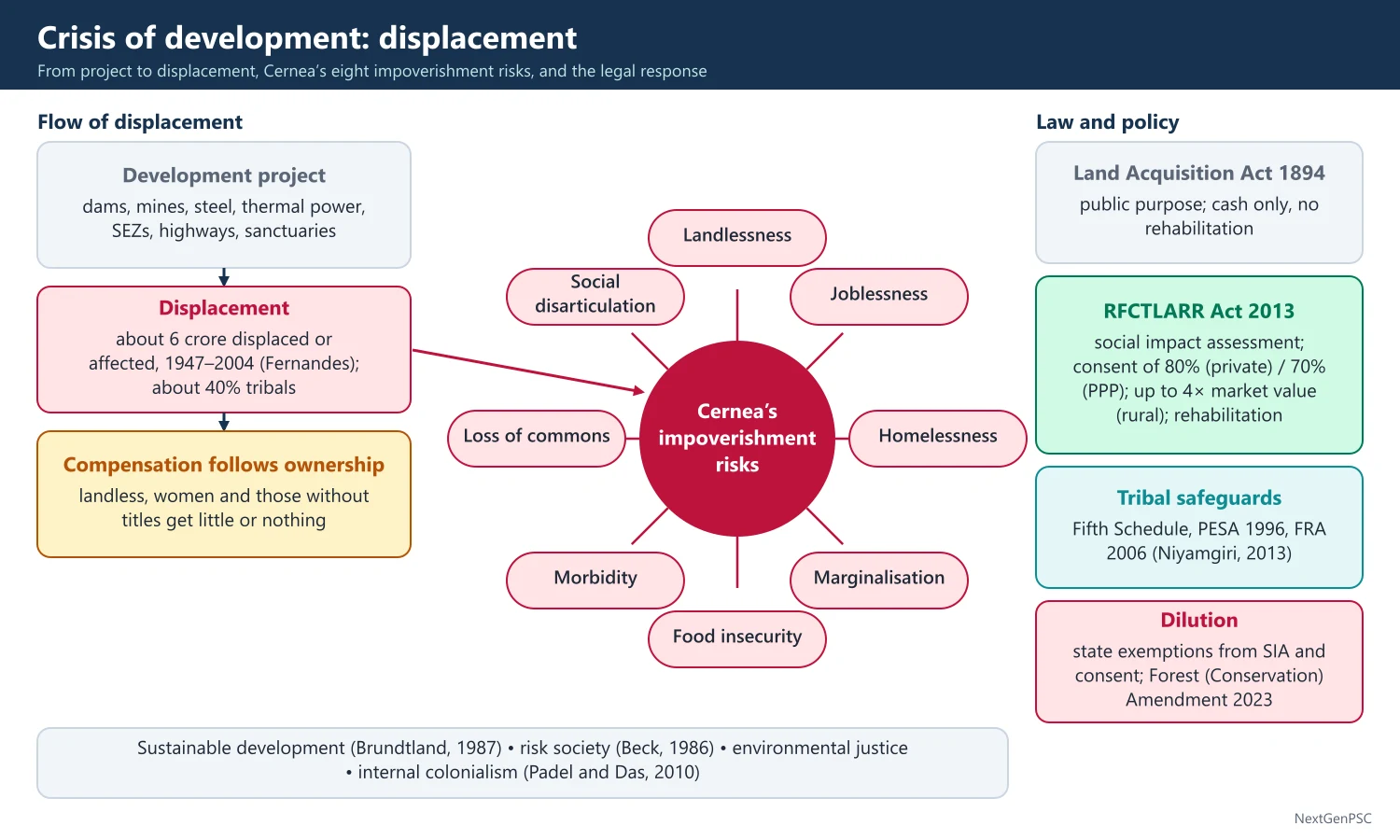
Impoverishment Risks and Reconstruction (IRR) model: Michael Cernea (World Bank, 1990s) identified eight risks of displacement: landlessness, joblessness, homelessness, marginalisation, food insecurity, increased morbidity, loss of common property and social disarticulation.
Risk society: Ulrich Beck (Risk Society, 1986) argued that modern societies produce manufactured risks (pollution, nuclear accidents, climate change) that cross class and national boundaries, though the poor are more exposed.
Sustainable development: the Brundtland Commission (Our Common Future, 1987) defined it as development that meets the needs of the present without compromising the ability of future generations to meet their own needs.
Treadmill of production: Allan Schnaiberg (The Environment, 1980) argued that capitalist growth requires ever more extraction and waste; ecological modernisation theorists (Arthur Mol, Gert Spaargaren) argue instead that technology and regulation can decouple growth from damage.
Environmental justice: the principle that environmental harms and benefits should be fairly shared; in India it is linked to the 'environmentalism of the poor' (Guha and Martinez-Alier).
Internal colonialism: the view that resource-rich tribal regions (Jharkhand, Odisha, Chhattisgarh) are exploited for the benefit of the core, a frame used by scholars such as Felix Padel and Samarendra Das (Out of This Earth, 2010) on bauxite mining.
2. Displacement in India: scale and causes
Scale: Walter Fernandes estimated that around 6 crore people were displaced or affected by development projects between 1947 and 2004, about 40% of them tribals, though there is no official national count, so figures are estimates.
Causes: large dams (India has several thousand large dams), mining, steel plants, thermal power, special economic zones, urban expansion, highways, and wildlife sanctuaries ('conservation refugees').
Who is displaced: mostly tribals, Dalits, small peasants, fisherfolk and forest dwellers without formal titles; landless people often receive nothing because compensation follows ownership.
Gender: compensation is usually paid to male heads, so women lose access to commons (fuel, fodder, forest produce) and economic independence, and face higher risks in resettlement colonies.
Cultural loss: for Adivasis, land is tied to clan, ancestors and sacred sites (for example, Niyam Raja for the Dongria Kondh), so cash compensation cannot replace it; this is Cernea's 'social disarticulation'.
3. Cases and conflicts
Sardar Sarovar (Narmada): submerged villages in Gujarat, Madhya Pradesh and Maharashtra; the Narmada Bachao Andolan exposed inadequate land-for-land rehabilitation; Amita Baviskar (In the Belly of the River, 1995) showed the clash of Adivasi and State views of nature.
Singur and Nandigram (West Bengal, 2006–07): farmers resisted land acquisition for a car factory and a chemical hub; police firing at Nandigram on 14 March 2007 killed 14 people; in 2016 the Supreme Court quashed the Singur acquisition and ordered land returned.
Kalinganagar (Odisha): police firing on 2 January 2006 killed 13 Adivasis protesting a steel plant, a turning point in debates on tribal land.
Mining belts: Hasdeo Arand (Chhattisgarh) coal mining, iron-ore mining in Keonjhar and Bellary, and the Maoist conflict in Bastar show how resource extraction, displacement and insurgency are linked.
Urban displacement: slum demolitions for beautification, metro projects and events such as the Commonwealth Games (2010) displaced the urban poor (Chapter 23).
4. Law and policy on displacement
Colonial law: the Land Acquisition Act 1894 allowed acquisition for 'public purpose' with cash compensation and no rehabilitation; it was used for over a century.
RFCTLARR Act 2013: the Right to Fair Compensation and Transparency in Land Acquisition, Rehabilitation and Resettlement Act (in force from 1 January 2014) requires a social impact assessment, consent of 80% of affected families for private projects and 70% for public–private projects, compensation up to four times market value in rural areas, and rehabilitation for livelihood losers.
Dilution debate: several states passed their own laws exempting categories of projects from the social impact assessment and consent clauses, which critics say weakens the 2013 Act.
Tribal safeguards: the Fifth Schedule, PESA 1996 (gram sabha consultation) and the Forest Rights Act 2006 (recognition of individual and community forest rights, gram sabha consent for diversion, upheld in the Niyamgiri case, 2013).
Recent changes: the Forest (Conservation) Amendment Act 2023, renamed Van (Sanrakshan Evam Samvardhan) Adhiniyam, exempts some land categories near borders and linear projects, which critics say weakens forest protection.
5. Environmental problems and their social side
Industrial disaster: the Bhopal gas tragedy (2–3 December 1984), a leak of methyl isocyanate from the Union Carbide plant, killed thousands; its victims were mostly poor slum dwellers, and compensation struggles lasted decades.
Air and water: north Indian cities, especially Delhi, face severe winter air pollution from vehicles, industry, construction and stubble burning; rivers such as the Yamuna carry heavy untreated sewage; the poor, who work outdoors, are most exposed.
Groundwater and agriculture: Green Revolution states such as Punjab and Haryana face falling water tables and soil degradation (Chapter 22).
Himalayan fragility: land subsidence at Joshimath (January 2023), the Kedarnath floods (2013), the Wayanad landslides in Kerala (30 July 2024) and repeated hill disasters raise questions about road, hydropower and tourism expansion in fragile zones; the Gadgil report (2011) on the Western Ghats warned of this.
Climate change: heatwaves, erratic monsoons and floods hit farmers, informal workers and coastal fisherfolk hardest; climate-induced migration from the Sundarbans and drought regions is growing.
6. Sustainability: policy and debate
India's commitments: at COP26 (Glasgow, 2021) India announced a net-zero target for 2070; its updated NDC (2022) aims at about 50% of installed power capacity from non-fossil sources by 2030, a share officially reported as reached in 2025.
Equity argument: India argues for 'common but differentiated responsibilities' (Rio, 1992) because historical emissions came from rich countries; per-capita emissions in India remain well below the world average.
Green growth vs degrowth: mainstream policy (Mission LiFE, 2022; renewable energy) follows ecological modernisation; critics such as Ashish Kothari propose 'radical ecological democracy' based on local self-rule.
Green displacement: large solar parks and wildlife conservation can also displace people, showing that even 'green' development needs consent and benefit-sharing.
Judicial role: the Supreme Court's environmental jurisprudence (M.C. Mehta cases, the polluter pays and precautionary principles in Vellore Citizens' Welfare Forum, 1996) and the National Green Tribunal (2010) have made courts key actors.
7. Linking thinkers
Link to Marx's metabolic rift (developed by John Bellamy Foster) and to dependency theory: extraction serves distant markets.
Link to Beck and Giddens (reflexive modernisation) and to post-development critiques (Escobar, Vandana Shiva).
Link to environmental movements (Chapter 25), tribal issues and planning (Chapter 21).
8. Using it in the exam
10 marks: define development-induced displacement, give Cernea's risks and one Indian case.
15–20 marks: scale and social profile of the displaced, cases, law (1894 → 2013 → state dilutions), environmental crises, sustainability debate, and a conclusion on participatory, rights-based development.
Thinkers and studies: Michael Cernea, Walter Fernandes, Amita Baviskar, Ulrich Beck, Ramachandra Guha, Padel and Das.
Diagram idea: Cernea's eight risks around a central box 'displacement', with the reconstruction strategy (land-based resettlement, jobs, housing, inclusion) as arrows outwards.
Quotation to use: the Brundtland definition of sustainable development.
| Risk | Meaning | Indian example |
|---|---|---|
| Landlessness | Loss of land, the main asset | Sardar Sarovar oustees given poor or no land |
| Joblessness | Loss of work, especially for the landless | Fisherfolk and labourers in dam areas |
| Homelessness | Loss of shelter | Slum demolitions in Delhi (Yamuna Pushta, 2004) |
| Marginalisation | Fall in status and confidence | Tribals becoming casual labour in towns |
| Food insecurity | Loss of food sources | Loss of forest produce after mining |
| Morbidity | More illness | Pollution near mines and plants |
| Loss of commons | Loss of forests, grazing, water | Hasdeo, Niyamgiri |
| Social disarticulation | Breakup of community and kinship | Scattered resettlement of villages |
Mains points
- Typical questions: 'Development-induced displacement is a crisis of development. Discuss' and 'Who bears the cost of development in India?'.
- Use Cernea's model as the analytical spine and Indian cases as evidence.
- Say clearly that displacement figures are estimates (Fernandes) and there is no official count.
- Cover law precisely: 1894 Act, RFCTLARR 2013 provisions, FRA 2006, PESA 1996, Forest Conservation Amendment 2023.
- Bring the gender and caste dimension of displacement and environmental harm.
- Conclude with sustainable and participatory development rather than an anti-development position.
Did you know?
- Nehru called dams 'temples of modern India' in 1954, but in 1958 he warned against 'the disease of giantism', showing that doubts began early.
Poverty, Deprivation and Inequalities
Poverty in India has fallen sharply by most measures: NITI Aayog's multidimensional poverty fell to 11.28% in 2022–23 and the World Bank put extreme poverty at 5.3% in 2022–23. But sociologists stress that poverty is also deprivation and social exclusion, concentrated among Scheduled Tribes, Dalits, Muslims, women-headed households and eastern and central states, while income and wealth inequality at the top has risen. The topic covers measurement, theories and the social structure of inequality.
In simple words
Poverty is not having enough income or basic things like food, housing, health and schooling; inequality is the gap between those at the top and bottom.
Imagine a race where some start far behind the line because of caste, gender or where they were born: even if everyone runs faster, the gaps can remain.
Sociologists study why poverty sticks to certain groups and how exclusion keeps them out of opportunities.
UPSC asks about measurement debates, the social profile of the poor and growing inequality.
1. Concepts and definitions
Absolute poverty: lack of resources to meet basic needs measured against a fixed poverty line; Charles Booth and Seebohm Rowntree (York, 1901) pioneered such measurement.
Relative deprivation: Peter Townsend (Poverty in the United Kingdom, 1979) defined poverty as lacking the resources to participate in the customary activities and living conditions of one's society.
Capability and entitlement: Amartya Sen (Poverty and Famines, 1981) showed that famines result from collapse of entitlements, not just food shortage, as in the Bengal famine of 1943; his capability approach sees poverty as deprivation of basic freedoms.
Social exclusion: a term from René Lenoir (France, 1974) for processes that shut groups out of social, economic and political life; in India, Sukhadeo Thorat applies it to caste-based exclusion from markets and services.
Culture of poverty vs structural view: Oscar Lewis blamed a self-perpetuating subculture; structural theorists (Marxists, Myrdal on 'cumulative causation') point to land, labour markets, caste and State policy.
Functionalist view: Herbert Gans ('The Positive Functions of Poverty', 1972) listed ways in which poverty serves the non-poor (cheap labour, jobs for welfare workers), a provocative critique of functionalism.
Inequality measures: the Gini coefficient (0 = perfect equality, 1 = perfect inequality), top income and wealth shares, and the Palma ratio.
2. Measuring poverty in India
Early estimates: V.M. Dandekar and N. Rath (Poverty in India, 1971) used a calorie-based line; the Planning Commission's Task Force (Alagh, 1979) set calorie norms of 2,400 (rural) and 2,100 (urban).
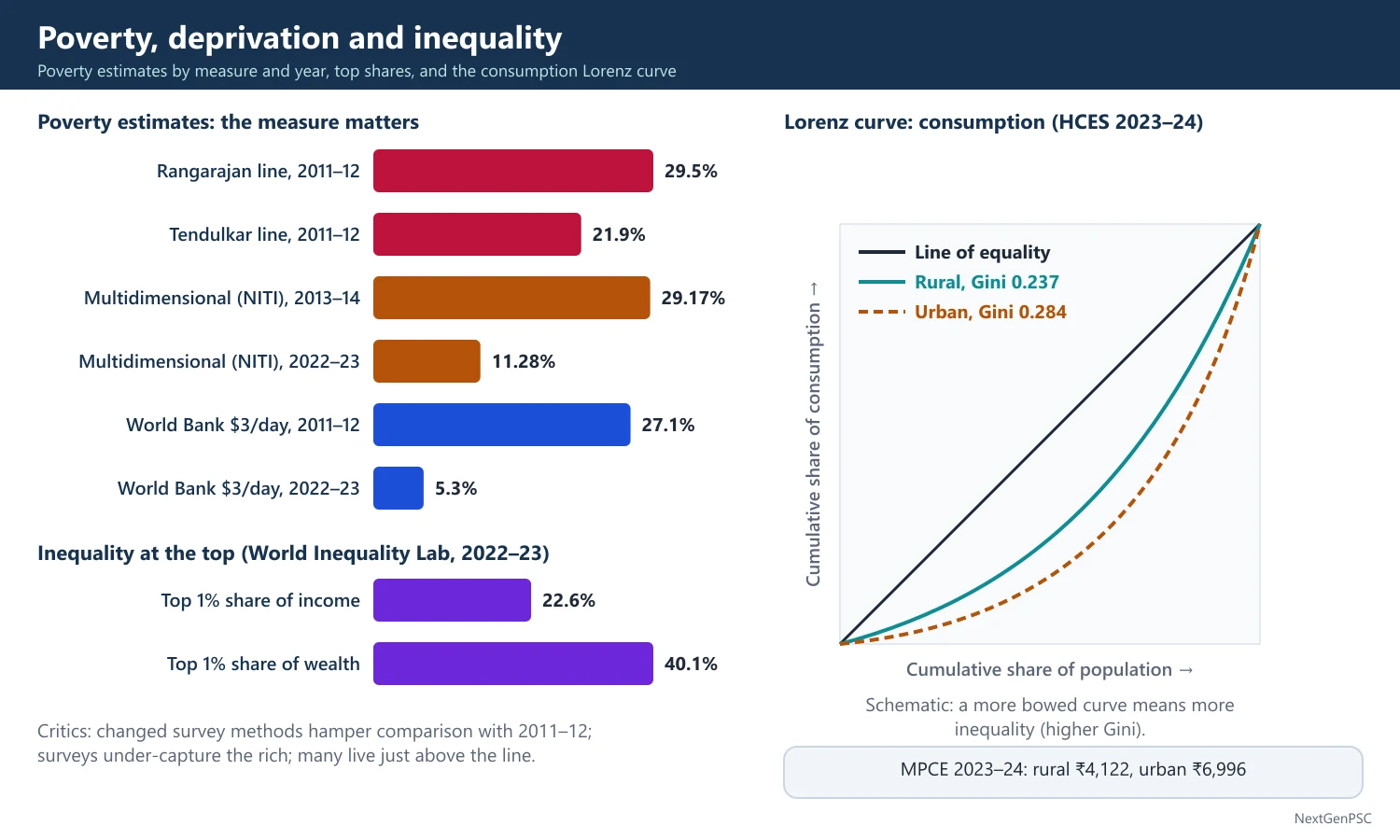
Expert groups: Lakdawala (1993), Tendulkar (2009), which put poverty at 21.9% in 2011–12, and Rangarajan (2014), which put it at 29.5% in 2011–12; no official poverty line has been adopted since.
Multidimensional poverty: NITI Aayog's MPI, based on NFHS health, education and living-standard indicators, estimated 11.28% poor in 2022–23 against 29.17% in 2013–14 (discussion paper, January 2024).
World Bank: using the HCES 2022–23, it estimated extreme poverty at 5.3% at 3 US dollars a day (2021 PPP), down from 27.1% in 2011–12, about 7.5 crore people.
Consumption data: HCES 2023–24 showed average MPCE of about ₹4,122 (rural) and ₹6,996 (urban), and consumption Gini falling to 0.237 (rural) and 0.284 (urban).
Debate: critics note that changes in survey method make comparison with 2011–12 difficult, that consumption surveys under-capture the rich, and that a low headcount can hide large numbers just above the line who are vulnerable to shocks.
3. Social profile of deprivation
Caste and tribe: multidimensional poverty is highest among Scheduled Tribes, followed by Scheduled Castes (NITI and UNDP–OPHI global MPI reports); Adivasis face land loss, remoteness and poor services.
Discrimination in markets: Sukhadeo Thorat and Paul Attewell's audit study (EPW, 2007) found that job applicants with Dalit or Muslim names were less likely to be called for interviews than equally qualified upper-caste Hindus.
Wealth gaps: the All India Debt and Investment Survey (NSS 77th round, 2019) showed that SC and ST households hold a much smaller share of assets than their population share, mainly due to low land ownership.
Muslims: the Sachar Committee (2006) found Muslims behind on education, formal jobs, credit and public employment; the Kundu Committee (2014) reviewed progress and found gaps persisting.
Gender: women's low labour force participation (40.0% in PLFS 2025), wage gaps, unpaid care work and lack of land titles make poverty gendered; intra-household inequality is hidden in household surveys (Bina Agarwal).
Region: Bihar, Jharkhand, Uttar Pradesh, Madhya Pradesh and Meghalaya have the highest MPI shares, while Kerala, Goa and Tamil Nadu have the lowest; HCES 2023–24 shows Sikkim with the highest and Chhattisgarh with the lowest MPCE among states.
Nutrition: NFHS-5 (2019–21) found 35.5% of children under five stunted and 57% of women anaemic, showing deprivation beyond income.
4. Inequality at the top
Income and wealth concentration: the World Inequality Lab study by Bharti, Chancel, Piketty and Somanchi (March 2024) estimated that the top 1% held about 22.6% of national income and 40.1% of wealth in 2022–23, among the highest shares in the world.
Contradiction with consumption data: official consumption Gini fell while income and wealth concentration rose; the gap reflects different data (surveys vs tax and rich lists), which is a debated point.
Caste at the top: Satish Deshpande (Contemporary India: A Sociological View, 2003) and later work show that upper castes are over-represented in elite occupations, media, judiciary and corporate boards.
Intergenerational mobility: studies using NSS and IHDS data (for example, by Ashwini Deshpande and Rajesh Ramachandran) find that SC and ST mobility has improved but gaps with upper castes persist.
5. Policy responses
Entitlements: NFSA 2013 (free grain under PMGKAY, extended for five years from 1 January 2024), the rural employment guarantee (MGNREGA, replaced by the VB-G RAM G Act from 1 July 2026), PMAY housing, Jan Dhan accounts and Ayushman Bharat health insurance.
Group-targeted policy: reservations, Scheduled Caste Sub-Plan and Tribal Sub-Plan (now development action plans), PM-JANMAN (2023) for Particularly Vulnerable Tribal Groups and Stand-Up India loans for SC, ST and women entrepreneurs.
Debate on welfare: some economists call free transfers 'revdi' (freebies) that strain budgets; others (Jean Drèze, Reetika Khera) argue that public provision of food, health and schooling is the foundation of capability.
6. Further studies and comparisons
Chronic poverty: studies of the Chronic Poverty Research Centre show that households falling into poverty through illness, debt or dowry are as important as those escaping it, so poverty is dynamic.
Health shocks: out-of-pocket health spending is a major cause of impoverishment; Ayushman Bharat PM-JAY (2018) aims to reduce it, but studies show gaps in coverage of outpatient care and medicines.
Urban poverty: slum dwellers and informal workers face poverty through insecure work, rent and lack of services, which household consumption surveys capture poorly (Chapter 23).
World comparison: Brazil reduced inequality in the 2000s through Bolsa Família and minimum wage increases, while China cut extreme poverty fastest through growth; India's path combines growth with large transfer programmes.
7. Linking thinkers
Link to stratification theory: Davis and Moore (inequality as functional) versus Tumin's critique, Marx (class exploitation) and Weber (life chances, status groups).
Link to caste as a system of graded inequality (Ambedkar) and to Béteille's distinction between inequality of status and of class.
Link to rural development (Chapter 22), informal work (Chapter 23) and education disparities (later in this chapter).
8. Using it in the exam
10 marks: distinguish absolute and relative poverty with Indian measures (Tendulkar, MPI) and one group-wise fact.
15–20 marks: concepts (Townsend, Sen, exclusion), measurement and recent data, social profile (caste, tribe, gender, religion, region), inequality at the top, policy, and a conclusion that poverty reduction needs attacks on structural exclusion.
Thinkers and studies: Townsend, Amartya Sen, Oscar Lewis, Sukhadeo Thorat, Satish Deshpande, the World Inequality Lab.
Diagram idea: a two-axis chart with 'income poverty' falling and 'top 1% wealth share' rising over 2011–2023, to show the two faces of inequality.
Quotation to use: Townsend's definition of poverty as exclusion from the ordinary living patterns of society.
| Measure | Estimate | Year | Source |
|---|---|---|---|
| Tendulkar poverty line | 21.9% | 2011–12 | Planning Commission (2013) |
| Rangarajan poverty line | 29.5% | 2011–12 | Rangarajan Expert Group (2014) |
| Multidimensional poverty | 11.28% | 2022–23 | NITI Aayog (Jan 2024) |
| Extreme poverty, 3 US dollars a day | 5.3% | 2022–23 | World Bank (2025) |
| Top 1% income share | 22.6% | 2022–23 | World Inequality Lab (2024) |
| Top 1% wealth share | 40.1% | 2022–23 | World Inequality Lab (2024) |
Mains points
- Expect 'Poverty in India is not merely economic but social. Discuss' or 'Analyse the relationship between caste and poverty'.
- Give the measurement debate with years and sources, and say that no official poverty line has been adopted since 2014.
- Present both trends: falling poverty and rising top-end concentration.
- Use Indian studies of discrimination (Thorat and Attewell) to show exclusion, not just low income.
- Avoid blaming the poor; critique the culture of poverty thesis.
- Conclude with capability expansion and anti-discrimination as complements to growth.
Did you know?
- Rowntree's 1901 survey of York was one of the first scientific poverty studies; India's first official poverty estimates came about 70 years later.
Violence against Women and Caste Conflicts
Violence against women in India, from domestic cruelty and dowry deaths to rape and 'honour' crimes, is rooted in patriarchy and in caste control over women's sexuality; NCRB recorded about 4.41 lakh crimes against women in 2024. Caste conflicts range from atrocities on Dalits (55,698 crimes against SCs in 2024) to clashes between castes over land, wages, temples and reservation. Both show how assertion by subordinate groups often meets violent backlash, and how law alone has not ended them.
In simple words
Violence against women includes beating at home, dowry harassment, rape and killing in the name of family 'honour'.
Caste conflict is violence or tension between castes, often when Dalits claim land, wages, a temple or a horse at a wedding.
Both are like a power struggle at home and in the village: those who held power use force when it is challenged.
UPSC asks about their social roots, data and the effectiveness of laws.
1. Concepts and definitions
Gender-based violence: the UN Declaration on the Elimination of Violence against Women (1993) defines it as any act of gender-based violence that results in physical, sexual or psychological harm to women, in public or private life.
Radical feminist view: Susan Brownmiller (Against Our Will, 1975) argued that rape is a means of male control over all women, not just individual deviance.
Hegemonic masculinity: R.W. Connell (Gender and Power, 1987) described the dominant form of masculinity that legitimises men's power and links violence to proving manhood.
Patriarchal bargain: Deniz Kandiyoti (1988) showed how women in classic patriarchy accept constraints in exchange for protection and later power as mothers-in-law, explaining women's role in dowry harassment.
Atrocity: under the SC/ST (Prevention of Atrocities) Act 1989, specified offences by non-SC/ST persons against SCs and STs, ranging from humiliation and social boycott to land grabbing, sexual assault and murder.
Caste conflict: collective tension or violence between caste groups over resources, status or power; it includes atrocities (dominant against Dalit), inter-OBC and Dalit–OBC clashes, and agitations over reservation.
2. Violence against women: forms and data
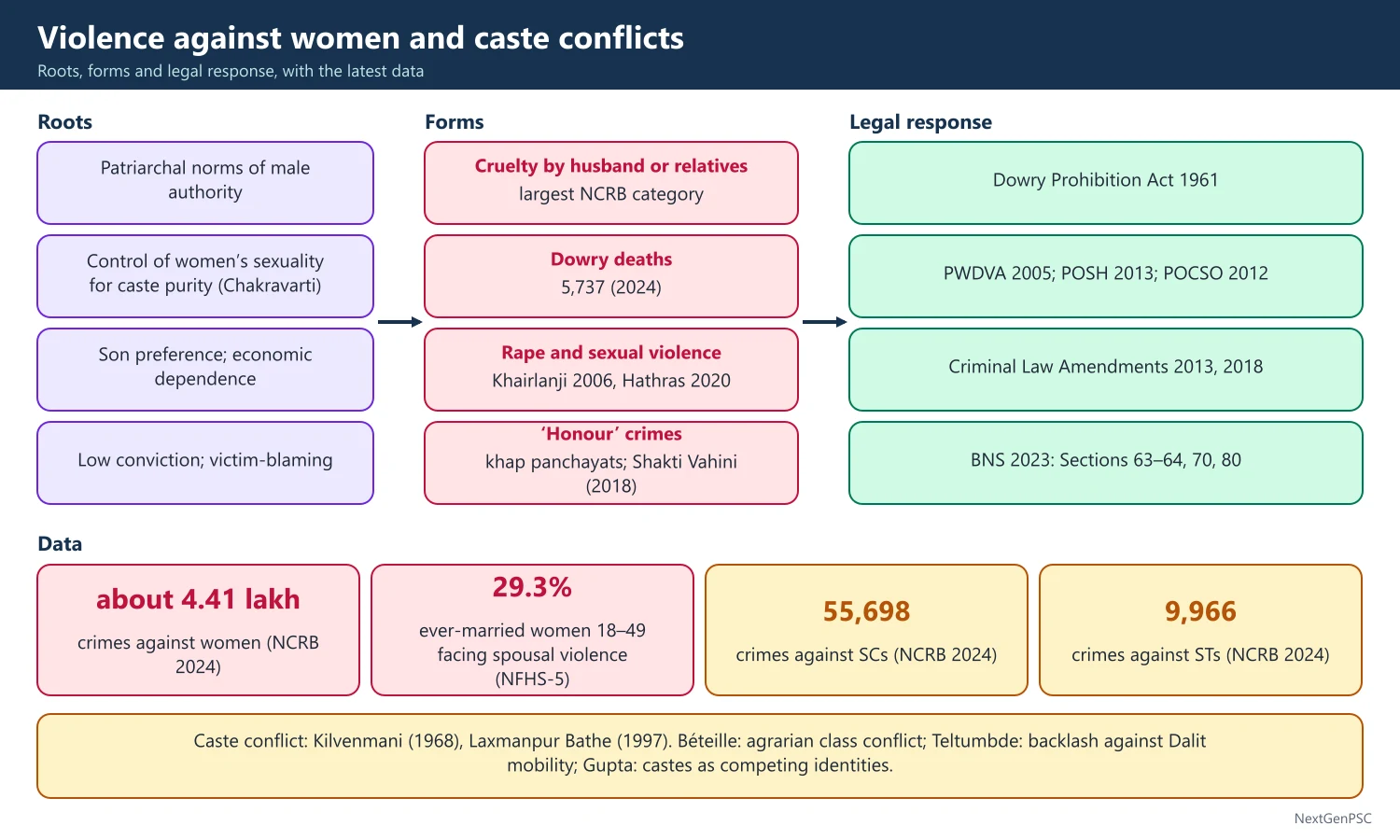
NCRB Crime in India 2024 (released 6 May 2026): about 4.41 lakh cases, 1.5% fewer than 2023 (4,48,211); the rate fell to about 64.6 per lakh women; 'cruelty by husband or relatives' was the largest category, followed by kidnapping and assault on women.
Dowry deaths: 5,737 in 2024 (NCRB), despite the Dowry Prohibition Act 1961; dowry has spread to communities that did not practise it earlier, linked to consumerism and hypergamy (Srinivas, 'Some Reflections on Dowry', 1984).
Domestic violence: NFHS-5 (2019–21) found that 29.3% of ever-married women aged 18–49 had experienced physical or sexual violence by a husband; only a small share sought help, so NCRB figures greatly undercount.
'Honour' crimes: killings of couples marrying across caste or gotra, often ordered by khap panchayats in Haryana and western UP; the Supreme Court in Shakti Vahini (2018) declared such interference illegal.
Other forms: acid attacks (sale regulated after Laxmi v. Union of India, 2013), witch-hunting of tribal women in Jharkhand and Odisha, trafficking, cyber harassment and sexual violence in conflict (Manipur, 2023).
Caste and gender intersect: Dalit women face sexual violence as a tool of caste domination, as in Khairlanji (Maharashtra, 2006) and Hathras (Uttar Pradesh, 2020); Kalpana Kannabiran calls this the 'caste-gender' nexus of violence.
Why it persists: patriarchal norms of male authority, son preference, economic dependence, control of women's sexuality for caste purity (Uma Chakravarti), low conviction rates and victim-blaming in police and courts.
3. Law and policy on violence against women
Bharatiya Nyaya Sanhita 2023 (from 1 July 2024): rape (Sections 63–64), gang rape (Section 70), sexual intercourse by deceitful means including false promise of marriage (Section 69), stalking (Section 78), dowry death (Section 80) and cruelty (Section 85); the marital rape exception remains and is under challenge in the Supreme Court.
Other laws: PWDVA 2005, POSH Act 2013, the POCSO Act 2012 for children, and the Criminal Law (Amendment) Acts of 2013 (after the Delhi case) and 2018 (death penalty possible for rape of girls under 12).
Institutions: the Nirbhaya Fund (2013), One Stop Centres (2015), the women's helpline 181 and Mission Shakti (2022); fast-track and special courts deal with rape and POCSO cases.
Debate: feminists argue that harsher punishment (death penalty) does not deter and may reduce reporting where the accused are relatives; they stress certainty of conviction, police reform and changing masculinity.
4. Caste atrocities and conflicts
Data: NCRB recorded 55,698 crimes against Scheduled Castes in 2024 (down 3.6% from 57,789 in 2023), with Uttar Pradesh reporting the most; crimes against Scheduled Tribes were 9,966 in 2024 after a sharp rise to 12,960 in 2023, driven by Manipur.
Massacres: Kilvenmani (Tamil Nadu, 1968: 44 Dalit labourers burned over wage demands), Belchi (Bihar, 1977), Karamchedu (Andhra, 1985), Tsundur (Andhra, 1991) and Laxmanpur Bathe (Bihar, 1997: 58 Dalits killed by the Ranvir Sena).
Recent cases: Mirchpur (Haryana, 2010), Dharmapuri (Tamil Nadu, 2012, over an inter-caste marriage), Una (Gujarat, 2016), Saharanpur (2017), Bhima Koregaon (2018) and Hathras (2020).
Explanations: André Béteille linked violence to agrarian class conflict between landowning intermediate castes and Dalit labourers; Srinivas's dominant castes enforce hierarchy; Anand Teltumbde argues that Dalit education and assertion provoke backlash ('atrocities as a reaction to mobility').
Caste as identity, not hierarchy: Dipankar Gupta (Interrogating Caste, 2000) argued that castes increasingly see themselves as discrete, competing identities rather than ranks in one hierarchy, which explains competitive mobilisation and clashes.
Reservation agitations: anti-Mandal protests (1990), anti-reservation riots in Gujarat (1981, 1985), and demands for OBC status by Patidars (2015), Jats (2016, with about 30 deaths) and Marathas (2016–18 and again 2023–24 under Manoj Jarange) show conflict over shrinking public jobs.
Law: the PCR Act 1955, the SC/ST (PoA) Act 1989 with special courts, the 2015 amendment (new offences such as garlanding with footwear and social boycott), and the 2018 amendment (Section 18A) restoring no anticipatory bail after the Subhash Kashinath Mahajan judgment.
Implementation gap: high pendency and low conviction rates in atrocity cases, hostile witnesses under pressure, and police reluctance to register cases are widely documented in NCRB data and NHRC reports.
5. Further studies and debates
Veena Das (Life and Words, 2007) studied how women survivors of Partition and the 1984 anti-Sikh violence carried violence into everyday life, showing that violence shapes memory and kinship long after the event.
Public space and safety: Shilpa Phadke, Sameera Khan and Shilpa Ranade (Why Loiter?, 2011) argued that women's right to public space is restricted in the name of safety, and that the answer is more women in public, not fewer.
Workplace violence: the RG Kar Medical College case in Kolkata (August 2024) led the Supreme Court to set up a National Task Force on the safety of medical professionals, highlighting violence against women at work.
Inter-caste marriage and violence: caste endogamy remains strong (IHDS data show inter-caste marriages at about 5% of marriages), so couples who cross caste lines face family and community violence, linking gender and caste conflict.
Dalit–OBC tensions: in many regions the main perpetrators of atrocities are now landowning intermediate castes (OBCs) rather than upper castes, which complicates the idea of a united 'bahujan' bloc.
Caste in cities and online: caste discrimination appears in housing, campus life and online abuse, showing that urbanisation has not ended caste conflict but changed its forms.
World comparison: race-based violence in the USA (lynching and its memorialisation) and anti-Black violence movements such as Black Lives Matter (2013) are often compared with caste atrocities and Dalit activism.
6. Linking thinkers
Link violence against women to Walby's six structures of patriarchy, Connell's masculinity and Foucault's power over bodies.
Link caste conflict to Marx (class conflict in agrarian relations), Weber (status honour) and Dahrendorf (conflict over authority).
Link to Dalit and women's movements (Chapter 25) and to law and social change (Chapter 21).
7. Using it in the exam
10 marks: explain one form (dowry deaths or honour killings) with data, a theory and one law.
15–20 marks: forms and data (NCRB 2024, NFHS-5), theoretical explanations, the caste–gender nexus, legal framework, limits of law, and a conclusion on social change in norms.
Thinkers and studies: Walby, Brownmiller, Kandiyoti, Uma Chakravarti, Béteille, Dipankar Gupta.
Diagram idea: an iceberg: NCRB-registered cases above water, unreported domestic violence (NFHS-5: 29.3%) below.
Quotation to use: Brownmiller's view, in paraphrase, that rape functions as a means of keeping all women in fear.
| Indicator | Value | Year | Source |
|---|---|---|---|
| Crimes against women | about 4.41 lakh | 2024 | NCRB Crime in India 2024 |
| Dowry deaths | 5,737 | 2024 | NCRB |
| Ever-married women 18–49 facing spousal violence | 29.3% | 2019–21 | NFHS-5 |
| Crimes against Scheduled Castes | 55,698 | 2024 | NCRB |
| Crimes against Scheduled Tribes | 9,966 | 2024 | NCRB |
Mains points
- Expect 'Violence against women is a product of patriarchy. Discuss' and 'Why do caste atrocities persist despite legal safeguards?'.
- Use NCRB 2024 and NFHS-5 data correctly, and explain under-reporting.
- Show the caste–gender nexus with cases (Khairlanji, Hathras).
- Update laws: BNS 2023 sections, SC/ST Act amendments 2015 and 2018.
- Explain caste conflict through agrarian change, dominant castes and assertion–backlash (Béteille, Srinivas, Teltumbde).
- Conclude that legal measures need changes in norms, economic independence and police and judicial reform.
Did you know?
- In Kilvenmani (1968), the dispute that led to the massacre was a demand for an extra half measure of paddy as wages.
Ethnic Conflicts, Communalism and Religious Revivalism
Communalism is the ideology that religious communities have separate and opposed interests; it has produced recurring communal violence in India from Partition to Delhi (2020). Ethnic conflicts in the North-East and elsewhere, most recently in Manipur (2023), arise from competition over land, identity and political power. Religious revivalism, among all communities, mixes reform with assertion. Sociologists (Bipan Chandra, Paul Brass, Ashutosh Varshney) explain these as political and social constructions, not inevitable products of religious difference.
In simple words
Communalism is the belief that people of one religion share common interests that are opposed to those of another religion, which can turn neighbours into enemies.
It is like two families in a colony who have lived together for years but are made to believe the other side is stealing their water; a rumour can then start a fight.
Ethnic conflict is similar but based on tribe, language or region, and revivalism is a return to what a group sees as the pure form of its religion.
UPSC asks about causes, theories and remedies, with Indian cases.
1. Concepts and definitions
Communalism: Bipan Chandra (Communalism in Modern India, 1984) defined it as the belief that people following a religion have common secular interests, that these differ from those of other religions, and finally that they are antagonistic.
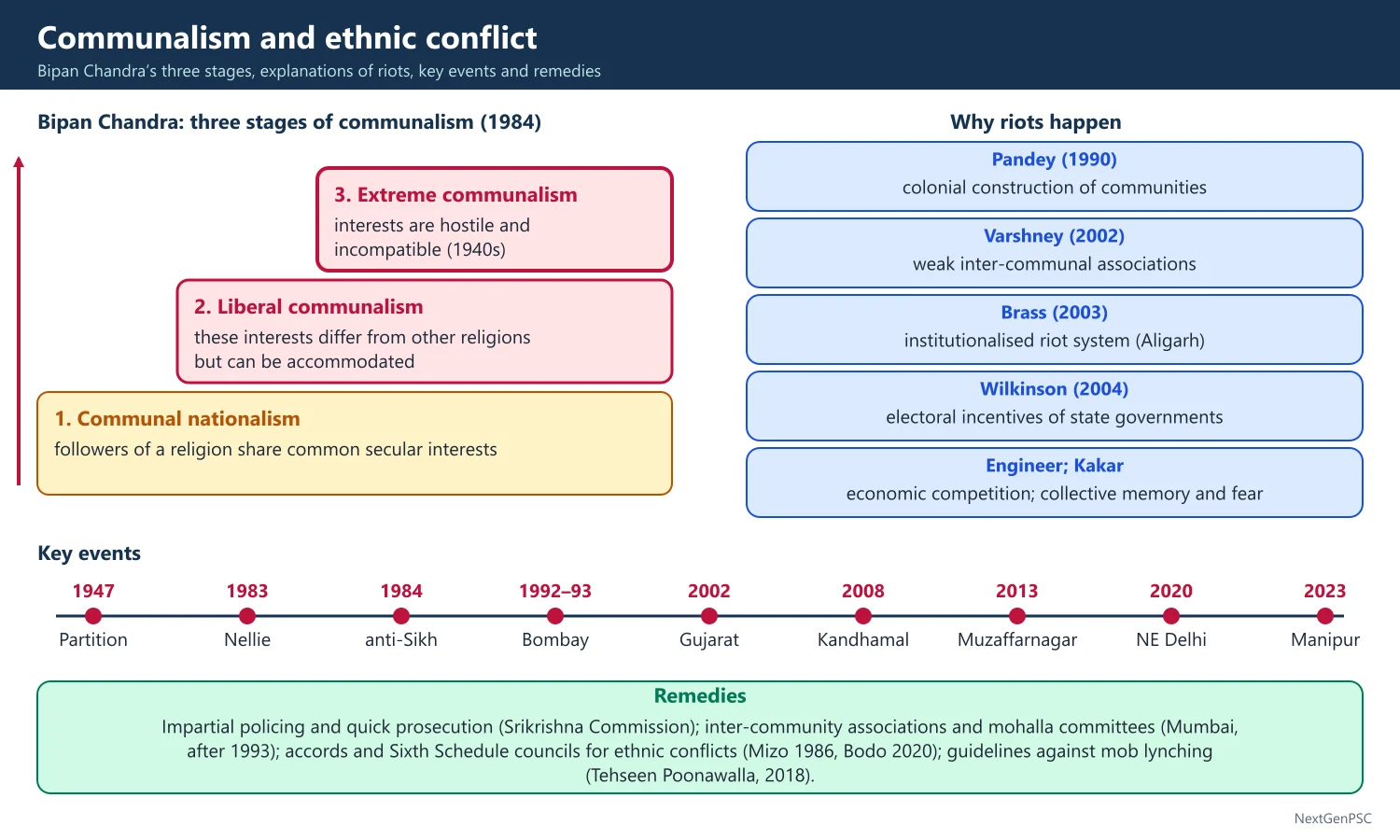
Three stages (Bipan Chandra): communal nationalism (shared community interests), liberal communalism (separate interests that can be accommodated) and extreme communalism (hostile, incompatible interests), as seen in the 1940s.
Ethnic conflict: conflict between groups defined by shared descent, language, religion or region, usually over territory, resources, jobs and political recognition.
Religious revivalism: movements that seek to restore what they see as the original purity of a faith; fundamentalism (a term from early 20th-century American Protestantism) is a more rigid, often political, form that rejects pluralism.
Construction of communalism: Gyanendra Pandey (The Construction of Communalism in Colonial North India, 1990) argued that colonial knowledge (census categories, separate electorates from 1909) helped construct fixed religious communities.
Majoritarianism: the political claim that the majority community's culture should define the nation; scholars such as Christophe Jaffrelot (Modi's India, 2021) describe an 'ethnic democracy' trend, which supporters of Hindu nationalism reject, so it is a debated characterisation.
2. Theories of communal and ethnic violence
Institutionalised riot system: Paul Brass (The Production of Hindu–Muslim Violence in Contemporary India, 2003), studying Aligarh, argued that riots are produced by networks of 'riot specialists', politicians and media, especially around elections.
Civic engagement: Ashutosh Varshney (Ethnic Conflict and Civic Life, 2002) compared three pairs of cities (Aligarh–Calicut, Hyderabad–Lucknow, Ahmedabad–Surat) and found that inter-communal associations (business, unions, clubs) prevent riots, while everyday contact alone is weaker.
Electoral incentives: Steven Wilkinson (Votes and Violence, 2004) showed that riots are controlled when state governments depend on minority votes and spread when they do not.
Economic and Marxist view: Asghar Ali Engineer and others pointed to economic competition (for example, between Hindu and Muslim artisans and traders in Moradabad, Bhiwandi), with communal identity masking class interests.
Psychological and cultural view: Sudhir Kakar (The Colors of Violence, 1996), on Hyderabad, showed how collective memories and fears of the other are mobilised in riots.
Primordialism vs instrumentalism: Geertz's primordial attachments versus Brass's elite manipulation; most Indian sociologists combine the two, stressing that identities are real but are politicised by leaders.
3. Communal violence in India: key events
Partition (1947): mass killing, abduction of women and displacement of about 1.5 crore people (estimates of deaths vary widely, from several lakh to around 10 lakh).
Post-independence riots: Ahmedabad (1969), Bhiwandi (1970), Moradabad (1980), Bhagalpur (1989), Bombay (December 1992–January 1993, investigated by the Srikrishna Commission) after the demolition of the Babri Masjid on 6 December 1992.
Anti-Sikh violence (1984): after Indira Gandhi's assassination on 31 October 1984, about 2,800 Sikhs were killed in Delhi by official count, with political involvement documented by later commissions.
Gujarat (2002): after the burning of a train coach at Godhra on 27 February 2002 killed 59 people, riots across Gujarat killed over 1,000 people by official figures, most of them Muslims.
Later violence: Kandhamal, Odisha (2008, against Christians), Muzaffarnagar (2013), north-east Delhi (February 2020, 53 deaths) and incidents of lynching linked to cow protection after 2015.
Courts and law: the Supreme Court's Tehseen Poonawalla judgment (2018) issued guidelines against mob lynching; the BNS 2023 (Section 103(2)) makes murder by a mob of five or more on grounds such as race, caste or community a specific offence.
4. Ethnic conflicts
Assam: the Nellie massacre (18 February 1983) killed about 2,000 Bengali-speaking Muslims by official estimates during the anti-foreigners movement; Bodo–Muslim clashes (2012) displaced lakhs.
Manipur (2023): Meitei–Kuki-Zo violence from 3 May 2023, triggered by a High Court direction on ST status for Meiteis and rooted in land, hill–valley divides and armed groups, caused over 250 deaths and displaced about 60,000 people; President's Rule was imposed in February 2025.
Kashmir: the insurgency from 1989 and the exodus of Kashmiri Pandits (1990) combined ethnic, religious and separatist dimensions.
Nativist conflict: attacks on migrants (north Indians in Maharashtra, 2008; Biharis in Assam) show 'sons of the soil' ethnic tensions (Myron Weiner).
5. Religious revivalism
Colonial-era revival: Arya Samaj (1875, Dayananda Saraswati, shuddhi), Deoband (1866) and Aligarh (1875) among Muslims, Singh Sabha (1873) among Sikhs; reform and boundary-drawing went together.
Hindu nationalism: the RSS (1925), Savarkar's Hindutva (1923), the Ram Janmabhoomi movement from the 1980s, the Supreme Court's Ayodhya verdict (9 November 2019) and the temple consecration (22 January 2024) mark its growth.
Minority revivalism: the Tablighi Jamaat (1926) among Muslims, Sikh revivalism under Bhindranwale leading to Operation Blue Star (June 1984), and Christian Pentecostal growth among tribals show revivalism in all communities.
Contested sites and laws: the Places of Worship (Special Provisions) Act 1991 freezes the character of shrines as on 15 August 1947 (Ayodhya excepted); in December 2024 the Supreme Court restrained courts from passing survey orders in new suits while challenges to the Act are pending; the Waqf (Amendment) Act 2025 and state anti-conversion laws are further sites of contention.
Global context: Samuel Huntington's 'clash of civilisations' (1996) and Mark Juergensmeyer's Terror in the Mind of God (2000) frame religious revival as a global reaction to secular modernity; T.N. Madan and Ashis Nandy see it partly as a reaction to imposed secularism.
6. Remedies and peace-building
Institutional: impartial policing and quick prosecution (Srikrishna and other commissions stressed police bias), compensation and rehabilitation of victims, and the National Commission for Minorities (1992).
Social: Varshney's finding suggests building inter-community associations; peace committees (mohalla committees in Mumbai after 1993) and shared economic interests reduce violence.
Political and ethnic accommodation: accords (Mizo 1986, Bodo 2020), Sixth Schedule councils and dialogue have ended or reduced several ethnic conflicts.
Media regulation: rumours on social media have triggered lynchings and riots, so fact-checking, platform accountability and media literacy are now part of prevention.
7. Linking thinkers
Link to Durkheim (religion as collective conscience that integrates the group and separates it from others) and Marx (religion as ideology masking class).
Link to secularisation and secularism debates (Chapter 24) and to ethnic movements (Chapter 25).
Link to Coser's functions of conflict: external conflict increases internal cohesion, which explains how riots harden community boundaries.
8. Using it in the exam
10 marks: define communalism (Bipan Chandra), give its three stages and one cause.
15–20 marks: definitions, historical roots, theories (Brass, Varshney, Wilkinson, Engineer), major events with dates, ethnic conflicts including Manipur, revivalism, and remedies.
Thinkers and studies: Bipan Chandra, Paul Brass, Ashutosh Varshney, Steven Wilkinson, Gyanendra Pandey, T.N. Madan.
Diagram idea: Varshney's model: everyday engagement and associational engagement, with associational ties as the stronger 'firewall' against riots.
Quotation to use: Brass's idea, in paraphrase, that riots are 'produced' by an institutionalised system rather than arising spontaneously.
| Scholar | Work (year) | Explanation | Field site |
|---|---|---|---|
| Bipan Chandra | Communalism in Modern India (1984) | Ideology developing in three stages | Colonial India |
| Gyanendra Pandey | The Construction of Communalism (1990) | Colonial construction of communities | North India |
| Ashutosh Varshney | Ethnic Conflict and Civic Life (2002) | Weak inter-communal associations | Six cities |
| Paul Brass | The Production of Hindu–Muslim Violence (2003) | Institutionalised riot system | Aligarh |
| Steven Wilkinson | Votes and Violence (2004) | Electoral incentives of state governments | Indian states |
Mains points
- Typical questions: 'Communal riots are not spontaneous but organised. Discuss' and 'Analyse the causes of ethnic conflict in North-East India'.
- Use the theory table (Brass, Varshney, Wilkinson) rather than general statements.
- Write about all communities' revivalism and violence in a balanced, factual way with dates and official figures.
- Include recent developments: Manipur (2023), Places of Worship Act litigation (2024), Waqf (Amendment) Act 2025, BNS mob-lynching provision.
- Distinguish religiosity from communalism; being religious is not being communal.
- Conclude with constructive remedies: civic associations, impartial policing, accommodation and education.
Did you know?
- Varshney found that Calicut, despite a large Muslim population and a history of Moplah violence, had almost no riots, because its trade and social associations were mixed.
Illiteracy and Disparities in Education
India's literacy rose from about 18% in 1951 to 74% in 2011 (Census), and several states were declared fully literate under ULLAS in 2025, yet large disparities remain by gender, caste, tribe, religion, region and class. Enrolment is near universal at the primary level, but learning outcomes are low (ASER 2024: only 23.4% of rural Class 3 children could read a Class 2 text). Sociologists explain these gaps through exclusion, cultural capital and school quality, and evaluate policies from RTE 2009 to NEP 2020.
In simple words
Illiteracy means not being able to read and write with understanding; educational disparity means some groups get much less or worse schooling than others.
It is like a race where everyone is now allowed on the track, but some runners have no shoes, no coach and must also fetch water before running.
Girls, Dalit and Adivasi children, Muslims and children in poor states often fall behind because of poverty, discrimination and weak schools.
UPSC asks about causes of illiteracy and disparities and the effect of policies, with data.
1. Concepts and definitions
Literate (Census of India): a person aged 7 or above who can both read and write with understanding in any language; the literacy rate is calculated for the population aged 7 and above.
Functional literacy: the ability to use reading, writing and numeracy in daily life; ULLAS (the New India Literacy Programme, 2022–27) assesses adults through a Foundational Literacy and Numeracy Assessment Test.
Educational disparity: systematic differences in access, participation, completion and learning between social groups, which sociologists see as a dimension of stratification.
Elaborated and restricted codes: Basil Bernstein (Class, Codes and Control, 1971) argued that schools use the 'elaborated code' of middle-class speech, disadvantaging working-class children who use a 'restricted code'; in India this works through English and standard Hindi.
Cultural capital: Bourdieu's concept that schools reward the dispositions of dominant classes; first-generation learners lack this capital and are labelled weak.
Resistance and counter-school culture: Paul Willis (Learning to Labour, 1977) showed how working-class boys rejected school and thereby reproduced their class position.
2. Literacy: trends and gaps
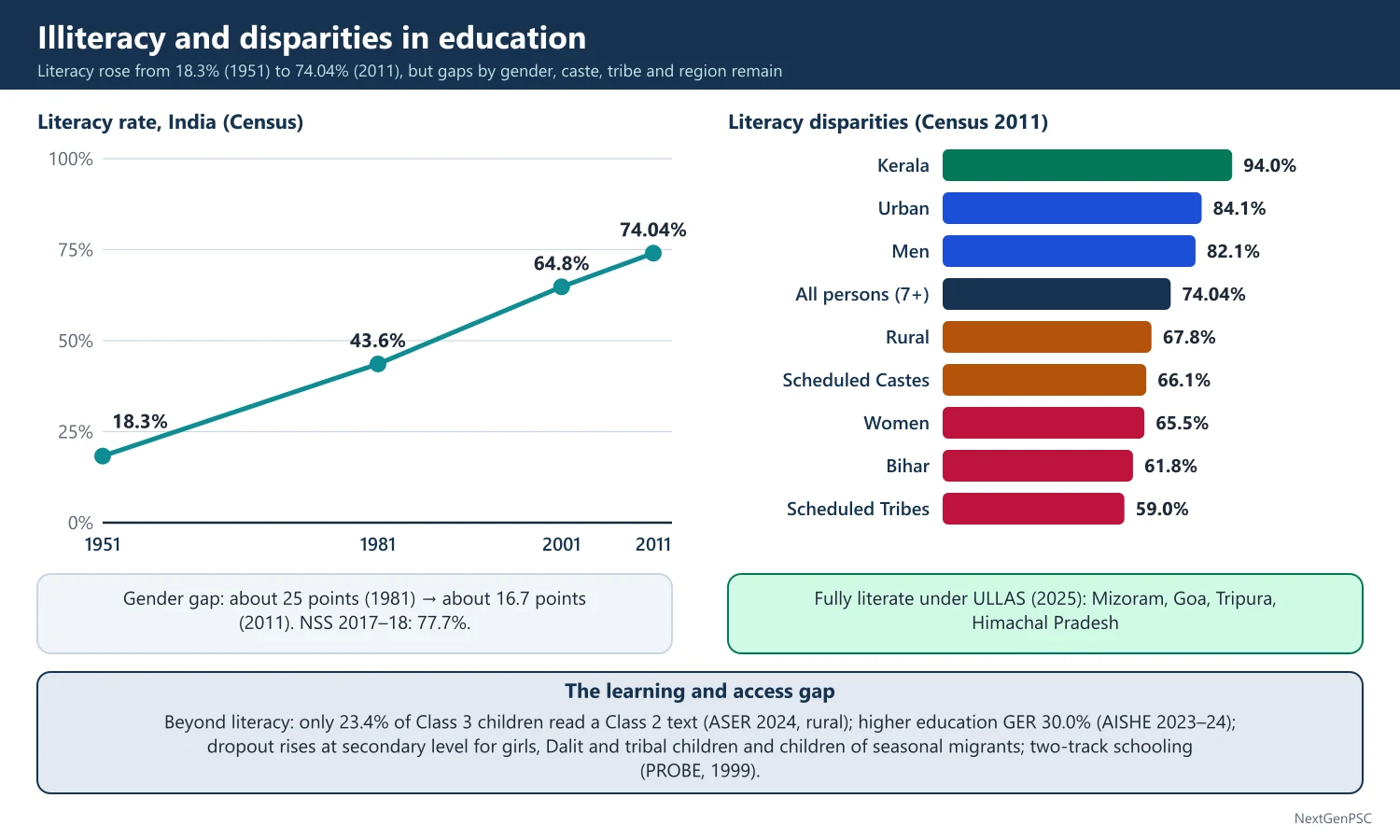
Census trend: literacy was 18.3% in 1951, 43.6% in 1981, 64.8% in 2001 and 74.04% in 2011 (men 82.1%, women 65.5%); the gender gap narrowed from about 25 points in 1981 to about 16.7 points in 2011.
Recent estimates: the NSS 75th round (2017–18) put literacy (7+) at 77.7%; PLFS-based figures for 2023–24 are reported between about 77% and 81% depending on the measure, so Census 2027 will give the definitive figure.
Caste and tribe: in 2011 literacy was 66.1% among Scheduled Castes and 59.0% among Scheduled Tribes, against 74.04% overall; ST women in states such as Madhya Pradesh and Odisha had among the lowest literacy.
Region: Kerala had 94.0% and Bihar 61.8% in 2011; Mizoram (May 2025), Goa, Tripura and Himachal Pradesh (September 2025) were declared fully literate (95% or more) under ULLAS, after Ladakh among Union Territories (2024).
Rural–urban: literacy was 67.8% in rural and 84.1% in urban India in 2011.
Muslims: the Sachar Committee (2006) found Muslim literacy at 59.1% in 2001, below the national 64.8%, with low representation in higher education.
3. Beyond literacy: participation and learning
Learning crisis: ASER 2024 (rural, released January 2025) found 23.4% of Class 3 children able to read a Class 2 text, recovering from 16.3% in 2022 after COVID-19 school closures.
Higher education: AISHE 2023–24 (released July 2026) put the GER at 30.0% and female GER at 31.2%; gaps remain for SC and ST students and between states.
Dropout: dropout rises sharply at the secondary level, especially for girls (household work, safety, early marriage), Dalit and tribal children, and children of seasonal migrants.
Two-track schooling: private English-medium schools for the middle class and government schools for the poor reproduce class and caste; the PROBE report (1999) documented poor functioning of government schools in north India.
Digital divide: online schooling during 2020–21 excluded children without smartphones and internet, widening gaps by class, gender and region.
4. Sociological explanations
Caste exclusion in schools: Geetha Nambissan's studies in Rajasthan documented Dalit children being seated separately, denied water and excluded from mid-day meal serving, which she calls exclusion within inclusion.
Elite beliefs: Myron Weiner (The Child and the State in India, 1991) argued that Indian elites' acceptance of hierarchy delayed compulsory education, unlike in Europe and East Asia.
Gender norms: investment in sons' education, fear for girls' safety and the idea of the daughter as 'paraya dhan' reduce girls' schooling (Leela Dube); yet girls now outnumber boys in higher-education GER, showing change.
Tribal children: schooling in a non-tribal language and curriculum alienates them (Verrier Elwin's warning); multilingual education programmes in Odisha use tribal mother tongues in early grades.
Merit and reproduction: coaching hubs and high-stakes exams convert family resources into credentials (Bourdieu; Satish Deshpande on caste and 'merit'); exam paper leaks and stress-related student suicides in Kota show the costs.
Caste in higher education: the death of Rohith Vemula (2016) and later cases led to demands for a law against caste discrimination on campuses; UGC issued anti-discrimination regulations, and the Supreme Court has heard petitions on campus caste discrimination.
5. Policy responses
Adult literacy: the National Adult Education Programme (1978), the National Literacy Mission (1988) with total literacy campaigns (Ernakulam was declared the first totally literate district in 1990), Saakshar Bharat (2009) and ULLAS (2022–27).
School access: Sarva Shiksha Abhiyan (2001), the RTE Act 2009 (free and compulsory education for ages 6–14, 25% seats in private schools for disadvantaged children), Samagra Shiksha (2018), Kasturba Gandhi Balika Vidyalayas (2004) for girls, and PM POSHAN (2021) meals.
Equity measures: post-matric scholarships for SC, ST and OBC students, Eklavya Model Residential Schools for tribal children, and reservation in higher education (27% OBC since 2006; 10% EWS since 2019).
NEP 2020: foundational literacy and numeracy by Class 3 (NIPUN Bharat, 2021), focus on 'socio-economically disadvantaged groups', a Gender Inclusion Fund and 50% higher-education GER by 2035; critics question funding (the 6% of GDP target remains unmet) and privatisation.
Success stories: Kerala (missionaries, social reform, public action) and Himachal Pradesh (public schools, women's participation, PROBE called it a 'schooling revolution') show that political will and social mobilisation close gaps.
Children with disabilities: the Rights of Persons with Disabilities Act 2016 mandates inclusive education, but children with disabilities remain among the most likely to be out of school.
Teachers: single-teacher schools, contract teachers and teacher absenteeism (documented in several studies) weaken government schools serving the poor.
World comparison: East Asian countries (Japan, South Korea) and Sri Lanka achieved mass literacy early through public schooling, which Drèze and Sen contrast with India's neglect of basic education.
6. Linking thinkers
Link to Durkheim and Parsons (education for integration and merit) versus Bourdieu, Bernstein, Bowles and Gintis and Willis (reproduction).
Link to Phule and Ambedkar on education as liberation, and to Freire's critical pedagogy used in literacy campaigns.
Link to education and social change (Chapter 21) and poverty and inequality (this chapter).
7. Using it in the exam
10 marks: give the literacy trend and two disparities (gender, caste) with Census 2011 data, and one policy.
15–20 marks: trends, disparities by gender, caste, tribe, religion, region and class, learning crisis, sociological explanations (Bourdieu, Bernstein, Nambissan, Weiner), policies and a conclusion on equity with quality.
Thinkers and studies: Bourdieu, Bernstein, Myron Weiner, Geetha Nambissan, Krishna Kumar, the PROBE team.
Diagram idea: a funnel from enrolment (near universal) → completion of secondary → learning at grade level → higher education, showing where each disadvantaged group drops out.
Quotation to use: Ambedkar's 'Educate, Agitate, Organise'.
| Group | Literacy rate |
|---|---|
| All persons (7+) | 74.04% |
| Men / Women | 82.1% / 65.5% |
| Scheduled Castes | 66.1% |
| Scheduled Tribes | 59.0% |
| Rural / Urban | 67.8% / 84.1% |
| Kerala / Bihar | 94.0% / 61.8% |
| Indicator | Value | Year | Source |
|---|---|---|---|
| Literacy (7+) | 77.7% | 2017–18 | NSS 75th round |
| Class 3 reading Class 2 text (rural) | 23.4% | 2024 | ASER 2024 |
| Higher education GER | 30.0% (female 31.2%) | 2023–24 | AISHE 2023–24 |
| States declared fully literate (ULLAS) | Mizoram, Goa, Tripura, Himachal Pradesh | 2025 | Ministry of Education |
Mains points
- Expect 'Discuss the social factors behind educational disparities in India' or 'Despite near-universal enrolment, learning outcomes remain poor. Why?'.
- Use Census 2011 for group-wise literacy and ASER/AISHE for recent trends, with years.
- Note that national literacy estimates after 2011 differ by source, and Census 2027 will settle them.
- Explain disparities sociologically (exclusion, cultural capital, gender norms, language), not only by poverty.
- Use Kerala and Himachal Pradesh as positive models.
- Conclude that equity requires quality public schooling, not just enrolment.
Did you know?
- Ernakulam in Kerala was declared India's first totally literate district in 1990, through a volunteer-driven campaign.
UPSC Previous Year Questions: Challenges of Social Transformation
From 2014 to 2026 UPSC asked 43 question parts (670 marks) from this chapter, all in Paper II, the most of any chapter in the syllabus. The crisis of development (displacement, environment, sustainability) is the most-asked topic (14 parts), followed by violence against women and caste conflicts (11 parts), poverty and inequality (7 parts), ethnic conflict, communalism and revivalism (6 parts) and disparities in education (5 parts). Every question below has a model answer written to the UPSC word limit.
In simple words
Write your own answer to each question first, in about 7 minutes for 10 marks and 11 minutes for 20 marks.
Then compare it with the model answer: check the concepts (displacement, deprivation, patriarchy, communalism, cultural capital), the thinkers and the latest data with year and source.
Note what you missed and revise the matching topic in this chapter's notes before the next question.
1. Crisis of Development: Displacement, Environment and Sustainability
Example 1 (UPSC 2025, 20 marks): Is it possible to have sustainable development in India? Cite major environmental issues and suggest a few measures to achieve the sustainability.
Paper and question: Paper II, Q8(a)
Approach: Answer yes, with conditions: define sustainable development (Brundtland), cite major environmental issues with data, then suggest measures; conclude that sustainability is possible if growth becomes socially just and ecologically bounded.
Sustainable development, defined by the Brundtland Commission (Our Common Future, 1987), is development that meets the needs of the present without compromising the ability of future generations to meet their own needs. For India, with a large poor population and fragile ecosystems, it is both necessary and difficult.
Major environmental issues: (i) Air pollution: Delhi and many north Indian cities regularly record hazardous winter air, driven by vehicles, industry, construction and crop-residue burning. (ii) Water stress: groundwater depletion in Punjab, Haryana and Rajasthan, and polluted rivers such as the Ganga and Yamuna. (iii) Land degradation: ISRO's Desertification Atlas (2021) estimated that nearly 30% of India's land was degraded. (iv) Forests and biodiversity: forest and tree cover is about 25% of the area (ISFR 2023), but natural forests are lost to mining and linear projects. (v) Climate change: heatwaves, floods, glacial retreat and Himalayan disasters such as Joshimath (2023) and Wayanad (2024).
Is it possible? Yes, there are signs: India committed to net zero by 2070 at COP26 (2021), reached about half of installed power capacity from non-fossil sources in 2025, and runs Mission LiFE (2022), the National Green Tribunal (2010) and community forest rights under the Forest Rights Act 2006.
Measures: renewable energy with a just transition for coal regions; water conservation, crop diversification away from paddy in the north-west and natural farming; enforcement of pollution norms and public transport in cities; community-based forest and commons management, recognising the 'environmentalism of the poor' (Guha and Martinez-Alier); strict social and environmental impact assessment; and sustainable consumption by the affluent.
Sustainable development in India is therefore possible, but only if growth is made socially just and respects ecological limits, with local communities as partners rather than casualties.
Example 2 (UPSC 2024, 20 marks): What is sustainable development? How can sustainability be achieved in India where livelihood needs conflict with environmental protection?
Paper and question: Paper II, Q6(b)
Approach: Two parts: define sustainable development, then show how it can be achieved where livelihoods clash with conservation, using the 'environmentalism of the poor', community rights, examples and policy; conclude.
Sustainable development, in the Brundtland Commission's words (1987), is development that meets present needs without compromising the ability of future generations to meet theirs; it joins three pillars: economic growth, social equity and environmental protection, reflected in the UN's Sustainable Development Goals (2015).
The conflict in India: crores of people depend directly on forests, fisheries, grazing land and rivers. Conservation that excludes them, such as the relocation of villages from tiger reserves, bans on forest produce or fishing restrictions, threatens livelihoods, while unregulated use and extraction by industry degrade resources. Madhav Gadgil and Ramachandra Guha describe this as a conflict between 'ecosystem people' and 'omnivores' who draw resources from far away.
How sustainability can be achieved: (i) Rights-based conservation: the Forest Rights Act 2006 recognises community forest rights, and gram sabhas in Mendha Lekha (Maharashtra) manage and sell bamboo sustainably. (ii) Co-management: Joint Forest Management (from 1990), community reserves and fishers' participation in coastal management. (iii) Green livelihoods: eco-tourism run by communities, as in Periyar Tiger Reserve, non-timber forest produce value chains and payments for ecosystem services. (iv) Sustainable agriculture: natural farming, watershed development (as in Ralegan Siddhi) and millets. (v) Just transition: reskilling for coal and fishing communities, and fair rehabilitation under the 2013 land law. (vi) Regulating the affluent: pollution control and limits on consumption, since the rich have larger ecological footprints.
The debate over the Gadgil (2011) and Kasturirangan (2013) reports on the Western Ghats shows that sustainability needs local consent, not only expert zoning.
Sustainability in India is achievable when communities become stewards with secure rights and fair incomes, turning the livelihood–environment conflict into a partnership.
Example 3 (UPSC 2023, 10 marks): Citing some case studies, expand the concept of 'Development-induced Displacement'.
Paper and question: Paper II, Q5(a)
Approach: Expand the concept: define development-induced displacement, give its scale and Cernea's risk model, and illustrate with two or three case studies.
Development-induced displacement is the forced removal of people from their homes and land for projects such as dams, mines, industries, highways and urban renewal. Walter Fernandes estimated that about 6 crore people were displaced or affected in India between 1947 and 2004, about 40% of them tribals.
Michael Cernea's impoverishment risks and reconstruction model identifies eight risks: landlessness, joblessness, homelessness, marginalisation, food insecurity, increased morbidity, loss of common property and social disarticulation.
Case studies: the Sardar Sarovar dam on the Narmada displaced Adivasi and peasant communities, many resettled without adequate land, leading to the Narmada Bachao Andolan; at Niyamgiri (Odisha), the Dongria Kondh used the Forest Rights Act in 2013 to reject bauxite mining; Singur and Nandigram (2006–07) saw farmers resist acquisition for industry; and Hirakud (1950s) displaced thousands whose rehabilitation remained incomplete for decades.
These cases led to the RFCTLARR Act 2013, which requires social impact assessment and consent.
Example 4 (UPSC 2022, 20 marks): Critically examine the dialectics between 'development and environment'.
Paper and question: Paper II, Q8(b)
Approach: Critically examine the dialectic: thesis (development needs resource use), antithesis (ecological limits and the poor's resistance), and synthesis (sustainable, just development), with theory (Marx's metabolic rift, ecological modernisation, Guha), Indian cases, and a balanced conclusion.
A dialectic is a relation of opposition that produces change. Development and environment stand in such a relation: development uses and transforms nature, while environmental limits and the communities who depend on nature push back, forcing new forms of development.
Thesis (development): in post-independence India, dams, steel plants and the Green Revolution were treated as the 'temples of modern India', and growth was seen as the way out of poverty. Even today, coal, mining, highways and urban expansion are justified as necessary for jobs and energy security.
Antithesis (environment): this model produced ecological crises: groundwater depletion and soil degradation in Punjab, toxic disasters such as Bhopal (1984), polluted rivers, deforestation and climate risks; and it displaced millions, mainly Adivasis and peasants. Marx's idea of a 'metabolic rift' between society and nature, developed by John Bellamy Foster, explains how capitalist agriculture and industry break natural cycles. Movements such as Chipko, Silent Valley, Narmada and Niyamgiri expressed what Guha and Martinez-Alier call the 'environmentalism of the poor'.
Synthesis (sustainable development): the State responded with environmental laws (1986), the Forest Rights Act 2006, the National Green Tribunal (2010), the 2013 land law and renewable energy targets, following ecological modernisation theory, which holds that technology and regulation can reconcile growth with ecology.
Critical view: critics argue that 'green growth' often shifts burdens to the poor, as with solar parks on commons or plantations under compensatory afforestation, and that laws are diluted, as in the Forest (Conservation) Amendment Act 2023. Thinkers such as Ashish Kothari call for 'radical ecological democracy'.
The dialectic thus continues: development and environment are not simply opposed, but their reconciliation depends on who decides and who bears the costs.
Example 5 (UPSC 2021, 20 marks): The problem of displacement is inherent in the idea of development. Analyze the statement critically.
Paper and question: Paper II, Q7(a)
Approach: Analyse critically whether displacement is inherent: argue that the dominant model makes it so (land, resources, State power, data), then counter that displacement is not inevitable (alternatives, minimisation, consent, benefit-sharing); conclude.
The statement reflects the experience that modern development, built on large dams, mines, industrial zones, highways and cities, needs land, water and minerals, which are often held by peasants, Adivasis and the urban poor. Walter Fernandes estimated about 6 crore people displaced or affected between 1947 and 2004, about 40% of them tribals, while tribals form about 8.6% of the population (Census 2011).
Why displacement seems inherent: (i) the dominant model of growth is resource-intensive and spatially concentrated; (ii) the State's power of 'eminent domain', from the Land Acquisition Act 1894 onwards, treated land as a commodity and ignored common property and customary rights; (iii) Marxist scholars describe 'accumulation by dispossession' (David Harvey), and Felix Padel and Samarendra Das show how mining in Odisha transfers wealth from tribal regions to corporations; (iv) the displaced are seldom the main beneficiaries; Michael Cernea's model shows how they become poorer through landlessness, joblessness and social disarticulation.
Why it is not inevitable: (i) the scale of displacement depends on design choices, such as smaller dams, decentralised renewable energy, watershed development and brownfield sites; (ii) the RFCTLARR Act 2013 requires social impact assessment, consent of 80% of affected families for private projects (70% for public–private), and rehabilitation; (iii) the Forest Rights Act 2006 and PESA 1996 give gram sabhas a voice, as at Niyamgiri (2013); (iv) benefit-sharing, such as the District Mineral Foundations (2015), and land-pooling, as in some urban projects, can make people partners.
Critical note: state amendments exempting projects from consent, and weak implementation, show that law alone does not prevent displacement.
Displacement is therefore inherent not in development as such but in a particular top-down, extractive model; participatory and rights-based development can minimise it and make the displaced its beneficiaries.
Example 6 (UPSC 2020, 20 marks): Evaluate the nature and scope of anthropogenic influence on climate in India and also analyze the environmental movements arising out of it.
Paper and question: Paper II, Q7(b)
Approach: Two parts: evaluate the nature and scope of human influence on India's climate (sources, impacts, vulnerability, data), then analyse environmental and climate movements arising from it, with theory; conclude.
Anthropogenic influence means human-caused change in climate through greenhouse gas emissions, land-use change and pollution. The IPCC's Sixth Assessment Report (2021) concluded that human influence has unequivocally warmed the planet.
Nature and scope in India: (i) Sources: coal-based power, industry, transport, rice paddies and livestock (methane), and loss of forests and wetlands; India is now the third-largest emitter in absolute terms, though its per-capita emissions are well below the world average. (ii) Impacts: more intense heatwaves, erratic monsoons, floods (Kerala 2018), cyclones on the east coast, glacial retreat and Himalayan disasters such as Kedarnath (2013) and Joshimath subsidence (2023), and urban heat islands. (iii) Social vulnerability: farmers, fishers, outdoor workers, slum dwellers and women bear the brunt, which Ulrich Beck's idea of the 'risk society' and the concept of climate justice capture.
Movements arising from it: (i) older ecological movements such as Chipko and the Narmada Bachao Andolan, which questioned the development model; (ii) local struggles against coal and mining, such as Hasdeo Arand in Chhattisgarh, and against deforestation for urban projects, such as Save Aarey in Mumbai (2019) and Save Mollem in Goa (2020); (iii) youth climate activism, such as Fridays for Future India and child activist Licypriya Kangujam; (iv) Ladakh's movement for ecological safeguards and Sixth Schedule protection, with Sonam Wangchuk's climate fast (2024); and (v) legal activism, as in the Supreme Court's recognition in 2024 of a right against the adverse effects of climate change in the Great Indian Bustard case.
These movements combine environmental concern with livelihood and identity, fitting the 'environmentalism of the poor' and new social movement theory (Melucci), which stresses identity and values.
Climate change in India is thus a social issue of justice as much as of science; adaptation, a just energy transition and the voices of affected communities are essential.
Example 7 (UPSC 2019, 10 marks): Elucidate the concerns of growing urban displacement dynamics in India.
Paper and question: Paper II, Q5(e)
Approach: Elucidate the concerns of urban displacement: causes (infrastructure, beautification, events, redevelopment), who is displaced, social consequences, legal position, and a line on remedies.
Urban displacement is the forced removal of people, mostly the urban poor, from their homes and workplaces for infrastructure, beautification, redevelopment or real estate.
Dynamics: metro and highway projects, riverfront development (such as Sabarmati in Ahmedabad), Smart Cities, mega-events such as the Commonwealth Games (2010) and the G20 summit (2023) in Delhi, and slum redevelopment such as the Dharavi project drive evictions. Those displaced are slum dwellers, street vendors, waste pickers and migrants, many of them Dalits and Muslims. Concerns: relocation to distant colonies such as Bawana and Savda Ghevra after the Yamuna Pushta demolitions (2004) cut people off from work and schools; women and children suffer most; eligibility cut-off dates exclude recent migrants; and Amita Baviskar called such drives 'bourgeois environmentalism'.
Legally, Olga Tellis (1985) linked shelter to the right to livelihood, but evictions continue, as urban projects fall outside the 2013 land law's rehabilitation for informal occupants.
In-situ upgrading, rental housing and the 'right to the city' (Lefebvre) offer better paths.
Example 8 (UPSC 2019, 20 marks): Highlight the main features of the 'Inter-linking of Rivers' project in India. What could be its probable advantages to Indian agriculture?
Paper and question: Paper II, Q6(b)
Approach: Two parts: main features of the ILR project (origin, components, agencies, first link), then probable advantages to agriculture, with a brief sociological and ecological caution; conclude.
The Inter-linking of Rivers (ILR) project aims to transfer water from surplus to deficit basins through canals, tunnels and reservoirs, to reduce regional imbalance in water availability.
Main features: (i) it is based on the National Perspective Plan of 1980 prepared by the then Ministry of Irrigation and the Central Water Commission; (ii) the National Water Development Agency (1982) identified 30 links, 14 in the Himalayan component and 16 in the Peninsular component; (iii) the Supreme Court in 2012 asked the government to implement the project in a time-bound manner and set up a special committee; (iv) the Ken–Betwa link in Madhya Pradesh and Uttar Pradesh is the first to be taken up, with its foundation stone laid in December 2024; other proposed links include Par–Tapi–Narmada and Godavari–Cauvery; (v) water is a state subject, so projects require inter-state agreements, as on Ken–Betwa (2021).
Probable advantages to agriculture: (i) the NWDA estimated that the full project could add irrigation to about 35 million hectares, reducing dependence on erratic monsoons; (ii) drought-prone regions such as Bundelkhand, Marathwada and Rayalaseema could stabilise crop output and reduce distress migration and farmer suicides; (iii) flood moderation in the Ganga–Brahmaputra basin could protect crops; (iv) hydropower (estimated around 34,000 MW) could support pumps and rural industry; (v) assured water could enable crop diversification and higher incomes, strengthening food security.
Caution: sociologists and ecologists warn of large-scale displacement, submergence of forests (part of Panna Tiger Reserve under Ken–Betwa), disputes between states, high costs and the risk of reproducing the Green Revolution's unequal benefits for larger farmers.
ILR could transform agriculture in water-scarce regions, but only with careful assessment, fair rehabilitation and local water conservation alongside it.
Example 9 (UPSC 2019, 10 marks): Has reduction of green cover affected ecological degradation leading to global warming? Elaborate your answer with illustration.
Paper and question: Paper II, Q6(c)
Approach: Elaborate with illustrations: explain how forests act as carbon sinks and regulators, show reduction of green cover in India with examples and its ecological effects, and link to warming; add a nuance and remedy.
Yes. Forests and other green cover absorb carbon dioxide, regulate rainfall and temperature, hold soil and protect biodiversity, so their loss releases stored carbon and weakens natural cooling, contributing to global warming.
Illustrations from India: although official forest and tree cover is about 25% of the country (ISFR 2023), much of the gain is in plantations, while dense natural forests have been lost to mining in central India (Hasdeo Arand, Odisha), linear projects and dams. Mangrove loss in the Sundarbans and Mumbai weakens protection against cyclones and storm surges. Deforestation and road building in the Western Ghats and Himalaya have been linked to landslides, as in Wayanad (2024) and Joshimath (2023). In cities such as Bengaluru, the loss of trees and lakes has created urban heat islands. Shifting land use reduces local rainfall and soil moisture.
Global warming is driven mainly by fossil-fuel emissions, so green cover is one important factor among several.
India's NDC aims at an additional carbon sink of 2.5–3 billion tonnes of CO2-equivalent by 2030, and community forest rights can protect natural forests better than plantations alone.
Example 10 (UPSC 2018, 20 marks): Discuss development-induced displacement in the context of tribal uprising in India. Substantiate your answer with any one detailed illustration from India.
Paper and question: Paper II, Q3(b)
Approach: Discuss development-induced displacement as a cause of tribal uprisings (structural reasons, theory), then give one detailed illustration (Narmada, Niyamgiri, or Jharkhand/Koel Karo), and conclude with lessons.
Development-induced displacement has fallen disproportionately on tribals: Walter Fernandes estimated that about 40% of the roughly 6 crore people displaced or affected between 1947 and 2004 were tribals, though they are about 8.6% of the population. Because tribal life is tied to land, forest and community, displacement destroys not only livelihood but identity, which explains why it has often produced uprisings.
Why displacement leads to uprisings: tribal regions hold most of India's minerals, forests and dam sites; land was taken under the Land Acquisition Act 1894 without recognising customary and community rights; compensation went only to titleholders; rehabilitation was poor; and outsiders (dikus) gained jobs. Michael Cernea's risks of landlessness, joblessness and social disarticulation, and relative deprivation (Gurr), explain the resulting anger, while the Maoist insurgency drew on such grievances in central India.
Detailed illustration: Niyamgiri (Odisha). The Dongria Kondh, a Particularly Vulnerable Tribal Group, live on the Niyamgiri hills, which they regard as the abode of their god Niyam Raja. In the 2000s, a bauxite mining project linked to Vedanta's alumina refinery at Lanjigarh threatened their forests and streams. The Dongria, supported by activists and international campaigns, mobilised through protests, rallies and legal action. In April 2013 the Supreme Court held that gram sabhas must decide under the Forest Rights Act 2006 whether the mining affected their religious and community rights; all twelve chosen gram sabhas rejected the project, and the Ministry of Environment rejected forest clearance in 2014.
Niyamgiri shows a non-violent, rights-based uprising that combined identity, ecology and law; elsewhere, as at Kalinganagar (2006), where police firing killed tribal protesters, displacement led to violence.
The lesson is that tribal consent through PESA 1996 and the Forest Rights Act, fair benefit-sharing and respect for cultural rights can turn conflict into partnership.
Example 11 (UPSC 2018, 20 marks): Western patriarchy which surrenders feminine principles is the new development project in India. Do you agree with this view? Why?
Paper and question: Paper II, Q8(b)
Approach: Give a reasoned partial agreement: explain Vandana Shiva's thesis of maldevelopment as a Western patriarchal project that destroys the feminine principle, apply it to Indian development, then present critiques (Agarwal, Nanda, Guha) and conclude.
The statement draws on Vandana Shiva's Staying Alive: Women, Ecology and Survival in India (1988), which argues that modern development is maldevelopment: a Western, patriarchal project rooted in reductionist science that treats nature as a resource to be exploited and abandons the feminine principle (prakriti, shakti), the creative, life-sustaining force embodied in nature and women's work.
Arguments in support: (i) the Green Revolution replaced women's knowledge of diverse seeds and organic farming with monocultures, chemicals and machines controlled by men and corporations; (ii) commercial forestry and plantations replaced diverse forests that women used for fuel, fodder and food, increasing their burden, as Chipko women argued; (iii) big dams and mines displaced communities and destroyed commons on which women depend; (iv) development measured by GDP ignores unpaid care and subsistence work, which feminist economists such as Marilyn Waring (If Women Counted, 1988) highlighted; (v) mechanisation and market-led growth have pushed women out of paid work, contributing to a low female labour force participation rate (40.0% in PLFS 2025).
Critiques: (i) Bina Agarwal's 'feminist environmentalism' (1992) argues that women's relation to nature arises from the gendered division of labour and property, not from an essential feminine nature; (ii) Meera Nanda (Prophets Facing Backward, 2003) criticised Shiva for romanticising tradition and ignoring caste and patriarchy within Indian society; (iii) Ramachandra Guha saw Chipko mainly as a peasant movement; (iv) development has also brought women education, health and legal rights, and Indian patriarchy is not a Western import.
Assessment: I agree partly: the dominant development model has been extractive and gender-blind, and has marginalised women's knowledge and work; but describing it simply as 'Western patriarchy' ignores indigenous patriarchy and the emancipatory gains of modernity.
What is needed is a gender-just and ecologically sustainable development that values care, commons and women's voice, combining Shiva's ecological critique with Agarwal's attention to rights and resources.
Example 12 (UPSC 2017, 20 marks): Discuss some of the striking issues of development induced imbalances that need urgent attention.
Paper and question: Paper II, Q6(a)
Approach: Discuss the striking development-induced imbalances needing urgent attention (regional, rural–urban and sectoral, income and wealth, social group, gender, environmental), with data and theory, and suggest priorities.
Rapid growth since 1991 has made India one of the world's largest economies, but it has produced development-induced imbalances, uneven gains across regions, sectors and social groups, which Gunnar Myrdal's idea of 'cumulative causation' and backwash effects helps explain: growth poles attract capital and labour from lagging areas.
Regional imbalance: Bihar, Jharkhand, Uttar Pradesh and Madhya Pradesh have the highest shares of multidimensional poverty, while Kerala, Goa and Tamil Nadu have the lowest (NITI Aayog MPI); per-capita incomes vary several-fold between states, driving migration. Sectoral and rural–urban imbalance: agriculture employs about 46% of workers (PLFS 2023–24) but produces under one-fifth of output, so rural incomes lag; manufacturing has not absorbed labour, a pattern Dani Rodrik calls premature deindustrialisation.
Income and wealth: the World Inequality Lab (2024) estimated that the top 1% held about 22.6% of national income and 40.1% of wealth in 2022–23. Social groups: SCs, STs and Muslims lag in assets, education and formal jobs, as the Sachar Committee (2006) showed. Gender: female labour force participation was only 40.0% (PLFS 2025), and NFHS-5 found 57% of women anaemic. Environment: costs of growth, such as pollution, displacement and depletion, fall on the poor and tribal regions, while benefits flow to cities.
Urgent priorities: job-rich manufacturing and rural non-farm work; investment in health, nutrition and schooling in lagging states (as the Aspirational Districts Programme, 2018, attempts); land and forest rights and fair rehabilitation; progressive taxation and universal social protection; women's employment and care infrastructure; and environmental regulation that protects the vulnerable.
Development will be sustainable only if it reduces these imbalances; otherwise, as Myrdal warned, inequality will cumulate and threaten social cohesion.
Example 13 (UPSC 2015, 10 marks): Effect of displacement through development on the rural landless and marginal farmers
Paper and question: Paper II, Q5(c)
Approach: Explain the effect on landless and marginal farmers: why they lose most (no title, dependence on commons and wage work), Cernea's risks, evidence, and the 2013 law's partial remedy.
Development-induced displacement hits the rural landless and marginal farmers hardest, because they have the least to bargain with and the most to lose.
The landless, mostly Dalit and Adivasi labourers, tenants and artisans, received no compensation under the Land Acquisition Act 1894, which paid only titleholders, though they lost wage work, grazing land, fishing and forest produce. Marginal farmers, who hold 86% of holdings with small plots (Agriculture Census 2015–16), received cash too small to buy land elsewhere, and many slipped into wage labour. Michael Cernea's model of impoverishment risks, landlessness, joblessness, food insecurity and loss of common property, fits their experience, and women lost most as commons disappeared. Studies of the Sardar Sarovar and coal-mining areas of Jharkhand record such downward mobility.
The RFCTLARR Act 2013 recognises agricultural labourers and others whose livelihood depended on the land for three years as affected families entitled to rehabilitation, but implementation is weak.
Land-for-land, jobs and benefit-sharing are essential to protect them.
Example 14 (UPSC 2014, 10 marks): Rural landless labourers and development induced displacement
Paper and question: Paper II, Q5(e)
Approach: Explain how displacement affects rural landless labourers specifically: invisibility in compensation, loss of work and commons, social disruption, gender, and remedies.
Rural landless labourers, who outnumbered cultivators in Census 2011 (14.43 crore against 11.88 crore), are the most invisible victims of development-induced displacement.
Because they own no land, they were ignored in compensation under the Land Acquisition Act 1894; yet acquisition destroyed the farm work, grazing land, ponds and forests on which they lived. Their patron–client networks and local credit broke up, what Michael Cernea calls social disarticulation, and many were forced into distant, circular migration and informal urban work, the 'footloose labour' Jan Breman describes. Most are Dalits and Adivasis, so displacement deepened caste and class disadvantage, and women lost access to fuel, fodder and water. Walter Fernandes's studies found that the landless rarely appeared in official lists of project-affected people.
The RFCTLARR Act 2013 now counts agricultural labourers dependent on the land for three years as affected families, with rehabilitation and annuities.
Real protection needs enumeration, jobs, skill training and land allotment where possible.
2. Poverty, Deprivation and Inequalities
Example 15 (UPSC 2025, 20 marks): Do you think that forced displacement of labourers has caused their deprivation and resultant inequalities during the recent past years? Elaborate.
Paper and question: Paper II, Q8(b)
Approach: Elaborate, taking a position: identify recent forms of forced displacement of labourers (pandemic, evictions, projects, conflict, climate), then show how each produced deprivation and inequality, with data and theory; conclude.
Yes. Forced displacement of labourers, their compelled movement from homes or workplaces, has in recent years deepened deprivation, in Amartya Sen's sense of capability loss, and widened inequalities, because those displaced are mostly informal, Dalit, Adivasi, Muslim and migrant workers with the least protection.
Forms and effects: (i) Pandemic displacement: the lockdown of March 2020 forced over one crore migrant workers to return home; they lost income, savings and dignity, while formal workers worked from home, a sharp class divide. Azim Premji University's studies recorded large income losses among informal workers. (ii) Urban evictions: demolitions for beautification and events, such as before the G20 summit in Delhi (2023), displaced vendors and slum dwellers from their livelihoods. (iii) Development projects: mines, dams and industrial corridors displace Adivasi labourers and the landless, who rarely receive compensation, as Walter Fernandes and Michael Cernea's risk model show. (iv) Conflict: the ethnic violence in Manipur from 2023 displaced about 60,000 people into relief camps. (v) Climate: floods in Assam and Bihar, cyclones and drought push labourers into distress migration.
How deprivation turns into inequality: displacement destroys assets and networks (social capital), interrupts children's schooling, pushes families into debt and neo-bondage (Jan Breman), and excludes them from welfare tied to residence. Women face added care burdens and insecurity. Meanwhile, those who own capital and land near new projects gain, so displacement transfers resources upward, what David Harvey calls accumulation by dispossession.
Responses: One Nation One Ration Card, e-Shram (about 31.89 crore registrations by August 2026), the Labour Codes (in force from November 2025) and the 2013 land law offer partial protection, but portability, enforcement and rehabilitation remain weak.
Forced displacement has thus been a powerful mechanism of deprivation and inequality; protecting the mobility and rights of labour is central to inclusive development.
Example 16 (UPSC 2020, 10 marks): Give an account of the consequences and remedies of chronic malnutrition in India.
Paper and question: Paper II, Q5(c)
Approach: Give an account of the consequences and remedies of chronic malnutrition: data, consequences (health, cognitive, economic, intergenerational), social causes in brief, and remedies with schemes.
Chronic malnutrition, long-term undernutrition reflected in stunting, remains high in India: NFHS-5 (2019–21) found 35.5% of children under five stunted, 19.3% wasted and 32.1% underweight, with 57% of women and 67.1% of children aged 6–59 months anaemic.
Consequences: higher child mortality and illness; impaired cognitive development and learning, which lowers school performance and adult earnings; reduced productivity, which erodes the demographic dividend; and an intergenerational cycle, as anaemic, undernourished mothers give birth to low-weight babies. Its burden falls most on poor, Dalit, Adivasi and rural households and on girls, reflecting caste, class and gender inequality, as well as poor sanitation, which Diane Coffey and Dean Spears linked to stunting.
Remedies: ICDS (1975) and anganwadis, POSHAN Abhiyaan (2018) and Poshan 2.0, PM POSHAN school meals, free grain under NFSA and PMGKAY, rice fortification, promotion of millets, maternity benefits (PMMVY), and sanitation and safe water under Swachh Bharat and Jal Jeevan Mission.
Women's education, dietary diversity and accountable delivery are the keys to breaking the cycle.
Example 17 (UPSC 2019, 10 marks): What is 'social security'? Examine recent security measures adopted by the Government in India.
Paper and question: Paper II, Q8(c)
Approach: Define social security (ILO), then examine recent measures (insurance, pension, health, informal and gig workers, the Social Security Code) and their limits.
Social security, as the ILO describes it, is the protection a society provides to individuals and households to ensure access to health care and income security, especially in old age, unemployment, sickness, disability, work injury, maternity or loss of a breadwinner. In India, Articles 38, 39, 41 and 42 direct the State towards it.
Recent measures: Pradhan Mantri Jeevan Jyoti Bima Yojana and Suraksha Bima Yojana (2015) offer low-cost life and accident insurance; Atal Pension Yojana (2015) and PM Shram Yogi Maan-dhan (2019) give contributory pensions to informal workers; Ayushman Bharat PM-JAY (2018) covers hospital costs, extended in 2024 to all people aged 70 and above; the Maternity Benefit (Amendment) Act 2017 raised leave to 26 weeks; the e-Shram portal (2021) registers unorganised workers; and the Code on Social Security 2020, in force from 21 November 2025, recognises gig and platform workers for the first time.
Limits: benefits are small, many schemes are contributory and voluntary, coverage of informal workers remains low, and digital processes exclude some.
A universal, tax-funded social protection floor is the next step.
Example 18 (UPSC 2017, 20 marks): What, according to you, are the two fundamental axes of social discrimination in Indian society? Are they changing?
Paper and question: Paper II, Q8(b)
Approach: Identify caste and gender (patriarchy) as the two fundamental axes, explain each with theory and data, show their intersection, then assess whether they are changing (yes in form, persistent in substance); conclude.
In my view, the two fundamental axes of social discrimination in Indian society are caste and gender. Both are ascriptive, assigned at birth, and both organise the division of labour, access to resources and dignity; other inequalities of class, region and religion are often refracted through them.
Caste: Ghurye listed hierarchy, restrictions on commensality, endogamy and hereditary occupation as its features; Dumont saw purity and pollution as its organising principle, and Ambedkar called it 'graded inequality'. Its effects persist: NCRB recorded 55,698 crimes against SCs in 2024, inter-caste marriages are only about 5% of marriages (IHDS), and SCs and STs hold a much smaller share of assets than their population share (NSS AIDIS, 2019).
Gender: patriarchy, which Sylvia Walby defines as a system of social structures through which men dominate and exploit women, operates through patrilineal inheritance, dowry, control of sexuality and the sexual division of labour. NFHS-5 (2019–21) found 29.3% of ever-married women had faced spousal violence, the sex ratio at birth was 929, and female labour force participation was 40.0% in PLFS 2025. Uma Chakravarti's concept of 'brahmanical patriarchy' shows how caste purity depends on controlling women, so the two axes intersect, and Dalit women face both, as Kimberlé Crenshaw's idea of intersectionality suggests.
Are they changing? Yes, in form: untouchability in public spaces has declined, reservation has created Dalit and OBC middle classes, women's education and political representation have risen, and laws from the 1989 Atrocities Act to the Women's Reservation Act 2023 have strengthened rights. Caste is shifting from ritual hierarchy to political identity (Kothari), and women increasingly claim public space. But in substance they persist through endogamy, occupational segregation, honour killings, dowry and violence, and new forms appear in urban housing markets, online spaces and the labour market.
The two axes are therefore changing more in their outward expression than in their deep structure; education, economic independence, inter-caste marriage and enforcement of law are needed to change them fundamentally.
Example 19 (UPSC 2016, 20 marks): Discuss the emerging forms of 'inequalities' and 'acute poverty' as major challenges of social transformation in India.
Paper and question: Paper II, Q6(b)
Approach: Discuss emerging forms of inequality (wealth concentration, regional, digital, informal and precarious work, health, climate) and acute poverty (ultra-poor groups, urban poor, vulnerability), with data and theory, and show why they challenge social transformation; conclude.
India has reduced poverty substantially, with NITI Aayog estimating multidimensional poverty at 11.28% in 2022–23 against 29.17% in 2013–14, and the World Bank estimating extreme poverty at 5.3% in 2022–23. Yet new forms of inequality and pockets of acute poverty have emerged, challenging the goal of an equal society.
Emerging inequalities: (i) Wealth concentration: the World Inequality Lab (2024) estimated that the top 1% held about 22.6% of income and 40.1% of wealth in 2022–23, which its authors called a 'billionaire raj'. (ii) Regional: Bihar, Jharkhand and Uttar Pradesh lag far behind the south and west. (iii) Labour market: informality and contract work, gig work without social security, and jobless growth for educated youth. (iv) Digital divide: unequal access to smartphones and the internet, exposed during online schooling in 2020–21. (v) Health and education: private hospitals and schools for the rich and under-funded public services for the poor. (vi) Climate: heat, floods and drought hit outdoor workers and farmers hardest.
Acute poverty: it is concentrated among Particularly Vulnerable Tribal Groups (hence PM-JANMAN, 2023), landless Dalits such as the Musahars, female-headed households, the disabled, urban homeless and migrant workers; many people just above the poverty line remain vulnerable to health shocks, as out-of-pocket spending pushes families into poverty. NFHS-5 found 35.5% of children stunted.
Why they challenge transformation: Amartya Sen's capability approach shows that such deprivations limit freedom; Bourdieu shows how wealth converts into cultural and social capital, reproducing privilege; and high inequality weakens democracy and social cohesion, feeding conflict and alienation.
Social transformation therefore requires not only growth but redistribution: universal health and education, progressive taxation, social protection for informal workers, and targeted support for the ultra-poor.
Example 20 (UPSC 2015, 10 marks): Feminization of poverty
Paper and question: Paper II, Q1(e)
Approach: Define feminisation of poverty (Diana Pearce), show how it applies in India (work, assets, households, widows, intra-household inequality) with data, and remedies.
The feminisation of poverty, a term coined by Diana Pearce (1978), refers to the growing share of women among the poor and to the fact that women experience poverty more severely because of gender inequality.
In India it appears in several ways: women's labour force participation is low (40.0% in PLFS 2025) and concentrated in unpaid family and low-paid informal work; women rarely own land, despite the 2005 Hindu Succession amendment, as Bina Agarwal shows; widows, deserted women and female-headed households, including the 'left-behind' wives of migrants, face high vulnerability; and household surveys hide intra-household inequality in food, health care and decision-making, which Amartya Sen's idea of 'cooperative conflict' explains. NFHS-5 found 57% of women anaemic, a sign of deprivation beyond income. Unpaid care work, far heavier for women (Time Use Survey 2024), limits their earnings.
Remedies include self-help groups under DAY-NRLM, women's land titles, maternity benefits, pensions for widows and care infrastructure.
Poverty policy must therefore be gender-sensitive to be effective.
Example 21 (UPSC 2014, 10 marks): How do caste and class come together in creating the category of extreme poor?
Paper and question: Paper II, Q7(c)
Approach: Explain how caste and class overlap to produce the extreme poor: historical denial of land and education, occupational segregation, discrimination, with groups and data, and policy implications.
In India, the extreme poor are concentrated where low caste status and low class position coincide; scholars such as Sukhadeo Thorat and Katherine Newman call this the 'caste-class nexus' of economic discrimination.
How they come together: caste historically denied Dalits and many Adivasis land, education and dignified occupations, so they entered modern India as landless labourers, which André Béteille's Sripuram study and Kathleen Gough's work showed as a near-overlap of caste and class at the bottom. Hereditary 'polluting' occupations such as scavenging and leather work kept them in low-paid, stigmatised work; discrimination in labour, credit and housing markets, documented in Thorat and Newman's audit studies, limits mobility; and lack of assets means shocks push them deeper into poverty. Groups such as the Musahars of Bihar, manual scavengers and Particularly Vulnerable Tribal Groups are among the poorest, and SCs and STs hold a much smaller share of assets than their population share (NSS AIDIS, 2019).
Yet class differentiation within castes is growing, as a Dalit middle class shows.
Policy must combine caste-based measures (reservation, land) with class-based ones (employment, social security) to reach the extreme poor.
3. Violence against Women and Caste Conflicts
Example 22 (UPSC 2026, 20 marks): Give a sociological explanation of violence against women in India. What suggestions would you give to mitigate these violences?
Paper and question: Paper II, Q7(b)
Approach: Two parts: a sociological explanation (patriarchy, honour and sexuality control, caste–gender nexus, backlash, structural and cultural violence, State failure) with data, then suggestions at legal, institutional, economic and cultural levels; conclude.
Violence against women includes domestic violence, dowry deaths, rape, harassment, honour crimes, trafficking and online abuse. NCRB recorded about 4.41 lakh crimes against women in 2024, with cruelty by husband or relatives the largest category and 5,737 dowry deaths, while NFHS-5 (2019–21) found that 29.3% of ever-married women had faced spousal physical or sexual violence, most of it unreported.
Sociological explanation: (i) Patriarchy: Sylvia Walby sees male violence as one structure of patriarchy; in India patrilineal inheritance, patrilocal marriage and dowry make women dependent and their bodies sites of family 'honour'. (ii) Caste and sexuality: Uma Chakravarti's 'brahmanical patriarchy' explains how control of women's sexuality preserves caste purity, producing honour killings and sexual violence against Dalit women as a tool of caste domination, as at Khairlanji (2006) and Hathras (2020). (iii) Backlash: women's growing education, work and mobility challenge male authority, and some men respond with violence, particularly amid unemployment and insecure masculinity. (iv) Cultural legitimation: norms that justify wife-beating, victim-blaming and media objectification, which Johan Galtung would call cultural violence. (v) Institutional failure: under-reporting, police insensitivity, slow trials and low conviction rates weaken deterrence.
Suggestions: (i) Legal: effective enforcement of the Bharatiya Nyaya Sanhita 2023, the Domestic Violence Act 2005, the POSH Act 2013 and POCSO, with fast-track courts and witness protection; (ii) Institutional: more women police, One Stop Centres, gender sensitisation of police and judiciary; (iii) Economic: women's employment, land and housing rights, which raise bargaining power; (iv) Cultural: gender education in schools, engaging men and boys, and responsible media; (v) Public space: safe transport, lighting and the claim to the city that Phadke, Khan and Ranade argue for in Why Loiter? (2011).
Violence against women is thus a social product of unequal gender and caste relations; lasting change requires transforming those relations along with stronger law.
Example 23 (UPSC 2025, 10 marks): Which measures would you suggest for preventing caste conflicts in India? Justify your argument.
Paper and question: Paper II, Q6(c)
Approach: Suggest and justify measures to prevent caste conflicts at structural, legal, political, educational and community levels, each linked to the causes.
Caste conflicts arise from competition over land, wages, status, reservation and political power, and from resistance to Dalit assertion; NCRB recorded 55,698 crimes against SCs in 2024.
Measures and justification: (i) Land and livelihood: land reform, secure work and non-farm jobs reduce the economic dependence that fuels domination, since many conflicts begin over wages or land, as at Kilvenmani (1968). (ii) Strict enforcement of law: the SC/ST (Prevention of Atrocities) Act 1989 with special courts and quick trials deters violence; the 2018 restoration of the Act shows its importance. (iii) Inclusive education: schools and campuses free of discrimination, with anti-caste curricula, weaken prejudice, as Ambedkar stressed. (iv) Inter-caste marriage and contact: incentives and protection for couples (Shakti Vahini, 2018) build bonds across castes, following Allport's contact hypothesis. (v) Responsible politics: discourage caste mobilisation that provokes violence and ensure fair sharing of reservation through sub-classification (Davinder Singh, 2024). (vi) Community and administration: peace committees, early-warning policing and representative police forces.
Ashutosh Varshney shows that inter-community civic associations prevent riots; the same applies to caste.
Prevention therefore requires reducing inequality, not only policing conflict.
Example 24 (UPSC 2024, 20 marks): To what extent have the legal provisions been effective in curbing violence against women in India? Give your argument.
Paper and question: Paper II, Q7(b)
Approach: Give an argued assessment: list the legal framework and its achievements (with data), then its limits (reporting, enforcement, conviction, social norms, gaps such as marital rape), and conclude that law has been partly effective.
India has built an extensive legal framework against violence on women: the Dowry Prohibition Act 1961, Sections 498A (1983) and 304B (1986), the Protection of Women from Domestic Violence Act 2005, the Criminal Law (Amendment) Act 2013 after the Delhi gang rape, the POSH Act 2013, POCSO 2012, the 2018 amendment on rape of minors, and the Bharatiya Nyaya Sanhita 2023, in force from 1 July 2024, which retains these offences and adds sexual intercourse by deceitful means (Section 69).
Effectiveness: law has made violence visible and punishable. Each legal milestone followed a movement, from the Mathura case (1979) to Vishaka (1997) and Nirbhaya (2012), and widened definitions to include stalking, voyeurism and acid attacks. Reporting has risen, which partly reflects greater willingness to approach the police; institutions such as One Stop Centres (2015), fast-track courts and the Nirbhaya Fund have been created; and courts have expanded protection, as in Shakti Vahini (2018) against honour killings.
Limits: (i) Under-reporting: NFHS-5 (2019–21) found 29.3% of ever-married women had faced spousal violence, but very few sought help, so NCRB's 4.41 lakh cases (2024) are only the tip of the iceberg. (ii) Enforcement and justice: police reluctance, delays, large pendency and low conviction rates weaken deterrence. (iii) Gaps: marital rape is still not a crime, and the POSH Act's Internal Committees are often missing, as the Supreme Court noted in 2023. (iv) Social norms: patriarchal values, family pressure and stigma lead women to withdraw complaints, while caste power protects offenders, as in Hathras (2020). (v) Misuse debates around 498A have produced a backlash.
Legal provisions have therefore been partly effective: they have changed public discourse and given women tools, but have not reduced violence substantially because its roots lie in patriarchy and inequality.
Law must be combined with economic empowerment, police reform and change in social norms to curb violence effectively.
Example 25 (UPSC 2023, 20 marks): Explain the thematic linkages between 'Patriarchy' and 'Honour killing' in India, citing some recent cases.
Paper and question: Paper II, Q8(a)
Approach: Explain the thematic linkages: define patriarchy and honour killing, then link them through control of sexuality, caste endogamy (brahmanical patriarchy), family and community honour, and institutions (khaps); cite recent cases; add legal response and conclude.
Patriarchy is a system of social structures and practices in which men dominate, oppress and exploit women (Sylvia Walby). An honour killing is the murder of a person, usually a woman or a couple, by family or community members who believe the victim has brought dishonour, typically by marrying or loving across caste, religion or gotra lines.
Linkage 1: control of women's sexuality. Patriarchy treats women's bodies and choices as the property of the family; honour (izzat) is located in women's chastity, so a woman's independent choice of partner is seen as a loss of male honour. Linkage 2: caste endogamy. Uma Chakravarti's concept of 'brahmanical patriarchy' (1993) shows that the purity of caste depends on controlling women's sexuality; Ambedkar saw endogamy as the essence of caste. Honour killings are therefore most common when a woman marries a man of a lower caste, especially a Dalit. Linkage 3: community institutions. Prem Chowdhry's studies of Haryana (Contentious Marriages, Eloping Couples, 2007) show khap panchayats enforcing gotra and village exogamy and caste endogamy, sometimes ordering violence.
Recent cases: the killing of Shankar, a Dalit youth, in Udumalpet, Tamil Nadu (2016) for marrying a Thevar woman; Pranay Perumalla in Miryalaguda, Telangana (2018), killed at his wife's family's instigation; and Kevin Joseph in Kerala (2018), a Dalit Christian killed by his wife's relatives. Such cases are under-recorded in NCRB data because many are reported as ordinary murders or suicides.
Legal response: the Supreme Court in Lata Singh (2006) protected adult couples' right to marry, and in Shakti Vahini (2018) declared khap interference illegal and issued preventive guidelines; the Law Commission (242nd Report, 2012) proposed a special law, which has not been enacted.
Honour killing is thus the most violent expression of patriarchy intersecting with caste; preventing it needs protection for couples, punishment of perpetrators and a social change that recognises women's autonomy.
Example 26 (UPSC 2019, 20 marks): What is POSH Act? "Identification of tormentor by women at workplace does not come easily even today." Examine the statement with substantive examples from India.
Paper and question: Paper II, Q8(b)
Approach: Two parts: explain the POSH Act 2013 (origin, definitions, Internal and Local Committees, duties), then examine why identifying the harasser remains difficult (power hierarchies, fear, stigma, weak committees, informal sector, legal process), with Indian examples; conclude.
The Sexual Harassment of Women at Workplace (Prevention, Prohibition and Redressal) Act 2013, known as the POSH Act, grew out of the Supreme Court's Vishaka guidelines (1997), issued after the gang rape of Bhanwari Devi, a sathin of Rajasthan's Women's Development Programme. It defines sexual harassment broadly (unwelcome physical contact, sexual demands, remarks, showing pornography and a hostile work environment), requires every employer with ten or more employees to set up an Internal Committee headed by a senior woman with an external member, and requires districts to have Local Committees for the informal sector and small workplaces. Employers must publicise the policy and conduct awareness programmes.
Why identifying the tormentor is still difficult: (i) Power hierarchies: harassers are often superiors, mentors or powerful public figures, so complaints threaten careers; the protests by women wrestlers in 2023 against the then chief of the Wrestling Federation showed how hard it is to proceed against the powerful. (ii) Fear of retaliation and stigma: women fear being labelled troublemakers, losing jobs or facing defamation suits, as M.J. Akbar's case against journalist Priya Ramani (acquitted in 2021) showed. (iii) Weak or absent committees: the Supreme Court in Aureliano Fernandes (2023) found serious lapses in setting up Internal Committees, and the Hema Committee report (2024) revealed a culture of silence in the Malayalam film industry. (iv) Informal sector: domestic workers, construction workers and farm labourers rarely know of Local Committees. (v) Patriarchal culture: normalisation of harassment as 'harmless', victim-blaming and lack of witnesses, especially in hierarchical workplaces such as hospitals, as the RG Kar case in Kolkata (2024) highlighted.
Movements such as #MeToo (2018) made it easier to name harassers, but mainly for educated urban women.
The statement is therefore largely true; effective enforcement, independent committees, protection from retaliation and a culture of workplace equality are needed to make the law work.
Example 27 (UPSC 2018, 10 marks): Construct a sociological narrative on the increasing trend of child abuse in India.
Paper and question: Paper II, Q5(b)
Approach: Construct a sociological narrative: forms and data, causes (family power, digital media, migration and urbanisation, institutional neglect, culture of silence), the legal response, and the sociological meaning (childhood, power).
Child abuse includes physical, sexual and emotional abuse and neglect. A Ministry of Women and Child Development study (2007) found that more than half of the children surveyed reported some form of sexual abuse, and cases under the POCSO Act 2012 now number in tens of thousands each year (NCRB).
Narrative: the rising trend partly reflects better reporting after POCSO and awareness campaigns, but also real changes. Most abusers are known to the child, relatives, neighbours, teachers or caregivers, so the family and institutions, seen as safe, are sites of power over children, as feminist and childhood sociologists (Philippe Ariès on the social construction of childhood) help us see. Migration and urbanisation leave children unsupervised in slums and worksites; shelter homes have been scenes of abuse, as in Muzaffarpur (2018); and the internet has brought online grooming and child sexual abuse material. A culture of silence, family honour and the absence of sex education prevent disclosure. Corporal punishment and child labour reflect the low status of children.
The State responded with POCSO (amended 2019), the Juvenile Justice Act 2015, Childline (1098) and child-friendly courts.
Protecting children requires recognising them as rights-bearing persons rather than family property.
Example 28 (UPSC 2017, 10 marks): What are the reasons for the escalation of violence against women in the public domain?
Paper and question: Paper II, Q5(a)
Approach: Give reasons for escalating violence in the public domain: women's growing presence and backlash, urbanisation and anonymity, masculinity and unemployment, media and technology, poor infrastructure and policing, with examples.
Violence against women in the public domain, harassment on streets and transport, stalking, assault and rape, has drawn attention since the Delhi gang rape of December 2012.
Reasons: (i) Women's growing presence in public space through education and work challenges the patriarchal idea that public space belongs to men, and some men respond with violence, a form of backlash. (ii) Urbanisation and anonymity: migration creates large populations of young, single men in cities with weak community controls, as Louis Wirth's idea of urban anonymity suggests. (iii) Masculinity and unemployment: frustrated, educated but jobless young men, whom Craig Jeffrey describes, may assert dominance through harassment. (iv) Media and technology: objectification in films and online pornography, and cyber-stalking. (v) Poor infrastructure: unlit streets, unsafe transport and lack of public toilets. (vi) Weak deterrence: police insensitivity and slow justice.
Shilpa Phadke and co-authors (Why Loiter?, 2011) argue that restricting women in the name of safety is the wrong answer.
The solution is safer cities, more women in public life, gender education and prompt justice.
Example 29 (UPSC 2015, 10 marks): How serious is the problem of trafficking against women and children in India?
Paper and question: Paper II, Q6(c)
Approach: Assess how serious trafficking is: forms, scale and vulnerable groups, causes, legal framework and its gaps, and a concluding judgement.
Trafficking is the recruitment, transport or harbouring of persons by force, fraud or deception for exploitation; in India it involves women and children for commercial sexual exploitation, forced marriage, bonded and domestic labour, begging and organ trade. It is a serious problem, though precise figures are uncertain because most cases go unrecorded.
Vulnerable groups and causes: poor, Dalit and Adivasi girls from Jharkhand, Odisha, West Bengal and Assam, and women from Nepal and Bangladesh, are trafficked to cities and to north-western states where skewed sex ratios create demand for 'brides'. Poverty, distress migration, disasters, family breakdown, gender discrimination and the demand for cheap labour and commercial sex sustain it; online recruitment has added new routes.
Law: Article 23, the Immoral Traffic (Prevention) Act 1956, the Bharatiya Nyaya Sanhita 2023 (Section 143), the Bonded Labour Act 1976 and POCSO; Anti-Human Trafficking Units and the Ujjawala scheme (2007) aim at rescue and rehabilitation. But a comprehensive anti-trafficking law is still awaited, convictions are rare and rescued women face stigma.
Trafficking is thus a grave violation rooted in gender and class inequality, requiring prevention at source.
Example 30 (UPSC 2014, 10 marks): Domestic Violence Act, 2005
Paper and question: Paper II, Q5(b)
Approach: Write a note on the PWDVA 2005: background, key provisions (definition, shared household, orders, protection officers), judicial expansion, impact and limits with NFHS data.
The Protection of Women from Domestic Violence Act 2005, in force from October 2006, was the outcome of decades of feminist campaigning against violence within the family; unlike Section 498A, it provides civil remedies.
Key provisions: it defines domestic violence broadly as physical, sexual, verbal, emotional and economic abuse; it covers women in marriage and in relationships in the nature of marriage, as well as mothers, sisters and daughters; it recognises the woman's right to reside in the shared household; magistrates can pass protection, residence, monetary relief, custody and compensation orders; and Protection Officers and service providers assist women. The Supreme Court widened it in Hiral Harsora (2016), removing the restriction that respondents be adult males, and in Satish Chander Ahuja (2020) on the shared household.
Yet NFHS-5 (2019–21) found 29.3% of ever-married women had faced spousal violence, few seek help, Protection Officers are scarce, and family pressure and stigma deter women.
The Act gave women a civil right to a violence-free home, but its success depends on implementation and social support.
Example 31 (UPSC 2014, 20 marks): What are the possible underlying causes of the spurt of increased violence against women in public spaces in the last decade?
Paper and question: Paper II, Q7(b)
Approach: Discuss the underlying causes of the spurt in public-space violence (asked in 2014, covering 2004–14): structural change (women in public, urbanisation, migration), masculinity and backlash, cultural and media factors, institutional failure, and reporting; conclude with the post-2012 response.
The decade before 2014 saw a visible spurt in violence against women in public spaces, culminating in the gang rape and murder of a young woman in a moving bus in Delhi in December 2012, which triggered mass protests.
Structural causes: (i) after liberalisation, more women entered colleges, offices, call centres and malls, often travelling at night, so their presence in public space grew faster than the infrastructure and attitudes to support it; (ii) rapid urbanisation and migration created large populations of young men separated from families and community controls, whom Louis Wirth's ideas on anonymity and weakened primary ties help explain; (iii) rising inequality and jobless growth produced frustrated young men, as Craig Jeffrey's study of 'timepass' in Meerut shows.
Masculinity and backlash: R.W. Connell's idea of hegemonic masculinity explains how men whose status is threatened may reassert dominance through violence; women's independence in dress, work and choice of partner was read by some as a challenge to patriarchal control, and moral policing of women in pubs and parks (Mangaluru, 2009) expressed this backlash.
Cultural and institutional causes: objectification in media and easy access to pornography; victim-blaming by public figures; poor lighting, unsafe public transport and lack of women police; and slow, insensitive justice, which weakened deterrence. Part of the spurt was also greater reporting, as women became more willing to complain.
The response included the Justice Verma Committee and the Criminal Law (Amendment) Act 2013, the Nirbhaya Fund and safety audits; but the deeper remedy lies in changing patriarchal attitudes and making public space genuinely shared.
Example 32 (UPSC 2014, 20 marks): 'Many caste conflicts are between castes which are close to each other on the hierarchical scale.' Give a sociological explanation for this phenomenon.
Paper and question: Paper II, Q8(a)
Approach: Give a sociological explanation of conflicts between castes close in hierarchy: status competition and mobility (Srinivas), relative deprivation, competition for the same resources, assertion and backlash, political competition; with Indian examples and theory; conclude.
Many caste conflicts in contemporary India occur not between Brahmins and Dalits, the two ends of the ritual scale, but between castes that are close to each other: dominant middle or backward castes and Dalits, or neighbouring Dalit sub-castes. Examples include Jats and Valmikis at Mirchpur, Haryana (2010), Vanniyars and Dalits at Dharmapuri, Tamil Nadu (2012), Thevars and Devendrakula Vellalars in southern Tamil Nadu, Marathas and Mahars around Bhima Koregaon (2018), and Malas and Madigas over sub-classification in Andhra Pradesh.
Status competition and mobility: M.N. Srinivas showed that castes seek mobility through Sanskritisation and political power; when a lower caste rises, it threatens the status of the caste just above it, which has the most to lose from the closing of the gap. Upwardly mobile OBC peasant castes, newly dominant after land reform and the Green Revolution, insist on their superiority over Dalits, who are now educated and assertive.
Competition for the same resources: neighbouring castes compete for the same land, wages, jobs, reserved seats and political space. Dalit labourers' demands for higher wages or land directly hit middle-caste landowners, as at Kilvenmani (1968). Within categories, sub-castes compete for reservation benefits.
Relative deprivation and identity: Ted Gurr's relative deprivation theory explains that groups compare themselves with near neighbours, not distant ones. Dipankar Gupta (Interrogating Caste, 2000) argues that castes behave as discrete identities competing for power rather than as fixed ranks in one hierarchy, so conflict arises where boundaries are most contested. Freud's 'narcissism of minor differences' also suggests that close groups emphasise small distinctions. Dalit assertion, such as refusing traditional duties or celebrating Ambedkar, often provokes backlash from these intermediate castes, as Anand Teltumbde notes.
Political competition: electoral democracy makes numerically strong, proximate castes rivals for the same vote banks and local offices, as Rajni Kothari's politicisation thesis suggests.
These conflicts therefore reflect change rather than stagnation: they arise where hierarchy is being challenged and resources contested, and reducing them requires secure livelihoods, fair sharing of benefits and strict enforcement of the Atrocities Act.
4. Ethnic Conflicts, Communalism and Religious Revivalism
Example 33 (UPSC 2021, 20 marks): Rising 'ethnocentrism' is leading to conflict in our society. Assess this statement with appropriate reasons.
Paper and question: Paper II, Q7(b)
Approach: Assess the statement: define ethnocentrism (Sumner), show how it fuels conflict in India across region, language, ethnicity, caste and religion with examples, explain why it is rising, add counter-points, and suggest remedies.
Ethnocentrism, a term coined by William Graham Sumner (Folkways, 1906), is the tendency to view one's own group as the centre of everything and to judge others by its standards, combining in-group loyalty with out-group contempt. In a plural society like India, rising ethnocentrism turns difference into hostility.
Forms of conflict: (i) Regional and linguistic: 'sons of the soil' campaigns against migrants, such as attacks on north Indian workers in Maharashtra (2008) and on migrants in Gujarat (2018), and recurring language disputes. (ii) Racial discrimination against people from the North-East in metropolitan cities; the death of Nido Taniam in Delhi (2014) led to the Bezbaruah Committee. (iii) Ethnic violence: Meitei–Kuki-Zo conflict in Manipur from May 2023, Bodo–Muslim clashes in Assam (2012). (iv) Communal tension: stereotyping of religious minorities, riots (Delhi, 2020) and lynchings. (v) Caste pride expressed in honour killings and violence against Dalit assertion.
Why it is rising: competition for jobs and resources amid unemployment (relative deprivation); identity politics and electoral mobilisation; social media echo chambers and misinformation; migration that brings groups into contact without integration; and globalisation, which, as Manuel Castells argues, provokes defensive 'resistance identities'.
Counter-points: India also shows strong everyday coexistence, inter-group friendships in cities and workplaces, and civic associations that, as Ashutosh Varshney found, prevent riots; not all identity assertion is ethnocentric, since marginal groups' demands for recognition can be democratic.
Remedies: constitutional values of fraternity, education for diversity, inter-group contact (Allport), firm action against hate speech and violence, and inclusive development. The statement is largely valid, but ethnocentrism can be checked by India's own traditions of pluralism.
Example 34 (UPSC 2021, 20 marks): Discuss the role of social media in communal polarisation. Suggest ways to combat it.
Paper and question: Paper II, Q8(a)
Approach: Two parts: explain how social media drives communal polarisation (mechanisms, Indian cases, theory), then suggest ways to combat it (legal, platform, State, civil society, education); conclude.
Communal polarisation is the division of society into mutually hostile religious blocs. Social media, used by hundreds of millions of Indians through WhatsApp, YouTube, Facebook, Instagram and X, has become a powerful force in deepening it.
Mechanisms: (i) Misinformation and rumours: doctored videos and false claims spread faster than corrections; a fake video circulated before the Muzaffarnagar riots (2013), and child-lifting and cow-related rumours on WhatsApp led to lynchings in 2017–18. (ii) Echo chambers and algorithms: platforms reward outrage and show users content that confirms their prejudices, which Cass Sunstein called 'echo chambers', producing group polarisation. (iii) Organised propaganda: party IT cells and troll networks amplify hate and target critics, journalists and minorities. (iv) Hate speech and dehumanisation: memes and labels that portray the other community as a threat, as seen around the Delhi riots (2020). (v) Anonymity and speed lower social restraints. Habermas's public sphere is thus fragmented into hostile enclaves.
Ways to combat it: (i) Law: firm, impartial use of provisions against promoting enmity (Section 196 of the Bharatiya Nyaya Sanhita, earlier Section 153A IPC) and the Supreme Court's Tehseen Poonawalla (2018) guidelines against mob lynching; (ii) Platforms: faster fact-checking, limits on forwarding (as WhatsApp introduced in 2018), transparency of algorithms and accountability under the IT Rules 2021, without curbing legitimate dissent; (iii) Civil society: independent fact-checkers such as Alt News and BOOM, and counter-narratives of coexistence; (iv) Education: digital and media literacy in schools; (v) Political responsibility: parties must stop using hate for mobilisation, and the police must act early.
Social media is a tool; it polarises when used by organised interests in a context of distrust, and can equally connect communities when backed by truth, law and civic values.
Example 35 (UPSC 2017, 10 marks): Explain the issues relating to ethnicity and sub-ethnicity.
Paper and question: Paper II, Q7(c)
Approach: Explain ethnicity and sub-ethnicity (Barth, Brass), give examples of sub-ethnic divisions within ethnic groups in India, and the issues they raise (autonomy within autonomy, competition, conflict).
Ethnicity is a collective identity based on belief in common descent, culture and territory (Weber; Barth on boundaries); sub-ethnicity refers to smaller identities within a larger ethnic group, based on tribe, clan, dialect or region, which may assert themselves against the larger group.
Indian examples: within the Naga identity, tribes such as the Angami, Ao, Sumi and Konyak have distinct interests, and factions of the NSCN have divided along such lines; in Assam, the creation of the Bodoland Territorial Council (2003) provoked demands from non-Bodo groups within it, and Karbi and Dimasa groups seek their own councils; in Meghalaya, Khasi and Garo identities compete; the Kuki-Zo umbrella includes many sub-groups; and Gorkha identity coexists with Lepcha and Bhutia assertion in Darjeeling.
Issues: demands for 'autonomy within autonomy', competition over jobs, land and reservation within the same broad category, fragmentation of movements, and inter-group violence. Paul Brass's instrumentalist view explains how elites mobilise sub-identities for power.
Accommodation through nested councils and fair sharing of benefits helps manage such divisions.
Example 36 (UPSC 2017, 20 marks): What is Cultural Revivalism? Give some examples from performing arts, language dissemination and arts and crafts in recent times.
Paper and question: Paper II, Q8(a)
Approach: Define cultural revivalism (Wallace's revitalisation, Hobsbawm's invented tradition), then give examples from performing arts, language and arts and crafts in recent times, with the role of State and market, and assess its meaning (identity, commodification, politics).
Cultural revivalism is the conscious effort to restore, reinterpret and promote cultural traditions seen as declining or threatened. Anthony F.C. Wallace (1956) described 'revitalisation movements' as deliberate efforts to construct a more satisfying culture, and Eric Hobsbawm's idea of the 'invention of tradition' (1983) reminds us that revived traditions are often reshaped for present needs, including identity and politics.
Performing arts: in the twentieth century Rukmini Devi Arundale's Kalakshetra (1936) revived and reshaped Bharatanatyam, and Vallathol's Kerala Kalamandalam (1930) did the same for Kathakali. Recently, folk and ritual forms such as Theyyam, Chhau, Yakshagana and Gotipua have gained new audiences through festivals, tourism and the Sangeet Natak Akademi; UNESCO's inscription of Kolkata's Durga Puja (2021) and Gujarat's Garba (2023) as intangible heritage has boosted their status.
Language dissemination: the 'classical language' status, first given to Tamil (2004), was extended in October 2024 to Marathi, Pali, Prakrit, Assamese and Bengali, taking the total to eleven; NEP 2020 encourages mother-tongue education and Sanskrit and Indian languages; tribal languages such as Santali (Ol Chiki script, in the Eighth Schedule since 2003) see revival through literature and digital tools, and the Bhashini platform uses AI for Indian languages.
Arts and crafts: Geographical Indication tags for products such as Madhubani painting, Channapatna toys and Banarasi saris; National Handloom Day (7 August, since 2015); One District One Product; and PM Vishwakarma (2023) for traditional artisans, along with e-commerce and design schools, have revived crafts.
Assessment: revivalism strengthens identity and livelihoods and resists cultural homogenisation, but it can commodify culture for tourism, freeze living traditions, privilege elite versions over folk and Dalit forms, and be used for majoritarian politics; inclusive, community-led revival is therefore the most sustainable.
Example 37 (UPSC 2016, 20 marks): Elucidate the concepts of 'majoritarianism' and 'minoritarianism' in accentuating communal tensions in India.
Paper and question: Paper II, Q3(b)
Approach: Elucidate both concepts, show how each accentuates communal tension with Indian examples (and how they feed each other), use theory (Brass, Varshney, Bipan Chandra), and conclude with the constitutional middle path.
Communalism, in Bipan Chandra's analysis, is the belief that people who follow the same religion share common secular interests opposed to those of other religious communities. Two tendencies sharpen it: majoritarianism, the claim that the majority community's culture and interests should define the nation and its institutions, and minoritarianism, the claim that a minority's religious identity entitles it to separate treatment that overrides common citizenship or reform.
Majoritarianism and communal tension: it treats minorities as outsiders or second-class citizens, demands cultural conformity and uses religious symbols for mobilisation. The Ram Janmabhoomi movement leading to the demolition of the Babri Masjid (1992) and the riots that followed, cow-vigilante violence and lynchings after 2015, and campaigns against inter-faith marriage are examples. Christophe Jaffrelot describes a trend towards 'ethnic democracy', a view supporters reject as the assertion of cultural nationalism.
Minoritarianism and communal tension: when minority leaders resist reform of personal law or demand special privileges in the name of identity, it feeds majority resentment. The reversal of the Shah Bano judgment through the Muslim Women (Protection of Rights on Divorce) Act 1986 and the ban on Salman Rushdie's The Satanic Verses (1988) were portrayed as 'appeasement', which in turn strengthened majoritarian mobilisation.
Mutual reinforcement: the two feed each other in a cycle of fear and resentment, which political entrepreneurs exploit; Paul Brass calls the organised production of riots an 'institutionalised riot system', and Ashutosh Varshney shows that riots are rarer where inter-communal civic associations exist.
The constitutional middle path, equal citizenship, freedom of religion, protection of minorities and reform from within all communities, guided by Rajeev Bhargava's 'principled distance', can reduce communal tension better than either majoritarian or minoritarian politics.
Example 38 (UPSC 2014, 20 marks): 'Tribal conflicts based on ethnic differences often camouflage a struggle for political and economic advantage.' Substantiate with examples.
Paper and question: Paper II, Q8(b)
Approach: Substantiate the instrumentalist claim (Brass) against primordialism with Indian examples where tribal or ethnic conflict masks competition for land, jobs, reservation, territory and power; add a nuance that identity also matters; conclude.
The statement reflects the instrumentalist view of ethnicity, associated with Paul Brass, which holds that ethnic identities are mobilised by elites in competition for political and economic advantage, as opposed to the primordialist view of Clifford Geertz, which sees ethnic attachments as given and emotional. Indian tribal conflicts largely support the instrumentalist reading.
Examples: (i) Bodo–Adivasi and Bodo–Muslim violence in Assam (1996, 1998, 2012) was framed as ethnic, but at its core lay control over land and the demographic majority needed to secure the Bodoland Territorial Council and its political offices. (ii) Naga–Kuki clashes in Manipur (1990s) were about territory claimed for 'Greater Nagaland' and control of hill land and trade routes. (iii) Meitei–Kuki-Zo conflict (from May 2023) erupted after a court direction on ST status for Meiteis, which would allow them to buy hill land and claim reserved jobs, mixing ethnicity with land, reservation and political power. (iv) Tripura's tribal–Bengali conflict grew from land alienation and loss of political majority after migration from East Pakistan. (v) Jharkhand: the opposition between Adivasis and 'dikus' (outsiders) expressed conflict over land, mines, jobs and statehood, achieved in 2000.
In each case, ethnic labels mobilise solidarity, but the stakes are land, jobs, quotas, autonomous councils, state power and resources, and leaders gain office through such mobilisation, as Brass argues. Relative deprivation and the State's policy of territorial autonomy create incentives to define groups ethnically.
Nuance: identity is not merely a mask; language, customs, religion and historical memory give ethnic claims real emotional force, and fears of cultural extinction are genuine, as constructivists such as Fredrik Barth suggest in emphasising boundaries.
Ethnic conflicts are therefore best understood as struggles in which identity and interest are fused; durable solutions need fair land rights, equitable development and power-sharing, not only cultural recognition.
5. Illiteracy and Disparities in Education
Example 39 (UPSC 2022, 20 marks): “Instead of promoting equality in society, the present system of education itself has contributed to increased socio-economic disparities.” Comment.
Paper and question: Paper II, Q7(a)
Approach: Comment with a balanced view: show how the present system increases disparities (two-track schooling, privatisation, English, coaching, learning gaps, digital divide, higher education) with theory and data, then acknowledge equalising effects, and conclude with reforms.
The statement echoes conflict theorists: Pierre Bourdieu argued that schools reward the cultural capital of dominant classes and so convert privilege into merit, and Bowles and Gintis's correspondence principle shows schooling reproducing class hierarchy. Indian evidence supports much of this.
How education widens disparities: (i) Two-track schooling: English-medium private schools for the middle classes and under-resourced government schools for the poor, Dalits, Adivasis and rural girls; Krishna Kumar traced how curriculum and language serve dominant groups. (ii) Learning gaps: ASER 2024 found only 23.4% of rural Class 3 children could read a Class 2 text, while private tuition and coaching, costly and urban, decide entry to elite institutions. (iii) English as cultural capital: fluency in English opens high-paid jobs. (iv) Higher education: GER was 30.0% in AISHE 2023–24, with lower rates for SC, ST and poorer states, and costly private colleges. (v) Digital divide: online schooling during 2020–21 excluded children without devices. (vi) Educated unemployment: degrees from weak institutions bring little mobility, as Craig Jeffrey's 'timepass' study shows. (vii) Campus discrimination against Dalit students, highlighted by Rohith Vemula's death (2016).
But education also equalises: literacy rose to 74% in 2011, female GER now exceeds male GER, reservation has created a Dalit and OBC professional class, and the RTE Act 2009 brought near-universal elementary enrolment, as functionalists such as Parsons would expect.
The statement is therefore largely valid for the quality and stratification of education, though access has become more equal. Reforms needed are a strong common public school system, as the Kothari Commission proposed, quality and accountability in government schools, regulation of private fees and coaching, mother-tongue and bilingual teaching, scholarships and anti-discrimination measures, and public spending closer to 6% of GDP.
Example 40 (UPSC 2020, 10 marks): How does the New Education Policy, 2020 aim to eradicate disparities in the system of education in India?
Paper and question: Paper II, Q5(d)
Approach: Explain how NEP 2020 aims to reduce disparities: SEDGs, gender, regional and tribal measures, ECCE and FLN, language, higher education access and finance, with a line of critique.
The National Education Policy 2020 makes equity and inclusion one of its central principles, focusing on 'socio-economically disadvantaged groups' (SEDGs) defined by gender, caste, tribe, disability, region and economic status.
Measures: (i) universal early childhood care and education through the 5+3+3+4 structure, which helps poor children who lacked pre-school; (ii) foundational literacy and numeracy by Class 3 (NIPUN Bharat, 2021), addressing the learning gap that ASER surveys reveal; (iii) a Gender Inclusion Fund for girls and transgender students; (iv) Special Education Zones in disadvantaged regions with large SEDG populations; (v) teaching in the mother tongue or home language where possible, to help first-generation learners; (vi) inclusive education for children with disabilities; (vii) scholarships, hostels and expansion of public higher education in underserved districts towards 50% GER by 2035; and (viii) public spending of 6% of GDP.
Critics note that funding remains below target, digital approaches may widen gaps, and private expansion may deepen stratification.
NEP's equity goals will succeed only through strong public schools and adequate finance.
Example 41 (UPSC 2018, 10 marks): Assess the role of the State in promoting education of girl child.
Paper and question: Paper II, Q5(d)
Approach: Assess the State's role: constitutional basis, key schemes and their results (with data), then the limits and social barriers, and a judgement.
The State promotes girls' education under Articles 15(3), 21A and 46, viewing it as central to gender equality and development, as Amartya Sen and Jean Drèze stress.
Measures and results: Kasturba Gandhi Balika Vidyalayas (2004) give residential schooling to girls from disadvantaged groups; mid-day meals (PM POSHAN) raised girls' attendance; Beti Bachao Beti Padhao (2015) links education to the sex ratio; Sukanya Samriddhi (2015) encourages savings for daughters; state schemes such as Bihar's bicycle scheme for schoolgirls (2006) increased secondary enrolment, as studies by Karthik Muralidharan and Nishith Prakash showed; separate toilets under Swachh Vidyalaya (2014) reduced dropout; and NEP 2020 created a Gender Inclusion Fund. Female literacy rose from 8.9% in 1951 to 65.5% in 2011, and female GER in higher education (31.2%, AISHE 2023–24) now exceeds the male rate.
Limits: early marriage (23.3% of women aged 20–24 married before 18, NFHS-5), domestic work burdens, safety concerns, and gaps for Dalit, Adivasi and Muslim girls persist.
The State's role has been significant, but social norms must change for girls to convert schooling into autonomy.
Example 42 (UPSC 2016, 10 marks): Privatization of education and increasing inequalities
Paper and question: Paper II, Q5(a)
Approach: Explain how privatisation of education increases inequality: expansion of private schools and colleges, fees and access, quality stratification, RTE quota limits, with theory and a balancing line.
Privatisation of education refers to the growing role of private schools, colleges, coaching and fee-based courses, which expanded rapidly after 1991 as public spending lagged.
How it increases inequality: private schools charging high fees cater to the urban middle class, while low-fee 'budget' private schools offer variable quality to the aspiring poor, and government schools are left with the poorest, mostly Dalit, Adivasi, Muslim and girl children; this stratified system mirrors class, as Bourdieu's cultural capital thesis predicts. In higher education, costly private engineering, medical and management colleges, capitation fees and coaching for entrance tests favour those who can pay, so access to elite professions depends on family income. Education becomes a private investment rather than a public good, which George Ritzer's idea of McDonaldisation and critiques of commodification describe.
The RTE Act's 25% quota in private schools (2009) partly opens access, but implementation is uneven and minority schools are exempt.
Privatisation expands capacity, but without strong regulation and public schools it deepens inequality.
Example 43 (UPSC 2014, 10 marks): Impact of privatisation on educational disparities
Paper and question: Paper II, Q5(d)
Approach: Discuss the impact of privatisation on educational disparities across class, caste, gender, region and rural–urban lines, with evidence, and note regulatory responses.
Privatisation has reshaped Indian education since the 1990s; private unaided schools and self-financing colleges now educate a large and growing share of students, especially in cities.
Impact on disparities: (i) Class: families' ability to pay determines school quality, so education reproduces class advantage. (ii) Gender: studies of household spending show that families more often send sons to fee-paying English-medium schools and daughters to free government schools, widening the gender gap in quality. (iii) Caste and community: Dalit, Adivasi and Muslim children are concentrated in government schools and under-represented in private professional colleges, as the Sachar Committee (2006) noted for Muslims. (iv) Region and rural–urban: private institutions cluster in cities and richer states, such as engineering colleges in the south. (v) Language: English-medium private schooling creates a cultural divide that Krishna Kumar and others describe.
Responses include the RTE Act 2009's 25% reservation in private schools, fee-regulation laws in several states, and court rulings such as TMA Pai (2002) and P.A. Inamdar (2005) on private colleges.
Reducing disparities requires strengthening public education rather than relying on the market.
Mains points
- Displacement and sustainability are asked almost every year: use Walter Fernandes's estimates, Cernea's impoverishment risks model, case studies (Narmada, Niyamgiri, Singur), the 2013 land law and the Forest Rights Act, and the 'environmentalism of the poor'.
- Violence-against-women answers need theory (Walby's patriarchy, Chakravarti's brahmanical patriarchy, backlash, Galtung's cultural violence), data (NCRB 2024, NFHS-5's 29.3%) and an honest assessment of what law has and has not achieved.
- Caste-conflict and ethnic-conflict questions reward explanation over description: Srinivas's dominant caste, relative deprivation, Dipankar Gupta on discrete castes, and Brass's instrumentalism versus Geertz's primordialism.
- Poverty and education answers should separate income, multidimensional and capability views (NITI MPI, World Bank, Sen) and use Bourdieu, Bowles and Gintis and ASER data to show how education can widen inequality.
- Conclude with balanced, rights-based remedies; examiners reward recent Indian cases and judgments (Shakti Vahini, Tehseen Poonawalla, Aureliano Fernandes) cited accurately.
Did you know?
- The term 'ethnocentrism' was coined by William Graham Sumner in Folkways (1906), more than a century before social media made it a daily headline.
Sociology Optional: All chapters
- Exam Pattern, Syllabus and Strategy
- Sociology: The Discipline
- Sociology as Science
- Research Methods and Analysis
- Sociological Thinkers: Marx and Durkheim
- Sociological Thinkers: Max Weber
- Sociological Thinkers: Parsons, Merton and Mead
- Stratification and Mobility
- Works and Economic Life
- Politics and Society
- Religion and Society
- Systems of Kinship
- Social Change in Modern Society
- Perspectives on the Study of Indian Society
- Impact of Colonial Rule on Indian Society
- Rural and Agrarian Social Structure
- Caste System
- Tribal Communities in India
- Social Classes in India
- Kinship, Family and Religion in India
- Visions of Social Change in India
- Rural and Agrarian Transformation in India
- Industrialisation and Urbanisation in India
- Politics and Society in India
- Social Movements in Modern India
- Population Dynamics
- Challenges of Social Transformation