
Sociology Optional · UPSC Notes
Visions of Social Change in India — UPSC Sociology Optional Notes
Free, exam-focused notes for UPSC Prelims and Mains, with Prelims tips and Mains points for every topic. 4 topics.
Open in the interactive reader: bookmarks, progress tracking and read-aloud.
Development Planning and the Mixed Economy
After 1947 India chose development planning within a mixed economy: the State would lead heavy industry and infrastructure, while private enterprise and agriculture continued alongside. Sociologists study this as a vision of social change in which a modernising State was expected to remove poverty, caste inequality and backwardness from above. Its record, its critics (Gandhian, Marxist, liberal and feminist) and the shift after 1991 and to NITI Aayog in 2015 are the core of this topic.
In simple words
Development planning means the government writes a plan for several years saying where the country's money and effort should go: dams, steel plants, schools, irrigation.
A mixed economy is like a joint family business where the elders (the State) run the big, risky shops and the younger members (private firms) run the rest.
It matters because planning decided who gained from independence: big farmers, industrial workers, the urban middle class, or the landless and tribals.
UPSC asks you to evaluate planning as a vision of social change, with its achievements and its social costs.
1. Concepts and definitions
Development: a planned, directed change in economy and society aimed at higher output, better living standards and wider freedoms; sociologists distinguish it from growth, which is only a rise in output.
Development planning: deliberate allocation of national resources by the State through multi-year plans with targets; India's First Five Year Plan ran from 1951 to 1956 and the Twelfth (the last) ended in March 2017.
Mixed economy: an economy where a public sector and a private sector coexist, with the State regulating the private sector; the Industrial Policy Resolution of 1956 reserved key industries for the State (Schedule A).
Socialistic pattern of society: the goal adopted by the Congress at its Avadi session in 1955 and written into the Second Plan; it meant reducing inequality of income and wealth through State action, not abolishing private property.
Planning Commission: set up by a Cabinet resolution on 15 March 1950 with Jawaharlal Nehru as chairman; it was replaced on 1 January 2015 by NITI Aayog (National Institution for Transforming India), an advisory think tank without power to allocate funds to states.
Mahalanobis model: the strategy of the Second Plan (1956–61) designed by P.C. Mahalanobis, giving priority to heavy capital-goods industry so that India could build its own machines.
Soft state: Gunnar Myrdal's term in Asian Drama (1968) for South Asian states that make progressive laws and plans but lack the will or capacity to enforce them on powerful groups.
2. Visions behind Indian planning
Nehruvian vision: modern science, heavy industry, dams ('temples of modern India', as Nehru called them at Bhakra Nangal) and a secular State would dissolve caste, superstition and poverty; this is a modernisation view close to Parsons's evolutionary model.
Gandhian vision: self-sufficient village republics, cottage industry, trusteeship and decentralised production (Hind Swaraj, 1909); the Gandhian Plan of S.N. Agarwal (1944) put this into a plan form, and its echo survives in Khadi and Village Industries and in Panchayati Raj.
Capitalist and industrialist vision: the Bombay Plan of 1944, signed by industrialists including J.R.D. Tata and G.D. Birla, itself asked for a strong State role in basic industry, which shows that planning had support from Indian capital.
Ambedkar's vision: in States and Minorities (1947) B.R. Ambedkar proposed State ownership of key industries and agricultural land as 'State socialism' written into the Constitution, so that political democracy would rest on social and economic democracy.
Directive Principles as a planning charter: Articles 38, 39 and 46 ask the State to minimise inequalities, prevent concentration of wealth and promote the interests of Scheduled Castes, Scheduled Tribes and weaker sections; planning was the tool to achieve them.
3. Phases and the social record of planning
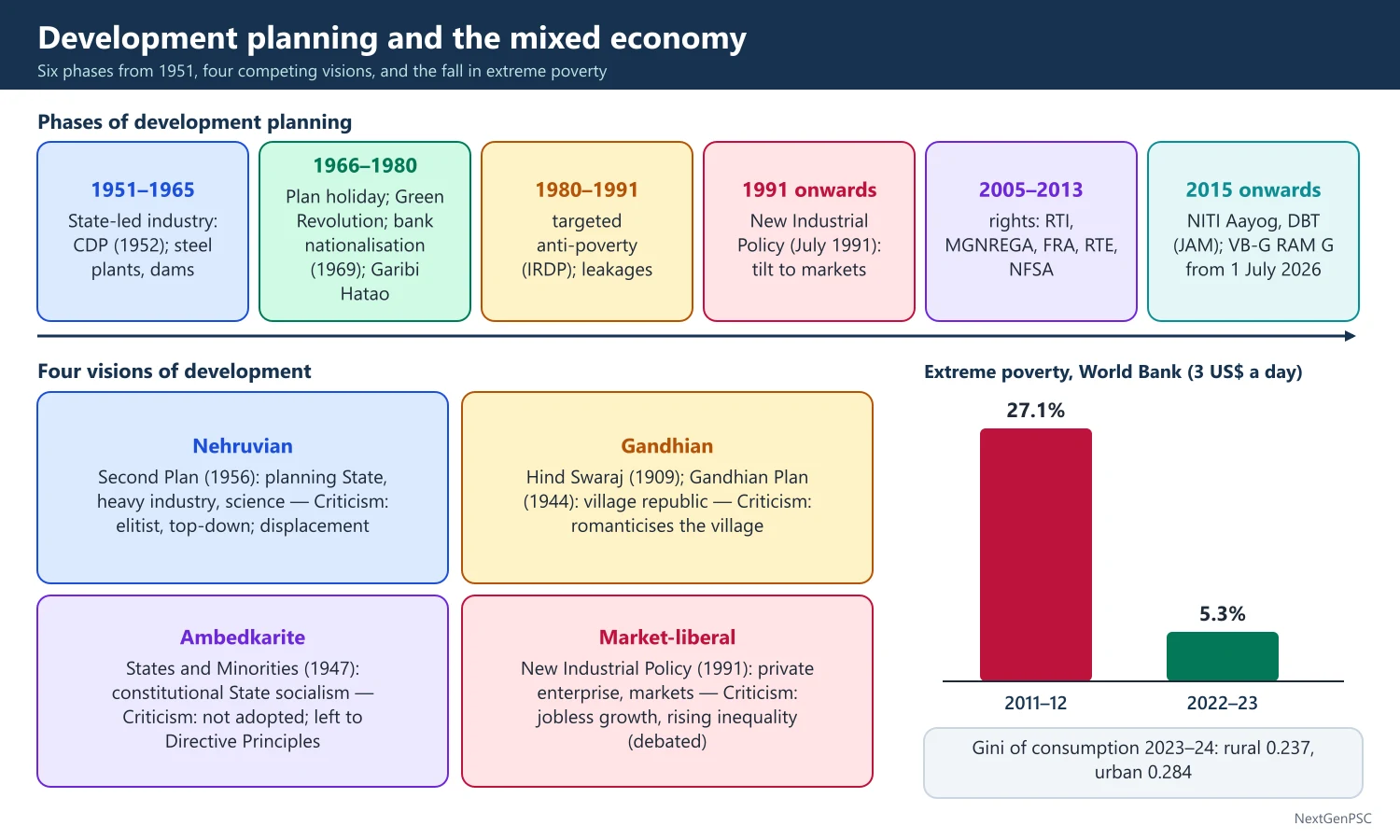
1951–1965 (State-led industrialisation): the First Plan stressed agriculture and the Community Development Programme (1952); the Second Plan built steel plants at Bhilai, Rourkela and Durgapur and large dams.
1966–1980 (crisis and Green Revolution): after drought and the 1966–69 plan holiday, the State backed new seed technology in irrigated regions and nationalised 14 banks in 1969; the slogan Garibi Hatao (1971) turned planning towards poverty.
1980–1991 (targeted anti-poverty programmes): the Integrated Rural Development Programme (1978–80 onwards) and wage-employment schemes tried to reach the poor directly, but studies found leakages to better-off households.
1991 onwards (liberalisation): the balance-of-payments crisis led to the New Industrial Policy of July 1991, ending most licensing and reducing the reserved public sector; the mixed economy tilted towards markets.
Rights-based phase (2005–2013): laws gave legal entitlements: the Right to Information Act 2005, MGNREGA 2005, the Forest Rights Act 2006, the Right to Education Act 2009 and the National Food Security Act 2013.
2015 onwards (NITI Aayog and direct delivery): planning gave way to cooperative federalism, mission-mode schemes and Direct Benefit Transfer using Jan Dhan, Aadhaar and mobile (JAM); MGNREGA was repealed and replaced from 1 July 2026 by the Viksit Bharat – Guarantee for Rozgar and Ajeevika Mission (Gramin) Act, 2025 (VB-G RAM G), which raises the guarantee to 125 days and makes states share the cost.
Achievements: a diversified industrial base, food self-sufficiency after the Green Revolution, a large public education and health system, and a fall in poverty; the World Bank estimated extreme poverty at 5.3% in 2022–23 at 3 US dollars a day (2021 PPP), down from 27.1% in 2011–12.
Social costs: regional imbalance, rising inter-personal inequality, displacement of tribals by dams, mines and steel towns, and a weak record on land reform, primary health and female literacy in the early decades.
4. Sociological debates and criticism
Modernisation view: Yogendra Singh in Modernization of Indian Tradition (1973) saw planning, democracy and education as exogenous sources of structural change that would move India from particularistic to universalistic norms.
Marxist critique: A.R. Desai argued in India's Path of Development (1984) that the Indian State followed a capitalist path that served the bourgeoisie and rich peasants while speaking the language of socialism.
Dominant proprietary classes: Pranab Bardhan (The Political Economy of Development in India, 1984) argued that the industrial capitalists, rich farmers and professionals (including the bureaucracy) competed for subsidies, slowing public investment.
Dependency and world-system views: Andre Gunder Frank's 'development of underdevelopment' and Immanuel Wallerstein's core–periphery model place Indian planning inside a global capitalist order; critics say India's large domestic market and State capacity make it a semi-periphery rather than a simple dependency.
Capability approach: Amartya Sen (Development as Freedom, 1999) and Jean Drèze and Sen (An Uncertain Glory, 2013) argued that Indian planning neglected health, schooling and women's agency, unlike East Asia and Kerala.
Post-development critique: Arturo Escobar (Encountering Development, 1995) treats development as a Western discourse; in India, Vandana Shiva and the anti-dam movement argued that 'development' destroyed livelihoods of forest and river communities.
Feminist critique: the Committee on the Status of Women in India report Towards Equality (1974) showed that planning had bypassed women; 'Women in Development' gave way to 'Gender and Development' and gender budgeting (introduced in the Union Budget in 2005–06).
Bureaucratic critique: Weber's legal-rational bureaucracy was the instrument of planning, but Merton's 'bureaucratic personality' and trained incapacity describe the red tape that Indian villagers met in Community Development blocks, as S.C. Dube noted in India's Changing Villages (1958).
Debated point: whether liberalisation after 1991 ended the mixed economy or only rebalanced it is debated; the State still owns railways, major banks and defence production and runs the largest food and employment programmes in the world.
5. Indian examples and recent data
Bhilai: Jonathan Parry's long fieldwork in the Bhilai Steel Plant township (from the 1990s) showed how a public-sector job created a privileged 'labour aristocracy' separate from contract and informal workers.
Kerala model: high literacy and low infant mortality at modest income, produced by land reform, public action and social movements, is used as evidence that the social content of planning matters more than growth alone.
Multidimensional poverty: NITI Aayog's discussion paper (January 2024) estimated that multidimensional poverty fell from 29.17% in 2013–14 to 11.28% in 2022–23, with 24.82 crore people moving out.
Consumption inequality: the Household Consumption Expenditure Survey 2023–24 (MoSPI) put average monthly per-capita consumption at about ₹4,122 in rural and ₹6,996 in urban India, with the Gini coefficient falling to 0.237 (rural) and 0.284 (urban).
Aspirational Districts Programme (2018): NITI Aayog ranks 112 backward districts on health, education, agriculture, financial inclusion and infrastructure, a shift from five-year plans to competitive, data-driven monitoring.
World comparison: the Soviet Union's command planning, Britain's post-1945 welfare state and East Asian 'developmental states' (Japan, South Korea) are the reference points; India borrowed planning from the first and the welfare idea from the second.
6. Linking thinkers
Link planning to Weber's rationalisation: the plan is a rational-legal instrument, and its failures show Weber's warning about the 'iron cage' of bureaucracy.
Link to Marx: the debate on whether Indian planning was 'State capitalism' connects to Marx's base and superstructure and to the mode-of-production debate in Indian agriculture (Chapter 22).
Link to Paper I social change: modernisation theory (Rostow's stages of growth, 1960), dependency theory and Sen's capability approach give the three lenses for judging Indian planning.
Link to displacement (Chapter 27), Green Revolution (Chapter 22) and education (this chapter): each is an outcome of the planning vision and a good example to cite.
7. Using it in the exam
10 marks (150 words): define development planning and mixed economy, give the Nehruvian logic in two lines, one achievement and one social cost with data, and end with the 2015 shift to NITI Aayog.
15 marks (200 words): add the competing visions (Nehru, Gandhi, Ambedkar, Bombay Plan) and two critiques (Desai and Sen).
20 marks (250 words): introduction, phases of planning, sociological evaluation through modernisation, Marxist and capability lenses, current data (MPI 2022–23, HCES 2023–24), and a conclusion on the State as an agent of social change.
Thinkers to cite: Yogendra Singh, A.R. Desai, Gunnar Myrdal, Amartya Sen, S.C. Dube, Pranab Bardhan.
Diagram idea: a timeline arrow 1951 → 1966 → 1991 → 2005 → 2015 → 2026 with the dominant idea of each phase (heavy industry, Green Revolution, liberalisation, rights, NITI and DBT, VB-G RAM G).
Quotation to use: Myrdal's view, in paraphrase, that India was a 'soft state' whose plans were sound on paper but weakly enforced against powerful interests.
| Vision | Key text and year | Agent of change | Sociological criticism |
|---|---|---|---|
| Nehruvian | Second Plan (1956), Industrial Policy Resolution 1956 | Planning State, heavy industry, science | Elitist, top-down; displacement; weak land reform |
| Gandhian | Hind Swaraj (1909); Gandhian Plan (1944) | Village republic, cottage industry | Romanticises the village, which Ambedkar called a den of localism |
| Ambedkarite | States and Minorities (1947) | Constitutional State socialism, rights | Not adopted; State socialism left to Directive Principles |
| Market-liberal | New Industrial Policy, July 1991 | Private enterprise, markets | Jobless growth, rising inequality (debated) |
| Indicator | Value | Year | Source |
|---|---|---|---|
| Multidimensional poverty headcount | 11.28% | 2022–23 | NITI Aayog discussion paper, Jan 2024 |
| Extreme poverty at 3 US dollars a day (2021 PPP) | 5.3% | 2022–23 | World Bank, 2025 |
| Average MPCE rural / urban | ₹4,122 / ₹6,996 | 2023–24 | HCES 2023–24, MoSPI |
| Gini of consumption rural / urban | 0.237 / 0.284 | 2023–24 | HCES 2023–24, MoSPI |
Mains points
- UPSC asks you to 'critically examine' planning as an instrument of social change; always give both achievements and social costs, not a list of plans.
- Do not write an economics answer; frame it through visions (Nehru, Gandhi, Ambedkar), classes (Desai, Bardhan) and capabilities (Sen).
- Bring in one ethnography (Parry on Bhilai or Dube on Community Development) to show sociological depth.
- Use current data with year and source: NITI MPI 2022–23, HCES 2023–24, the World Bank 2022–23 estimate.
- Mention the institutional shift: Planning Commission (1950) to NITI Aayog (2015) and MGNREGA to VB-G RAM G (from 1 July 2026), and what it means for centre–state relations.
- A common mistake is to call the 1991 reforms the 'end of the State'; show instead the State's new role as regulator and welfare provider.
Did you know?
- Memory trick for the four visions: 'N-G-A-M' — Nehru builds, Gandhi spins, Ambedkar legislates, Markets trade.
- Even the industrialists' Bombay Plan of 1944 asked for more State planning, which surprises most students.
Constitution, Law and Social Change
The Indian Constitution (in force from 26 January 1950) is a vision of social change: it abolished untouchability, promised equality and gave the State power to make special provisions for disadvantaged groups. Sociologists ask whether law leads or follows social change, why many progressive laws remain weakly enforced, and how courts and movements have used law to change caste, gender and family relations.
In simple words
The Constitution is the rulebook of the country, and it was written to change an unequal society, not just to run a government.
Think of a school that makes a new rule against bullying: the rule helps, but bullying stops only when students and teachers change their habits too.
In the same way, laws against untouchability, dowry or child marriage changed society only partly, and sociology studies that gap between law and practice.
UPSC asks whether law can bring social change, with examples of laws and judgments.
1. Concepts and definitions
Law: a body of rules backed by the sanctions of the State; Weber defined it as an order guaranteed by a staff ready to use coercion to secure conformity (Economy and Society, 1922).
Repressive and restitutive law: Durkheim in The Division of Labour in Society (1893) linked repressive (penal) law to mechanical solidarity and restitutive (civil, contract) law to organic solidarity; the growth of restitutive law is an index of social change.
Status to contract: Henry Maine (Ancient Law, 1861) argued that progressive societies move from relations fixed by birth (status) to relations chosen by agreement (contract); caste-based rights giving way to individual rights in India fits this idea.
Law as social engineering: Roscoe Pound's idea that law balances competing interests to build a better society; Indian judges and Upendra Baxi used it to describe the Constitution's transformative role.
Transformative constitutionalism: the view that the Constitution is meant to transform an unjust social order, used by the Supreme Court in Navtej Singh Johar (2018) and Joseph Shine (2018).
Compensatory discrimination: Marc Galanter's term in Competing Equalities (1984) for reservations and special provisions that treat unequals unequally to produce substantive equality.
Legal pluralism: the coexistence of State law with customary and religious law, such as caste panchayats, khap panchayats and personal laws; it explains why State law often meets resistance.
2. The Constitution as a charter of social change
Equality: Article 14 (equality before law), Article 15 (no discrimination on grounds of religion, race, caste, sex or place of birth) and Article 16 (equality in public employment).
Article 17: abolishes untouchability and forbids its practice in any form; it was given effect by the Untouchability (Offences) Act 1955, renamed the Protection of Civil Rights Act in 1976.
Articles 23 and 24: prohibit forced labour (including begar) and employment of children below 14 in factories, mines and hazardous work.
Special provisions: Articles 15(4), 15(5), 16(4), 330 and 332 allow reservations for SCs, STs and backward classes; the 103rd Amendment (2019) added 10% reservation for economically weaker sections, upheld in Janhit Abhiyan (November 2022).
Fifth and Sixth Schedules: special administration and self-rule for Scheduled Areas and tribal areas of the North-East, later extended by PESA 1996 and the Forest Rights Act 2006.
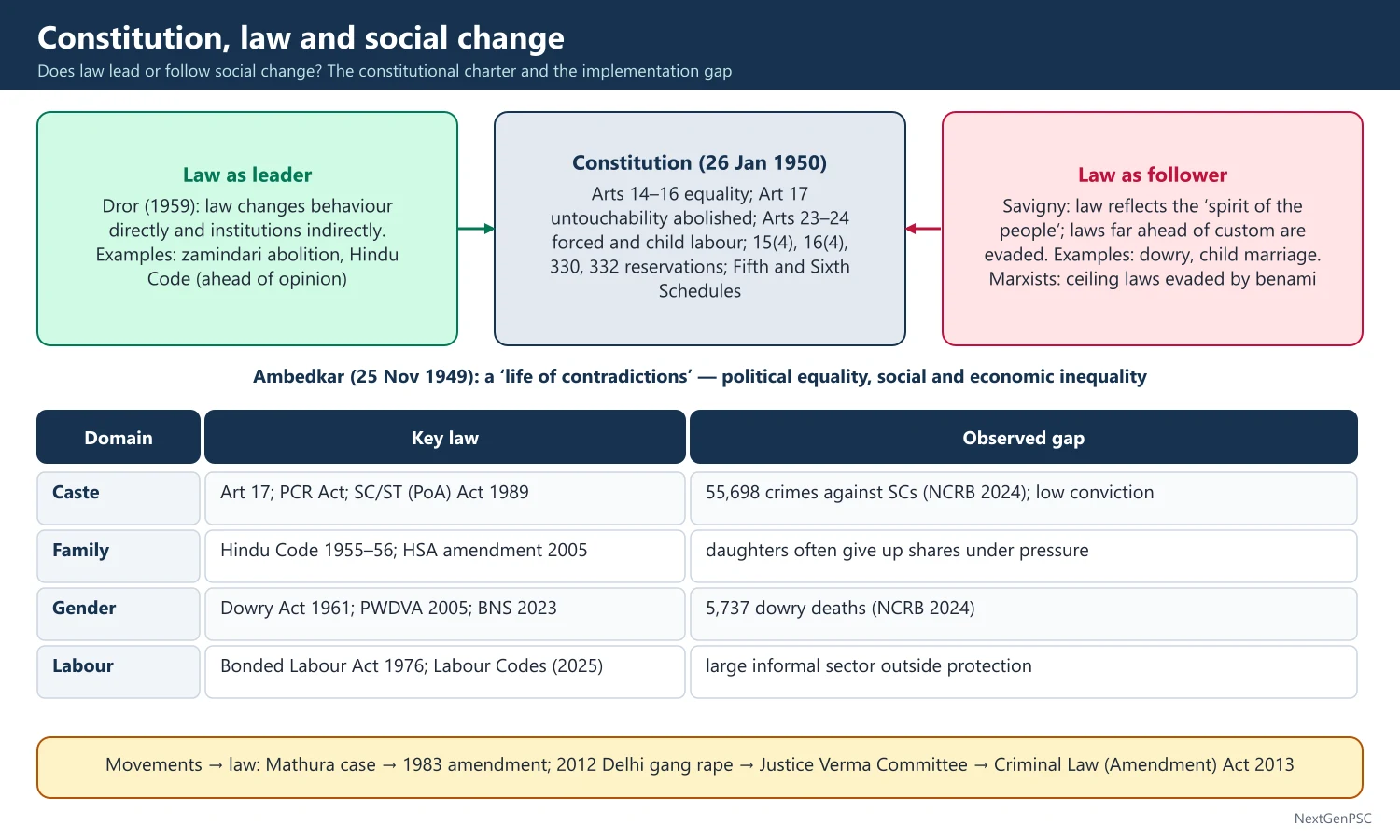
Ambedkar's warning: in his speech to the Constituent Assembly on 25 November 1949, Ambedkar said India was entering a 'life of contradictions', with equality in politics and inequality in social and economic life; this is the classic statement of the law–society gap.
3. Laws that targeted social institutions
Family and gender: the Hindu Marriage Act 1955 and Hindu Succession Act 1956 (the Hindu Code) made monogamy compulsory and allowed divorce; the 2005 amendment gave daughters equal coparcenary rights, confirmed in Vineeta Sharma (2020).
Women's protection: Dowry Prohibition Act 1961, Protection of Women from Domestic Violence Act 2005, Prohibition of Child Marriage Act 2006, Sexual Harassment of Women at Workplace Act 2013 and the Muslim Women (Protection of Rights on Marriage) Act 2019 after Shayara Bano (2017).
Caste: the SC/ST (Prevention of Atrocities) Act 1989, amended in 2015 and again in 2018 (Section 18A) after the Supreme Court's Subhash Kashinath Mahajan ruling of March 2018 diluted it; the amendment was upheld in Prithvi Raj Chauhan (2020).
Land and labour: zamindari abolition laws (1950s), land ceiling laws, the Bonded Labour System (Abolition) Act 1976, and the four Labour Codes brought into force on 21 November 2025.
Criminal law reform: the Bharatiya Nyaya Sanhita 2023 replaced the Indian Penal Code from 1 July 2024; it retains offences such as cruelty by husband (Section 85) and dowry death (Section 80) and adds sexual intercourse by deceitful means (Section 69).
Sexuality and personhood: NALSA (2014) recognised transgender persons as a third gender; Navtej Singh Johar (2018) decriminalised consensual same-sex relations; Puttaswamy (2017) declared privacy a fundamental right; the Transgender Persons (Protection of Rights) Act 2019 followed.
Political inclusion: the 73rd and 74th Amendments (1992) reserved one-third of local seats for women, and the Constitution (106th Amendment) Act 2023, the Women's Reservation Act, reserves one-third of Lok Sabha and assembly seats for women after the delimitation that follows the next census.
4. Does law lead or follow change? The debate
Law as a leader: Yehezkel Dror (1959) argued that law can directly change behaviour and indirectly shape institutions; the abolition of zamindari and the Hindu Code are examples where law moved ahead of public opinion.
Law as a follower: the historical school (Savigny) held that law reflects the 'spirit of the people', so laws that run far ahead of custom will be evaded; persistent dowry and child marriage support this view.
Marxist view: law is part of the superstructure that protects the ruling class; land ceiling laws were evaded through benami transfers, which Marxists cite as proof.
Galanter's assessment: reservations created a Dalit middle class and political leadership but benefits concentrated among the better-off sub-castes, which later led to the sub-classification judgment in State of Punjab v. Davinder Singh (1 August 2024).
Implementation gap: conviction rates under the Atrocities Act and the Dowry Prohibition Act remain low in NCRB data, which shows that police, courts and village power structures filter the effect of law.
Judicial activism and PIL: from the late 1970s, Public Interest Litigation let courts act for bonded labourers (Bandhua Mukti Morcha, 1984), pavement dwellers (Olga Tellis, 1985) and working women (Vishaka, 1997); Upendra Baxi called this 'social action litigation'.
Movements and law: most social laws followed movements: the anti-rape campaign after the Mathura case led to the 1983 amendment, and the 2012 Delhi gang rape led to the Justice Verma Committee and the Criminal Law (Amendment) Act 2013.
Debated area: a Uniform Civil Code; Uttarakhand's Uniform Civil Code came into force on 27 January 2025, and supporters see gender justice while critics see a threat to minority autonomy and legal pluralism.
World examples: the US Supreme Court's Brown v. Board of Education (1954) ended legal school segregation but needed the civil rights movement and the Civil Rights Act 1964 to work, a close parallel to Article 17 in India.
Caste panchayats and the courts: in Shakti Vahini (2018) the Supreme Court held khap interference in inter-caste and inter-faith marriages illegal and issued guidelines against 'honour' crimes, a direct clash between State law and customary law.
Sabarimala: the 2018 judgment allowing women of all ages into the temple met mass protest, and a larger bench is reviewing religious-freedom questions; it shows the limit of court-led change against strong religious sentiment.
5. Linking thinkers
Durkheim's shift from repressive to restitutive law and Maine's status-to-contract are the Paper I anchors for this Paper II topic.
Weber's formal-rational law explains why the Constitution replaced caste-based customary justice; his idea of legitimate domination explains why courts carry moral authority.
Link to Srinivas's dominant caste: in villages like Rampura, the dominant caste controlled dispute settlement, so State law reached Dalits only when it could bypass that power.
Link to Foucault: law is one of many disciplinary techniques; welfare laws also extend State surveillance (for example, Aadhaar-linked entitlements).
6. Using it in the exam
10 marks: define law as an agent of social change, cite two constitutional articles and two laws, and note the implementation gap with one NCRB fact.
15 marks: present the lead-or-follow debate (Dror vs the historical school) with Indian laws on each side.
20 marks: Constitution as charter (Articles 14–17, 46), laws by domain (caste, gender, labour, sexuality), role of PIL and movements, limits (Galanter, Baxi, Ambedkar's contradictions), and a balanced conclusion.
Thinkers to cite: Durkheim, Maine, Weber, Marc Galanter, Upendra Baxi, B.R. Ambedkar.
Diagram idea: a cycle: social movement → law or judgment → implementation by bureaucracy and police → resistance by custom and dominant groups → renewed movement.
Quotation to use: Ambedkar (25 November 1949): 'In politics we will have equality and in social and economic life we will have inequality'.
| Domain | Key law or judgment (year) | Intended change | Observed gap |
|---|---|---|---|
| Caste | Article 17; PCR Act 1955/1976; SC/ST (PoA) Act 1989, amended 2018 | End untouchability and atrocities | NCRB 2024: 55,698 crimes against SCs; low conviction |
| Family | Hindu Code 1955–56; HSA amendment 2005 | Monogamy, divorce, daughters' inheritance | Daughters often relinquish shares under family pressure |
| Gender | Dowry Prohibition Act 1961; PWDVA 2005; BNS 2023 | End dowry and domestic violence | NCRB 2024: 5,737 dowry deaths |
| Labour | Bonded Labour Act 1976; Labour Codes in force 21 Nov 2025 | Free and protected labour | Large informal sector outside protection |
| Sexuality | NALSA 2014; Navtej Johar 2018 | Dignity of LGBTQ persons | Social stigma persists; no marriage equality (Supriyo, 2023) |
Mains points
- The standard question is 'Can law be an effective instrument of social change? Discuss with Indian examples'; answer with both the enabling and limiting sides.
- Avoid writing a polity answer with only article numbers; add sociological concepts (Durkheim, Maine, legal pluralism, dominant caste).
- Use recent changes: BNS 2023 from 1 July 2024, Labour Codes from 21 November 2025, SC sub-classification (2024), Uttarakhand UCC (2025).
- Show the role of movements and PIL: most laws follow social mobilisation, so law and movement are partners.
- Quote NCRB data on atrocities or dowry deaths with the year to show the implementation gap.
- Conclude that law is necessary but not sufficient: it needs education, economic change and political will.
Did you know?
- Memory trick for the lead-or-follow debate: 'Dror drives, Savigny follows'.
Education and Social Change in India
Education was expected to be the main engine of social change in independent India: to create citizens, skilled workers and a mobile, caste-free society. Sociologists show it does both liberate (Dalit and women's mobility, Ambedkar's call to educate) and reproduce inequality (Bourdieu's cultural capital, English-medium privilege). The topic covers policy from the Kothari Commission to NEP 2020, and current data on access and learning.
In simple words
Education is how a society passes on knowledge, skills and values, mostly through schools and colleges.
It works like a ladder: a first-generation graduate from a poor family can climb into a government job, but children of rich families start on a higher rung with tuition and English.
So education can break caste and gender barriers but can also keep old inequalities in a new form, which sociologists call reproduction.
UPSC asks whether education is an agent of change or of status quo, with Indian data.
1. Concepts and definitions
Education as socialisation: Durkheim (Education and Sociology, 1922) defined education as the methodical socialisation of the young generation, transmitting the collective values needed for social solidarity.
School as a social system: Talcott Parsons ('The School Class as a Social System', 1959) said the school teaches universalistic and achievement norms and allocates people to roles by merit.
Cultural capital: Pierre Bourdieu (with Passeron, Reproduction in Education, Society and Culture, 1970) argued that schools reward the language, tastes and manners of dominant classes, so inequality looks like merit.
Correspondence principle: Samuel Bowles and Herbert Gintis (Schooling in Capitalist America, 1976) argued that school hierarchy mirrors workplace hierarchy and prepares obedient workers.
Hidden curriculum: the unwritten lessons of school (punctuality, obedience, gender roles); in India, separate seating or tasks for Dalit children are part of it, as studies by Geetha Nambissan have shown.
Deschooling and critical pedagogy: Ivan Illich (Deschooling Society, 1971) attacked compulsory schooling; Paulo Freire (Pedagogy of the Oppressed, 1968) proposed education as dialogue for freedom.
Educated unemployment and 'timepass': Craig Jeffrey's study of young men in Meerut (Timepass, 2010) and Jeffrey, Jeffery and Jeffery (Degrees without Freedom?, 2008) showed that degrees without jobs produce frustration rather than mobility.
2. History and policy
Colonial phase: Macaulay's Minute (1835) created an English-educated class; Wood's Despatch (1854) and the first universities (1857) produced the professional middle class that led reform and nationalism.
Reformers: Jyotirao and Savitribai Phule opened a school for girls in Pune in 1848; Ambedkar's slogan 'Educate, Agitate, Organise' made education the first step of Dalit liberation.
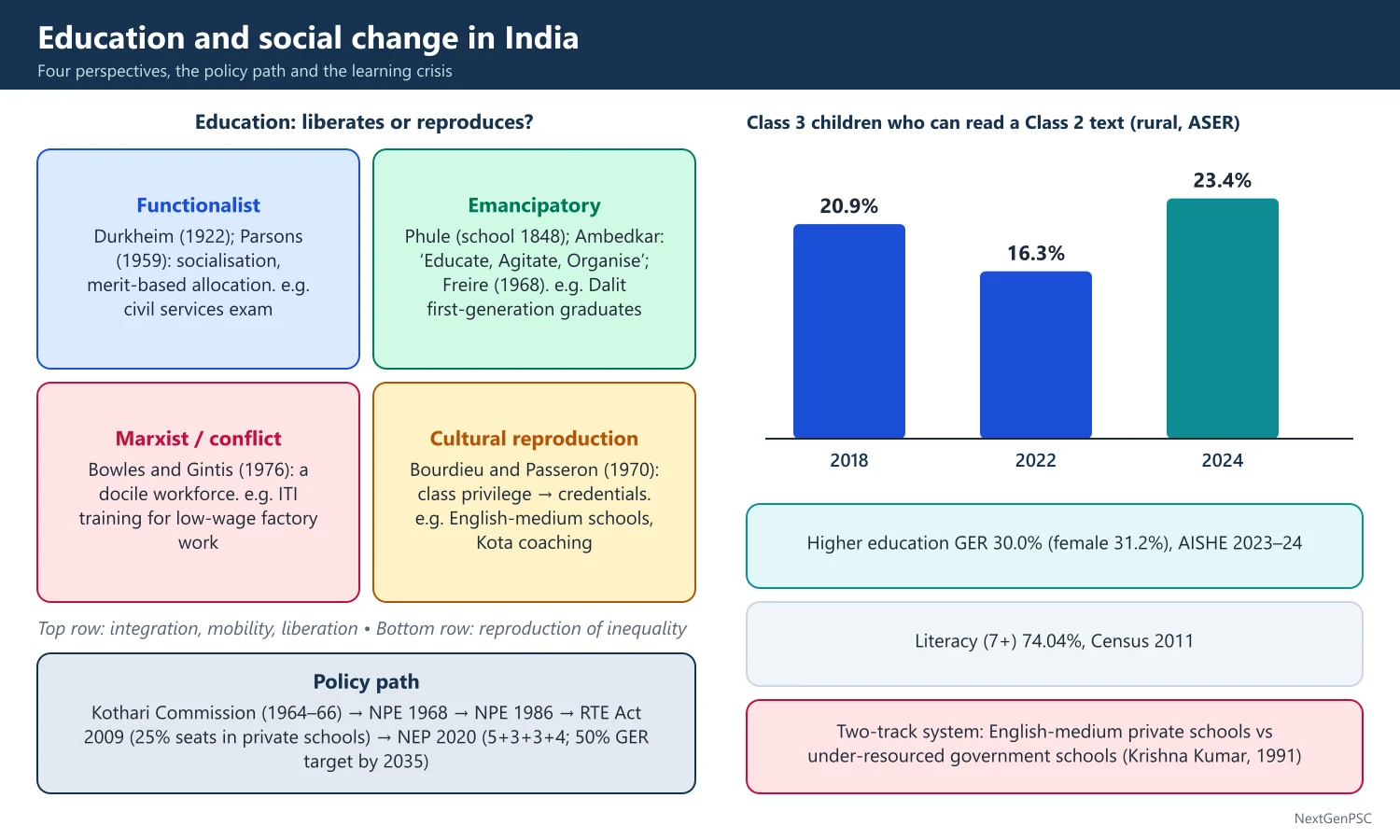
Kothari Commission (1964–66): called education the instrument of national development, proposed a common school system and 6% of GDP for education; it led to the National Policy on Education 1968.
NPE 1986 (revised 1992): stressed equal access, Operation Blackboard and non-formal education; the District Primary Education Programme (1994) and Sarva Shiksha Abhiyan (2001) expanded primary schooling.
Right to Education: Article 21A (86th Amendment, 2002) and the RTE Act 2009 made education free and compulsory for ages 6–14 and reserved 25% of entry seats in private unaided schools for disadvantaged children (Section 12(1)(c)), upheld in 2012.
National Education Policy 2020: a 5+3+3+4 school structure, foundational literacy and numeracy (NIPUN Bharat, 2021), mother tongue as medium where possible up to Class 5, multidisciplinary higher education, and a target of 50% higher-education GER by 2035.
Debated points of NEP: critics fear centralisation, a three-language formula seen in Tamil Nadu as Hindi imposition, and growth of private and online provision that may widen inequality.
3. Education as change and as reproduction
Change: education gave Dalits, OBCs and women access to government jobs and politics; Srinivas noted that westernisation spread first through English education among Brahmins and later to other castes.
Women: female education is linked to lower fertility, later marriage and lower child mortality; NFHS-5 (2019–21) shows women with 12 or more years of schooling have a much lower total fertility rate than women with none.
Reproduction: a two-track system has formed, with English-medium private schools for the middle class and under-resourced government schools for the poor; Krishna Kumar (Political Agenda of Education, 1991) traced how curriculum served dominant groups.
Merit debate: Satish Deshpande argues that upper castes have converted caste capital into 'merit' and modern capital, so that caste appears invisible to them while remaining real for others.
Higher education access: AISHE 2023–24 (released July 2026) put the gross enrolment ratio at 30.0%, up from 29.5% in 2022–23, with female GER at 31.2%, higher than male GER.
Learning crisis: ASER 2024 (rural, released January 2025) found that only 23.4% of Class 3 children could read a Class 2 text, up from 16.3% in 2022 and 20.9% in 2018.
Shadow education: coaching hubs such as Kota show how private tutoring converts family money into exam success, a clear case of Bourdieu's economic capital becoming cultural capital.
Language: English acts as a gatekeeper to elite jobs; Dalit writers such as Chandra Bhan Prasad have argued for English as a tool of liberation, which is debated against NEP's mother-tongue stress.
4. Indian examples and studies
Kerala: missionary schools, the SNDP movement of Sree Narayana Guru and State policy made Kerala the most literate large state (93.9% in Census 2011).
Himachal Pradesh: rose from low literacy in 1971 to near-universal schooling through public investment and women's participation; it was declared fully literate under ULLAS in September 2025.
Mid-day meals: the Supreme Court order of 2001 made cooked meals universal, now PM POSHAN (2021); studies found higher attendance of girls and Dalit children and, in some places, resistance to Dalit cooks, which shows caste in the hidden curriculum.
Reservation in higher education: the 93rd Amendment (2005) and the Central Educational Institutions Act 2006 brought 27% OBC reservation; studies of IITs show both mobility and experiences of stigma among reserved-category students.
Navodaya and Eklavya schools: Jawahar Navodaya Vidyalayas (from 1986) for talented rural children and Eklavya Model Residential Schools for tribal children are State attempts to open elite-quality schooling to the disadvantaged.
Tribal education: Verrier Elwin warned that schooling in a foreign language and culture alienated tribal children; residential schools and Hindi or English medium are still debated for this reason.
Muslims: the Sachar Committee (2006) found Muslim literacy (59.1% in 2001) below the national average (64.8%) and very low representation in higher education and public jobs.
Digital divide: during COVID-19 school closures (2020–21) children without smartphones or internet fell behind, which widened class, gender and rural–urban gaps in learning.
World examples: the Coleman Report (USA, 1966) found that family background explained more of achievement than school resources; Finland's equal public schools are cited as a counter-model.
5. Linking thinkers
Link Durkheim and Parsons (functionalist, school builds consensus and merit) with Bourdieu, Bowles and Gintis (conflict, school reproduces class) and with Ambedkar and Phule (emancipation).
Link to stratification and mobility (Paper I): Sorokin's idea of the school as a channel of vertical mobility, and Lipset and Bendix on education and mobility in industrial societies.
Link to Weber: credentials as a basis of status groups and social closure; Randall Collins (The Credential Society, 1979) extended this to explain degree inflation, visible in India's crowded competitive exams.
Link to Chapter 27 (illiteracy and disparities) for data by caste, gender, region and religion, and to Chapter 21 planning for the State's vision.
6. Using it in the exam
10 marks: define education as an agent of change, give one functionalist and one conflict view, and one Indian data point (AISHE or ASER) with year.
15–20 marks: history and policy (Kothari, RTE, NEP 2020), change (caste, gender mobility), reproduction (Bourdieu, two-track schooling, coaching), learning crisis, and conclusion on the conditions under which education liberates.
Thinkers to cite: Durkheim, Bourdieu, Bowles and Gintis, Krishna Kumar, Craig Jeffrey, Ambedkar.
Diagram idea: two arrows from 'Education': one to 'mobility, empowerment, secular values' and one to 'reproduction of class, caste and gender', with the conditions (public investment, language, quality) in the middle.
Quotation to use: Ambedkar's call to 'Educate, Agitate, Organise', which places education first in the struggle for dignity.
| Perspective | Thinker and work | Role of education | Indian illustration |
|---|---|---|---|
| Functionalist | Durkheim (1922); Parsons (1959) | Socialisation, consensus, merit-based allocation | Civil services exam as open competition |
| Marxist / conflict | Bowles and Gintis (1976) | Prepares a docile workforce | ITI training for low-wage factory work |
| Cultural reproduction | Bourdieu and Passeron (1970) | Converts class privilege into credentials | English-medium schools and Kota coaching |
| Emancipatory | Phule; Ambedkar; Freire (1968) | Liberation and critical consciousness | Dalit first-generation graduates; Phule's school 1848 |
| Indicator | Value | Year | Source |
|---|---|---|---|
| Literacy rate (7+) | 74.04% | 2011 | Census of India |
| Higher education GER (18–23) | 30.0% (female 31.2%) | 2023–24 | AISHE 2023–24 |
| Class 3 children reading Class 2 text (rural) | 23.4% | 2024 | ASER 2024 |
| States declared fully literate under ULLAS | Mizoram, Goa, Tripura, Himachal Pradesh | 2025 | Ministry of Education |
Mains points
- The usual question asks whether education is an agent of social change or of reproduction; give both and decide on conditions.
- Bring Indian voices (Phule, Ambedkar, Krishna Kumar, Deshpande, Jeffrey) alongside Bourdieu and Parsons.
- Use recent data with year: AISHE 2023–24 GER 30.0%, ASER 2024, ULLAS fully-literate states (2025).
- Discuss NEP 2020 critically: its promise (foundational learning, multidisciplinary) and the debate on language, centralisation and privatisation.
- A common mistake is to equate enrolment with learning; mention the learning crisis.
- Link to gender (female education and fertility) and caste (reservation, hidden curriculum) to show breadth.
Did you know?
- India's higher-education GER crossed 30% for the first time in 2023–24, and women's GER has been above men's for several years.
- Memory trick: 'Three Cs of Bourdieu' — Capital, Code, Credential.
UPSC Previous Year Questions: Visions of Social Change in India
From 2014 to 2026 UPSC asked 22 question parts (310 marks) from this chapter, all in Paper II. Education and social change is the most-asked topic (10 parts, with NEP 2020 alone appearing four times), followed by development planning (6 parts) and constitution and law (6 parts). Every question below has a model answer written to the UPSC word limit.
In simple words
Read the question and write your own answer in the time limit first: about 7 minutes for 10 marks and 11 minutes for 20 marks.
Then compare it with the model answer: check the introduction, the thinkers and studies used, the Indian data with year and source, and the conclusion.
Note what you missed in a notebook and revise the matching topic in the notes of this chapter before you try the next question.
1. Development Planning and the Mixed Economy
Example 1 (UPSC 2026, 20 marks): Synchronise the developmental programmes and social change in India, and describe them through visible and lived experiences.
Paper and question: Paper II, Q6(b)
Approach: The question asks you to link (synchronise) development programmes with the social changes they produced and to show these through everyday, lived experience. Organise by programme clusters (sanitation, fuel, banking, water, employment), each with its visible change and the lived reality, then evaluate with theory.
Development programmes are planned State interventions meant to change living conditions; sociologically they are also agents of social change, because they alter roles, relations and aspirations. Yogendra Singh called such State action an exogenous source of structural change, while S.C. Dube (India's Changing Villages, 1958) showed that villagers experience programmes through caste, class and gender.
Visible change: Swachh Bharat Mission (2014) built more than ten crore household toilets; Ujjwala (2016) gave LPG connections to over ten crore poor women; Jan Dhan (2014) opened more than 50 crore bank accounts; and Jal Jeevan Mission (2019) took tap water to most rural homes. NITI Aayog estimated that multidimensional poverty fell from 29.17% (2013–14) to 11.28% (2022–23).
Lived experience: for women, a toilet and a tap mean safety, dignity and saved time; a bank account and Direct Benefit Transfer give them a little economic agency, and self-help groups have made women visible in village public life. Wage employment under MGNREGA (2005), replaced from 1 July 2026 by the VB-G RAM G Act (125 days), reduced distress migration and raised women's bargaining power, as field studies recorded.
Yet the lived experience is uneven. Studies of sanitation found continued open defecation where caste notions of purity made pit-emptying a 'Dalit task'; LPG refills fell when prices rose, so many women returned to firewood; and digital authentication excluded the old and those with worn fingerprints.
Flow chart: programme → material change (toilet, tap, account, wage) → change in roles (women's time, mobility, voice) → new aspirations and new inequalities (caste, region, digital divide).
Thus programmes and social change are synchronised only when delivery passes through people's social structure; Amartya Sen's capability lens reminds us that the test is what people are able to do and be. Participatory planning through gram sabhas, social audits and attention to caste and gender can turn visible assets into lasting change.
Example 2 (UPSC 2024, 10 marks): Critically examine the relevance of development planning in India.
Paper and question: Paper II, Q6(c)
Approach: Critically examine means weigh relevance against limits. Define planning, show why it mattered, show the post-1991 and post-2015 change, and judge whether planning is still relevant in a new form.
Development planning is the deliberate allocation of resources by the State through targets; India ran twelve Five Year Plans (1951–2017) under the Planning Commission, which NITI Aayog replaced on 1 January 2015.
Relevance: planning built an industrial base (Bhilai, Rourkela, Durgapur), food self-sufficiency through the Green Revolution, and public schooling and health systems. Today, planning survives in the form of goals and monitoring: NITI Aayog's Aspirational Districts Programme (2018) and the SDG India Index, while multidimensional poverty fell from 29.17% (2013–14) to 11.28% (2022–23).
Limits: A.R. Desai argued that planning followed a capitalist path that helped rich peasants and the bourgeoisie; Gunnar Myrdal called India a 'soft state' that could not enforce its own plans; Drèze and Sen showed neglect of health and schooling; and displacement by dams fell mainly on tribals.
Hence centralised five-year planning has lost relevance in a market economy, but planning as strategic State direction of social change remains relevant, especially to reduce regional, caste and gender inequality and to manage climate transition.
Example 3 (UPSC 2021, 10 marks): Analyze the idea of developmental planning in India.
Paper and question: Paper II, Q5(a)
Approach: Analyse the idea: its origins (Nehru, Mahalanobis, Gandhian and Bombay Plans), its goals and assumptions, and its sociological evaluation in brief.
The idea of developmental planning in India was that a democratic State would consciously direct economic growth and social justice together, through Five Year Plans beginning in 1951.
Its roots lay in Nehru's National Planning Committee (1938), the Bombay Plan of industrialists (1944) and the Gandhian Plan of S.N. Agarwal (1944); the Second Plan's Mahalanobis model stressed heavy industry, and the Avadi resolution (1955) set the goal of a socialistic pattern of society within a mixed economy.
Its assumptions were that growth would trickle down, that a neutral bureaucracy would deliver, and that modern institutions would dissolve caste and feudal ties. Sociologists questioned each: A.R. Desai saw a capitalist path, S.C. Dube found Community Development captured by dominant castes, and Myrdal spoke of a 'soft state'.
From 1991 the idea shifted towards indicative planning with markets, and from 2015 NITI Aayog replaced plans with cooperative federalism, missions and outcome monitoring. The core idea, that the State should steer social transformation, still survives.
Example 4 (UPSC 2020, 20 marks): Discuss in detail the main issues of development planning in mixed economy like India.
Paper and question: Paper II, Q6(a)
Approach: Discuss the main issues in detail: define the mixed economy, then take issues one by one (growth vs equity, public sector efficiency, agrarian and regional imbalance, bureaucracy, displacement, gender, social sectors), each with a thinker or data, and conclude.
A mixed economy combines a public and a private sector under State regulation; India adopted it through the Industrial Policy Resolution of 1956 and used Five Year Plans (1951–2017) to direct it towards growth with social justice.
Growth versus equity: the Mahalanobis strategy assumed growth would trickle down, but poverty remained high until the 1970s, which led to Garibi Hatao and targeted schemes such as IRDP. A.R. Desai argued that the State served capitalists and rich peasants while using socialist language, and Pranab Bardhan showed how the dominant proprietary classes competed for subsidies.
Public sector and bureaucracy: the licence system bred delays and rent-seeking; Myrdal's 'soft state' and Merton's 'trained incapacity' describe red tape, and S.C. Dube found Community Development blocks remote from villagers.
Agrarian and regional imbalance: the Green Revolution concentrated gains in Punjab, Haryana and western Uttar Pradesh and among larger farmers, as Francine Frankel noted; eastern and tribal regions lagged.
Displacement and ecology: dams and mines displaced millions, mostly Adivasis, as Walter Fernandes estimated; the Narmada Bachao Andolan made this a national issue.
Social sectors and gender: Drèze and Sen showed that India under-invested in health and schooling; Towards Equality (1974) showed planning bypassed women.
After 1991 the balance moved towards markets, and in 2015 NITI Aayog replaced the Planning Commission. Still, State investment, rights-based laws (MGNREGA 2005, NFSA 2013) and mission schemes show that the mixed economy remains, with the issue now being inclusive, accountable and sustainable growth.
Example 5 (UPSC 2019, 20 marks): Examine the importance of Development Planning in Indian Mixed Economy, and analyze its problems and prospects.
Paper and question: Paper II, Q6(a)
Approach: Three demands: importance, problems, prospects. Give a short introduction, then three clear sections with thinkers and data, and a forward-looking conclusion.
In India's mixed economy, planning was the instrument through which the State tried to combine growth, self-reliance and social justice, beginning with the First Five Year Plan in 1951.
Importance: in a poor, unequal ex-colony, markets alone would not build steel, power, irrigation or schools. Planning created the heavy-industry base of the Second Plan, the Community Development Programme (1952), the Green Revolution and bank nationalisation (1969). Yogendra Singh saw planning, democracy and education as exogenous forces that moved Indian society from particularistic to universalistic norms.
Problems: benefits were captured by rich peasants and the urban middle class (A.R. Desai; Pranab Bardhan's dominant proprietary classes); implementation suffered from what Myrdal called the 'soft state'; the Green Revolution widened regional and class gaps; big projects displaced Adivasis; and social sectors and women were neglected, as Drèze and Sen and the Towards Equality report (1974) showed. The licence-permit system slowed growth until the 1991 crisis.
Prospects: since 2015 NITI Aayog has moved to cooperative federalism, competitive ranking (Aspirational Districts, 2018), direct benefit transfer and mission schemes. Multidimensional poverty fell from 29.17% (2013–14) to 11.28% (2022–23) by NITI Aayog's estimate. Future planning must address jobs for the young, climate change, the care economy and regional inequality.
Planning is therefore less about controlling the economy and more about guiding social transformation; its success will depend on participation through Panchayati Raj and on accountability, not on targets alone.
Example 6 (UPSC 2015, 20 marks): Human development approach affirms that education and health-care growth are more important than economic growth. Discuss this issue in the light of post-liberalized Indian society.
Paper and question: Paper II, Q8(b)
Approach: Discuss the human development claim against the growth-first view in post-1991 India. Define the approach (Mahbub ul Haq, Sen), present the debate (Sen–Drèze versus Bhagwati–Panagariya), give Indian evidence, and conclude that the two are complementary.
The human development approach, developed by Mahbub ul Haq and Amartya Sen for the first UNDP Human Development Report (1990), defines development as the enlargement of people's choices and capabilities; income is a means, while health and education are ends in themselves.
After liberalisation in 1991, India's GDP grew fast, but its human development lagged. Drèze and Sen (An Uncertain Glory, 2013) showed that India fell behind Bangladesh on several social indicators despite higher income, and the Human Development Report 2025 ranked India 130th of 193 countries. Kerala, with high literacy and low infant mortality at modest income, is the classic Indian proof that public education and health can deliver well-being.
The counter-view of Jagdish Bhagwati and Arvind Panagariya (Why Growth Matters, 2012) is that growth pays for schools and hospitals and itself pulls people out of poverty; the fall in poverty after 2005 supports them in part.
Sociologically, the debate is about who benefits. Growth after 1991 created a new middle class, while informal workers, Dalits, Adivasis and women gained less; the female labour force participation rate stayed low for two decades before rising to 41.7% in PLFS 2023–24. Unequal access to private schools and hospitals reproduces class, as Bourdieu's idea of cultural capital predicts.
Rights-based laws such as the Right to Education Act 2009 and the National Food Security Act 2013, and schemes such as Ayushman Bharat (2018), show the State moving towards human development.
The best reading is that the two are complementary: growth without capabilities is jobless and unequal, and capabilities without growth cannot be financed. The human development view rightly insists that education and health come first in sequence, as East Asia and Kerala show.
2. Constitution, Law and Social Change
Example 7 (UPSC 2025, 20 marks): In what respects have the constitutional provisions changed the socio-economic and political conditions of Scheduled Castes and Scheduled Tribes in India? Critically examine.
Paper and question: Paper II, Q6(a)
Approach: Critically examine the change in three spheres (social, economic, political) brought by constitutional provisions for SCs and STs, then show the limits with data and studies, and conclude.
The Constitution treats SCs (16.6% of the population, Census 2011) and STs (8.6%) through compensatory discrimination, Marc Galanter's term for treating unequals unequally: Article 17 abolishes untouchability, Articles 15(4), 16(4), 46, 330, 332 and 335 provide reservation and protection, and the Fifth and Sixth Schedules protect tribal areas.
Political change: 84 Lok Sabha seats are reserved for SCs and 47 for STs, and reservation in panchayats (73rd Amendment, 1992) and PESA 1996 brought lakhs of Dalit and Adivasi representatives into local power. Christophe Jaffrelot called the rise of parties such as the BSP a 'silent revolution'.
Socio-economic change: reservation in education and jobs created a Dalit middle class and professional elite; SC literacy rose from about 10% in 1961 to 66.1% in 2011, and laws such as the Protection of Civil Rights Act (1955, renamed 1976), the SC/ST (Prevention of Atrocities) Act 1989 and the Forest Rights Act 2006 gave legal protection and land rights. Public humiliation and open untouchability have declined, as Srinivas and later field studies note.
Limits: benefits concentrated in a few sub-castes, which led to sub-classification in State of Punjab v. Davinder Singh (2024); NCRB recorded 57,582 crimes against SCs and 10,064 against STs in 2022; most Dalits remain landless labourers; and STs carry the highest multidimensional poverty and the burden of displacement. Anand Teltumbde and Gail Omvedt argue that reservation without land reform and quality schooling leaves the structure intact, and Ambedkar himself warned of a 'life of contradictions'.
The provisions have thus transformed political voice and created mobility, but social and economic equality remains unfinished; it needs land and forest rights in practice, quality education and firm enforcement of atrocity law.
Example 8 (UPSC 2024, 20 marks): Do you think that the constitutional provisions for women have led to their uplift? Give reasons for your answer.
Paper and question: Paper II, Q3(b)
Approach: Take a position with reasons: list the provisions, show where they lifted women (law, politics, education, property), then where they did not (data on work, violence, representation), and give a reasoned verdict.
The Constitution guarantees equality (Articles 14, 15(1), 16), allows special provisions for women (Article 15(3)), directs equal pay and maternity relief (Articles 39(d), 42), asks citizens to renounce practices derogatory to women (Article 51A(e)), and reserves one-third of panchayat and municipal seats (Articles 243D and 243T, 1992). The 106th Amendment (2023) will reserve one-third of Lok Sabha and assembly seats after the next delimitation.
Uplift: these provisions enabled laws such as the Hindu Succession (Amendment) Act 2005, the Domestic Violence Act 2005, the POSH Act 2013 and the Maternity Benefit (Amendment) Act 2017, and judgments such as Vishaka (1997), Shayara Bano (2017) and Vineeta Sharma (2020). Women now hold about 46% of panchayat seats, female higher-education GER (31.2%, AISHE 2023–24) is above the male rate, and NFHS-5 (2019–21) found 78.6% of women operating their own bank accounts. Niraja Gopal Jayal and others show that panchayat quotas created a new class of women leaders.
Limits: the provisions work through a patriarchal society. The female labour force participation rate was only 41.7% (PLFS 2023–24), much of it unpaid family work; NCRB recorded 4,45,256 crimes against women in 2022; women formed about 13.6% of the Lok Sabha elected in 2024; and the 'sarpanch-pati' phenomenon shows proxy power. Leela Dube and Sylvia Walby explain this through the persistence of private and public patriarchy, and Myrdal's 'soft state' through weak enforcement.
Therefore the constitutional provisions have produced real legal and political uplift and changed women's aspirations, but not yet substantive equality. Uplift depends on enforcement, economic independence, safe public spaces and change in family norms, which law can lead but cannot complete alone.
Example 9 (UPSC 2022, 10 marks): Discuss law as an important instrument for women's empowerment.
Paper and question: Paper II, Q5(a)
Approach: Discuss law as an instrument: define law as an agent of change (Dror), list key laws for women, show their effect, and note the gap between law and practice.
Yehezkel Dror argued that law can change society directly by altering behaviour and indirectly by shaping institutions; in India, law has been a key instrument of women's empowerment under Articles 14, 15(3) and 39.
Laws have given women rights in the family (Hindu Marriage Act 1955, Hindu Succession Amendment 2005, Muslim Women (Protection of Rights on Marriage) Act 2019), protection against violence (Dowry Prohibition Act 1961, Domestic Violence Act 2005, Criminal Law Amendment 2013, now the Bharatiya Nyaya Sanhita from 1 July 2024), dignity at work (POSH Act 2013) and political voice (73rd and 74th Amendments, 1992; Women's Reservation Act 2023).
Their effect is visible in women's property claims, about 46% share in panchayat seats and wider reporting of violence. Yet NCRB recorded 4,45,256 crimes against women in 2022, dowry deaths continue, and daughters often give up land rights, as Bina Agarwal showed.
Law is thus necessary but not sufficient: it empowers women when backed by movements, legal literacy, quick justice and economic independence.
Example 10 (UPSC 2018, 10 marks): Elaborate the concept of constitutional morality as given by B. R. Ambedkar.
Paper and question: Paper II, Q5(a)
Approach: Elaborate Ambedkar's concept: its source (Grote), his speech of 4 November 1948, its meaning, and its later use by the Supreme Court.
Ambedkar borrowed the term constitutional morality from the historian George Grote, who meant by it a paramount reverence for the forms of the constitution combined with freedom of criticism and self-restraint by those in power.
In the Constituent Assembly on 4 November 1948, Ambedkar argued that constitutional morality is not a natural sentiment and has to be cultivated, warning that democracy in India was only a top-dressing on a soil that was essentially undemocratic.
For Ambedkar, constitutional morality meant respect for the rule of law and institutions, respect for dissent, and above all the values of liberty, equality and fraternity against the social morality of caste. In his speech of 25 November 1949 he added that political democracy cannot last unless it rests on social democracy.
The Supreme Court used it in Navtej Singh Johar (2018) and Sabarimala (2018) to place constitutional values above popular or religious morality; critics fear judicial subjectivity. Sociologically, it is a call to make the Constitution a lived normative order, not a text.
Example 11 (UPSC 2018, 10 marks): Assess the impact of ban on 'Triple Talak' on marriage and divorce among the Muslim community in India.
Paper and question: Paper II, Q8(c)
Approach: Assess impact: state the law (Shayara Bano 2017 and the 2019 Act), then its effects on marriage, divorce and women's security, with criticism and a balanced judgement.
In Shayara Bano v. Union of India (August 2017) the Supreme Court held instant triple talaq (talaq-e-biddat) unconstitutional; the Muslim Women (Protection of Rights on Marriage) Act 2019 made its pronouncement void and a cognisable offence punishable with up to three years' imprisonment, with subsistence allowance and custody for the wife.
Impact on marriage and divorce: it removed the husband's power to end a marriage in one sitting and strengthened the security of the wife within marriage; divorce now follows procedures with reconciliation periods, such as talaq-e-ahsan, or khula. Muslim women's groups such as the Bharatiya Muslim Mahila Andolan saw it as a victory of rights over patriarchal personal law.
Criticism: scholars such as Flavia Agnes argued that criminalising a civil wrong may push husbands to desert wives rather than divorce them, and that a jailed husband cannot pay maintenance; others saw selective targeting of one community.
The ban is therefore an important legal step towards gender justice, but its real impact depends on women's economic independence and access to courts.
Example 12 (UPSC 2017, 10 marks): Give an account of the problems relating to the "creamy layer".
Paper and question: Paper II, Q5(c)
Approach: Give an account of problems: define creamy layer (Indra Sawhney), then list its problems (criteria, income ceiling, salary rule, SC/ST extension, implementation) and conclude.
The creamy layer is the socially and economically advanced section of the backward classes that is excluded from OBC reservation; it was mandated by the Supreme Court in Indra Sawhney (1992), and the income ceiling has been ₹8 lakh a year since 2017.
Problems: first, the income limit is revised irregularly and excludes agricultural income, so rich landowning OBCs often stay inside while salaried families are excluded. Second, rules on counting salary and on equivalence of posts are disputed. Third, many reserved seats go unfilled because 'non-creamy' candidates lack schooling, showing that exclusion without capacity-building is hollow.
A further debate is whether creamy layer should apply to SCs and STs: Jarnail Singh (2018) allowed it for promotions, and in Davinder Singh (2024) some judges suggested it, but critics argue that untouchability, not income, defines SC disadvantage.
Sociologically, the creamy layer reflects what Srinivas and later scholars saw as a new elite within backward castes; periodic review, sub-classification (the Rohini Commission, 2017–2023) and better schooling can make reservation reach the most deprived.
3. Education and Social Change in India
Example 13 (UPSC 2026, 20 marks): How does the Constitution of India promote education? Do you think that education can be a major instrument of social change? Clarify.
Paper and question: Paper II, Q4(a)
Approach: Two parts: first list the constitutional provisions that promote education; then clarify, with functionalist and conflict theories and Indian evidence, whether education is a major instrument of social change, ending with a qualified yes.
The Constitution makes education both a right and a duty of the State. Article 21A (86th Amendment, 2002) makes free and compulsory education a fundamental right for children of 6–14 years, given effect by the RTE Act 2009; Article 45 now directs early childhood care for children below six; Article 46 asks the State to promote the education of SCs, STs and weaker sections; Article 15(5) (93rd Amendment, 2005) permits reservation in educational institutions; Articles 29 and 30 protect minority institutions; Article 51A(k) makes it a parent's duty to educate children; and the 42nd Amendment (1976) placed education in the Concurrent List.
Education as an instrument of change: for Durkheim it transmits shared values, and for Parsons the school teaches universalistic, achievement norms; Yogendra Singh counted education among the main forces of modernisation in India. Evidence supports this: the Phules and Ambedkar ('Educate, Agitate, Organise') made education the path of Dalit liberation; Kerala's near-universal literacy (93.9%, Census 2011) went with low fertility and high women's status; and NFHS-5 (2019–21) shows women with twelve or more years of schooling have far fewer children than women with none. Female GER in higher education (31.2%, AISHE 2023–24) now exceeds the male rate.
Limits: Bourdieu's cultural capital and Bowles and Gintis's correspondence principle show schools reproducing inequality; in India a two-track system of English-medium private and weak government schools does the same, ASER 2024 found only 23.4% of Class 3 children able to read a Class 2 text, and Craig Jeffrey's study of educated unemployed youth in Meerut (Timepass, 2010) shows degrees without jobs.
Education is therefore a major, though not sufficient, instrument of social change; it transforms society when quality, equity and links to employment are assured, as NEP 2020 intends.
Example 14 (UPSC 2025, 20 marks): “Educational development is the only Panacea for country's all ills and evils.” Critically examine the above statement with reference to NEP-2020.
Paper and question: Paper II, Q7(b)
Approach: Critically examine the claim that education alone cures all ills, using NEP 2020: show what NEP promises and where education does transform, then why it cannot be the only panacea (structure, jobs, inequality, implementation), and conclude.
The statement reflects the liberal-functionalist faith, from Durkheim and Parsons to the Kothari Commission (1964–66), that education is the master key to national development; NEP 2020 shares this hope when it calls education fundamental to achieving full human potential and an equitable society.
Where it holds: NEP 2020 seeks universal access from pre-school to Class 12, foundational literacy and numeracy (NIPUN Bharat, 2021), mother-tongue teaching where possible up to Class 5, vocational exposure from Class 6, multidisciplinary higher education and 50% higher-education GER by 2035, with public spending of 6% of GDP. Indian evidence shows education's wide effects: Kerala's literacy lowered fertility and infant mortality, female schooling delays marriage (NFHS-5, 2019–21), and education gave Dalits through Ambedkar and Phule the means of assertion. Amartya Sen treats education as a core capability.
Why it is not the only panacea: conflict theorists show that education reproduces inequality, through Bourdieu's cultural capital and Bowles and Gintis's correspondence principle; in India, private English-medium schooling, coaching and the digital divide favour the middle class. ASER 2024 found only 23.4% of Class 3 children able to read a Class 2 text, so access without learning is hollow. Educated unemployment among youth, studied by Craig Jeffrey in Timepass (2010), shows that degrees need jobs; caste violence and dowry persist among the educated; and NEP itself faces criticism over language politics, centralisation and the gap between the 6% target and actual spending of about 4–4.6% of GDP.
Flow chart: education → skills and values → mobility and change, but filtered by class, caste, gender and the labour market.
Education is thus the most powerful single instrument of social change, but not a panacea; it works with land reform, employment, health, law and political participation. NEP 2020 will succeed only if implementation reaches the government school and the first-generation learner.
Example 15 (UPSC 2024, 10 marks): Education is a key to social development. Elucidate.
Paper and question: Paper II, Q3(c)
Approach: Elucidate how education drives social development: define, show its economic, social, political and gender effects with Indian evidence, and add one limit.
Social development means the expansion of well-being, equality and capabilities; Amartya Sen treats education as both a constituent and an instrument of it, and Durkheim saw education as the methodical socialisation that holds society together.
Education raises productivity and mobility: Parsons saw the school allocating roles by merit, and in India reservation in education created a Dalit and OBC professional class. It changes the family: NFHS-5 (2019–21) shows that educated women marry later and have fewer children, and Kerala's literacy (93.9%, Census 2011) underlies its low infant mortality. It deepens democracy: the Phules and Ambedkar made education the basis of assertion against caste, and literate voters and panchayat members claim rights.
Yet Bourdieu warns that schools can reproduce class through cultural capital, and ASER 2024 shows weak learning in rural schools.
Education is therefore a key to social development when it is universal, of good quality and linked to work, which is the aim of the RTE Act 2009 and NEP 2020.
Example 16 (UPSC 2023, 10 marks): Highlight the salient features of the New Education Policy (NEP) 2020.
Paper and question: Paper II, Q5(c)
Approach: Highlight salient features: a crisp list grouped into school, higher education, vocational, language and governance, with one line of sociological comment.
The National Education Policy 2020, approved on 29 July 2020 on the basis of the Kasturirangan Committee's draft, replaced the National Policy on Education 1986 (revised 1992).
School: a 5+3+3+4 structure that brings ages 3–6 into early childhood care and education; foundational literacy and numeracy by Class 3 (NIPUN Bharat, 2021); mother tongue or regional language as medium of instruction where possible at least up to Class 5; and a new assessment body, PARAKH. Vocational: vocational exposure and internships from Class 6, aiming to give at least half of learners vocational education by 2025.
Higher education: multidisciplinary universities, a four-year undergraduate degree with multiple entry and exit, an Academic Bank of Credits, a single regulator (the proposed Higher Education Commission of India) and a target of 50% GER by 2035. Equity and finance: Special Education Zones and a Gender Inclusion Fund for disadvantaged groups, and public spending of 6% of GDP.
Sociologically, NEP aims at equity and flexibility, but critics fear centralisation, language controversies and private expansion that may widen inequality.
Example 17 (UPSC 2021, 20 marks): Explain the sociological significance of the New Education Policy and its thrust on vocationalization and skill development.
Paper and question: Paper II, Q6(a)
Approach: Explain the sociological significance of NEP in general and then its specific thrust on vocationalisation and skills: theories (functionalist, human capital, conflict), Indian context (caste and the dignity of labour, informal work, unemployment), problems, and a conclusion.
NEP 2020 is sociologically significant because it redefines the purpose of schooling in a society marked by caste, class and gender gaps: it extends State responsibility to early childhood (5+3+3+4), stresses foundational learning, mother-tongue instruction, multidisciplinary and flexible higher education, and equity through Special Education Zones and a Gender Inclusion Fund.
Thrust on vocationalisation: NEP plans vocational exposure and internships from Class 6, wants at least half of learners to receive vocational education by 2025, and seeks to end the hard separation between academic and vocational streams. It complements the Skill India Mission and PMKVY (2015) and the National Policy for Skill Development and Entrepreneurship (2015).
Significance: from a functionalist and human-capital view (Parsons; Schultz and Becker), skills match education to the needs of a changing economy and a young population. In India, it also challenges the caste hierarchy of knowledge, which placed mental above manual work; Gandhi's Nai Talim (1937) and Ambedkar's stress on dignity of labour anticipated this. Skilling may help women and rural youth enter non-farm work and reduce the educated unemployment Craig Jeffrey described in Timepass (2010).
Concerns: conflict theorists warn that vocational tracks may channel poor, Dalit and Adivasi children into manual work early, as Bowles and Gintis's correspondence principle suggests, while elite children keep academic routes; the Kothari Commission's vocationalisation plan failed partly because vocational courses carried low status. Over 80% of work in India is informal, so skills alone may not bring decent jobs, and implementation needs trainers, industry links and recognition of prior learning of artisans.
NEP's vocational thrust is thus a potential instrument of social change if it raises the status of skill and connects it to jobs, without becoming a new form of social sorting.
Example 18 (UPSC 2020, 10 marks): How can skill development programme induce social change? Illustrate.
Paper and question: Paper II, Q6(c)
Approach: Illustrate how skilling induces change: define, give mechanisms (mobility, women's work, migration, caste occupations) with Indian examples, and note limits.
Skill development programmes, such as the Skill India Mission and Pradhan Mantri Kaushal Vikas Yojana (2015), DDU-GKY for rural youth (2014) and PM Vishwakarma for artisans (2023), aim to give employable skills; sociologically they can change occupation, status and aspirations.
Occupational mobility: skills allow youth to move from farm to non-farm work, weakening the link between caste and hereditary occupation that Ghurye listed as a feature of caste. Gender: training in tailoring, nursing, electronics assembly and self-help group enterprises has drawn rural women into paid work and public life; women in electronics factories around Chennai and Kudumbashree in Kerala are examples. Migration and urbanisation: skilled youth from Bihar and Odisha move to industrial clusters, carrying new lifestyles home. Dignity of labour: certification gives social recognition to manual skill.
Limits are real: placement rates in PMKVY have been modest, skills without jobs breed frustration, and caste networks still decide access to good work.
Skill development therefore induces social change when linked to jobs, credit and equal access.
Example 19 (UPSC 2019, 10 marks): Comment on the critical issues of commercialization of higher education in India.
Paper and question: Paper II, Q5(a)
Approach: Comment on critical issues: define commercialisation, then list issues (access and equity, quality, capitation and debt, regulation, values) with judgments and theory, and conclude.
Commercialisation of higher education means treating education as a market commodity sold for profit; after 1991, with limited public funds, private self-financing colleges expanded rapidly, and today most Indian colleges are privately managed (AISHE).
Access and equity: high fees exclude the poor, Dalits, Adivasis and rural women, so higher education reproduces class, as Bourdieu's cultural capital argument predicts. Capitation and debt: despite the Supreme Court's rulings in Mohini Jain (1992) and Unni Krishnan (1993), and limits set after TMA Pai (2002) and P.A. Inamdar (2005), hidden capitation fees persist, especially in medical and engineering seats, pushing families into debt.
Quality: many 'degree shops' lack faculty and research, producing unemployable graduates and what Craig Jeffrey called 'timepass'. Values: education shifts from a public good and a means of citizenship to a private investment, the McDonaldisation that George Ritzer describes.
Private capital is needed to reach NEP's 50% GER target, but strong regulation, scholarships and public universities are essential to keep higher education an instrument of equality.
Example 20 (UPSC 2017, 10 marks): Write a note on Education and Equality in India.
Paper and question: Paper II, Q5(b)
Approach: Write a note on the two-way link: education as an equaliser (functionalist, constitutional measures) and as a reproducer of inequality (conflict view, Indian data), with a short conclusion.
In India, where caste once denied learning to Shudras, Dalits and women, education has been seen as the main route to equality; the Phules' school for girls (1848) and Ambedkar's call 'Educate, Agitate, Organise' express this hope.
Education as equaliser: Parsons saw schools allocating roles by achievement, and the Constitution backs this with Articles 21A, 46 and 15(5), the RTE Act 2009 (including 25% seats in private schools for disadvantaged children), reservation in higher education and mid-day meals. Literacy rose from 18% in 1951 to 73% in 2011, and female GER in higher education now exceeds the male rate (AISHE 2023–24).
Education as reproducer: Bourdieu and Bowles and Gintis argue that schools convert class advantage into credentials; in India, English-medium private schools for the rich and weak government schools for the poor form two tracks, ASER 2024 shows a learning crisis, and Dalit students face discrimination on campuses. Muslims and STs remain below average (Sachar Committee, 2006).
Education thus promotes equality only when access is matched by quality and dignity for all.
Example 21 (UPSC 2016, 10 marks): Empowerment through 'Right to Education'
Paper and question: Paper II, Q5(d)
Approach: Explain how the RTE Act empowers: its provisions, its empowering effects on disadvantaged groups, and its limits.
The Right of Children to Free and Compulsory Education Act 2009, in force from 1 April 2010 under Article 21A (86th Amendment, 2002), makes elementary education for children aged 6–14 a justiciable right.
It empowers in several ways: it bans capitation fees, screening and corporal punishment; it sets norms for teachers, classrooms and pupil-teacher ratios; it creates School Management Committees with parents, at least half of them women, giving poor parents a voice; and Section 12(1)(c) reserves 25% of entry seats in private unaided schools for children of weaker sections, upheld by the Supreme Court in 2012. Enrolment in elementary school became nearly universal, and girls, Dalit and Adivasi children entered school in large numbers, a step towards the capability Amartya Sen describes.
Its limits are equally clear: ASER surveys show weak learning, the 25% quota is unevenly implemented, minority schools were exempted (Pramati, 2014), and the no-detention policy was diluted in 2019.
RTE thus empowers by giving a legal claim to schooling, but empowerment requires learning, not only enrolment.
Example 22 (UPSC 2015, 10 marks): Important components of National Education Policy in India
Paper and question: Paper II, Q5(a)
Approach: List and explain the important components of national education policy in India (1968, 1986/92 and the then-draft new policy), with a line of evaluation.
India's National Policy on Education has evolved from the Kothari Commission (1964–66) through the policies of 1968 and 1986 (revised 1992) to NEP 2020.
NPE 1968: free and compulsory education up to 14 years, a common school system, the three-language formula, teacher status and 6% of national income for education. NPE 1986 and the 1992 Programme of Action: equal educational opportunity with special attention to women, SCs, STs and minorities; universal enrolment and retention; Operation Blackboard for basic school facilities; non-formal and adult education (the National Literacy Mission, 1988); Navodaya Vidyalayas; and vocationalisation at the secondary stage. These led to DPEP (1994), Sarva Shiksha Abhiyan (2001), mid-day meals and the RTE Act 2009.
When the question was set, a new policy was being prepared (the T.S.R. Subramanian Committee, 2016); it became NEP 2020, which added early childhood education, foundational literacy and a target of 50% higher-education GER by 2035.
The common thread is equity and national integration, but gaps in learning, funding and the common school idea remain.
Mains points
- Education questions recur almost every year; NEP 2020, RTE 2009, skill development and commercialisation are favourites, so keep Parsons, Bourdieu, Bowles and Gintis and Indian studies (Krishna Kumar, Jeffrey) ready with AISHE and ASER data.
- Planning questions ask for evaluation, not history: use three lenses (modernisation, Marxist, capability) and end with NITI Aayog and the shift to rights and direct benefit transfer.
- Law questions test the gap between law and society: quote Ambedkar's 'life of contradictions' and constitutional morality, and use Galanter on compensatory discrimination.
- Examiners reward a balanced conclusion: law, planning and education are agents of change, but caste, class and gender structures filter their effects.
- Always give data with year and source (NFHS-5, PLFS 2023–24, NITI MPI 2024, AISHE 2023–24, NCRB) and name laws with their years and key judgments.
Did you know?
- The Kothari Commission (1964–66) asked for 6% of GDP for education; almost sixty years later NEP 2020 repeated the same 6% target.
Sociology Optional: All chapters
- Exam Pattern, Syllabus and Strategy
- Sociology: The Discipline
- Sociology as Science
- Research Methods and Analysis
- Sociological Thinkers: Marx and Durkheim
- Sociological Thinkers: Max Weber
- Sociological Thinkers: Parsons, Merton and Mead
- Stratification and Mobility
- Works and Economic Life
- Politics and Society
- Religion and Society
- Systems of Kinship
- Social Change in Modern Society
- Perspectives on the Study of Indian Society
- Impact of Colonial Rule on Indian Society
- Rural and Agrarian Social Structure
- Caste System
- Tribal Communities in India
- Social Classes in India
- Kinship, Family and Religion in India
- Visions of Social Change in India
- Rural and Agrarian Transformation in India
- Industrialisation and Urbanisation in India
- Politics and Society in India
- Social Movements in Modern India
- Population Dynamics
- Challenges of Social Transformation