
Sociology Optional · UPSC Notes
Religion and Society — UPSC Sociology Optional Notes
Free, exam-focused notes for UPSC Prelims and Mains, with Prelims tips and Mains points for every topic. 4 topics.
Open in the interactive reader: bookmarks, progress tracking and read-aloud.
Sociological Theories of Religion
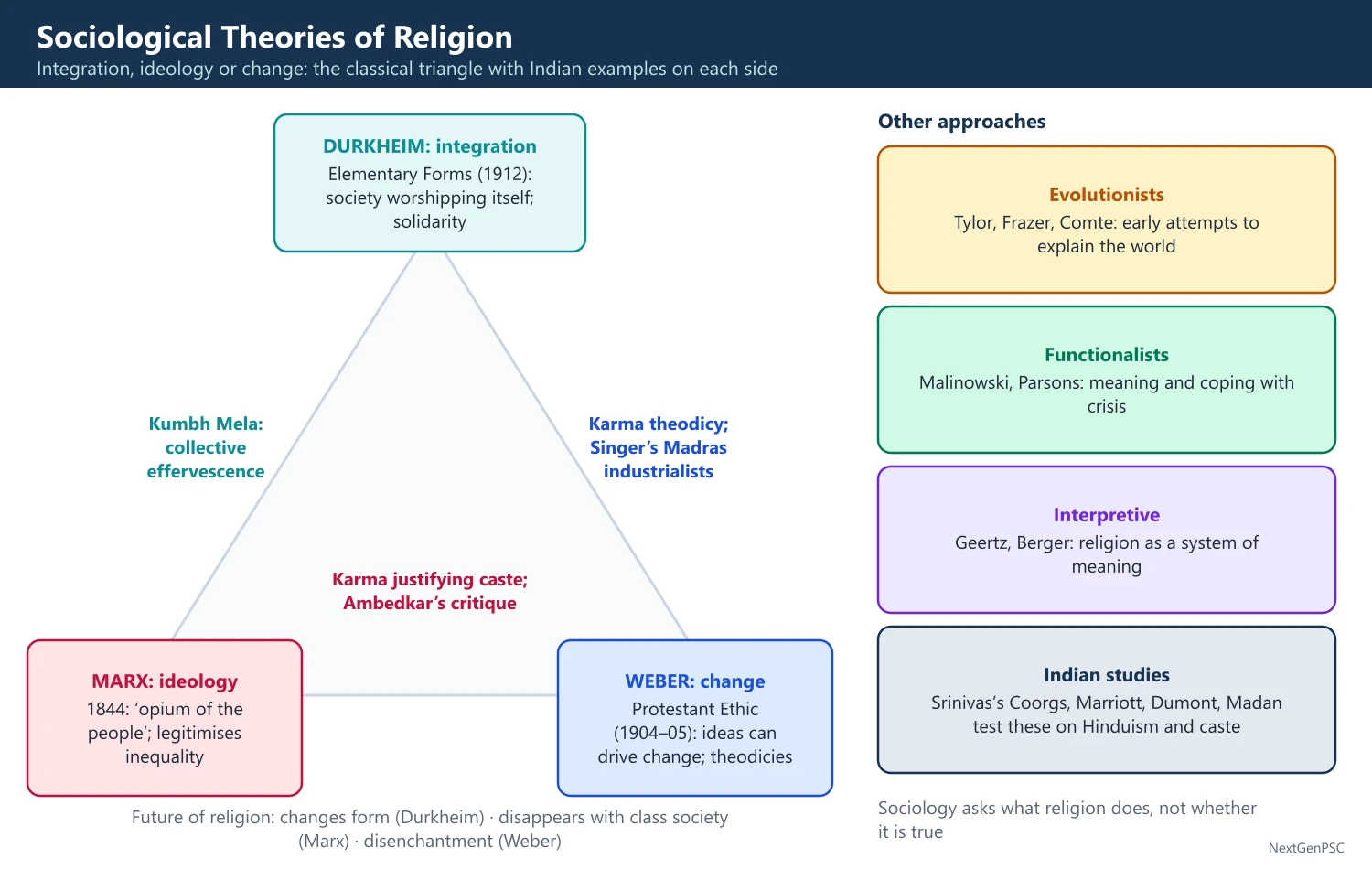
Sociology does not ask whether religious beliefs are true but what religion does in society. Evolutionists (Tylor, Frazer, Comte) traced religion to early attempts to explain the world; functionalists (Durkheim, Malinowski, Parsons) show how it creates solidarity and meaning; Marxists see it as ideology, the 'opium of the people'; Weber shows how religious ideas can drive change; interpretive scholars (Geertz, Berger) treat it as a system of meaning. Indian studies (Srinivas's Coorgs, Marriott, Dumont, Madan) test these theories on Hinduism and caste.
In simple words
Sociologists study religion like a mirror of society: who goes to which temple, why festivals bring people together, and how faith shapes work and politics.
Durkheim said religion is society worshipping itself; Marx said it is a painkiller for the poor; Weber said religious ideas can even help start capitalism.
In India, festivals, caste rules and pilgrimages give rich examples of religion and society.
UPSC asks you to compare these theories and apply them to Indian religion.
1. Defining Religion
Substantive vs functional definitions: substantive definitions say what religion is (belief in the supernatural); functional definitions say what it does (creates solidarity or meaning); inclusive functional definitions may count nationalism or football as religion.
Tylor's minimum definition: religion is 'belief in Spiritual Beings' (Primitive Culture, 1871).
Durkheim's definition: 'a unified system of beliefs and practices relative to sacred things, that is to say, things set apart and forbidden, beliefs and practices which unite into one single moral community called a Church all those who adhere to them' (The Elementary Forms of the Religious Life, 1912).
Sacred and profane: for Durkheim the core of religion is the division of the world into the sacred (set apart, inspiring awe) and the profane (ordinary); anything can become sacred.
Weber: declined to define religion at the start of his Sociology of Religion, preferring to study the conditions and effects of religious action.
Clifford Geertz ('Religion as a Cultural System', 1966): religion is a system of symbols that establishes powerful, pervasive and long-lasting moods and motivations by formulating conceptions of a general order of existence.
Peter Berger (The Sacred Canopy, 1967): religion is the human enterprise by which a sacred cosmos is established; it is a canopy of meaning that protects people from chaos (anomy).
Rudolf Otto (The Idea of the Holy, 1917): the holy is experienced as mysterium tremendum et fascinans, a mystery that both terrifies and attracts.
2. Evolutionary and Intellectualist Theories
Comte: human thought passes through theological, metaphysical and positive (scientific) stages; he later proposed a 'religion of humanity'.
E.B. Tylor: animism, belief in souls and spirits, arose from early humans' attempts to explain dreams, death and trance; it is the minimal and earliest form of religion.
James Frazer (The Golden Bough, 1890): human thought moved from magic to religion to science; magic rests on laws of similarity and contagion.
Max Müller: naturism, the personification of natural forces such as sun and sky, as the origin of religion, based on Vedic studies.
Critique: E.E. Evans-Pritchard (Theories of Primitive Religion, 1965) called these speculative 'if I were a horse' theories, built without fieldwork and with a bias that treated non-Western people as primitive.
3. Functionalist Theories
Durkheim's totemism: studying Australian Aboriginal clans (Arunta), he argued that the totem is the symbol of both the god and the clan, so in worshipping the god people worship society itself.
Collective effervescence: in periodic gatherings, intense shared emotion makes individuals feel a force greater than themselves, renewing commitment to the group.
Functions of religion (Durkheim): disciplinary, cohesive, revitalising and euphoric functions; religion also gives the categories of thought (time, space, cause).
Malinowski (Magic, Science and Religion, 1925): among Trobriand Islanders, magic was used for dangerous open-sea fishing but not for safe lagoon fishing; religion and magic reduce anxiety and help at life crises such as birth, puberty and death.
Radcliffe-Brown (The Andaman Islanders, 1922): rituals express and maintain the social sentiments on which society depends.
Parsons: religion provides the core values of society and answers 'problems of meaning' such as suffering and injustice.
Civil religion: Robert Bellah ('Civil Religion in America', 1967) showed that the American nation has its own sacred symbols, rituals and texts; Republic Day parades in India are a comparable case.
Criticism: functionalism ignores religion's role in conflict (communal riots, sectarian wars) and in change; it fits small, single-religion societies better than plural ones like India.
4. Marxist, Conflict and Feminist Views
Marx (1844, Introduction to A Contribution to the Critique of Hegel's Philosophy of Right): 'Religion is the sigh of the oppressed creature, the heart of a heartless world, and the soul of soulless conditions. It is the opium of the people.'
Ideology: religion legitimises the rule of the dominant class (divine right of kings, karma justifying caste) and offers illusory happiness in an afterlife.
Neo-Marxists: Engels noted early Christianity began as a movement of the oppressed; Otto Maduro (1982) argued religion can be relatively autonomous and revolutionary, as in Latin American liberation theology; Gramsci saw religion as part of hegemony.
Feminist views: religion often legitimises patriarchy through male clergy, purity rules and sacred texts; Karen Armstrong and Linda Woodhead note both oppression and women's agency within faith.
Indian conflict view: B.R. Ambedkar argued that Hindu scriptures sanctioned caste inequality and converted to Buddhism with lakhs of followers at Nagpur on 14 October 1956.
Indian feminist critique: Uma Chakravarti's brahmanical patriarchy links religious purity norms to control over women; the Sabarimala case (2018) raised the question of women's temple entry.
5. Weberian and Interpretive Views
Weber: The Protestant Ethic and the Spirit of Capitalism (1904–05) showed that Calvinist ideas of predestination and the calling encouraged rational, disciplined economic action.
Theodicy: every religion must explain suffering and inequality; Weber called the Hindu doctrine of karma and rebirth the most consistent theodicy ever produced, as it justified caste position by past deeds.
Weber on India (The Religion of India, 1916): he argued that caste and other-worldly ideals did not produce a rational ethic of capitalism; Milton Singer (When a Great Tradition Modernizes, 1972) found Madras industrialists combining Hindu practice with entrepreneurship, challenging Weber.
Prophets and charisma: Weber distinguished ethical prophets (who demand obedience as a duty) from exemplary prophets (who show a path by personal example, like the Buddha); charisma becomes routinised after the founder.
Phenomenological view: Berger and Luckmann (The Social Construction of Reality, 1966) treat religion as a socially constructed reality that legitimises institutions.
Rational choice theory: Rodney Stark and William Bainbridge treat religion as a market where people seek 'compensators' for rewards they cannot obtain; more competition increases religious activity.
6. Indian Studies of Religion
M.N. Srinivas (Religion and Society among the Coorgs of South India, 1952): identified all-India, peninsular, regional and local Hinduism and introduced Sanskritisation; ritual links caste, kinship and village.
Great and little traditions: Robert Redfield (Peasant Society and Culture, 1956) separated the reflective great tradition of the elite from the little tradition of villagers; McKim Marriott's Kishangarhi study (1955) described universalisation (local practices rising into the great tradition) and parochialisation (great tradition elements localised).
Louis Dumont: caste rests on the religious opposition of pure and impure; the Brahmin's ritual status encompasses the king's power.
T.N. Madan (Non-Renunciation, 1987): a study of Kashmiri Pandits showing how householders combine worldly life and religious values.
Data: Census 2011: Hindus 79.8%, Muslims 14.2%, Christians 2.3%, Sikhs 1.7%, Buddhists 0.7%, Jains 0.4% of the population.
Pew Research Center (Religion in India: Tolerance and Segregation, 2021): about 97% of Indians surveyed said they believe in God, and most valued religious tolerance while preferring to keep social life within their own community.
7. Linking and Exam Use
Links: Durkheim's sacred and profane to Dumont's pure and impure; Weber's theodicy to caste; Marx's opium to Ambedkar's critique; Malinowski's anxiety to vrat and pilgrimage before exams or harvest.
10 marks: give one theory's core claim with the thinker's term (collective effervescence, opium, theodicy) and an Indian example.
20 marks: compare Durkheim, Marx and Weber on religion in a table, then show which best explains Indian religion today (festivals as effervescence, religion in politics, entrepreneurial communities like Marwaris and Jains).
Diagram idea: a triangle with Durkheim (integration), Marx (ideology) and Weber (change) at the corners and Indian examples along each side.
Quotation: Marx: 'Religion is the sigh of the oppressed creature … It is the opium of the people' (1844).
| Point | Durkheim | Marx | Weber |
|---|---|---|---|
| Key work | The Elementary Forms of the Religious Life (1912) | Critique of Hegel's Philosophy of Right, Introduction (1844) | The Protestant Ethic (1904–05); The Religion of India (1916–17) |
| What religion is | Society worshipping itself; sacred vs profane | Ideology; opium of the people | Meaningful action; theodicies and ethics |
| Main effect | Solidarity and moral order | False consciousness, legitimises inequality | Can cause social and economic change |
| Future | Will change form, not vanish | Will disappear with class society | Disenchantment through rationalisation |
| Indian application | Kumbh Mela as collective effervescence | Karma justifying caste; Ambedkar's critique | Karma theodicy; Singer's Madras industrialists |
Mains points
- Begin with a definition (Durkheim or Geertz) and the distinction between substantive and functional definitions.
- Compare the classical trio with a table and add one modern view (Berger, Geertz, rational choice) to show depth.
- Every theory should be tested on Indian religion: Srinivas's Coorgs, Marriott's universalisation, Dumont's purity, Ambedkar's critique, Singer's challenge to Weber.
- Avoid presenting Marx as only negative; mention the 'heart of a heartless world' line and neo-Marxist views of religion as protest.
- Show the limits of functionalism in a plural society where religion can divide as well as unite.
- Use Census 2011 and Pew 2021 data for questions on religion's continuing importance.
Did you know?
- Durkheim never visited Australia; he built his theory of totemism from ethnographic reports by Baldwin Spencer and Francis Gillen.
- Memory trick: 'D-M-W = Glue, Drug, Engine' — for Durkheim religion is glue, for Marx a drug, for Weber an engine of change.
Types of Religious Practices: Animism, Monism, Pluralism, Sects and Cults
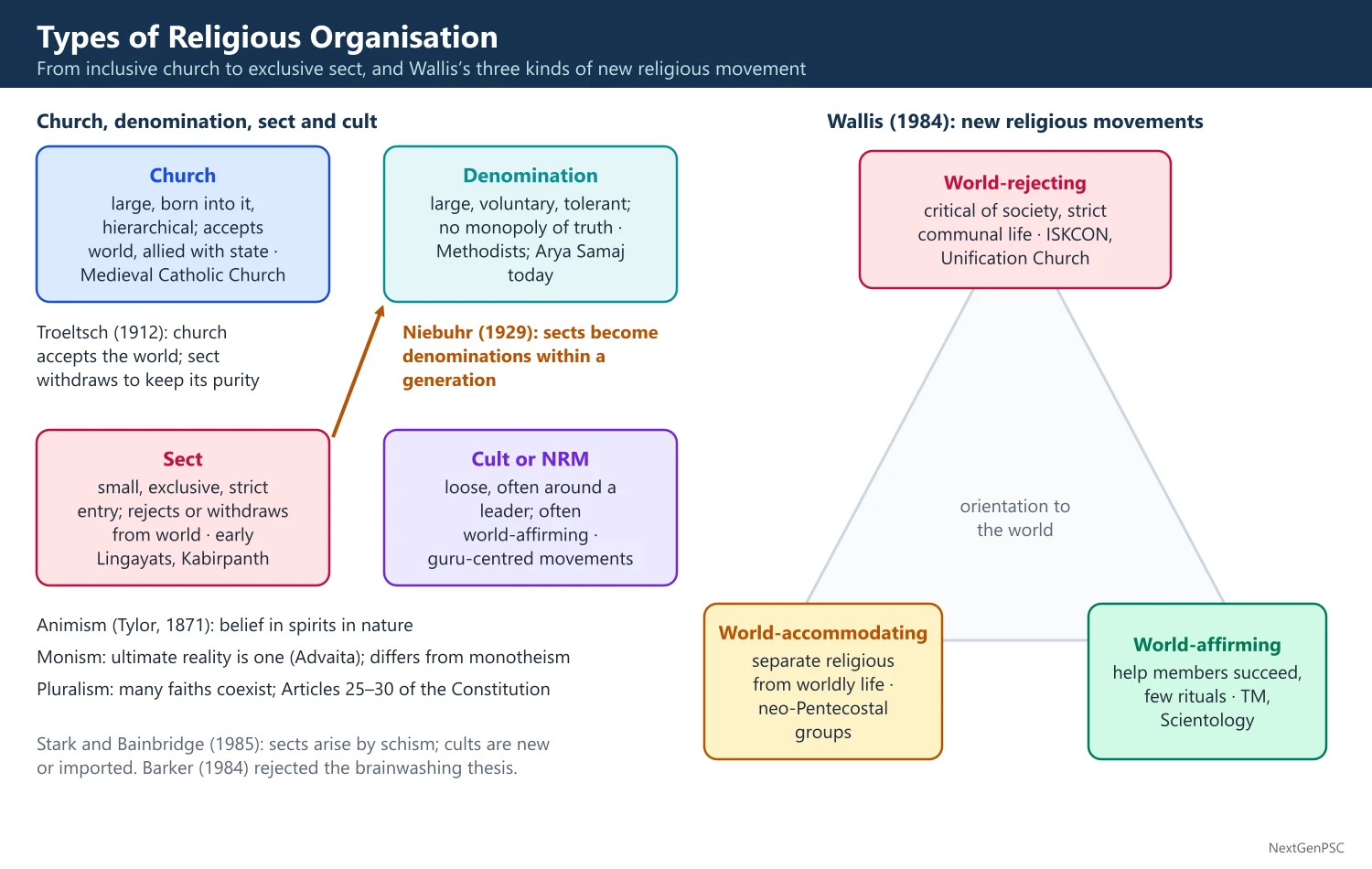
Religious practice takes many forms. Animism (Tylor) is belief in spirits in nature; monism holds that ultimate reality is one (Advaita Vedanta), distinct from monotheism (one personal God); pluralism is the coexistence and acceptance of many faiths. Religious organisations range from the inclusive church and denomination to the exclusive sect and the novel cult (Troeltsch, Niebuhr, Wilson, Wallis, Stark and Bainbridge). India offers tribal animism, Advaita monism, plural coexistence, Bhakti sects, deras and new religious movements.
In simple words
A tribal village that worships the spirit of a sacred grove practises animism; a philosopher who says everything is one Brahman holds monism.
A big temple tradition that anyone can join is like a church; a small strict group that breaks away is a sect; a new group around a guru is often called a cult.
India has all of these side by side, which is pluralism.
UPSC asks you to define each type with thinkers and give Indian examples.
1. Animism, Animatism and Totemism
Animism: E.B. Tylor (Primitive Culture, 1871) defined it as belief in spiritual beings, souls of humans and spirits in animals, plants and objects; he thought it arose from reflection on dreams and death.
Animatism: R.R. Marett (The Threshold of Religion, 1909) argued that an earlier stage was belief in an impersonal supernatural force, like the Melanesian mana described by R.H. Codrington (1891).
Naturism: Max Müller traced religion to the worship of natural phenomena (sun, sky, fire), drawing on the Vedas.
Totemism: a clan's mystical relation with an animal or plant; Durkheim saw it as the elementary form of religion, while Claude Lévi-Strauss (Totemism, 1962) argued that natural species are chosen because they are 'good to think', as a classification system.
Shamanism: a religious specialist (shaman) enters trance to contact spirits for healing or divination; found among many Siberian and Indian tribal groups.
Indian tribal religion: the Munda, Ho and Santhal worship bongas (spirits) and maintain sacred groves (sarna); D.N. Majumdar described Ho beliefs around bonga; Verrier Elwin documented Baiga and Gond religion.
Sarna code demand: Adivasi groups in Jharkhand demand a separate Sarna religion code in the census; the Jharkhand Assembly passed a resolution supporting it in November 2020.
Census: in 2011 about 79 lakh people (0.66%) were recorded under 'Other Religions and Persuasions', mostly tribal faiths, while many tribals were counted as Hindus or Christians, a classification issue that remains debated.
2. Monism, Monotheism and Polytheism
Monism: the philosophical view that ultimate reality is one; in Shankara's Advaita Vedanta, Brahman alone is real, the world is maya (appearance) and the individual self (atman) is identical with Brahman.
Monotheism: belief in one personal God, as in Judaism, Christianity, Islam and Sikhism (Ik Onkar); some textbooks read 'monism' in the syllabus as monotheism, so a good answer covers both.
Polytheism: worship of many gods, as in ancient Greece and in much of popular Hinduism.
Henotheism: Max Müller's term for worship of one god at a time without denying others, which he found in Vedic hymns.
Pantheism: the identification of God with the universe as a whole, close to monism.
India: Hinduism combines monism at the philosophical level with polytheism and local deities at the popular level, matching Redfield's great and little traditions; Srinivas showed that the same villager can worship village goddesses and Sanskritic gods.
Bhakti: devotional movements from the 6th century in Tamil Nadu to Kabir and Mirabai stressed personal devotion to one god and often rejected caste ritual.
3. Religious Pluralism
Meaning: as a social fact, pluralism is the coexistence of many religions in one society; as a value, it is the acceptance that many paths may be valid, going beyond mere tolerance.
Berger: in The Sacred Canopy (1967) he argued that pluralism weakens the taken-for-granted nature of any one faith; in The Many Altars of Modernity (2014) he said modernity produces pluralism rather than secularisation.
Indian tradition: the Rig Vedic line 'Ekam sat vipra bahudha vadanti' (truth is one, the wise call it by many names); Ashoka's Rock Edict XII on respect for all sects; Akbar's sulh-i-kul (peace with all); Gandhi's sarva dharma samabhava.
Syncretism: Sufi shrines such as the Ajmer dargah, Kabir's verses and shared saints like Sai Baba of Shirdi draw followers of several faiths.
Constitutional pluralism: Articles 25–28 guarantee freedom of conscience and religion, and Articles 29–30 protect minority cultural and educational rights.
Limits: Pew's 2021 survey described Indian pluralism as 'tolerance and segregation': people value religious tolerance but most prefer friends and marriage within their own religion.
4. Church, Denomination and Sect
Weber: a church is a compulsory association into which one is born, a sect a voluntary association of the religiously qualified.
Ernst Troeltsch (The Social Teaching of the Christian Churches, 1912): the church is large, inclusive, hierarchical and accepts the world, often allied to the state and upper classes; the sect is small, exclusive, egalitarian, rejects the world and draws on the lower classes.
H. Richard Niebuhr (The Social Sources of Denominationalism, 1929): sects rarely survive beyond one generation as sects; children born into them and rising prosperity turn them into denominations, which are tolerant, accept the world and do not claim a monopoly of truth.
Bryan Wilson (Magic and the Millennium, 1973): classified sects by their response to the world: conversionist, revolutionist (adventist), introversionist, manipulationist, thaumaturgical, reformist and utopian; he argued some sects, such as Jehovah's Witnesses, persist as 'established sects'.
Roy Wallis (The Elementary Forms of the New Religious Life, 1984): world-rejecting (e.g. ISKCON, Unification Church), world-accommodating (e.g. neo-Pentecostal groups) and world-affirming (e.g. Transcendental Meditation, Scientology) new religious movements.
Stark and Bainbridge (The Future of Religion, 1985): sects arise by schism from an existing religion; cults are new religions or imports; cults can be audience cults, client cults or cult movements.
Why sects arise: marginality (Weber: sects attract the disprivileged by offering a theodicy of disprivilege), relative deprivation (Glock, 1964), social change and anomie, and dissatisfaction with a church grown worldly.
Indian sects: Lingayats (Virashaiva) founded on Basava's 12th-century teachings rejected caste ritual; Kabirpanth and Ravidasi panth drew lower castes; Sikhism began as a panth and became a separate religion.
Reform sects: the Brahmo Samaj (1828) and Arya Samaj (1875) were reformist sects within Hinduism, the first universalist and the second revivalist.
5. Cults and New Religious Movements
Cult: a loosely organised group, often centred on a charismatic leader and new or imported beliefs; the term is often used pejoratively, so many sociologists prefer 'new religious movement' (NRM).
Brainwashing debate: Eileen Barker (The Making of a Moonie, 1984) found that most people who attended Unification Church workshops did not join and many who joined later left, rejecting the brainwashing thesis.
Destructive cases: the Peoples Temple at Jonestown (1978, over 900 deaths), Aum Shinrikyo's sarin attack on the Tokyo subway (1995) and Heaven's Gate (1997) show the risks of closed, leader-centred groups.
Explanations of NRM growth: secularisation leaves a spiritual vacuum; post-modern consumer choice; Steve Bruce sees them as a sign of individualised religion that weakens rather than strengthens religion overall.
New Age: Paul Heelas and Linda Woodhead (The Spiritual Revolution, 2005) found a shift from 'religion' to subjective 'spirituality' in Kendal, England.
6. Indian Sects, Deras and Guru Movements
Guru movements: Lawrence Babb (Redemptive Encounters, 1986) studied the Radhasoami movement, the Brahma Kumaris and the Sathya Sai Baba movement as modern Hindu devotional groups.
Deras of Punjab and Haryana: groups such as Dera Sacha Sauda and Dera Sachkhand Ballan attract many Dalit followers seeking dignity outside Sikh and Hindu hierarchies; Ronki Ram has studied this link between caste and deras.
Ravidassia religion: in 2010 Dera Sachkhand Ballan declared a separate Ravidassia religion with its own scripture, an example of a sect becoming a religion.
Dangers: the conviction of Dera Sacha Sauda head Gurmeet Ram Rahim in August 2017 was followed by deadly violence in Panchkula, showing the intense loyalty such groups command.
Global Indian NRMs: ISKCON, founded in New York in 1966 by A.C. Bhaktivedanta Swami Prabhupada, is a world-rejecting movement in Wallis's terms; yoga and meditation movements are world-affirming.
Middle-class spirituality: urban middle classes join meditation and self-improvement movements, which match Wallis's world-affirming type and Heelas's spiritual revolution.
Church–sect in India: Hinduism has no single church; Dumont and others note that the renouncer (sannyasi) has historically been the founder of sects, which then reintegrate into caste society.
7. Using It in the Exam
10 marks: define the term with its thinker (Tylor for animism, Troeltsch for sect) and give one Indian and one world example.
15 or 20 marks: trace the church–sect–denomination–cult typology (Weber, Troeltsch, Niebuhr, Wilson, Wallis, Stark and Bainbridge) and apply it to Indian sects and deras.
Thinkers examiners look for: Tylor, Marett, Durkheim, Lévi-Strauss, Troeltsch, Niebuhr, Wilson, Wallis, Stark and Bainbridge, Barker, Babb.
Diagram idea: Wallis's triangle with world-rejecting, world-accommodating and world-affirming NRMs at the corners and ISKCON, Pentecostal groups and Art of Living-type movements placed accordingly.
Quotation: Troeltsch's idea, paraphrased: the church seeks to dominate the world by accepting it, while the sect withdraws from the world to keep its purity.
| Type | Size and membership | Attitude to world | Example (world / India) |
|---|---|---|---|
| Church | Large, born into it, hierarchical | Accepts and allied with the state | Medieval Catholic Church / no single Hindu church |
| Denomination | Large, voluntary, tolerant | Accepts world, no monopoly of truth | Methodists / Arya Samaj today |
| Sect | Small, exclusive, strict entry | Rejects or withdraws from world | Early Quakers / early Lingayats, Kabirpanth |
| Cult or NRM | Loose, often around a leader | Varies; often world-affirming | Scientology / guru-centred movements |
| Type | Features | Example |
|---|---|---|
| World-rejecting | Critical of society, strict communal life | ISKCON, Unification Church |
| World-accommodating | Separate religious life from worldly, renew faith | Neo-Pentecostal groups |
| World-affirming | Help members succeed in the world, few rituals | Transcendental Meditation, Scientology |
Mains points
- Define animism (Tylor), animatism (Marett) and totemism (Durkheim, Lévi-Strauss) separately; candidates often mix them.
- Clarify monism vs monotheism; covering both shows awareness of how the syllabus is read.
- For sects and cults, trace the typology historically and apply it to Indian cases: Lingayats, Kabirpanth, Arya Samaj, deras, ISKCON.
- Explain why sects arise (marginality, deprivation, social change) and how they change (Niebuhr's denominationalisation).
- For pluralism, combine Indian tradition and the Constitution with evidence of its limits (Pew 2021).
- Use the neutral term 'new religious movement' and note the brainwashing debate.
Did you know?
- Lévi-Strauss turned the question around: animals are chosen as totems not because they are 'good to eat' but because they are 'good to think'.
- Memory trick for Wallis: 'Reject, Accommodate, Affirm' = RAA, like a cheer.
Religion in Modern Society: Science, Secularisation, Revivalism and Fundamentalism
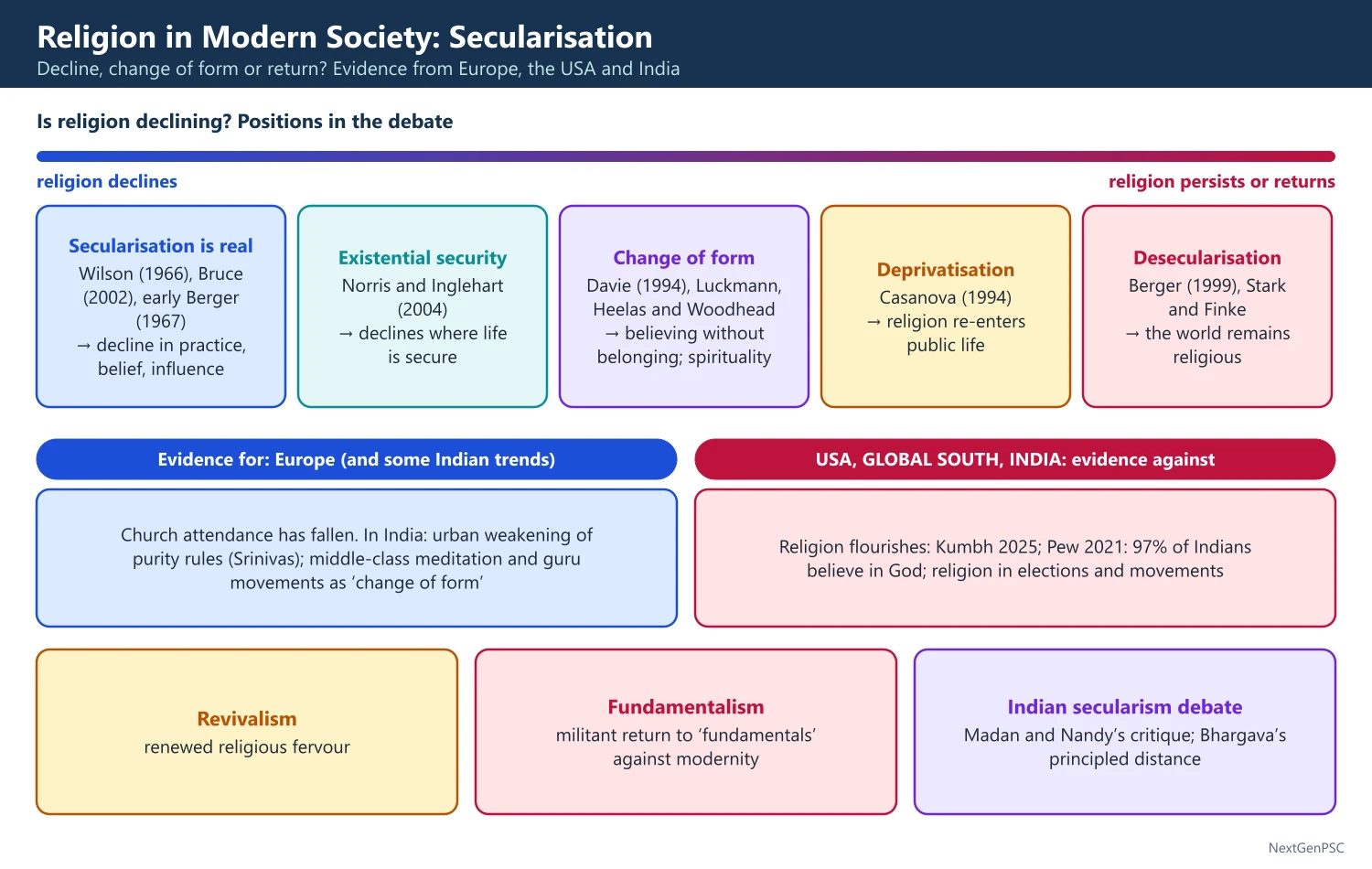
Classical sociologists expected secularisation, the decline of religion's social significance, as science and rationality spread. Evidence is mixed: church attendance fell in Europe, but religion flourishes in the USA, the global South and India, leading Berger to speak of desecularisation and Casanova of public religion. Revivalism (renewed fervour) and fundamentalism (a militant return to 'fundamentals' against modernity) show religion's continuing force. In India the debate includes Madan and Nandy's critique of secularism, Bhargava's principled distance and the rise of religious nationalism.
In simple words
A hundred years ago many thinkers believed science would make religion fade away, like candles after electricity.
Yet today temples, mosques and churches are full, pilgrimages are bigger than ever, and religion shapes elections.
Sociologists debate whether religion is declining (secularisation), changing form, or returning strongly as revivalism and fundamentalism.
UPSC asks about these debates and how they apply to India.
1. Religion and Science
Conflict thesis: 19th-century writers such as John Draper (1874) and Andrew Dickson White (1896) portrayed a long war between science and religion, citing Galileo's trial (1633) and opposition to Darwin's On the Origin of Species (1859); historians now see this as oversimplified.
Positivist view: Comte expected science to replace theology; Frazer saw science as the final stage after magic and religion.
Merton thesis (1938, Science, Technology and Society in Seventeenth-Century England): Puritan values of utility, rationalism and glorifying God through studying nature encouraged the growth of English science, a Weberian argument.
Complementarity: Stephen Jay Gould (1997) proposed 'non-overlapping magisteria': science deals with facts, religion with meaning and values; Malinowski earlier showed that Trobrianders used both practical knowledge and magic.
Indian context: Article 51A(h), added by the 42nd Amendment (1976), makes developing scientific temper a fundamental duty; Nehru championed scientific temper.
Anti-superstition laws: after the murder of rationalist Narendra Dabholkar in August 2013, Maharashtra enacted an anti-superstition and black magic law in 2013; Karnataka passed a similar Act in 2017.
2. The Secularisation Thesis and Its Critics
Definition: Bryan Wilson (Religion in Secular Society, 1966) defined secularisation as the process whereby religious thinking, practice and institutions lose social significance.
Dimensions: Karel Dobbelaere (1981) separated societal secularisation (differentiation of institutions), organisational secularisation (change within churches) and individual secularisation (decline of belief and practice).
Classical roots: Weber's disenchantment of the world through rationalisation; Durkheim's view that religion's functions pass to other institutions; Parsons's structural differentiation.
Berger's early view (1967): pluralism and rationalisation destroy the sacred canopy, making religion a matter of private choice.
Evidence for: falling church attendance and membership in Britain and Western Europe; Steve Bruce (God is Dead, 2002) is the leading defender of the thesis.
Believing without belonging: Grace Davie (1994) found that many Britons still believe privately but do not attend church, so attendance underestimates religiosity.
José Casanova (Public Religions in the Modern World, 1994): secularisation contains three claims: differentiation of spheres, decline of belief and privatisation; only differentiation holds, while religions have 'deprivatised' and re-entered public life.
Berger's revision (The Desecularization of the World, 1999): the world is as 'furiously religious' as ever, with Western Europe and a global intellectual elite as exceptions.
Existential security: Pippa Norris and Ronald Inglehart (Sacred and Secular, 2004) argued that religion declines where people feel economically and physically secure and persists where they do not, explaining high religiosity in poorer societies.
Rational choice critique: Stark and Finke argue that religious demand is stable; religious markets with competition (USA) have high participation, while state monopolies (Scandinavia) have low participation.
3. Secularisation and Secularism in India
Constitutional secularism: the word 'secular' was added to the Preamble by the 42nd Amendment (1976); in S.R. Bommai v. Union of India (1994) the Supreme Court held secularism to be part of the basic structure.
Indian model: Rajeev Bhargava calls it 'principled distance', where the state may intervene in or support religions for the sake of equality and freedom (for example abolishing untouchability and opening temples), unlike strict Western separation.
T.N. Madan ('Secularism in its Place', 1987): argued that secularism is a gift of Christianity, unsuited to South Asia where religion is a totalising life-world, and that imposing it provokes fundamentalism.
Ashis Nandy (1988): in an 'anti-secularist manifesto' argued that modern secular state ideology weakened traditional tolerance rooted in faith and fuelled communal violence.
Srinivas (Social Change in Modern India, 1966): described secularisation as a process where purity–pollution rules weaken and rationalism spreads, especially among urban educated groups.
Counter-evidence: growth of pilgrimage and religious tourism, temple building and religious television; the Uttar Pradesh government claimed over 66 crore visits at the Prayagraj Maha Kumbh (2025).
Data: the Pew survey (2021) found that about 97% of Indians believe in God, which argues against individual secularisation.
Balanced view: India shows institutional differentiation (law, education, medicine separated from religion) but not decline of belief, matching Casanova's argument.
4. Religious Revivalism
Meaning: renewed fervour and assertion of a religion, often presented as a return to an earlier, purer form, and often a response to rapid social change, colonialism or perceived threats.
World examples: the Great Awakenings in America, the global Pentecostal boom, and the Islamic resurgence after the 1979 Iranian Revolution; Gilles Kepel (The Revenge of God, 1991) described simultaneous Christian, Jewish and Islamic revivals from the 1970s.
Colonial India: Arya Samaj (1875) called for a return to the Vedas; the Deoband seminary (1866) promoted Islamic reform; the Singh Sabha movement (1873) defined Sikh identity.
Contemporary India: the Ram Janmabhoomi movement of the 1980s led to the demolition of the Babri Masjid on 6 December 1992; the Supreme Court's verdict of 9 November 2019 allotted the site for a temple, consecrated on 22 January 2024.
Other forms: the Tablighi Jamaat (founded 1926) as an Islamic revival movement; the spread of Pentecostal churches; Buddhist revival among Dalits after Ambedkar's conversion in 1956.
Explanations: identity politics, media, migration, the anxieties of globalisation and middle-class aspirations; Christophe Jaffrelot and others link Hindu revivalism to political mobilisation.
5. Fundamentalism
Origin of the term: from The Fundamentals, pamphlets published by American Protestants between 1910 and 1915 defending biblical literalism.
Fundamentalism Project: Martin Marty and Scott Appleby (1991–95) identified features: reaction against modernity's marginalisation of religion, selectivity, moral dualism, absolutism and inerrancy, millennialism, an elect membership, sharp boundaries, authoritarian leadership and strict behavioural rules.
Giddens: fundamentalism is 'tradition defended in the traditional way', a response to globalisation that refuses dialogue in a world that demands reasons.
Castells: fundamentalism is a form of 'resistance identity' against the network society (The Power of Identity, 1997).
Clash of civilisations: Samuel Huntington (1996) predicted conflict between civilisations defined by religion; Edward Said and others criticised this as essentialist.
India: communalism, which Bipan Chandra described as moving from communal nationalism to liberal and extreme communalism, overlaps with fundamentalism; the Khalistan movement of the 1980s and Operation Blue Star (June 1984) are often cited; scholars caution that the label is contested and should not be applied to whole communities.
Fundamentalism and gender: most fundamentalist movements seek to restore patriarchal control over women's dress, mobility and sexuality.
6. Linking and Exam Use
Links: Weber's rationalisation to secularisation; Durkheim's prediction that religion changes form to civil religion and nationalism; Marx's ideology to religious nationalism; Berger's pluralism to Indian plural society.
10 marks: define secularisation (Wilson) and give one argument for and one against, with an Indian example.
20 marks: 'Is secularisation a myth?' Present Wilson and Bruce, then Davie, Casanova, Berger's revision, Norris and Inglehart, and Indian evidence (Madan, Nandy, Bhargava, Kumbh, Pew).
Diagram idea: a two-column table of evidence for and against secularisation, with Europe on one side and the USA and India on the other.
Quotation: Berger (1999), paraphrased: the assumption that we live in a secularised world is false; the world today is as furiously religious as it ever was.
| Position | Thinkers | Main argument | Indian relevance |
|---|---|---|---|
| Secularisation is real | Wilson (1966), Bruce (2002), early Berger (1967) | Decline in practice, belief and social influence | Urban weakening of purity rules (Srinivas) |
| Change of form | Davie (1994), Luckmann, Heelas and Woodhead | Believing without belonging; spirituality | Middle-class meditation and guru movements |
| Deprivatisation | Casanova (1994) | Religion re-enters public life | Religion in elections and movements |
| Desecularisation | Berger (1999), Stark and Finke | World remains religious; markets boost faith | Kumbh 2025, Pew 2021 (97% believe in God) |
| Existential security | Norris and Inglehart (2004) | Religion declines with security | High religiosity amid insecurity |
Mains points
- Distinguish secularisation (a social process) from secularism (a state policy or ideology); confusing them is a common mistake.
- Present the thesis, its dimensions (Dobbelaere) and its critics (Davie, Casanova, Berger, Norris and Inglehart, Stark) in a balanced way.
- For India, use Srinivas, Madan, Nandy and Bhargava together with constitutional facts (42nd Amendment 1976, Bommai 1994).
- Treat revivalism and fundamentalism with careful, neutral language, with examples from several religions and the world.
- Use Marty and Appleby's features or Giddens's definition for fundamentalism questions; examiners reward precise features.
- For religion and science, mention the Merton thesis, Article 51A(h) and anti-superstition laws to bring in Indian content.
Did you know?
- Peter Berger is one of the few major sociologists to publicly reverse his own famous theory, from predicting secularisation in 1967 to announcing desecularisation in 1999.
- Memory trick for Casanova: 'D-D-P' — Differentiation (holds), Decline (fails), Privatisation (fails).
UPSC Previous Year Questions: Religion and Society
From 2014 to 2026 UPSC asked 26 question parts worth 370 marks from Religion and Society, all in Paper I. The most-asked topics are types of religious practice (11 parts: sects, cults, new religious movements, animism, totemism and pluralism) and religion in modern society (10 parts: secularisation, revivalism, fundamentalism and science), followed by the classical theories of Durkheim, Marx and Weber (5 parts). Every question below has a model answer written to the UPSC word limit.
In simple words
Read the question and spend five minutes jotting down the thinkers, concepts and Indian examples you would use.
Write your own answer within the word limit (150 words for 10 marks, 250 for 20 marks) before opening the model answer.
Then compare: check the approach line, the thinkers named, the Indian examples and the conclusion, and note what you missed.
1. Sociological Theories of Religion
Example 1 (UPSC 2025, 20 marks): How do theories of Marx, Weber and Durkheim differ in understanding religion? Explain.
Paper and question: Paper I, Q7(b)
Approach: The question wants a comparison of the three classical theories of religion. Open with the shared question (what does religion do for society), compare Durkheim (integration), Marx (ideology) and Weber (meaning and change) point by point with Indian examples, and end with how they complement each other.
Marx, Durkheim and Weber all explained religion sociologically, but asked different questions: Durkheim how religion holds society together, Marx whose interests it serves, and Weber how religious ideas shape action and change.
Durkheim (The Elementary Forms of the Religious Life, 1912) defined religion through the division of the world into sacred and profane. Studying Australian Aboriginal totemism, he argued that the totem symbolises both the god and the clan, so in worshipping the god people worship society itself. Rituals produce collective effervescence and renew solidarity. Kumbh gatherings or village jatras in India show this integrative function.
Marx called religion 'the opium of the people' (1844): an illusory happiness that eases the pain of exploitation and legitimises the rule of the dominant class. The doctrine of karma justifying caste position, and Ambedkar's rejection of scriptures that sanctioned untouchability, fit this conflict view.
Weber treated religion as an independent cause. In The Protestant Ethic and the Spirit of Capitalism (1904–05) he argued that Calvinist predestination and the idea of a calling produced the disciplined, rational conduct capitalism needed. In The Religion of India (1916) he held that karma, the most consistent theodicy, and other-worldly ideals blocked such an ethic, a view Milton Singer's study of Madras industrialists challenged.
Flow chart: Durkheim: religion → collective rituals → solidarity (stability); Marx: class domination → religion as ideology → false consciousness; Weber: religious ideas → ethic of conduct → economic change.
Thus Durkheim stresses order, Marx domination and Weber meaning and change. Durkheim is criticised for ignoring religious conflict in plural societies, Marx for reducing belief to economics (neo-Marxists like Otto Maduro show religion can be revolutionary), and Weber for a contested reading of Calvinism and India.
Together they explain Indian religion better than any one alone: festivals integrate, religious mobilisation reflects interests, and Jain and Marwari communities show ethics shaping economic life.
Example 2 (UPSC 2021, 10 marks): Critically compare the views of E.B. Tylor and Max Muller on Religion.
Paper and question: Paper I, Q5(c)
Approach: A critical comparison of two evolutionary, intellectualist theories of the origin of religion: Tylor's animism and Max Müller's naturism. Define each, compare their sources and logic, then give the common criticism (Durkheim, Evans-Pritchard) with an Indian example.
E.B. Tylor and Max Müller were 19th-century evolutionary and intellectualist theorists who traced religion to early humans' attempts to explain their experience.
Tylor (Primitive Culture, 1871) defined religion minimally as 'belief in Spiritual Beings'. Reflecting on dreams, trance and death, early humans inferred a soul separate from the body and extended souls to animals, plants and objects. This animism was the earliest religion, from which polytheism and monotheism evolved.
Max Müller, drawing on the Vedas, found the origin in naturism: awe at sun, sky, fire and dawn, personified as gods like Surya, Agni and Varuna.
Tylor starts from inner experience and ethnographic reports, Müller from external nature and philology; both explain religion as an individual's mistaken reasoning.
Durkheim objected that an illusion could not last so long and that neither explains the sacred or collective ritual; Evans-Pritchard called such theories speculative 'if I were a horse' reasoning. Munda worship of bongas alongside nature deities shows elements of both.
Example 3 (UPSC 2020, 10 marks): State the reasons for the various religious beliefs and practices in pre-modern societies.
Paper and question: Paper I, Q5(d)
Approach: The question asks for the causes of religious belief and practice in pre-modern societies. Organise the reasons by theory: intellectual (Tylor, Frazer), emotional or psychological (Malinowski), social (Durkheim, Radcliffe-Brown) and power (Marx), with tribal Indian examples.
In pre-modern societies religion pervaded economy, kinship and politics, for several reasons.
Need to explain: Tylor traced animism to reflection on dreams and death, and Frazer (The Golden Bough, 1890) saw magic and religion as early attempts to explain and control nature before science.
Uncertainty and anxiety: Malinowski found that Trobriand Islanders used magic for dangerous open-sea fishing but not in the safe lagoon; religion helps at life crises such as birth, puberty and death. Rain rituals and harvest festivals among Indian peasants serve the same purpose.
Social solidarity: for Durkheim, totemic rituals expressed and renewed the unity of the clan, and Radcliffe-Brown showed that Andamanese rituals maintained social sentiments. The Santhal and Munda sacred grove (sarna) is the focus of village unity.
Legitimation and control: Marx and later conflict theorists saw religion as sanctioning the authority of chiefs, priests and kings, as in divine kingship.
With low technology and close-knit communities, religion supplied explanation, comfort, unity and order at once.
Example 4 (UPSC 2019, 20 marks): Are all world religions patriarchal? Substantiate your answer with examples.
Paper and question: Paper I, Q3(b)
Approach: The question asks for a judgement on whether world religions are patriarchal. Define patriarchy, give the feminist case with examples from several religions, then the counter-evidence of women's agency and egalitarian strands, and conclude that religions are largely patriarchal in organisation but not uniformly so.
Patriarchy, in Sylvia Walby's sense, is a system of social structures and practices in which men dominate, oppress and exploit women. Feminist sociologists argue that most world religions have legitimised it, though the picture is not uniform.
Evidence of patriarchy: in organisation, the Catholic priesthood, most Islamic religious leadership and Hindu temple priesthood remain male. Sacred texts often prescribe female subordination, as in the Manusmriti's insistence that a woman be guarded by father, husband and son. Purity rules restrict women: menstrual taboos kept women of reproductive age out of Sabarimala until the Supreme Court's 2018 verdict, and the Bombay High Court opened the inner sanctum of Haji Ali dargah to women in 2016. Uma Chakravarti calls the Indian form brahmanical patriarchy, linking caste purity to control over women's sexuality.
Counter-evidence: religions also contain egalitarian strands. Sikh teaching rejects the inferiority of women, the Buddha admitted women to the order of nuns, and bhakti saints such as Mirabai and Akka Mahadevi defied male authority. Goddess worship (Shakti) is central to Hinduism. Linda Woodhead and Karen Armstrong argue that women often use religion to gain space, community and dignity, and Saba Mahmood's study of the women's mosque movement in Egypt shows agency within piety.
Founders' messages were often more egalitarian than later institutions, which absorbed their societies' patriarchy; patriarchy is thus social rather than inherent in religion.
Reform is visible today: women priests in some Protestant churches and the Shayara Bano judgment (2017) against instant triple talaq.
Therefore most world religions are patriarchal in their institutions and dominant interpretations, but not all of their teachings are, and women's agency is reshaping them.
Example 5 (UPSC 2016, 20 marks): How is Durkheim's theory of religion different from Max Weber's theory of religion?
Paper and question: Paper I, Q8(b)
Approach: A focused comparison of Durkheim and Weber on religion: definition, method, unit of study, function and relation to change. Use a point-wise comparison, an Indian illustration for each, and conclude on their complementarity.
Durkheim and Weber both rejected the view that religion is mere illusion and treated it as central to social life, but they differed in method, focus and conclusions.
Definition and method: Durkheim defined religion as a unified system of beliefs and practices relative to sacred things that unites adherents into a moral community. He used a positivist method, treating religion as a social fact and studying its simplest form, Australian totemism. Weber refused to define religion at the outset and used verstehen, interpreting the meanings believers attach to their action, and compared world religions historically.
Function versus meaning: for Durkheim the god is society worshipped symbolically; ritual produces collective effervescence and solidarity, and religion even supplies the categories of thought. For Weber religion answers the problem of meaning through theodicy, the explanation of suffering, and shapes economic ethics.
Stability versus change: Durkheim stressed integration and continuity, while Weber showed religion as a cause of change: the Protestant ethic aided capitalism, and charismatic prophets break tradition until charisma is routinised.
Level: Durkheim worked at the level of the collectivity; Weber at the level of individual action and of status groups such as priests, prophets and intellectuals who carry religions.
In India, Durkheim helps explain festivals and Dumont's sacred hierarchy of pure and impure, while Weber helps explain karma as a theodicy of caste and the business ethic of Jains. Durkheim is criticised for ignoring conflict, Weber for an Orientalist reading of India.
The two are complementary: Durkheim shows what religion does for groups, Weber what it means to actors and how it changes history.
2. Types of Religious Practices: Animism, Monism, Pluralism, Sects and Cults
Example 6 (UPSC 2026, 10 marks): How does the rise of new 'cults' and 'sects' influence intercaste relations?
Paper and question: Paper I, Q6(c)
Approach: Define sects and cults (Troeltsch, Stark and Bainbridge), then show how new sects and cults both loosen caste boundaries (egalitarian membership, Dalit deras) and reproduce them (caste-specific followings, conflict with dominant castes), ending with a balanced view.
A sect, in Troeltsch's sense, is a small, voluntary, egalitarian group that breaks away from an established religion, while a cult, for Stark and Bainbridge, is a new or imported faith, often around a charismatic leader. Both affect intercaste relations in India.
Bridging caste: membership is by choice, not birth, so sects often reject caste ritual, as Basava's Lingayats and the Kabirpanth did. Today deras such as Dera Sacha Sauda and Dera Sachkhand Ballan give Dalit followers dignity and shared kitchens, and guru movements like the Radhasoami movement (Lawrence Babb) build cross-caste devotional communities.
Reproducing caste: many sects become caste-specific. Ronki Ram shows that deras express Dalit assertion against dominant Jat Sikhs, which can sharpen boundaries, as in the separate Ravidassia religion declared in 2010. As Dumont noted, sects founded by renouncers tend to be reabsorbed into caste society.
Thus new sects and cults ease ritual hierarchy and create spaces of equality, but they also become vehicles of caste identity and competition rather than ending caste.
Example 7 (UPSC 2024, 10 marks): Discuss the concept of animism and differentiate it from naturism.
Paper and question: Paper I, Q6(c)
Approach: Define animism (Tylor) and naturism (Max Müller), then distinguish them on the object of belief, origin and source, adding Durkheim's critique and an Indian tribal example.
Animism, a term made central by E.B. Tylor (Primitive Culture, 1871), is belief in spiritual beings: souls of humans and spirits residing in animals, plants, rivers and objects. Tylor held that early humans inferred a soul from dreams, trance and death, and regarded animism as the earliest form of religion.
Naturism, associated with Max Müller, traces religion to the worship of natural forces such as sun, sky, fire and storm, which inspire awe and are personified as gods; Müller drew on Vedic deities like Agni, Surya and Varuna.
The two differ in three ways. The object of animism is souls and spirits, of naturism the great forces of nature. Animism begins from inner experience, naturism from external phenomena. Tylor relied on ethnography, Müller on philology.
Durkheim rejected both as making religion an illusion, preferring totemism. Among the Munda and Ho, bongas (spirits) and sun worship coexist, showing that animism and naturism overlap in practice.
Example 8 (UPSC 2024, 20 marks): How do you understand the phenomena of the mushrooming of sects and cults in contemporary society? Discuss the factors responsible for the trend.
Paper and question: Paper I, Q7(b)
Approach: Explain what sects and cults are, describe their contemporary growth with Indian and global examples, then discuss the factors (secularisation, anomie, deprivation, market choice, media, charisma) with named theorists, and conclude on what the trend means for religion.
Troeltsch defined the sect as a small, exclusive, voluntary group that rejects the world, and Stark and Bainbridge called cults new or imported religions, often loosely organised around a charismatic leader. Many sociologists now use the neutral term new religious movements (NRMs).
The trend: since the 1960s NRMs have multiplied: ISKCON (1966), the Unification Church, Scientology and Pentecostal churches worldwide; in India, deras in Punjab and Haryana, guru movements such as the Brahma Kumaris and Sathya Sai Baba movement studied by Lawrence Babb, and middle-class meditation movements.
Factors: First, secularisation of mainstream churches leaves a spiritual vacuum, and Bryan Wilson saw NRMs as a sign of religion's marginality. Second, rapid social change, migration and urban anomie push people towards close communities. Third, relative deprivation (Glock) and Weber's theodicy of disprivilege attract the marginal, as Dalits join deras for dignity. Fourth, Roy Wallis notes that world-affirming movements offer the affluent self-improvement and success. Fifth, rational choice theorists see a competitive religious market offering many products. Finally, television, social media and charismatic leaders spread them fast.
Flow chart: social change and anomie → search for meaning, community or status → charismatic leader → sect or cult → routinisation into denomination (Niebuhr).
Assessment: Steve Bruce sees this pluralism as weakening religion, while Heelas and Woodhead see a shift from religion to personal spirituality. Cases such as the violence after Gurmeet Ram Rahim's conviction in 2017 show risks.
The mushrooming of sects and cults thus reflects not the end of religion but its individualisation and diversification in modern society, and calls for regulation of exploitative groups without curbing religious freedom.
Example 9 (UPSC 2023, 10 marks): Highlight the differences and similarities between totemism and animism.
Paper and question: Paper I, Q4(c)
Approach: Define totemism (Durkheim, Lévi-Strauss) and animism (Tylor), then set out the differences and similarities point by point with an Indian tribal example.
Animism, for E.B. Tylor (1871), is belief in spiritual beings, souls and spirits dwelling in humans, animals, plants and objects. Totemism is a mystical relationship between a clan and an animal or plant (the totem), which Durkheim (1912), studying the Australian Arunta, called the elementary form of religion.
Differences: animism is a belief about souls everywhere, held by individuals; totemism is a clan institution linking a group to one species, with taboos on killing or eating the totem and clan exogamy. For Durkheim the totem symbolises the clan itself, whereas Tylor explained animism by individual reasoning about dreams. Lévi-Strauss (1962) treated totemism as a classification system, since species are 'good to think'.
Similarities: both are found in simple societies, both sacralise nature, and both were used by evolutionists to locate the origin of religion.
In India, Munda, Oraon and Santhal clans (kili, gotar) carry totemic names and observe exogamy, while also worshipping spirits (bongas), so the two often coexist.
Example 10 (UPSC 2023, 10 marks): What functions does religion perform in a pluralistic society?
Paper and question: Paper I, Q5(c)
Approach: Define a pluralistic society, then list the functions religion performs there (integration within groups, meaning, identity, civil religion, social service, dialogue) and the dysfunctions, with Indian examples and thinkers.
A pluralistic society is one where several religions coexist, as in India where Census 2011 recorded Hindus 79.8%, Muslims 14.2%, Christians 2.3% and Sikhs 1.7%. Durkheim's integrative view, built on single-religion societies, must be adapted here.
Functions: religion integrates each community and gives meaning and identity (Durkheim, Parsons). Shared syncretic sites such as the Ajmer dargah and Shirdi Sai Baba create bridges across faiths. A civil religion (Bellah) of constitutional symbols, Republic Day and national heroes provides overarching unity. Religious bodies run schools, hospitals and langars, and interfaith ideals such as Gandhi's sarva dharma samabhava teach tolerance. Berger notes that pluralism makes faith a matter of choice.
Dysfunctions: religion can divide: communal riots and Pew's 2021 finding of 'tolerance and segregation' show limited mixing.
Hence in plural societies religion integrates mainly within groups, and wider unity depends on secular, constitutional values.
Example 11 (UPSC 2023, 20 marks): What are new religious movements? Elaborate emphasizing their forms and orientations.
Paper and question: Paper I, Q8(b)
Approach: Define new religious movements, explain why the term replaced 'cult', classify their forms with Wallis (world-rejecting, world-affirming, world-accommodating) and Stark and Bainbridge, add orientations by Wilson, illustrate with global and Indian cases, and assess.
New religious movements (NRMs) are religious or spiritual groups of recent origin, mostly since the 1950s, that stand outside the mainstream churches and faiths. Sociologists such as Eileen Barker prefer the term to 'cult', which carries a negative charge. Wallis classified them by their orientation to the world.
Forms (Roy Wallis, 1984): world-rejecting movements are critical of the world and demand total commitment and communal life, such as ISKCON and the Unification Church. World-affirming movements accept the world and promise success, health and self-realisation through techniques, such as Transcendental Meditation and Scientology. World-accommodating movements are offshoots of existing faiths that renew personal spirituality while leaving the world largely as it is, such as neo-Pentecostal groups.
Flow chart: attitude to the world → rejecting (ISKCON) / accommodating (Pentecostal) / affirming (TM, meditation movements).
Other classifications: Stark and Bainbridge separate audience cults (consumers of books or media), client cults (therapist and client) and cult movements (full religions). Bryan Wilson classified sects by orientation to salvation, such as conversionist, revolutionist, introversionist, manipulationist and thaumaturgical.
India: Lawrence Babb studied the Radhasoami movement, the Brahma Kumaris and the Sathya Sai Baba movement; deras attract Dalits; urban middle classes join world-affirming meditation movements.
Assessment: Barker's The Making of a Moonie (1984) rejected the brainwashing thesis, as most recruits left voluntarily, though Jonestown (1978) shows the dangers of closed groups. Bruce reads NRMs as evidence of secularisation, while Heelas and Woodhead see a spiritual revolution.
NRMs thus show religion diversifying and becoming personal rather than disappearing; in India they coexist with, and often draw on, established traditions of guru and bhakti.
Example 12 (UPSC 2021, 10 marks): What is cult? Explain the growth of cults in the contemporary world.
Paper and question: Paper I, Q5(d)
Approach: Define cult (Stark and Bainbridge, Wallis) and its features, then explain its growth with sociological causes and Indian and world examples in a short, structured answer.
A cult is a loosely organised religious group with new or imported beliefs, usually centred on a charismatic leader. Stark and Bainbridge distinguish it from a sect, which breaks away from an existing faith, and Roy Wallis noted that cults are tolerant of other beliefs, unlike sects. The neutral term new religious movement is now preferred.
Growth: first, secularisation and the decline of mainstream churches leave a spiritual vacuum. Second, urban anomie and loneliness create a search for community. Third, affluent groups seek self-improvement, which Wallis's world-affirming cults offer, such as Transcendental Meditation. Fourth, globalisation and media spread imported faiths, as ISKCON spread from New York (1966) and yoga-based movements went global. Fifth, in rational choice terms a free religious market encourages new 'products'.
Indian examples include guru-centred movements and deras, while Jonestown (1978) and Aum Shinrikyo (1995) show dangers.
Bruce sees cults as signs of weakened religion, Heelas as a spiritual revolution.
Example 13 (UPSC 2018, 20 marks): What are sects? Discuss their role in multi-religious societies with empirical examples.
Paper and question: Paper I, Q8(b)
Approach: Define sects using the church–sect typology (Weber, Troeltsch, Niebuhr, Wilson), then discuss their role in multi-religious societies, positive and negative, with empirical examples from India and elsewhere, and conclude.
For Weber, a church is a compulsory association into which one is born, while a sect is a voluntary association of the religiously qualified. Ernst Troeltsch (1912) described sects as small, exclusive, egalitarian groups that reject the world and draw on the lower classes. H. Richard Niebuhr argued that sects tend to become denominations within a generation, while Bryan Wilson showed that some persist as established sects and classified them by response to the world.
Role in multi-religious societies:
First, protest and equality: Weber noted that sects offer the disprivileged a theodicy of disprivilege. In India the Lingayats of Basava, the Kabirpanth and the Ravidasi panth rejected caste ritual, and today deras such as Dera Sachkhand Ballan give Dalits dignity, as Ronki Ram has shown.
Second, bridging faiths: syncretic sects such as the Kabirpanth and followers of Sufi orders draw Hindus and Muslims alike, sustaining pluralism.
Third, new religions: sects may become separate faiths, as Sikhism grew from a panth and the Ravidassia religion was declared in 2010, adding to diversity.
Fourth, conflict: sects can sharpen boundaries, as in the 2007 clashes between Dera Sacha Sauda followers and Sikh groups in Punjab and the violence in Panchkula after its head's conviction in 2017. Sectarian divisions within religions, such as Shia–Sunni conflict in West Asia or the Ahmadiyya's exclusion in Pakistan, show their divisive side.
Thus sects are carriers of protest, pluralism and religious innovation, but their exclusiveness can also fuel conflict in plural societies.
Example 14 (UPSC 2017, 10 marks): Elaborate on various types of religious practices prevalent in Indian society.
Paper and question: Paper I, Q8(c)
Approach: Survey the main types of religious practice in India (animism and totemism, polytheism and monism, sects and bhakti, syncretism and pluralism, guru movements) using Srinivas, Redfield and Marriott, in a compact classified answer.
Indian society contains almost every type of religious practice that sociologists classify, often coexisting within one community.
Animism and totemism: tribes such as the Munda, Ho and Santhal worship bongas and keep sacred groves (sarna), and clans carry totemic names with exogamy.
Polytheism and monism: popular Hinduism worships many gods and village deities, while Advaita Vedanta holds that Brahman alone is real. Redfield's great and little traditions and McKim Marriott's study of Kishangarhi (universalisation and parochialisation) show how these levels interact; Srinivas identified all-India, regional and local Hinduism among the Coorgs.
Monotheism and sects: Islam, Christianity and Sikhism are monotheistic; bhakti panths, Lingayats and deras form sects around gurus.
Syncretism and pluralism: Sufi dargahs and Shirdi Sai Baba draw devotees across faiths.
Modern forms: guru movements and the Brahma Kumaris, studied by Lawrence Babb, and televised rituals show religion adapting to modern life.
Example 15 (UPSC 2016, 20 marks): "Religious pluralism is the order of present-day societies." Explain by giving suitable examples.
Paper and question: Paper I, Q7(a)
Approach: Explain religious pluralism as a fact and as a value (Berger), show why it is the order of present-day societies (migration, globalisation, NRMs, constitutional freedoms) with Indian and world examples, then note its limits and tensions, and conclude.
Religious pluralism means, as a social fact, the coexistence of many religions within one society and, as a value, the acceptance that several faiths may be valid, going beyond mere tolerance. Peter Berger argued in The Many Altars of Modernity (2014) that modernity produces pluralism rather than secularisation.
Why pluralism is the present order: first, migration has brought Islam, Hinduism and Sikhism to Europe and North America, so cities like London and Toronto are multi-faith. Second, globalisation and media spread faiths such as ISKCON, Buddhism and yoga across the world. Third, NRMs and sects multiply choice within religions. Fourth, liberal constitutions protect freedom of conscience; in India Articles 25–28 guarantee religious freedom and Articles 29–30 protect minority rights. Fifth, individualisation turns religion into a personal choice, which Grace Davie and Heelas observe.
India as a model: pluralism has deep roots in the Rig Vedic idea that truth is one but the wise call it by many names, Ashoka's Rock Edict XII, Akbar's sulh-i-kul and Gandhi's sarva dharma samabhava. Census 2011 records six major religions and many tribal faiths, and Sufi shrines draw all communities.
Limits: plurality does not always mean pluralism. Pew's 2021 survey found Indians valuing tolerance but preferring to marry and befriend within their faith ('tolerance and segregation'). Huntington's clash of civilisations thesis, though criticised by Edward Said, and rising fundamentalism point to conflict, and France's restrictions on religious symbols show tensions within secular states.
Religious pluralism is therefore the fact of present-day societies, but turning plurality into genuine pluralism needs dialogue, secular institutions and equal citizenship.
Example 16 (UPSC 2015, 10 marks): Distinguish between sects and cults with illustrations.
Paper and question: Paper I, Q5(c)
Approach: Distinguish sects from cults on origin, organisation, beliefs, attitude to other faiths and leadership, using Troeltsch, Wallis and Stark and Bainbridge, with one illustration of each.
Sects and cults are both small religious groups outside the mainstream, but sociologists distinguish them clearly.
Origin: Stark and Bainbridge note that a sect arises by schism from an existing religion, claiming to restore its pure form, while a cult brings new beliefs or imports a faith from another culture.
Organisation and exclusiveness: Troeltsch's sect is a tightly knit, exclusive group demanding strong commitment; Roy Wallis described sects as 'epistemologically authoritarian', claiming a monopoly of truth, whereas cults are loosely organised, 'epistemologically individualistic' and tolerant of members holding other beliefs.
Leadership: cults are usually centred on a charismatic leader or a technique.
Illustrations: the Lingayats, who broke from Brahmanical Hinduism, and Jehovah's Witnesses are sects. Transcendental Meditation, which brought Indian meditation to the West, and ISKCON in its Western setting are cult-like movements.
The line is not fixed: cults can become sects, and sects can grow into denominations, as Niebuhr argued.
3. Religion in Modern Society: Science, Secularisation, Revivalism and Fundamentalism
Example 17 (UPSC 2026, 20 marks): Discuss the relationship between religion and science in modern society. Do they necessarily remain in conflict?
Paper and question: Paper I, Q3(a)
Approach: Discuss the three models of the relationship (conflict, independence or complementarity, mutual influence) with thinkers and examples, then answer the second part directly: they are not necessarily in conflict, with Indian examples and a balanced conclusion.
Religion and science are both systems of knowledge and meaning. Their relationship in modern society has been read in three ways: conflict, separation and mutual influence.
Conflict thesis: 19th-century writers such as John Draper (1874) and Andrew Dickson White (1896) described a long war between the two, citing Galileo's trial (1633) and opposition to Darwin's theory of evolution. Comte's law of three stages and Frazer's sequence from magic to religion to science expected science to replace religion, and Weber saw rationalisation leading to the disenchantment of the world. Present-day disputes over creationism in American schools, or resistance to vaccination on religious grounds, are cited as continuing conflict.
Separation and complementarity: Stephen Jay Gould proposed 'non-overlapping magisteria', science dealing with facts and religion with meaning and values. Malinowski had shown that Trobrianders used practical knowledge and magic side by side. Many scientists remain believers, and ISRO scientists offering prayers before launches show coexistence in India.
Mutual influence: Robert K. Merton (1938) argued that Puritan values encouraged the growth of 17th-century English science, a Weberian thesis. Conversely, science reshapes religion, through televised rituals, online darshan and reinterpretation of texts in scientific terms.
Indian context: Article 51A(h) makes developing scientific temper a fundamental duty, and Maharashtra (2013) and Karnataka (2017) passed anti-superstition laws after rationalist Narendra Dabholkar's murder in 2013, showing conflict mainly with superstition rather than faith as such.
They do not necessarily remain in conflict: conflict arises when either claims authority over the other's domain, while in everyday life most people combine scientific practice with religious meaning.
Example 18 (UPSC 2025, 10 marks): What is the nature of relationship between science and religion in modern society? Analyze with suitable examples.
Paper and question: Paper I, Q7(c)
Approach: A short analysis of the science–religion relationship: state the conflict, complementarity and interaction views with one thinker each, illustrate each with an example (preferably Indian), and conclude.
The relationship between science and religion in modern society is not one of simple replacement, as Comte expected, but takes several forms.
Conflict: the Galileo trial (1633) and debates over Darwin's evolution gave rise to the conflict thesis of Draper and White. Today conflict appears over creationism, faith-healing claims and superstition; Maharashtra's anti-superstition law (2013) followed the murder of rationalist Narendra Dabholkar.
Complementarity: Stephen Jay Gould's 'non-overlapping magisteria' assigns facts to science and meaning to religion. Indian scientists who pray before launches, and doctors who also visit temples, show coexistence.
Interaction: Robert K. Merton (1938) showed that Puritan values encouraged English science. Religion in turn adopts technology through online pujas and televised sermons, and science raises ethical questions on which religions speak.
The relationship is thus negotiated: conflict occurs at the boundaries, but most people combine scientific temper, a fundamental duty under Article 51A(h), with faith.
Example 19 (UPSC 2024, 20 marks): Do modernization and secularization necessarily go together? Give your views.
Paper and question: Paper I, Q7(a)
Approach: The question tests the classical secularisation thesis. Explain why modernisation was expected to produce secularisation (Weber, Durkheim, Wilson, Bruce), then present the counter-evidence (Berger's revision, Casanova, Davie, Norris and Inglehart, USA, India), and give a reasoned view that the link is contingent.
Bryan Wilson defined secularisation as the process whereby religious thinking, practice and institutions lose social significance. Classical sociology assumed that modernisation, meaning industrialisation, urbanisation, science and rational bureaucracy, would bring it about.
The case for a link: Weber argued that rationalisation leads to the disenchantment of the world; Durkheim expected religion's functions to pass to other institutions; Parsons saw structural differentiation separating education, law and medicine from the church. Early Berger held that pluralism shatters the sacred canopy. Falling church attendance in Britain and Western Europe, defended by Steve Bruce, supports the thesis.
The case against: the USA is highly modern yet highly religious, which rational choice theorists Stark and Finke explain by a competitive religious market. Grace Davie found Britons 'believing without belonging'. José Casanova showed that only institutional differentiation holds, while religions have 'deprivatised' and re-entered public life. Berger himself conceded in 1999 that the world is as furiously religious as ever. Norris and Inglehart argue that religion declines where existential security is high, not because of modernity as such.
India: modernisation has weakened purity–pollution rules, as Srinivas noted, and separated law and education from religion, yet belief remains strong: Pew (2021) found about 97% of Indians believe in God, and pilgrimages and religious media have grown with prosperity and technology. T.N. Madan argues that secularism sits uneasily where religion is a totalising life-world.
Flow chart: modernisation → differentiation (holds widely) → decline of belief (Europe) / religious revival and deprivatisation (USA, India, Islamic world).
Hence modernisation and secularisation do not necessarily go together; modernity transforms religion, often privatising or diversifying it, but whether it declines depends on history, security and the religious market.
Example 20 (UPSC 2022, 10 marks): Write a note on global trends of secularization.
Paper and question: Paper I, Q5(d)
Approach: A short note: define secularisation, summarise the global pattern region by region (Western Europe, USA, Global South, India) with the key theorists, and conclude that the trend is uneven.
Secularisation, for Bryan Wilson, is the decline in the social significance of religious thinking, practice and institutions. Globally, the trend is uneven.
Western Europe: church attendance and membership have fallen sharply, which Steve Bruce takes as proof of the thesis, though Grace Davie notes 'believing without belonging'.
USA: religiosity remains high, explained by Stark and Finke's competitive religious market, though the share of the religiously unaffiliated has grown.
Global South: Pentecostalism in Africa and Latin America, Islamic resurgence and religious nationalism show desecularisation, which Berger (1999) acknowledged.
India: differentiation of law, education and medicine from religion has occurred, but belief and public religion remain strong: Pew (2021) found about 97% of Indians believe in God, and pilgrimages have grown.
Norris and Inglehart link secularisation to existential security, and Casanova shows that institutional differentiation is the only near-universal trend, with religion deprivatising elsewhere.
Example 21 (UPSC 2021, 10 marks): Give your comments on the growth of religious revivalism in the present day context.
Paper and question: Paper I, Q6(c)
Approach: Define religious revivalism, give present-day examples (global and Indian), explain the causes with named sociologists, and comment briefly on its consequences.
Religious revivalism is the renewed fervour and public assertion of a religion, often presented as a return to its purer, original form, usually in response to rapid change or perceived threat.
Present-day examples: the global Pentecostal boom, Islamic resurgence since the 1979 Iranian Revolution, evangelical politics in the USA, and in India the Ram Janmabhoomi movement, culminating in the temple consecrated on 22 January 2024, along with the growth of the Tablighi Jamaat and mass pilgrimages such as the Kumbh.
Causes: Giddens and Castells see revival as a defence of identity against globalisation and the network society; Norris and Inglehart link it to insecurity; media and the new middle class spread it; and Christophe Jaffrelot ties Hindu revivalism to political mobilisation.
Comment: revival can restore meaning and community, but when tied to politics it can slide into communalism and threaten pluralism. It contradicts the classical secularisation thesis and supports Berger's desecularisation argument.
Example 22 (UPSC 2018, 10 marks): Discuss the challenges thrown by religious revivalism to a secular nation-state.
Paper and question: Paper I, Q4(c)
Approach: Define revivalism and the secular nation-state, then list the specific challenges revivalism poses (to equal citizenship, state neutrality, law, minorities, public order) with Indian and world examples, and end with how the state can respond.
Religious revivalism is the renewed assertion of a faith as a return to its pure form. A secular nation-state bases citizenship on equal rights regardless of religion; India's version, in Rajeev Bhargava's term, keeps a 'principled distance' from all religions.
Challenges: first, revivalism can redefine the nation in religious terms, threatening equal citizenship of minorities. Second, it pressures the state to abandon neutrality, as in debates over religious symbols and conversion laws. Third, it can clash with constitutional rights, especially of women, as seen in resistance after the Sabarimala verdict (2018). Fourth, it can provoke communal violence, as after the Babri Masjid demolition (1992). Fifth, competitive revivalisms among communities feed one another. Globally, the Iranian Revolution (1979) turned a state theocratic.
T.N. Madan and Ashis Nandy argue that rigid secularism itself provoked revivalism, while Bhargava defends principled distance.
The state can respond by enforcing equal rights impartially and supporting interfaith dialogue.
Example 23 (UPSC 2017, 10 marks): Problematise the concept of secularism in the present context.
Paper and question: Paper I, Q7(c)
Approach: 'Problematise' asks you to show the tensions within the concept. Define Western and Indian secularism, then raise the debates (Madan, Nandy, Bhargava, Chatterjee) and present-day controversies, and conclude on what secularism can mean today.
Secularism is the principle governing the relation of state and religion. The Western model separates the two strictly, as in French laïcité, while the Indian model, written into the Preamble by the 42nd Amendment (1976) and held part of the basic structure in S.R. Bommai (1994), allows the state to engage with all religions equally.
Problems: T.N. Madan argued that secularism, a product of Christian history, is unsuited to South Asia, where religion is a totalising life-world. Ashis Nandy claimed that the secular state weakened faith-based tolerance. Partha Chatterjee noted that intervening in some religions but not others invites charges of bias. Rajeev Bhargava defended Indian secularism as 'principled distance', allowing intervention for equality, as in temple entry.
Present context: debates over a Uniform Civil Code, conversion laws, hijab bans and religious symbols in public life show that the line between state and religion is contested.
Secularism today is best understood as equal citizenship and freedom of conscience rather than the absence of religion.
Example 24 (UPSC 2016, 10 marks): Is religion playing an important role in increasing fundamentalism? Give reasons for your answer.
Paper and question: Paper I, Q5(c)
Approach: Define fundamentalism (Marty and Appleby, Giddens), then give reasons why religion is used to fuel it and why other factors (politics, globalisation, insecurity) matter more, with examples, ending with a qualified answer.
Fundamentalism is a militant return to the claimed fundamentals of a faith with literal reading of texts, sharp boundaries and rejection of dialogue; Giddens calls it 'tradition defended in the traditional way'. Marty and Appleby's Fundamentalism Project saw it as a reaction against modernity's marginalisation of religion.
Religion's role: sacred texts, absolute truth claims and moral dualism provide the vocabulary and legitimacy for fundamentalism, and religious leaders and networks mobilise followers, as in Islamist movements or the Khalistan movement of the 1980s.
Other causes: yet the drivers are often non-religious. Castells sees fundamentalism as a resistance identity against globalisation; political actors use religion for power; economic insecurity and humiliation, as Norris and Inglehart note, increase its appeal. Most believers in every faith reject fundamentalism.
So religion supplies the idiom of fundamentalism, but its rise is explained more by politics, identity and insecurity than by religion itself.
Example 25 (UPSC 2015, 20 marks): Define Secularisation. What are its major dimensions in the modern world?
Paper and question: Paper I, Q7(a)
Approach: Define secularisation (Wilson) and set out its dimensions with Dobbelaere (societal, organisational, individual) and Casanova (differentiation, decline, privatisation), illustrate each with world and Indian evidence, add the critics, and conclude.
Bryan Wilson (Religion in Secular Society, 1966) defined secularisation as the process whereby religious thinking, practice and institutions lose social significance. Its roots lie in Weber's disenchantment of the world and Durkheim's idea that religion's functions pass to other institutions.
Dimensions (Karel Dobbelaere, 1981): first, societal secularisation or structural differentiation: education, law, medicine and politics separate from religion, as in modern state schools and civil courts. Second, organisational secularisation: religious bodies themselves become worldly and rational, as churches adopt management methods or temples run trusts and websites. Third, individual secularisation: decline in belief, attendance and religious control of personal conduct, seen in falling church attendance in Britain.
Casanova's three claims (1994): differentiation, decline of belief and privatisation of religion. He found only differentiation to be general; religions have deprivatised and entered public life, as in the role of the Catholic Church in Poland or religious nationalism in many countries.
Other dimensions: Berger stressed pluralism, which makes religion a matter of choice; Grace Davie's 'believing without belonging' separates belief from practice.
India: Srinivas saw secularisation in the weakening of purity–pollution rules among urban, educated groups; the Constitution separates the state from any religion; yet Pew (2021) found about 97% believe in God, and the Kumbh and temple building show strong public religion.
Critique: Stark and Finke call secularisation a myth, citing the USA, and Norris and Inglehart tie it to existential security. Secularisation is thus a multidimensional process that advances unevenly: differentiation is widespread, while decline of belief is largely a Western European pattern.
Example 26 (UPSC 2014, 20 marks): How is religious revivalism different from communalism? Elaborate with suitable examples from the Indian context.
Paper and question: Paper I, Q7(a)
Approach: Define both terms, distinguish them on aim, target, relation to other communities and politics, illustrate with Indian examples (Arya Samaj, Singh Sabha, Deoband versus riots and communal parties; Bipan Chandra's stages), and note how revivalism can slide into communalism.
Religious revivalism is the renewed assertion of a religion as a return to its pure or original form, aimed mainly at reforming and energising its own followers. Communalism is an ideology that treats a religious community as a political unit whose interests are opposed to those of other communities; Bipan Chandra traced its growth from communal nationalism to liberal and then extreme communalism.
Differences: first, aim: revivalism seeks religious renewal and purification, communalism seeks political power and advantage for a community. Second, direction: revivalism looks inward at belief and practice, communalism looks outward at an 'other' defined as the enemy. Third, means: revivalism uses preaching, education and ritual; communalism uses mobilisation, propaganda and sometimes violence. Fourth, revivalism need not be hostile to others, while hostility is inherent in communalism.
Indian examples: colonial revivalist movements such as the Arya Samaj (1875) with its call to return to the Vedas, the Deoband seminary (1866) and the Singh Sabha (1873) aimed at reform within their communities. Communalism appears in the politics that led to Partition, in riots such as Bhagalpur (1989), Mumbai (1992–93) and Gujarat (2002), and in the use of religious identity in elections.
The overlap: revivalism can become communal when it defines identity against another community, as the Arya Samaj's shuddhi campaigns and Muslim tabligh in the 1920s fed mutual suspicion, and the Ram Janmabhoomi movement led to the Babri Masjid demolition in 1992. Asghar Ali Engineer stressed that communalism is a product of elite and political interests rather than religion itself.
Revivalism is thus a religious phenomenon and communalism a political one; secular institutions and interfaith dialogue keep the first from turning into the second.
Mains points
- Sects, cults and new religious movements recur almost every year: examiners reward the full typology (Weber, Troeltsch, Niebuhr, Wilson, Wallis, Stark and Bainbridge) applied to Indian deras and guru movements.
- Secularisation questions expect both sides: Wilson, Bruce and Dobbelaere for the thesis, and Davie, Casanova, Berger's 1999 revision, Norris and Inglehart and Stark and Finke against it, with Indian evidence.
- Indian secularism must be kept distinct from secularisation: cite the 42nd Amendment, S.R. Bommai (1994), Bhargava's principled distance and the Madan–Nandy critique.
- Comparisons of Durkheim, Marx and Weber score best as point-wise contrasts (definition, method, function, change) with an Indian example for each.
- Separate revivalism, fundamentalism and communalism precisely, and avoid labelling whole communities; use cases with dates (Babri Masjid 1992, Sabarimala 2018) and named scholars.
Did you know?
- Peter Berger, once a leading voice of the secularisation thesis, reversed his view in 1999, saying the world remains as furiously religious as ever; quoting both of his positions makes a strong balanced answer.
Sociology Optional: All chapters
- Exam Pattern, Syllabus and Strategy
- Sociology: The Discipline
- Sociology as Science
- Research Methods and Analysis
- Sociological Thinkers: Marx and Durkheim
- Sociological Thinkers: Max Weber
- Sociological Thinkers: Parsons, Merton and Mead
- Stratification and Mobility
- Works and Economic Life
- Politics and Society
- Religion and Society
- Systems of Kinship
- Social Change in Modern Society
- Perspectives on the Study of Indian Society
- Impact of Colonial Rule on Indian Society
- Rural and Agrarian Social Structure
- Caste System
- Tribal Communities in India
- Social Classes in India
- Kinship, Family and Religion in India
- Visions of Social Change in India
- Rural and Agrarian Transformation in India
- Industrialisation and Urbanisation in India
- Politics and Society in India
- Social Movements in Modern India
- Population Dynamics
- Challenges of Social Transformation