
Sociology Optional · UPSC Notes
Politics and Society — UPSC Sociology Optional Notes
Free, exam-focused notes for UPSC Prelims and Mains, with Prelims tips and Mains points for every topic. 4 topics.
Open in the interactive reader: bookmarks, progress tracking and read-aloud.
Theories of Power, Power Elite, Bureaucracy, Pressure Groups and Parties
Power is the capacity to realise one's will even against resistance (Weber). Sociologists ask who holds power and how: elite theorists (Pareto, Mosca, Michels, C. Wright Mills's power elite) say a minority always rules; pluralists (Dahl) say power is spread among competing groups; Marxists (Miliband, Poulantzas) tie it to class; Lukes, Gramsci and Foucault show hidden and everyday forms. Bureaucracy, pressure groups and parties are the institutions through which power works, as seen in India's Congress system, caste associations and farmer lobbies.
In simple words
Power is getting others to do what you want, even if they do not want to.
Some say a small group of rich and powerful people always rules, like a club; others say many groups such as unions, farmers and business compete, like teams in a league.
Power also works quietly, by keeping issues off the agenda or shaping what people want.
UPSC asks you to compare elite, pluralist and Marxist theories and apply them to Indian politics.
1. Concepts of Power
Weber's definition: power is the chance of a person or a number of persons to realise their own will in a social action even against the resistance of others (Economy and Society, 1922); legitimate power is authority (domination), of three types: traditional, charismatic and legal-rational.
Zero-sum vs variable-sum: for Weber power is zero-sum (one side's gain is the other's loss); Talcott Parsons ('On the Concept of Political Power', 1963) saw power as a generalised medium, like money, held by the system to achieve collective goals, so it can grow.
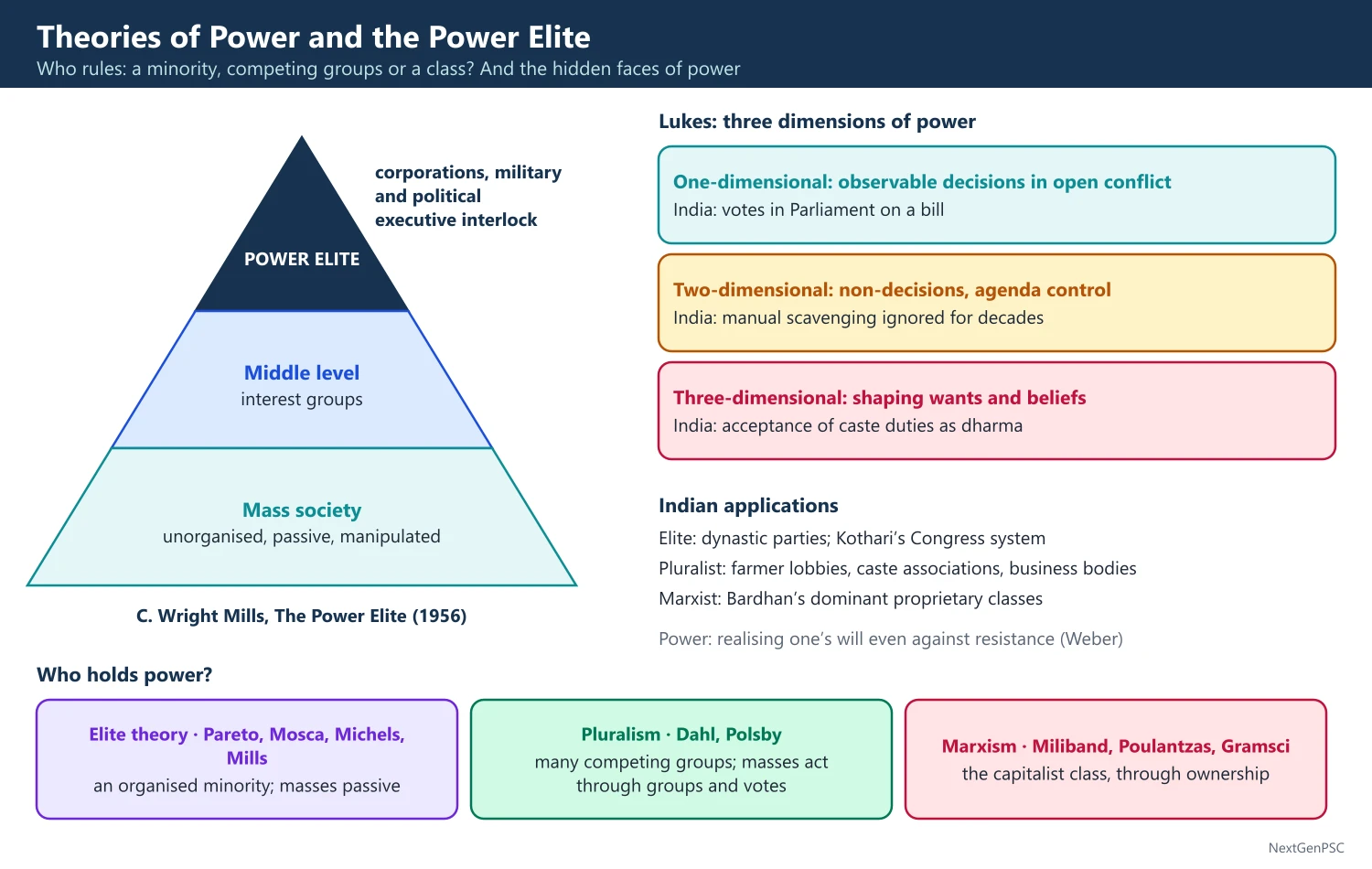
Steven Lukes (Power: A Radical View, 1974): the one-dimensional view looks at observable decisions (Dahl); the two-dimensional view adds non-decision-making, keeping issues off the agenda (Bachrach and Baratz, 'Two Faces of Power', 1962); the three-dimensional view adds shaping people's very wants so that conflict never appears.
Gramsci's hegemony: in the Prison Notebooks (written 1929–35), the ruling class rules mainly through consent produced in civil society (schools, church, media), backed by coercion.
Foucault: power is not a possession of the state but a network of relations that runs through everyday practices; disciplinary power works through surveillance, as in Bentham's Panopticon (Discipline and Punish, 1975); power and knowledge produce each other.
Arendt: power arises when people act in concert, unlike violence, which destroys power (On Violence, 1970).
Michael Mann (The Sources of Social Power, 1986): four sources: ideological, economic, military and political (IEMP model).
Bourdieu: symbolic power makes domination appear natural and legitimate, so the dominated accept it.
Indian example: Srinivas's dominant caste shows power resting on land, numbers and ritual rank together; Lukes's third face appears where Dalits once accepted untouchability as their dharma.
2. Theories of the Distribution of Power
Vilfredo Pareto (The Mind and Society, 1916): every society is ruled by an elite; elites of 'lions' (who rule by force) and 'foxes' (who rule by cunning) replace each other in the circulation of elites; history is a 'graveyard of aristocracies'.
Gaetano Mosca (The Ruling Class; Italian original 1896): an organised minority always rules a disorganised majority; it justifies itself through a 'political formula'.
Robert Michels (Political Parties, 1911): studying the German Social Democratic Party, he formulated the iron law of oligarchy: 'who says organisation says oligarchy'.
C. Wright Mills (The Power Elite, 1956): in the USA, top positions in the corporations, the military and the political executive form an interlocking power elite with similar social backgrounds, who move between institutions and make the key decisions; below them is a middle level of interest groups and a mass society.
Pluralism: Robert Dahl (Who Governs?, 1961), studying New Haven, found that different groups won on different issues (urban renewal, education, party nominations), so power is dispersed; he later called this polyarchy (1971).
Critique of pluralism: Bachrach and Baratz said Dahl ignored non-decisions; Charles Lindblom (Politics and Markets, 1977) noted the 'privileged position of business', an argument called neo-pluralism.
Instrumental Marxism: Ralph Miliband (The State in Capitalist Society, 1969) showed that state elites share class background and ties with business, so the state acts for the capitalist class.
Structural Marxism: Nicos Poulantzas (Political Power and Social Classes, 1968) replied that the state serves capital because of its structural position, whoever staffs it, and has relative autonomy; the Miliband–Poulantzas debate (1969–70) is a classic.
Critique of elite theory: pluralists say elites compete and are accountable through elections; Marxists say elite theory ignores the economic base of power.
Competitive elitism: Joseph Schumpeter (Capitalism, Socialism and Democracy, 1942) combined the views: democracy is competition among elites for the people's vote.
3. Bureaucracy
Weber's ideal type: a hierarchy of offices, written rules, impersonality, appointment by merit, salaried full-time officials and separation of office from the person; it is technically superior but threatens freedom as an 'iron cage'.
Critiques: Merton's bureaucratic personality and trained incapacity; Michels on oligarchy; Gouldner and Blau on informal practices; Michael Lipsky's street-level bureaucrats (1980) who make policy through daily discretion.
Indian bureaucracy: the ICS was called the 'steel frame'; after Independence the IAS continued; the 1970s saw a 'committed bureaucracy' debate about loyalty to the ruling party's programme.
Structural violence: Akhil Gupta (Red Tape, 2012) argued that writing, files and arbitrary bureaucratic procedures in poverty programmes produce structural violence against the poor in India.
Reforms: lateral entry at joint secretary level began in 2018; the Right to Information Act 2005 and social audits seek to make bureaucracy accountable.
Bureaucracy and caste: reservation has changed the social composition of the civil services, an example of representative bureaucracy.
4. Pressure Groups and Political Parties
Pressure groups: organised groups that try to influence policy without seeking to form a government; sectional (interest) groups defend members' interests, promotional (cause) groups promote an idea; Wyn Grant (1989) distinguished insider and outsider groups by their access to government.
Indian pressure groups: business bodies (FICCI, founded 1927; CII; ASSOCHAM), farmers' organisations (Bharatiya Kisan Union under Mahendra Singh Tikait from 1987; Shetkari Sanghatana under Sharad Joshi), trade unions, professional bodies and NGOs.
Caste associations: Lloyd and Susanne Rudolph (The Modernity of Tradition, 1967) showed how caste associations such as the Vanniyar Kula Kshatriya Sangam acted as pressure groups, so tradition helped democracy.
Political parties: Weber defined parties as associations aiming to secure power for leaders; Maurice Duverger (Political Parties, 1951) separated cadre and mass parties and gave Duverger's law (plurality voting tends to produce two parties); Otto Kirchheimer (1966) described catch-all parties.
Congress system: Rajni Kothari ('The Congress System in India', 1964) described one-party dominance in which the Congress absorbed many groups, with opposition parties acting as a 'margin of pressure'.
Later phases: coalition era from 1989, rise of caste-based and regional parties (BSP founded by Kanshi Ram in 1984), and a new phase of single-party dominance after 2014; Yogendra Yadav and Suhas Palshikar describe these as successive party systems.
Rules: the anti-defection law (Tenth Schedule, 52nd Amendment, 1985) disciplines legislators; the Supreme Court struck down the electoral bond scheme on 15 February 2024 (Association for Democratic Reforms v. Union of India).
Michels in India: dynastic succession and high-command culture in many parties are often cited as examples of oligarchy.
World example: lobbying by the National Rifle Association in the USA is a classic case of a powerful sectional group.
5. Linking Thinkers
Weber's authority links to bureaucracy (chapter 6); Merton's bureaucratic personality links to Indian red tape.
Pareto's circulation of elites links to social mobility (chapter 8) and to the rise of OBC and Dalit leaders in India.
Gramsci's hegemony and Lukes's third face link to ideology and to Bourdieu's symbolic violence.
6. Using It in the Exam
10 marks: define power with Weber, add Lukes's three faces with one Indian example each.
15 or 20 marks: compare elite, pluralist and Marxist theories in a table, then apply them to India: Congress system, business lobbies, farmer groups, dominant castes.
Thinkers examiners look for: Weber, Lukes, Pareto, Mosca, Michels, Mills, Dahl, Miliband, Poulantzas, Kothari, the Rudolphs.
Diagram idea: Mills's pyramid: power elite at the top (corporate, military, political), middle level of interest groups, mass society at the base.
Quotation: Michels: 'Who says organisation, says oligarchy' (Political Parties, 1911).
| Point | Elite theory | Pluralism | Marxism |
|---|---|---|---|
| Key thinkers | Pareto, Mosca, Michels, Mills | Dahl, Polsby | Miliband, Poulantzas, Gramsci |
| Who holds power | Organised minority or power elite | Many competing groups | Capitalist class |
| Basis of power | Personal qualities, organisation, institutional position | Resources spread across groups | Ownership of means of production |
| Role of masses | Passive, manipulated | Active through groups and votes | Exploited, can become class-conscious |
| Indian application | Dynastic parties; Kothari's Congress system | Farmer lobbies, caste associations, business bodies | Bardhan's dominant proprietary classes |
| Dimension | Focus | Indian example |
|---|---|---|
| One-dimensional | Observable decisions in open conflict | Votes in Parliament on a bill |
| Two-dimensional | Non-decisions, agenda control | Manual scavenging ignored for decades |
| Three-dimensional | Shaping wants and beliefs | Acceptance of caste duties as dharma |
Mains points
- Begin with Weber's definition and distinguish power from authority; then present theories of distribution.
- Compare elite, pluralist and Marxist views and end with a synthesis (Schumpeter's competitive elitism, neo-pluralism, Lukes).
- Apply to India: Kothari's Congress system, the Rudolphs' caste associations, farmer and business lobbies, dominant caste.
- For power elite questions, give Mills's three institutions and ask whether India has an analogous elite (business–political–bureaucratic links), noting it is debated.
- Mention Foucault and Gramsci for hidden power; examiners reward going beyond the classical trio.
- For pressure groups vs parties, define both, give types, and use Indian examples with years.
Did you know?
- Michels was himself a socialist when he studied the German SPD, and his disappointment with its oligarchy later led him towards Italian fascism.
- Memory trick for Lukes: 'Decide, Hide, Guide' — decisions, hidden agenda, guiding wants.
Nation, State, Citizenship, Democracy, Civil Society and Ideology
A nation is a community that sees itself as one people (Anderson's 'imagined community'); a state is the institution that claims a monopoly of legitimate force over a territory (Weber). Citizenship is membership with rights (Marshall's civil, political and social rights). Democracy ranges from elite competition (Schumpeter) to participation. Civil society is the space of voluntary associations between family and state (Tocqueville, Gramsci, Habermas), and ideology is a system of ideas that legitimises or challenges power (Marx, Mannheim). India tests all of these as a diverse, post-colonial democracy.
In simple words
A nation is a feeling of 'we are one people'; a state is the government machinery with police, courts and borders.
Citizenship is your membership card with rights; democracy is how citizens choose and control rulers; civil society is clubs, unions, NGOs and the press that stand between you and the state.
Ideology is the set of ideas that tells people what is normal or just.
UPSC asks how these ideas apply to India, for example nation-building, citizenship debates and civil society movements.
1. Nation and Nationalism
Nation: a large community bound by a sense of shared history, culture and destiny that seeks political self-rule; Ernest Renan ('What is a Nation?', 1882) called it a 'daily plebiscite' based on shared memories and the will to live together.
Benedict Anderson (Imagined Communities, 1983): the nation is imagined because members never meet most others; print capitalism (newspapers, novels in vernacular languages) made this imagination possible.
Ernest Gellner (Nations and Nationalism, 1983): nationalism is a product of industrial society, which needs a mobile, literate workforce sharing one high culture spread by mass education.
Eric Hobsbawm and Terence Ranger (The Invention of Tradition, 1983): many 'ancient' national traditions are recent inventions, such as royal ceremonies and national costumes.
Anthony D. Smith (The Ethnic Origins of Nations, 1986): ethnosymbolism: modern nations build on older ethnic myths, memories and symbols, so they are not purely invented.
Civic vs ethnic nationalism: civic nationalism bases membership on shared citizenship and law; ethnic nationalism bases it on descent, language or religion (Hans Kohn, 1944).
Indian nationalism: A.R. Desai (Social Background of Indian Nationalism, 1948) linked it to new classes created by colonial capitalism; Partha Chatterjee (The Nation and Its Fragments, 1993) argued that anti-colonial nationalism claimed sovereignty first in an 'inner' spiritual domain (family, religion, culture).
T.K. Oommen: distinguished nation (territory plus language), ethnicity and state, and argued that India is a multi-national state rather than a single nation-state (Citizenship, Nationality and Ethnicity, 1997).
2. State
Weber: the state is a human community that successfully claims the monopoly of the legitimate use of physical force within a given territory ('Politics as a Vocation', 1919).
Marx and Engels: 'The executive of the modern state is but a committee for managing the common affairs of the whole bourgeoisie' (Communist Manifesto, 1848).
Pluralist view: the state is a neutral arena or referee among competing groups; state-centred view: Theda Skocpol and colleagues (Bringing the State Back In, 1985) argued that state officials have their own interests and autonomy.
Welfare state: Gøsta Esping-Andersen (The Three Worlds of Welfare Capitalism, 1990) distinguished liberal, conservative and social democratic regimes by how far they decommodify labour.
Indian state: Pranab Bardhan (The Political Economy of Development in India, 1984) identified three dominant proprietary classes (industrial capitalists, rich farmers and professionals including bureaucrats) whose competing demands shaped policy; the Rudolphs (In Pursuit of Lakshmi, 1987) called it both weak and strong.
Welfare in India: a rights-based phase gave the Right to Information Act 2005, rural employment guarantee 2005, Right to Education Act 2009 and National Food Security Act 2013.
3. Citizenship
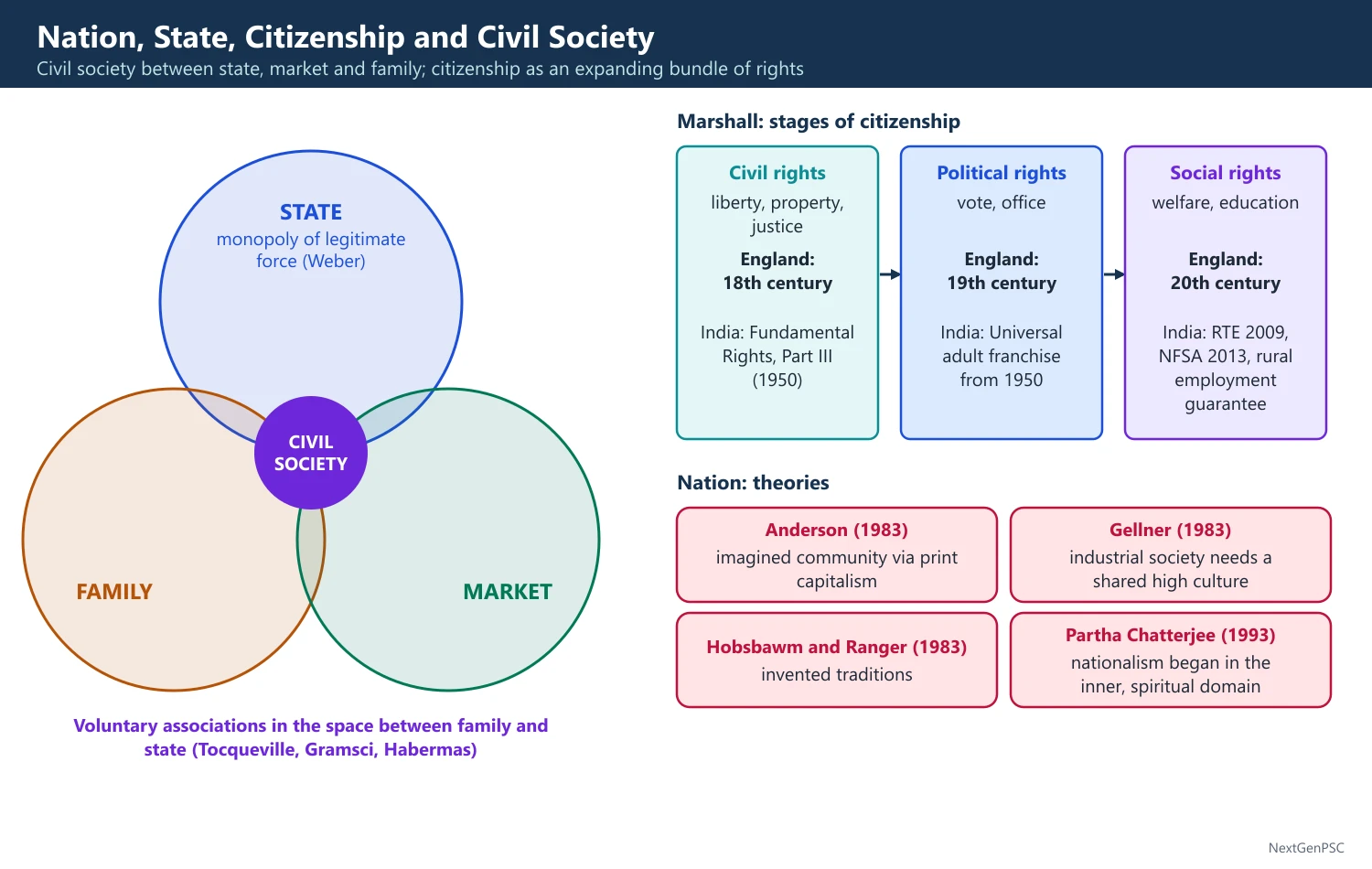
T.H. Marshall (Citizenship and Social Class, 1950): citizenship developed in England in three stages: civil rights (18th century), political rights (19th century) and social rights (20th century welfare state).
Critiques: Marshall's sequence fits England, not colonies; feminists note women gained rights in a different order; Iris Marion Young (1989) argued for differentiated citizenship giving group-specific rights to disadvantaged groups.
Indian citizenship: Part II of the Constitution and the Citizenship Act, 1955; India adopted a civic, jus soli based model that has moved towards descent over time (Niraja Gopal Jayal, Citizenship and Its Discontents, 2013).
Differentiated citizenship in India: reservations for SCs, STs and OBCs, Fifth and Sixth Schedules, and minority rights (Articles 29–30) are group-differentiated rights.
Recent debates: the Citizenship (Amendment) Act, 2019 offered a faster route to citizenship for Hindu, Sikh, Buddhist, Jain, Parsi and Christian migrants from Afghanistan, Bangladesh and Pakistan; its rules were notified in March 2024; critics argued it introduced religion as a criterion.
NRC in Assam: the final National Register of Citizens list (August 2019) left out about 19 lakh people, raising questions about statelessness and documentation.
4. Democracy
Competitive elitism: Schumpeter (1942) defined democracy as an institutional arrangement in which leaders acquire power through a competitive struggle for the people's vote.
Polyarchy: Dahl (1971) set two dimensions: public contestation and inclusive participation.
Social requisites: Seymour Martin Lipset ('Some Social Requisites of Democracy', 1959) linked democracy to economic development, education and a large middle class.
Barrington Moore (Social Origins of Dictatorship and Democracy, 1966): 'no bourgeoisie, no democracy'; he treated India as a case where democracy existed without the usual agrarian transformation, at the cost of slow growth.
Puzzle of Indian democracy: India sustained democracy despite poverty, illiteracy and diversity, against Lipset's thesis; Arend Lijphart (1996) explained it by power-sharing (consociational) features; Yogendra Yadav described a 'second democratic upsurge' in the 1990s as lower castes and the poor voted more.
Ambedkar's warning: in his speech of 25 November 1949 he said, in substance, that India was entering a life of contradictions, with political equality but social and economic inequality, which must be removed to save democracy.
Participation: the 2024 Lok Sabha election had around 97 crore registered electors, the largest electorate in the world; the 73rd and 74th Amendments (1992) created local democracy with one-third seats for women.
5. Civil Society
Meaning: the realm of voluntary associations between the family, the market and the state; Hegel saw it as the sphere of needs and contracts; Alexis de Tocqueville (Democracy in America, 1835–40) saw associations as schools of democracy.
Gramsci: civil society is where hegemony is produced and also where counter-hegemony can grow.
Public sphere: Jürgen Habermas (The Structural Transformation of the Public Sphere, 1962) described coffee houses and newspapers in 18th-century Europe where private persons debated public matters; he saw it weakened by mass media and commerce.
Social capital: Robert Putnam (Making Democracy Work, 1993) found that northern Italian regions with dense civic associations had better government; Bowling Alone (2000) described declining American civic life.
India: Partha Chatterjee (The Politics of the Governed, 2004) separated a small 'civil society' of rights-bearing citizens from a large 'political society' of the poor who negotiate with the state through collective claims; the MKSS-led campaign in Rajasthan led to the Right to Information Act, 2005.
6. Ideology
Marx: ideology is a distorted set of ideas serving the ruling class (The German Ideology, 1845–46); Louis Althusser (1970) added ideological state apparatuses such as school, family and church.
Karl Mannheim (Ideology and Utopia, 1929): ideologies defend the existing order, utopias seek to transform it; all thought is socially located (sociology of knowledge).
End of ideology: Daniel Bell (The End of Ideology, 1960) and later Francis Fukuyama ('The End of History?', 1989) claimed that liberal democracy had won; critics point to the rise of religious nationalism, populism and environmentalism.
Indian ideologies: Gandhism, Nehruvian socialism and secularism, Ambedkarism, Hindutva, Dravidian ideology and Marxism compete in Indian politics.
Ideology and caste: the ideology of karma and dharma legitimised hierarchy (Dumont); anti-caste thinkers such as Phule and Ambedkar built counter-ideologies.
7. Linking and Exam Use
Links: Marshall's citizenship to stratification (chapter 8); Gramsci's civil society to power (previous topic); Anderson's nation to ethnicity and identity movements.
10 marks: define the concept with its thinker, add one critique and one Indian example with a year.
20 marks: 'Is civil society the guardian of democracy?' Use Tocqueville, Gramsci, Habermas, Putnam and Chatterjee, with the RTI campaign and anti-corruption movement as Indian cases.
Diagram idea: three circles labelled state, market and family, with civil society in the space between them.
Quotation: Weber: the state is a human community that successfully claims the monopoly of the legitimate use of physical force within a given territory ('Politics as a Vocation', 1919).
| Thinker | Work | Core argument |
|---|---|---|
| Ernest Renan | What is a Nation? (1882) | Nation as a daily plebiscite of shared will |
| Benedict Anderson | Imagined Communities (1983) | Nation imagined through print capitalism |
| Ernest Gellner | Nations and Nationalism (1983) | Industrial society needs a shared high culture |
| Hobsbawm and Ranger | The Invention of Tradition (1983) | National traditions are often recent inventions |
| Anthony D. Smith | The Ethnic Origins of Nations (1986) | Nations rest on older ethnic myths and symbols |
| Partha Chatterjee | The Nation and Its Fragments (1993) | Anti-colonial nationalism began in the inner, spiritual domain |
| Type of right | Period in England | Indian parallel |
|---|---|---|
| Civil (liberty, property, justice) | 18th century | Fundamental Rights, Part III (1950) |
| Political (vote, office) | 19th century | Universal adult franchise from 1950 |
| Social (welfare, education) | 20th century | RTE 2009, NFSA 2013, rural employment guarantee |
Mains points
- Keep nation and state distinct; many answers confuse them. Use Oommen to show that India is a multi-national, multi-ethnic state.
- For democracy, contrast Lipset's requisites with India's puzzle and bring Ambedkar's 25 November 1949 warning.
- For citizenship, use Marshall plus critiques and Indian debates (CAA 2019, NRC 2019, differentiated rights), presenting both sides neutrally.
- For civil society, show both the democratic (Tocqueville, Putnam) and critical (Gramsci, Chatterjee) views.
- For ideology, define with Marx and Mannheim and give Indian examples; note the 'end of ideology' thesis and its critics.
- Short definitions with thinker and year, followed by an Indian case, are the formula for 10-mark parts.
Did you know?
- Anderson noted that tombs of the Unknown Soldier are filled with national imagination precisely because no one knows who lies inside.
- Memory trick for Marshall: 'C-P-S in 18-19-20' — Civil, Political, Social rights in the 18th, 19th and 20th centuries.
Protest, Social Movements, Collective Action and Revolution
A social movement is a sustained, organised collective effort to promote or resist change. Theories explain why movements arise: relative deprivation (Gurr), Smelser's value-added model, resource mobilisation (McCarthy and Zald), political process (McAdam, Tarrow, Tilly) and new social movements (Touraine, Melucci, Habermas). Revolution is a rapid, basic transformation of state and class structures (Skocpol). Indian studies by M.S.A. Rao, Ghanshyam Shah, T.K. Oommen and Gail Omvedt apply these to peasant, Dalit, women's, environmental and anti-corruption movements.
In simple words
When many people join together over time to demand change, like Chipko villagers hugging trees, that is a social movement.
A one-day protest is like a spark; a movement is a fire that keeps burning because it has leaders, members, money and a clear message.
A revolution is the biggest fire, changing who rules and who owns.
UPSC asks why movements arise, how they differ from protests and revolutions, and expects Indian examples.
1. Concepts and Definitions
Collective behaviour: relatively spontaneous and unstructured group behaviour such as crowds, riots, panics and fads; Gustave Le Bon (The Crowd, 1895) argued that individuals in a crowd lose reason and follow a 'collective mind'; Herbert Blumer described circular reaction among crowd members.
Protest and agitation: protest is a public expression of objection; agitation is a phase of intense mobilisation that may grow into a movement.
Social movement: Charles Tilly (Social Movements, 1768–2004, 2004) defined it as a sustained campaign of claim-making using a repertoire of performances (marches, rallies, petitions) and public displays of WUNC: worthiness, unity, numbers and commitment.
Collective action problem: Mancur Olson (The Logic of Collective Action, 1965) argued that rational individuals will free-ride on others' efforts unless offered selective incentives or coerced.
Revolution: Theda Skocpol (States and Social Revolutions, 1979) defined social revolutions as rapid, basic transformations of a society's state and class structures, accompanied and in part carried through by class-based revolts from below.
Types of movements: David Aberle (1966) classified movements by the amount of change (partial or total) and its target (individual or society): alterative, redemptive, reformative and transformative.
Life cycle: movements pass through emergence, coalescence, bureaucratisation and decline (after Blumer and later writers); decline may come from success, repression, co-optation or failure.
Counter-movements: movements that resist change, such as opposition to anti-dowry or temple-entry campaigns.
2. Theories of Social Movements
Relative deprivation: James Davies's J-curve (1962) argued that revolutions occur when a long period of rising expectations is followed by a sharp reversal; Ted Gurr (Why Men Rebel, 1970) linked rebellion to the gap between value expectations and value capabilities.
Critique of deprivation theory: deprivation is widespread but movements are rare; it ignores organisation and resources.
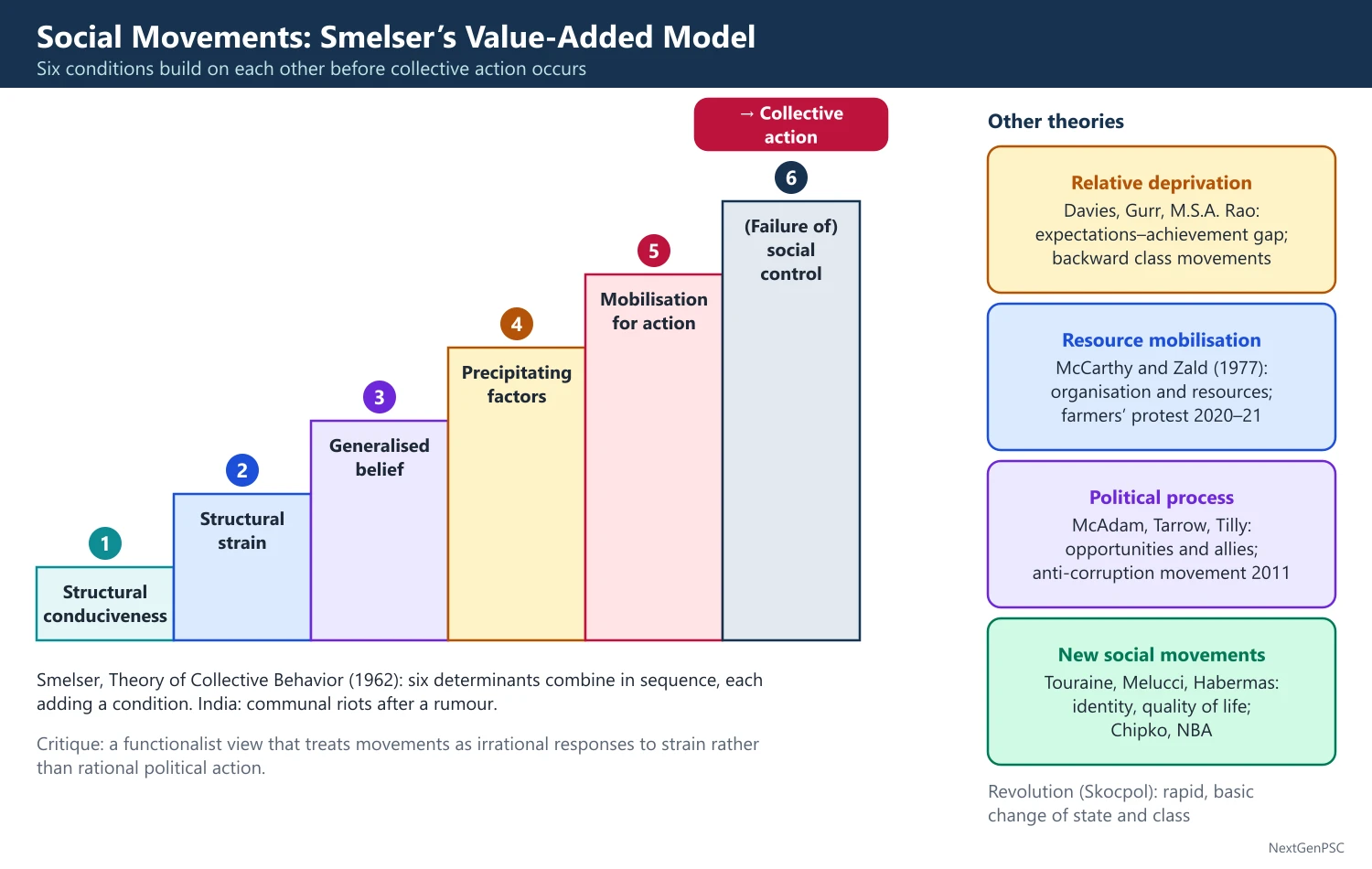
Smelser's value-added theory (Theory of Collective Behavior, 1962): six determinants must combine in sequence: structural conduciveness, structural strain, generalised belief, precipitating factors, mobilisation for action and (failure of) social control.
Critique of Smelser: a functionalist view that treats movements as irrational responses to strain rather than rational political action.
Resource mobilisation: John McCarthy and Mayer Zald (1977) argued that movements succeed when social movement organisations gather resources such as money, members, leadership and media access; grievances are constant.
Political process and political opportunity: Doug McAdam (Political Process and the Development of Black Insurgency, 1982) and Sidney Tarrow (Power in Movement, 1994) stressed openings in the political system, elite divisions and allies.
Tilly's mobilisation model (From Mobilization to Revolution, 1978): interests, organisation, mobilisation, opportunity and repertoires of contention explain collective action.
Framing: David Snow and Robert Benford (1988) showed that movements succeed when they frame problems, blame and solutions in ways that resonate with people (diagnostic, prognostic and motivational framing).
New social movements: Alain Touraine, Alberto Melucci (Nomads of the Present, 1989), Claus Offe and Jürgen Habermas argued that post-industrial movements (environmental, feminist, peace, gay rights) focus on identity, lifestyle and quality of life rather than class and the economy, use decentralised networks and resist the 'colonisation of the lifeworld' (Habermas).
Critique of NSM: many 'new' features existed in older movements, and material issues remain central in the global South (Gail Omvedt, Ghanshyam Shah).
Networked movements: Manuel Castells (Networks of Outrage and Hope, 2012) studied the Arab Spring and Occupy, which spread through digital networks and occupied urban spaces.
3. Revolution
Marx: revolution occurs when productive forces outgrow relations of production and the exploited class becomes conscious and organised; he expected it in advanced capitalist countries.
Tocqueville's paradox (The Old Regime and the Revolution, 1856): the French Revolution came when conditions were improving, because grievances became intolerable once relief seemed possible.
Skocpol's structural theory: in France (1789), Russia (1917) and China (1911–49), revolutions came when states weakened under international pressure and peasant revolts could succeed; she said revolutions are not made, they come.
Barrington Moore (1966): different paths of agrarian change produce democracy, fascism or communism; peasants are central to revolution.
Hannah Arendt (On Revolution, 1963): contrasted the American Revolution, focused on political freedom, with the French, overwhelmed by the social question of poverty.
India: Naxalbari (1967) began a Maoist strategy of agrarian revolution; Gandhi's mass non-violent movement and Jayaprakash Narayan's call for 'total revolution' (1974) show non-violent paths; whether India has had a social revolution is debated.
4. Indian Studies and Examples
M.S.A. Rao (Social Movements in India, 2 vols, 1978–79): used relative deprivation and classified movements as reformist, transformative and revolutionary, with ideology as central.
Ghanshyam Shah (Social Movements in India: A Review of Literature, 1990; revised 2004): classified movements by participants and issues: peasant, tribal, Dalit, backward caste, women, students, middle class, working class and human rights.
T.K. Oommen: studied the Bhoodan–Gramdan movement (Charisma, Stability and Change, 1972) and agrarian movements in Kerala, showing how charisma is routinised and how movements become institutions.
Gail Omvedt (Reinventing Revolution, 1993): argued that Indian new social movements of Dalits, women, farmers and environmentalists combine identity with material demands.
Environmental movements: Chipko (1973, Uttarakhand), Narmada Bachao Andolan (from 1985) against big dams and displacement; Ramachandra Guha (The Unquiet Woods, 1989) traced Chipko to older peasant resistance.
Anti-corruption and rights movements: the India Against Corruption movement (2011) led by Anna Hazare pressed for the Lokpal and Lokayuktas Act, 2013; the RTI campaign led to the 2005 Act.
Women's movement: protests after the December 2012 Delhi gang rape led to the Criminal Law (Amendment) Act, 2013.
Farmers' protest (2020–21): farmers' unions, mainly from Punjab, Haryana and western Uttar Pradesh, protested at Delhi's borders from November 2020; Parliament repealed the three farm laws in late 2021, a clear case of resource mobilisation and political opportunity.
World examples: the US civil rights movement (1950s–60s), the Arab Spring (2010–11), #MeToo (2017) and Fridays for Future (from 2018).
5. Linking Thinkers
Relative deprivation links to Merton's reference groups and Runciman (chapter 8); Weber's charisma links to movement leadership and its routinisation (Oommen).
Michels's oligarchy explains bureaucratisation of movements; Gramsci's counter-hegemony explains Dalit and feminist movements.
Marx's class consciousness links to peasant and working-class movements (Paper II chapter 25).
6. Using It in the Exam
10 marks: distinguish protest, social movement and revolution with Tilly and Skocpol, plus one Indian example each.
15 or 20 marks: evaluate one theory (resource mobilisation or NSM) using two Indian movements (farmers' protest, Chipko, NBA), and contrast with another theory.
Thinkers examiners look for: Smelser, Gurr, McCarthy and Zald, Tilly, McAdam, Touraine, Melucci, Skocpol, M.S.A. Rao, Ghanshyam Shah, Oommen, Omvedt.
Diagram idea: Smelser's value-added staircase of six steps, each adding a condition before collective action occurs.
Quotation: Skocpol's definition, paraphrased: social revolutions are rapid, basic transformations of a society's state and class structures carried through in part by class-based revolts from below.
| Theory | Thinkers | Why movements arise | Indian illustration |
|---|---|---|---|
| Relative deprivation | Davies (1962), Gurr (1970), M.S.A. Rao | Gap between expectations and achievements | Backward class movements |
| Value-added | Smelser (1962) | Six conditions combine in sequence | Communal riots after a rumour |
| Resource mobilisation | McCarthy and Zald (1977) | Organisation and resources | Farmers' protest 2020–21 |
| Political process | McAdam (1982), Tarrow, Tilly | Political opportunities and allies | Anti-corruption movement 2011 |
| New social movements | Touraine, Melucci, Habermas | Identity and quality of life in post-industrial society | Chipko, NBA, queer rights |
Mains points
- Distinguish clearly between collective behaviour, protest, social movement and revolution before discussing theories.
- Present theories in historical order (deprivation, Smelser, resource mobilisation, political process, NSM) with a criticism of each.
- Every Paper I answer should use Indian movements: Chipko, NBA, farmers' protest 2020–21, India Against Corruption 2011, Dalit movements.
- Cite Indian sociologists of movements (M.S.A. Rao, Ghanshyam Shah, Oommen, Omvedt); examiners specifically look for them.
- For NSM questions, argue whether Indian movements are 'new' or mix identity with material demands.
- For revolution, contrast Marx with Skocpol and Tocqueville, and note that India's change has been largely non-revolutionary.
Did you know?
- The word 'Chipko' means 'to stick' or 'to hug'; women of Reni village led by Gaura Devi in 1974 hugged trees to stop loggers.
- Memory trick for Smelser: 'C-S-G-P-M-S' — Conduciveness, Strain, Generalised belief, Precipitating factor, Mobilisation, Social control.
UPSC Previous Year Questions: Politics and Society
From 2014 to 2026 UPSC asked 42 question parts worth 590 marks from Politics and Society, all in Paper I. The most-asked areas are theories of power, elites and pressure groups (15 parts: Pareto, Mosca, Michels, Mills, Weber and Parsons), social movements and protest (14 parts, with recent stress on social media and new social movements) and nation, state, citizenship and civil society (13 parts). Every question below has a model answer written to the UPSC word limit.
In simple words
Read the question and note its directive word (discuss, examine, comment) and the thinker or theme it names.
Write your own answer first in the time limit: about 7 minutes for 150 words and 11 minutes for 250 words.
Then compare it with the model answer: check the thinkers, the Indian examples and the conclusion you missed, and note them for revision.
1. Theories of Power, Power Elite, Bureaucracy, Pressure Groups and Parties
Example 1 (UPSC 2026, 20 marks): Elaborate major sociological theories of power. How do power elite shape the political process in modern societies?
Paper and question: Paper I, Q4(a)
Approach: Two demands: first survey the major theories of power (Weber, Parsons, Lukes, Marxist, Foucault), then show how power elites shape the political process using Pareto, Mosca, Michels and Mills, with Indian illustrations and a pluralist counterpoint.
Max Weber defined power as the chance of an actor to realise his will in social action even against the resistance of others (Economy and Society, 1922).
Conflict and zero-sum views: for Weber and Marx power is held by some at the expense of others; Marx locates it in ownership of the means of production, so the state serves the bourgeoisie. Talcott Parsons instead saw power as a generalised capacity of the whole system to achieve collective goals, a variable-sum resource like money.
Radical and post-structural views: Steven Lukes (1974) added the second face of agenda-setting and the third face of shaping people's very wants; Gramsci's hegemony works through consent produced in civil society; Foucault sees power dispersed in everyday disciplinary practices rather than possessed by the state.
Elite theory: Pareto and Mosca argued that an organised minority always rules; Michels found an iron law of oligarchy inside even socialist parties; C. Wright Mills (The Power Elite, 1956) showed that the heads of corporations, the military and the political executive in the USA form an interlocking group with shared backgrounds.
Power elites shape the political process by controlling party nominations and funding, setting the agenda and moving between business and government posts. In India, high-command and dynastic control of parties illustrates Michels, while corporate funding of elections, debated after the Supreme Court struck down electoral bonds in 2024, suggests a Mills-type nexus.
Pluralists such as Robert Dahl (Who Governs?, 1961) reply that different groups win on different issues, and in India farmer unions and social movements have checked elites, as in the repeal of the farm laws in 2021. Power is therefore elite-dominated but contested.
Example 2 (UPSC 2025, 20 marks): Are pressure groups a threat to or a necessary element of democracy? Explain with suitable illustrations.
Paper and question: Paper I, Q3(b)
Approach: Take a balanced position: define pressure groups, show their democratic functions (pluralist view, Rudolphs), then the threats (elite and Marxist critiques, Lindblom, Olson), with Indian illustrations, and conclude that regulated pressure groups are necessary.
Pressure groups are organised groups that seek to influence public policy without trying to capture government. They may be sectional (FICCI, trade unions, Bharatiya Kisan Union) or promotional, working for a cause (Narmada Bachao Andolan, environmental NGOs).
A necessary element: for pluralists such as Robert Dahl, democracy is a competition among many groups, none of which dominates, and groups carry citizens' demands to the state between elections. Tocqueville saw associations as schools of democracy. In India, Lloyd and Susanne Rudolph (The Modernity of Tradition, 1967) showed that caste associations such as the Vanniyar Kula Kshatriya Sangam taught backward castes to bargain politically, widening participation.
Indian illustrations: the campaign of the Mazdoor Kisan Shakti Sangathan led to the Right to Information Act 2005; women's groups after the December 2012 Delhi gang rape secured the Criminal Law (Amendment) Act, 2013; farmer unions forced the repeal of the three farm laws in 2021.
A threat: groups are unequal. Mancur Olson (1965) showed that small, concentrated interests organise more easily than large diffuse publics; Charles Lindblom spoke of the privileged position of business; Mills and Marxists such as Miliband see well-funded lobbies as part of a ruling class. Lobbying by the National Rifle Association in the USA and opaque corporate funding of parties in India show how groups can capture policy.
Some caste or religious bodies also press narrow claims against constitutional values.
Pressure groups are thus a necessary element of democracy, because they voice interests that parties ignore, but they become a threat when access is unequal and secret. Transparent political funding and space for weaker groups keep them democratic.
Example 3 (UPSC 2025, 20 marks): What would you identify as the similarities and differences in the elite theories of Mosca, Michels and Pareto? Discuss their main/crucial issues.
Paper and question: Paper I, Q4(b)
Approach: Compare the three classical elitists: state each thinker's core idea, then list similarities and differences (basis of elite rule, mechanism, view of democracy), and close with the crucial issues and criticisms, with Indian illustrations. A comparison flow chart helps.
Classical elite theory rejected both liberal democracy and Marx's classless society by arguing that a minority always rules.
Pareto (The Mind and Society, 1916) explained elite rule by unequal individual qualities and residues: 'lions' rule by force and 'foxes' by cunning, and history is a 'graveyard of aristocracies' through the circulation of elites. Mosca (The Ruling Class, 1896) stressed organisation: an organised minority dominates the disorganised majority and legitimises itself through a political formula. Michels (Political Parties, 1911), studying the German Social Democratic Party, argued that large organisations need leaders, expertise and hierarchy, producing an iron law of oligarchy.
Similarities: all three hold that minority rule is inevitable, that the masses are passive or incompetent, and that democracy and socialism cannot abolish elites; all reject economic determinism and give politics autonomy.
Differences: Pareto's basis is psychological, Mosca's organisational and Michels's technical-organisational. Pareto saw elites changing through cyclical circulation, often violent; Mosca allowed a gradual renewal from a middle stratum and was more open to representative government; Michels was a disillusioned socialist whose focus was the party rather than society as a whole.
Flow chart: Pareto (psychological residues → lions and foxes → circulation) | Mosca (organisation → political formula → ruling class) | Michels (organisation → leadership and expertise → oligarchy).
Crucial issues: Is elite rule compatible with democracy? Schumpeter answered yes, as competition among elites; Mills extended the idea to an institutional power elite; pluralists like Dahl argued that elites are plural and accountable; Marxists said the theorists ignored the class basis of power, and Pareto's 'residues' are hard to test.
In India, dynastic leadership in parties illustrates Michels, the rise of OBC and Dalit leaders since the 1990s illustrates circulation, and the 'Congress system' described by Rajni Kothari fits Mosca's organised minority. Elite theory thus underrates popular mobilisation.
Example 4 (UPSC 2023, 20 marks): What, according to Robert Michels, is the iron law of oligarchy? Do lions and foxes in Vilfredo Pareto's theory, essentially differ from each other? Substantiate.
Paper and question: Paper I, Q2(a)
Approach: Two parts: explain Michels's iron law of oligarchy (study, causes, criticism, Indian examples), then show that Pareto's lions and foxes differ in method of rule and residues yet both belong to the governing elite and replace each other in circulation.
Iron law of oligarchy: Robert Michels (Political Parties, 1911) studied the German Social Democratic Party, which preached democracy, and found it run by a small leadership. He summed up: who says organisation says oligarchy.
His reasons were organisational, psychological and technical: large organisations need a division of labour and full-time leaders; leaders gain expertise, control over communication and funds, and wish to keep their posts; the masses are apathetic and grateful to leaders. Leaders thus become conservative and put the organisation's survival above its goals.
Critics note exceptions: Lipset, Trow and Coleman's study of the International Typographical Union (Union Democracy, 1956) found competitive two-party democracy inside a union. In India, high-command culture and dynastic succession in many parties, and the long tenure of leaders of trade unions and cooperatives, fit Michels, while inner-party elections remain rare.
Lions and foxes: Vilfredo Pareto (The Mind and Society, 1916) divided the governing elite by dominant residues. Lions, with strong residues of persistence of aggregates, value order, tradition and force; foxes, with the residue of combinations, rule by cunning, manipulation and bargaining.
They do differ in method: a lion elite governs through coercion and loyalty (military regimes), a fox elite through compromise, propaganda and economic deals (parliamentary politicians and financiers). But essentially they are two types of the same governing minority, and neither is superior. Each tends to fail by its excess: foxes avoid force and lose control in crises, lions lack flexibility, so one replaces the other in the circulation of elites.
Flow chart: fox elite (cunning, deals) → crisis requiring force → lions take over → stagnation needing flexibility → foxes return.
Thus Michels shows oligarchy within organisations, and Pareto shows that elites change in style but not in the fact of minority rule; both underplay mass movements.
Example 5 (UPSC 2022, 10 marks): Illustrate with examples the role of pressure groups in the formulation of social policies.
Paper and question: Paper I, Q7(c)
Approach: Define pressure groups and explain, with Indian examples, how they shape social policy at the stages of agenda-setting, drafting and implementation, adding a brief note on unequal influence.
Pressure groups are organised groups that try to influence public policy without seeking office.
Agenda-setting: groups raise neglected issues. The Mazdoor Kisan Shakti Sangathan's public hearings in Rajasthan in the 1990s made transparency a national issue and led to the Right to Information Act 2005.
Drafting and legislation: women's organisations shaped the Protection of Women from Domestic Violence Act 2005, and after the December 2012 Delhi protests their submissions to the Justice Verma Committee fed into the Criminal Law (Amendment) Act, 2013.
Implementation and reversal: social audits of rural employment schemes and the farmers' agitation of 2020–21, which led to the repeal of the three farm laws, show groups monitoring or reversing policy.
Influence is unequal: Lindblom's privileged position of business and Olson's logic of collective action explain why the poor organise with difficulty. Still, pressure groups make social policy more responsive and informed.
Example 6 (UPSC 2021, 10 marks): Critically examine the relevance of Vilfredo Pareto's theory of Circulation of Elites in the present scenario.
Paper and question: Paper I, Q5(b)
Approach: Briefly state Pareto's theory of circulation of elites, then assess its relevance today with Indian and world examples, and note its limits (pluralism, democratic institutions, untestable residues).
Vilfredo Pareto (The Mind and Society, 1916) held that every society is ruled by a governing elite. Elites of 'lions', who rule by force, and 'foxes', who rule by cunning, decay and are replaced, so that history is a graveyard of aristocracies; this is the circulation of elites.
Relevance today: the idea helps explain recurrent elite turnover. In India, the decline of the Congress system and the rise of OBC leaders after the Mandal period, Dalit leadership through the BSP, and the shift to a new dominant party after 2014 resemble a circulation of governing elites. Military takeovers in Myanmar and parts of Africa fit his cycle of foxes yielding to lions.
Limits: democracy institutionalises circulation through elections, so change need not be violent; pluralists like Dahl argue that power is dispersed; Marxists say Pareto ignores the economic base; and his residues are psychological and hard to test.
It remains a useful heuristic for elite change, best combined with institutional and class analysis.
Example 7 (UPSC 2021, 20 marks): Explain how political parties and pressure groups are dialectically related to each other in terms of achieving their goals.
Paper and question: Paper I, Q6(b)
Approach: Distinguish parties and pressure groups, then explain their dialectical relationship (mutual dependence and tension, groups becoming parties and parties creating groups) with Duverger, Kothari, the Rudolphs and Indian cases, ending with a synthesis.
Weber defined political parties as associations aiming to secure power for their leaders, while pressure groups seek to influence policy without contesting power. Their relationship is dialectical: each depends on and opposes the other, and their interaction produces new forms.
Mutual dependence: parties need groups for votes, funds, cadres and information; groups need parties to turn demands into law. Maurice Duverger noted that mass parties grew out of trade unions and other associations, as the British Labour Party did. In India, trade union federations are tied to parties (INTUC to the Congress, BMS to the Sangh family, CITU to the CPI(M)).
Tension and opposition: groups press narrow interests that parties must balance against a wider electorate, and they shift support when ignored. The Bharatiya Kisan Union under Mahendra Singh Tikait remained non-party and bargained with all governments; during 2020–21 farmer unions kept political parties off their platform while pressing the government to repeal the farm laws, which it did in 2021.
Synthesis: pressure groups often become parties, and parties create or absorb groups. The India Against Corruption movement of 2011 gave rise to the Aam Aadmi Party in 2012; caste associations studied by Lloyd and Susanne Rudolph, such as the Vanniyar Kula Kshatriya Sangam, later formed the Pattali Makkal Katchi.
Rajni Kothari's 'Congress system' showed this dialectic at the system level: the dominant party absorbed groups, while groups and opposition parties acted as a margin of pressure that pushed it to change.
Flow chart: group demand → party absorbs or rejects → if rejected, group escalates or forms a party → new party bargains with other groups.
Parties and pressure groups thus complete each other in achieving goals; the contradiction between aggregating and articulating interests keeps democratic competition alive.
Example 8 (UPSC 2020, 20 marks): According to Mills, “Elites rule in institutional terms rather than psychological terms.” Comment.
Paper and question: Paper I, Q6(b)
Approach: Explain Mills's institutional (not psychological) theory of the power elite, contrast it with Pareto's psychological basis, evaluate with critics (Dahl, Parsons, Sweezy), and apply to India.
C. Wright Mills (The Power Elite, 1956) argued that in the mid-twentieth-century USA, major decisions were made by a small power elite. He explained its power by the positions its members occupy in key institutions, not by their personal qualities.
This was a deliberate break from classical elitism. Pareto traced elite rule to psychological residues, the lions' persistence and the foxes' cunning; Mosca and Michels relied partly on the incompetence and apathy of the masses. For Mills, people are powerful because they command the 'big three' institutional hierarchies: the corporations, the military and the federal political executive.
These institutions had become centralised and interlocked after the Second World War. Men moved between them (generals joining corporate boards, executives becoming cabinet members), shared similar class backgrounds, elite schools and clubs, and so formed a cohesive group. Below them was a middle level of Congress and interest groups, and at the base a passive mass society shaped by media.
Flow chart: institutional command posts (corporate, military, political) → interchange of personnel and shared background → cohesive power elite → decisions over a mass society.
Criticism: Robert Dahl said Mills did not show that the elite actually prevailed in specific decisions; Talcott Parsons objected to his zero-sum view of power; Marxists like Paul Sweezy said the elite is really the capitalist class. Mills did mention shared psychology and lifestyle, so the line between institutional and psychological is not absolute.
In India, the nexus between top bureaucrats, ministers and large business houses, and the movement of retired officials into regulatory and corporate posts, show institutional power; but competitive elections and movements limit any single elite.
Mills's statement thus shifts elite theory from personality to structure, which makes it testable and still useful.
Example 9 (UPSC 2019, 20 marks): What are the theoretical models of societal power? Which one of them is most applicable in advanced industrial societies?
Paper and question: Paper I, Q6(b)
Approach: Outline the main models of societal power (elite, pluralist, Marxist, with neo-pluralism and Foucault), then argue which best fits advanced industrial societies; a reasoned conclusion favouring a combined elite-pluralist (neo-pluralist) view is expected.
Models of societal power ask how power is distributed in a society as a whole: concentrated in a minority, dispersed among groups, or rooted in class.
Elite model: Pareto, Mosca and Michels held that an organised minority always rules; C. Wright Mills (The Power Elite, 1956) found an interlocking corporate, military and political elite in the USA.
Pluralist model: Robert Dahl (Who Governs?, 1961), studying New Haven, found that different groups prevailed on different issues, so power is dispersed and competitive; Schumpeter's competitive elitism sees democracy as elites competing for votes.
Marxist model: power derives from ownership of the means of production. Ralph Miliband (1969) stressed the shared class background of state and business elites; Nicos Poulantzas argued that the state serves capital structurally, with relative autonomy. Gramsci added hegemony through consent.
Critiques and newer views: Bachrach and Baratz and Steven Lukes (1974) showed that pluralists miss non-decisions and the shaping of preferences; Charles Lindblom's neo-pluralism notes the privileged position of business; Foucault sees power spread through disciplinary institutions.
Most applicable: advanced industrial societies combine competitive elections, organised interests and free media with strong concentration of corporate power, so a neo-pluralist or elite-pluralist model fits best. Lobbying and campaign finance in the USA, and the role of large business houses alongside farmer and caste groups in India, show both concentration and contest.
No single model is sufficient: pluralism describes the visible process, while elite and Marxist models explain whose interests set its limits.
Example 10 (UPSC 2019, 10 marks): Discuss the concept of circulation of elite.
Paper and question: Paper I, Q7(c)
Approach: Define circulation of elites with Pareto's lions and foxes and the two forms of circulation, add Mosca's view, an Indian illustration and a brief criticism.
The circulation of elites is Vilfredo Pareto's idea (The Mind and Society, 1916) that governing elites decay and are replaced by new elites, so that history is a graveyard of aristocracies.
Pareto saw circulation in two forms: individuals moving between the elite and the non-elite, and the replacement of one whole elite by another. Elites are of two types: lions, who rule by force and value order, and foxes, who rule by cunning and bargaining. Each decays through its own excess, and when able people are blocked from rising, a counter-elite forms and overthrows the old one, sometimes by revolution.
Mosca similarly saw a ruling class renewed from a middle stratum. In India, the decline of upper-caste dominance in the Congress system and the rise of OBC and Dalit leaders after the 1990s are often read as a circulation of elites.
Critics say Pareto's residues are psychological and untestable, and that elections now make circulation routine rather than violent.
Example 11 (UPSC 2018, 10 marks): What, according to Pareto, are the basic characteristics of elites? Discuss.
Paper and question: Paper I, Q7(c)
Approach: State Pareto's definition of the elite and list its characteristics (unequal ability, governing and non-governing elite, residues, lions and foxes, circulation), with a brief criticism and example.
For Vilfredo Pareto (The Mind and Society, 1916), the elite consists of those who score highest in their field of activity, whether law, business, chess or crime. Society is always divided into a small elite and the masses.
Characteristics: first, elites rest on unequal natural qualities, not on property as Marx held. Second, the elite is split into a governing elite, which directly or indirectly rules, and a non-governing elite of able people outside power. Third, elite behaviour is driven by non-logical sentiments he called residues, especially the residue of combinations (cunning) and of persistence of aggregates (force and tradition).
Fourth, governing elites are therefore of two types, foxes and lions. Fifth, elites are not permanent: they degenerate and are replaced in a circulation of elites.
Critics such as C. Wright Mills shifted attention from personal qualities to institutional positions, and Marxists see elites as expressions of class. Yet the idea helps explain how new regional leaders in India rise into the governing elite.
Example 12 (UPSC 2017, 10 marks): Examine the dynamics of pressure groups in multi-party political system.
Paper and question: Paper I, Q6(c)
Approach: Explain how pressure groups behave in a multi-party system (multiple access points, partisan affiliations, shifting alliances, coalition bargaining) with Indian examples, and note the risks.
Pressure groups seek to influence policy without contesting power. In a multi-party system such as India's, their dynamics differ from a two-party system because power is fragmented across many parties, coalitions and states.
First, groups gain many access points and can shift support between parties, raising their bargaining power, especially in coalition governments after 1989, when small parties carried sectional demands into the cabinet. Second, many groups are tied to parties: trade union federations such as INTUC, CITU and BMS, and student wings, act as party arms, which splits groups along party lines.
Third, regional and caste groups bargain with state parties; the Rudolphs showed how caste associations became political actors, and some, like the Vanniyar Sangam, turned into parties. Fourth, non-party groups such as the Bharatiya Kisan Union keep distance from all parties to pressure whichever is in power, as in the 2020–21 farmers' protest.
The risk is fragmentation and populist competition, but multiplicity also gives weaker groups more chances to be heard.
Example 13 (UPSC 2016, 10 marks): Discuss the importance of 'power elite' in democracy.
Paper and question: Paper I, Q5(b)
Approach: Define the power elite (Mills), then weigh its importance in democracy: elitist, competitive-elitist and pluralist views, with an Indian illustration and a balanced conclusion.
C. Wright Mills (The Power Elite, 1956) used the term power elite for the small group that commands the corporations, the military and the political executive in the USA.
Importance in democracy: for Mills the power elite hollows democracy, since key decisions escape public debate and citizens become a passive mass society. Joseph Schumpeter's competitive elitism gives elites a positive role: democracy is the method by which competing elites seek the people's vote, providing leadership, expertise and stability. Pluralists like Robert Dahl reply that elites are many and must bargain with groups, so no single power elite exists.
In India, a nexus of senior bureaucrats, ministers and large business houses influences policy; yet elections regularly replace ruling parties, and movements such as the RTI campaign have forced elites to concede.
The power elite is thus important in democracy as a source of leadership and a danger to equality; accountability through elections, courts and a free press decides which role dominates.
Example 14 (UPSC 2014, 10 marks): Distinguish between Political Parties and Pressure Groups.
Paper and question: Paper I, Q5(d)
Approach: Define both, then distinguish them on aim, membership, organisation, methods and accountability, with Indian examples, and note their overlap.
Max Weber described political parties as associations that aim to secure power within an organisation for their leaders; pressure groups are organised groups that try to influence policy without seeking to form a government.
Aim: parties seek to capture and exercise state power; pressure groups seek favourable decisions from whoever holds power. Scope: parties aggregate many interests into a programme for the whole electorate; groups articulate a specific interest or cause, such as FICCI for industry or the Bharatiya Kisan Union for farmers.
Methods: parties contest elections and form governments; groups lobby, petition, litigate and protest. Accountability: parties answer to voters and are regulated by the Election Commission and the anti-defection law; groups are not directly accountable to the electorate. Membership of groups can also cut across parties.
Yet the line is blurred: Indian trade unions are party wings, and groups can turn into parties, as the India Against Corruption movement led to the Aam Aadmi Party in 2012.
Example 15 (UPSC 2014, 20 marks): "Power is not a zero-sum game." Discuss with reference to Weber's and Parsons' views.
Paper and question: Paper I, Q6(a)
Approach: Contrast Weber's zero-sum (distributive) concept of power with Parsons's variable-sum (collective) concept, assess both with critics (Mills, Giddens, Lukes) and Indian examples, and conclude that power has both aspects.
A zero-sum view treats power as a fixed quantity, so that one party's gain is another's loss; a variable-sum view holds that the total amount of power in a society can grow.
Weber: power is the chance of a person or group to realise their will in social action even against the resistance of others (Economy and Society, 1922). Power here is distributive and conflictual: it is exercised over others, and in his analysis of class, status and party, groups struggle for a limited share. Mills's power elite and Marxist theories share this view.
Parsons ('On the Concept of Political Power', 1963) argued that power is a generalised capacity of the social system to mobilise resources for collective goals, legitimised by shared values. Like money in an economy, power can be 'created': when citizens trust leaders and grant them authority, the capacity of the whole society to act grows, as in a war effort or a public health campaign. Power is therefore not a zero-sum game.
Flow chart: shared values → legitimacy and trust → authority granted to leaders → greater collective capacity (Parsons) versus scarce power → competing groups → gain of one is loss of another (Weber).
Evaluation: Anthony Giddens noted that Parsons ignored the hierarchical side of power, which is always used by some over others; Mills held that the collective goals are often the goals of the elite. Steven Lukes showed that apparent consensus may itself be a product of power.
In India, a national immunisation drive or the panchayati raj system after the 73rd Amendment (1992) increased the collective capacity of society, supporting Parsons; yet land reform and reservation conflicts show distributive struggle, supporting Weber.
Power thus has two faces: distributive and collective. A complete analysis combines Weber's attention to conflict with Parsons's attention to legitimacy and capacity.
2. Nation, State, Citizenship, Democracy, Civil Society and Ideology
Example 16 (UPSC 2026, 20 marks): How are the concepts of nation, state and citizenship interrelated in a democracy? Elaborate.
Paper and question: Paper I, Q8(a)
Approach: Define nation, state and citizenship with their thinkers, then show how they interlock in a democracy (state gives the legal frame, nation the solidarity, citizenship the link of rights and duties), illustrate with India, and discuss tensions such as multi-nation states and contested citizenship.
Max Weber defined the state as a human community that successfully claims the monopoly of the legitimate use of physical force within a territory. A nation is a community of shared memory and destiny; Benedict Anderson called it an 'imagined community' made possible by print capitalism. Citizenship, for T.H. Marshall (1950), is full membership of a community carrying civil, political and social rights.
Interrelation: in a democracy the state supplies the legal and territorial frame, the nation supplies the solidarity and sense of 'we' that makes people accept majority decisions, and citizenship links the individual to both through rights and duties. The modern nation-state fused the three: Ernest Gellner showed that industrial states spread one national culture through mass education, turning subjects into citizens.
Democracy depends on this triangle. Elections give citizens a share in sovereignty, which legitimises the state; and social rights, in Marshall's sense, give the poor a stake in the nation.
Flow chart: state (territory, law, legitimate force) ⇄ citizenship (rights and duties, vote) ⇄ nation (shared identity, solidarity) → democratic legitimacy.
India: the Constitution created a civic nation of equal citizens out of great diversity, with universal adult franchise from 1950; group-differentiated rights such as reservation and the Sixth Schedule, which Iris Marion Young would call differentiated citizenship, bind minorities to the nation. T.K. Oommen argued that India is better seen as a multi-national state, where nation and state do not coincide.
Tensions: when the nation is defined ethnically, citizenship narrows; Niraja Gopal Jayal notes India's drift from birth-based towards descent-based citizenship, seen in debates on the Citizenship (Amendment) Act, 2019 and the Assam NRC (2019).
A democracy is stable when the state is accountable, the nation inclusive and citizenship equal and substantive.
Example 17 (UPSC 2024, 10 marks): Democracy needs a vibrant culture of civil society in order to strengthen its foundation of citizenship. Comment.
Paper and question: Paper I, Q1(d)
Approach: Agree with qualification: define civil society, show how it strengthens citizenship (Tocqueville, Putnam, Habermas) with Indian examples, and note limits (Chatterjee's political society, uncivil groups).
Civil society is the realm of voluntary associations between family, market and state. Citizenship, as T.H. Marshall showed, is not only legal status but the active use of rights, and civil society is where citizens learn and practise it.
Alexis de Tocqueville saw associations in America as schools of democracy that check the tyranny of the majority. Robert Putnam (Making Democracy Work, 1993) found that Italian regions with dense civic networks had more effective governments, because associations build social capital.
In India, the Mazdoor Kisan Shakti Sangathan's campaign produced the RTI Act 2005, women's groups shaped laws on domestic violence and sexual assault, and social audits made citizens monitors of welfare schemes.
Yet Partha Chatterjee warns that India's civil society is small and middle-class, while most of the poor deal with the state as 'political society'; and caste or communal associations may be uncivil. A vibrant, inclusive civil society is therefore a foundation, not a substitute, for democratic citizenship.
Example 18 (UPSC 2024, 20 marks): How does a multicultural society accommodate diversities of all kinds — ethnic, linguistic and religious? Discuss its major challenges.
Paper and question: Paper I, Q6(b)
Approach: Define multiculturalism and its theories (Taylor, Kymlicka, Parekh), explain the accommodation mechanisms with India as the main case (linguistic states, minority rights, Sixth Schedule, secularism), then discuss challenges with examples and conclude.
A multicultural society contains several ethnic, linguistic and religious communities and treats this diversity as legitimate. Multiculturalism goes beyond tolerance to the public recognition of group identities.
Theories: Charles Taylor ('The Politics of Recognition', 1992) argued that misrecognition harms identity, so cultures deserve respect; Will Kymlicka (Multicultural Citizenship, 1995) defended group-differentiated rights: self-government for national minorities and polyethnic rights for immigrants; Bhikhu Parekh (Rethinking Multiculturalism, 2000) called for intercultural dialogue.
Accommodation in India: linguistic diversity was accommodated by reorganising states on linguistic lines (States Reorganisation Act, 1956) and recognising 22 languages in the Eighth Schedule; religious diversity through Articles 25–30, minority educational institutions and personal laws, under a secularism that Rajeev Bhargava calls 'principled distance'; ethnic and tribal diversity through the Fifth and Sixth Schedules and autonomous councils in the North-East. Federalism and reservations give groups a share in power. Abroad, Canada adopted official multiculturalism in 1971 and Switzerland balances four languages.
Challenges: first, majoritarian nationalism may see recognition as appeasement and push assimilation. Second, ethnic conflicts persist, as in the Manipur violence between Meiteis and Kukis since May 2023. Third, language disputes recur over the place of Hindi. Fourth, group rights can clash with individual rights, especially of women, as feminist critics such as Susan Okin argued; the triple talaq judgment (2017) illustrates this. Fifth, Brian Barry warned that multiculturalism may divide citizens and weaken redistribution.
Flow chart: diversity → recognition (rights, autonomy, federalism) → shared citizenship → integration; failure of recognition → grievance → conflict.
Multicultural accommodation works when recognition of difference is joined to equal citizenship and a shared civic identity, which is the spirit of India's 'unity in diversity'.
Example 19 (UPSC 2023, 10 marks): How is civil society useful in deepening the roots of democracy?
Paper and question: Paper I, Q5(b)
Approach: Define civil society and list the ways it deepens democracy (participation, accountability, public sphere, social capital, voice for the marginalised) with Indian examples, plus one limitation.
Civil society is the space of voluntary associations, movements, media and NGOs between the family, the market and the state. Democracy deepens when citizens participate beyond voting, and civil society makes this possible.
First, it builds social capital and civic habits: Tocqueville's schools of democracy and Putnam's finding that dense associations make governments work. Second, it creates a public sphere (Habermas) where policy is debated openly. Third, it enforces accountability: the RTI movement led to the RTI Act 2005, and social audits expose corruption in welfare schemes. Fourth, it gives voice to the marginalised: Dalit, tribal and women's organisations push issues that parties neglect, as in the Forest Rights Act 2006. Fifth, Gramsci saw civil society as the terrain where counter-hegemonic ideas grow.
Its limits are real: Partha Chatterjee notes that the poor often act through 'political society', and some associations are communal or elitist.
A plural, autonomous and inclusive civil society thus roots democracy in everyday life.
Example 20 (UPSC 2022, 20 marks): Analyse the nature of transition from ideology to identity politics in India.
Paper and question: Paper I, Q6(b)
Approach: Explain what ideology-based and identity-based politics mean, trace the transition in India in phases (Nehruvian consensus, Mandal–Mandir, regional and caste parties, welfare and religious identity), explain it with Kothari, Yadav, Jaffrelot and Chandra, and evaluate whether ideology has really ended.
Ideological politics mobilises voters around programmes of society as a whole, such as socialism, liberalism or Gandhism. Identity politics mobilises them around group membership, caste, religion, region or language, and claims recognition and a share of power for the group.
Phases: in the first decades after 1947, the Congress system, as Rajni Kothari described it, rested on a broad Nehruvian ideology of secularism, planning and socialism, with communist and socialist parties offering ideological alternatives. Even then, Kothari (Caste in Indian Politics, 1970) showed that caste was being politicised, and the Rudolphs noted caste associations entering politics.
From the late 1980s the shift became decisive. Implementation of the Mandal Commission report in 1990 brought OBC parties to the fore (Christophe Jaffrelot called it India's 'silent revolution'), the BSP mobilised Dalits, and the Ram Janmabhoomi movement made religious identity central. Yogendra Yadav described a 'second democratic upsurge' of lower castes, and regional parties grew on linguistic and regional pride.
Explanations: Kanchan Chandra (Why Ethnic Parties Succeed, 2004) argued that in a patronage democracy voters expect benefits through co-ethnic leaders; the decline of the left after 1991 and the end of the Cold War, echoed in Daniel Bell's earlier 'end of ideology' thesis, weakened class-based programmes.
Evaluation: the transition is partial. Identity itself carries ideology: Hindutva, Ambedkarism and Dravidian thought are ideological projects built on identity. Since 2014, a dominant party combines religious-cultural nationalism with welfare delivery, and caste census debates show identity and redistribution together.
Identity politics has democratised representation, but critics such as André Béteille warn that it can harden group boundaries; the Indian experience is less an end of ideology than its fusion with identity.
Example 21 (UPSC 2021, 10 marks): Highlight the roles and functions of civil society in a democratic system.
Paper and question: Paper I, Q8(c)
Approach: Define civil society with its thinkers and list its roles and functions in a democracy with Indian examples, adding a short note on limits.
Civil society is the arena of voluntary associations, NGOs, unions, religious and caste bodies, media and movements that lies between family, market and state. Hegel, Tocqueville, Gramsci and Habermas gave the concept its classic forms.
Roles and functions: (1) Watchdog on state power: civil liberties groups such as the PUCL, founded in 1976, document rights violations. (2) Articulating interests and aggregating opinion, forming Habermas's public sphere. (3) Service delivery and partnership: SEWA, founded in 1972, organises informal women workers; NGOs implement health and education programmes. (4) Advocacy for rights-based laws such as the RTI Act 2005 and the Right to Education Act 2009. (5) Building social capital and democratic norms (Putnam). (6) Representing the marginalised and contesting dominant ideas, which Gramsci called counter-hegemony.
Civil society can also be captured by elites, divided on communal lines or dependent on foreign funding, which the state regulates through the Foreign Contribution (Regulation) Act.
Its democratic value depends on its autonomy and inclusiveness.
Example 22 (UPSC 2020, 10 marks): Explain democracy as an order of society. What are the factors preventing people's participation in politics?
Paper and question: Paper I, Q2(c)
Approach: Two parts: explain democracy as a social order (Tocqueville, Ambedkar, Dewey) beyond a form of government, then list the social, economic and institutional factors that prevent participation, with Indian examples.
Democracy is not only a method of choosing governments but an order of society. Tocqueville (Democracy in America) saw it as a social condition of equality of status that shapes manners and associations.
B.R. Ambedkar, following John Dewey, called democracy a mode of associated living, and in 1949 warned that political democracy cannot last without social democracy based on liberty, equality and fraternity.
Factors preventing participation: (1) Social hierarchy: caste dominance and fear of reprisal limit Dalit participation in some villages. (2) Patriarchy: women face restrictions in public life, and some elected women panchayat members act as proxies for male relatives. (3) Poverty and lack of time or resources, which Sidney Verba linked to unequal participation. (4) Illiteracy and lack of information. (5) Migration: internal migrants often cannot vote where they work. (6) Apathy and distrust of politicians, notably among urban middle classes. (7) Money and muscle power in elections.
Removing these barriers turns formal democracy into a social order of equal citizens.
Example 23 (UPSC 2019, 10 marks): What is civil society? Present a note on civil society engagement with science and technology policy in India.
Paper and question: Paper I, Q5(c)
Approach: Define civil society briefly, then give Indian examples of its engagement with science and technology policy (people's science movements, Bhopal, GM crops, nuclear power, digital rights), ending with an assessment.
Civil society is the sphere of voluntary associations, NGOs, movements and media between family, market and state, where, in Habermas's sense, citizens debate public questions.
In India it has engaged with science and technology policy in several ways. People's science movements such as the Kerala Sastra Sahitya Parishad (founded 1962) spread scientific literacy and helped stop the Silent Valley hydroelectric project in the early 1980s by questioning its ecological costs.
After the Bhopal gas disaster of 1984, activist groups pressed for corporate liability and better industrial safety. In 2010, after public consultations and objections from farmers' and consumer groups, the government placed a moratorium on Bt brinjal. Protests against the Kudankulam nuclear plant raised questions of risk and consultation, and digital rights groups have debated Aadhaar and data protection.
Such engagement democratises technology choices, as Ulrich Beck's idea of risk society suggests, though critics say some campaigns slow innovation.
Example 24 (UPSC 2017, 10 marks): Discuss the changing interface between state and civil society in post-independent India.
Paper and question: Paper I, Q5(b)
Approach: Trace the changing state–civil society interface in phases (Nehruvian partnership, Emergency and non-party formations, NGO expansion, rights-based laws, recent regulation), with thinkers such as Kothari, Sheth and Chatterjee.
The relation between the state and civil society in India has moved through cooperation, confrontation and regulation.
1950s–60s: Gandhian constructive workers and voluntary bodies largely cooperated with the developmental state in nation-building and community development. 1970s: the Emergency (1975–77) turned civil society towards confrontation; civil liberties groups such as the PUCL (1976) arose, and Rajni Kothari and D.L. Sheth described a non-party political process of grassroots movements outside parties.
1980s–90s: NGOs multiplied, often funded by the state or donors, and after liberalisation became partners in service delivery. 2000s: rights-based campaigns shaped the RTI Act 2005 and rural employment guarantee, and the anti-corruption movement of 2011 pressed for the Lokpal Act 2013.
Recent years: the state has tightened regulation of foreign funding through the FCRA amendments of 2020, while Partha Chatterjee's 'political society' of the poor negotiates directly with the state. The interface thus swings between partnership and contestation.
Example 25 (UPSC 2015, 10 marks): "Ideology is crucial for social transformation in a democracy." Discuss.
Paper and question: Paper I, Q5(b)
Approach: Define ideology (Marx, Mannheim, Gramsci), argue how ideology drives transformation in a democracy with Indian examples (Constitution, Ambedkarism, Gandhism), and qualify with the 'end of ideology' debate.
An ideology is a system of ideas that interprets society and guides action. Marx saw it as ruling-class ideas that mask exploitation, while Karl Mannheim (Ideology and Utopia, 1929) contrasted ideologies that defend the order with utopias that seek to transform it.
In a democracy, change comes through persuasion and votes, so ideas matter. Gramsci argued that subordinate groups must build counter-hegemony in civil society before they can change society. In India, the Constitution itself embodies a transformative ideology of equality, which Granville Austin called a social revolution. Ambedkarite ideology turned Dalit grievances into a programme of rights; Gandhism shaped village self-rule and the Bhoodan movement; socialist ideas drove land reform and bank nationalisation in 1969.
Daniel Bell's 'end of ideology' thesis (1960) argued that pragmatism had replaced grand ideas, but the rise of identity-based and religious nationalism shows ideology remains active.
Ideology is thus crucial, though it works best when joined to organisation and interests.
Example 26 (UPSC 2015, 10 marks): Caste ideology appears to have strengthened democracy. Comment.
Paper and question: Paper I, Q7(c)
Approach: Comment with balance: show how caste ideology and identity widened participation and representation (Rudolphs, Kothari, Srinivas, Yadav), then the costs (vote-bank politics, conflict, Béteille's critique).
Caste was expected to fade with democracy, but in India it became a channel of political mobilisation. Rajni Kothari (Caste in Indian Politics, 1970) argued that politics politicised caste while caste gave politics a ready organisational base.
Strengthening democracy: Lloyd and Susanne Rudolph showed that caste associations taught lower castes to bargain and vote, a 'modernity of tradition'. M.N. Srinivas noted that dominant castes used numbers to gain power, and Yogendra Yadav's second democratic upsurge of the 1990s brought OBC and Dalit parties, such as the BSP, into power. Turnout among the poor and lower castes rose, and reservations gave them a stake in the system.
Weakening it: caste-based vote banks encourage patronage and parochialism; André Béteille warned that politicising caste hardens identities; caste rivalries can produce violence and exclusion of smaller castes.
Caste ideology has therefore deepened democratic participation, while straining its liberal, individual-citizen ideal.
Example 27 (UPSC 2015, 20 marks): "Globalization involves deterritorialization." Examine with reference to the nation-state.
Paper and question: Paper I, Q8(a)
Approach: Define globalisation and deterritorialisation (Scholte, Giddens, Appadurai), show how it challenges the nation-state economically, politically and culturally, then present the sceptic and reterritorialisation counter-argument with Indian examples, and conclude that the state is transformed rather than ended.
Deterritorialisation means that social relations, economic activity and identities are no longer tied to a fixed territory. Jan Aart Scholte (Globalization: A Critical Introduction, 2000) defined globalisation as the spread of 'supraterritorial' connections; Anthony Giddens (The Consequences of Modernity, 1990) spoke of time-space distanciation and the disembedding of relations from local contexts.
Challenges to the nation-state: the nation-state rests on sovereignty over a bounded territory. Economically, global finance, transnational corporations and digital services cross borders instantly, so states compete for capital; Kenichi Ohmae even predicted the end of the nation-state. Politically, the WTO, climate treaties and human rights regimes constrain national choices. Culturally, Arjun Appadurai (Modernity at Large, 1996) showed how ethnoscapes, mediascapes and other flows create identities detached from place, such as diasporic nationalism.
India illustrates this: IT outsourcing links Bengaluru workers to clients abroad, remittances from a large diaspora shape Kerala's economy, and the 1991 reforms tied policy to global markets.
Flow chart: flows of capital, people, media and ideas → weakening of territorial control → supranational governance and diasporic identities → reterritorialisation (borders, data laws, nationalism).
Counter-argument: sceptics such as Paul Hirst and Grahame Thompson argued that most trade remains regional and states remain powerful. States reassert territory through border controls, Brexit (2016), tariff wars and data localisation; India's Digital Personal Data Protection Act, 2023 regulates cross-border data. Saskia Sassen showed that globalisation itself is organised through national institutions.
Globalisation thus involves deterritorialisation, but it reshapes rather than abolishes the nation-state, which remains the main bearer of citizenship and legitimate force.
Example 28 (UPSC 2014, 10 marks): Discuss T. H. Marshall's views on citizenship.
Paper and question: Paper I, Q5(c)
Approach: Explain Marshall's three elements of citizenship and their historical sequence, his argument on citizenship and social class, then criticisms (Mann, Turner, feminists, Young) and an Indian application.
T.H. Marshall (Citizenship and Social Class, 1950) defined citizenship as a status bestowed on full members of a community, all of whom are equal in rights and duties.
He traced three elements in England: civil rights (liberty, property, justice) in the 18th century, political rights (the vote) in the 19th, and social rights (education, health, welfare) in the 20th-century welfare state. Social rights reduced the inequality produced by the market, so citizenship and capitalist class were 'at war', yet citizenship made class inequality more acceptable.
Criticism: Michael Mann argued that the sequence fitted England only; Bryan Turner showed that rights were won through struggle, not evolution; feminists noted women gained rights in a different order; Iris Marion Young argued for differentiated citizenship.
India granted political rights to all in 1950 before social rights, which came later through laws such as the Right to Education Act 2009 and the National Food Security Act 2013, reversing Marshall's order.
3. Protest, Social Movements, Collective Action and Revolution
Example 29 (UPSC 2026, 10 marks): Explain in brief the relationship between social movement, collective action and revolution in bringing about social and political changes.
Paper and question: Paper I, Q1(e)
Approach: Define the three terms (Olson or Tilly, Tilly, Skocpol), show them as points on a continuum of scale, organisation and depth of change, with Indian examples, in about 150 words.
Collective action is any joint action by people to pursue shared interests, from a strike to a road blockade. A social movement, for Charles Tilly, is a sustained campaign of claim-making through a repertoire of protest. A revolution, for Theda Skocpol, is a rapid, basic transformation of a society's state and class structures, carried through partly by revolts from below.
They form a continuum. Episodic collective action, such as the 2012 Delhi protests, becomes a movement when it gains organisation, leadership, ideology and continuity, as Smelser and resource mobilisation theorists explain. A movement becomes revolutionary when it aims at, and achieves, the overthrow of the state and class order.
Flow chart: grievance → collective action → organised social movement → reform or revolution.
Most movements bring reform: the RTI campaign produced the RTI Act 2005, and the farmers' protest forced repeal of the farm laws in 2021. Revolutions, such as Russia in 1917, are rare; Naxalbari (1967) aimed at revolution but did not achieve it. Each level brings change, differing in scale and depth.
Example 30 (UPSC 2026, 10 marks): How do different theories explain social dimensions of social movements? Discuss.
Paper and question: Paper I, Q5(e)
Approach: Briefly survey the major theories (relative deprivation, Smelser, resource mobilisation, political process, framing, new social movements), showing for each which social dimension of movements it highlights, with Indian examples.
Social movements are collective, sustained efforts to promote or resist change. Each theory highlights a different social dimension.
Relative deprivation (Gurr; used in India by M.S.A. Rao) stresses the gap between expectations and achievements, explaining backward-class movements. Smelser's value-added theory (1962) stresses structural strain and generalised beliefs, a functionalist reading. Resource mobilisation (McCarthy and Zald, 1977) stresses organisation, money and leadership, as in the farmers' unions of 2020–21. The political process model (McAdam, Tarrow) stresses openings in the political system, such as coalition governments.
Framing theory (Snow and Benford) stresses meaning: Chipko framed forest loss as a threat to livelihood and women's work. New social movement theory (Touraine, Melucci) stresses identity, culture and post-material values, as in environmental, feminist and queer movements; Gail Omvedt noted that Indian movements join identity to material demands.
No single theory suffices; together they explain why, how and with what meaning people mobilise.
Example 31 (UPSC 2025, 10 marks): How can you assess the significance of social movements in the digital era? Explain.
Paper and question: Paper I, Q6(c)
Approach: Assess the significance of movements in the digital era: what digital media change (Castells, Tufekci), Indian and world examples, and the limits (slacktivism, surveillance, shutdowns), ending with a balanced judgement.
In the digital era, social movements increasingly organise through social media, messaging apps and online petitions. Manuel Castells (Networks of Outrage and Hope, 2012) called them networked social movements, linking online networks with occupied urban spaces, as in the Arab Spring and Occupy.
Significance: digital tools lower the cost of mobilisation, bypass mainstream media, and let marginal voices frame issues. In India, #MeToo (2018) exposed sexual harassment in media and film; the farmers' protest of 2020–21 used social media and its own channels to counter hostile coverage; Dalit activists use digital platforms to document atrocities.
Limits: Zeynep Tufekci (Twitter and Tear Gas, 2017) showed that networked movements grow fast but lack the organisational capacity to negotiate and endure; Malcolm Gladwell criticised 'slacktivism' based on weak ties. States use surveillance and internet shutdowns, and misinformation can fuel counter-mobilisation.
Digital media therefore amplify movements, but lasting change still needs organisation offline.
Example 32 (UPSC 2024, 20 marks): Underline the role of social media in contemporary social movements and describe its challenges.
Paper and question: Paper I, Q6(a)
Approach: Two parts: explain the roles of social media in contemporary movements (mobilisation, framing, documentation, transnational solidarity) with theory and Indian and world cases, then the challenges (organisational weakness, surveillance, shutdowns, misinformation, digital divide), and conclude.
Contemporary movements increasingly rely on social media. Manuel Castells (Networks of Outrage and Hope, 2012) described networked social movements that are born online, spread virally and occupy public spaces, as in the Arab Spring (2010–11) and Occupy Wall Street (2011).
Roles: (1) Mobilisation at low cost: in resource mobilisation terms, digital networks replace costly organisations; the India Against Corruption movement (2011) used missed-call campaigns and Facebook to gather supporters. (2) Framing: hashtags such as #MeToo (India, 2018) turn private grievances into public issues, in Snow and Benford's sense. (3) Documentation and counter-narrative: Dalit activists circulated the video of the Una flogging in 2016, sparking state-wide protests; farmers in 2020–21 ran their own digital channels. (4) Transnational solidarity, as with Fridays for Future from 2018. (5) Decentralised, leaderless forms that fit Melucci's idea of submerged networks.
Challenges: first, organisational fragility: Zeynep Tufekci (2017) argued that digital ease lets movements skip the slow building of capacity, so they struggle to negotiate or survive repression. Second, slacktivism: Malcolm Gladwell (2010) said weak online ties rarely sustain high-risk activism. Third, state control: surveillance, takedown orders under the IT Rules 2021 and frequent internet shutdowns in India. Fourth, misinformation and trolling, which also aid counter-movements and communal mobilisation. Fifth, the digital divide of gender, class and region excludes many of the poor.
Flow chart: grievance → viral framing online → rapid mass mobilisation → offline organisation needed for durable change; otherwise quick decline.
Social media has transformed the speed and reach of movements, but durable change still depends on offline organisation, leadership and alliances.
Example 33 (UPSC 2023, 20 marks): Do you think that the social media has brought significant changes in the forms of protest? Argue your case.
Paper and question: Paper I, Q7(b)
Approach: Take a position: social media has changed the forms of protest (new repertoires, scale, speed, leadership), shown through Tilly's repertoire concept and cases; then argue the limits and continuity with older forms, concluding with a hybrid view.
Charles Tilly showed that each era has its repertoire of contention: the familiar set of protest forms people know how to use, such as petitions, marches and strikes. Social media has added new items to this repertoire and changed how old ones are organised.
Significant changes: first, new forms: hashtag campaigns, online petitions, viral videos, digital boycotts and 'Twitter storms'; #MeToo (India, 2018) was largely an online form of protest. Second, scale and speed: protests can be called within hours, as in the anti-CAA protests of 2019–20, when sit-ins like Shaheen Bagh spread to many cities. Third, leaderless and decentralised organisation, which Manuel Castells calls networked movements. Fourth, citizen journalism: the Una flogging video (2016) mobilised Dalits across Gujarat. Fifth, global reach: Fridays for Future and Black Lives Matter (2020) spread across continents.
The case for continuity: online action mostly supports, rather than replaces, offline protest. The farmers' protest of 2020–21 was won by year-long sit-ins at Delhi's borders, organised by unions, langars and village networks; social media helped publicise it. Zeynep Tufekci argues that digital ease can weaken the organisational muscle that older movements built. Malcolm Gladwell saw online 'slacktivism' as low-risk and weak.
States have also adapted, with surveillance, content takedowns and internet shutdowns, reshaping protest again.
Flow chart: old repertoire (march, strike, dharna) + digital tools (hashtag, livestream, crowdfunding) → hybrid repertoire.
Social media has brought significant changes in the forms of protest, producing a hybrid repertoire, but the power to win concessions still lies in sustained collective action on the ground.
Example 34 (UPSC 2022, 20 marks): Discuss how 'environmentalism' can be explained with new social movements approach.
Paper and question: Paper I, Q7(b)
Approach: Explain the new social movements approach (Touraine, Melucci, Offe, Habermas, Inglehart), apply its features to environmentalism with Western and Indian cases, then show where Indian environmentalism departs from NSM (Guha, Omvedt, environmentalism of the poor), and conclude.
The new social movements (NSM) approach, developed by Alain Touraine, Alberto Melucci, Claus Offe and Jürgen Habermas, argued that post-industrial societies produce movements different from the old labour movement: they focus on identity, culture and quality of life rather than class and wages, draw on the educated new middle class, and are decentralised.
Environmentalism as NSM: first, its values are post-material, in Ronald Inglehart's sense: concern for nature, future generations and lifestyle. Second, Habermas saw such movements as resisting the 'colonisation of the lifeworld' by markets and bureaucracy. Third, Melucci stressed that they create new collective identities and cultural codes through submerged networks, like green consumers or climate activists. Fourth, they use non-hierarchical forms and symbolic action; Greenpeace and Fridays for Future (from 2018) fit this.
Indian application: parts of Indian environmentalism fit. Urban campaigns against air pollution in Delhi, the Save Aarey Forest protests in Mumbai and youth climate strikes are middle-class, identity- and lifestyle-oriented.
Limits of NSM: most Indian environmental movements are struggles over livelihood. Ramachandra Guha (The Unquiet Woods, 1989) traced Chipko (1973) to peasant resistance against commercial forestry; Guha and Martínez-Alier called this the environmentalism of the poor. The Narmada Bachao Andolan (from 1985) and the Dongria Kondh resistance to bauxite mining in Niyamgiri, upheld by gram sabhas after the Supreme Court's 2013 order, fused ecology with displacement, tribal rights and survival. Gail Omvedt argued that Indian NSMs combine identity with material demands.
Flow chart: post-industrial society → post-material values → identity-based green movement (West); resource extraction → threat to livelihood → environmentalism of the poor (India).
The NSM approach thus explains the cultural and identity dimension of environmentalism, but in India it must be combined with class, livelihood and resource mobilisation perspectives.
Example 35 (UPSC 2020, 10 marks): Examine how social movements come to an end. Illustrate with examples.
Paper and question: Paper I, Q8(c)
Approach: Use the life-cycle model (Blumer and later writers) and Miller's four routes of decline (success, failure, co-optation, repression), with an Indian example for each.
Social movements pass through a life cycle of emergence, coalescence, bureaucratisation and decline, a model developed from Herbert Blumer's work. Frederick Miller (1999) identified four main routes by which movements end.
Success: when goals are met, the movement dissolves or turns into an institution. The farmers' protest of 2020–21 ended in December 2021 after the three farm laws were repealed. Co-optation: leaders are absorbed into the system; Weber's routinisation of charisma and Michels's oligarchy explain this, as when the India Against Corruption movement gave rise to the Aam Aadmi Party in 2012, and T.K. Oommen showed the Bhoodan movement becoming an institution.
Repression: the state crushes the movement, as with the Telangana armed struggle after 1948 and Naxalite groups in the 1970s. Failure: internal splits, loss of resources or of public support, as the Narmada Bachao Andolan weakened after the Supreme Court allowed the dam's construction in 2000.
Movements rarely vanish entirely; their ideas often survive in laws, parties and new movements.
Example 36 (UPSC 2019, 10 marks): How is terrorism a new form of asymmetrical warfare? What are some of the challenges in trying to win the war on terrorism?
Paper and question: Paper I, Q8(c)
Approach: Explain terrorism as asymmetrical warfare (weaker non-state actors against strong states, targeting civilians, Kaldor's new wars), with examples, then list the challenges of countering it (no clear enemy, radicalisation, state sponsorship, rights trade-offs).
Asymmetrical warfare is conflict between parties of very unequal military strength, in which the weaker side avoids direct battle and uses unconventional means. Terrorism, the use of violence against civilians to spread fear for political ends, is its typical form.
Non-state groups cannot match state armies, so they strike soft targets, use suicide attacks and digital propaganda, and rely on media attention to magnify small actions, as in 9/11 (2001) and the Mumbai attacks of 26/11 (2008). Mary Kaldor (New and Old Wars, 1999) described such 'new wars' as fought by networks around identity rather than by states over territory; Mark Juergensmeyer showed how religious terrorists imagine a 'cosmic war'.
Challenges: there is no clear enemy, front or victory; groups are decentralised and recruit through online radicalisation; cross-border sponsorship complicates response; and heavy-handed counter-terrorism under laws such as the UAPA can alienate communities and erode civil liberties.
Winning requires intelligence, international cooperation and addressing grievances, not force alone.
Example 37 (UPSC 2018, 10 marks): Are social movements primordial in means and progressive in agenda? Explain.
Paper and question: Paper I, Q5(b)
Approach: Explain 'primordial means' (Geertz's primordial ties) and 'progressive agenda', show Indian movements that use caste, ethnic or religious identity for emancipatory goals, then counter-examples where both means and agenda are primordial, and conclude that it varies.
Clifford Geertz used primordial ties for attachments of kinship, caste, religion, language and ethnicity that feel given. Many movements mobilise through such ties while pursuing progressive goals of equality and rights.
In India, the SNDP Yogam, guided by Sree Narayana Guru, used Ezhava caste organisation to fight untouchability; Ambedkar's movement mobilised Mahars, and the mass conversion to Buddhism in 1956 used religion to reject caste; tribal movements such as the Jharkhand movement used ethnic identity to claim land, forest rights and statehood, achieved in 2000. Lloyd and Susanne Rudolph called this the 'modernity of tradition'.
But not all such movements are progressive. Myron Weiner's sons of the soil movements, such as the early Shiv Sena against South Indian migrants in Mumbai, and communal mobilisations are primordial in both means and agenda. Some modern movements, such as the RTI or environmental campaigns, use civic, not primordial, means.
So the claim holds for many emancipatory identity movements, but it is not a general law.
Example 38 (UPSC 2017, 20 marks): What is new in 'new social movements'? Elaborate your answer with special reference to India.
Paper and question: Paper I, Q6(b)
Approach: State the NSM thesis and what is 'new' (issues, actors, values, organisation, identity), then examine Indian movements against it (Chipko, NBA, women's, Dalit, farmers), bringing in Omvedt, Shah and Guha, and evaluate the newness critically.
The term new social movements was used by Alain Touraine, Alberto Melucci, Claus Offe and Jürgen Habermas for movements that emerged in Western societies from the 1960s: student, feminist, environmental, peace and gay rights movements.
What is new: (1) Issues: identity, culture, autonomy and quality of life rather than class and wages. (2) Actors: the educated new middle class rather than the industrial working class. (3) Values: post-material, in Inglehart's sense. (4) Organisation: decentralised, networked and non-hierarchical rather than party-led. (5) Aim: to defend civil society and the 'lifeworld' from state and market, not to capture state power. Melucci stressed that they produce new collective identities.
Indian application: from the 1970s India saw movements that were new in issue and form: Chipko (1973), the women's movement against dowry and rape in the late 1970s and 1980s, the Narmada Bachao Andolan (from 1985), the Dalit Panthers (1972) and the Shetkari Sanghatana of Sharad Joshi. Gail Omvedt (Reinventing Revolution, 1993) called them new social movements because they challenged both state-led development and old left parties.
Differences from the Western model: Indian movements are rooted in survival and livelihood: Chipko and the NBA concerned forest rights and displacement, which Guha and Martínez-Alier call the environmentalism of the poor. Their actors are peasants, tribals, Dalits and women, not only the middle class. Ghanshyam Shah noted that identity and material demands go together.
What is new in India is the shift from party-led class politics to autonomous, issue- and identity-based mobilisation; but the material base remains central, so Indian NSMs are better described as a blend of old and new.
Example 39 (UPSC 2016, 10 marks): Examine the role of protest movements in changing the status of Dalits in India.
Paper and question: Paper I, Q6(c)
Approach: Trace key Dalit protest movements (Ambedkar's Mahad and temple-entry satyagrahas, conversion, Dalit Panthers, BSP, recent protests) and show their effects on status (rights, laws, identity, political power), noting limits.
Protest movements have been central to the improvement in the status of Dalits, moving them from accepting caste disabilities to asserting rights.
Ambedkar's Mahad satyagraha (1927) for access to a public water tank and the Kalaram temple-entry agitation (1930) challenged untouchability; his conversion to Buddhism with lakhs of followers in 1956 created a new, dignified identity, which Eleanor Zelliot studied in the Mahar movement. The Dalit Panthers (1972) brought militant literature and self-respect.
These struggles helped secure constitutional abolition of untouchability (Article 17), reservations and the SC/ST (Prevention of Atrocities) Act, 1989. Kanshi Ram's BSP (1984) turned Dalits into a political force; Mayawati became Chief Minister of Uttar Pradesh. The nationwide Dalit protests of April 2018 led Parliament to restore the Atrocities Act's provisions diluted by the Supreme Court.
Gail Omvedt saw these as a democratic revolution, yet atrocities and economic gaps persist, so the change in status remains incomplete.
Example 40 (UPSC 2016, 10 marks): To what extent revolution replaces the existing order of society? Discuss.
Paper and question: Paper I, Q7(c)
Approach: Define revolution (Marx, Skocpol), then weigh how far it replaces the old order: arguments for radical replacement versus continuity (Tocqueville, Pareto, Djilas, Gramsci's passive revolution), with examples, ending with a balanced view.
Theda Skocpol defined social revolutions as rapid, basic transformations of a society's state and class structures, carried through partly by class-based revolts from below. For Marx, revolution replaces one mode of production and ruling class with another.
Revolutions do replace much: the French Revolution (1789) abolished feudal privileges; the Russian (1917) and Chinese (1949) revolutions abolished landlordism and private ownership of industry.
Yet much continues. Tocqueville (The Old Regime and the Revolution, 1856) showed that the centralised French state grew stronger after 1789. Pareto saw revolution as a mere circulation of elites; Milovan Djilas (The New Class, 1957) found a new bureaucratic ruling class in communist states. Culture, family and religion change slowly. Gramsci's passive revolution, applied to India by Partha Chatterjee, describes change through elite-led compromise rather than rupture.
Revolution therefore replaces the political and property order quickly, but social and cultural orders persist and adapt.
Example 41 (UPSC 2015, 20 marks): Explain the conditions under which a collective action transforms into a social movement.
Paper and question: Paper I, Q6(b)
Approach: Distinguish collective action from a social movement, then explain the conditions of transformation using Smelser, resource mobilisation, political opportunity, framing and leadership (Weber, Oommen), with Indian contrasts (episodic protest vs sustained movement), and conclude.
Collective action is joint action by a group in pursuit of shared aims, often episodic and unorganised, like a riot, a road blockade or a candlelight vigil. A social movement is, in Charles Tilly's terms, a sustained campaign of claim-making with organisation, ideology and a repertoire of action.
Conditions of transformation: (1) Structural strain and generalised belief: Neil Smelser's value-added theory (1962) holds that conduciveness, strain, a shared belief, precipitating factors, mobilisation and weak social control must combine. (2) Relative deprivation felt widely, as M.S.A. Rao argued for Indian movements. (3) Resources and organisation: McCarthy and Zald stressed that social movement organisations convert discontent into sustained action. (4) Political opportunity: Doug McAdam and Sidney Tarrow showed that divisions among elites or openings in the state encourage mobilisation. (5) Framing: Snow and Benford argued that a shared diagnosis and solution build collective identity. (6) Leadership: charismatic leaders, later routinised, as T.K. Oommen showed for the Bhoodan movement.
Indian illustration: the protests after the December 2012 Delhi gang rape were intense but episodic, though women's organisations carried them into the Justice Verma Committee and the 2013 law. In contrast, the Chipko protest of 1973 grew into a movement through Gandhian leaders, village women's networks and a powerful frame of forest rights, and the 2020–21 farmers' protest was sustained by unions, community kitchens and resources from Punjab's villages.
Mancur Olson added that selective incentives are needed to overcome free riding.
Flow chart: strain and grievance → precipitating event → collective action → organisation, resources, frame, leadership and opportunity → sustained social movement.
Collective action becomes a movement when grievance meets organisation, meaning and opportunity; without them it fades quickly.
Example 42 (UPSC 2014, 10 marks): What do you understand by social movement? How has the mobilization by Scheduled Castes helped them in constructing a new identity?
Paper and question: Paper I, Q8(c)
Approach: Define a social movement briefly, then show how Scheduled Caste mobilisation (Ambedkar, neo-Buddhism, Adi-Dharm, Dalit Panthers, BSP) constructed a new identity, with studies by Zelliot, Juergensmeyer and Omvedt.
A social movement is a sustained, organised collective effort to bring about or resist change, with an ideology and leadership (M.S.A. Rao; Charles Tilly).
Scheduled Caste mobilisation turned a stigmatised identity into an assertive one. Early movements such as Adi-Dharm in Punjab in the 1920s, studied by Mark Juergensmeyer, claimed that Dalits were the original inhabitants with their own religion. Ambedkar rejected Sanskritisation and Hindu caste identity; the mass conversion of 1956 created a neo-Buddhist identity based on equality, which Eleanor Zelliot traced in the Mahar movement.
The Dalit Panthers (1972) adopted the word 'Dalit' (the oppressed) as a proud political identity, and Dalit literature expressed it. Kanshi Ram's BSP (1984) built a 'Bahujan' identity uniting SCs, OBCs and minorities against upper-caste dominance. Gail Omvedt called this anti-caste assertion a democratic revolution.
The new identity is based on dignity, rights and political power rather than ritual status, though internal divisions among SC sub-castes remain.
Mains points
- Elite theory is a favourite: know the exact basis of Pareto (residues, lions and foxes), Mosca (organised minority, political formula), Michels (iron law of oligarchy) and Mills (institutional power elite), and how they differ.
- Power questions reward contrasting Weber's zero-sum view with Parsons's variable-sum view and adding Lukes's three faces, Gramsci and Foucault.
- Civil society and democracy questions recur: use Tocqueville, Habermas, Putnam and Gramsci, then Partha Chatterjee's political society and Indian cases such as the RTI movement.
- Movement questions now stress social media and new social movements: cite Castells and Tufekci, and show that Indian movements (Chipko, NBA, farmers' protest) join identity with livelihood (Omvedt, Guha).
- Examiners reward Indian illustrations with years (Kothari's Congress system, the Rudolphs' caste associations, Mandal 1990, RTI Act 2005, farm-law repeal 2021) and a balanced conclusion.
Did you know?
- Memory trick for the classical elitists: 'P-M-M' = Psychology (Pareto), Minority organised (Mosca), Machine of the party (Michels); Mills then moved the elite into institutions.
Sociology Optional: All chapters
- Exam Pattern, Syllabus and Strategy
- Sociology: The Discipline
- Sociology as Science
- Research Methods and Analysis
- Sociological Thinkers: Marx and Durkheim
- Sociological Thinkers: Max Weber
- Sociological Thinkers: Parsons, Merton and Mead
- Stratification and Mobility
- Works and Economic Life
- Politics and Society
- Religion and Society
- Systems of Kinship
- Social Change in Modern Society
- Perspectives on the Study of Indian Society
- Impact of Colonial Rule on Indian Society
- Rural and Agrarian Social Structure
- Caste System
- Tribal Communities in India
- Social Classes in India
- Kinship, Family and Religion in India
- Visions of Social Change in India
- Rural and Agrarian Transformation in India
- Industrialisation and Urbanisation in India
- Politics and Society in India
- Social Movements in Modern India
- Population Dynamics
- Challenges of Social Transformation