
Sociology Optional · UPSC Notes
Stratification and Mobility — UPSC Sociology Optional Notes
Free, exam-focused notes for UPSC Prelims and Mains, with Prelims tips and Mains points for every topic. 5 topics.
Open in the interactive reader: bookmarks, progress tracking and read-aloud.
Equality, Inequality, Hierarchy, Exclusion, Poverty and Deprivation
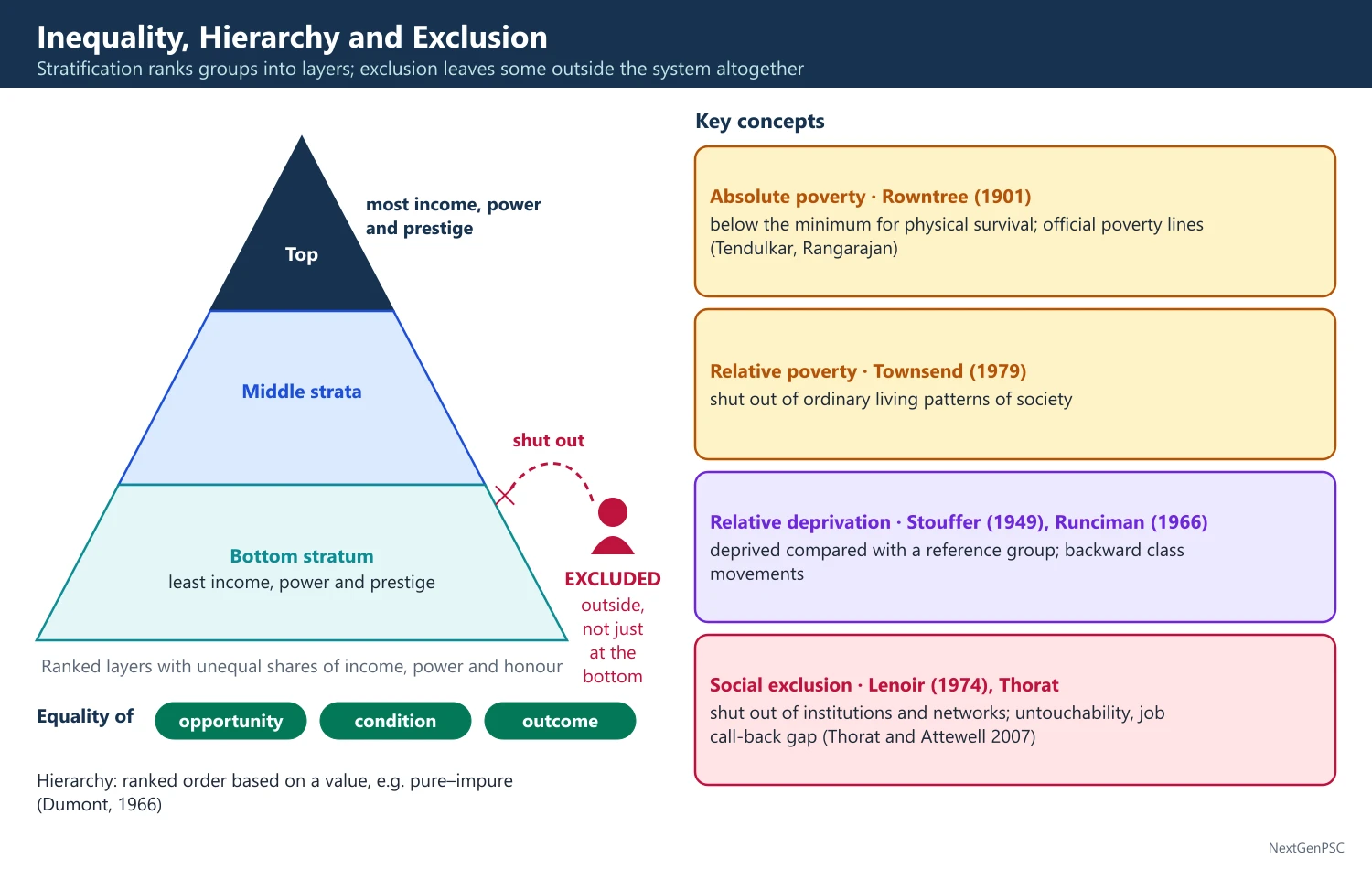
Social stratification is the ranking of groups in a society into layers that get unequal shares of income, power and honour. The basic concepts are equality (of opportunity, condition and outcome), inequality, hierarchy (ranked order, as in Dumont's caste model), social exclusion, poverty (absolute and relative) and relative deprivation. In India these ideas explain caste, untouchability, landlessness and the gap between law and lived reality.
In simple words
Society is like a building with floors: some people live on the top floor with money, power and respect, others on the ground floor with little of any. This layering is called stratification.
Inequality means some have more than others; exclusion means some are kept out of the building's rooms altogether, like Dalits once kept out of temples and wells.
Poverty can be absolute (not enough food) or relative (much less than others around you).
UPSC asks you to define these terms, compare them and illustrate them with Indian data.
1. Concepts and Definitions
Social stratification: a structured, relatively permanent ranking of groups (strata) that receive unequal rewards; Melvin Tumin (1967, Social Stratification: The Forms and Functions of Inequality) stressed that it is social, ancient, universal, diverse in form and consequential for life chances.
Differentiation vs stratification: differentiation is mere difference (age, skill, role); stratification begins only when differences are ranked and tied to unequal rewards that are passed across generations.
Equality: R.H. Tawney in Equality (1931) argued that a good society reduces inequalities of circumstance, not only of opportunity; sociologists distinguish equality of opportunity, equality of condition and equality of outcome.
Equality of opportunity: the liberal ideal that positions are open to talent, linked to meritocracy; critics such as Bourdieu show that formally equal competition still favours those with cultural capital.
Equality of outcome: the socialist ideal of similar results for all, associated with Marx's principle 'from each according to his ability, to each according to his needs' (Critique of the Gotha Programme, 1875).
Citizenship and equality: T.H. Marshall in Citizenship and Social Class (1950) traced civil, political and social rights, and argued that social rights of citizenship soften class inequality.
Justice as fairness: John Rawls (A Theory of Justice, 1971) proposed the difference principle: inequalities are just only if they benefit the least advantaged.
Inequality: unequal access to valued resources such as income, wealth, power, prestige, education and health; it can be natural (physical) or social (created by institutions), a distinction going back to Rousseau's Discourse on Inequality (1755).
Hierarchy: a graded order in which units are ranked above and below one another; Louis Dumont in Homo Hierarchicus (1966) saw caste as hierarchy based on the opposition of pure and impure, in which the whole encompasses its parts.
Homo hierarchicus vs homo aequalis: Dumont contrasted holistic, hierarchical Indian society with individualistic, egalitarian Western society; André Béteille and Dipankar Gupta criticised this as too ideological and static.
Social exclusion: a term popularised by René Lenoir in France (1974) for people shut out of the social mainstream; it is multidimensional, relational and process-based, not only lack of income.
Exclusion in India: Sukhadeo Thorat links exclusion to caste and untouchability, where denial of access to land, temples, water, markets and jobs is built into social rules.
Social closure: Frank Parkin (1979) used Weber's idea to show how groups monopolise rewards by exclusion (from above) and usurpation (from below).
Poverty: absolute poverty is lack of the minimum for survival, measured by a poverty line (Rowntree's study of York, 1901, is the classic); relative poverty is a standard of living far below the society's normal one.
Relative deprivation (poverty): Peter Townsend in Poverty in the United Kingdom (1979) defined the poor as those whose resources are so far below average that they are excluded from ordinary living patterns, customs and activities.
Relative deprivation (perception): the feeling of being deprived compared with a reference group; first noted in Stouffer's The American Soldier (1949) and developed by W.G. Runciman in Relative Deprivation and Social Justice (1966).
Multidimensional poverty: Amartya Sen's capability approach (Development as Freedom, 1999) sees poverty as deprivation of capabilities, not just income; the Alkire–Foster method behind the global MPI follows this idea.
2. The Debates Explained
Is inequality inevitable? Functionalists (Davis and Moore, 1945) say yes, because unequal rewards motivate people to fill important jobs; Marxists say it is a product of private property and can be abolished; this remains debated.
Culture of poverty: Oscar Lewis (1959, Five Families; 1966, La Vida) argued that the poor develop a self-perpetuating subculture of fatalism and present-time orientation.
Critique of culture of poverty: Charles Valentine (1968) and later structural writers argued that poverty comes from lack of jobs and power, not from the values of the poor; blaming culture blames the victim.
Underclass debate: Charles Murray (1984) blamed welfare dependency, while William Julius Wilson (The Truly Disadvantaged, 1987) blamed de-industrialisation and joblessness in inner cities.
Exclusion vs poverty: exclusion asks who is excluded, by whom and through which institutions; a well-off Dalit can still face exclusion in housing, which a pure income measure misses.
Hierarchy vs inequality: Béteille (Inequality among Men, 1977) noted that modern societies accept inequality as a fact but reject hierarchy as a value, whereas traditional India accepted hierarchy as legitimate.
3. Indian Examples and Data
Constitutional equality: Articles 14–17 guarantee equality before law, ban discrimination and abolish untouchability (Article 17); Article 46 directs the state to promote the interests of weaker sections.
Gap between law and practice: Béteille called this the tension between the egalitarian Constitution and a hierarchical society, a gap that remains visible in atrocities and inter-caste marriage rates.
Labour market exclusion: Sukhadeo Thorat and Paul Attewell's field experiment (EPW, 2007) sent matched job applications to private firms and found applicants with Dalit and Muslim names received fewer calls, showing exclusion in modern sectors.
Muslim deprivation: the Sachar Committee report (2006) documented lower educational attainment and lower share in government jobs among Indian Muslims.
Multidimensional poverty: NITI Aayog's discussion paper (January 2024) estimated that the share of people in multidimensional poverty fell from 29.17% in 2013–14 to 11.28% in 2022–23, with about 24.82 crore people moving out.
Informal deprivation: the NCEUS report (Arjun Sengupta, 2007) estimated that about 77% of Indians lived on less than Rs 20 a day in 2004–05, showing vulnerability above the official poverty line.
Relative deprivation in movements: M.S.A. Rao used relative deprivation to explain backward class and peasant movements, where groups compare themselves with more advanced castes.
World examples: apartheid in South Africa (1948–1994) was legal exclusion by race; the Roma in Europe face exclusion in housing and schools.
4. Linking Thinkers
Rousseau's natural vs social inequality leads to Marx's class analysis, which sees property as the root of inequality.
Dumont's hierarchy links to Srinivas's Sanskritisation (mobility inside hierarchy) and to Ghurye's features of caste.
Runciman's relative deprivation links to Merton's reference group theory (chapter 7) and to Gurr's theory of rebellion (chapter 10).
Townsend's relative poverty links to Sen's capability approach and to Weber's life chances.
Parkin's social closure links Weber's status groups to Indian caste endogamy and to job reservation as usurpation.
5. Using It in the Exam
10-mark answer (150 words): define the term with its thinker, give two dimensions, one Indian example with data, and one line of criticism.
15-mark answer (200 words): contrast two concepts (for example exclusion vs poverty), bring a study such as Thorat and Attewell, and conclude on policy (reservation, MGNREGA-type rights).
20-mark answer (250 words): theory (Davis–Moore vs Tumin or Lewis vs Valentine), Indian evidence (NITI MPI, Sachar, Article 17) and a balanced conclusion.
Thinkers examiners look for: Tawney, Marshall, Dumont, Béteille, Townsend, Runciman, Lewis, Sen, Thorat.
Diagram idea: a pyramid showing income, power and prestige, with an arrow outside it labelled 'excluded' to show that exclusion is about being outside, not just at the bottom.
Quotation: Townsend's idea, paraphrased: people are poor when their resources are so seriously below the average that they are excluded from ordinary living patterns.
| Concept | Key thinker | Core idea | Indian example |
|---|---|---|---|
| Absolute poverty | Seebohm Rowntree (1901) | Below the minimum needed for physical survival | Official poverty lines (Tendulkar, Rangarajan) |
| Relative poverty | Peter Townsend (1979) | Excluded from ordinary living patterns of society | Households unable to afford schooling or a smartphone |
| Relative deprivation | Stouffer (1949), Runciman (1966) | Feeling deprived compared with a reference group | Backward class movements (M.S.A. Rao) |
| Social exclusion | René Lenoir (1974), Thorat | Being shut out of institutions and networks | Untouchability, job call-back gap (Thorat and Attewell 2007) |
| Hierarchy | Louis Dumont (1966) | Ranked order based on a value (pure–impure) | Caste ranking, rules of commensality |
Mains points
- Questions often ask you to distinguish poverty from deprivation or exclusion; define each with its thinker before comparing.
- Do not treat inequality and stratification as the same: stratification is structured, ranked and inherited inequality.
- Bring Indian evidence in every Paper I answer: Article 17, Thorat and Attewell's job study, Sachar Committee, NITI Aayog MPI (2024).
- For 'Is equality possible?' type questions, set functionalist inevitability against Marxist and Rawlsian views and end with Marshall's citizenship rights.
- Mention the culture of poverty debate with both Lewis and his critics; examiners penalise one-sided answers.
- Link relative deprivation to social movements and reference groups to show integration across the syllabus.
Did you know?
- Memory trick for types of equality: 'O-C-O' — Opportunity (liberal), Condition (starting point), Outcome (socialist).
- Dumont's book title Homo Hierarchicus deliberately plays on Homo sapiens to suggest that Indians are 'hierarchical man', a claim many Indian sociologists reject.
Theories of Stratification: Functionalist, Marxist and Weberian
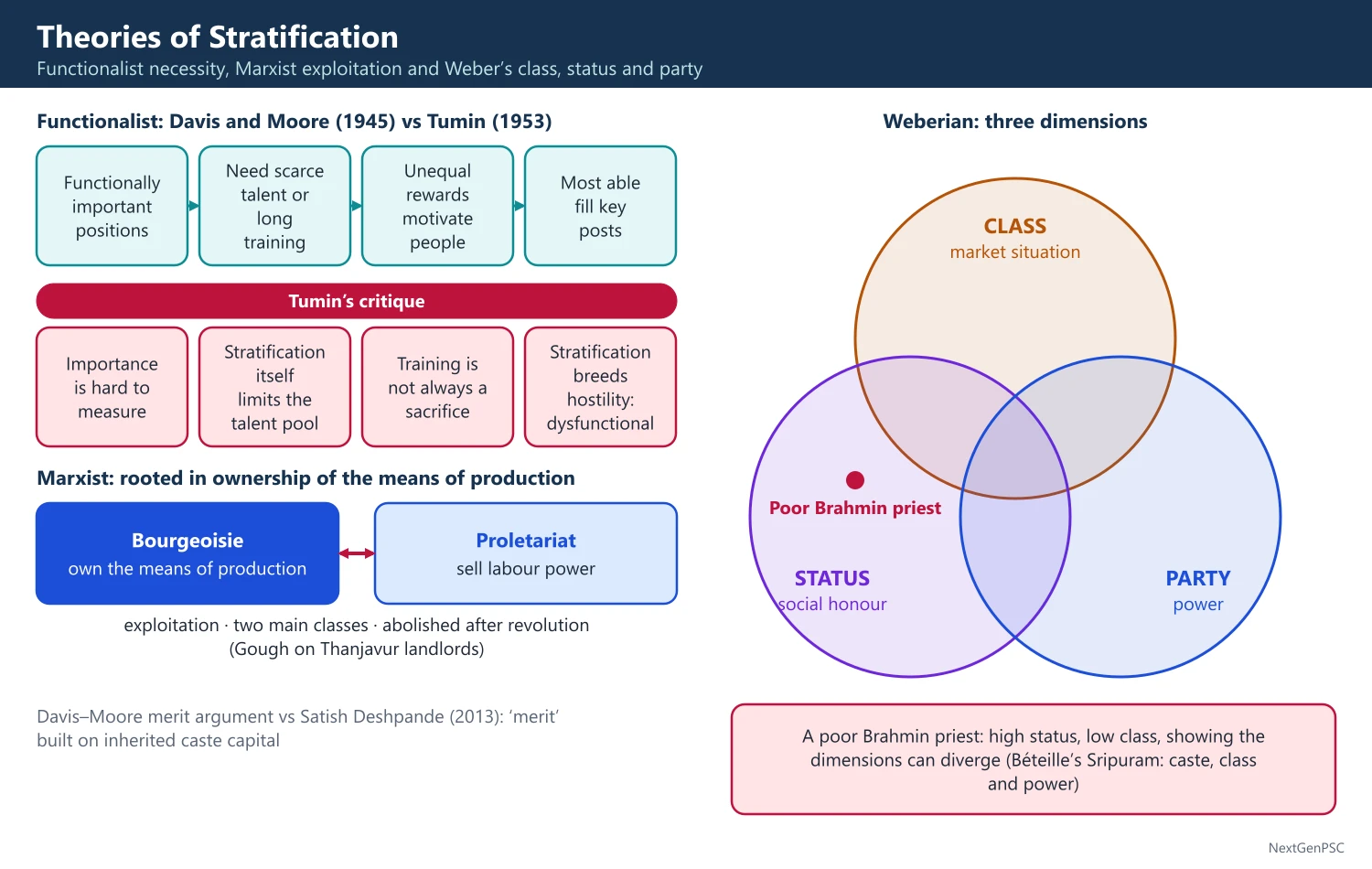
Three theories explain why stratification exists. Functionalists (Parsons; Davis and Moore, 1945) see it as necessary to place the most able in the most important positions. Marxists see it as rooted in ownership of the means of production and exploitation. Weber made it multidimensional: class, status and party. Caste in India is the best test case for all three.
In simple words
Why do doctors earn more than cleaners? Functionalists say society must pay more to attract talent to important jobs.
Marxists reply that the rich own factories and land, and simply take the surplus that workers produce.
Weber said it is not one ladder but three: money (class), honour (status) and power (party); a poor Brahmin priest may have high status but little money.
UPSC asks you to compare these theories and test them on caste and class in India.
1. Structural Functionalist Theory
Parsons (1940, 'An Analytical Approach to the Theory of Social Stratification'; revised 1953): stratification ranks individuals by how far they embody the shared values of society; in the USA, achievement in occupation is valued, so successful professionals rank high.
Davis and Moore (1945, 'Some Principles of Stratification', American Sociological Review): every society must motivate people to fill positions that are functionally important and need scarce talent or long training; unequal rewards are the device that does this.
Their two determinants: the functional importance of a position and the scarcity of personnel able to fill it; a doctor ranks high on both.
Conclusion: stratification is universal, functional and an 'unconsciously evolved device' by which societies ensure that the most important positions are filled by the most qualified persons.
Melvin Tumin's critique (1953, 'Some Principles of Stratification: A Critical Analysis'): functional importance is hard to measure (is an engineer more important than a worker?); the pool of talent is restricted by stratification itself, since the poor lack access to training.
Tumin continued: training is not always a sacrifice (students enjoy leisure and are supported by parents); stratification creates hostility, suspicion and distrust and so can be dysfunctional; non-material rewards like job satisfaction can also motivate.
Other critics: Buckley (1958) said Davis and Moore confused differentiation with stratification; Wrong (1959) noted that they explained inequality of positions, not inheritance of position across generations.
Michael Young's satire The Rise of the Meritocracy (1958) warned that a society ranking purely by IQ plus effort would be harsh and new elites would close ranks.
2. Marxist Theory
Core claim: in every class society the decisive division is between those who own the means of production and those who do not; slave owner and slave, lord and serf, bourgeoisie and proletariat.
Exploitation: under capitalism workers sell labour power; the value they produce above their wage is surplus value, appropriated by the capitalist (Capital, Vol. 1, 1867).
Class in itself and class for itself: a class in itself shares an objective position; it becomes a class for itself when it gains class consciousness and organises (The Poverty of Philosophy, 1847).
Ideology: the ruling class also controls ideas ('the ideas of the ruling class are in every epoch the ruling ideas', The German Ideology, 1845–46), producing false consciousness among the exploited.
Prediction: polarisation into two classes, pauperisation of workers, revolution and a classless communist society.
Criticism: the middle class grew instead of disappearing (Dahrendorf, Goldthorpe); ownership separated from control in joint-stock companies (Dahrendorf, Class and Class Conflict in Industrial Society, 1959); revolutions came in peasant societies, not advanced capitalist ones; the theory neglects status, gender and ethnicity.
Neo-Marxists: Erik Olin Wright (Classes, 1985) introduced contradictory class locations, such as managers who control labour but do not own capital; Harry Braverman (1974) argued that white-collar work was deskilled and proletarianised.
3. Weberian Theory
Source: 'Class, Status, Party' in Economy and Society (published 1922); power is distributed in three orders: economic, social and political.
Class: people who share common life chances in the market, based on property and skills; Weber separated property classes and commercial (acquisition) classes, so skilled professionals form distinct classes, unlike Marx's two-class model.
Status group: people who share a similar social estimation of honour and a common style of life; status groups restrict marriage and dining, and caste is Weber's extreme case of a closed status group.
Party: groups oriented to acquiring social power to influence decisions, such as political parties and pressure groups; parties may represent classes, status groups or both.
Key argument: class, status and power can vary independently; status can even act against the market, since status groups oppose pure market rules.
Criticism: Marxists say Weber described surface differences and ignored the basic relation of exploitation; others say the three dimensions are usually strongly correlated in practice.
Neo-Weberians: John Goldthorpe's class schema (used in the Oxford Mobility Study, 1972) ranks occupations by market and work situation; David Lockwood's The Blackcoated Worker (1958) showed clerks differed from manual workers in work and status situation.
4. Other Perspectives and Synthesis
Gerhard Lenski (Power and Privilege, 1966): a synthesis: needs are distributed by functional logic, but the surplus beyond needs is distributed by power; inequality rises with surplus from hunting to agrarian societies and falls slightly in industrial societies.
Dahrendorf: conflict arises from authority relations in 'imperatively coordinated associations', not only property.
Feminist critique: all three theories took the family and the male breadwinner as the unit of analysis, hiding women's position (Acker, 1973).
Bourdieu: class is reproduced through economic, cultural and social capital and through habitus (Distinction, 1979), joining Marx's economics with Weber's lifestyle.
Marx on caste: in 'The Future Results of British Rule in India' (1853) Marx expected railways and modern industry to dissolve the hereditary division of labour on which Indian castes rest; later Indian Marxists debated whether caste is part of the base or the superstructure.
Merit debate in India: opponents of reservation use a Davis–Moore style merit argument, while Satish Deshpande ('Caste and Castelessness', EPW, 2013) argues that upper-caste 'merit' is itself built on inherited caste capital.
Links across the syllabus: Davis–Moore connects to Parsons's pattern variable of achievement vs ascription (chapter 7); Marx's class links to Thorner's and Desai's agrarian class structure (Paper II); Weber's status group links to Ghurye's endogamy and Dumont's hierarchy.
Gender gap in all three: none of the classical theories explains why women in the same class have fewer life chances, which is why Walby and Crenshaw are added in the next topic.
5. Testing the Theories on India
Functionalist reading of caste: some scholars saw caste as a stable division of labour that gave every group a place, as in the jajmani system described by William Wiser (The Hindu Jajmani System, 1936).
Critique: Kathleen Gough, Gerald Berreman and later Dalit scholars stress that caste rewards were based on birth, not talent, and enforced by force and ritual degradation.
Marxist reading: A.R. Desai and Kathleen Gough linked caste to land ownership; Gough's Thanjavur studies showed Brahmin landlords and Dalit labourers.
Weberian reading: André Béteille's Caste, Class and Power (1965), a study of Sripuram village in Thanjavur, showed that caste, class and power once coincided in Brahmin hands but were becoming dispersed as non-Brahmins gained land and political office.
Dominant caste: M.N. Srinivas's concept (Rampura) combines numerical strength, land (class), political power and ritual rank, a Weberian mix of dimensions.
Contemporary India: rising Dalit middle class and Dalit entrepreneurs (DICCI, founded 2005) show class and status separating, as Weber predicted.
6. Using It in the Exam
10 marks: state Davis–Moore's two determinants and Tumin's three main objections, with one Indian example.
15 or 20 marks: compare all three theories in a table, then test them on caste using Béteille's Sripuram and Srinivas's dominant caste.
Thinkers to cite: Davis and Moore, Tumin, Marx, Wright, Weber, Goldthorpe, Lenski, Béteille, Gough.
Diagram idea: three overlapping circles labelled class, status and party, with a Brahmin priest placed in high status but low class.
Quotation: Davis and Moore's idea, paraphrased: social inequality is an unconsciously evolved device to ensure that the most important positions are filled by the most qualified persons.
| Point | Functionalist | Marxist | Weberian |
|---|---|---|---|
| Main thinkers | Parsons; Davis and Moore | Marx; Wright; Braverman | Weber; Goldthorpe; Lockwood |
| Basis of strata | Functional importance and scarce talent | Ownership of means of production | Market situation, status honour and power |
| Nature of inequality | Universal and necessary | Exploitative and historical | Multidimensional and variable |
| Number of classes | Continuous ranking | Two main classes | Many classes and status groups |
| Future | Remains, becomes more meritocratic | Abolished after revolution | Bureaucratisation, no end of inequality |
| Indian test case | Jajmani as division of labour | Gough on Thanjavur landlords | Béteille's Sripuram |
Mains points
- The Davis–Moore vs Tumin debate is a favourite; list Tumin's objections point by point and add Indian evidence that talent is wasted when access to education depends on caste and class.
- For Marx vs Weber, show that Weber did not reject class but added status and party; avoid the common mistake of calling Weber anti-Marx.
- Use caste as the test case: Weber's closed status group, Gough's class reading, Béteille's dispersal of caste, class and power.
- Mention neo-Marxists (Wright) and neo-Weberians (Goldthorpe) to show updated knowledge.
- A comparison table followed by a short evaluation paragraph scores well in 20-mark answers.
- Conclude that modern sociologists combine the theories (Lenski, Bourdieu) rather than choosing one.
Did you know?
- Memory trick for Weber: 'Money, Honour, Power' = Class, Status, Party.
- Michael Young coined the word 'meritocracy' as a warning in his 1958 satire, yet the word is now used as praise.
Dimensions of Stratification: Class, Status, Gender, Ethnicity and Race
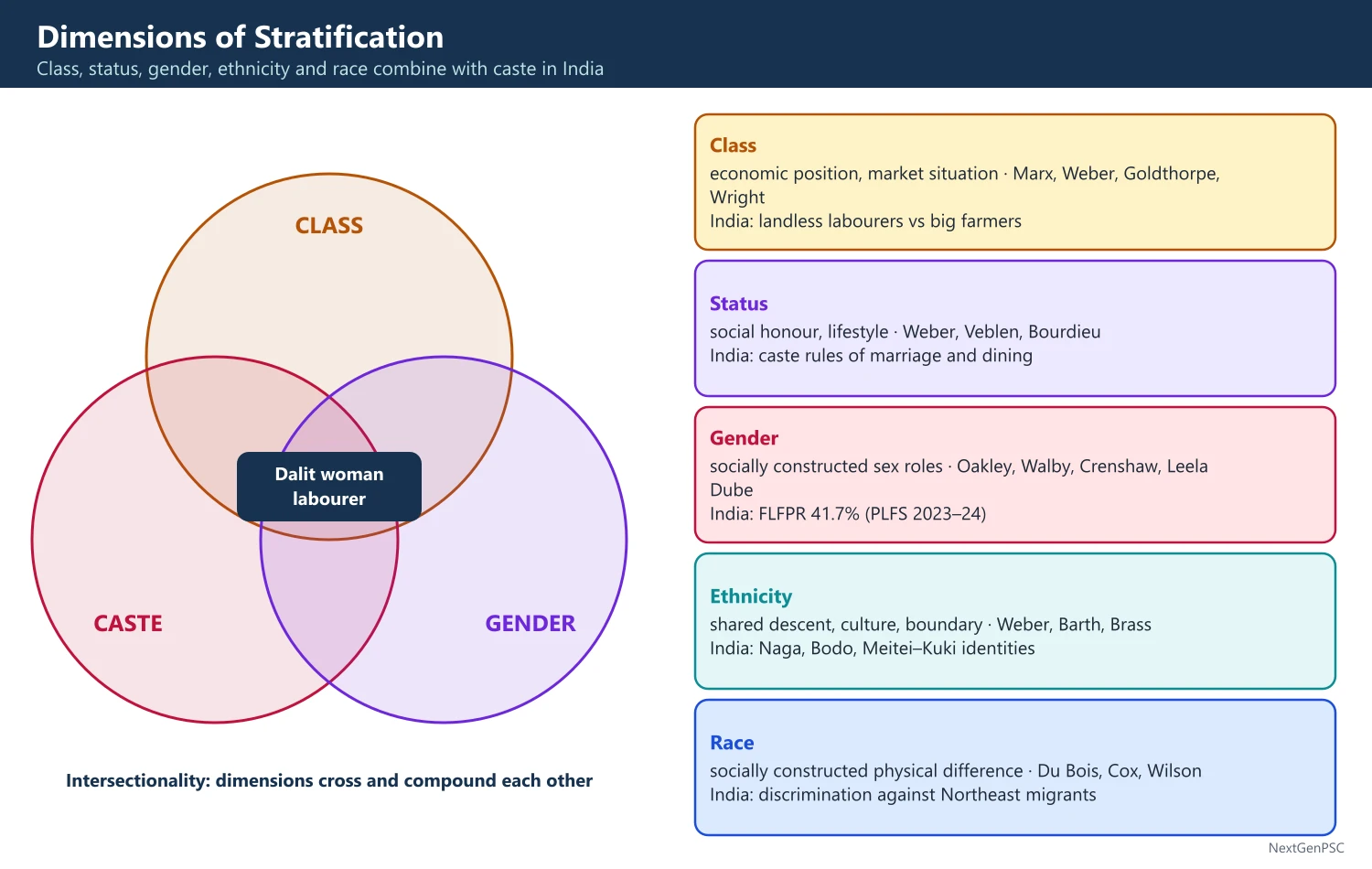
Stratification has several dimensions. Class rests on economic position, status on social honour and lifestyle, gender on socially constructed differences between men and women, ethnicity on shared culture and descent, and race on supposed biological difference that is socially constructed. These dimensions cross each other, an idea called intersectionality, and in India they combine with caste, tribe and religion.
In simple words
A person's place in society is not set by one thing only. Money decides class, respect decides status, and being a woman, a tribal or a member of a minority adds further layers.
Think of a Dalit woman farm labourer: she is poor, low in caste and a woman, all at once.
Sociologists call this crossing of disadvantages intersectionality.
UPSC asks how gender, ethnicity and race create inequality and how they combine with class.
1. Class
Marx: class is a relation to the means of production; Weber: class is a shared market situation and life chances; Goldthorpe: class is defined by employment relations (service relationship vs labour contract).
Measuring class: the UK's National Statistics Socio-economic Classification (NS-SEC) grew out of Goldthorpe's schema; Indian surveys use occupation, land and consumption (HCES, PLFS).
Class in India: agrarian classes (landlords, rich peasants, small peasants, landless labourers, after Daniel Thorner's 1956 categories of malik, kisan and mazdoor) and industrial classes; the urban middle class grew after 1991 (Leela Fernandes, India's New Middle Class, 2006).
Death of class? Pakulski and Waters (The Death of Class, 1996) argued that consumption and identity have replaced class; critics such as Goldthorpe show class still predicts life chances strongly; debated.
Precariat: Guy Standing (The Precariat, 2011) describes a growing class with insecure work and no occupational identity, relevant to India's gig and platform workers.
2. Status Groups
Weber: status is positive or negative social estimation of honour, expressed in a style of life, restrictions on marriage (connubium) and dining (commensality), and in monopolies of privileges.
Caste as status group: Weber (The Religion of India, 1916) saw caste as the extreme form of a closed status group backed by ritual and religion.
Status and consumption: Thorstein Veblen (The Theory of the Leisure Class, 1899) described conspicuous consumption; Bourdieu (Distinction, 1979) showed that taste marks status.
Indian example: big weddings and dowry, SUV purchases by rural dominant castes and English-medium schooling are status markers studied by Satish Deshpande and others.
Status inconsistency: Gerhard Lenski (1954) used the idea of status crystallisation for people who rank high on one dimension and low on another, such as a Dalit officer who still faces caste prejudice.
3. Gender Stratification
Sex vs gender: Ann Oakley (Sex, Gender and Society, 1972) separated biological sex from culturally learned gender roles; Simone de Beauvoir wrote 'one is not born, but rather becomes, a woman' (The Second Sex, 1949).
Patriarchy: Sylvia Walby (Theorizing Patriarchy, 1990) identified six structures: household production, paid work, the state, male violence, sexuality and cultural institutions; she distinguished private and public patriarchy.
Liberal feminism stresses legal equality and socialisation; Marxist feminism links women's oppression to capitalism and unpaid domestic labour; radical feminism (Kate Millett, Sexual Politics, 1970; Shulamith Firestone, 1970) sees patriarchy as the primary oppression; black feminism (bell hooks) adds race.
Intersectionality: Kimberlé Crenshaw (1989) showed that black women faced discrimination that neither race law nor sex law alone captured.
Debate on the unit of stratification: Goldthorpe (1983) defended the family as the unit, classed by the male head; Stanworth (1984) and others argued women should be classified individually.
Indian data: female labour force participation was 41.7% (PLFS 2023–24, age 15+, usual status), up from 23.3% in 2017–18; the Time Use Survey 2019 found women spent about 299 minutes a day on unpaid domestic work against 97 minutes for men (among those who did such work).
Indian concepts: Uma Chakravarti's brahmanical patriarchy (1993) links caste purity to control over women's sexuality; Leela Dube shows how kinship and socialisation reproduce gender inequality.
Laws: Hindu Succession (Amendment) Act 2005 made daughters coparceners; the Constitution (106th Amendment) Act 2023 reserves one-third of seats for women in the Lok Sabha and state assemblies after the next census and delimitation.
Son preference: NFHS-5 (2019–21) recorded 1,020 women per 1,000 men in the household population but a sex ratio at birth of 929 for children born in the five years before the survey.
Glass ceiling and sticky floor: women crowd into low-paid informal work (sticky floor) and are rare at the top (glass ceiling); 74 women were elected to the 543-member Lok Sabha in 2024, about 13.6%.
Marxist feminism and class: Margaret Benston (1969) argued that women's unpaid housework reproduces labour power for capital, linking gender to Marx's class analysis.
4. Ethnicity
Definition: an ethnic group shares a sense of common descent, culture, language or religion; Weber defined it by a subjective belief in common descent.
Primordialism vs constructivism: Clifford Geertz (1963) stressed primordial attachments; Fredrik Barth (Ethnic Groups and Boundaries, 1969) argued that ethnicity is defined by the boundary maintained between groups, not by the cultural stuff inside.
Instrumentalism: Paul Brass (Ethnicity and Nationalism, 1991) showed elites mobilise ethnic identity for political gain, using Indian cases such as Punjab and Muslim separatism.
Indian examples: the Northeast (Naga, Bodo, Mizo movements), linguistic reorganisation of states (1956), and the Meitei–Kuki conflict in Manipur since May 2023.
Ethnicity and stratification: Michael Hechter's internal colonialism (1975) showed ethnic regions in a cultural division of labour; tribes in India are both an ethnic category and the poorest stratum.
Tribes in numbers: Census 2011 counted about 10.4 crore Scheduled Tribe people, 8.6% of India's population, notified under Article 342.
Assimilation vs pluralism: Robert Park's race relations cycle (1920s) of contact, competition, accommodation and assimilation contrasts with pluralist models; India's Fifth and Sixth Schedules follow a pluralist approach.
5. Race
Race as social construct: biologically, human genetic variation does not fall into discrete races; the UNESCO statements on race (from 1950) rejected scientific racism, but race persists as a social category with real effects.
Racism: individual prejudice, institutional racism (named by Carmichael and Hamilton, 1967; the Macpherson Report in the UK, 1999) and structural racism.
Theories: W.E.B. Du Bois described double consciousness (The Souls of Black Folk, 1903); Oliver Cox (1948) gave a Marxist theory of race as capitalist exploitation; William Julius Wilson (The Declining Significance of Race, 1978) argued that class was becoming more important than race for black Americans, a debated view.
Caste and race: the 2001 Durban UN conference saw Dalit groups seek to include caste as descent-based discrimination; Béteille opposed equating caste with race, while Isabel Wilkerson's Caste (2020) compares them; debated.
Indian examples: racial abuse of people from the Northeast in Indian cities prompted the Bezbaruah Committee (2014); colourism in marriage advertisements.
Caste and race compared: legal segregation under apartheid and the Jim Crow laws of the US South (ended by the Civil Rights Act 1964) led Gerald Berreman ('Caste in India and the United States', 1960) to treat caste and race as similar closed systems.
Black Lives Matter (from 2013) shows that race still shapes policing and life chances in the USA long after legal equality.
6. Linking and Exam Use
Gender links to patriarchy and sexual division of labour (chapter 12); ethnicity links to nation and identity movements (chapter 10); class links to Marx and Weber (chapter 5 and 6).
Weber's status group and Parkin's social closure explain how caste, race and gender all work as exclusion that markets alone do not remove.
10 marks: define the dimension with its thinker, one theory, one Indian example with data.
20 marks: show how dimensions intersect: a Dalit woman, an Adivasi migrant worker; use Crenshaw, Walby and Barth with Indian data.
Diagram idea: a Venn diagram of class, caste and gender with a Dalit woman labourer in the centre.
Quotation: de Beauvoir: 'One is not born, but rather becomes, a woman' (The Second Sex, 1949).
| Dimension | Basis | Key thinkers | Indian example |
|---|---|---|---|
| Class | Economic position, market situation | Marx, Weber, Goldthorpe, Wright | Landless labourers vs big farmers |
| Status | Social honour, lifestyle | Weber, Veblen, Bourdieu | Caste rules of marriage and dining |
| Gender | Socially constructed sex roles | Oakley, Walby, Crenshaw, Leela Dube | FLFPR 41.7% (PLFS 2023–24) |
| Ethnicity | Shared descent, culture, boundary | Weber, Barth, Brass | Naga, Bodo, Meitei–Kuki identities |
| Race | Socially constructed physical difference | Du Bois, Cox, Wilson | Discrimination against Northeast migrants |
Mains points
- Questions ask whether gender, ethnicity or race are independent dimensions or reducible to class; present Marxist, Weberian and feminist views, then intersectionality.
- Use Indian data with years: PLFS 2023–24 FLFPR, Time Use Survey 2019, NFHS-5 for gender; Census 2011 tribal share (8.6%) for ethnicity.
- For caste vs race, give both sides (Durban 2001 debate, Béteille's objection) and mark it as debated.
- Barth's boundary approach and Brass's instrumentalism help explain Indian ethnic movements.
- Avoid presenting race as biological; state clearly that it is socially constructed but has real consequences.
- End with a policy link: reservation, Women's Reservation Act 2023, Sixth Schedule.
Did you know?
- Kimberlé Crenshaw explained intersectionality with the image of a traffic intersection: discrimination can come from several directions at once.
- Memory trick: 'C-S-G-E-R' = Class, Status, Gender, Ethnicity, Race, the five dimensions in the syllabus.
Social Mobility: Open and Closed Systems, Types and Causes
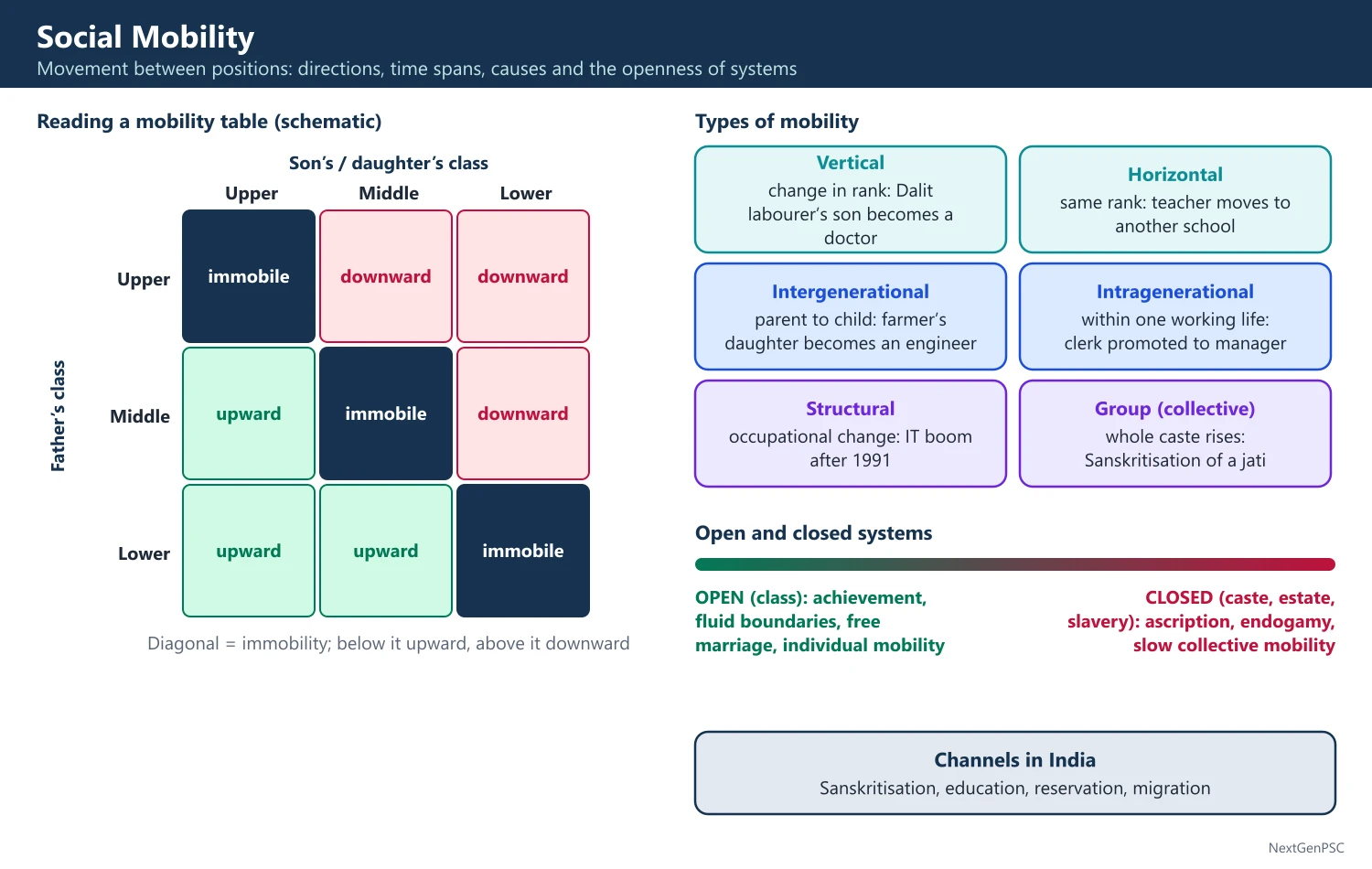
Social mobility is the movement of individuals or groups between positions in a stratification system. Open systems (class) allow mobility by achievement; closed systems (caste, estate, slavery) fix position by birth. Mobility can be vertical or horizontal, intergenerational or intragenerational, structural or exchange, individual or group. In India, Sanskritisation, education, reservation and migration are key channels.
In simple words
Social mobility means moving up or down the social ladder, like a farmer's son becoming an IAS officer.
In an open system like class, the ladder has many rungs you can climb; in a closed system like traditional caste, you stay on the rung you were born on.
Mobility can happen within one life or between parent and child, and to one person or to a whole caste.
UPSC asks about types of mobility, its causes and whether caste is really closed.
1. Concepts and Definitions
Social mobility: Pitirim Sorokin in Social Mobility (1927), the first systematic study, defined it as any transition of an individual or social object from one social position to another.
Open system: positions are achieved and boundaries between strata are weak, as in modern class societies; closed system: positions are ascribed by birth, as in caste, feudal estates and slavery; real societies lie between the two ideal types.
Vertical mobility: upward or downward movement in rank (Sorokin's ascending and descending mobility); horizontal mobility: change of position without change in rank, such as a clerk moving from one bank to another, or rural–urban migration in the same occupation.
Intergenerational mobility: change between parents' and children's positions; intragenerational (career) mobility: change within an individual's working life.
Structural mobility: caused by change in the occupational structure itself, such as the growth of white-collar and service jobs; exchange (circulation) mobility: some move up while others move down in a fixed structure.
Absolute vs relative mobility: absolute mobility counts how many people move; relative mobility (social fluidity) compares the chances of people from different origins reaching a destination, measured by odds ratios (Goldthorpe).
Short-range vs long-range mobility: movement between neighbouring strata versus movement across distant strata (Glass, 1954).
Elite self-recruitment: the share of top positions filled by children of those already at the top; a direct measure of closure.
Individual vs group mobility: in caste societies, mobility is largely collective, as whole jatis claim higher rank (Srinivas).
Sponsored vs contest mobility: Ralph Turner (1960) contrasted the British pattern of early selection of an elite (sponsored) with the American open race (contest).
2. Classic Mobility Studies
Glass (1954), Social Mobility in Britain: found considerable short-range mobility but little long-range mobility; the elite was largely self-recruiting.
Lipset and Bendix (Social Mobility in Industrial Society, 1959): found broadly similar total mobility rates across industrial nations once industrialisation reached a certain level, challenging American exceptionalism.
Blau and Duncan (The American Occupational Structure, 1967): used path analysis and found that a person's own education was a stronger predictor of occupational attainment than father's occupation, supporting meritocracy in part.
Goldthorpe's Oxford Mobility Study (1972; Social Mobility and Class Structure in Modern Britain, 1980): found much absolute upward mobility due to expansion of the service class, but relative chances remained unequal: the 1:2:4 rule of thumb, in which the son of a service-class father had several times better chance of reaching the service class than a working-class son.
Feminist critique: early studies counted only men; Abbott and Payne (1990) and others included women and found that women's mobility differs because of occupational segregation.
Recent: Raj Chetty and colleagues (2014 onwards) used tax data to show that upward mobility in the USA varies sharply by neighbourhood and has declined over cohorts.
3. Sources and Causes of Mobility
Structural causes: industrialisation, urbanisation, expansion of education and the service sector create new positions (structural mobility).
Demographic causes: differential fertility; if upper strata have fewer children, vacancies at the top must be filled from below (Sorokin, Lipset and Bendix).
Individual causes: education, ability, aspiration and deferred gratification; Blau and Duncan's emphasis on own education.
Cultural and social capital: Bourdieu showed that parents' cultural capital shapes children's school success, reducing fluidity.
State policy: reservation, land reform, free education and welfare open channels; Sorokin called schools, army, church and political organisations 'channels of vertical circulation'.
Migration: rural to urban and international migration (Gulf migration from Kerala) raises income and status.
Technology: mobile phones and online learning open new channels, but the digital divide by gender, caste and region limits who can use them.
Barriers: caste, gender, race and region; lack of networks; Parkin's social closure.
4. Mobility in India
Is caste closed? Ghurye and Dumont stress closure, but Srinivas showed that caste has always allowed group mobility through Sanskritisation, the process by which a low caste adopts the customs, rituals and lifestyle of a higher, often twice-born, caste (Religion and Society among the Coorgs, 1952).
Westernisation: Srinivas's term for changes brought by British rule in technology, institutions, ideology and values, an important channel of mobility for upper castes first.
Positional, not structural change: Srinivas noted that Sanskritisation changed the position of a caste, not the structure of hierarchy itself.
Historical evidence: K.M. Panikkar and Srinivas noted that many ruling families came from lower origins and were made Kshatriya, while Burton Stein described peasant castes rising in medieval South India.
Other processes: de-Sanskritisation and assertion of non-Brahmin identity (Periyar's Self-Respect Movement, 1925); Yogendra Singh's framework of orthogenetic and heterogenetic change.
Education and reservation: Constitutional reservation for SCs and STs (Articles 15(4), 16(4), 46, 330, 332) and OBCs (Mandal, implemented 1990; upheld in Indra Sawhney, 1992) have created a Dalit and OBC middle class; the EWS quota (103rd Amendment, 2019) was upheld in Janhit Abhiyan (2022).
Evidence on mobility: Desai and Dubey (EPW, 2012) using IHDS data found persistent caste gaps in education and income though gaps narrowed in some areas; Azam and others found intergenerational educational mobility rising for SCs; debated.
Mobility through politics: Yogendra Yadav's 'second democratic upsurge' of the 1990s saw OBCs, Dalits and Adivasis vote and win office in larger numbers, giving group mobility in power.
Dalit status markers: Kapur, Prasad, Pritchett and Babu (EPW, 2010) reported improved lifestyle and status markers among Dalits in two Uttar Pradesh districts after market reforms; their findings are widely cited and debated.
Gulf migration: the Kerala Migration Surveys of K.C. Zachariah and S. Irudaya Rajan (from 1998) document how remittances raised the status of many Ezhava and Muslim families.
Downward mobility: agrarian distress, debt and land fragmentation push small farmers into wage labour; Jan Breman's studies of footloose labour in Gujarat show insecure circulation rather than mobility.
Gender: marriage, hypergamy and dowry shape women's mobility; Karve noted North Indian hypergamy linking families of different rank.
5. Linking and Exam Use
Mobility links to Weber's life chances, to Merton's anticipatory socialisation and reference groups (Sanskritisation as anticipatory socialisation), and to education and social change (chapter 13).
Pareto's circulation of elites (chapter 10) is a political form of mobility; Sorokin's channels of vertical circulation fit the army and civil services in India.
10 marks: define two types with examples (structural vs exchange; intergenerational vs intragenerational) and give an Indian case.
20 marks: 'Is caste a closed system?' Set Ghurye and Dumont against Srinivas, Béteille and current evidence on reservation and Dalit entrepreneurs.
Diagram idea: a 3 × 3 mobility table with father's class as rows and son's class as columns; diagonal cells show immobility.
Quotation: Srinivas, paraphrased: Sanskritisation is the process by which a low caste changes its customs, ritual, ideology and way of life in the direction of a high and frequently twice-born caste.
| Type | Meaning | Example |
|---|---|---|
| Vertical | Change in rank, up or down | Dalit labourer's son becomes a doctor |
| Horizontal | Change of position without change in rank | Teacher moves from one school to another |
| Intergenerational | Between parent and child | Farmer's daughter becomes an engineer |
| Intragenerational | Within one working life | Clerk promoted to manager |
| Structural | Due to change in occupational structure | IT boom after 1991 creating service jobs |
| Group (collective) | Whole caste changes rank | Sanskritisation of a jati over generations |
| Feature | Open (class) | Closed (caste, estate) |
|---|---|---|
| Basis of position | Achievement | Ascription by birth |
| Boundaries | Fluid | Rigid, backed by religion or law |
| Marriage | Free choice | Endogamy |
| Mobility | Individual | Mostly collective and slow |
Mains points
- Define each type precisely and give a pair-wise contrast; vague definitions lose marks.
- Cite at least two classic studies (Lipset and Bendix, Blau and Duncan, Goldthorpe) and note the feminist critique.
- For India, discuss Sanskritisation, Westernisation, reservation and migration as channels, and agrarian distress as a source of downward mobility.
- Questions on 'open vs closed' expect you to say that no system is fully open or closed, with caste mobility as evidence.
- Distinguish absolute from relative mobility: expansion of jobs can raise absolute mobility while relative chances stay unequal.
- Use a mobility table diagram for 15–20 mark answers.
Did you know?
- Sorokin, who wrote the first big book on social mobility, was himself mobile: born in a poor village in Russia, he became founder of Harvard's sociology department.
- Memory trick: 'VISE' = Vertical, Intergenerational, Structural, Exchange, the four most asked types.
UPSC Previous Year Questions: Stratification and Mobility
From 2014 to 2026 UPSC asked 42 question parts worth 610 marks from Stratification and Mobility (23 parts of 10 marks and 19 of 20 marks), making it one of the heaviest chapters of Paper I. The most-asked topics are theories of stratification (12 parts, mostly Weber versus Marx and Davis–Moore) and dimensions of stratification (12 parts on caste, class, gender, ethnicity and race), followed by equality, exclusion and poverty (9) and social mobility (9). Every question below has a model answer written to the UPSC word limit.
In simple words
Read the question and write your own answer first, keeping to about 150 words for 10 marks and 250 words for 20 marks.
Then read the approach and model answer, and check whether you used the right thinker (Weber, Marx, Davis and Moore, Tumin, Sorokin), an Indian example and a clear conclusion.
Note the points you missed and revise the matching topic of this chapter before trying the next question.
1. Equality, Inequality, Hierarchy, Exclusion, Poverty and Deprivation
Example 1 (UPSC 2026, 20 marks): Differentiate between social hierarchy and social exclusion and substantiate your answer with reference to the caste system.
Paper and question: Paper I, Q2(b)
Approach: Define both concepts with their thinkers, set out the differences point by point, then show how caste works both as a hierarchy (Dumont, Ghurye) and as a system of exclusion (Ambedkar, Thorat), ending with how the two are linked today.
Social hierarchy is a graded ranking of groups by worth, honour or purity; Louis Dumont (Homo Hierarchicus, 1966) saw caste as its purest case, ordered by the opposition of pure and impure. Social exclusion, a term popularised by René Lenoir in France (1974), is the process by which groups are shut out from full participation in economic, social and political life.
The two differ. Hierarchy is a matter of rank inside a system: groups are included, but unequally. Exclusion is a matter of boundary: a group is kept out. Hierarchy is gradational and often legitimised by an ideology that even lower groups share, whereas exclusion is a relational denial of rights and access.
Caste as hierarchy: G.S. Ghurye listed hierarchy, segmental division, restrictions on food and social intercourse, disabilities, hereditary occupation and endogamy as its features. The jajmani system, described by W.H. Wiser (1936), tied castes into an unequal but interdependent exchange, an inclusion through rank.
Caste as exclusion: untouchable castes were placed outside the varna order and denied temples, wells, schools and land; B.R. Ambedkar called caste a system of graded inequality. Thorat and Attewell's field experiment (2007) found that applicants with Dalit and Muslim names got fewer interview calls from private firms.
The two reinforce each other: hierarchy at the top produces exclusion at the bottom. Dipankar Gupta argues that castes today present themselves as separate identities rather than rungs of one ladder, so hierarchy weakens while exclusion persists.
Flow chart: Purity–pollution ideology → graded ranking of jatis (hierarchy) → disabilities and segregation at the bottom (exclusion) → denial of land, education, jobs → low life chances.
Hence Article 17 and the SC/ST (Prevention of Atrocities) Act, 1989 target exclusion, while reservation and education flatten hierarchy; an inclusive society needs both.
Example 2 (UPSC 2025, 20 marks): Compare capability deprivation approach with that of social capital deprivation in understanding chronic poverty.
Paper and question: Paper I, Q3(a)
Approach: Explain chronic poverty, then the capability deprivation approach (Sen) and the social capital deprivation approach (Bourdieu, Putnam, Woolcock), compare them point by point with Indian examples, and conclude that they complement each other.
Chronic poverty lasts for long periods or passes between generations, as among landless Dalit labourers or displaced Adivasi households. Two approaches explain why such households cannot escape.
The capability deprivation approach of Amartya Sen (Development as Freedom, 1999) sees poverty not as low income but as the lack of real freedoms to achieve valued functionings such as being healthy, literate and well nourished. Conversion factors like gender, disability and region decide what a person can do with income. It underlies the Alkire–Foster multidimensional poverty index; NITI Aayog estimated that India's multidimensional poverty fell from 29.17% (2013–14) to 11.28% (2022–23).
The social capital deprivation approach stresses missing networks and trust. Pierre Bourdieu saw social capital as resources gained through durable networks, unequally distributed by class; Robert Putnam (Bowling Alone, 2000) separated bonding from bridging capital, and Michael Woolcock added linking capital to people in power. The poor often have bonding ties but lack bridging and linking ties to jobs, credit and officials.
Comparison: Sen's approach is individual-centred and focuses on freedoms; the social capital approach is relational and group-centred. Sen explains persistence through ill health, illiteracy and gender bias; social capital explains reproduction through closed networks, as when Dalit youths lack referrals in private hiring. Sen is criticised for neglecting power; social capital for romanticising community and shifting the burden to the poor (Ben Fine).
Flow chart: Low capabilities (health, education) + weak bridging and linking ties → exclusion from jobs, credit and state schemes → low income and assets → poverty passed to the next generation.
Kerala's Kudumbashree (1998) self-help groups build social capital, while nutrition, schooling and health schemes build capabilities. The two approaches are complementary: capabilities give the ability to act, networks the opportunity to use it.
Example 3 (UPSC 2024, 10 marks): Discuss the dimensions of power in the construction and maintenance of social hierarchies in a society.
Paper and question: Paper I, Q7(c)
Approach: Define power (Weber) and show its economic, status, political and ideological dimensions (Marx, Srinivas, Gramsci, Lukes, Foucault) in building and keeping hierarchies, with Indian caste and gender examples.
Max Weber defined power as the chance of realising one's will even against the resistance of others. Social hierarchies are built and maintained through several dimensions of power.
Economic power: for Marx, control over the means of production gives owners power over labour, as landowning castes controlled tenants and labourers in Indian villages. Status and political power: Weber treated class, status and party as distinct dimensions; M.N. Srinivas's dominant caste in Rampura combined land, numbers, political influence and ritual rank.
Ideological power: Gramsci's hegemony explains how dominant groups win consent, so that purity–pollution or patriarchal norms seem natural; Steven Lukes (1974) called this the third face of power, shaping people's very wishes. Michel Foucault added disciplinary power working through knowledge and surveillance, such as colonial census classifications that fixed caste ranks.
Power is also contested: Dalit and women's movements, reservation and legal rights show that hierarchies change when the balance of power shifts.
Example 4 (UPSC 2023, 20 marks): How is poverty a form of social exclusion? Illustrate in this connection the different dimensions of poverty and social exclusion.
Paper and question: Paper I, Q4(b)
Approach: Show why poverty is not only low income but a relational process of exclusion (Townsend, Lenoir, Sen), then set out the dimensions of poverty and of exclusion with Indian examples, and conclude on policy.
Peter Townsend (1979) redefined poverty as relative deprivation: lacking the resources to take part in the activities and living conditions customary in one's society. In this sense poverty is itself a form of social exclusion, René Lenoir's term (1974) for those shut out of the mainstream.
The poor are excluded from markets (credit, land, decent jobs), from social participation (schooling, networks) and from political voice. Amartya Sen (2000) called exclusion constitutive when being left out is itself a loss, and instrumental when it causes other deprivations, as exclusion from credit causes low income.
Dimensions of poverty: income poverty (the Tendulkar line put 21.9% of Indians below it in 2011–12); multidimensional poverty in health, education and living standards (NITI Aayog: 11.28% in 2022–23); and vulnerability, as the NCEUS (2007) showed most informal workers living just above subsistence.
Dimensions of exclusion: economic (Dalit landlessness); social and cultural (untouchability, and stigma, which Oscar Lewis linked to a culture of poverty though Charles Valentine criticised him for blaming the poor); political (weak voice of denotified tribes); spatial (slums, remote tribal hamlets); and institutional (lack of documents blocking rations).
Flow chart: Caste, gender or region → denial of land, education and networks → low income and capabilities → stigma and weak voice → deeper exclusion, a vicious circle.
Indian studies confirm the link: Sukhadeo Thorat shows poverty is highest among groups facing caste and ethnic exclusion, and the Sachar Committee (2006) recorded Muslims' weaker access to jobs and credit.
Since poverty and exclusion feed each other, income transfers are not enough; rights-based measures such as the Forest Rights Act 2006, the National Food Security Act 2013 and reservation are needed for full citizenship.
Example 5 (UPSC 2020, 20 marks): How are Hierarchy and Exclusion the major impediments in the transformation of societies? Discuss.
Paper and question: Paper I, Q2(b)
Approach: Define hierarchy, exclusion and transformation, explain through theory (Myrdal, Tumin, Parkin, Dumont) how they block economic, political and cultural change, give Indian evidence, and balance it with ways in which they are being challenged.
Hierarchy is a ranked ordering of groups by status, and exclusion is the denial of full participation in social life (René Lenoir, 1974). Transformation means a shift towards open, democratic and productive social arrangements; both act as brakes on it.
Economic impediment: hierarchy fixes occupations by birth and wastes talent. Gunnar Myrdal's Asian Drama (1968) saw caste and status attitudes as obstacles to development, and Melvin Tumin argued that stratification limits the discovery of talent among the poor. Hereditary occupations, Dalit landlessness and low female labour force participation keep human resources idle.
Political impediment: exclusion silences some groups while dominant groups capture institutions. Frank Parkin's social closure, drawn from Weber, shows privileged groups monopolising opportunities, as in elite capture of panchayats and welfare benefits.
Cultural impediment: hierarchy legitimised by religion (Dumont's pure and impure) breeds fatalism and resistance to inter-caste marriage, seen in honour killings and caste panchayats. Exclusion also breeds distrust and conflict, as Tumin noted, weakening national integration.
Flow chart: Ascribed hierarchy + exclusion → wasted talent, low human capital, elite capture → slow growth, weak democracy → conflict and mistrust → stalled transformation.
Yet the relation is not one way. Marxists see hierarchy changing as economic relations change; Srinivas showed Sanskritisation and westernisation creating mobility; and Christophe Jaffrelot's "silent revolution" of backward castes in politics shows the excluded transforming society. Globalisation has opened new jobs but also new exclusions such as the digital divide.
Hierarchy and exclusion are therefore major but not insurmountable impediments; inclusive education, land and labour rights and anti-discrimination law turn them into issues of democratic struggle.
Example 6 (UPSC 2019, 10 marks): What is affirmative action? Substantiate theoretical positions on affirmative actions with examples.
Paper and question: Paper I, Q6(c)
Approach: Define affirmative action, then set out the theoretical positions for (compensatory justice, Rawls, substantive equality) and against (merit, Nozick, creamy layer), with Indian examples.
Affirmative action means positive measures to raise the representation of historically disadvantaged groups in education, jobs and politics. In India it takes the form of reservation for SCs, STs and OBCs.
Supporting positions: compensatory justice holds that groups harmed by untouchability deserve redress, as Ambedkar argued. John Rawls's difference principle (A Theory of Justice, 1971) allows inequalities only if they benefit the least advantaged. Marc Galanter's Competing Equalities (1984) described India's policy as a pursuit of substantive rather than formal equality.
Opposing positions: libertarians such as Robert Nozick see it as violating individual entitlement and merit; others say it benefits a creamy layer and stigmatises beneficiaries. In Indra Sawhney (1992) the Supreme Court upheld OBC reservation but excluded the creamy layer and set a 50% ceiling; the 103rd Amendment (2019) added a 10% EWS quota.
André Béteille accepts it as a corrective for group exclusion but warns against making caste identities permanent; its value lies in widening opportunity together with education.
Example 7 (UPSC 2018, 10 marks): What is the difference between natural and social inequality? Give examples from caste and class dimensions.
Paper and question: Paper I, Q1(d)
Approach: Distinguish natural from social inequality using Rousseau and Béteille, then illustrate how caste and class turn differences into social inequality.
Jean-Jacques Rousseau (Discourse on the Origin of Inequality, 1755) distinguished natural inequality of age, health, strength and mind, established by nature, from social (moral or political) inequality of wealth, honour and power, established by convention.
Natural inequality is individual and given; social inequality is group-based, persistent and justified by ideology. André Béteille notes that societies select some natural differences, such as sex or skin colour, and attach social value to them.
Caste: the claim that Brahmins are naturally pure and untouchables naturally polluting is a social ranking presented as natural. Ghurye showed hereditary occupation and endogamy fixing it by birth, and Ambedkar exposed it as man-made graded inequality.
Class: income gaps seem to reflect talent, as Davis and Moore suggest, but Marx traced them to ownership of the means of production and Bourdieu to inherited cultural capital, as when professionals' children dominate entrance examinations through coaching.
Inequality that looks natural is thus usually social, and therefore open to change through law, education and redistribution.
Example 8 (UPSC 2017, 10 marks): Can we equate 'poverty' with 'poor living'? Elaborate your answer.
Paper and question: Paper I, Q1(e)
Approach: Distinguish poverty (income, capability, relative deprivation) from poor living (living conditions), show where they overlap and where they diverge with examples, and conclude.
Poverty is usually the lack of income or resources for a minimum standard of life, measured by a poverty line. Poor living refers to actual conditions of life: bad housing, sanitation, health and environment.
They overlap: low income usually means poor housing and nutrition, and Peter Townsend defined poverty as inability to share the living conditions customary in a society. Amartya Sen's capability approach also judges poverty by what people can actually be and do.
But they are not identical. A well-paid migrant in a Mumbai slum may be above the poverty line yet live in overcrowded, unsafe conditions, while a tribal household in Odisha with little cash may have clean air, forest food and strong community support. Public provision can also improve living without raising income, as Kerala's health and education record showed.
Poverty and poor living should therefore not be equated; multidimensional measures such as NITI Aayog's MPI capture living conditions better than income lines.
Example 9 (UPSC 2016, 10 marks): Discuss the relationship between poverty and social exclusion.
Paper and question: Paper I, Q4(c)
Approach: Define both terms, show the two-way relationship (exclusion causes poverty and poverty causes exclusion) with Sen, Townsend and Indian studies, and note that they are not identical.
Poverty is deprivation of income, resources or capabilities; social exclusion (René Lenoir, 1974) is the process by which groups are prevented from participating fully in society. Poverty describes a state, exclusion a relational process.
Exclusion causes poverty: Amartya Sen (2000) showed that exclusion from credit, land or labour markets leads to income poverty. Sukhadeo Thorat links the higher poverty of Dalits and Adivasis to caste-based denial of land, education and jobs, and Thorat and Attewell (2007) found Dalit and Muslim applicants receiving fewer interview calls.
Poverty causes exclusion: Peter Townsend's relative deprivation shows the poor unable to afford customary social participation, and slum dwellers without address proof are kept out of banking and rations.
Yet they differ: a rich Dalit may still face exclusion in housing or marriage, while a poor upper-caste household is poor without caste exclusion. Policy must combine anti-poverty schemes with anti-discrimination measures such as reservation and the SC/ST (Prevention of Atrocities) Act, 1989.
2. Theories of Stratification: Functionalist, Marxist and Weberian
Example 10 (UPSC 2026, 20 marks): According to Weber how do class, status and power interact to produce and sustain social inequality?
Paper and question: Paper I, Q7(b)
Approach: Define Weber's three orders of power (class, status, party), show how each produces inequality and how they reinforce or cut across one another, with Indian examples, and end with criticism and relevance.
In 'Class, Status, Party' (Economy and Society, published 1922) Max Weber treated stratification as the distribution of power, the chance to realise one's will against resistance, across three orders: economic, social and political.
Class is a group sharing the same market situation and therefore the same life chances; property and lack of property are its basic categories, but skills also count. Status is the social estimation of honour, expressed in a style of life, restrictions on social intercourse and marriage; status groups are communities, while classes are not. Party is an organised group seeking to influence the exercise of power, whether based on class, status or neither.
Interaction: the three often reinforce each other. Wealth can be converted into honour over time, honour gives access to networks and offices, and political power secures property, as with landowning dominant castes in Srinivas's Rampura who controlled the panchayat. They can also diverge: Weber noted that property is not always recognised as a status qualification, so the newly rich may be denied honour, while a poor Brahmin priest keeps high ritual status.
Weber argued that status groups sustain inequality by social closure: monopolising marriage, occupations and privileges, with caste as the extreme case of a closed status group. In periods of stability status dominates; in periods of rapid economic and technological change class comes to the fore.
Flow chart: Market position (class) ⇄ social honour (status) ⇄ organised influence (party) → unequal life chances → closure and legitimation → persistent inequality.
Critics such as Marxists argue that Weber underplays the economic base on which status and party rest, and feminists note the absence of gender. Yet Frank Parkin's closure theory and the Indian shift from caste rank to class and political assertion show the lasting value of Weber's multidimensional model.
Example 11 (UPSC 2025, 10 marks): Does the structural-functionalist perspective on social stratification promote a status quo? Give reasons for your answer.
Paper and question: Paper I, Q5(b)
Approach: State the functionalist view (Davis and Moore, Parsons), show why critics say it justifies the status quo (Tumin, Marxists), note the functionalist reply, and judge.
Kingsley Davis and Wilbert Moore (1945) argued that stratification is universal and necessary because unequal rewards motivate the most talented to fill the most important positions; Talcott Parsons saw rank as reflecting shared values of a society.
Yes, in several ways it supports the status quo. By presenting inequality as functional and value-based, it legitimises existing rewards. Melvin Tumin (1953) showed that functional importance cannot be measured objectively, that stratification restricts the discovery of talent among the poor, and that it breeds hostility. Marxists see it as ideology that hides exploitation, and the theory cannot explain caste, where rank is fixed by birth, not talent.
In its defence, the theory claims positions are open and rewards follow merit, which implies mobility, and later functionalists such as Parsons accepted change through structural differentiation.
On balance, by explaining inequality as what society needs and ignoring power and conflict, the perspective tends to justify existing arrangements rather than question them, as Dahrendorf's critique of the consensus model also argued.
Example 12 (UPSC 2023, 20 marks): Explain Max Weber's theory of social stratification. How does Weber's idea of class differ from that of Marx?
Paper and question: Paper I, Q6(b)
Approach: Explain Weber's three-dimensional theory (class, status, party) with its key ideas, then contrast Weber's class with Marx's class point by point, using Indian examples, and conclude.
Max Weber, in 'Class, Status, Party' (Economy and Society), saw stratification as the unequal distribution of power in three separate orders, rejecting a single economic explanation.
Class is based on market situation: people with similar property, skills and qualifications share similar life chances. Weber distinguished property classes, commercial classes and social classes (manual workers, petty bourgeoisie, propertyless intelligentsia and specialists, and those privileged by property and education). Status rests on social honour and lifestyle; status groups practise closure in marriage and dining, and caste is the extreme closed status group. Party refers to groups organised to capture power.
Weber's class differs from Marx's in five ways. First, basis: for Marx class is a relation to the means of production; for Weber it is market position, which includes skills, so professionals form a distinct class. Second, number: Marx foresaw polarisation into bourgeoisie and proletariat; Weber saw many classes and a growing middle class of clerks and managers. Third, consciousness: Marx expected class-in-itself to become class-for-itself; Weber held that a class is not a community and need not act together. Fourth, primacy: Marx gave the economy priority; Weber gave status and party independent weight. Fifth, outcome: Marx predicted revolution; Weber predicted bureaucratisation.
Flow chart: Marx: means of production → two classes → class struggle → revolution. Weber: market + honour + power → many strata → closure and bureaucracy.
In India, the IT professional with high market capacity but no property fits Weber, while A.R. Desai and Kathleen Gough used Marx to analyse agrarian classes of landlords and labourers. Together the two help explain how caste status and class position now overlap and diverge.
Example 13 (UPSC 2022, 20 marks): Social stratification is claimed to contribute to the maintenance of social order and stability in society. Critically assess.
Paper and question: Paper I, Q4(b)
Approach: Present the functionalist claim (Durkheim, Davis and Moore, Parsons) that stratification maintains order, then assess it critically with Tumin, Marx, Dahrendorf and Indian evidence, and conclude in a balanced way.
The claim that stratification maintains order comes from the functionalist tradition, which sees society as a system of interdependent parts held together by shared values.
Arguments for: Durkheim held that inequality is just when it reflects natural talents in a spontaneous division of labour. Davis and Moore (1945) argued that unequal rewards ensure the most important positions are filled by the most qualified, describing inequality as "an unconsciously evolved device" for this purpose. Parsons saw ranking as an expression of common values, so people accept their place. In India, Dumont argued that hierarchy based on purity and impurity integrated castes, and the jajmani system tied them in mutual obligations.
Arguments against: Melvin Tumin (1953) showed that stratification limits the discovery of talent, creates hostility and distrust, and is maintained by those who benefit. For Marx, stratification rests on exploitation and produces class struggle, not stability; any order is enforced through ideology. Ralf Dahrendorf held that unequal authority in all organisations generates conflict.
Indian evidence supports the critics: caste atrocities, the Dalit Panther movement of the 1970s, agrarian conflicts such as Naxalbari (1967), and reservation agitations show that inequality breeds unrest. Kathleen Gough and Joan Mencher found the jajmani system more exploitative than harmonious.
Flow chart: Functionalist: shared values → unequal rewards accepted → order. Conflict: unequal power → exploitation → resentment and mobilisation → conflict and change.
Stratification can produce stability only when it is seen as legitimate and open to mobility; rigid and exploitative inequality produces conflict. As Lenski suggested, a synthesis is needed: some inequality may reward skill, but beyond that it reflects power and threatens order.
Example 14 (UPSC 2021, 10 marks): Critically examine Max Weber's theory of Social Stratification.
Paper and question: Paper I, Q1(e)
Approach: Summarise Weber's three-dimensional theory in two or three lines, then examine its strengths and its criticisms (Marxist, feminist, Indian), and conclude.
Max Weber saw stratification as the distribution of power in three orders: class (market situation and life chances), status (social honour and lifestyle) and party (organised pursuit of power).
Strengths: the model is multidimensional and explains the growth of the middle class, the importance of skills and credentials, and cases where wealth and honour diverge, such as the poor Brahmin or the rich but low-ranked trader. It fits India, where caste (status), class and political power (party) interact, as Béteille showed in Sripuram.
Criticisms: Marxists argue that status and party ultimately rest on economic power, and that Weber's market focus hides exploitation in production. His categories are loosely defined, making the number of classes indeterminate. Feminists note that he ignores gender, and his view of caste as an extreme status group was criticised by Dumont for ignoring its religious logic of purity.
Despite these limits, Weber's theory remains the most flexible tool for analysing inequality in plural societies like India.
Example 15 (UPSC 2019, 10 marks): Davis and Moore made it clear that social stratification is a functional necessity and also an unconscious device. Discuss.
Paper and question: Paper I, Q1(b)
Approach: Explain the two parts of the Davis–Moore thesis (functional necessity and unconsciously evolved device), then give Tumin's criticism and an Indian illustration.
In 'Some Principles of Stratification' (1945) Kingsley Davis and Wilbert Moore argued that every society must place and motivate individuals in its positions, and that unequal rewards do this. They described social inequality as "an unconsciously evolved device" by which societies ensure that the most important positions are filled by the most qualified persons.
Functional necessity: some positions are functionally more important and need scarce talent and long training; higher rewards of income, prestige and leisure attract people to them, so stratification is universal. Unconscious device: no one plans it; it evolves as a society's response to its needs, like an invisible sorting mechanism.
Melvin Tumin (1953) objected that functional importance is hard to measure, that stratification itself limits the pool of talent, and that rewards often reflect power rather than function.
In India, caste allotted positions by birth rather than talent, which contradicts the thesis; yet the competitive civil services and IITs partly fit its logic of rewarding scarce skills.
Example 16 (UPSC 2019, 20 marks): Compare and contrast the contributions of Marx and Weber on social stratification in capitalist society.
Paper and question: Paper I, Q4(b)
Approach: Present Marx's view of stratification in capitalism and Weber's view, then compare and contrast them on basis, classes, middle class, consciousness, status and future, with Indian examples, and conclude on their complementarity.
Both Marx and Weber studied stratification as a product of modern capitalism, but from different standpoints: Marx from relations of production, Weber from the distribution of power in the market and beyond.
Marx: in capitalism the bourgeoisie owns the means of production and extracts surplus value from the proletariat, who own only labour power. Intermediate strata would sink into the proletariat, polarisation and immiseration would grow, and class-in-itself would become class-for-itself, leading to revolution.
Weber: class is a shared market situation determining life chances; besides property, skills and credentials create classes such as the propertyless intelligentsia. Status groups based on honour and party based on power are separate dimensions.
Similarities: both see class as central to capitalism, both link property to life chances, and both treat stratification as a source of conflict and change. Differences: Marx sees two main classes, Weber many; Marx predicts a shrinking middle class, Weber a growing white-collar class; Marx treats status and politics as superstructure, Weber gives them autonomy; Marx expects class action, Weber thinks classes rarely act as communities; Marx foresees socialism, Weber an iron cage of bureaucracy.
Flow chart: 2 × 2 view: Marx = production + two classes + revolution; Weber = market + many classes + status and party + bureaucratisation.
History has favoured Weber on the middle class: in India the salaried middle class grew after liberalisation, and caste status still shapes life chances alongside class. Yet Marx is vindicated by rising wealth concentration and informal workers' insecurity. Erik Olin Wright combined both by placing managers and experts in 'contradictory class locations'.
Example 17 (UPSC 2018, 10 marks): Evaluate if social stratification is functional for society.
Paper and question: Paper I, Q2(c)
Approach: Give the functionalist case (Davis and Moore), then evaluate it with Tumin's dysfunctions and conflict views, using an Indian example, and judge.
Davis and Moore (1945) argued that stratification is functional because unequal rewards motivate the most able to train for and fill the most important positions; Parsons added that ranking reflects shared values and so integrates society.
Evaluation: Melvin Tumin (1953) listed its dysfunctions. It limits the discovery of talent because the poor lack access to education; it creates hostility, suspicion and distrust; it makes unequal rewards hereditary, so they reflect inheritance rather than merit; and it weakens loyalty among those at the bottom. Marxists see it as serving the ruling class, and Dahrendorf links unequal authority to conflict.
Indian evidence: caste assigned positions by birth, wasting talent among Dalits, and produced conflict and movements; the dominance of coaching-backed urban students in entrance examinations suggests inherited advantage rather than function.
Stratification may be functional where positions are open and rewards follow skill, but rigid or hereditary inequality is largely dysfunctional for society as a whole.
Example 18 (UPSC 2017, 20 marks): What is Weberian critique of Marxist notion of social stratification?
Paper and question: Paper I, Q4(a)
Approach: Outline Marx's theory of stratification briefly, then set out Weber's critique point by point (multidimensionality, market and skills, middle class, status and party, class action, bureaucracy), test it on India, and evaluate.
For Marx, stratification is class division rooted in ownership or non-ownership of the means of production. Society polarises into bourgeoisie and proletariat, and class struggle is the motor of history. Max Weber accepted that property is a basic source of inequality but criticised Marx's economic determinism in several ways.
First, multidimensionality: inequality has three independent dimensions, class, status and party. Status honour and political power are not mere reflections of the economy; a Brahmin priest may be poor but honoured, a rich trader wealthy but of lower rank.
Second, market situation: class arises in the market, not only in production. Skills and educational credentials create distinct life chances, so there are many classes, not two.
Third, the middle class: instead of disappearing, the white-collar and professional middle class grows with bureaucracy and technology. Fourth, class action: a class is not a community; shared class position does not automatically produce consciousness or revolution, and people may act on status or religious lines. Fifth, the future: socialism would not end domination but deepen bureaucratisation, the 'iron cage'.
Flow chart: Marx: economy → class → struggle → revolution. Weber: class + status + party → many strata → closure → bureaucratic domination.
Indian experience supports Weber in part: caste as a status group cuts across class, and parties mobilise caste rather than class, as the rise of BSP and backward-caste parties shows. But Marxists such as Kathleen Gough and A.R. Desai showed how caste rank and land ownership coincide.
Weber's critique therefore refines rather than rejects Marx; neo-Weberians (Goldthorpe) and neo-Marxists (Wright) have since moved closer to each other.
Example 19 (UPSC 2016, 20 marks): Elucidate the basic premises of Davis' structural-functional theory of social stratification. How far is it relevant in understanding contemporary Indian society?
Paper and question: Paper I, Q2(a)
Approach: Set out the premises of the Davis–Moore theory, note Tumin's criticism, then assess its relevance to contemporary India (where it fits: competitive and market positions; where it fails: caste, gender, inherited advantage).
Kingsley Davis and Wilbert Moore, in 'Some Principles of Stratification' (1945), gave the classic structural-functional theory of stratification, explaining why inequality is found in every society.
Basic premises: (1) every society must fill its positions and motivate people to perform their duties; (2) positions differ in functional importance; (3) some positions require scarce talent and long, costly training; (4) to attract able people, these positions must carry greater rewards of income, prestige and leisure; (5) hence unequal rewards are an unconsciously evolved device, and stratification is universal and functionally necessary.
Melvin Tumin (1953) objected that functional importance is subjective, that stratification itself restricts talent by denying the poor education, that training is not always a sacrifice, and that inequality breeds hostility.
Relevance to India: the theory partly fits the modern sector. Competitive examinations for the civil services, high salaries for doctors and engineers, and the premium on skills in the IT economy reflect rewards for scarce talent and training.
But it fails to explain much. Caste assigned occupations and rank by birth, not talent; Dalits remain over-represented in sanitation work despite its importance. Gender inequality in pay and the low female labour force participation rate have no functional basis. Inherited cultural capital and wealth, coaching and English-medium schooling shape who gets the top jobs, as Bourdieu's theory predicts. Reservation itself assumes that the playing field is not level.
Flow chart: Functional importance + scarce talent → higher rewards → motivation → positions filled; Indian reality: birth, wealth and networks → unequal access to training → reproduction of privilege.
The theory thus has limited relevance: it describes the logic of a meritocratic market sector, but India's stratification is better explained by combining it with conflict and Weberian views.
Example 20 (UPSC 2015, 20 marks): Differentiate between Marxian and Weberian theories of Social Stratification.
Paper and question: Paper I, Q3(b)
Approach: Differentiate the two theories in a structured way (basis, nature of class, number of classes, middle class, consciousness, other dimensions, future), possibly as a table described in a flow chart line, then apply both to India and conclude.
Marx and Weber gave the two classical conflict-based theories of social stratification; both saw inequality as rooted in power and property, but they differed sharply on its basis and future.
Basis: for Marx, class is defined by relation to the means of production, owners versus non-owners; for Weber, class is defined by market situation, which includes property, skills and credentials. Dimensions: Marx's theory is one-dimensional, with status and politics as superstructure; Weber's is three-dimensional, with class, status groups and parties partly independent.
Number of classes: Marx foresaw polarisation into two classes; Weber saw many, including the propertyless intelligentsia and specialists. Middle class: Marx expected it to sink into the proletariat; Weber expected it to expand with bureaucracy. Nature of class: Marx treated class as a real group with objective interests that can become class-for-itself; Weber treated class as a category of people sharing life chances, not a community.
Change: Marx saw class struggle leading to revolution and a classless society; Weber saw rationalisation and bureaucracy as the future, with socialism increasing domination. Method: Marx's theory is historical and materialist; Weber's uses ideal types and stresses meaning and multiple causes.
Flow chart: Table, Marx vs Weber: production vs market; one vs three dimensions; two vs many classes; shrinking vs growing middle class; revolution vs bureaucratisation.
In India, Marxist scholars such as A.R. Desai and Kathleen Gough used class to study agrarian relations, while Weber's status group helps explain caste, and Béteille's Sripuram study showed caste, class and power separating with change. Both theories are needed: Marx for exploitation, Weber for the many forms of inequality.
Example 21 (UPSC 2014, 20 marks): "According to Max Weber, 'class' and 'status' are two different dimensions of power." Discuss.
Paper and question: Paper I, Q3(b)
Approach: Explain Weber's view of power and its distribution, define class and status as separate dimensions with how they differ and interact, add party, illustrate with Indian examples, and evaluate.
Max Weber defined power as the chance of a person or group to realise their will in social action even against the resistance of others. In 'Class, Status, Party' he argued that power is distributed through three orders, the economic, the social and the legal-political, so inequality cannot be reduced to economics as Marx did.
Class is the economic dimension: people in the same class situation share similar life chances in the market, based on property or skills. Status is the social dimension: a typical component of life fate determined by a specific social estimation of honour, expressed in a style of life, in restrictions on social intercourse and in endogamy. Status groups are communities.
Differences: class is rooted in production and acquisition of goods; status in their consumption through lifestyles. Class is relatively open; status groups practise closure, and caste is the extreme case where status distinctions are backed by ritual sanctions.
Interaction: property can become a status qualification over time, but Weber noted it is not always recognised as such; the newly rich are often looked down upon by old status groups. In times of economic transformation class comes forward; in stable times status dominates. Party, the third dimension, is oriented to acquiring power and may represent class or status interests.
Flow chart: Power → class (market, production) | status (honour, consumption) | party (organised influence) → combined life chances.
Indian examples: Srinivas's dominant caste combines all three; Béteille's Sripuram showed Brahmins losing land and political power to non-Brahmins while keeping ritual status. Critics note that Weber left the relation between the dimensions vague, but his distinction remains basic to understanding caste and class in India.
3. Dimensions of Stratification: Class, Status, Gender, Ethnicity and Race
Example 22 (UPSC 2026, 10 marks): In what ways do class and caste intersect and overlap in shaping social structure?
Paper and question: Paper I, Q1(a)
Approach: Define caste and class, show where they overlap (the caste–class nexus) and where they diverge, with Indian studies (Béteille, Gough, Sharma, Deshpande), and conclude.
Caste is a closed, hereditary status group marked by endogamy, hierarchy and purity–pollution; class is a stratum based on economic position, which for Marx is ownership of means of production and for Weber market situation. Caste is ascribed, class relatively achieved.
Overlap: historically the two coincided, which K.L. Sharma and others call the caste–class nexus. Upper castes owned land and controlled education, while Dalits were landless labourers; Kathleen Gough's study of Kumbapettai in Thanjavur showed caste rank matching agrarian class. Satish Deshpande shows that upper castes still dominate the top of the urban salaried class.
Divergence: André Béteille's Caste, Class and Power (1965) on Sripuram showed land, education and political power slipping from Brahmins to non-Brahmins, so the three became separate. Land reforms, reservation and urban jobs have produced a Dalit middle class, while poor Brahmins exist too.
Thus caste shapes access to class positions, and class mobility changes caste practices; today they intersect as distinct but interacting hierarchies.
Example 23 (UPSC 2025, 10 marks): Is the social stratification theory gender-blind? Elucidate.
Paper and question: Paper I, Q1(e)
Approach: Explain the charge of gender-blindness against classical theories (Acker, Walby), note the conventional view (Goldthorpe) and the feminist alternatives, with an Indian example.
Joan Acker (1973) called classical stratification theory a case of 'intellectual sexism' because Marx, Weber and Davis–Moore analysed inequality among men or families and treated women as invisible. In that sense the theory has been largely gender-blind.
Its assumptions show this: the family is the unit of stratification and its class is that of the male head, as John Goldthorpe (1983) defended; women's unpaid domestic work is not counted as production; and gender is treated as natural difference rather than social inequality.
Feminists corrected this. Sylvia Walby (Theorizing Patriarchy, 1990) treated patriarchy as a system of six structures, including paid work, household production and violence; Michelle Stanworth (1984) argued that women should be classified individually; Kimberlé Crenshaw's intersectionality (1989) showed that gender combines with race and class.
In India, Uma Chakravarti's concept of Brahmanical patriarchy shows caste purity maintained through control of women's sexuality. Theory is now less gender-blind, but mainstream class schemes still struggle to place women's work.
Example 24 (UPSC 2024, 10 marks): Analyse the changing nature of caste as a status group.
Paper and question: Paper I, Q1(b)
Approach: Explain caste as Weber's status group, then show its changing nature (from hierarchy to difference, politicisation, caste associations, decline of ritual, persistence of endogamy) with Indian thinkers, and conclude.
Max Weber described caste as the extreme form of a status group: a community ranked by social honour, with a distinct lifestyle, closure in marriage and dining, and distinctions backed by ritual sanctions of purity and pollution.
Its nature has changed. Ritual hierarchy has weakened: restrictions on commensality and occupation have declined in cities. Dipankar Gupta argues that castes now present themselves as discrete identities, each claiming its own worth, rather than accepting one ladder, a shift from hierarchy to difference.
Caste has been politicised: Lloyd and Susanne Rudolph described caste associations, Rajni Kothari the politicisation of caste, and Srinivas coined 'vote bank'. Status now rests more on education, wealth and political power, as backward castes' assertion and Dalit middle-class mobility show.
Yet closure persists in endogamy and matrimonial advertisements, and untouchability survives in rural areas. Caste has thus moved from a ritual status group to a political and identity group.
Example 25 (UPSC 2023, 10 marks): Do you think that the boundary line between ethnicity and race is blurred? Justify your answer.
Paper and question: Paper I, Q1(e)
Approach: Define race and ethnicity, show the conventional distinction, then argue with examples why the boundary is blurred (both socially constructed, racialisation of ethnic groups), and give a justified conclusion.
Race conventionally refers to groups distinguished by supposed physical traits such as skin colour, while ethnicity refers to shared culture, language, religion, ancestry and a sense of common origin. Race was seen as imposed from outside and biological; ethnicity as chosen and cultural.
Yes, the boundary is blurred. Biology has discredited race as a valid division of humanity (UNESCO statements from 1950), so race is now treated as socially constructed, like ethnicity. Fredrik Barth (1969) showed ethnic boundaries are maintained by social interaction, not cultural content, and the same applies to racial lines.
Ethnic groups are often racialised: Jews in Nazi Germany, Irish immigrants in nineteenth-century USA, and people from Northeast India facing racial slurs in Indian cities. Conversely, racial groups develop ethnic cultures, such as African-American identity.
Yet a distinction remains useful: racial markers are visible and harder to shed, so racism works through the body, while ethnicity can be more fluid. The two are best seen as overlapping.
Example 26 (UPSC 2022, 10 marks): How do sociologists construct gender in their analysis on social inequality?
Paper and question: Paper I, Q1(e)
Approach: Show how sociologists build gender into the study of inequality: sex–gender distinction, gender as a social construct and performance, patriarchy as structure, and intersectionality, with Indian data.
Sociologists separate biological sex from gender, the socially constructed roles and identities of men and women; Ann Oakley (Sex, Gender and Society, 1972) made this distinction central, turning gender into a dimension of inequality rather than natural difference.
They construct gender analytically at several levels. As socialisation and performance: Simone de Beauvoir argued one is not born but becomes a woman, and Candace West and Don Zimmerman (1987) described 'doing gender' in interaction. As structure: Sylvia Walby's patriarchy works through paid work, household, state, violence, sexuality and culture. As intersection: Kimberlé Crenshaw (1989) showed gender combining with race and class.
In India, Leela Dube showed how socialisation teaches daughters they are temporary members of the natal home, and Uma Chakravarti linked caste to control of women. PLFS 2023–24 put the female labour force participation rate at about 41.7%, far below men's, reflecting unpaid care work.
Gender is thus analysed as a social, structural and intersecting basis of unequal life chances.
Example 27 (UPSC 2021, 10 marks): Explain the growing salience of ethnicity in the contemporary world with illustrations.
Paper and question: Paper I, Q7(c)
Approach: Define ethnicity, explain why its salience has grown (globalisation, migration, state policies, decline of class politics, identity politics) with world and Indian illustrations, and conclude.
Ethnicity is a sense of collective identity based on shared culture, language, religion or ancestry. Modernisation theorists expected it to fade, but it has become more salient.
Reasons: globalisation and mass migration bring groups into contact and competition, producing anti-immigrant politics in Europe and the USA; the collapse of the Soviet Union and Yugoslavia released ethnic nationalisms, leading to genocide in Bosnia (1995) and, in Africa, Rwanda (1994). Instrumentalists such as Paul Brass show elites mobilising ethnicity for power, while Fredrik Barth stresses boundary-making against others.
Illustrations from India include the linguistic reorganisation of states (1956), demands such as Gorkhaland, and the ethnic conflict between Meitei and Kuki-Zo communities in Manipur since May 2023. Sri Lanka's Sinhala–Tamil conflict and Myanmar's treatment of the Rohingya show the same pattern in South Asia.
Ethnicity grows salient when it becomes a basis for claiming resources, recognition and political power, so inclusive federalism and minority rights are key to managing it.
Example 28 (UPSC 2019, 10 marks): Present a sociological review on the 'new middle-class'.
Paper and question: Paper I, Q1(d)
Approach: Define the new middle class (Mills, Lockwood), review the debates on its nature (embourgeoisement vs proletarianisation, Wright), then the Indian new middle class after liberalisation (Varma, Fernandes, Deshpande), and conclude.
The new middle class refers to salaried white-collar employees, professionals and managers, unlike the old middle class of small owners and traders. C. Wright Mills's White Collar (1951) described them as dependent employees with status anxieties, and Weber had predicted their growth with bureaucracy.
Debates: David Lockwood (The Blackcoated Worker, 1958) found clerks distinct from manual workers in market, work and status situation. Harry Braverman (1974) argued routine white-collar work was being deskilled, a proletarianisation; Erik Olin Wright placed managers and experts in contradictory class locations.
In India, the new middle class expanded after the 1991 reforms through IT, services and finance. Pavan Varma (1998) criticised its consumerism and civic withdrawal; Leela Fernandes (2006) saw it as a political project of liberalisation; Satish Deshpande noted its upper-caste dominance, though reservation has created a Dalit middle class.
It is thus internally divided and insecure, but culturally and politically influential.
Example 29 (UPSC 2019, 20 marks): Modernisation presupposes class society; however caste, ethnicity and race are still predominant. Explain.
Paper and question: Paper I, Q4(a)
Approach: Explain why modernisation theory expected class to replace ascriptive divisions (Parsons, Marx, Weber), then show with Indian and world evidence why caste, ethnicity and race persist and are even revitalised, and conclude on their coexistence with class.
Modernisation theory held that industrialisation, urbanisation and education would replace ascription with achievement. Talcott Parsons's pattern variables predicted a shift from particularism to universalism, and Marx expected class to sweep away all 'fixed, fast-frozen relations'. Modern society would therefore be a class society with open, market-based strata.
Partly this happened. In India, occupations are less tied to caste, ritual restrictions have weakened in cities, and the new middle class is defined by education and income. Béteille's Sripuram showed class and power separating from caste.
But caste, ethnicity and race remain powerful. Caste persists in endogamy, in occupational concentration such as Dalits in sanitation work, and in politics: Srinivas's 'vote bank' and Kothari's politicisation of caste show modern democracy reviving caste as an interest group. Thorat and Attewell (2007) found caste discrimination in modern private hiring.
Ethnicity has grown with globalisation and migration: ethnic conflicts in Yugoslavia and Rwanda, and in India the Manipur conflict since 2023. Race persists despite civil rights laws, as the Black Lives Matter movement (2013 onward) shows.
Explanations: Weber's status groups use closure to protect privilege; Fredrik Barth shows boundaries maintained through interaction; Marxists argue capitalism uses ethnic and racial divisions to split workers and cheapen labour; and democratic competition rewards identity mobilisation. Yogendra Singh described Indian modernisation as selective adaptation of tradition.
Flow chart: Industrialisation + education → class formation; competition for scarce jobs and votes → mobilisation of caste, ethnicity, race → coexistence of class and ascriptive identities.
Modernisation has therefore not replaced ascription but reshaped it: class and ascriptive identities now intersect, and inequality must be studied along all of them.
Example 30 (UPSC 2019, 10 marks): Differentiate between 'Life-chances' and 'Life-style' with suitable examples.
Paper and question: Paper I, Q5(a)
Approach: Define life chances and lifestyle in Weber's sense (class and status), differentiate them clearly, illustrate each with Indian examples, and link them through Bourdieu.
Both terms come from Max Weber. Life chances are the typical probabilities of access to goods, outward living conditions and personal life experiences, determined by one's class situation in the market. Lifestyle (style of life) is the pattern of consumption, manners, tastes and conduct through which a status group expresses its honour.
Differences: life chances belong to the economic order (class), lifestyle to the social order (status). Life chances are about what one can obtain, such as health, education and security; lifestyle is about how one lives and displays distinction.
Examples: a child born to a landless labourer has lower life chances of schooling and survival than one born to a doctor. A newly rich trader may have high life chances but be denied honour until he adopts the lifestyle of vegetarianism and ritual purity, as in Sanskritisation.
Pierre Bourdieu (Distinction, 1979) linked the two: lifestyle and taste convert into cultural capital that improves life chances.
Example 31 (UPSC 2019, 20 marks): Why is gender a dimension of social stratification? How does gender intersect other dimensions of inequality based on caste, class, race and ethnicity?
Paper and question: Paper I, Q6(a)
Approach: First explain why gender is a dimension of stratification (social construction, unequal resources, patriarchy as structure, Walby, Oakley), then show its intersection with caste, class, race and ethnicity (Crenshaw, Collins, Rege, Chakravarti) with Indian data, and conclude.
Stratification is the structured ranking of groups with unequal access to wealth, power and prestige. Gender qualifies as a dimension because the difference between men and women is socially constructed (Ann Oakley, 1972) and systematically converted into unequal rewards.
Why gender is a dimension: women have lower access to property, paid work and political power across societies. Sylvia Walby (1990) described patriarchy as a system of six structures: household production, paid work, the state, male violence, sexuality and culture. In India, PLFS 2023–24 put the female labour force participation rate at about 41.7%, women own a small share of land, and only the Women's Reservation Act, 2023 promises one-third of seats in legislatures. The gender division of labour assigns unpaid care to women, which is ranked lower.
Intersection: Kimberlé Crenshaw's intersectionality (1989) showed that black women faced discrimination that neither race nor sex law captured, and Patricia Hill Collins described a matrix of domination.
With caste: Uma Chakravarti's Brahmanical patriarchy shows upper-caste purity maintained through control of women's sexuality and marriage, while Dalit women face both caste violence and patriarchy, which Sharmila Rege's Dalit feminist standpoint highlights. With class: poor women carry a double burden of paid informal work and domestic work, while middle-class women can hire domestic workers. With ethnicity and race: tribal women in conflict zones and migrant women of colour face compounded vulnerability.
Flow chart: Gender + caste + class + ethnicity → a distinct, combined position (e.g. a Dalit landless woman) → specific forms of discrimination and life chances.
Gender is thus not a separate ladder but cuts through every other hierarchy; analysis and policy must address these intersections together.
Example 32 (UPSC 2017, 20 marks): Examine gender, ethnicity and race as major dimensions of social stratification.
Paper and question: Paper I, Q4(b)
Approach: Define stratification and take each dimension in turn (gender, ethnicity, race) with its theory, global and Indian examples, then show how they intersect and conclude.
Classical theories focused on class and status, but stratification is multidimensional: gender, ethnicity and race are ascribed bases on which wealth, power and prestige are unequally distributed.
Gender: the social construction of masculinity and femininity (Ann Oakley, 1972) ranks men above women. Sylvia Walby's patriarchy operates through paid work, household, state, violence, sexuality and culture. Joan Acker (1973) criticised stratification theory for ignoring women. In India, low female work participation, son preference reflected in skewed sex ratios, and dowry show gender stratification; NFHS-5 (2019–21) recorded a sex ratio at birth of 929 females per 1,000 males.
Ethnicity: groups sharing culture, language or origin are ranked when one controls the state and economy. Fredrik Barth (1969) showed that ethnic boundaries persist through interaction; Michael Hechter's internal colonialism explained ethnic inequality between core and periphery. In India, tribal groups' displacement and Northeastern ethnic conflicts illustrate this.
Race: socially constructed categories based on physical markers. Apartheid in South Africa (1948–1994) and Jim Crow segregation in the USA were explicit racial stratification; Oliver Cox (1948) argued racism arose with capitalist exploitation. Gerald Berreman compared caste with race in the American South, though Dumont rejected the comparison since caste rests on religious hierarchy.
Flow chart: Ascribed marker (sex, culture, colour) → social meaning and stereotypes → closure and discrimination → unequal life chances.
These dimensions intersect: Kimberlé Crenshaw showed that black women face distinct disadvantages. Unlike class, they are hard to change by individual effort, so law, affirmative action and recognition are needed alongside economic change.
Example 33 (UPSC 2014, 20 marks): What do you understand by gender? How does it shape 'male' identity?
Paper and question: Paper I, Q3(a)
Approach: Define gender as distinct from sex (Oakley), explain how gender is constructed through socialisation and institutions, then show how it shapes male identity (Connell's hegemonic masculinity, Indian examples of 'mard', son preference, honour), noting its costs and changes.
Gender refers to the socially constructed roles, behaviours and identities that a society considers appropriate for men and women, as distinct from biological sex. Ann Oakley (Sex, Gender and Society, 1972) established this distinction, and Simone de Beauvoir's idea that one becomes a woman applies equally to becoming a man.
Gender is produced through socialisation in family, school, peer groups, religion and media, and is reinforced by institutions such as the gendered division of labour. Candace West and Don Zimmerman (1987) showed it is continually 'done' in everyday interaction, and Judith Butler (1990) called it performative.
Shaping male identity: R.W. Connell (Gender and Power, 1987; Masculinities, 1995) described hegemonic masculinity, the culturally dominant ideal of manhood based on strength, control, heterosexuality and breadwinning, against which subordinate and marginalised masculinities are ranked. Boys learn to suppress emotion, take risks and assert authority over women.
In India, the ideal of the 'mard' as protector and provider, son preference, the son's role in lighting the funeral pyre and continuing the lineage, and family honour (izzat) shape masculinity. These ideals legitimise control over women's mobility and marriage, sometimes through honour crimes.
Masculinity also harms men: pressure to be the sole earner, suppression of emotions and risky behaviour; NCRB data show men form the majority of recorded suicides. Unemployed young men may experience a crisis of masculinity.
Flow chart: Gender norms → socialisation (family, school, media) → hegemonic masculinity (provider, protector, control) → privileges for men + costs to men and women.
Male identity is thus a social product, not a biological given, and is changing with women's education, shared parenting and campaigns for gender equality.
4. Social Mobility: Open and Closed Systems, Types and Causes
Example 34 (UPSC 2024, 10 marks): What is social mobility? Critically examine the classification of 'closed' and 'open' models of social stratification.
Paper and question: Paper I, Q2(c)
Approach: Define social mobility (Sorokin), explain the closed–open classification, then critically examine it as ideal types that no real society fits, with caste and class examples.
Pitirim Sorokin (Social Mobility, 1927) defined social mobility as any transition of an individual or social object from one social position to another; it may be vertical (upward or downward) or horizontal, and intra- or inter-generational.
The classification: a closed system assigns positions by birth, with little movement, as in caste or feudal estates; an open system allocates positions by achievement, as in modern class societies. The model links stratification type to the chances of mobility.
Critique: first, these are ideal types; Sorokin himself held that no society is absolutely open or closed. Caste allowed group mobility through Sanskritisation (Srinivas) and Kshatriya claims, while Goldthorpe's Oxford study found relative mobility chances in Britain unequal (his 1:2:4 rule of thumb). Second, it is static, ignoring how systems change. Third, it ignores gender and race, which close even 'open' societies. Fourth, Bourdieu shows openness can be formal while cultural capital reproduces privilege.
The classification is useful as a continuum rather than a dichotomy.
Example 35 (UPSC 2022, 10 marks): Discuss social mobility in open and closed system.
Paper and question: Paper I, Q2(c)
Approach: Define open and closed systems, describe how mobility occurs in each (individual vs group, channels, limits) with Indian and Western studies, and conclude that both lie on a continuum.
An open system of stratification allows individuals to change position through achievement, as in class societies; a closed system fixes position by birth, as in caste, estate and slavery.
In open systems mobility is mainly individual and occurs through education, occupation and income. Lipset and Bendix (1959) found broadly similar total mobility rates across industrial societies, and Blau and Duncan (1967) showed education as the main route to occupational attainment in the USA. Yet Goldthorpe found that relative chances remained unequal by class origin.
In closed systems mobility is mainly collective and slow. M.N. Srinivas showed lower castes rising through Sanskritisation, adopting the rituals of higher castes over a generation or two; Robert Hardgrave's study of the Nadars of Tamil Nadu shows a caste rising through trade, education and caste associations. Sorokin called the army, church and schools channels of vertical circulation.
Since every closed system permits some movement and every open one retains barriers, they are best seen as ends of a continuum.
Example 36 (UPSC 2021, 20 marks): Explain the concept of social mobility. Describe with suitable illustrations how education and social mobility are related to each other.
Paper and question: Paper I, Q4(a)
Approach: Define social mobility and its types (Sorokin, Goldthorpe), then explain the education–mobility relationship from the functionalist view (Blau and Duncan, Turner) and the conflict view (Bowles and Gintis, Bourdieu, Boudon), with Indian illustrations, and conclude.
Pitirim Sorokin (1927) defined social mobility as movement of individuals or groups from one social position to another. It may be vertical or horizontal, intra-generational (within a career) or inter-generational (between parents and children), and absolute or relative, the latter measuring chances by class origin (Goldthorpe).
Functionalist view: education is the main channel of mobility in modern societies. Blau and Duncan's The American Occupational Structure (1967) found that education explained occupational attainment more than father's status. Ralph Turner (1960) contrasted the American 'contest mobility' with British 'sponsored mobility', showing education systems shape routes to the top.
Indian illustrations: education and reservation produced a Dalit and OBC middle class in government jobs; first-generation graduates from rural families enter the IT sector; Srinivas noted westernisation through English education as a route to status. Expansion is visible in AISHE's gross enrolment ratio of 28.4% in higher education (2021–22).
Conflict view: education also reproduces inequality. Bowles and Gintis (Schooling in Capitalist America, 1976) argued that schools correspond to the hierarchy of work; Pierre Bourdieu showed that cultural capital of the upper classes turns into academic success; Raymond Boudon (1974) explained that poorer families choose shorter courses even at equal ability. In India, English-medium private schooling and costly coaching favour the well-off, and degree inflation weakens the value of credentials.
Flow chart: Family origin → access to quality schooling and cultural capital → credentials → occupation → class destination; reservation and public schools can open the chain, private advantages can close it.
Education is thus a necessary but not sufficient condition for mobility: it opens doors when it is equal in quality, as the Right to Education Act, 2009 and NEP 2020 intend, but otherwise it can legitimise inherited privilege.
Example 37 (UPSC 2020, 10 marks): Critically assess social mobility in closed and open systems.
Paper and question: Paper I, Q4(c)
Approach: Assess mobility in closed and open systems critically: what is possible in each, with studies, and the limits of the dichotomy.
Closed systems such as caste fix status by birth, while open systems such as class allow movement by achievement. The contrast, however, is one of degree.
Closed systems: mobility is collective and positional. Srinivas showed castes rising through Sanskritisation, Surajit Sinha described tribal groups claiming Rajput status, and Owen Lynch (1969) showed the Jatavs of Agra moving from Sanskritisation to Ambedkarite Buddhism and political mobilisation. Yet Srinivas noted that such change is only positional; the hierarchy itself remains.
Open systems: mobility is individual and higher, but not equal. Goldthorpe's Oxford Mobility Study found that much upward mobility in Britain came from the expansion of service-class jobs (structural mobility), while relative chances by class origin barely changed. Racial and gender barriers persist, and Bourdieu shows privilege passed on through cultural capital.
Hence closed systems are not static and open systems are not fully fair; both must be assessed by actual rates and channels of mobility.
Example 38 (UPSC 2018, 20 marks): Schooling does not ensure upward mobility of all members of the society. Discuss with reference to class societies.
Paper and question: Paper I, Q4(b)
Approach: Explain the liberal promise that schooling ensures mobility, then show with conflict theory and studies (Bowles and Gintis, Bourdieu, Boudon, Willis, Goldthorpe) why it does not in class societies, add Indian evidence, and conclude on conditions under which schooling helps.
Liberal and functionalist theory sees schooling as the great equaliser of a meritocracy: Davis and Moore and Parsons argued that schools sort pupils by ability, and Blau and Duncan (1967) found education the main route to occupational attainment. Yet in class societies schooling does not ensure upward mobility for all.
Reproduction: Bowles and Gintis (1976) proposed a correspondence principle, by which schools mirror the hierarchy of capitalist work and teach obedience to working-class children. Pierre Bourdieu and Jean-Claude Passeron argued that schools reward the cultural capital and habitus of dominant classes, turning inherited advantage into apparent merit.
Choices and culture: Raymond Boudon (1974) showed that even at equal ability, working-class pupils choose shorter, safer courses because costs and risks weigh more on them. Paul Willis's Learning to Labour (1977) found working-class 'lads' rejecting school culture and so entering manual jobs. Basil Bernstein linked restricted and elaborated language codes to school success.
Structural limits: when credentials expand faster than good jobs, degree inflation sets in, and Goldthorpe found that relative mobility chances by class origin changed little despite educational expansion.
India confirms this: a two-tier system of English-medium private schools and under-resourced government schools, costly coaching for entrance examinations, and ASER reports of weak learning in rural schools mean that children of the poor often finish school without mobility. Educated unemployment among youth shows that schooling without jobs does not lift.
Flow chart: Class origin → type and quality of school + cultural capital → credentials of unequal value → labour market networks → class reproduction.
Schooling promotes mobility only when quality is equalised and backed by jobs and supportive policies such as reservation and scholarships; otherwise it legitimises class inequality.
Example 39 (UPSC 2018, 10 marks): Is social mobility possible in closed systems of stratification? Illustrate from research work.
Paper and question: Paper I, Q5(e)
Approach: Answer yes, with limits: explain closed systems, then illustrate mobility in caste from research (Srinivas, Hardgrave, Lynch, Sinha, Pocock), and note its positional nature.
A closed system ascribes status by birth and restricts movement through endogamy and hereditary occupation, as in caste. Yet research shows mobility is possible, mainly at the level of groups.
M.N. Srinivas's concept of Sanskritisation, developed in Religion and Society among the Coorgs (1952), showed lower castes adopting the customs of higher castes and claiming higher rank over a generation or two. Robert Hardgrave's The Nadars of Tamilnad (1969) traced a toddy-tapping caste rising through trade, education and caste associations. Owen Lynch (1969) showed the Jatavs of Agra seeking mobility first through Sanskritisation and then through Buddhism and politics. Surajit Sinha described tribes claiming Rajput status, and David Pocock studied the Patidars of Gujarat rising through land and wealth.
Individual mobility also occurs through education, reservation and urban jobs, creating Dalit middle classes.
However, Srinivas stressed that such mobility brings positional rather than structural change: castes move within the hierarchy, which itself persists.
Example 40 (UPSC 2016, 10 marks): "Vertical mobility brings structural change even in a closed social system." Comment.
Paper and question: Paper I, Q1(e)
Approach: Explain vertical mobility in a closed system, contrast Srinivas's view that it brings only positional change with evidence that cumulative mobility and mobilisation can change structure, and give a balanced comment.
Vertical mobility is movement up or down the hierarchy. In a closed system like caste it occurs mainly as group mobility through Sanskritisation, wealth or political power.
Against the statement: M.N. Srinivas argued that Sanskritisation produces only positional change; a caste moves up while the hierarchy, endogamy and purity–pollution remain. Mobility may even reinforce the system by accepting upper-caste values as the standard.
For the statement: cumulative mobility can alter the structure. The rise of non-Brahmin peasant castes through land reform and the Green Revolution shifted rural power, and Béteille's Sripuram showed caste, class and power separating. Dalit mobility through education and reservation, and assertion inspired by Ambedkar, challenged the legitimacy of hierarchy itself; Dipankar Gupta sees castes now competing as equal identities rather than ranks. Yogendra Singh linked such change to wider modernisation.
Thus mobility of individuals and single castes is mostly positional, but large-scale and collective mobility combined with political mobilisation can bring structural change.
Example 41 (UPSC 2016, 20 marks): "Education is a major source of social mobility in contemporary society." Explain.
Paper and question: Paper I, Q8(a)
Approach: Explain why education is seen as a major source of mobility in contemporary society (functionalist, human capital, Indian evidence), then qualify it with reproduction theories and Indian inequalities, and conclude.
In contemporary knowledge-based economies, occupations are allotted increasingly on the basis of credentials rather than birth. Education has therefore become, in Sorokin's terms, a key channel of vertical circulation.
Functionalist view: Parsons saw the school as an agency that sorts pupils by achievement according to universalistic standards. Blau and Duncan (1967) found that one's own education explained occupational status more than father's status. Human capital theorists such as Gary Becker linked schooling to higher earnings, and Daniel Bell's post-industrial society placed theoretical knowledge at the centre.
Indian evidence: English education produced the colonial middle class; Srinivas linked it to westernisation. After independence, education with reservation created SC, ST and OBC middle classes in public employment, and the IT boom offered mobility to engineering graduates from small towns. Kerala's mass literacy enabled migration to the Gulf. Policies such as the Right to Education Act, 2009 and NEP 2020 aim to widen access.
Limits: Bourdieu's cultural capital and Bowles and Gintis's correspondence principle show that schools also reproduce class. In India, unequal schools, the English divide, coaching costs and gender norms that withdraw girls after marriage limit mobility; credential inflation and educated unemployment reduce returns. Thorat and Attewell (2007) found that equally qualified Dalit and Muslim applicants received fewer interview calls, so credentials do not erase caste.
Flow chart: Access to education → credentials and skills → occupational entry → income and status mobility; filtered by class, caste, gender and quality of schooling.
Education is thus a major but conditional source of mobility: it lifts most when it is of equal quality and linked to expanding jobs, and least when private advantages dominate.
Example 42 (UPSC 2015, 10 marks): "No society can either be absolutely open or absolutely closed." Comment.
Paper and question: Paper I, Q1(e)
Approach: Explain the statement (Sorokin), show why no society is absolutely closed (mobility in caste, estates) or absolutely open (inheritance, closure, gender), with examples, and agree with qualifications.
Pitirim Sorokin (Social Mobility, 1927) argued that absolutely closed and absolutely open societies have never existed; real societies lie between these ideal types.
No society is absolutely closed: even caste allowed mobility. Srinivas's Sanskritisation, the rise of the Nadars and Patidars, and Kshatriya claims by successful warrior groups show movement; medieval European estates allowed entry through the church and the army.
No society is absolutely open: inheritance of property, Bourdieu's cultural capital, and Parkin's social closure through credentials and networks pass advantage to the next generation. Goldthorpe's Oxford study found relative mobility chances unequal by class origin, while gender and race restrict women and minorities. In India, upper castes still dominate elite professions despite formal equality.
The statement is therefore valid: systems differ in degree of openness, which depends on economic change, state policy such as reservation, and the strength of ascriptive barriers.
Mains points
- Weber's class, status and party is the most repeated theme (2014, 2015, 2017, 2019, 2021, 2023, 2026): define each dimension in Weber's own terms, show how they reinforce and diverge, and contrast them point by point with Marx.
- Davis–Moore questions (2016, 2018, 2019, 2022, 2025) reward the five premises, Tumin's 1953 objections and a test on Indian caste, where rank follows birth rather than talent.
- Concept questions on hierarchy, exclusion and poverty need precise definitions (Dumont, Lenoir, Townsend, Sen) and Indian studies such as Thorat and Attewell (2007), the Sachar Committee and NITI Aayog's MPI.
- Gender, ethnicity and race questions are rewarded for Oakley, Walby, Acker, Connell, Barth and Crenshaw's intersectionality, with Indian illustrations such as Brahmanical patriarchy, Dalit women and the Manipur conflict.
- Mobility questions recur on open and closed systems and on education: use Sorokin, Goldthorpe, Blau and Duncan, Bourdieu and Boudon, and Srinivas's point that Sanskritisation brings positional, not structural, change.
- In Paper I, examiners give extra credit for relating Western theory to Indian caste and class and for a balanced, judged conclusion rather than description.
Did you know?
- In the German original of Economy and Society, published after his death in 1921–22, Weber's section is titled 'Klassen, Stände, Parteien'; 'Stand' means estate or status group, which is why caste fits his status order so naturally.
Sociology Optional: All chapters
- Exam Pattern, Syllabus and Strategy
- Sociology: The Discipline
- Sociology as Science
- Research Methods and Analysis
- Sociological Thinkers: Marx and Durkheim
- Sociological Thinkers: Max Weber
- Sociological Thinkers: Parsons, Merton and Mead
- Stratification and Mobility
- Works and Economic Life
- Politics and Society
- Religion and Society
- Systems of Kinship
- Social Change in Modern Society
- Perspectives on the Study of Indian Society
- Impact of Colonial Rule on Indian Society
- Rural and Agrarian Social Structure
- Caste System
- Tribal Communities in India
- Social Classes in India
- Kinship, Family and Religion in India
- Visions of Social Change in India
- Rural and Agrarian Transformation in India
- Industrialisation and Urbanisation in India
- Politics and Society in India
- Social Movements in Modern India
- Population Dynamics
- Challenges of Social Transformation