
Sociology Optional · UPSC Notes
Social Classes in India — UPSC Sociology Optional Notes
Free, exam-focused notes for UPSC Prelims and Mains, with Prelims tips and Mains points for every topic. 4 topics.
Open in the interactive reader: bookmarks, progress tracking and read-aloud.
Agrarian Class Structure
Rural India is divided into agrarian classes based on ownership and control of land and use of labour: landlords, rich or capitalist farmers, middle and small peasants, tenants and sharecroppers, and landless agricultural labourers. Daniel Thorner’s malik–kisan–mazdur scheme and Utsa Patnaik’s labour-exploitation criterion are the classic tools. Land reforms and the Green Revolution created a class of capitalist farmers drawn largely from middle peasant castes, while Dalits remain concentrated among labourers.
In simple words
In a village some families own a lot of land and hire workers, some farm their own small plots, and many own nothing and work for daily wages.
These layers are agrarian classes.
It is like a company with owners, managers and contract workers, except that here the company is the land.
UPSC asks how these classes are defined, how they changed after land reforms and the Green Revolution, and how class links with caste.
1. Concepts
Agrarian class: a group of rural households sharing a similar position in relation to land (owning, renting in or out, or landless) and labour (hiring in, working on own land, or selling labour).
Marx and Lenin: Lenin (The Development of Capitalism in Russia, 1899) argued that capitalism splits the peasantry into a rural bourgeoisie and a rural proletariat, with a shrinking middle.
Chayanov argued instead that peasant family farms follow their own logic of balancing family needs and labour, so differentiation is not inevitable.
2. Daniel Thorner’s classification
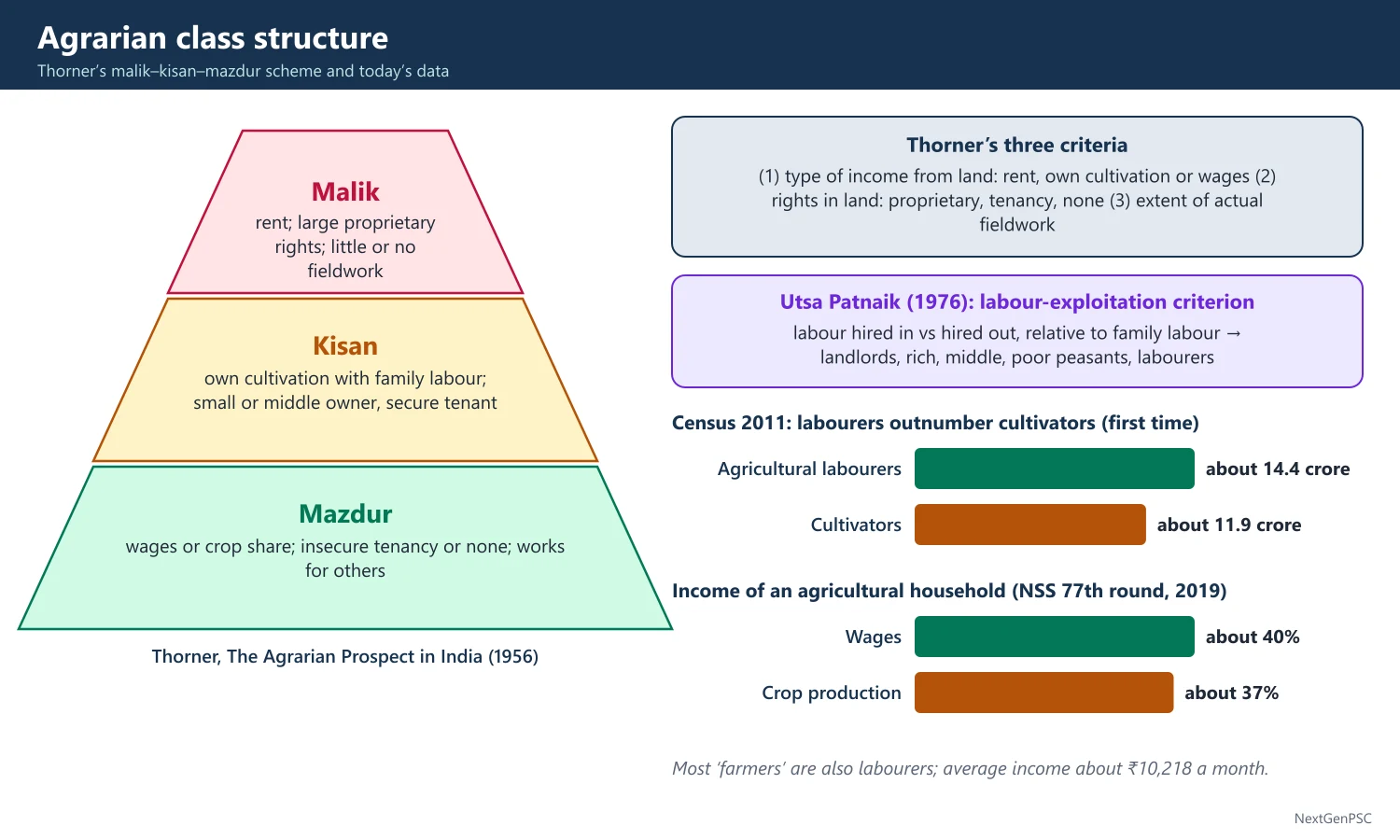
Thorner (The Agrarian Prospect in India, 1956) used three criteria: the type of income from land (rent, own cultivation or wages), the nature of rights in land (proprietary, tenancy, none), and the extent of actual fieldwork done.
Malik: big absentee landlords living on rent, and rich resident landowners who supervise hired labour.
Kisan: working peasants who own or securely rent small or middle holdings and cultivate mainly with family labour.
Mazdur: poor tenants, sharecroppers and landless labourers who earn mainly by working for others.
3. Other classifications
Utsa Patnaik (‘Class Differentiation within the Peasantry’, 1976) proposed a labour-exploitation criterion: compare the labour a household hires in with the labour it hires out, relative to family labour, to separate landlords, rich, middle and poor peasants and labourers.
Mao-style scheme used by Indian left parties: landlords, rich peasants, middle peasants, poor peasants and agricultural labourers.
André Béteille (Studies in Agrarian Social Structure, 1974) stressed that land, caste and power combine differently across regions, so no single scheme fits all of India.
4. Changes after independence
Land reforms removed most big zamindars, turned many tenants into owners and created a stratum of rich owner-cultivators (P.C. Joshi).
Green Revolution (from the mid-1960s, Punjab, Haryana, western Uttar Pradesh, coastal Andhra): high-yielding seeds, irrigation, fertiliser and machines made farming profitable for those with land and capital; the mode of production debate asked whether this meant capitalist agriculture.
Bullock capitalists: Lloyd and Susanne Rudolph (In Pursuit of Lakshmi, 1987) used this term for self-employed middle farmers who used family labour and modest capital, and who became politically powerful.
Casualisation of labour: permanent attached labour declined and casual, seasonal and migrant labour grew; Jan Breman (Footloose Labour, 1996) described circulating migrant labourers in Gujarat.
Bonded labour: abolished by the Bonded Labour System (Abolition) Act 1976, but debt bondage survives in brick kilns, agriculture and quarries.
Tenancy today: much tenancy is oral and unrecorded, so tenants, often Dalit or OBC, cannot get crop loans, insurance or PM-KISAN; Andhra Pradesh’s Crop Cultivators Rights Act 2019 tried to address this.
5. Agrarian classes today (data)
Census 2011: for the first time agricultural labourers (about 14.4 crore) outnumbered cultivators (about 11.9 crore).
Agriculture Census 2015–16: marginal and small holdings were 86.2% of all holdings; the average holding was 1.08 hectares.
Situation Assessment Survey 2019 (NSS 77th round): an agricultural household earned about ₹10,218 a month, of which wages were the largest source (about 40%) and crop production about 37%, showing that most ‘farmers’ are also labourers.
Workforce: about 46% of all workers were in agriculture in PLFS 2023–24; women form a growing share of the agricultural workforce as men migrate (feminisation of agriculture).
Distress: NCRB ADSI 2023 recorded 4,690 suicides of farmers or cultivators and 6,096 of agricultural labourers; labourers now outnumber cultivators among farm-sector suicides.
Policy: PM-KISAN (2019) pays ₹6,000 a year to landholding families, which excludes tenants and labourers; the VB-G RAM G Act 2025, replacing MGNREGA from 1 July 2026, guarantees 125 days of wage work and is crucial for labouring households.
6. Caste and agrarian class
Overlap: upper and dominant castes are concentrated among landowners and rich farmers; middle castes (OBCs) among owner-cultivators; Dalits and tribals among labourers and marginal farmers.
Kathleen Gough in Thanjavur and Joan Mencher in Tamil Nadu showed that caste was used to control labour; conflicts such as the Kilvenmani massacre (1968) were at once caste and class conflicts.
Not identical: Béteille showed that caste and class diverge as land changes hands; poor Brahmins and rich Dalits exist.
Gender: women do much of the farm work but own little land; Bina Agarwal argued that independent land rights are central to women’s bargaining power within the household.
7. Agrarian movements and class
Old peasant movements: Telangana, Tebhaga, Naxalbari (1967) represented poor peasants and labourers against landlords.
New farmers’ movements (1980s): Sharad Joshi’s Shetkari Sanghatana in Maharashtra, Mahendra Singh Tikait’s Bharatiya Kisan Union (1987 mobilisation) and Karnataka Rajya Raitha Sangha demanded higher prices and lower input costs, framing the conflict as ‘Bharat versus India’; they mainly represented surplus-producing farmers.
2020–21 farmers’ protest: against three farm laws, led by Punjab, Haryana and western Uttar Pradesh farmer unions; the laws were repealed in November 2021; labourers’ interests were less visible.
8. Linking thinkers
Marx: class in itself versus class for itself explains why agricultural labourers, though numerous, are weakly organised.
Weber: class, status and party help separate economic position (land), caste status and political power.
James Scott: ‘weapons of the weak’ (1985) such as foot-dragging describe everyday resistance by Indian labourers too.
9. Using it in the exam
10 marks: give Thorner’s three criteria and three classes with examples.
15 marks: show how land reforms and the Green Revolution changed the class structure.
20 marks: discuss classifications (Thorner, Patnaik), change, caste–class overlap, movements and current data (Census 2011, SAS 2019, ADSI 2023).
Diagram idea: a pyramid with malik at the top, kisan in the middle and mazdur at the base, with caste groups marked on each layer.
Useful line: Thorner classified agrarian groups by income from land, rights in land and the amount of fieldwork actually done (paraphrase).
| Class | Main income | Rights in land | Fieldwork |
|---|---|---|---|
| Malik | Rent or supervised cultivation | Proprietary, large | Little or none |
| Kisan | Own cultivation with family labour | Small or middle owner, secure tenant | Substantial |
| Mazdur | Wages or crop share | Insecure tenancy or none | Works for others |
Mains points
- Define agrarian class with clear criteria; examiners penalise vague descriptions.
- Use Thorner as the base and add Patnaik and the Lenin–Chayanov debate for depth.
- Explain change: land reform, Green Revolution, casualisation and migration.
- Show the caste–class link with village studies (Gough, Béteille, Mencher, Breman).
- Bring current data with years: Census 2011, Agriculture Census 2015–16, SAS 2019, PLFS 2023–24, ADSI 2023.
- Distinguish old peasant movements from new farmers’ movements by their class base.
Did you know?
- Memory trick for Thorner: ‘MKM’ – the Malik owns, the Kisan works his own field, the Mazdur works someone else’s.
Industrial Class Structure
India’s industrial class structure includes the industrial bourgeoisie (business houses and new entrepreneurs), a managerial and professional class, a relatively protected organised working class, and a vast informal or unorganised workforce that makes up around nine in ten workers. Caste, kinship, region and gender shape recruitment and work, as studies by N.R. Sheth, Holmström and Breman show. The four labour codes, in force from 21 November 2025, and the rise of gig work are reshaping this structure.
In simple words
In a factory town you find owners, managers and engineers, permanent workers with fixed pay and benefits, and many more contract and daily workers with no security.
Add delivery riders working through apps, and you have India’s industrial classes.
It is like a cricket squad where a few players have central contracts and most play match by match.
UPSC asks how these classes formed, how they differ from Western patterns, and how informality and new labour laws affect them.
1. Concepts
Marx: industrial capitalism divides society into the bourgeoisie (owners of capital) and the proletariat (sellers of labour power), with alienation and exploitation through surplus value.
Dahrendorf (Class and Class Conflict in Industrial Society, 1959): class rests on authority in organisations, and conflict is institutionalised through collective bargaining.
Braverman (Labor and Monopoly Capital, 1974): deskilling of work under monopoly capitalism; Erik Olin Wright: managers and supervisors hold ‘contradictory class locations’.
Formal and informal sector: Keith Hart (1973) introduced the term informal sector for self-employed and casual urban work outside regulation.
2. Formation of industrial classes in India
Colonial period: cotton mills in Bombay and Ahmedabad (from the 1850s), jute mills in Calcutta, railways, mines and plantations; capital came from trading communities (Parsis, Marwaris, Gujarati Banias, Chettiars).
Recruitment through jobbers: Rajnarayan Chandavarkar (The Origins of Industrial Capitalism in India, 1994) and Dipesh Chakrabarty (Rethinking Working-Class History, 1989) showed that jobbers and sardars recruited workers through caste, kinship and village ties.
Plantation and mine labour: contract and indentured recruitment brought Adivasi and Dalit workers to Assam tea gardens and the Jharia coalfield, creating a labour force marked by caste and tribe.
After 1947: planned industrialisation built a large public sector and a protected organised workforce; after 1991 liberalisation grew private industry and services, contract labour and the IT and business process sector.
3. The classes
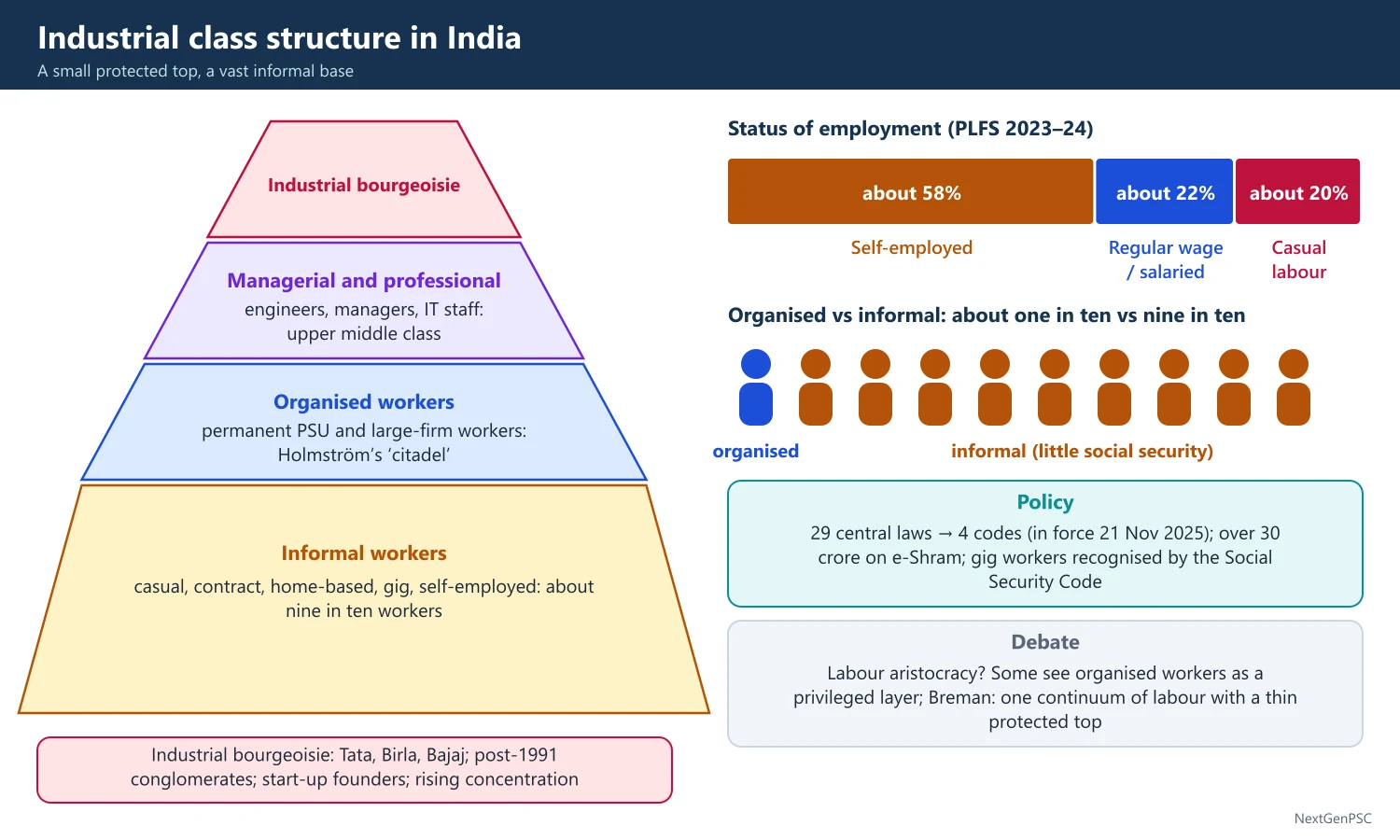
Industrial bourgeoisie: old business houses (Tata, Birla, Bajaj), post-1991 conglomerates and new start-up founders; concentration of wealth has grown sharply since 1991.
Managerial and professional class: engineers, managers and IT professionals who form the upper middle class.
Organised working class: permanent workers in public sector units and large firms with job security, provident fund and unions; Mark Holmström (South Indian Factory Workers, 1976) called the organised sector a ‘citadel’ that outsiders try to enter.
Informal workers: casual labourers, contract workers, home-based workers, street vendors, construction workers and the self-employed, with no written contract or social security.
Petty bourgeoisie: small traders, workshop owners and contractors who both work and employ others form a large group in Indian towns.
Migrant workers: Census 2011 counted about 45 crore internal migrants by place of last residence; the 2020 lockdown exodus showed how many urban workers lacked any security.
Labour aristocracy debate: some argue that organised workers became a privileged layer separate from the informal mass; Breman sees one continuum of labour with a thin protected top.
4. Caste, kinship and gender at work
Sheth (N.R.) (The Social Framework of an Indian Factory, 1968) found that caste and kinship influenced recruitment and relations inside a Gujarat factory, though work roles followed formal rules.
Barbara Harriss-White (India Working, 2003) argued that caste, religion, gender and locality act as ‘social structures of accumulation’ regulating India’s informal economy.
Dalits are over-represented in sanitation, leather and casual labour; trading castes dominate business ownership; women are concentrated in home-based, garment and care work.
Women workers: female labour force participation (15 and above, usual status) was 41.7% in PLFS 2023–24, but women are concentrated in self-employment and unpaid family work, and the gender wage gap remains wide.
Milton Singer showed that Madras industrialists combined modern business with traditional family and ritual life.
5. Trade unions
Major federations: AITUC (1920), INTUC (1947), BMS (1955), HMS (1948) and CITU (1970), mostly tied to political parties.
Political unionism: because federations are tied to parties, workers in one plant are often divided among rival unions.
Ramaswamy (E.A.) (The Worker and His Union, 1977) studied Coimbatore textile unions and their political links.
Decline: the Bombay textile strike of 1982–83 under Datta Samant ended in mill closures; unions are weak in the informal sector; flashpoints such as the Maruti Manesar unrest (2012) show conflict over contract labour.
New organising: SEWA (Ela Bhatt, 1972) organised self-employed women; street vendors and gig workers are forming new associations.
6. Current data and policy
Status of employment (PLFS 2023–24): about 58% of workers were self-employed, about 22% regular wage or salaried and about 20% casual labourers.
Informality: around nine in ten workers are informally employed (various official estimates); over 30 crore unorganised workers had registered on the e-Shram portal (launched 2021).
Labour codes: the Code on Wages (2019), the Industrial Relations Code (2020), the Code on Social Security (2020) and the Occupational Safety, Health and Working Conditions Code (2020) consolidated 29 central labour laws and came into force on 21 November 2025; unions criticise easier hire-and-fire rules and stricter strike conditions, while employers welcome simplification.
Gig and platform workers: the Social Security Code recognises them for the first time; Rajasthan passed the first state law for platform-based gig workers (2023).
7. Sociological assessment
India did not follow the Western path in which peasants became factory workers; it moved straight from agriculture to informal services and construction, and the factory working class remained small (Kalyan Sanyal, Rethinking Capitalist Development, 2007, on the ‘need economy’ outside capital).
Class consciousness is cut across by caste, region, religion and gender, which weakens a single working-class identity.
Jan Breman (The Making and Unmaking of an Industrial Working Class, 2004) traced how Ahmedabad’s mill workers lost secure jobs when the mills closed in the 1980s and 1990s and fell into the informal economy.
Automation and artificial intelligence now threaten routine jobs in IT services and manufacturing, reviving Braverman’s deskilling debate.
8. Linking thinkers and using it in the exam
Links: Marx’s alienation in Indian factories and gig work; Weber’s bureaucracy in public sector units; Durkheim’s forced division of labour in caste-segmented labour markets.
10 marks: list the industrial classes with an Indian feature of each.
15 marks: explain the organised–informal divide with Holmström and Breman and current data.
20 marks: analyse formation, caste and gender, unions, informality, labour codes and gig work, and compare with Western theory.
Diagram idea: a narrow ‘citadel’ of organised workers on top of a wide base of informal workers, with the bourgeoisie and managers above.
| Class | Who | Key feature |
|---|---|---|
| Industrial bourgeoisie | Business houses, conglomerates, start-up founders | Rooted in trading communities; rising concentration |
| Managerial and professional | Managers, engineers, IT staff | Upper middle class; mostly upper caste |
| Organised workers | Permanent PSU and large-firm workers | Job security, unions; a small ‘citadel’ |
| Informal workers | Casual, contract, home-based, gig, self-employed | About nine in ten workers; little social security |
Mains points
- Start with a theoretical frame (Marx, Weber, Dahrendorf) and then show the Indian specifics.
- Stress the organised–informal divide; it is the defining feature of India’s industrial class structure.
- Use Indian studies: Sheth, Holmström, Ramaswamy, Breman, Chandavarkar, Harriss-White.
- Show how caste and gender shape class position.
- Add current developments with dates: labour codes (21 November 2025), e-Shram, gig workers’ laws, PLFS 2023–24.
- Avoid assuming a Western-style working class; explain why India’s path differs.
Did you know?
- The word ‘jobber’ in Bombay mills came from the man who brought workers from his own village and caste; many mill floors were once almost entirely staffed by one region’s migrants, such as Konkan Marathas.
Middle Classes in India
India’s middle class was born in colonial times among English-educated professionals and officials, expanded through the post-1947 public sector, and changed after 1991 into a larger, consumption-oriented new middle class linked to private services and IT. Scholars debate its size (from tens of millions to about a third of the population, depending on definition), its strongly upper-caste character, its consumerism and its political role.
In simple words
The middle class is the group between the very rich and the poor: salaried employees, teachers, small business owners and professionals.
In India it grew from a small group of English-educated clerks and lawyers into millions of people who buy cars, phones and private schooling.
Think of it as the ‘EMI generation’, comfortable but anxious about jobs and fees.
UPSC asks about its origins, growth after 1991, caste composition and role in politics and culture.
1. Concepts
Marx: the petty bourgeoisie (small owners) would shrink and be pushed into the proletariat; history proved otherwise as white-collar work grew.
Weber: class is based on market situation and life chances, including skills and education, so the propertyless but educated form middle classes; status adds lifestyle and honour.
Wright Mills (White Collar, 1951) described the new salaried middle class of clerks, salespeople and managers as politically anxious and dependent.
Bourdieu (Distinction, 1979): classes are separated by cultural capital and taste as well as income.
Goldthorpe placed professionals and managers in a ‘service class’ with secure careers.
Old and new middle class: sociologists distinguish the old middle class of small owners (shopkeepers, independent farmers) from the new middle class of salaried employees and professionals.
2. Origins and growth
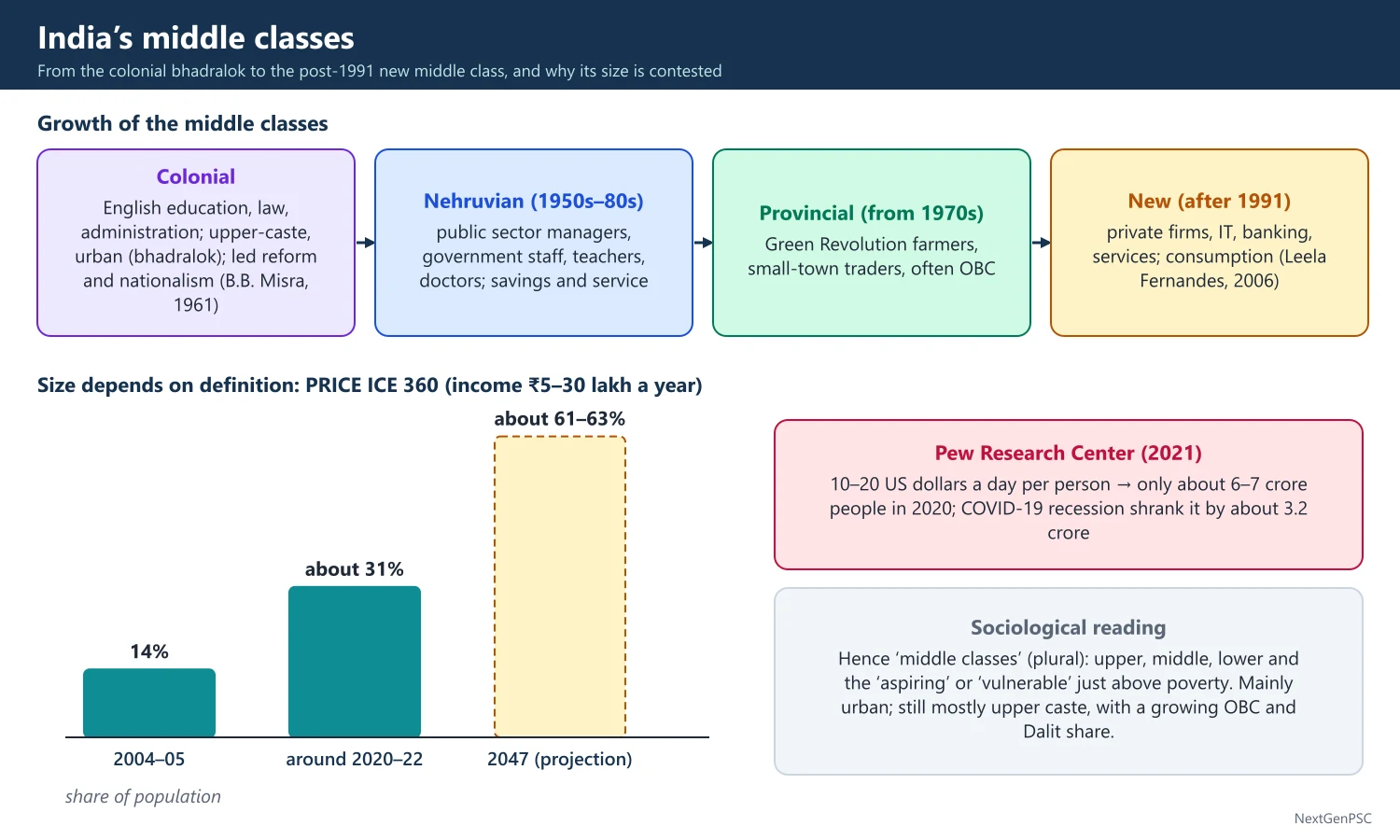
Colonial middle class: B.B. Misra (The Indian Middle Classes, 1961) traced its rise from English education, law, administration and commerce; it was mostly upper-caste and urban (bhadralok in Bengal) and led social reform and early nationalism.
Role in nationalism: the colonial middle class led the Congress, the press and reform bodies, as A.R. Desai showed.
Nehruvian middle class (1950s–80s): public sector managers, government employees, teachers, doctors and engineers, valuing savings, education and service to the nation.
Rural rich and provincial middle class: Green Revolution farmers and small-town traders joined from the 1970s, often from OBC castes.
Liberalisation (1991): deregulation, the IT boom of the late 1990s in Bengaluru and Hyderabad and the growth of private banking and telecom created new salaried jobs.
New middle class (after 1991): employees of private firms, IT, banking and services; Leela Fernandes (India’s New Middle Class, 2006) showed it as a political project that defines the ‘new India’ through consumption.
3. Size: a contested question
Estimates depend on definition (income, consumption, occupation or self-identification), so figures vary widely.
PRICE (ICE 360 survey): households earning roughly ₹5 lakh to ₹30 lakh a year (2020–21 prices) were about 31% of the population around 2020–22, up from 14% in 2004–05, and are projected to reach about 61–63% by 2047 (projection).
Stricter definitions: Pew Research Center (2021) estimated India’s middle class (living on about 10–20 US dollars a day) at only about 6–7 crore in 2020, and said the COVID-19 recession shrank it by about 3.2 crore.
Sociologists therefore speak of middle classes (plural): upper, middle and lower, and the ‘aspiring’ or ‘vulnerable’ classes just above poverty.
Whatever the measure, the middle class is mainly urban and is concentrated in big cities and in the more developed southern and western states.
4. Culture and lifestyle
Pavan Varma (The Great Indian Middle Class, 1998) argued that the middle class moved from Nehruvian idealism to self-centred consumerism and indifference to the poor.
Consumption: malls, cars, branded goods, private schools and hospitals, foreign travel and online shopping mark middle-class status (Bourdieu’s distinction).
Language: English-medium education is a key marker and route of mobility, a form of cultural capital in Bourdieu’s sense.
Space: gated communities and private services allow the middle class to opt out of public schools, hospitals and transport, weakening pressure to improve them.
Family and gender: smaller families, investment in children’s education (coaching culture), working women, but continued dowry and arranged caste marriages; Patricia Uberoi notes ‘arranged love marriages’ in this class.
Religion: the middle class has become more visible in religious life (new gurus, temple tourism, televised religion), against the simple expectation of secularisation.
5. Caste and the middle class
Upper-caste dominance: Satish Deshpande argued that the Indian middle class is overwhelmingly upper caste and that its members think of themselves as ‘casteless’ because their caste advantage has turned into educational and professional capital.
Anti-reservation protests by middle-class students in 1990 (after Mandal) and 2006 (OBC quota in higher education) showed these caste interests.
Dalit and OBC middle class: reservation produced a Dalit middle class in government service; the Dalit Indian Chamber of Commerce and Industry (2005) promotes Dalit entrepreneurs; yet this class faces discrimination in housing and private jobs.
Religious minorities: the Sachar Committee (2006) found Muslims under-represented in government jobs and the salaried middle class.
A smaller Muslim middle class has grown through trade, Gulf migration and the professions, especially in Kerala.
6. Middle-class politics
Civil society activism: resident welfare associations, consumer rights and the anti-corruption movement of 2011 (Anna Hazare) drew strong middle-class support; Partha Chatterjee contrasts this ‘civil society’ with the ‘political society’ of the poor who bargain with the state.
Policy focus: income tax relief (no tax under the new regime on incomes up to ₹12 lakh from 2025–26) and housing loans target this class as voters.
Anxieties: job insecurity in private and gig work, high education costs and urban congestion mark the ‘anxious middle class’.
Electoral role: Yogendra Yadav described a ‘second democratic upsurge’ in the 1990s driven by the participation of the poor, lower castes and rural voters, while the urban middle class often votes at lower rates.
7. Linking thinkers and using it in the exam
Links: Weber’s status groups; Bourdieu’s cultural capital; Mills’s white collar; Gramsci on the intelligentsia; Dipankar Gupta’s ‘mistaken modernity’ (consumerism mistaken for modern values).
Davis and Moore versus Tumin: functionalists see middle-class rewards as returns to scarce skills; Tumin’s critique of inherited advantage matches Deshpande’s argument on caste capital.
10 marks: define the middle class (Weber) and give its colonial origins and post-1991 change.
15 marks: discuss size estimates and their definitions, and the caste composition (Deshpande).
20 marks: trace the old and new middle class, their culture (Varma, Fernandes), caste and minority composition and political role, and conclude on their place in Indian democracy.
Diagram idea: a timeline showing the colonial bhadralok, the Nehruvian salaried class, the provincial rural rich and the post-1991 new middle class.
Useful line: Leela Fernandes described India’s new middle class as a social group produced by economic liberalisation and defined through consumption (paraphrase).
| Point | Old (colonial and Nehruvian) | New (after 1991) |
|---|---|---|
| Main jobs | Government service, law, teaching, public sector | Private firms, IT, finance, services, start-ups |
| Values | Saving, public service, reform, nationalism | Consumption, career, global lifestyle |
| Caste profile | Overwhelmingly upper caste | Still mostly upper caste, with growing OBC and Dalit share |
| Key scholars | B.B. Misra (1961) | Pavan Varma (1998), Leela Fernandes (2006), Satish Deshpande (2003) |
| Source (year) | Definition | Estimate |
|---|---|---|
| PRICE ICE 360 (around 2021–22) | Household income ₹5–30 lakh a year (2020–21 prices) | About 31% of population |
| Pew Research Center (2021) | About 10–20 US dollars a day per person | About 6–7 crore people in 2020 |
Mains points
- Begin with a definition and say clearly that size depends on the definition used.
- Trace three phases: colonial, Nehruvian and post-1991, with a scholar for each.
- Discuss caste composition with Deshpande, and minorities with the Sachar Committee.
- Use Weber, Bourdieu and Mills to give theoretical depth.
- Show the middle class’s political role (anti-corruption movement, anti-reservation protests, civil society versus political society).
- Avoid giving a single figure for its size without naming the source and year.
Did you know?
- The Bengali word ‘bhadralok’ (respectable people) for the colonial educated class is still used in Kolkata today, often with a touch of irony.
UPSC Previous Year Questions: Social Classes in India
From 2014 to 2026 UPSC asked 16 question parts carrying 240 marks from this chapter in Paper II. The most-asked topics are Middle Classes in India (8 parts) and Agrarian Class Structure (6 parts). Every question below has a model answer written to the UPSC word limit: about 150 words for 10 marks and 250 words for 20 marks.
In simple words
First read the question and write your own answer in the time UPSC gives (about 7 minutes for 10 marks and 11 minutes for 20 marks).
Then compare it with the model answer: check the approach, the thinkers and studies used, the Indian data and the conclusion.
Note what you missed and revise that topic in the notes before trying the next question.
1. Agrarian Class Structure
Example 1 (UPSC 2026, 20 marks): Explain the emergence of middle class in agrarian society in India. What have been the socio-structural implications of the emergence of this middle class?
Paper and question: Paper II, Q3(b)
Approach: Two parts: explain how an agrarian middle class emerged (land reform, Green Revolution, cooperatives, education, state support) with examples; then its socio-structural implications (political power, caste assertion and reservation demands, migration and education, gender, conflict with Dalits, farmer movements).
A middle class in agrarian society refers to owner-cultivators and rich peasants who operate medium to large holdings, use family and hired labour, produce for the market and invest in education and non-farm ventures. M.N. Srinivas's dominant castes, such as Jats, Patidars, Marathas, Kammas, Reddys and Yadavs, largely form this class.
Its emergence had several causes. Zamindari abolition in the 1950s turned upper tenants into owners. The Green Revolution of the late 1960s gave those with irrigated land high returns. Cooperatives, such as sugar cooperatives in Maharashtra and dairy cooperatives in Gujarat, and state support through minimum support prices, subsidised inputs and credit built their wealth. Education in rural colleges let their children enter jobs and professions.
The socio-structural implications are wide. Politically, this class became the base of leaders such as Charan Singh and of farmers' movements such as the Bharatiya Kisan Union of Mahendra Singh Tikait (1980s), shifting rural power from Brahmin and Rajput landlords to middle castes. Rudolph and Rudolph called them ‘bullock capitalists’. The 2020–21 farmers' protest showed their continued organising power.
Flow chart: Land reform + Green Revolution + cooperatives + state support → agrarian middle class (dominant castes) → political power and farmer movements; education and migration; reservation demands; gender and caste tensions.
Socially, as farm incomes stagnated and holdings fragmented, this class sought government jobs and education, leading to reservation agitations by Patidars (2015), Jats (2016) and Marathas. Its prosperity was linked with dowry inflation and declining child sex ratios in Haryana and Punjab, and its dominance produced conflict with Dalit labourers who asserted their rights. Its children's migration to cities and abroad also links the village with urban middle-class culture.
The agrarian middle class thus transformed rural power and politics, but it also reproduced caste and gender hierarchies and now faces its own crisis of agrarian stagnation.
Example 2 (UPSC 2025, 20 marks): 'Agrarian class structure has been undergoing changes due to modern forces.' Critically examine.
Paper and question: Paper II, Q2(b)
Approach: Critically examine: identify the modern forces (land reform, Green Revolution, markets and globalisation, technology, education, migration, state schemes, democracy) and the changes they produced in agrarian classes, then the limits and continuities, and conclude.
The agrarian class structure of India, once dominated by zamindars above tenants and landless labourers, has been changing under modern forces such as state policy, technology, markets and democracy. The statement is largely valid, but the change is uneven.
Land reforms in the 1950s abolished zamindari and turned many tenants into owners. The Green Revolution from the late 1960s brought high-yielding seeds, fertilisers and irrigation, creating a class of capitalist farmers from middle castes who hire wage labour and produce for the market. Utsa Patnaik's work in the 1970s traced this rise of capitalist agriculture.
Markets and globalisation after 1991 linked farmers to national and world prices, and mechanisation reduced demand for labour. Education, roads and mobile phones opened non-farm jobs, so rural households now combine farming with wage work and migration; the jajmani and attached-labour systems have largely disappeared. State schemes such as MGNREGA (2005), now replaced by the VB-G RAM G Act from 1 July 2026, and PM-KISAN (2019) raised the bargaining power of labourers and small farmers.
Flow chart: Land reform → owner-cultivators; Green Revolution → capitalist farmers; markets and mechanisation → labour displacement; education and migration → non-farm diversification; welfare schemes → labour bargaining power.
Yet the change is limited. Land remains concentrated among dominant castes while Dalits remain largely landless; marginal and small farmers hold about 86% of holdings but about 47% of the area (Agriculture Census 2015–16). Distress, debt and farmer suicides show that modern forces also produced vulnerability, and women do much farm work without owning land.
Modern forces have thus transformed the agrarian structure from semi-feudal to capitalist and diversified, but have reproduced caste and class inequality in new forms.
Example 3 (UPSC 2024, 10 marks): What, according to André Beteille, are the bases of agrarian class structure in India? Analyse.
Paper and question: Paper II, Q2(c)
Approach: Analyse Béteille's bases of agrarian classes: ownership, control and use of land (owners, tenants, labourers), the relation with caste, regional variation, and assess.
André Béteille, in Studies in Agrarian Social Structure (1974) and his Sripuram study, argued that agrarian classes are formed by people's relations to land.
He identified three bases: ownership of land, control over its management, and its use through actual labour. From these come landowners who do not work the land, owner-cultivators, tenants and sharecroppers, and agricultural labourers. He stressed that these categories overlap, since one household may own some land, lease more and also work for wages.
Béteille also showed that these classes correlate with caste, with Brahmins as owners and Adi-Dravidas as labourers in Tanjore, but the link is loosening, and patterns vary by region and crop.
His Weberian approach captures complexity better than a two-class Marxist model, though Marxists such as Utsa Patnaik say it underplays exploitation and the drive towards capitalist polarisation. It remains useful for mapping today's mixed household livelihoods.
Example 4 (UPSC 2023, 20 marks): Explain the implications and the impact of globalization in situating the changing agrarian class structure in India.
Paper and question: Paper II, Q4(b)
Approach: Explain globalisation's channels into agriculture (trade liberalisation, WTO, MNC inputs, contract farming, markets, migration), then its impact on each agrarian class with examples and data, and conclude.
Globalisation, the integration of economies through trade, capital and technology, reached Indian agriculture after the 1991 reforms and the WTO Agreement on Agriculture (1995). It has reshaped the agrarian class structure in uneven ways.
Its channels include export markets for crops such as cotton, basmati and horticulture, multinational seeds and inputs such as Bt cotton (approved in 2002), contract farming with agribusiness, supermarket supply chains and fluctuating world prices.
The impact differs by class. Rich capitalist farmers with irrigated land, capital and market links gained from exports and new crops, as in Punjab and coastal Andhra. Small and marginal farmers faced rising input costs, price volatility and debt; Bt cotton farmers in Vidarbha suffered crop failures and indebtedness, and NCRB recorded 11,290 suicides in the farming sector in 2022. Landless labourers lost work to mechanisation and moved to non-farm and migrant work, a process scholars call de-peasantisation.
Flow chart: Globalisation (WTO, MNC inputs, exports, prices) → rich farmers gain; small farmers face costs, risk, debt; labourers displaced by machines → de-peasantisation, migration, feminisation → farmer movements.
Globalisation also feminised agriculture as men migrated, and generated new farmer politics. The 2020–21 protest against the three farm laws, repealed in November 2021, showed the organised power of commercial farmers fearing corporate control, while Dalit labourers had different concerns. Scholars such as Utsa Patnaik see growing polarisation, while others see a more diversified rural economy.
Overall, globalisation has deepened differentiation within the peasantry, benefiting the top and exposing the bottom to risk, which makes price support, credit and rural non-farm jobs central to policy.
Example 5 (UPSC 2022, 10 marks): Do you agree that the agrarian class structure in India is changing? Justify your answer with illustrations.
Paper and question: Paper II, Q1(b)
Approach: Agree, and justify with illustrations: decline of landlordism, rise of capitalist farmers, fragmentation, non-farm diversification, feminisation, migration; note continuities.
Yes, the agrarian class structure, described by Daniel Thorner as maliks, kisans and mazdoors, is changing in important ways.
Zamindari abolition and the Green Revolution replaced absentee landlords with capitalist farmers from middle castes. Holdings have fragmented: average size fell to 1.08 hectares in the Agriculture Census 2015–16. Rural households increasingly combine farming with non-farm work, construction and migration, which Surinder Jodhka and others describe as a diversification of livelihoods. With men migrating, women form a growing share of the farm workforce, a process called feminisation of agriculture. Tenancy has returned in new forms, with small owners leasing out land.
Yet continuities remain: land is still concentrated among dominant castes, and Dalits remain largely landless labourers.
The structure is thus changing from semi-feudal to capitalist and diversified, without removing caste-based inequality.
Example 6 (UPSC 2019, 20 marks): Is industrial development in India a bane or a boon to agrarian class structure? Substantiate your answer with suitable examples.
Paper and question: Paper II, Q3(b)
Approach: Take a balanced position: show how industrial development benefited agrarian classes (markets, non-farm jobs, mechanisation, remittances) and how it harmed them (land acquisition and displacement, inequality, pollution, distress), with examples, and conclude.
The agrarian class structure consists of landlords, rich and middle peasants, small and marginal farmers, tenants and landless labourers, as described by Daniel Thorner and André Béteille. Industrial development has affected these classes in both positive and negative ways.
It has been a boon in several ways. Industry supplied fertilisers, tractors and pumps that drove the Green Revolution, creating a class of prosperous capitalist farmers in Punjab, Haryana and western Uttar Pradesh. Urban and industrial jobs absorbed surplus rural labour; Jan Breman and others show how migration and remittances raised incomes of labourers and small farmers. Agro-industries such as dairy cooperatives (Amul in Gujarat) and sugar mills in Maharashtra gave farmers markets and political power.
It has also been a bane. Land acquisition for industry, dams and special economic zones displaced peasants and tribals, sparking protests at Singur (2006–08) and Nandigram (2007), which led to the Right to Fair Compensation and Transparency in Land Acquisition, Rehabilitation and Resettlement Act, 2013. Benefits went mainly to larger farmers, widening the gap with marginal farmers and labourers, and mechanisation reduced demand for farm labour.
Flow chart: Industrial growth → inputs and markets → capitalist farmers prosper (boon) and labour moves to cities; but → land acquisition, displacement, inequality, pollution → protests and the 2013 land law (bane).
Industrial pollution has damaged farmland and water in places such as the Noyyal river region near Tiruppur, and slow industrial job growth means agriculture still employs about 46% of workers (PLFS 2023–24), keeping many in low-income farming.
Industrial development has thus been a boon for the upper agrarian classes and a mixed blessing for the poor; making it a boon for all requires fair land acquisition, rural industry and labour-intensive growth.
2. Industrial Class Structure
Example 7 (UPSC 2025, 20 marks): “Industrial class structure is a function of social structure of Indian society.” Do you agree with this statement? Analyze.
Paper and question: Paper II, Q4(b)
Approach: Agree largely: show how caste, kinship, region, religion and gender shape industrial ownership, recruitment, labour segmentation and unions (Morris, Holmström, Damodaran, Breman), then show the autonomous role of markets, technology and the state, and conclude.
The statement means that the classes formed by industry in India, owners, managers and workers, are shaped by the wider social structure of caste, kinship, region, religion and gender, rather than by the market alone. The evidence largely supports it, though industry also changes social structure.
At the top, industrial ownership has been concentrated among traditional trading communities such as Marwaris, Gujarati Banias, Parsis and Chettiars, using caste and kin networks for capital and trust. Harish Damodaran's India's New Capitalists (2008) shows newer entrants from peasant castes such as Kammas, Reddys and Patidars, but Dalits remain rare among owners despite efforts such as DICCI.
Among workers, Morris D. Morris's study of Bombay cotton mills (1965) showed recruitment through jobbers along caste, kin and village lines, and Dalits were long excluded from weaving departments on grounds of pollution. Mark Holmström's Industry and Inequality (1984) described the organised sector as a citadel of secure jobs, entered through networks, surrounded by a large informal sector. Jan Breman showed how migrant labour circulates through caste and regional networks.
Flow chart: Social structure (caste, kin, region, gender) → access to capital and networks → trading castes own industry; caste and kin recruitment; Dalits and women in informal, low-paid work → segmented industrial class structure.
Gender adds another layer: women are concentrated in low-paid garment, electronics assembly and home-based work, and only about 21.7% of all workers held regular salaried jobs in PLFS 2023–24, with women's share lower still. Trade unions too often divide along party, caste or regional lines, as in Shiv Sena's unions in Mumbai.
Yet industry is not only a function of social structure. Markets, technology, education and reservations in public employment have allowed new mobility, and IT and the professions recruit more on credentials. So the statement is broadly valid: social structure strongly shapes industrial classes, while industrialisation slowly reshapes social structure in turn.
Example 8 (UPSC 2024, 10 marks): Discuss the changes taking place in the industrial class structure in India.
Paper and question: Paper II, Q1(b)
Approach: Discuss changes in the industrial class structure: owners (from family houses to corporates and startups), managers and professionals, shrinking organised working class, informalisation and gig work, with PLFS data and labour codes.
India's industrial class structure has traditionally included industrial capitalists, managers and professionals, a unionised organised working class, and a large unorganised workforce. Since 1991 it has changed significantly.
At the top, family business houses have been joined by multinational firms, IT companies and startups, and a new managerial and professional class has grown. The organised working class has shrunk relatively, with contract labour replacing permanent jobs. Informalisation is the main trend: PLFS 2023–24 found 58.4% of workers self-employed, 21.7% in regular salaried jobs and 19.8% in casual work, and many regular workers lack written contracts. Gig and platform work is rising; NITI Aayog (2022) estimated 77 lakh gig workers in 2020–21.
Trade unions have weakened, and the four labour codes, in force from 21 November 2025, consolidate 29 laws and extend social security to gig workers while easing hiring rules.
The structure is thus becoming more polarised between a secure professional elite and an insecure, informal majority.
3. Middle Classes in India
Example 9 (UPSC 2025, 10 marks): Describe the main features of Indian new middle class. How is it different from the old middle class?
Paper and question: Paper II, Q3(c)
Approach: Describe the features of the new middle class and contrast it with the old middle class on origin, occupation, values, consumption and relation to the state.
The new middle class, which grew after the economic reforms of 1991, is employed mainly in the private sector, IT, finance and services; relies on English and professional education; follows a consumer lifestyle; and has a global outlook, as Leela Fernandes describes in India's New Middle Class (2006).
The old middle class, traced by B.B. Misra to colonial times, consisted of government servants, teachers, lawyers, doctors, clerks and small traders. It differs from the new one in four ways. Origin: colonial and Nehruvian state versus the market after 1991. Occupation: public sector and professions versus private corporate jobs. Values: thrift, public service and nation-building versus individual achievement and consumption, as Pavan Varma argued. Relation to the state: dependence on it versus impatience with it.
Both remain dominated by upper castes, though reservations and markets are diversifying them.
The two often overlap within families, showing continuity as well as change.
Example 10 (UPSC 2023, 20 marks): Elaborate the salient features and the role of middle class in India's democracy and development.
Paper and question: Paper II, Q2(b)
Approach: Two parts: salient features of the Indian middle class (composition, education, occupation, heterogeneity, values); then its role in democracy (civil society, media, movements, voting patterns) and development (consumption, entrepreneurship, human capital, taxes), with criticisms; conclude.
The Indian middle class, traced by B.B. Misra to colonial education and professions, is defined by education, salaried or professional occupation and a certain lifestyle rather than by property. Estimates vary with definitions; the PRICE ICE 360 survey, for example, put the middle class at about 31% of the population in 2020–21.
Its salient features are: dependence on education as the main capital; heterogeneity by caste, religion, language and region, as André Béteille stressed; a split between an older, public-sector middle class and a new, private-sector, consumption-oriented one (Leela Fernandes); continued upper-caste dominance alongside a growing Dalit and OBC middle class created by reservations (Satish Deshpande); and values that combine modern aspirations with traditional family and caste practices.
In democracy, the middle class led the national movement and later staffed the bureaucracy, judiciary, media and universities that sustain democratic institutions. It is active in civil society, as in the Right to Information campaign (RTI Act 2005), the anti-corruption movement of 2011 and the protests after the 2012 Delhi gang rape. Yet scholars note its lower voter turnout compared with the poor and its impatience with democratic politics.
Flow chart: Education and salaried work → middle class → democracy: institutions, civil society, media, movements; development: skilled labour, consumption, entrepreneurship, taxes → limits: exclusivity, consumerism, low political participation.
In development, the middle class supplies skilled human capital for IT, health and engineering, drives consumer demand, contributes much of the direct tax base, and produces entrepreneurs and startups. Its demand for quality education and health shapes policy. Critics such as Pavan Varma argue that it has become insular, moving to private schools and hospitals and losing concern for public services and the poor.
The middle class is therefore central to India's democracy and development, but its role will be most positive when it widens to include more Dalits, OBCs and women and reconnects with public institutions.
Example 11 (UPSC 2021, 10 marks): Discuss the salient features of 'new middle class' in India.
Paper and question: Paper II, Q2(c)
Approach: List the salient features of the new middle class (post-1991 origin, private-sector and service jobs, consumption, English and global orientation, caste composition, political attitudes), with scholars.
The new middle class refers to the section that grew after the economic reforms of 1991, described by Leela Fernandes in India's New Middle Class (2006).
Its salient features are: employment mainly in the private sector, IT, finance, services and multinational firms rather than government; reliance on English education and professional degrees; a consumer lifestyle of brands, malls, cars and digital services; a global outlook, with migration and diaspora links; nuclear and dual-income families; and a preference for merit and market solutions, often with impatience towards the state. Pavan Varma noted its withdrawal from concern for the poor.
Satish Deshpande notes that it is still dominated by upper castes, though Dalit and OBC members are growing.
It is influential in shaping media, consumption and urban politics, though it is a minority of the population.
Example 12 (UPSC 2020, 10 marks): How does Andre Beteille justify 'middle class in India'?
Paper and question: Paper II, Q3(c)
Approach: Explain how Béteille characterises the Indian middle class (occupation and education based, heterogeneous by caste, language and region, its role in modern institutions), and assess.
André Béteille, writing in a Weberian tradition, justified the use of the term middle class in India by defining it through occupation, education and income rather than through ownership of property.
For Béteille, the Indian middle class consists mainly of salaried professionals, administrators, teachers, managers and technicians whose position rests on educational qualifications. It is heterogeneous, divided by caste, language, religion and region, so it lacks the unity of a single class. Yet it shares a common orientation towards merit, mobility and modern institutions.
He saw it as the main social base of institutions such as universities, the bureaucracy, the judiciary and the press, and therefore of democracy, while noting that upper castes dominated it.
Marxists object that it is not a class with shared interests, but Béteille's view captures its occupational and educational basis well.
Example 13 (UPSC 2018, 10 marks): Write a note on the changing roles of middle-class women in India.
Paper and question: Paper II, Q1(d)
Approach: Write a note on changing roles: from homemaker to earner and professional, in family decisions, public life and consumption, while noting the double burden and limits.
Roles of middle-class women in India have changed significantly since independence, especially after 1991.
Earlier, the ideal middle-class woman was a homemaker, and paid work was acceptable mainly in teaching or nursing. Today, with higher education, middle-class women work in IT, banking, medicine, law, media, the civil services and entrepreneurship. They take part in family decisions on money, children's education and property; NFHS-5 (2019–21) found that 88.7% of currently married women participate in major household decisions. They are visible in civil society, politics and consumer markets.
Yet change is partial. Women carry a double burden of job and housework, and many leave work after marriage or childbirth.
Middle-class women's roles have thus widened from domestic to public, though gender equality at home lags behind. Sharing of care work by men and workplace support such as creches will decide how far this change goes.
Example 14 (UPSC 2018, 20 marks): How has the New Economic Policy (1991) affected the lifestyle and life-chances of new middle class in India?
Paper and question: Paper II, Q4(a)
Approach: Using Weber's lifestyle and life chances, explain how the NEP 1991 changed the new middle class: jobs and incomes (IT, services), consumption and lifestyle, education and mobility, values; then its downsides (insecurity, inequality, debt, stress), and conclude.
Max Weber linked class with life chances, the opportunities a person has in the market, and status groups with lifestyle. The New Economic Policy of 1991, with liberalisation, privatisation and globalisation, transformed both for India's new middle class.
Life chances improved for many. The IT and IT-enabled services boom in cities such as Bengaluru, Hyderabad and Pune, private banking, telecom and multinational firms created well-paid jobs for English-educated graduates. Private engineering and management colleges multiplied, and global mobility for study and work increased. Income growth and easier credit allowed home ownership and savings in markets.
Lifestyle changed as well. Leela Fernandes, in India's New Middle Class (2006), and Pavan Varma, in The Great Indian Middle Class (1998), describe a shift from the Nehruvian middle class's values of thrift and public service towards consumption, brands, malls, cars and foreign holidays. Nuclear families, later marriage, dual-income couples and a culture of individual achievement became common.
Flow chart: NEP 1991 → IT, services, private sector jobs → higher incomes and credit → consumer lifestyle, nuclear families, global mobility → but job insecurity, debt, stress and exclusion of the poor.
There were costs. Private-sector jobs brought insecurity, long hours and stress, and the decline of public-sector employment narrowed secure routes for the lower middle class. Life chances remained unequal: access to English education and urban networks favoured upper castes, as Satish Deshpande notes, and rising inequality separated the middle class from the poor.
The NEP thus expanded and enriched the new middle class and changed its lifestyle, but made its life chances more market-dependent and unequal.
Example 15 (UPSC 2016, 10 marks): What accounts for the growth and consolidation of the middle classes in modern India?
Paper and question: Paper II, Q4(c)
Approach: Explain growth factors in phases (colonial education and professions, post-1947 state and public sector, post-1991 liberalisation and IT, reservations, urbanisation and consumption), with scholars.
The Indian middle class, as B.B. Misra showed in The Indian Middle Classes (1961), was a product of colonial rule and has since grown in phases.
In the colonial period, English education, the bureaucracy, law and trade created a professional class of clerks, lawyers, teachers and doctors. After 1947, planned development, the expanding public sector, banks and universities consolidated a salaried middle class. Reservations brought Dalits and OBCs into it. After 1991, liberalisation, the IT and service boom, private employment and consumer credit created a new, consumption-oriented middle class, which Leela Fernandes calls India's new middle class.
Urbanisation, media and aspiration further spread middle-class lifestyles to small towns and rural elites.
Its consolidation rests on education and salaried work, though it remains internally divided by caste, region and income.
Example 16 (UPSC 2014, 20 marks): Discuss the status of women among the emerging urban middle class.
Paper and question: Paper II, Q4(a)
Approach: Discuss the status of women in the emerging urban middle class: gains (education, employment, autonomy, marriage choice, law), persisting constraints (double burden, glass ceiling, dowry, safety, low FLFPR, son preference), with data and studies; conclude.
The urban middle class expanded rapidly after liberalisation in 1991, drawing on education, salaried jobs and consumption. Women's status within it shows real gains alongside persistent patriarchy.
The gains are clear. Middle-class girls now match or exceed boys in higher education enrolment, and women work as engineers, doctors, IT professionals, teachers and civil servants. Many have greater say in marriage, delay marriage and have fewer children. Laws such as the Protection of Women from Domestic Violence Act (2005), the Hindu Succession (Amendment) Act (2005) and the Sexual Harassment of Women at Workplace Act (2013) give legal backing, and urban middle-class women led campaigns such as the protests after the Delhi gang rape of 2012.
Constraints persist. Women carry a double burden of paid work and housework, what Arlie Hochschild called the second shift. Many middle-class families prefer women not to work after marriage, which partly explains low female participation; PLFS 2023–24 put the national female labour force participation rate at 41.7%, with urban rates lower than rural. Dowry, son preference and sex-selective abortion are common among the prosperous, and safety concerns restrict mobility.
Flow chart: Education + salaried jobs + laws → autonomy, career, choice → but double burden, glass ceiling, dowry, son preference, safety → partial empowerment.
At work, women face a glass ceiling in senior positions. Feminist scholars such as Leela Fernandes note that middle-class respectability norms still define the ideal woman as a modern but family-first figure.
Women's status in the urban middle class has thus improved in education and rights, but equality within the family and workplace remains incomplete.
Mains points
- Middle-class questions are the most frequent: know B.B. Misra (1961), Béteille, Pavan Varma (1998), Leela Fernandes (2006) and Satish Deshpande, and the old versus new middle class distinction.
- Agrarian class answers should use Thorner's malik–kisan–mazdoor scheme, Béteille's ownership–control–use of land, the Green Revolution's capitalist farmers and today's de-peasantisation and non-farm diversification.
- Industrial class answers gain from PLFS 2023–24 data (58.4% self-employed, 21.7% regular salaried, 19.8% casual), informality, gig work and the four labour codes in force from 21 November 2025.
- Examiners reward linking class with caste and gender: dominant peasant castes, caste networks in industry, and the double burden of middle-class women.
- Use Weberian terms (life chances, status, lifestyle) for the middle class and Marxist terms (ownership, exploitation) for agrarian and industrial classes; a mix shows theoretical range.
Did you know?
- B.B. Misra's The Indian Middle Classes (1961) traced the class to colonial land settlements, trade and English education, which is why it was first concentrated in the presidency towns of Calcutta, Bombay and Madras.
Sociology Optional: All chapters
- Exam Pattern, Syllabus and Strategy
- Sociology: The Discipline
- Sociology as Science
- Research Methods and Analysis
- Sociological Thinkers: Marx and Durkheim
- Sociological Thinkers: Max Weber
- Sociological Thinkers: Parsons, Merton and Mead
- Stratification and Mobility
- Works and Economic Life
- Politics and Society
- Religion and Society
- Systems of Kinship
- Social Change in Modern Society
- Perspectives on the Study of Indian Society
- Impact of Colonial Rule on Indian Society
- Rural and Agrarian Social Structure
- Caste System
- Tribal Communities in India
- Social Classes in India
- Kinship, Family and Religion in India
- Visions of Social Change in India
- Rural and Agrarian Transformation in India
- Industrialisation and Urbanisation in India
- Politics and Society in India
- Social Movements in Modern India
- Population Dynamics
- Challenges of Social Transformation