
Sociology Optional · UPSC Notes
Kinship, Family and Religion in India — UPSC Sociology Optional Notes
Free, exam-focused notes for UPSC Prelims and Mains, with Prelims tips and Mains points for every topic. 6 topics.
Open in the interactive reader: bookmarks, progress tracking and read-aloud.
Lineage, Descent and Kinship Systems in India
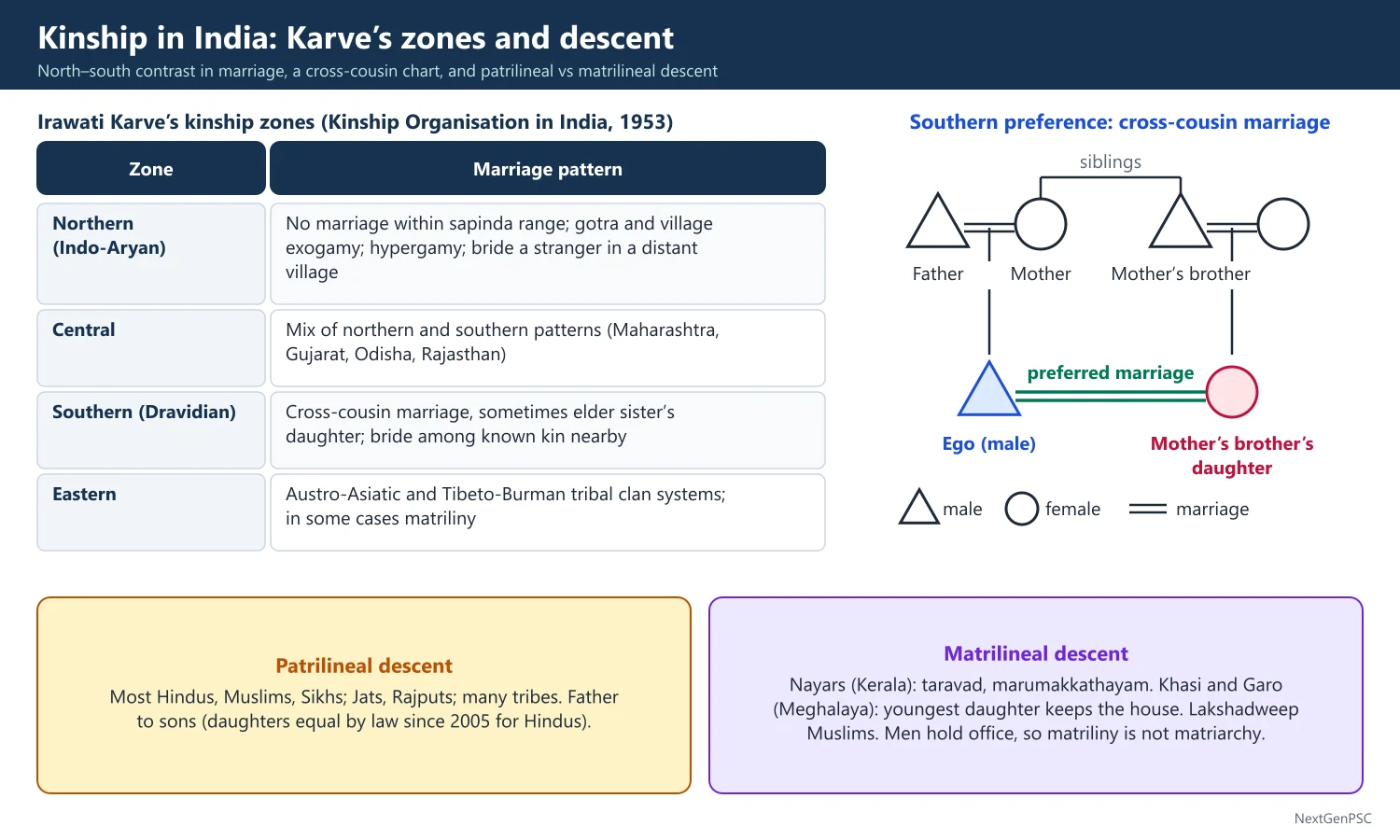
Kinship is the social recognition of ties by blood (consanguinity) and marriage (affinity). Most Indian communities follow patrilineal descent, but the Nayars of Kerala and the Khasi and Garo of Meghalaya are matrilineal. Irawati Karve’s Kinship Organisation in India (1953) mapped regional kinship zones: the north forbids marriage among close kin and practises village and gotra exogamy and hypergamy, while the south prefers cross-cousin and uncle–niece marriage, a contrast later explained through Dumont’s alliance approach.
In simple words
Kinship is the family tree that society recognises: who counts as your relative, whom you may marry and who inherits what.
In most of north India the family line passes through the father and you must marry outside your gotra and village.
In much of the south, marrying your mother’s brother’s daughter is preferred, and in some communities the line passes through the mother, like a property deed that names the daughter, not the son.
UPSC asks about lineage, descent, types of kinship systems and regional variations.
1. Basic concepts
Consanguineal and affinal kin: relatives by blood (parents, siblings, cousins) and by marriage (in-laws).
Descent: the rule by which a person is assigned to a kin group through one parent (unilineal: patrilineal or matrilineal) or both (bilateral).
Lineage: a descent group whose members can trace their actual genealogical links to a known common ancestor; in India the kutumb, khandan or bhaiyad of north India.
Clan: a larger group claiming descent from a common, often mythical, ancestor without traceable links; the gotra among Hindus, the clan (got) among Jats and the kur among the Khasi.
Residence: patrilocal (virilocal), matrilocal (uxorilocal), duolocal (as among traditional Nayar women, whose husbands visited them) and neolocal.
Kinship terminology: Lewis Henry Morgan distinguished classificatory systems (one term for several relatives, such as ‘chacha’ used widely) from descriptive systems.
Kinship usages: avoidance (between a woman and her husband’s elder brother in north India), joking relationships (with the wife’s younger sister or the husband’s younger brother), teknonymy (calling a woman ‘Ramu’s mother’) and avunculate (the special role of the mother’s brother).
2. Patrilineal descent in India
Most Hindu, Muslim, Sikh and many tribal communities are patrilineal and patrilocal: name, property and ritual roles pass from father to son, and the bride moves to the husband’s home.
Mitakshara and Dayabhaga: under Mitakshara (most of India) sons acquired a right in ancestral property by birth as coparceners; under Dayabhaga (Bengal) the father held full rights during his life.
Consequences: son preference, the ritual need for a son to perform funeral rites, and the view of daughters as ‘paraya dhan’; these feed the low child sex ratio.
Legal change: the Hindu Succession (Amendment) Act 2005 made daughters coparceners with equal rights by birth, and the Supreme Court in Vineeta Sharma v. Rakesh Sharma (2020) held that this applies even if the father died before 2005.
3. Matrilineal systems
Nayars of Kerala: the taravad was a matrilineal joint household headed by the eldest male (karanavar); women had sambandham unions with visiting husbands; property passed through women (marumakkathayam).
Kathleen Gough’s studies of the Nayars (1950s) asked whether marriage is universal; reforms such as the Madras Marumakkathayam Act (1933) and the Kerala Joint Hindu Family System (Abolition) Act 1975 ended the taravad as a legal unit.
Khasi and Garo of Meghalaya: descent and clan membership through the mother; among the Khasi the youngest daughter (ka khadduh) inherits the ancestral house and cares for parents; men hold political and ritual offices, so matriliny is not matriarchy.
Lakshadweep and the Mappilas of north Kerala: Leela Dube (Matriliny and Islam, 1969) studied matrilineal Muslims of Lakshadweep, showing how matriliny coexists with Islamic law.
Change: Khasi men’s groups have demanded patrilineal reforms, and land markets and migration are weakening matrilineal property systems.
4. Irawati Karve’s kinship zones
Northern zone (Indo-Aryan languages): marriage forbidden within the sapinda range (Hindu Marriage Act 1955 prohibits sapinda relationship up to three generations on the mother’s side and five on the father’s), gotra and village exogamy, hypergamy (daughters married ‘upwards’ to higher-status lineages), clear separation of a woman’s natal and conjugal families.
Southern zone (Dravidian languages): preferred marriage with the mother’s brother’s daughter or father’s sister’s daughter (cross-cousins) and, in some groups, the elder sister’s daughter; marriage often within a small circle of kin and nearby villages, so a bride is not a stranger.
Central zone: a mix of northern and southern patterns (Maharashtra, Gujarat, Odisha, Rajasthan).
Eastern zone: Austro-Asiatic and Tibeto-Burman speaking tribal communities with their own clan systems and, in some cases, matriliny.
Method: Karve combined texts, kinship terms and fieldwork, linking kinship to language regions.
5. Theories: descent and alliance
Descent theory (Radcliffe-Brown, Meyer Fortes): kinship is organised around corporate descent groups that hold property and rights.
Alliance theory (Lévi-Strauss, The Elementary Structures of Kinship, 1949): the exchange of women between groups through marriage rules, especially cross-cousin marriage, creates alliances; the incest taboo forces exchange.
Dumont (‘The Dravidian Kinship Terminology as an Expression of Marriage’, 1953) showed that Dravidian kin terms divide relatives into parallel kin and cross kin (potential affines), so affinity is inherited across generations; Thomas Trautmann (Dravidian Kinship, 1981) developed this.
North Indian contrast: wife-givers rank below wife-takers (hypergamy and kanyadan as a one-way gift), which links kinship to hierarchy, dowry and gender inequality.
6. Kinship and gender
Leela Dube (Women and Kinship, 1997) compared South and South-East Asia, showing how patrilineal kinship defines women as temporary members of their natal family; her ‘seed and field’ metaphor shows the man as seed-giver and the woman as field, which denies women claims on children and land.
South Indian women marrying within kin and nearby enjoyed closer ties to their natal family, which Tim Dyson and Mick Moore (1983) linked to better female autonomy and demographic outcomes in the south.
7. Kinship today
Continuity: kin networks support migration, jobs, business and elections; khap panchayats in Haryana enforce gotra and village exogamy, sometimes violently.
Change: cross-cousin marriage is declining in Tamil Nadu and Karnataka with education and health awareness; NFHS data show consanguineous marriage remains more common in the south.
New kinship: adoption, assisted reproduction (Surrogacy (Regulation) Act 2021) and queer chosen families raise new questions about what counts as kin.
8. Linking thinkers
Murdock (Social Structure, 1949) classified kinship systems cross-culturally; Indian matriliny and the Nayar case test his claim that the nuclear family is universal.
Malinowski on the mother’s brother among the matrilineal Trobrianders parallels the Nayar karanavar.
Patricia Uberoi (ed., Family, Kinship and Marriage in India, 1993) and T.N. Madan (Family and Kinship, 1965, Kashmiri Pandits) are standard Indian sources.
9. Using it in the exam
10 marks: define lineage, clan and descent and give Indian examples of patrilineal and matrilineal systems.
15 marks: compare north and south Indian kinship using Karve and Dumont.
20 marks: combine types, theories (descent versus alliance), gender (Leela Dube) and legal change (2005 amendment, Vineeta Sharma 2020).
Diagram idea: two kinship charts, one showing a north Indian marriage outside gotra and village, the other a south Indian marriage with the mother’s brother’s daughter.
Useful line: Karve held that to understand any cultural phenomenon in India one must understand the institutions of caste, family and the linguistic region (paraphrase of Kinship Organisation in India).
| Feature | North (Indo-Aryan) | South (Dravidian) |
|---|---|---|
| Preferred marriage | Outside close kin; gotra and village exogamy | Cross-cousin, sometimes uncle–niece |
| Status of families | Wife-takers above wife-givers (hypergamy) | Relative equality; alliance repeated |
| Bride’s position | Stranger in a distant village | Among known kin nearby |
| Kin terms | Distinguish consanguines and affines | Parallel versus cross kin |
| Women’s natal ties | Weak after marriage | Stronger |
| Type | Examples | Inheritance |
|---|---|---|
| Patrilineal | Most Hindus, Muslims, Sikhs; Jats, Rajputs; many tribes | Father to sons (daughters equal by law since 2005 for Hindus) |
| Matrilineal | Nayars (Kerala), Khasi and Garo (Meghalaya), Lakshadweep Muslims | Through women; Khasi youngest daughter keeps the house |
Mains points
- Define kinship terms precisely (lineage versus clan, descent, residence) before giving examples.
- Karve’s zones are the backbone of any regional comparison; present them in a table.
- Bring in the theory: Lévi-Strauss’s alliance, Dumont on Dravidian kinship, Radcliffe-Brown and Fortes on descent.
- Clarify that matriliny is not matriarchy (Khasi, Nayar examples).
- Link kinship to gender (Leela Dube, Dyson and Moore) and to law (2005 amendment, Vineeta Sharma 2020).
- Show change: decline of the taravad, khap conflicts, new reproductive technologies.
Did you know?
- Among the Khasi, children take their mother’s clan name, and the youngest daughter’s house is the clan’s ritual centre; a man who marries traditionally moves to his wife’s family.
Family, Marriage and Household in India
The Indian joint family (Karve, Kapadia, I.P. Desai) shares residence, hearth, property and worship across generations. A.M. Shah showed that the household (co-residence) must be separated from the family as a kinship group, and that nuclear households were common even in the past as families move through a developmental cycle. Marriage rules (endogamy, exogamy, hypergamy) and customs such as dowry and child marriage are changing with law, education, urbanisation and migration, yet arranged marriage and family obligations remain strong.
In simple words
A joint family is grandparents, parents, uncles and children living under one roof, eating from one kitchen and sharing property.
Today many people live in small flats with only parents and children, yet they still call relatives daily, send money home and let elders help choose a spouse.
So the house shrinks but the family stays big, like a company with branch offices.
UPSC asks whether the joint family is breaking up, how marriage is changing and what the household dimension means.
1. Concepts
Family: Murdock (Social Structure, 1949) defined it as a social group with common residence, economic cooperation and reproduction, including adults of both sexes in an approved sexual relationship and their children; he called the nuclear family universal.
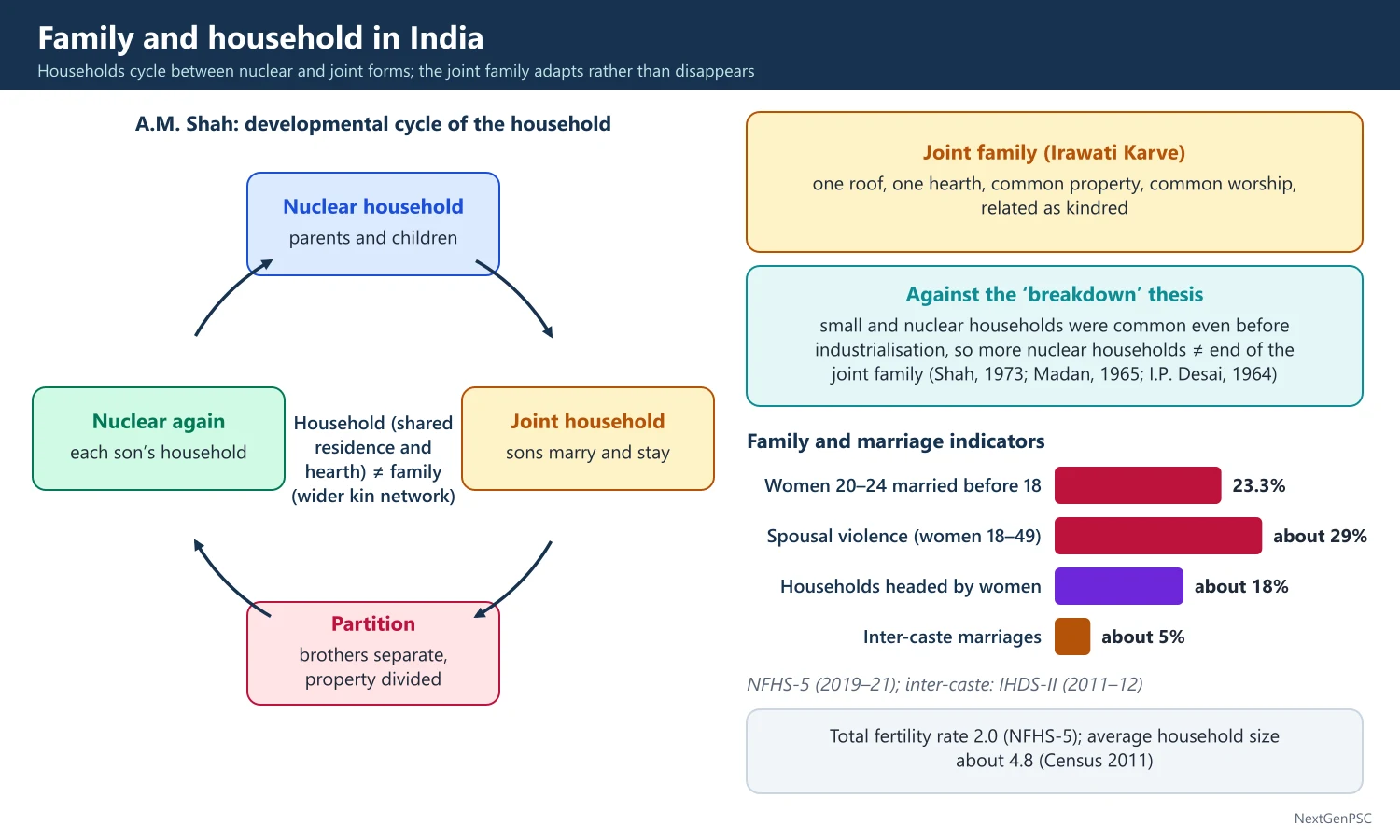
Joint family (Irawati Karve): a group of people who generally live under one roof, eat food cooked at one hearth, hold property in common, participate in common family worship and are related to each other as some particular type of kindred.
Types: by size and structure, families are nuclear, extended (vertical across generations or lateral among brothers) and joint; by authority, patriarchal or, rarely, matriarchal; by residence, patrilocal or matrilocal.
Desai (I.P.) (Some Aspects of Family in Mahuva, 1964) measured degrees of ‘jointness’ by obligations and property ties, not only by residence; many nuclear households remained functionally joint.
Kapadia (K.M.) (Marriage and Family in India, 1955) described the Hindu joint family as rooted in textual ideals and saw it adapting rather than disappearing.
2. The household dimension
Shah (A.M.) (The Household Dimension of the Family in India, 1973), using data from Radhvanaj village in Gujarat and historical census records, separated the household (people who share residence and a hearth) from the family (a wider network of kin).
Findings: small and nuclear households were common even before industrialisation; households move through a developmental cycle (nuclear → joint when sons marry → partition → nuclear again); so a rise in nuclear households does not prove the end of the joint family.
Criticism of the ‘breakdown’ thesis: the Western idea (Parsons, Goode’s World Revolution and Family Patterns, 1963) that industrialisation produces nuclear families does not fit India well; Milton Singer found Madras industrialists keeping joint families.
T.N. Madan (Family and Kinship, 1965), studying Kashmiri Pandits, also showed the family as a process in which households divide and re-form over time.
Functions of the joint family: security in old age, sickness and unemployment, pooling of labour and capital, and socialisation into caste norms; its costs include control over women and the young.
Household data: Census 2011 recorded an average household size of about 4.8; NFHS-5 (2019–21) found about 18% of households headed by women, often where men had migrated.
3. Marriage: forms and rules
Forms: monogamy (the legal norm for Hindus since the Hindu Marriage Act 1955), polygyny (permitted in Muslim personal law, rare in practice), polyandry (fraternal polyandry among the Khasa of Jaunsar-Bawar and in parts of Himachal; the Todas earlier).
Rules: caste endogamy; gotra, sapinda and village exogamy; hypergamy (anuloma) accepted and hypogamy (pratiloma) condemned in the texts.
Hindu marriage as sacrament: Kapadia stressed dharma, praja (progeny) and rati (pleasure) as its aims; the 1955 Act made it also a contract with divorce.
Marriage as alliance: arranged marriage joins two kin groups through exchange of gifts and obligations, not only two individuals.
Muslim marriage (nikah): a civil contract with mehr; the Muslim Women (Protection of Rights on Marriage) Act 2019 made instant triple talaq a criminal offence after Shayara Bano (2017).
Civil and uniform law: the Special Marriage Act 1954 allows inter-faith and inter-caste civil marriage; Uttarakhand’s Uniform Civil Code came into force on 27 January 2025, including compulsory registration of marriages and live-in relationships.
4. Problems: dowry, child marriage, violence
Dowry: banned by the Dowry Prohibition Act 1961, yet it has spread to communities that once practised bride price; M.N. Srinivas linked its spread to Sanskritisation and to the rising value of educated grooms in the job market.
Dowry deaths and cruelty are covered by the Bharatiya Nyaya Sanhita 2023 (in force from 1 July 2024), which carried over the earlier IPC offences (sections 304B and 498A).
Child marriage: under the Prohibition of Child Marriage Act 2006 (minimum age 18 for women, 21 for men), NFHS-5 (2019–21) found 23.3% of women aged 20–24 married before 18, down from 26.8% in NFHS-4 (2015–16); a 2021 bill to raise women’s age to 21 lapsed in 2024.
Son preference: family preference for sons produced a child sex ratio of 918 girls per 1,000 boys (age 0–6) in Census 2011; the PCPNDT Act 1994 bans sex determination.
Inter-caste and inter-faith marriage: still rare (about 5% inter-caste in IHDS-II, 2011–12); couples face honour crimes, and several states passed anti-conversion laws that affect inter-faith marriages.
Domestic violence: NFHS-5 found that about 29% of ever-married women aged 18–49 had experienced spousal violence; the Protection of Women from Domestic Violence Act 2005 provides civil remedies.
5. Forces of change
Urbanisation and migration: nuclear households in cities; ‘left-behind’ wives and elders in villages; remittance-based transnational families (Kerala and the Gulf).
Marriage migration: marriage is the leading reason for women’s migration in Census 2011, which shows the strength of patrilocal residence.
Education and women’s work: later marriage, smaller families (NFHS-5 total fertility rate 2.0, below replacement), more say in choosing spouses.
Arranged love marriages: Patricia Uberoi described the blend of choice and parental consent; matrimonial websites still filter by caste, religion and horoscope.
Ageing: Census 2011 counted about 10.4 crore people aged 60 and above (8.6%); the Maintenance and Welfare of Parents and Senior Citizens Act 2007 makes children legally responsible, showing the state stepping in where family care weakens.
New forms: single-parent households, live-in relationships (recognised for protection under the Domestic Violence Act), divorce rising slowly from a low base.
Policy and family attitudes: Beti Bachao Beti Padhao (2015) and Sukanya Samriddhi Yojana (2015) try to change family attitudes towards daughters.
6. Theoretical perspectives
Functionalist (Parsons): the isolated nuclear family fits industrial society, with expressive (wife) and instrumental (husband) roles; Indian evidence shows modified extended families instead.
Marxist and feminist: Engels (The Origin of the Family, Private Property and the State, 1884) linked monogamy and patriarchy to private property; Indian feminists show the family as a site of unequal labour, dowry and control of women’s sexuality.
Giddens (The Transformation of Intimacy, 1992): ‘pure relationships’ based on choice; in India choice grows but within family and caste limits.
Feminist Indian view: Leela Dube and Patricia Uberoi show how marriage and kinship norms shape women’s rights within the household, linking the family to patriarchy.
7. Using it in the exam
10 marks: define the joint family (Karve) and give A.M. Shah’s household argument.
15 marks: assess whether the joint family is disintegrating, using Shah, I.P. Desai, Singer and data.
20 marks: discuss changes in family and marriage (law, dowry, child marriage, choice, ageing) with NFHS-5 and Census data and theoretical perspectives.
Diagram idea: A.M. Shah’s developmental cycle drawn as a circle: nuclear → joint (sons marry) → partition → nuclear.
Useful line: A.M. Shah argued that the household and the family must be distinguished, since a change in household composition does not by itself mean the end of joint family ties (paraphrase).
| Indicator | Value | Source (year) |
|---|---|---|
| Women aged 20–24 married before 18 | 23.3% | NFHS-5 (2019–21) |
| Total fertility rate | 2.0 | NFHS-5 (2019–21) |
| Households headed by women | About 18% | NFHS-5 (2019–21) |
| Ever-married women (18–49) who faced spousal violence | About 29% | NFHS-5 (2019–21) |
| Inter-caste marriages | About 5% | IHDS-II (2011–12) |
| Population aged 60 and above | About 10.4 crore (8.6%) | Census 2011 |
Mains points
- Always separate family from household (A.M. Shah); this is the most rewarded point in joint-family questions.
- Avoid the simple ‘joint family is breaking down’ answer; show adaptation (I.P. Desai, Singer, functional jointness).
- Give marriage rules and laws with years (Hindu Marriage Act 1955, Special Marriage Act 1954, Dowry Prohibition Act 1961, PCMA 2006, 2019 triple talaq Act, Uttarakhand UCC 2025).
- Use NFHS-5 data for child marriage, fertility, women-headed households and violence.
- Bring theory: Murdock, Parsons, Goode, Engels, Giddens, and Indian feminists.
- Mention new forms (live-in, single parents, ageing parents alone) to show current awareness.
Did you know?
- A.M. Shah found that in Radhvanaj in the nineteenth century, small households were already common, which surprised scholars who assumed India had always lived in large joint households.
Patriarchy, Entitlements and Sexual Division of Labour
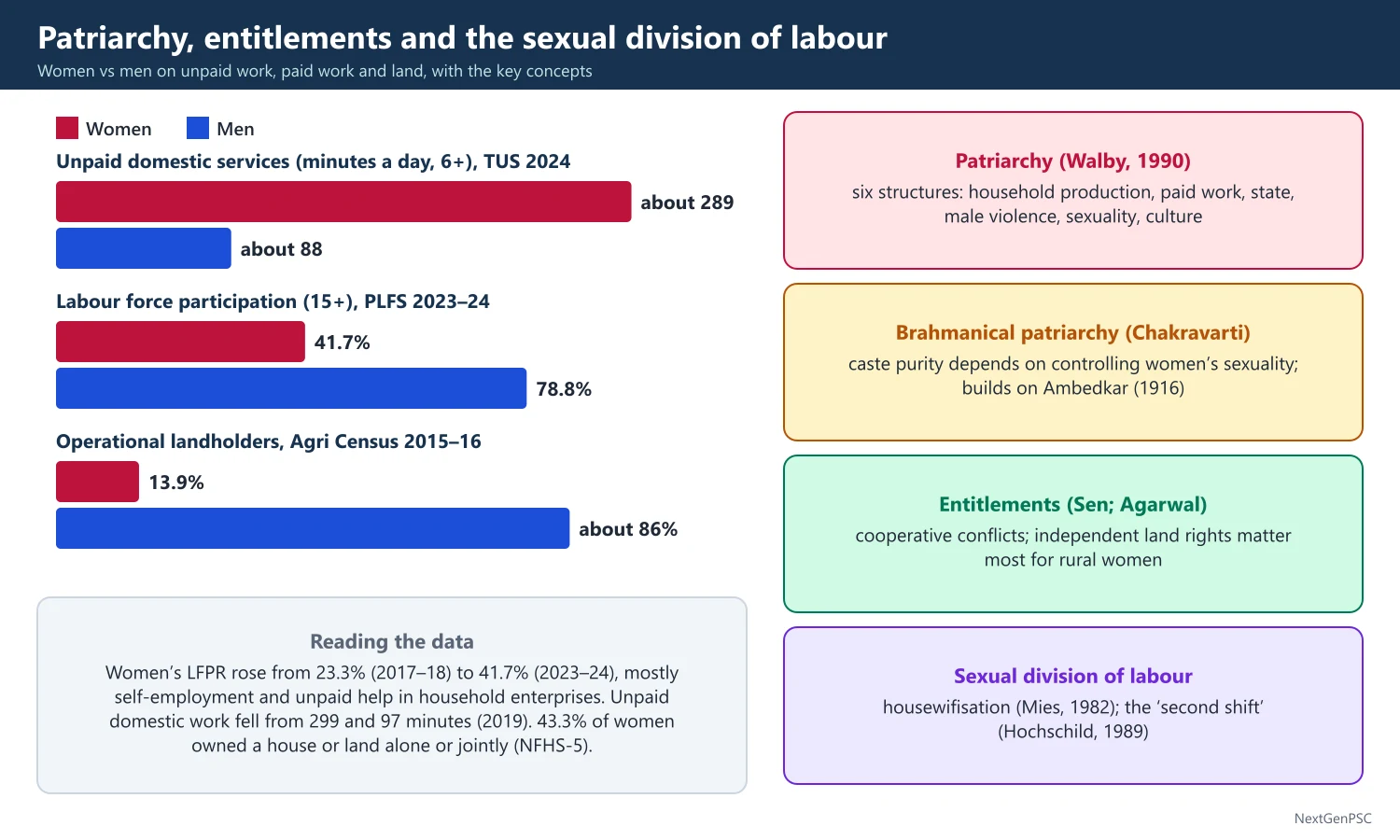
Patriarchy is a system of social structures and practices in which men dominate and exploit women (Sylvia Walby). In India it is shaped by caste, as Uma Chakravarti’s Brahmanical patriarchy shows. Women’s entitlements to land, property, food, health and income are weaker than men’s (Amartya Sen, Bina Agarwal), and a sexual division of labour assigns them most unpaid care work: women spent about 289 minutes a day on unpaid domestic work against 88 for men in the Time Use Survey 2024.
In simple words
Patriarchy means a system where men hold more power than women, at home, at work and in society.
In many Indian homes the daughter is fed after the son, the land goes to the son, and the mother cooks, cleans and cares for everyone without pay.
It is like a team where one side writes the rules and the other does most of the running.
UPSC asks how patriarchy works in India, how it links with caste, and what entitlements and the division of labour mean for women.
1. Concepts
Patriarchy: Sylvia Walby (Theorizing Patriarchy, 1990) defined it as a system of social structures and practices in which men dominate, oppress and exploit women, working through six structures: household production, paid work, the state, male violence, sexuality and culture.
Private and public patriarchy: Walby distinguished control within the household from control through the labour market and the state.
Kate Millett (Sexual Politics, 1970) used patriarchy for the universal political domination of men over women.
Gerda Lerner (The Creation of Patriarchy, 1986) argued that patriarchy is historical, not natural, arising with control over women’s sexuality and reproduction in early states.
Bargaining with patriarchy: Deniz Kandiyoti (1988) showed that women make strategic choices within patriarchal constraints, such as accepting a mother-in-law’s power in the hope of gaining it later.
Sex and gender: Ann Oakley (Sex, Gender and Society, 1972) separated biological sex from socially constructed gender roles.
2. Brahmanical patriarchy and caste
Uma Chakravarti (‘Conceptualising Brahmanical Patriarchy in Early India’, 1993; Gendering Caste, 2003) argued that caste purity depends on controlling women’s sexuality, so caste and gender hierarchies are built together.
This builds on Ambedkar (1916), who traced sati, enforced widowhood and child marriage to the need to maintain caste endogamy.
Caste differences: upper-caste women faced stricter seclusion but less wage work; Dalit women do hard wage labour and face sexual violence from dominant castes; Sanskritising castes often withdraw women from paid work (Srinivas, Leela Dube).
Honour and seclusion: the idea of izzat ties family and caste honour to women’s conduct, justifying purdah, early marriage and honour crimes.
Dalit feminism: Sharmila Rege and Gopal Guru (‘Dalit Women Talk Differently’, 1995) argued that mainstream feminism ignored caste.
3. Entitlements
Amartya Sen’s entitlement approach (Poverty and Famines, 1981): what a person can command through ownership, exchange, work and state transfers; famines result from entitlement failure, not only food shortage.
Intra-household inequality: Sen’s ‘cooperative conflicts’ (1990) model shows women get less within the household because their contribution is undervalued and their fallback position is weak; his ‘missing women’ estimate (1990) pointed to excess female mortality.
Land: Bina Agarwal (A Field of One’s Own, 1994) argued that independent land rights are the most important entitlement for rural women; women operated only 13.9% of holdings (Agriculture Census 2015–16).
Legal entitlements: Hindu Succession (Amendment) Act 2005 (equal coparcenary rights), Protection of Women from Domestic Violence Act 2005 (right to residence), maternity benefit raised to 26 weeks (2017), and the National Food Security Act 2013, which names the eldest woman as head of household for ration cards.
Outcomes (NFHS-5, 2019–21): 43.3% of women owned a house or land alone or jointly, 78.6% had a bank account they used, and about 54% had a mobile phone they used themselves; the sex ratio at birth for the five years before the survey was 929 females per 1,000 males.
4. Sexual division of labour
Functionalist view: Murdock saw it as practical and universal; Parsons assigned expressive roles to women and instrumental roles to men.
Marxist-feminist view: Engels linked women’s subordination to private property; Maria Mies (The Lace Makers of Narsapur, 1982) showed how women in Andhra Pradesh were defined as ‘housewives’ so that their lace-making for export could be paid as spare-time work (housewifisation).
Ann Oakley (Housewife, 1974) showed housework as real, unpaid and monotonous labour.
Unpaid care work in India: the Time Use Survey 2024 (NSO) found women aged 6 and above spent about 289 minutes a day on unpaid domestic services against about 88 minutes for men (down from 299 and 97 in 2019).
Double burden: women in paid work still do most housework, Arlie Hochschild’s ‘second shift’ (1989).
Paid work: female labour force participation (15 and above, usual status) rose to 41.7% in PLFS 2023–24 from 23.3% in 2017–18, but most of the rise is in self-employment and unpaid help in household enterprises, much of it rural and agricultural.
Segregation and wage gaps: women are concentrated in agriculture, domestic work, garments, care and scheme work (ASHA and anganwadi workers, classed as ‘volunteers’ with honoraria).
Feminisation of agriculture: as men migrate to towns, women take on more farm work without land titles, credit or recognition as ‘farmers’.
5. Violence and control
NCRB’s Crime in India 2023 recorded about 4.48 lakh cases of crimes against women, the largest share under cruelty by husband or relatives.
Son preference: the child sex ratio fell to 918 in Census 2011; the PCPNDT Act 1994 and Beti Bachao Beti Padhao (2015) target sex selection.
Laws: Criminal Law (Amendment) Act 2013 after the Justice Verma Committee; Sexual Harassment of Women at Workplace Act 2013; the Bharatiya Nyaya Sanhita 2023 (from 1 July 2024) kept the marital rape exception, which is under challenge in the Supreme Court.
6. Women’s movements and representation
Towards Equality (1974), the report of the Committee on the Status of Women in India (Vina Mazumdar), revealed declining sex ratios and women’s marginalisation and started women’s studies in India.
Movements against dowry and rape (Mathura case, 1979–80), the Chipko movement, anti-arrack protests in Andhra Pradesh (1992) and SEWA show women organising across issues.
Representation: the 73rd and 74th Amendments (1992) reserved one-third of local body seats for women (one-half in many states); the Constitution (106th Amendment) Act 2023, the Women’s Reservation Act, reserves one-third of Lok Sabha and state assembly seats, to take effect after delimitation following the next census.
Self-help groups: about 10 crore women are members of self-help groups under DAY-NRLM, a channel for credit and collective action.
7. Linking thinkers
Liberal, radical, Marxist and black or intersectional feminism (Kimberlé Crenshaw, 1989) map onto Indian debates on law reform, sexual violence, labour and caste.
Bourdieu’s masculine domination and Foucault’s disciplinary power explain everyday control of women’s bodies, dress and movement.
8. Using it in the exam
10 marks: define patriarchy (Walby) and Brahmanical patriarchy (Chakravarti) with one Indian example each.
15 marks: explain entitlements (Sen, Agarwal) and use NFHS-5 and Agriculture Census data.
20 marks: combine patriarchy, entitlements and the division of labour, using Time Use Survey 2024, PLFS 2023–24, NCRB 2023 and the Women’s Reservation Act, and conclude on change and persistence.
Diagram idea: a bar chart of daily minutes of unpaid domestic work, women 289 versus men 88 (Time Use Survey 2024).
Useful line: Simone de Beauvoir wrote that one is not born, but rather becomes, a woman (The Second Sex, 1949).
| Indicator | Women | Men | Source (year) |
|---|---|---|---|
| Unpaid domestic services (minutes per day, age 6+) | About 289 | About 88 | Time Use Survey 2024 |
| Labour force participation (15+, usual status) | 41.7% | 78.8% | PLFS 2023–24 |
| Share of operational holdings (by who operates them) | 13.9% | About 86% (nearly all the rest) | Agriculture Census 2015–16 |
| Own house or land (alone or jointly), age 15–49 | 43.3% | Not compared here | NFHS-5 (2019–21) |
Mains points
- Define patriarchy with a named theorist (Walby or Millett) and then show its Indian form through caste (Chakravarti, Ambedkar).
- Explain entitlements properly (Sen’s concept, Agarwal on land), not just as ‘rights’.
- Use recent data with source and year: Time Use Survey 2024, PLFS 2023–24, NFHS-5, NCRB 2023.
- Bring Indian feminist scholars: Leela Dube, Uma Chakravarti, Sharmila Rege, Maria Mies, Bina Agarwal, Vina Mazumdar.
- Show intersectionality: caste, class and region change women’s experience of patriarchy.
- Conclude with change (law, SHGs, reservation) and persistence (care burden, violence, low ownership).
Did you know?
- Ambedkar linked sati, enforced widowhood and girl marriage to caste endogamy in 1916, about 75 years before Uma Chakravarti named the system ‘Brahmanical patriarchy’ (1993).
Religious Communities and Problems of Religious Minorities
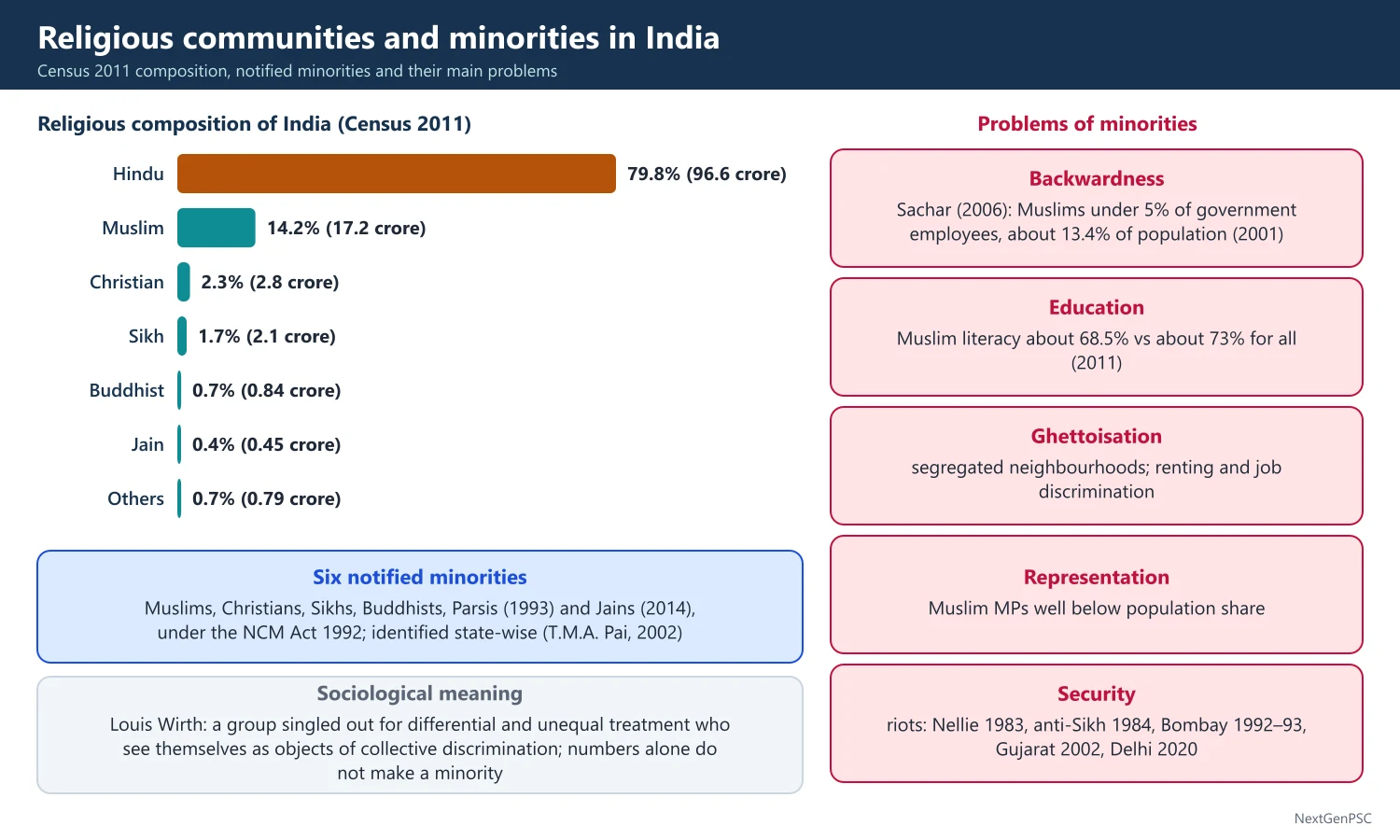
India is home to Hindus (79.8%), Muslims (14.2%), Christians (2.3%), Sikhs (1.7%), Buddhists (0.7%), Jains (0.4%) and others (Census 2011). Six communities are notified minorities under the National Commission for Minorities Act 1992. Minorities face problems of socio-economic backwardness (Sachar Committee 2006), under-representation, communal violence, insecurity and identity debates over personal law, conversion, citizenship and waqf, which sociologists study through theories of communalism and secularism.
In simple words
India has many religions living side by side; the smaller ones are called minorities and get special constitutional protection for their culture and schools.
Some minorities, especially many Muslims, lag in education and jobs and sometimes feel unsafe during riots or political tension.
It is like a joint family where younger members need assurance that their voice counts.
UPSC asks about religious communities, minority problems, communalism and secularism.
1. Religious composition (Census 2011)
Hindus 96.6 crore (79.8%), Muslims 17.2 crore (14.2%), Christians 2.8 crore (2.3%), Sikhs 2.1 crore (1.7%), Buddhists 0.84 crore (0.7%), Jains 0.45 crore (0.4%), other religions and persuasions about 0.79 crore (0.7%).
Regional concentration: Muslims are a majority in Jammu and Kashmir and Lakshadweep and large minorities in Assam, West Bengal, Kerala and Uttar Pradesh; Christians are majorities in Nagaland, Mizoram and Meghalaya; Sikhs in Punjab; Buddhists mainly in Maharashtra, Sikkim and Ladakh.
Fertility: NFHS-5 (2019–21) total fertility rate was 2.36 for Muslims and 1.94 for Hindus; the gap has narrowed sharply since NFHS-1 (1992–93), which shows fertility follows education and income more than religion.
Census 2027 (reference date 1 March 2027) will give the first new data on religion since 2011.
2. Who is a minority
The Constitution does not define ‘minority’; Articles 29 and 30 protect the culture, language and educational institutions of minorities; Articles 25–28 guarantee freedom of religion to all.
Notified minorities under the National Commission for Minorities Act 1992: Muslims, Christians, Sikhs, Buddhists and Parsis (1993), and Jains (2014).
State-level minority: in T.M.A. Pai Foundation (2002) the Supreme Court held that linguistic and religious minorities are to be identified state-wise; Hindus in some states (such as Mizoram, Nagaland, Punjab, Jammu and Kashmir) raise demands for minority status.
Sociological meaning: Louis Wirth defined a minority as a group singled out for differential and unequal treatment who regard themselves as objects of collective discrimination; numbers alone do not make a minority.
3. Internal diversity of communities
Muslims: divided by sect (Sunni, Shia, Ahmadiyya, Bohra), region and language, and by caste-like groups (ashraf, ajlaf, arzal); Imtiaz Ahmad (Caste and Social Stratification among Muslims in India, 1973; Ritual and Religion among Muslims in India, 1981) showed syncretic practices such as dargah worship; Pasmanda movements (Ali Anwar’s Pasmanda Muslim Mahaz, 1998) speak for backward Muslims.
Christians: Syrian Christians of Kerala, Goan Catholics, Dalit Christians in Tamil Nadu and Andhra Pradesh, and tribal Christians in the north-east and Jharkhand; caste persists within churches.
Sikhs: Jat Sikhs dominate land and politics in Punjab, while Mazhabi and Ravidassia Sikhs (Dalits) form about a third of Punjab’s population, the highest SC share of any state (31.9% in 2011).
Buddhists: mostly neo-Buddhists (Navayana) following Ambedkar’s 1956 conversion, plus Himalayan Buddhists; Parsis face a falling population, addressed by the Jiyo Parsi scheme (2013–14).
4. Problems of religious minorities
Socio-economic backwardness: the Sachar Committee (2006) found that Muslims lagged in education, credit and formal jobs, and formed under 5% of government employees though they were about 13.4% of the population in 2001; their condition was in some respects close to SCs and STs.
Follow-up: the Ranganath Misra Commission (2007) recommended reservation for minorities and SC status for Dalit Christians and Dalit Muslims; the K.G. Balakrishnan Commission (set up in 2022) examines SC status for converts; the Prime Minister’s New 15 Point Programme (2006) targets minority welfare.
Ghettoisation and discrimination: segregated neighbourhoods (Juhapura in Ahmedabad), difficulty in renting homes, and job discrimination (Thorat and Attewell, 2007).
Education: Census 2011 recorded literacy of about 68.5% among Muslims against about 73% for all, with the gap widest among women and in higher education.
Political representation: the share of Muslim MPs in the Lok Sabha has stayed well below their population share in recent elections.
Security: communal riots (Nellie 1983, the anti-Sikh violence of 1984, Bombay 1992–93, Gujarat 2002, Kandhamal 2008 against Christians, Muzaffarnagar 2013, north-east Delhi 2020) and mob lynchings.
Identity and law debates: personal law reform and the Uniform Civil Code (Uttarakhand UCC in force from 27 January 2025); anti-conversion laws in several states; the Citizenship (Amendment) Act 2019 (rules notified March 2024); the Waqf (Amendment) Act 2025, parts of which the Supreme Court stayed in an interim order on 15 September 2025; the hijab dispute in Karnataka (split Supreme Court verdict, October 2022).
Gender within minorities: Muslim women’s groups (Bharatiya Muslim Mahila Andolan) fought instant triple talaq, leading to Shayara Bano (2017) and the 2019 Act.
5. Communalism
Meaning: Bipan Chandra defined communalism as the belief that people who follow a religion share common secular interests that differ from, and finally oppose, those of other religious communities; he traced three stages: communal nationalism, liberal communalism and extreme communalism.
Causes: colonial divide and rule (separate electorates 1909), competition for jobs and resources, political mobilisation for votes, memories of Partition, rumour and media.
Paul Brass (The Production of Hindu–Muslim Violence in Contemporary India, 2003) argued that riots are produced by an ‘institutionalised riot system’ of political actors, not by spontaneous hatred.
Ashutosh Varshney (Ethnic Conflict and Civic Life, 2002) compared riot-prone and peaceful cities (for example Aligarh and Calicut) and found that inter-communal civic associations (business, trade unions, clubs) keep peace.
Asghar Ali Engineer documented riots for decades and stressed the economic and political roots of communal conflict.
6. Secularism debate
Indian secularism: the state keeps a ‘principled distance’ from religions (Rajeev Bhargava), allowing both intervention (temple entry, abolition of untouchability) and support (minority institutions), unlike strict Western separation.
Critics: T.N. Madan (‘Secularism in Its Place’, 1987) and Ashis Nandy argued that secularism is alien to a religious society and that religious tolerance should come from within traditions.
Courts: in S.R. Bommai (1994) the Supreme Court held secularism to be part of the basic structure of the Constitution.
Secularisation: Srinivas observed a decline of purity-pollution ideas among the educated, yet religion has become more visible in public life, which fits the global ‘desecularisation’ argument (Peter Berger, 1999).
Public opinion: the Pew Research Center survey ‘Religion in India: Tolerance and Segregation’ (2021) found that most Indians value religious tolerance yet prefer to keep religious communities separate in marriage and friendship.
7. Linking thinkers
Durkheim: religion creates solidarity within a group but can sharpen boundaries between groups.
Weber: status groups and social closure; Marx: religion as ideology that can divide the working class.
Anderson and Gellner: religious nationalism as a form of imagined community.
8. Using it in the exam
10 marks: give the religious composition with Census 2011 figures and list the legal safeguards.
15 marks: analyse problems of minorities using the Sachar Committee and recent legal debates.
20 marks: explain communalism (Bipan Chandra, Brass, Varshney) and the secularism debate (Bhargava versus Madan and Nandy), and suggest remedies.
Diagram idea: a pie chart of Census 2011 religious composition, and a flow chart from competition and mobilisation to riot (Brass’s riot system).
Useful line: Varshney argued that strong inter-communal civic networks are the best protection against riots (paraphrase).
| Religion | Population (crore) | Share |
|---|---|---|
| Hindu | 96.6 | 79.8% |
| Muslim | 17.2 | 14.2% |
| Christian | 2.8 | 2.3% |
| Sikh | 2.1 | 1.7% |
| Buddhist | 0.84 | 0.7% |
| Jain | 0.45 | 0.4% |
| Other religions and persuasions | 0.79 | 0.7% |
| Scholar (work, year) | Explanation |
|---|---|
| Bipan Chandra | Communal ideology in three stages, rooted in colonial politics |
| Paul Brass (2003) | Institutionalised riot systems run by political actors |
| Ashutosh Varshney (2002) | Weak inter-communal civic links make cities riot-prone |
| Asghar Ali Engineer | Economic competition and political interests |
Mains points
- Open with Census 2011 figures and the list of notified minorities with years.
- Treat each community as internally diverse (sect, caste, region); avoid treating Muslims or Christians as one block.
- Use the Sachar Committee for socio-economic problems and give recent legal developments with dates (UCC 2025, CAA rules 2024, Waqf Act 2025 and the interim order).
- Explain communalism with scholars (Bipan Chandra, Brass, Varshney) rather than only listing riots.
- Present the secularism debate in a balanced way.
- Keep the tone neutral and evidence-based on politically sensitive issues; examiners reward balance.
Did you know?
- Parsis numbered about 57,000 in Census 2011, one of the few communities in India whose population is shrinking; the Jiyo Parsi scheme supports fertility treatment for Parsi couples.
Gender and Sexuality: Transgender and LGBTQ Rights
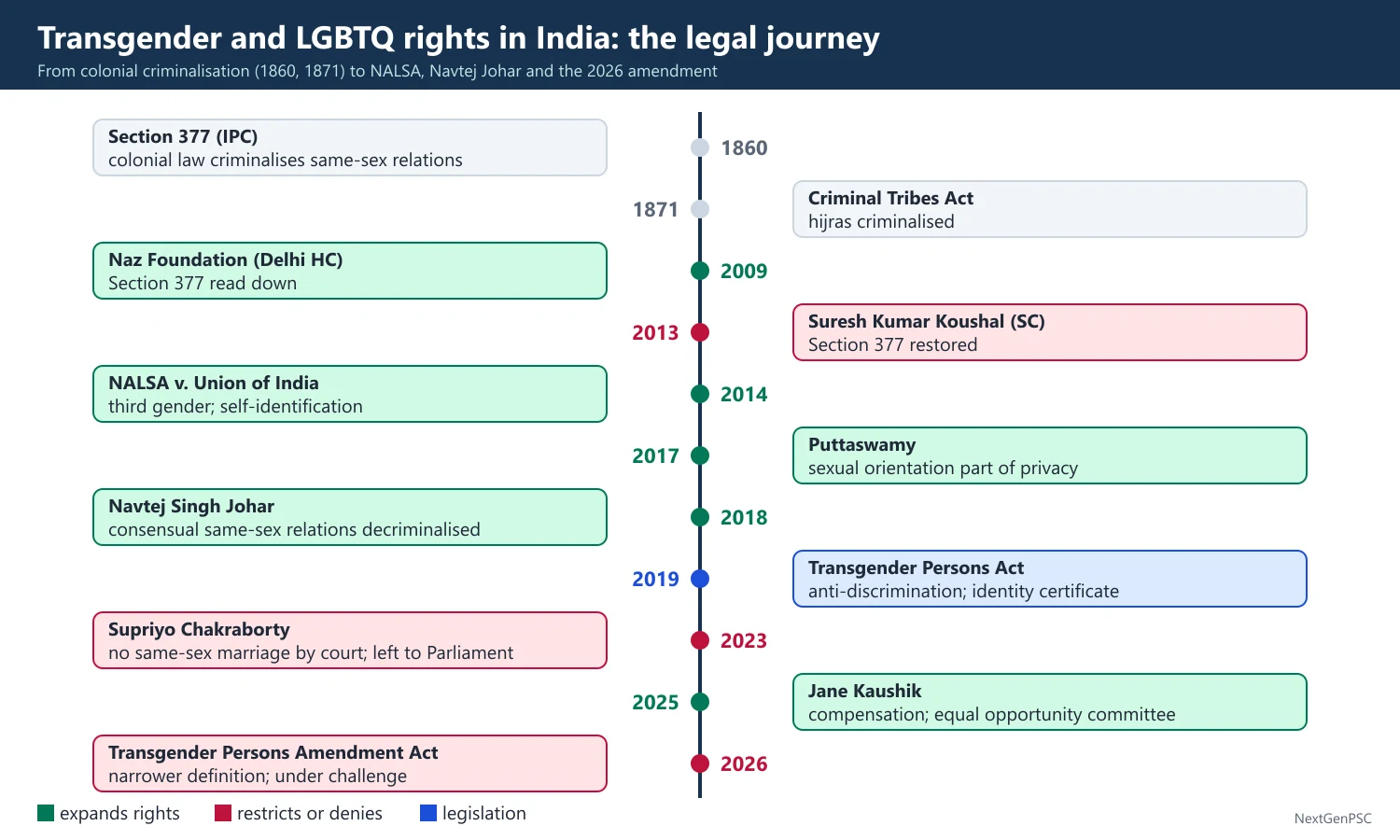
Sociology treats gender and sexuality as socially constructed and regulated, not only biological (Foucault, Butler). India has long-standing gender-variant communities such as the hijras, but colonial law (Section 377, 1860; Criminal Tribes Act 1871) criminalised them and same-sex relations. The Supreme Court recognised a third gender and self-identification in NALSA (2014) and decriminalised consensual same-sex relations in Navtej Singh Johar (2018), but declined to recognise same-sex marriage in Supriyo Chakraborty (2023). The Transgender Persons Act 2019 was amended in 2026 in ways critics say weaken self-identification; the amendment is under challenge.
In simple words
Biology gives us bodies, but society decides what it means to be a ‘man’ or ‘woman’, whom one may love and how one should dress.
Transgender people feel their gender differs from the sex recorded at birth, and LGBTQ people may love persons of the same sex.
It is like a school uniform rule: the cloth is natural, but the rule about who wears what is made by people and can change.
UPSC asks how Indian law and society treat these groups and what sociological theories explain gender and sexuality.
1. Concepts
Sex, gender, sexuality: sex refers to biological characteristics; gender to socially constructed roles and identities; sexual orientation to whom one is attracted; gender identity to one’s inner sense of being a man, woman, both or neither.
LGBTQ+: lesbian, gay, bisexual, transgender, queer and others, including intersex persons born with variations in sex characteristics.
Heteronormativity: the assumption that heterosexuality and a male–female binary are natural and normal, built into laws on marriage, inheritance and adoption.
2. Sociological perspectives
Social construction: Berger and Luckmann’s idea that reality is socially constructed applies to gender; Simone de Beauvoir’s claim that one becomes a woman anticipates it.
Michel Foucault (The History of Sexuality, Volume 1, 1976): modern societies did not simply repress sex but produced categories such as ‘the homosexual’ through medicine, law and psychiatry, as forms of power and discipline.
Judith Butler (Gender Trouble, 1990): gender is performative, created through repeated acts that conform to norms, not an inner essence; this opens space for queer identities.
Goffman (Stigma, 1963): ‘spoiled identity’ explains the stigma faced by transgender and queer persons; West and Zimmerman (‘Doing Gender’, 1987) show gender as an everyday accomplishment.
Functionalist view: Parsons saw clear sex roles as functional for the family; critics show this naturalises inequality and excludes queer families.
Indian scholarship: Ruth Vanita and Saleem Kidwai (Same-Sex Love in India, 2000) traced same-sex themes in Indian literature; Nivedita Menon (Seeing Like a Feminist, 2012) questions the naturalness of the binary.
3. The hijra community
Organisation: hijras live in households (deras) under a guru–chela (teacher–disciple) system, grouped into gharanas, with their own rules, kinship and initiation; Serena Nanda (Neither Man nor Woman, 1990) and Gayatri Reddy (With Respect to Sex, 2005) studied them.
Ritual role and livelihood: blessings at births and weddings (badhai), linked to the goddess Bahuchara Mata; today many depend on begging and sex work because of exclusion from schools and jobs.
Other identities: aravanis or thirunangais (Tamil Nadu), kinnars, jogtas and jogappas, shiv-shaktis; the Koovagam festival in Tamil Nadu is a major gathering.
Colonial criminalisation: ‘eunuchs’ were listed under the Criminal Tribes Act 1871 and same-sex intercourse was criminalised by Section 377 of the Indian Penal Code (1860), which marked a break from more ambiguous pre-colonial attitudes.
Numbers: Census 2011 counted about 4.88 lakh persons as ‘other’ gender, widely seen as an undercount.
4. Legal journey
Naz Foundation (Delhi High Court, 2009) read down Section 377 for consenting adults; the Supreme Court reversed this in Suresh Kumar Koushal (2013).
NALSA vs Union of India (15 April 2014): recognised transgender persons as a ‘third gender’, upheld the right to self-identify gender without surgery, and directed welfare measures and treatment as socially and educationally backward classes.
Puttaswamy (2017): the nine-judge privacy judgment held that sexual orientation is an essential attribute of privacy.
Navtej Singh Johar vs Union of India (6 September 2018): a five-judge bench decriminalised consensual sex between adults of the same sex, reading down Section 377 as violating Articles 14, 15, 19 and 21.
Transgender Persons (Protection of Rights) Act 2019 (in force from January 2020): bans discrimination in education, jobs, health and housing, provides for a certificate of identity from the District Magistrate and a National Council for Transgender Persons; critics objected to lighter penalties for sexual abuse of transgender persons and to certification procedures.
Supriyo Chakraborty vs Union of India (17 October 2023): a five-judge bench unanimously held that there is no fundamental right to marry and left recognition of same-sex marriage to Parliament; by 3:2 it declined to recognise civil unions or adoption by queer couples, while affirming that queer persons must not face discrimination; review petitions were dismissed in January 2025.
After Supriyo: the Union government formed a committee under the Cabinet Secretary (2024) to examine entitlements of queer couples such as ration cards, joint bank accounts and medical decisions.
Jane Kaushik vs Union of India (17 October 2025): the Supreme Court awarded compensation to a transgender teacher dismissed over her gender identity, found the state guilty of failing to enforce the 2019 Act, and set up an advisory committee chaired by former Delhi High Court judge Asha Menon to draft an equal opportunity policy.
Transgender Persons (Protection of Rights) Amendment Act 2026 (assent 30 March 2026): critics say it narrows the definition of a transgender person, removes self-identification and requires a medical board’s recommendation; petitions challenging it are pending in the Supreme Court, which issued notice in May 2026 but did not stay the Act.
Criminal law gap: the Bharatiya Nyaya Sanhita 2023 (from 1 July 2024) has no equivalent of Section 377, so non-consensual sexual acts against men and transgender persons lack a clear offence, a gap critics have pointed out.
5. State policies
Tamil Nadu set up a Transgender (Aravani) Welfare Board (2008); Kerala adopted India’s first State Policy for Transgenders (2015); Odisha and others extended welfare schemes.
The Centre’s SMILE scheme (2022) supports livelihood, skills and shelter homes (Garima Greh); a National Portal for Transgender Persons issues identity certificates.
The Madras High Court (Arunkumar, 2019) recognised a marriage between a man and a transwoman and led Tamil Nadu to ban sex-selective surgeries on intersex infants.
6. Social realities
Family rejection and violence: many queer and transgender persons face forced marriage, ‘conversion therapy’ and eviction from home; the Madras High Court (2021) banned conversion therapy and the National Medical Commission (2022) called it professional misconduct.
Exclusion: low school completion, job discrimination and difficulty getting identity documents push transgender persons to the margins.
Visibility: Pride marches in many cities, transgender persons elected to local bodies, and reserved posts in some states show growing assertion; urban, upper-class queer persons gain more than poor, rural and Dalit queer persons, an intersectional gap.
7. Linking thinkers
Durkheim: law reflects collective conscience, and Navtej shows the shift from repressive to restitutive law as values change.
New social movements (Melucci, Touraine): queer movements focus on identity, dignity and recognition rather than class.
Habermas and Fraser: recognition and redistribution; transgender welfare needs both legal recognition and economic support.
8. Using it in the exam
10 marks: distinguish sex, gender and sexuality, and cite Butler or Foucault with one Indian example.
15 marks: trace the legal journey (NALSA 2014, Navtej 2018, the 2019 Act, Supriyo 2023, the 2026 amendment) and its social impact.
20 marks: combine theory, the hijra community, law, state policy and social realities, and conclude on recognition versus redistribution.
Diagram idea: a timeline: IPC Section 377 (1860) → Criminal Tribes Act (1871) → Naz (2009) → Koushal (2013) → NALSA (2014) → Navtej (2018) → Act (2019) → Supriyo (2023) → Jane Kaushik (2025) → Amendment (2026).
Useful line: Butler argued that gender is performative, constituted by the very acts that are said to express it (paraphrase of Gender Trouble, 1990).
| Year | Case or law | Outcome |
|---|---|---|
| 2009 | Naz Foundation (Delhi High Court) | Section 377 read down |
| 2013 | Suresh Kumar Koushal (Supreme Court) | Section 377 restored |
| 2014 | NALSA v. Union of India | Third gender; self-identification |
| 2018 | Navtej Singh Johar | Consensual same-sex relations decriminalised |
| 2019 | Transgender Persons (Protection of Rights) Act | Anti-discrimination; identity certificate |
| 2023 | Supriyo Chakraborty | No same-sex marriage by court; left to Parliament |
| 2025 | Jane Kaushik | Compensation; advisory committee on equal opportunity |
| 2026 | Transgender Persons Amendment Act | Narrower definition; under challenge |
Mains points
- Start with the sex–gender–sexuality distinction and a theorist (Butler, Foucault); this shows sociological grounding.
- Use Indian ethnography of hijras (Nanda, Reddy) and the colonial criminalisation story.
- Give judgments with exact dates and holdings; examiners notice errors such as saying Supriyo legalised same-sex marriage.
- Mention the 2026 amendment and that it is under challenge, without predicting the outcome.
- Show the gap between legal rights and social acceptance, with family, school and job examples.
- Link to Paper I: social construction, new social movements, stigma, and Durkheim on law.
Did you know?
- In 2014 Padmini Prakash became one of India’s first transgender television news anchors, and in 2017 Joyita Mondal became India’s first transgender judge, at a Lok Adalat in West Bengal.
UPSC Previous Year Questions: Kinship, Family and Religion in India
From 2014 to 2026 UPSC asked 39 question parts carrying 560 marks from this chapter in Paper II. The most-asked topics are Family, Marriage and Household in India (10 parts) and Religious Communities and Problems of Religious Minorities (10 parts). Every question below has a model answer written to the UPSC word limit: about 150 words for 10 marks and 250 words for 20 marks.
In simple words
First read the question and write your own answer in the time UPSC gives (about 7 minutes for 10 marks and 11 minutes for 20 marks).
Then compare it with the model answer: check the approach, the thinkers and studies used, the Indian data and the conclusion.
Note what you missed and revise that topic in the notes before trying the next question.
1. Lineage, Descent and Kinship Systems in India
Example 1 (UPSC 2025, 10 marks): What is kinship? Briefly explain G. P. Murdock's contribution to the study of the kinship system.
Paper and question: Paper II, Q4(c)
Approach: Define kinship, then explain Murdock's contributions (Social Structure 1949: universality of the nuclear family, cross-cultural method, classification of kinship terminology, HRAF) and their criticism and relevance to India.
Kinship is the network of socially recognised relationships based on descent and marriage, which regulates residence, inheritance, marriage and mutual obligations.
George Peter Murdock's Social Structure (1949) compared about 250 societies statistically. He argued that the nuclear family is universal, performing four functions: sexual, economic, reproductive and educational. He classified kinship terminologies into types such as Eskimo, Hawaiian, Iroquois, Crow, Omaha and Sudanese, linking them to descent and residence rules. He also built the Human Relations Area Files, a database for cross-cultural comparison.
Critics used Indian cases against him: the Nayar taravad, where husbands were visitors, challenged the universality of the nuclear family, as Kathleen Gough showed.
Others objected that statistical comparison tears customs out of their cultural context. Still, Murdock's comparative method shaped kinship studies, including Karve's regional comparison in India.
Example 2 (UPSC 2023, 20 marks): Define the concepts of 'Descent' and 'Alliance'. Differentiate between North Indian and South Indian Kinship systems with examples.
Paper and question: Paper II, Q3(b)
Approach: Define descent (Radcliffe-Brown, Fortes) and alliance (Lévi-Strauss, Dumont), then differentiate North and South Indian kinship on several criteria with examples, and link to the theories.
Descent is the principle by which membership of kin groups, inheritance and succession are traced through parents. Descent theory, associated with A.R. Radcliffe-Brown and Meyer Fortes, saw unilineal descent groups, lineages and clans, as the basis of social order. Alliance is the principle that marriage creates lasting relations between groups. Alliance theory, from Claude Lévi-Strauss's The Elementary Structures of Kinship (1949), held that the exchange of women through marriage rules is the foundation of kinship.
Indian kinship shows both, and the North–South contrast drawn by Irawati Karve (1953) can be read through them. North Indian kinship emphasises descent: patrilineal gotras and lineages are strictly exogamous, marriage is forbidden with near kin on both sides and often within the village, and marriage brings in a stranger bride.
South Indian kinship emphasises alliance. Louis Dumont's 1953 study of Dravidian terminology showed that relatives are divided into parallel kin and cross kin, and cross cousins are classed as potential spouses, so the same families intermarry over generations. Cross-cousin marriage with the mother's brother's daughter and uncle–niece marriage are preferred, as among many Tamil and Kannada castes.
Other differences follow. In the North, kanyadan and hypergamy make wife-givers inferior and gifts one-way, supporting dowry; in the South, exchanges are more reciprocal and affines more equal. The northern bride moves far from her natal home; the southern bride often marries into known kin. Kinship terms in the North are descriptive, while Dravidian terms are classificatory.
Flow chart: North: descent emphasis → gotra and village exogamy → stranger bride, kanyadan, hypergamy → wife-givers inferior, dowry. South: alliance emphasis → cross-cousin marriage → repeated exchange → more equal affines, closer natal ties.
These contrasts are now blurring: consanguineous marriages are declining in the South, dowry has spread everywhere, and inheritance law gives daughters equal rights. Yet the regional patterns still influence women's autonomy, as Dyson and Moore argued.
Example 3 (UPSC 2021, 10 marks): Discuss different forms of kinship system in India.
Paper and question: Paper II, Q1(c)
Approach: Discuss forms of kinship in India: by descent, by residence, by region (Karve), consanguineal and affinal, with examples.
Kinship in India takes several forms, depending on whether ties come from blood or marriage, how descent is traced, where couples live and which region they belong to.
First, consanguineal kinship (blood relatives) and affinal kinship (relatives by marriage). Second, by descent: patrilineal among most castes, matrilineal among the Nayars, Khasi and Garo, and bilateral tendencies in some tribes. Third, by residence: patrilocal in most of India, matrilocal among the Khasi and in the Nayar visiting-husband system. Fourth, by region: Irawati Karve's four zones, northern, central, southern and eastern, with different marriage rules, especially the southern preference for cross-cousin marriage.
Kinship also has degrees, primary, secondary and tertiary, and usages such as avoidance and joking relationships.
These forms are changing with urbanisation and law, but kinship still shapes marriage and support networks.
Example 4 (UPSC 2020, 20 marks): Discuss the conceptual issues about lineage and descent in India. Give suitable illustrations.
Paper and question: Paper II, Q4(a)
Approach: Define lineage, clan and descent; discuss conceptual issues (descent vs alliance, unilineal vs bilateral, gotra as category vs group, complementary filiation, women's position) with Indian illustrations; conclude on change.
Descent is the rule by which a person is assigned membership of a kin group through a parent. A lineage is a descent group whose members can trace actual genealogical links to a known ancestor, while a clan or gotra claims descent from a remote or mythical ancestor without traceable links. Descent theory, developed by Radcliffe-Brown, Meyer Fortes and Evans-Pritchard, saw such groups as the building blocks of society.
In India, descent is mostly patrilineal. Rajput and Jat lineages (bhaiyad, khandan) hold land, perform ancestor rites and regulate marriage through gotra exogamy; Jat khap councils still enforce gotra rules. Matrilineal descent exists among the Nayars, whose taravad held property through women under a male karanavar, and among the Khasi and Garo of Meghalaya.
Several conceptual issues arise. First, descent versus alliance: Louis Dumont argued that in South India marriage alliance, repeated through cross-cousin marriage, organises kinship more than descent does, following Lévi-Strauss. Second, gotra is often a category for regulating marriage rather than a corporate group that acts together. Third, even in patrilineal systems the mother's side matters, what Fortes called complementary filiation, seen in the role of the mother's brother in Indian rituals.
Flow chart: Descent rule (patrilineal, matrilineal, bilateral) → lineage (traceable) and clan or gotra (putative) → regulates property, rituals and marriage → debates: descent vs alliance, category vs group, complementary filiation → change through law and migration.
Fourth, descent is gendered. Leela Dube showed that patriliny treats women as temporary members of their natal lineage, limiting their rights. Law has changed this: the Hindu Succession (Amendment) Act 2005 and the Vineeta Sharma judgment (2020) made daughters equal coparceners, and the Kerala Joint Hindu Family System (Abolition) Act 1975 ended the taravad. Lineage remains important in marriage and rituals, but its economic role is weakening.
Example 5 (UPSC 2017, 10 marks): Compare the North Indian Kinship System with the South Indian Kinship System.
Paper and question: Paper II, Q3(c)
Approach: Compare the two systems on exogamy rules, cross-cousin marriage, terminology, hierarchy between affines, women's position and change.
Irawati Karve's Kinship Organisation in India (1953) remains the basis for comparing the North Indian and South Indian kinship systems.
On marriage rules, the North prohibits marriage within the gotra and with near kin on both sides and often within the village, while the South prescribes cross-cousin and uncle–niece marriage. On terminology, northern kin terms are descriptive and separate blood kin from affines, while Dravidian terms classify cross cousins as potential spouses, as Dumont showed. On hierarchy, the North makes wife-givers inferior through kanyadan and hypergamy; the South has more equal, repeated exchanges.
For women, the northern bride is a stranger in her husband's home, while the southern bride often marries into a familiar family and keeps closer natal ties.
Both systems are changing as consanguineous marriage declines in the South and dowry spreads across regions.
Example 6 (UPSC 2015, 10 marks): Broadly compare the kinship system of North and South India.
Paper and question: Paper II, Q2(c)
Approach: Compare North and South Indian kinship (Karve, Dumont) on marriage rules, terminology, status of wife-givers, the bride's position and dowry.
Irawati Karve in Kinship Organisation in India (1953) and Louis Dumont in his 1953 essay on Dravidian kinship terminology showed sharp contrasts between North and South Indian kinship.
In the North, marriage avoids close kin: gotra exogamy, avoidance of several gotras, and often village exogamy. Wife-givers rank below wife-takers through kanyadan and hypergamy, the bride is a stranger who moves far from her natal home, and gifts flow one way, feeding dowry.
In the South, marriage within kin is preferred: cross-cousin (especially mother's brother's daughter) and uncle–niece marriage. Dumont showed that Dravidian terms divide relatives into parallel kin and cross kin who are potential spouses, so alliance is repeated across generations. The bride often marries among known relatives, and wife-givers and takers are more equal.
Studies such as Tim Dyson and Mick Moore's (1983) linked the southern pattern to women's relatively better position, though dowry has now spread there too.
Example 7 (UPSC 2014, 10 marks): Types of kinship systems in India
Paper and question: Paper II, Q1(c)
Approach: Classify kinship systems in India by descent (patrilineal, matrilineal, bilateral) and by region (Karve's zones), with examples.
Kinship is the system of social relationships based on blood (consanguinity) and marriage (affinity). In India it can be classified by rules of descent and by region.
By descent, most Indian communities are patrilineal, tracing descent, name and property through men, as among Rajputs and Jats. Some are matrilineal: the Nayars of Kerala with their taravad, and the Khasi and Garo of Meghalaya, where property passes to daughters. Many tribes and urban groups show bilateral tendencies.
By region, Irawati Karve's Kinship Organisation in India (1953) identified four zones. The northern zone has gotra and village exogamy and no cross-cousin marriage; the southern zone favours cross-cousin and uncle–niece marriage; the central zone mixes the two; and the eastern zone shows tribal and Austro-Asiatic features.
Karve held that kinship, caste and linguistic region together shape Indian culture, though migration and law are now changing these patterns.
2. Family, Marriage and Household in India
Example 8 (UPSC 2024, 10 marks): Do you think that family bondings are being affected by the changing kinship patterns in India? Comment.
Paper and question: Paper II, Q1(d)
Approach: Comment on how changing kinship patterns (smaller families, migration, fewer kin, bilateral ties, women's inheritance, new forms) affect family bonds, showing both weakening and new forms of bonding.
Yes, family bonds are being affected by changing kinship patterns, though they are being reshaped rather than simply weakened.
Several changes weaken old bonds. Falling fertility, with NFHS-5 (2019–21) recording a total fertility rate of 2.0, means fewer siblings, cousins and uncles. Migration to cities and abroad separates parents and children, leaving elderly alone. Wider kin such as the lineage or gotra matter less in daily life, and disputes over property, now shared equally with daughters under the 2005 amendment, sometimes strain sibling ties.
But new bonds emerge. Ties with the wife's natal family and daughters' care for parents are growing, making kinship more bilateral. Phones and video calls keep transnational families close, and grandparents help raise children of working couples.
Family bonds are thus becoming narrower, more chosen and more emotional, rather than disappearing.
Example 9 (UPSC 2024, 20 marks): Why is the study of marriage important in Sociology? Analyse the implications of changing marriage patterns for Indian society.
Paper and question: Paper II, Q3(a)
Approach: Two parts: why marriage matters to sociology (regulation of sexuality and reproduction, alliance, caste reproduction, property and status, gender) with theorists; then implications of changing patterns for Indian society (choice, age, inter-caste, dowry, divorce, fertility, sex ratio, same-sex debate), with data; conclude.
Marriage is a socially recognised union that regulates sexual relations, legitimises children and creates rights and obligations between spouses and their kin. Its study is central to sociology because it connects the individual with the structure of society.
Marriage matters for several reasons. Claude Lévi-Strauss showed that marriage creates alliances between groups through the exchange of women. In India, marriage reproduces caste: B.R. Ambedkar argued that endogamy is the essence of caste. It transfers property and status, through dowry and inheritance, and it is a key site of patriarchy, as Leela Dube and Uma Chakravarti showed in linking marriage rules to control over women's sexuality.
Marriage patterns in India are changing. Age at marriage is rising, with child marriage among women aged 20–24 falling to 23.3% in NFHS-5 (2019–21). Choice has increased through love and ‘love-cum-arranged’ marriages and matrimonial apps; inter-caste and inter-faith marriages under the Special Marriage Act (1954) are growing slowly from a low base of about 5% (IHDS 2011–12). Divorce, live-in relationships and single living are more visible in cities.
Flow chart: Education, employment, urbanisation, law and media → later marriage, more choice, inter-caste unions, divorce, live-in → implications: weaker caste control, women's autonomy, lower fertility; but dowry, honour violence and caste matching persist.
The implications are significant. Later marriage and education contribute to fertility decline, with a total fertility rate of 2.0 in NFHS-5, and to greater autonomy for women. Inter-caste marriage can slowly weaken caste, but it also provokes honour killings and khap opposition. Dowry has spread and commodified, and skewed sex ratios in states such as Haryana have created bride shortages and cross-regional marriages. The Supreme Court's refusal in Supriyo Chakraborty (2023) to recognise same-sex marriage shows that the definition of marriage itself is now debated.
Marriage thus remains a mirror of Indian society: its changing patterns reveal the pull between individual choice and the persistence of caste, family and patriarchy.
Example 10 (UPSC 2023, 10 marks): Analyse the role of market and modern forces in understanding the changing trends in marriage systems in India.
Paper and question: Paper II, Q2(c)
Approach: Analyse how market and modern forces (matrimonial sites, wedding industry, dowry commodification, education and employment, law, media) change marriage trends, with examples.
Marriage in India, once arranged by families within caste rules, is being reshaped by the market and modern forces.
Matrimonial websites and apps let families and individuals search widely, yet still filter by caste, showing endogamy using digital tools. A large wedding industry of planners, venues and destination weddings has made marriage a display of status, raising costs. Market values have commodified dowry, linking it to the groom's salary and consumer goods; the Dowry Prohibition Act (1961) remains weakly enforced. Women's education and employment have raised the age at marriage and given them more voice; NFHS-5 (2019–21) found that 23.3% of women aged 20–24 had married before 18, down from 26.8% in NFHS-4.
Media and urban life have spread ‘love-cum-arranged’ marriages, inter-caste unions under the Special Marriage Act (1954) and live-in relationships.
Modern forces thus widen choice but also reinforce caste and dowry through new means.
Example 11 (UPSC 2021, 10 marks): Discuss the changing dimensions of family structure in urban India.
Paper and question: Paper II, Q3(c)
Approach: Discuss changing dimensions of the urban family: structure, size, roles and gender relations, authority, marriage and new forms, with data and studies.
The urban family in India is changing in structure, roles and values, though, as A.M. Shah and I.P. Desai warned, not simply from joint to nuclear.
In structure, nuclear and smaller households are common, with NFHS-5 (2019–21) reporting a total fertility rate of 2.0 and lower in cities. In roles, dual-earner couples are more common, and husbands share some childcare, though women still carry a double burden. Authority has shifted from the patriarch to the conjugal couple, and children have more say. Marriage is changing too, with more self-choice, later marriage, rising though still low divorce, and live-in relationships.
New forms include single-parent and single-person households and elderly living alone, while many urban families stay functionally joint with parents nearby.
The urban family is thus becoming more conjugal and egalitarian, while keeping kin obligations.
Example 12 (UPSC 2020, 20 marks): Analyze household dimensions of family in India.
Paper and question: Paper II, Q4(b)
Approach: Analyse the household dimension of the Indian family: A.M. Shah's concepts and findings, developmental cycle, household composition by caste, region and class (Kolenda), new household forms (female-headed, migrant, single, elderly) with data, and implications.
The household dimension of the family refers to its residential and domestic aspect: who lives together, shares a hearth and pools resources. A.M. Shah's The Household Dimension of the Family in India (1973) argued that studying households separately from the wider family is the key to understanding change.
Shah's findings from Radhvanaj and from census records of the 19th century were that small and nuclear households were common long before industrialisation, and that a single family passes through different household forms over time: a couple's nuclear household becomes joint when sons marry, divides after the father's death or conflict, and starts again. This developmental cycle, also observed by T.N. Madan among Kashmiri Pandits, means that a snapshot of household types can mislead.
Household composition varies. Pauline Kolenda found joint households more common in North India and among landowning upper castes than among landless and lower castes, who had fewer assets to hold together. Class matters too: business families keep joint households to manage firms, while salaried urban couples live separately.
Flow chart: Family (kin group) → several households over time (nuclear → joint → partition → nuclear) → composition varies by caste, region, class → new forms: female-headed, migrant, elderly, single-person.
New household forms are emerging. NFHS-5 (2019–21) found about 18% of households headed by women, often due to male migration or widowhood. Migrant men live in shared rooms in cities while their families remain in villages; elderly couples live alone as children move away; and single-person and live-in households are growing in metropolitan areas.
The household dimension thus shows that the Indian family is a flexible process, and that household change does not mean the end of family obligations.
Example 13 (UPSC 2018, 10 marks): Illustrate the importance of 'Kanyadan' and 'Kulabadhu' in changing institutions of marriage and family.
Paper and question: Paper II, Q3(c)
Approach: Explain kanyadan (gift of a virgin, wife-givers' inferiority, one-way gifts) and kulabadhu (bride of the lineage, honour and control), and how both are changing with education, law and choice.
Kanyadan, the ‘gift of a virgin’, is the central rite of Hindu marriage in North India. The father gives his daughter as a religious gift without expecting a return, gaining merit. As Thomas Trautmann and others note, it makes wife-givers ritually inferior to wife-takers and makes gifts flow one way, which has fed dowry.
The kulabadhu (kulavadhu) is the bride of the lineage, who becomes a member of her husband's kul and carries its honour. The ideal demands chastity, modesty, obedience and service to in-laws, and links family honour to controlling women's sexuality and mobility.
Both ideas are changing. Educated, earning women question being ‘given away’, some couples drop kanyadan, and daughters now inherit equally under the 2005 amendment. Yet dowry persists despite the 1961 Act, and the kulabadhu ideal still shapes expectations of brides.
Their slow erosion marks the shift of marriage from a gift between families towards a partnership of individuals.
Example 14 (UPSC 2017, 20 marks): Clarify the distinction between 'household' and 'family' and evaluate whether joint families have completely disintegrated.
Paper and question: Paper II, Q3(b)
Approach: Clarify household vs family (A.M. Shah), then evaluate whether joint families have completely disintegrated using evidence for and against (Census and NFHS data, Desai, Shah, Kolenda, urban adaptation), and conclude.
A household is a co-resident unit sharing a dwelling and usually a kitchen, while a family is a group related by kinship, marriage and obligations that may extend across several households. A.M. Shah's The Household Dimension of the Family in India (1973) insisted that the two must not be confused.
This distinction is essential for judging whether joint families have disintegrated. Census and survey data count households, and they show that most households are nuclear or small, with NFHS-5 (2019–21) reporting a mean household size of about 4.4 and fertility at 2.0. Urban migration, wage employment and women's work have encouraged separate residence.
Yet joint families have not completely disintegrated. Shah showed that small households were common even before industrialisation and that households move through a cycle of joint and nuclear phases. I.P. Desai's Mahuva study found high functional jointness: separate households share property, rituals, decisions and support. Pauline Kolenda found joint living more common among landowning castes in the North, and family businesses from Marwari firms to small shops still run on joint lines.
Flow chart: Household data → mostly nuclear residence; family data → joint obligations, shared property and rituals, support networks → joint family transformed, not disintegrated.
New forms also show adaptation: elderly parents moving in with children in cities, grandparents raising children of working couples, and transnational families linked by remittances. Laws such as the Senior Citizens Act (2007) recognise these obligations.
Joint families have therefore changed from joint households to joint networks; what has declined is co-residence, not the joint family as a system of obligations.
Example 15 (UPSC 2016, 20 marks): Bring out the significance of the difference between family and household.
Paper and question: Paper II, Q3(a)
Approach: Define family and household (A.M. Shah), explain why the distinction matters (measuring change, developmental cycle, functional jointness, census data, policy), with Indian studies and data.
A household is a residential and domestic unit: people who live together and usually share a common hearth. A family is a kinship group bound by marriage, descent and obligations, whose members may live in different households. A.M. Shah's The Household Dimension of the Family in India (1973), based on Radhvanaj village in Gujarat and historical census records, made this distinction central to Indian sociology.
The distinction matters first for measuring change. Earlier scholars took the rise of nuclear households as proof that the joint family was breaking down. Shah showed that census data count households, not families, and that small households were common even in the 19th century, so the joint family was never the statistical norm.
Second, it reveals the developmental cycle: a household grows joint when sons marry, divides on the father's death or due to conflict, and becomes nuclear again; T.N. Madan found the same among Kashmiri Pandits. Third, it shows functional jointness: I.P. Desai's Mahuva study (1964) found that members of separate households shared property, rituals and support.
Flow chart: Household (residence, hearth) ≠ family (kinship, obligations) → nuclear households can belong to joint families → developmental cycle → census undercounts jointness → avoid ‘breakdown’ conclusions.
Fourth, it matters today with migration: families are spread across village, city and abroad, as with Kerala's Gulf migrants, while remaining one economic and emotional unit. NFHS-5 (2019–21) found about 18% of households headed by women, often because men had migrated, which only a household lens reveals. It also matters for policy, since ration cards, welfare schemes and surveys use the household as the unit.
The distinction thus corrects the myth of the joint family's collapse and gives a more accurate picture of how Indian families change.
Example 16 (UPSC 2016, 20 marks): Examine the impact of industrialization and urbanization on family structure.
Paper and question: Paper II, Q8(b)
Approach: Examine the classical thesis (Parsons, Goode: industrialisation produces the nuclear family), then Indian evidence showing nuclearisation in residence but continuity in obligations and adaptation (Desai, Shah, Singer, Kolenda), plus changes in roles and gender; conclude.
Classical theory held that industrialisation and urbanisation would replace the extended family with the nuclear family. Talcott Parsons argued that the isolated nuclear family fits the geographical and social mobility of industrial society, and William J. Goode's World Revolution and Family Patterns (1963) predicted a worldwide move towards the conjugal family.
In India, there is evidence of change in structure. Migration to cities for factory and service jobs has produced many nuclear households, smaller family size and neolocal residence. NFHS-5 (2019–21) recorded a total fertility rate of 2.0, below replacement, which reduces household size. Wage employment has weakened the authority of the patriarch over the earnings of sons.
But Indian studies show adaptation rather than collapse. I.P. Desai found that nuclear households in Mahuva stayed functionally joint through property and obligations. A.M. Shah showed that household size reflects a developmental cycle and that small households existed before industry. Milton Singer found Madras industrialists using joint families to manage firms, and many urban families now live as ‘joint’ through shared flats, elderly parents and grandparents caring for children of working couples.
Flow chart: Industrialisation and urbanisation → migration, wage work, smaller families → more nuclear households → but functional jointness, kin networks, care by grandparents → modified extended family.
Roles have changed more than structure. Women's education and employment have brought more conjugal partnership and say in decisions, though with a double burden. Elderly care has become a concern, leading to the Maintenance and Welfare of Parents and Senior Citizens Act, 2007. Left-behind wives and elders in migrant-sending villages show new household forms.
Industrialisation and urbanisation have therefore produced a modified extended family in India, nuclear in residence but joint in sentiment and support, rather than the isolated nuclear family that Parsons predicted.
Example 17 (UPSC 2015, 20 marks): Give some of the important studies relating to the structural changes in the Indian family system.
Paper and question: Paper II, Q2(b)
Approach: Present the important studies chronologically (Ghurye, Kapadia, Karve, I.P. Desai, Madan, A.M. Shah, Kolenda, Singer, Uberoi) with their findings on structural change, and conclude on the overall picture.
Structural change in the Indian family, especially the fate of the joint family under industrialisation and urbanisation, has been examined by several important studies.
Irawati Karve defined the joint family as a group living under one roof, eating food cooked at one hearth, holding property in common and sharing worship. K.M. Kapadia's Marriage and Family in India (1955) found that although nuclear households were increasing, joint family values and obligations persisted. G.S. Ghurye also argued that the joint family was adapting rather than breaking.
I.P. Desai's Some Aspects of Family in Mahuva (1964) measured degrees of jointness by obligations and property, showing that many nuclear households remained functionally joint. T.N. Madan's study of Kashmiri Pandits (1965) and A.M. Shah's The Household Dimension of the Family in India (1973) showed that households pass through a developmental cycle, so a nuclear household at one point may become joint later; Shah also found that small households were common even before industrialisation.
Flow chart: Karve (definition) → Kapadia, Ghurye (values persist) → I.P. Desai (degrees of jointness) → Madan, A.M. Shah (household cycle) → Kolenda (regional and caste variation) → Singer (adaptive joint family in industry).
Pauline Kolenda's Regional Differences in Family Structure in India (1987) compared many studies and found joint families more common in the North and among landowning higher castes. Milton Singer found that Madras industrialists used joint family networks to run businesses, showing adaptation to industry. Patricia Uberoi's edited Family, Kinship and Marriage in India (1993) brought gender and power into the analysis.
Together these studies show that the Indian family has not simply moved from joint to nuclear; it has changed in residence while retaining joint obligations, varying by region, caste and class.
3. Patriarchy, Entitlements and Sexual Division of Labour
Example 18 (UPSC 2024, 10 marks): Is patriarchy a key to understanding different forms of inequalities in Indian society? Elaborate.
Paper and question: Paper II, Q1(c)
Approach: Argue that patriarchy is a key but not the only key: show how it shapes gender inequality and intersects with caste, class and religion (Chakravarti, intersectionality), with examples, then note other axes.
Yes, patriarchy, the system of male dominance over women, is a key to understanding many inequalities in Indian society, though not the only one.
It explains gender gaps directly: a child sex ratio of 918 in Census 2011, women's low land ownership, unpaid work and violence. It is also bound up with caste: Uma Chakravarti's Brahmanical patriarchy shows that caste purity is maintained by controlling women's sexuality through endogamy, and Ambedkar saw endogamy as the essence of caste. Honour killings over inter-caste marriage show caste and patriarchy working together. Within religious communities, personal laws long shaped women's rights in marriage and inheritance.
But inequalities of class, caste and region also exist independently. Dalit feminists stress intersectionality: a Dalit labouring woman faces caste and class oppression that upper-caste women do not.
Patriarchy is therefore a key lens, best used together with caste and class analysis.
Example 19 (UPSC 2022, 10 marks): Explain Leela Dube's concept of “Seed and Earth”.
Paper and question: Paper II, Q1(e)
Approach: Explain Leela Dube's ‘seed and earth’ metaphor: the man as seed and woman as field or earth, what it implies for descent, children, property and women's sexuality, and its relevance.
Leela Dube, in her essay ‘Seed and Earth: The Symbolism of Biological Reproduction and Sexual Relations of Production’ (1986), analysed a common metaphor of Hindu patrilineal thought: the man provides the seed and the woman is the field or earth.
The metaphor implies that the child's identity, caste and lineage come from the father's seed, while the woman merely nurtures it, just as a crop belongs to the owner of the seed, not the field. Hence children belong to the father's lineage, sons inherit, and daughters leave at marriage. Because the field must not receive ‘alien’ seed, women's sexuality must be controlled, explaining concerns with virginity, chastity and caste purity. The metaphor also legitimised men's control over land and women together.
Dube showed that this symbolism links biology, kinship and the sexual division of labour, devaluing women's role in reproduction and production.
The concept remains useful for explaining son preference and women's limited inheritance.
Example 20 (UPSC 2022, 20 marks): Discuss the material basis of patriarchy as an ideological system.
Paper and question: Paper II, Q3(b)
Approach: Explain patriarchy as ideology and its material basis (control of property, labour, sexuality and reproduction) with Engels, Hartmann, Walby, Lerner, Chakravarti and Agarwal; give Indian illustrations; note critiques and conclude.
Patriarchy works as an ideological system: beliefs about women's nature, honour, duty and purity that make male dominance seem natural. Feminist theorists argue that this ideology has a material basis in men's control over property, women's labour, sexuality and reproduction.
Friedrich Engels, in The Origin of the Family, Private Property and the State (1884), linked the ‘world-historic defeat of the female sex’ to the rise of private property, when men sought legitimate heirs. Heidi Hartmann defined patriarchy as a set of relations among men, with a material base in men's control over women's labour power. Sylvia Walby located it in structures such as household production and paid work, and Gerda Lerner traced its historical creation.
In India the material base is clear. Patrilineal inheritance kept land with men; Bina Agarwal's A Field of One's Own (1994) showed land as the key to women's position. Uma Chakravarti's Brahmanical patriarchy explains how caste, a system of property and status, is reproduced by controlling upper-caste women's sexuality through endogamy, child marriage and widowhood rules. Women's unpaid domestic and farm work sustains household economies, and dowry transfers wealth between male-headed families.
Flow chart: Private property and patrilineal inheritance → need for legitimate heirs → control of women's sexuality and labour → ideology of honour, purity and duty (Brahmanical patriarchy) → legitimises the material order.
The ideology then legitimises this base: Leela Dube's ‘seed and earth’ symbolism makes children belong to the father, and notions of ‘paraya dhan’ justify investing less in daughters. Critics note that patriarchy also exists among propertyless groups, so ideology has some autonomy, and that Dalit women face caste-class oppression that a single model misses.
The material basis of patriarchy is therefore control over property and women's labour and bodies, while ideology makes it appear natural; change requires both equal property rights and a shift in cultural norms.
Example 21 (UPSC 2021, 10 marks): Does “economic empowerment” automatically bring about “substantive empowerment” for women? Briefly describe the main issues in women empowerment in India.
Paper and question: Paper II, Q8(c)
Approach: Answer no: distinguish economic from substantive empowerment (Kabeer's resources, agency, achievements), show with data why income alone is insufficient, then list main issues in women's empowerment in India.
No. Economic empowerment, access to income, jobs and assets, is necessary but does not automatically bring substantive empowerment, the real capacity to make choices about one's life. Naila Kabeer defined empowerment as the ability to make strategic choices, involving resources, agency and achievements.
Women's earnings are often controlled by husbands or in-laws; working women still carry the double burden of housework; and NFHS-5 (2019–21) found that about 29% of ever-married women had faced spousal violence, including many who earned. The rise in female labour force participation to 41.7% in PLFS 2023–24 is largely in unpaid and self-employed work.
The main issues in women's empowerment are: low ownership of land and assets, unpaid care work, violence and safety, son preference, limited political voice (the Women's Reservation Act 2023 awaits the next delimitation), and restrictive social norms.
Substantive empowerment therefore needs change in norms, law enforcement and shared care, alongside income.
Example 22 (UPSC 2019, 20 marks): Define patriarchy. Does it have bearings on women's entitlement in Indian family system? Explain.
Paper and question: Paper II, Q4(a)
Approach: Define patriarchy, then explain its bearing on women's entitlements in the Indian family (property and inheritance, intra-household allocation, decision-making, mobility, work and income, marriage and residence), with Sen, Agarwal, Dube and data; note legal change and conclude.
Patriarchy is a system of social structures and practices in which men dominate, oppress and exploit women (Sylvia Walby). Entitlements, in Amartya Sen's sense, are the set of resources and opportunities a person can legitimately command. In the Indian family, patriarchy strongly shapes women's entitlements.
First, property: under patrilineal inheritance, land and houses passed to sons. Bina Agarwal's A Field of One's Own (1994) showed that lack of land rights is the single most important source of rural women's weakness. Though the Hindu Succession (Amendment) Act 2005 and the Vineeta Sharma judgment (2020) give daughters equal coparcenary rights, many women give up their share to brothers; NFHS-5 (2019–21) found that about 43% of women owned a house or land alone or jointly.
Second, intra-household allocation. Amartya Sen's model of cooperative conflict shows that women receive less food, health care and education within the household because their contribution is undervalued and their fallback position is weak. Third, marriage and residence: patrilocality makes the bride a newcomer under her in-laws' authority, and Leela Dube showed that girls are raised as ‘paraya dhan’, temporary members of their natal family.
Flow chart: Patriliny + patrilocality + son preference → limited property rights, less food and education, little say in decisions, restricted mobility → weak fallback position → dependence → reinforced patriarchy.
Fourth, work and decisions: much of women's labour is unpaid, and PLFS 2023–24 shows that the rise in female labour force participation to 41.7% is mostly in self-employment and unpaid family work. Decision-making on large purchases and mobility outside the home are still often controlled by men, and dowry transfers wealth to the husband's family rather than to the woman.
Patriarchy therefore has deep bearings on women's entitlements in the Indian family; laws have expanded formal rights, but real entitlement depends on changing norms of inheritance, marriage and the value of women's work.
Example 23 (UPSC 2016, 10 marks): Patriarchy as a form of dominance
Paper and question: Paper II, Q1(e)
Approach: Explain patriarchy as a system of dominance in its structures (Walby), ideology (Lerner, Chakravarti) and Indian forms, and note resistance.
Patriarchy is a system of male dominance over women, sustained by structures, ideology and force. Gerda Lerner's The Creation of Patriarchy (1986) traced it to men's control over women's sexuality and reproduction in early states.
Sylvia Walby identified six structures through which dominance works: household production, paid work, the state, male violence, sexuality and cultural institutions. In India, patriliny and patrilocality make women dependants; Uma Chakravarti's concept of Brahmanical patriarchy shows how caste purity is maintained by controlling upper-caste women's sexuality. Violence enforces it: NFHS-5 (2019–21) found that about 29% of ever-married women aged 18–49 had experienced spousal violence.
Deniz Kandiyoti's idea of ‘bargaining with patriarchy’ shows that women also negotiate within it.
Women's movements, from the anti-dowry campaigns of the 1980s onwards, together with laws and education, are steadily challenging this dominance.
Example 24 (UPSC 2016, 20 marks): Comment on the factors behind the changing status of women in urban India.
Paper and question: Paper II, Q4(b)
Approach: Comment on the factors behind women's changing status in urban India: education, employment and economy, law, family change and fertility, media and technology, women's movements and politics; note persisting barriers and conclude.
The status of women, meaning their position in rights, resources, decision-making and respect relative to men, has changed significantly in urban India, driven by several factors.
Education is the foremost factor. Girls' enrolment in higher education now nearly equals boys', opening professions and delaying marriage. Employment in services, IT, banking, health and education has given urban women income and independence. The legal framework has expanded: the Hindu Succession (Amendment) Act 2005, the Protection of Women from Domestic Violence Act 2005, the Sexual Harassment of Women at Workplace Act 2013, the Maternity Benefit (Amendment) Act 2017 raising leave to 26 weeks, and the Women's Reservation Act 2023.
Family change also matters. Smaller nuclear households and lower fertility, with an urban total fertility rate below 2 in NFHS-5 (2019–21), reduce domestic burdens and give women more say. Media, the internet and smartphones spread ideas of equality and allow networks, while the women's movement, from the anti-dowry campaigns of the 1980s to the protests after the 2012 Delhi gang rape, pushed for legal reform and public awareness.
Flow chart: Education + urban jobs + laws + smaller families + media + women's movement → greater autonomy, mobility and voice → but double burden, safety concerns, low urban FLFPR, wage gaps.
Barriers persist. Urban female labour force participation remains lower than rural, women face a double burden and a glass ceiling, and safety concerns limit mobility; NCRB recorded over 4.4 lakh cases of crimes against women in 2022. Dowry and son preference survive among the prosperous.
The changing status of urban women is therefore real but uneven, driven by education, economy and law, and limited by persisting patriarchal norms in family and workplace.
Example 25 (UPSC 2015, 20 marks): What is patriarchy? How does it affect the child socialization pattern in India?
Paper and question: Paper II, Q3(b)
Approach: Define patriarchy, then show how it shapes child socialisation in India (son preference, gendered tasks and play, mobility and sexuality controls, education and aspirations, role models in family and media), with Leela Dube and Kakar, and note change.
Patriarchy is a system in which men hold primary power over women in the family and society; Sylvia Walby describes it as structures and practices through which men dominate, oppress and exploit women. Socialisation is the process by which children learn the norms, values and roles of their society, and patriarchy is reproduced largely through it.
Leela Dube's essay on the construction of gender among Hindu girls in patrilineal India (1988) showed how girls learn early that they are temporary members of their natal family, ‘paraya dhan’, to be given away at marriage. They are trained in domestic work, self-restraint, modesty and service, and their movement and contact with boys are restricted after puberty to protect family honour. Boys are seen as permanent members, heirs and supporters of parents in old age.
This shows in everyday socialisation: celebrations at a son's birth, gendered toys and games, girls doing household chores while boys play outside, and more investment in sons' education, often in private schools. Sudhir Kakar's The Inner World (1978) described how Indian boys and girls develop different relationships with mothers and families, shaping identity. Rituals such as Raksha Bandhan teach that brothers protect sisters, and media often show women as self-sacrificing mothers and wives.
Flow chart: Patriarchal values (son preference, honour, patriliny) → family, school, religion and media → girls trained for domesticity and restraint, boys for authority and earning → adult gender inequality → reproduced in the next generation.
The outcomes are serious: a child sex ratio of 918 in Census 2011, lower nutrition and schooling for girls in poorer families, and boys socialised into aggression and control. Change is visible as girls' education rises, families shrink and urban parents raise daughters with careers in mind, but caste and class shape how far this goes.
Socialisation is thus the main channel through which patriarchy reproduces itself, and gender-sensitive schooling and parenting are key to changing it.
Example 26 (UPSC 2014, 10 marks): Define Patriarchy. How does it impact the overall entitlement of a girl child in India?
Paper and question: Paper II, Q2(c)
Approach: Define patriarchy (Walby, Lerner), then show its impact on the girl child's entitlements across survival, nutrition and health, education, inheritance and autonomy, with data and laws.
Patriarchy, in Sylvia Walby's definition, is a system of social structures and practices in which men dominate, oppress and exploit women. Gerda Lerner showed that it is historical, not natural.
It shapes the girl child's entitlements from before birth. Son preference leads to sex-selective abortion: the child sex ratio was 918 girls per 1,000 boys in Census 2011, despite the PCPNDT Act 1994. Girls often get less nutrition and medical care, a pattern Amartya Sen linked to ‘missing women’. Families invest less in daughters' education, seeing them as ‘paraya dhan’ who will leave at marriage, and early marriage cuts schooling short. Inheritance was long denied to daughters until the Hindu Succession (Amendment) Act 2005.
Schemes such as Beti Bachao Beti Padhao (2015) and Sukanya Samriddhi Yojana seek to counter this.
Real change needs a shift in the value of daughters within the family, not only laws.
4. Religious Communities and Problems of Religious Minorities
Example 27 (UPSC 2026, 10 marks): Discuss the debates on the concepts 'duty' and 'worship' while understanding religion in India.
Paper and question: Paper II, Q1(d)
Approach: Discuss the debate: religion as ‘worship’ (belief, ritual, devotion; the Western and Durkheimian sense, Bhakti) versus religion as ‘duty’ (dharma as moral and social obligation; Gandhi; critiques by Ambedkar), and their implications for understanding Indian religion and law.
A key debate in understanding religion in India is whether it is mainly worship, a system of belief and ritual directed to the sacred, or mainly duty, a moral order of obligations captured in the idea of dharma.
The worship view follows Durkheim's definition of religion as beliefs and practices relative to sacred things, and is seen in temple ritual, pilgrimage and Bhakti devotion. The duty view holds that dharma is broader than ‘religion’: it means right conduct according to one's position, as in svadharma in the Gita. Gandhi saw true religion as ethics and service, and the Supreme Court in 1995 described Hinduism as a way of life.
Critics note that duty tied to varna legitimised caste; Ambedkar argued in Annihilation of Caste that Hindu religion had become a code of rules rather than principles. Courts too must decide which practices are ‘essential’ to religion.
Indian religion combines both, and the debate shapes questions of reform, rights and secularism.
Example 28 (UPSC 2024, 20 marks): How do religious communities contribute to the cultural diversity of India?
Paper and question: Paper II, Q4(a)
Approach: Explain how each religious community adds to India's cultural diversity (festivals, architecture, language and literature, music and art, food, institutions and social service) and their syncretic interaction, then note tensions and conclude.
India is home to Hindus (79.8% in Census 2011), Muslims (14.2%), Christians (2.3%), Sikhs (1.7%), Buddhists (0.7%), Jains (0.4%), Parsis, Jews and tribal faiths. Each has contributed to the country's cultural diversity, and their interaction has produced a composite culture.
Hindu traditions gave India a wide range of regional festivals, temple architecture from Khajuraho to Madurai, classical dance forms and epics retold in every language. Islam brought Indo-Islamic architecture such as the Taj Mahal and Qutb Minar, the Urdu language and its poetry, Sufi music and qawwali, and influences on cuisine and dress. Sikhism contributed the Gurmukhi script, Gurbani music and the institution of the langar, which feeds all regardless of caste or creed.
Christianity contributed modern schools, colleges and hospitals, and printing in Indian languages; Buddhism and Jainism gave the ideas of non-violence and compassion, monuments such as Sanchi and Ajanta, and Jain philanthropy; Parsis pioneered industry and charitable institutions in Bombay; and tribal religions preserve ecological knowledge and sacred groves.
Flow chart: Many religious communities → distinct festivals, arts, languages, food, institutions → interaction through Bhakti, Sufism, shared shrines and markets → composite culture (Ganga-Jamuni tehzeeb) → unity in diversity.
Interaction has also produced syncretism. The Bhakti and Sufi movements shared ideas of devotion; Kabir is revered by Hindus and Muslims; shrines such as Ajmer Sharif and the Vavar shrine near Sabarimala attract people of different faiths; and Hindustani classical music grew through Hindu and Muslim musicians together. Communal conflict shows that this diversity also needs protection.
Religious communities thus make India's culture diverse and composite, and protecting this pluralism through secular, constitutional values is essential to national unity.
Example 29 (UPSC 2022, 10 marks): Discuss the problems of religious minorities in India and suggest measures to solve them.
Paper and question: Paper II, Q2(c)
Approach: Briefly list the problems of religious minorities (backwardness, insecurity, discrimination, representation, internal inequalities) and suggest measures (education and economic inclusion, security and justice, representation, civic dialogue, internal reform).
India's religious minorities, about 20% of the population in Census 2011, face several problems despite constitutional safeguards in Articles 25–30.
The main problems are: socio-economic backwardness, especially of Muslims, documented by the Sachar Committee (2006); insecurity from communal riots and lynching; discrimination in housing and jobs; under-representation in legislatures, police and administration; and internal inequalities of caste and gender, raised by Pasmanda Muslims and Dalit Christians.
Measures should include expanding education and skills through scholarships and schemes such as the Prime Minister's 15-Point Programme; access to credit; swift justice and police accountability for communal violence; fair representation; inter-community civic associations, which Ashutosh Varshney found prevent riots; and internal reform of personal laws led by community members.
Together these would build trust and equal citizenship, strengthening both the security of minorities and the secular character of the Republic.
Example 30 (UPSC 2020, 10 marks): Write a note on 'cultural pluralism' in multi-religious society like India.
Paper and question: Paper II, Q4(c)
Approach: Define cultural pluralism, show its forms in India (religions, syncretism, festivals, constitutional secularism), give scholars' views (Madan, Bhargava, Nandy), and note challenges.
Cultural pluralism is a situation in which different cultural and religious groups maintain their distinct identities while participating together in a shared society, with mutual respect and equal rights.
India is a strong example. Hindus, Muslims, Christians, Sikhs, Buddhists, Jains, Parsis and tribal faiths coexist. Shared shrines such as Ajmer Sharif, the Bhakti and Sufi traditions, and festivals celebrated across communities created a composite culture often called Ganga-Jamuni tehzeeb. The Constitution supports pluralism through Articles 25–30 and the word ‘secular’, added to the Preamble in 1976; Rajeev Bhargava calls Indian secularism a form of principled distance from all religions.
Pluralism faces challenges from communalism and identity politics. T.N. Madan and Ashis Nandy argued that a secularism detached from religion may not suit Indian society, and urged drawing on traditions of tolerance.
Cultural pluralism thus remains both India's heritage and a democratic task.
Example 31 (UPSC 2019, 20 marks): How do you understand the 'minority' question? Examine the violence and discrimination against the religious minorities in India.
Paper and question: Paper II, Q4(b)
Approach: Explain the minority question (numerical, cultural and political definitions; constitutional and legal frame; who counts as minority), then examine violence and discrimination (riots, lynching, discrimination in housing and jobs, Sachar evidence), with balanced conclusions.
The minority question concerns how a democracy protects groups that are smaller in number and distinct in religion, language or culture from domination by the majority. In sociology, a minority is defined not just by numbers but by relative powerlessness and a sense of collective identity, as Louis Wirth argued.
In India, the Constitution does not define minority but protects religious and linguistic minorities through Articles 29 and 30. Six religious communities are notified under the National Commission for Minorities Act 1992. The question is debated: some argue for strong group rights to protect diversity, while others see them as dividing citizens.
Violence against minorities has taken several forms. Large communal riots, such as the anti-Sikh violence of 1984, the Bombay riots of 1992–93 and Gujarat in 2002, and attacks on Christians in Kandhamal in 2008, caused heavy loss of life. Paul Brass and Ashutosh Varshney showed that riots are often politically organised and concentrated in cities lacking inter-community civic associations. In recent years, mob lynchings linked to cow protection led the Supreme Court to issue guidelines in Tehseen Poonawalla (2018).
Flow chart: Minority identity + political mobilisation of religion → communal riots and lynching (violence); exclusion in jobs, credit, housing (discrimination) → ghettoisation and insecurity → constitutional and civic remedies.
Discrimination is subtler. The Sachar Committee (2006) found Muslims under-represented in government jobs and banks' lending, and noted discrimination in housing that pushes them into segregated localities. Field experiments, such as Thorat and Attewell's study of job applications (2007), found lower callbacks for Muslim names. Christians and Dalit converts face exclusion from Scheduled Caste benefits, which are limited to Hindus, Sikhs and Buddhists.
The minority question in India is therefore about both security and equal citizenship. Strengthening police accountability, inter-community civic life, which Varshney found prevents riots, and inclusive development is the way to resolve it within the constitutional framework.
Example 32 (UPSC 2018, 10 marks): Discuss the growth of religious sects in India.
Paper and question: Paper II, Q1(e)
Approach: Define sect (Weber, Troeltsch), describe the growth of sects in India historically and today with examples, and explain the reasons for their growth.
A sect, in the typology of Max Weber and Ernst Troeltsch, is a smaller religious group that breaks away from a larger tradition, demands strong commitment, and often protests against established authority.
India has a long history of sects. Buddhism and Jainism arose against Vedic ritualism; Bhakti produced the Virashaivas of Basava, the Kabirpanthis, the Ravidasis and the Varkaris. In modern times, groups such as the Radhasoami Satsang (1861), the Swaminarayan movement, ISKCON (1966), the Brahma Kumaris and many guru-led organisations have grown, along with deras in Punjab such as Dera Sacha Sauda, which attract many Dalits, as Surinder Jodhka has shown.
They grow because they offer status and dignity to lower castes, community and support to urban migrants facing anomie, simplified spirituality, and welfare services.
Sects thus show religion adapting to social change, though some face scandals over leaders' conduct.
Example 33 (UPSC 2018, 20 marks): Write a critical narrative on the concerns of religious minorities in India.
Paper and question: Paper II, Q4(b)
Approach: Write a critical narrative: identify minorities and constitutional safeguards, present their concerns (security, socio-economic, identity and law, representation, conversion and citizenship debates), present the counter-arguments (rights, schemes, debates on appeasement), and conclude.
India's religious minorities, Muslims, Christians, Sikhs, Buddhists, Jains and Parsis, together made up about 20% of the population in Census 2011. The Constitution protects them through Articles 25–30, the right to freedom of religion and to run educational institutions. Yet minorities have voiced several concerns, which must be examined critically.
The first concern is security. Communal riots, targeted violence and, more recently, mob lynchings over cattle have created fear; the Supreme Court in Tehseen Poonawalla v. Union of India (2018) issued guidelines against lynching. The second is socio-economic exclusion: the Sachar Committee (2006) found Muslims lagging in education, formal jobs, credit and government employment, and the Ranganath Misra Commission (2007) recommended reservations for minorities.
The third concerns identity and law. Debates on a uniform civil code, anti-conversion laws in several states, and controversies over places of worship are seen by many minorities as threats to religious freedom, while others view them as reform. The fourth is representation: Muslims are under-represented in Parliament, state legislatures, the police and the judiciary relative to their population share. Christians and Sikhs also raise concerns, such as attacks on churches and the memory of 1984.
Flow chart: Constitutional safeguards → concerns: security, socio-economic exclusion, identity and law, representation → counter-view: rights, schemes, reform of personal law → need for trust, inclusion and rule of law.
A critical narrative must also note the other side. Minorities enjoy strong constitutional rights, run many educational institutions, and benefit from schemes such as the Prime Minister's 15-Point Programme and scholarships. Some argue that minority politics has encouraged vote-bank appeasement and slowed reforms such as the end of instant triple talaq. Internal inequalities of caste and gender within minorities are also often ignored.
The concerns of minorities are thus real in security, socio-economic status and representation; addressing them through the rule of law, inclusive development and dialogue strengthens Indian secularism and national integration.
Example 34 (UPSC 2017, 10 marks): What are the distinct features of Islam as practised in India, and how have they changed over time?
Paper and question: Paper II, Q1(c)
Approach: Describe the distinct features of Indian Islam (syncretic Sufi traditions, local customs, caste-like stratification, regional diversity) with Imtiaz Ahmad, and show how they have changed (reformist movements, Islamisation, Pasmanda assertion, legal reform).
Islam in India, followed by 14.2% of the population in Census 2011, has distinct features shaped by its long encounter with Indian society. Imtiaz Ahmad's Ritual and Religion among Muslims in India (1981) showed that Indian Muslims combine Islamic scripture with local practices.
Its distinct features include Sufi traditions, with shrines such as Ajmer Sharif and Nizamuddin visited by people of all faiths; local customs in marriage, dress and festivals shared with neighbours; caste-like divisions of Ashraf, Ajlaf and Arzal; and regional diversity, from Malayali Mappilas to Bengali and Kashmiri Muslims.
These have changed. Reformist movements such as Deoband (1866), the Ahl-i-Hadith and the Tablighi Jamaat (1926) promoted scriptural Islam over shrine practices, a process scholars call Islamisation. The Pasmanda movement asserts the rights of backward Muslims, and the Muslim Women (Protection of Rights on Marriage) Act 2019, after the Shayara Bano judgment (2017), ended instant triple talaq.
Indian Islam thus remains plural, though reformist and identity pressures are reshaping it.
Example 35 (UPSC 2015, 20 marks): What are the basic tenets of Hindu religion? Is Hinduism based on monotheism or polytheism?
Paper and question: Paper II, Q4(b)
Approach: Explain the basic tenets of Hinduism (dharma, karma, samsara, moksha, purusharthas, ashramas, varna, Vedas and Upanishads), then discuss monotheism vs polytheism (Rigvedic ‘ekam sat’, henotheism, Upanishadic monism, Bhakti, folk polytheism; Srinivas's levels) and conclude.
Hinduism has no single founder, book or church; it is a family of traditions rooted in the Vedas, Upanishads, epics, Puranas and regional practices. Sociologically, M.N. Srinivas distinguished all-India, peninsular, regional and local Hinduism, showing its layered nature.
Its basic tenets include dharma, the moral order and the duties appropriate to one's position; karma, the principle that actions have consequences; samsara, the cycle of birth and rebirth; and moksha, liberation from that cycle. The four purusharthas (dharma, artha, kama, moksha) set the goals of life, and the four ashramas (brahmacharya, grihastha, vanaprastha, sannyasa) its stages. Varna placed society in a ritual hierarchy, though Bhakti and reform movements challenged it.
Whether Hinduism is monotheistic or polytheistic has no simple answer. At the level of practice it appears polytheistic: villages worship many gods and goddesses, local deities, spirits and ancestors. Yet the Rigveda already says that truth is one though the wise call it by many names, and Max Müller called Vedic worship henotheism, where each god is treated as supreme in turn. The Upanishads teach that the ultimate reality, Brahman, is one and identical with the self (atman), a monistic view systematised by Shankara's Advaita.
Flow chart: Folk practice: many deities (polytheism) → Vedic henotheism → Bhakti devotion to one personal god (Vishnu, Shiva, Devi) → Upanishadic monism: one Brahman behind all forms.
Bhakti traditions are often monotheistic in practice, devoted to one personal god such as Vishnu, Shiva or the Goddess, while recognising others as forms or subordinates. McKim Marriott's idea of universalisation shows how local deities are linked to great-tradition gods, uniting many forms into one framework.
Hinduism is therefore best described as polytheistic in form and largely monotheistic or monistic in philosophy: many gods are seen as manifestations of one ultimate reality.
Example 36 (UPSC 2014, 20 marks): Discuss the problems of religious minorities in India.
Paper and question: Paper II, Q3(b)
Approach: Define religious minorities with Census 2011 data and constitutional protections, then discuss their problems (socio-economic backwardness, security and violence, identity and representation, personal law and conversion debates, internal issues), and suggest a balanced conclusion.
Religious minorities are communities smaller in number than the majority, whose distinct identity needs protection. Six communities are notified under the National Commission for Minorities Act 1992: Muslims (14.2% of the population in Census 2011), Christians (2.3%), Sikhs (1.7%), Buddhists (0.7%), Jains (0.4%) and Parsis. Articles 25–30 guarantee freedom of religion and the right to run educational institutions.
The first problem is socio-economic backwardness, especially among Muslims. The Sachar Committee (2006) found Muslims behind in education, formal employment and credit, and under 5% of government employees. Many depend on self-employment and informal work, and live in segregated urban neighbourhoods.
The second is insecurity and violence. Communal riots, from the 1984 anti-Sikh violence and the 2002 Gujarat riots to the attacks on Christians in Kandhamal in 2008 and Muzaffarnagar in 2013, have left deep fears. Paul Brass described an ‘institutionalised riot system’ in which riots are organised for political ends.
Flow chart: Minority status → socio-economic backwardness (Sachar) + communal violence + identity anxiety + under-representation → ghettoisation and mistrust → need for inclusive development and secular governance.
The third is identity and representation: debates on personal law and a uniform civil code, anti-conversion laws in several states, and low representation of Muslims in legislatures and the police. There are also internal problems, such as caste among Muslims and Christians, which the Pasmanda movement and Dalit Christians highlight, and gender inequality within communities.
Addressing these problems requires inclusive development, as in the Prime Minister's 15-Point Programme (2006), firm action against communal violence, and secular governance that, in Rajeev Bhargava's term, keeps a principled distance from all religions.
5. Gender and Sexuality: Transgender and LGBTQ Rights
Example 37 (UPSC 2025, 10 marks): How same sex marriages are responsible for population dynamics in India? Discuss.
Paper and question: Paper II, Q2(c)
Approach: Address the premise critically: state the legal position (no recognition after Supriyo 2023), explain the real drivers of population dynamics (education, urbanisation, contraception; TFR 2.0), show why same-sex unions have a negligible demographic effect, and note related laws on adoption and ART.
The premise that same-sex marriages are responsible for population dynamics in India does not hold. Same-sex marriage is not legally recognised: in Supriyo Chakraborty v. Union of India (2023) the Supreme Court left the question to Parliament.
Population dynamics, the changes in fertility, mortality, migration and age structure, are driven by other forces. India's total fertility rate fell to 2.0 in NFHS-5 (2019–21), below replacement, because of female education, later marriage, urbanisation, contraception and the cost of raising children, as demographic transition theory explains. Same-sex couples are a small share of the population, and many LGBTQ persons in India are pressured into heterosexual marriages anyway, so their unions have a negligible demographic effect.
Related laws limit queer parenthood: the Surrogacy (Regulation) Act and the Assisted Reproductive Technology (Regulation) Act, both of 2021, exclude same-sex couples.
Sociologically, the debate is about family and rights, not population.
Example 38 (UPSC 2019, 10 marks): What do you understand by LGBTQ? Comment on the issues concerning their marriage rights.
Paper and question: Paper II, Q4(c)
Approach: Explain LGBTQ, then comment on marriage rights: legal history (Section 377, Navtej Johar 2018), the marriage-equality case (Supriyo 2023), arguments for and against, and later developments.
LGBTQ stands for lesbian, gay, bisexual, transgender and queer persons, groups whose sexual orientation or gender identity differs from the heterosexual, cisgender norm. Sociologists such as Nivedita Menon question the naturalness of this norm.
In Navtej Singh Johar v. Union of India (2018) the Supreme Court decriminalised consensual same-sex relations by reading down Section 377 of the IPC. But marriage rights remain unrecognised. In Supriyo Chakraborty v. Union of India (October 2023) a five-judge bench held that there is no fundamental right to marry and left the recognition of same-sex marriage to Parliament; the government then formed a committee to examine entitlements of queer couples.
Supporters argue that without marriage, couples lack rights to inheritance, adoption, insurance and medical decisions. Opponents cite religious and cultural views of marriage as between a man and a woman.
The issue shows the tension between changing ideas of family and traditional definitions of marriage.
Example 39 (UPSC 2018, 10 marks): Discuss the issues relating to the entitlement of transgender in Indian society.
Paper and question: Paper II, Q4(c)
Approach: Discuss transgender entitlements: identity, legal recognition (NALSA 2014, Act 2019 and its 2026 amendment), and issues in education, work, health, housing, family, violence and representation, with data.
Transgender persons are those whose gender identity differs from the sex assigned at birth, including India's hijra and kinnar communities. Census 2011 counted about 4.88 lakh persons under ‘others’, likely an undercount.
Their entitlements have expanded through law. In NALSA v. Union of India (2014) the Supreme Court recognised a ‘third gender’ and the right to self-identify gender, and directed welfare measures. The Transgender Persons (Protection of Rights) Act 2019 banned discrimination in education, employment, health and housing. In 2025, in Jane Kaushik's case, the Court found the state had failed to enforce the Act.
Issues remain: family rejection, school dropout, exclusion from formal jobs that pushes many into begging or sex work, lack of gender-affirming health care, and violence. The 2026 amendment, which replaced self-identification with certification on a medical board's recommendation, has been criticised as contrary to NALSA.
Real entitlement needs social acceptance, inclusive education and implementation of welfare boards.
Mains points
- This is the largest chapter of Paper II by questions: family and household, patriarchy and religious minorities each appear almost every year.
- Kinship answers need Irawati Karve's zones, Dumont's Dravidian terminology, descent versus alliance theory and Murdock; family answers need Karve's definition, I.P. Desai's jointness, A.M. Shah's household and Kolenda.
- Patriarchy answers score with a definition (Walby, Lerner), Indian concepts (Uma Chakravarti's Brahmanical patriarchy, Leela Dube's seed and earth) and data from NFHS-5 and PLFS 2023–24.
- Minority questions need Census 2011 shares, the Sachar Committee (2006), constitutional articles 25–30 and recent laws and judgments, presented in balanced, non-partisan language.
- LGBTQ and transgender questions require the judgments in sequence (NALSA 2014, Navtej Johar 2018, Supriyo 2023) and the 2019 Act and its 2026 amendment.
Did you know?
- Irawati Karve, India's first woman anthropologist, wrote Kinship Organisation in India (1953) and also the award-winning Marathi essays on the Mahabharata, Yuganta.
Sociology Optional: All chapters
- Exam Pattern, Syllabus and Strategy
- Sociology: The Discipline
- Sociology as Science
- Research Methods and Analysis
- Sociological Thinkers: Marx and Durkheim
- Sociological Thinkers: Max Weber
- Sociological Thinkers: Parsons, Merton and Mead
- Stratification and Mobility
- Works and Economic Life
- Politics and Society
- Religion and Society
- Systems of Kinship
- Social Change in Modern Society
- Perspectives on the Study of Indian Society
- Impact of Colonial Rule on Indian Society
- Rural and Agrarian Social Structure
- Caste System
- Tribal Communities in India
- Social Classes in India
- Kinship, Family and Religion in India
- Visions of Social Change in India
- Rural and Agrarian Transformation in India
- Industrialisation and Urbanisation in India
- Politics and Society in India
- Social Movements in Modern India
- Population Dynamics
- Challenges of Social Transformation