
Sociology Optional · UPSC Notes
Sociological Thinkers: Marx and Durkheim — UPSC Sociology Optional Notes
Free, exam-focused notes for UPSC Prelims and Mains, with Prelims tips and Mains points for every topic. 5 topics.
Open in the interactive reader: bookmarks, progress tracking and read-aloud.
Karl Marx: Historical Materialism and Mode of Production
Historical materialism is Marx’s theory that the way people produce their material life, the mode of production, shapes the rest of society. A mode of production combines forces of production (tools, technology, labour power) and relations of production (ownership and control); together they form the economic base on which the superstructure of law, politics, religion and ideas rests. History moves through modes of production as contradictions between forces and relations produce class struggle and revolution.
In simple words
Marx said that to understand a society, first look at how people earn their living and who owns the means of earning it.
Think of a building: the foundation is the economy, and the floors above are law, politics, religion and ideas; if the foundation shifts, the whole building changes.
This is historical materialism, and it explains why feudal, capitalist and other societies have different laws and beliefs.
UPSC asks you to explain this theory, its key terms, its critics, and its use for Indian agrarian society.
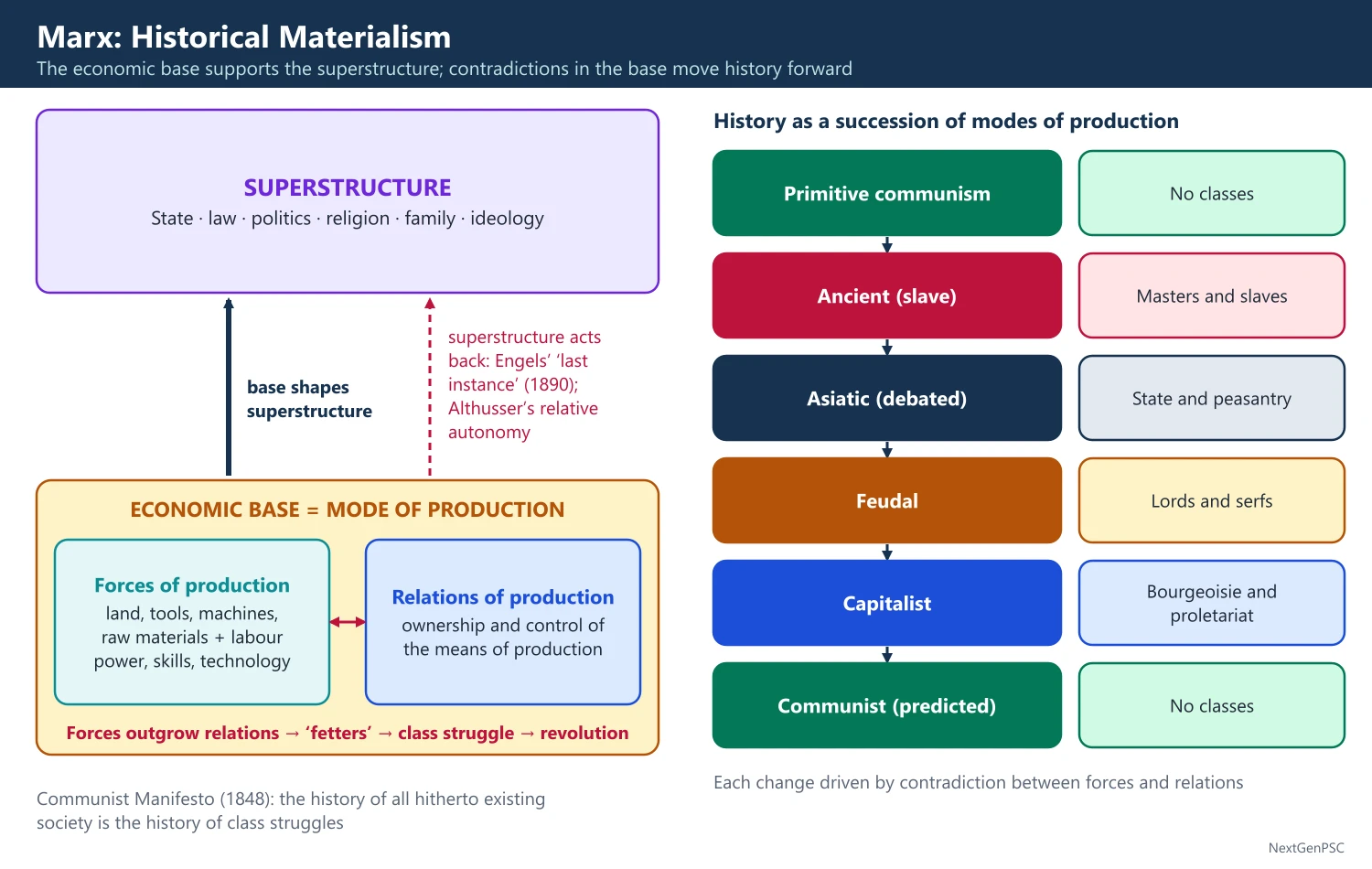
1. Concepts and Definitions
Historical materialism: Marx called it the ‘materialist conception of history’; the term ‘historical materialism’ was popularised by Friedrich Engels (for example in his 1892 introduction to Socialism: Utopian and Scientific).
Materialism: the view that material conditions of life, not ideas, are primary in explaining society; Marx took this from Ludwig Feuerbach but made it historical and social.
Dialectics: from G.W.F. Hegel, the idea that change happens through contradiction (thesis, antithesis, synthesis); Marx said he turned Hegel’s idealist dialectic ‘right side up’ by grounding it in material life.
Forces of production: means of production (land, tools, machines, raw materials) plus human labour power, skills and technology.
Relations of production: the social relations people enter into in production, especially ownership and control of the means of production (master–slave, lord–serf, capitalist–worker).
Mode of production: the combination of forces and relations of production that defines a type of society.
Base and superstructure: the economic base (mode of production) conditions the superstructure (state, law, religion, family, education, ideology).
2. The Theory Explained
Starting point (The German Ideology, written 1845–46 with Engels): the first historical act is the production of the means to satisfy needs; humans are defined by what and how they produce.
The 1859 Preface (A Contribution to the Critique of Political Economy): Marx wrote that it is not the consciousness of men that determines their being, but their social being that determines their consciousness.
Contradiction and change: at a certain stage the developing forces of production come into conflict with existing relations of production, which become ‘fetters’; then begins an epoch of social revolution.
Class struggle as motor: the contradiction is expressed as conflict between classes; the Communist Manifesto (1848) opens with the line that the history of all hitherto existing society is the history of class struggles.
Stages of history: primitive communism → ancient (slave) society → feudalism → capitalism → socialism and finally communism (a classless society); the 1859 Preface lists the Asiatic, ancient, feudal and modern bourgeois modes.
Asiatic mode of production: Marx suggested that in Asia, including India, self-sufficient village communities combining agriculture and crafts, with no private property in land and a despotic state controlling irrigation, made society stagnant.
Capitalism: based on private ownership of the means of production, wage labour and production for profit; its law of motion is the extraction of surplus value (Capital, Volume 1, 1867).
Role of ideology: the ruling ideas of each age are the ideas of its ruling class (The German Ideology), so law and religion tend to justify existing relations.
Engels’ clarification (letter to Joseph Bloch, 1890): the economic factor is determining only ‘in the last instance’; superstructural elements also influence history, so the theory is not crude economic determinism.
3. Criticism
Economic determinism: critics say the theory reduces culture, politics and religion to economics; Max Weber’s The Protestant Ethic (1904–05) showed ideas could help produce capitalism.
Falsifiability: Karl Popper (The Open Society and Its Enemies, 1945; The Poverty of Historicism, 1957) argued that Marx’s laws of history are unfalsifiable prophecies.
Failed predictions: revolutions occurred in peasant Russia and China, not in industrial Britain or Germany; capitalism adapted through the welfare state; the Soviet bloc collapsed by 1991.
Western Marxist revisions: Antonio Gramsci (Prison Notebooks, written 1929–35) stressed hegemony, rule by consent through culture; Louis Althusser (1965–70) argued for the ‘relative autonomy’ of the superstructure and ‘overdetermination’, and described ideological state apparatuses.
Analytical defence: G.A. Cohen (Karl Marx’s Theory of History: A Defence, 1978) restated it as a functional explanation in which forces of production have primacy.
Eurocentrism of the Asiatic mode: Indian historians such as Irfan Habib and R.S. Sharma showed that pre-colonial India had private rights in land, trade, towns and change, rejecting the idea of an unchanging village.
Neglect of other inequalities: feminists (for example Heidi Hartmann, 1979) and Indian scholars of caste argue that gender and caste cannot be reduced to class.
4. Indian Examples and Studies
Marx on India: in articles for the New York Daily Tribune (1853), such as ‘The British Rule in India’, Marx described British rule as destroying the old village system while unconsciously causing a social revolution, a view criticised as colonial in tone.
Indian Marxist historians: D.D. Kosambi (An Introduction to the Study of Indian History, 1956) and R.S. Sharma (Indian Feudalism, 1965) applied the materialist method to Indian history.
A.R. Desai (Social Background of Indian Nationalism, 1948): explained Indian nationalism as a product of new classes created by colonial capitalism.
Mode of production debate: from about 1969 to the late 1970s, mainly in Economic and Political Weekly, scholars such as Ashok Rudra, Utsa Patnaik, Paresh Chattopadhyay, Jairus Banaji, Hamza Alavi and Amit Bhaduri debated whether Indian agriculture was feudal, semi-feudal or capitalist.
Amit Bhaduri’s semi-feudalism (1973): the landlord who is also a moneylender may resist productive investment because indebted sharecroppers yield more through interest.
Capitalist farming: the Green Revolution in Punjab, Haryana and western Uttar Pradesh from the late 1960s created wage labour and commercial farming, which supporters of the capitalist thesis cited.
Pre-capitalist relations: the jajmani system described by William Wiser (The Hindu Jajmani System, 1936) and bonded labour, abolished by the Bonded Labour System (Abolition) Act 1976, show relations based on status and debt rather than free contract.
Contemporary: platform capitalism (app-based delivery and ride-hailing) shows new relations of production in which ownership of digital platforms controls dispersed workers; NITI Aayog (2022) estimated 77 lakh gig workers in 2020–21.
5. Linking Thinkers
Marx and Weber: Weber accepted the importance of economic interests but added ideas, status and party; his Protestant Ethic is often read as a ‘dialogue with the ghost of Marx’ (a phrase associated with Albert Salomon).
Marx and Durkheim: both studied the division of labour; Durkheim saw organic solidarity, Marx saw exploitation and alienation.
Marx and Indian perspectives: A.R. Desai, Kathleen Gough and D.N. Dhanagare used Marxist analysis for agrarian and peasant studies in India.
Marx and development theory: Andre Gunder Frank’s dependency theory and Immanuel Wallerstein’s world-systems theory extend Marx’s analysis to the global economy.
6. Using it in the Exam
10 marks: define historical materialism, give forces, relations and base-superstructure in a line each, and one criticism.
15 marks: add the stages of history, the 1859 Preface idea and the Indian mode of production debate.
20 marks: definition → dialectics and materialism → forces and relations → base and superstructure → contradiction and revolution → stages → critics (Weber, Popper, Gramsci, Althusser) → Indian application (Kosambi, Desai, mode of production debate) → conclusion on lasting value as a method.
Diagram idea: a two-level box: base (forces + relations of production) at the bottom, arrows up to superstructure (state, law, religion, family, ideology), with a small reverse arrow to show Engels’ ‘last instance’ and Althusser’s relative autonomy.
Thinkers examiners look for: Marx, Engels, Gramsci, Althusser, Weber, Popper, A.R. Desai, Utsa Patnaik, Amit Bhaduri.
Useful quotation: ‘It is not the consciousness of men that determines their being, but, on the contrary, their social being that determines their consciousness’ (Marx, Preface, 1859).
| Mode | Main forces of production | Relations of production | Main classes |
|---|---|---|---|
| Primitive communism | Hunting, gathering, simple tools | Common ownership | No classes |
| Ancient (slave) | Agriculture, crafts, slave labour | Masters own slaves | Masters and slaves |
| Asiatic (debated) | Village agriculture and crafts, state irrigation | State as landlord, village communities | State and peasantry |
| Feudal | Agriculture, handicrafts | Lords control land, serfs owe labour or rent | Lords and serfs |
| Capitalist | Machines, factories, wage labour | Private ownership of capital | Bourgeoisie and proletariat |
| Communist (predicted) | Advanced industry | Social ownership | No classes |
Mains points
- Typical angles: ‘Explain historical materialism’, ‘Is Marx an economic determinist?’, ‘relevance of mode of production for understanding Indian agriculture’.
- Define forces, relations, mode, base and superstructure precisely; examiners check vocabulary.
- Address the determinism charge with Engels’ ‘last instance’, Gramsci and Althusser.
- Bring the Indian mode of production debate (Patnaik, Rudra, Bhaduri, Banaji, Alavi) and Kosambi or Desai.
- Criticise the Asiatic mode of production with Indian historians’ evidence.
- Conclude that historical materialism remains a powerful method for studying change even where its predictions failed.
Did you know?
- Marx wrote about India for an American newspaper, the New York Daily Tribune, as its London correspondent in the 1850s; some of those pieces were actually drafted by Engels.
- Memory trick: Mode = Forces + Relations (M = F + R); Base holds up the Superstructure.
Karl Marx: Alienation and Class Struggle
Alienation is Marx’s term (Economic and Philosophic Manuscripts of 1844) for the estrangement of workers under capitalism from the product, the process of work, their species-being and other people. Class is defined by relation to the means of production, and class struggle between owners and non-owners drives history; a class in itself becomes a class for itself when it gains consciousness and organises. Weber, Dahrendorf, Wright and Indian scholars of caste have revised or criticised this theory.
In simple words
Alienation means feeling cut off from your own work: you make things you do not own, in a way you do not control, for someone else’s profit.
Picture a delivery rider ruled by an app: he cannot choose his route, rates or rating, and he never meets the people who profit from his labour.
Marx said such workers share a class position and, once they realise it, unite in class struggle.
UPSC asks about the four types of alienation, class consciousness and whether Marx’s ideas fit India.
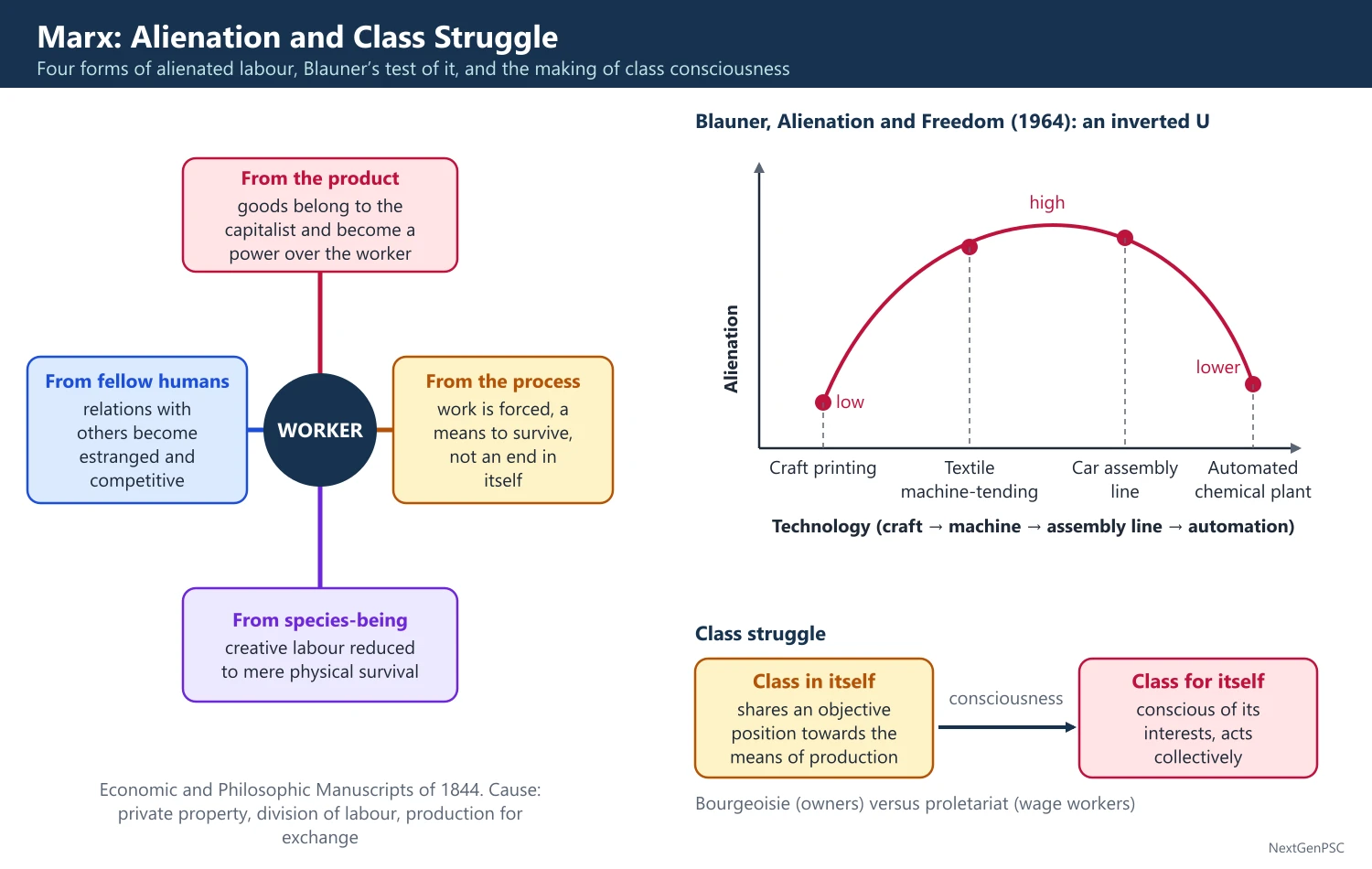
1. Concepts and Definitions
Alienation: a condition in which the products and activities of human beings become alien, hostile powers over them; Marx developed it in the Economic and Philosophic Manuscripts of 1844 (published only in 1932).
Species-being (Gattungswesen): Marx’s idea, adapted from Feuerbach, that humans realise their nature through free, conscious, creative labour.
Commodity fetishism: in Capital (1867) Marx argued that under capitalism social relations between people appear as relations between things (commodities and money).
Surplus value: the value workers create beyond the value of their wages, taken by the capitalist as profit; the basis of exploitation.
Class: a group defined by its common relation to the means of production; under capitalism the bourgeoisie (owners) and proletariat (wage workers).
Class in itself and class for itself: a class in itself shares an objective position; a class for itself is conscious of its interests and acts collectively; the idea is drawn from The Poverty of Philosophy (1847).
False consciousness: a term used by Engels (letter to Franz Mehring, 1893) for beliefs that hide the real conditions of the exploited.
2. Four Dimensions of Alienation
From the product: the worker makes goods owned by the capitalist; the more he produces, the more he strengthens a power over him.
From the process (activity) of labour: work is forced, not free; it is a means to survive rather than an end in itself, so the worker feels at home only outside work.
From species-being: creative labour, which should express human nature, becomes mere physical survival.
From other human beings: relations become competitive and market-based; workers are set against capitalists and against one another.
Cause: not technology as such but private property, the division of labour and production for exchange; ending capitalism would end alienation.
3. Class and Class Struggle
Two great classes: the Communist Manifesto (1848) predicted that society would split into two hostile camps, bourgeoisie and proletariat.
Other classes: Marx also wrote of the petty bourgeoisie, peasantry, landlords and the lumpenproletariat; in The Eighteenth Brumaire of Louis Bonaparte (1852) he compared French smallholding peasants to ‘a sack of potatoes’, unable to act as a class.
Polarisation and pauperisation: Marx expected middle groups to sink into the proletariat and the condition of workers to worsen relative to capital.
Path to revolution: concentration of workers in factories and towns, crises of overproduction and growing consciousness would turn the proletariat into a class for itself.
Role of the state: ‘the executive of the modern state is but a committee for managing the common affairs of the whole bourgeoisie’ (Communist Manifesto, 1848).
4. Later Studies and Criticism
Robert Blauner (Alienation and Freedom, 1964): found that alienation varies with technology, low in craft printing, high in textile machine-tending and car assembly lines, and lower again in automated chemical plants (an inverted U).
Melvin Seeman (1959): broke alienation into powerlessness, meaninglessness, normlessness, isolation and self-estrangement, making it measurable but more psychological.
Harry Braverman (Labor and Monopoly Capital, 1974): argued that scientific management (Taylorism) deskilled work and deepened alienation.
Arlie Hochschild (The Managed Heart, 1983): showed ‘emotional labour’ in service jobs, a new form of alienation of feelings.
Weber’s critique: class is one dimension among class, status and party; market situation, skills and education create many classes.
Ralf Dahrendorf (Class and Class Conflict in Industrial Society, 1959): argued that conflict is based on authority, not property, and that the separation of ownership and control created managers.
Growth of the middle class: Eduard Bernstein (1899), David Lockwood (The Blackcoated Worker, 1958) and the Affluent Worker studies of Goldthorpe and others (1968–69) showed a growing white-collar and affluent working class without revolutionary consciousness.
Erik Olin Wright (Classes, 1985): developed ‘contradictory class locations’ for managers and professionals.
Collapse of communist states (1989–91) and the welfare state: are cited as evidence against the predicted path, though Marxists reply that inequality and crises persist.
5. Indian Examples and Studies
Caste and class: B.R. Ambedkar (Annihilation of Caste, 1936) argued that caste is not merely a division of labour but a division of labourers, which blocks class unity; Gail Omvedt and others linked caste and class struggle.
Agrarian class struggles: the Telangana armed struggle (1946–51), the Tebhaga movement in Bengal (1946–47) and the Naxalbari uprising (1967) were led on class lines; D.N. Dhanagare (Peasant Movements in India 1920–1950, 1983) analysed them.
Industrial labour: the Bombay textile strike of 1982–83 led by Datta Samant and conflict at Maruti Suzuki’s Manesar plant (2012) show class conflict in modern industry.
Alienation today: gig and platform workers controlled by algorithms illustrate alienation from process; NITI Aayog (2022) projected the gig workforce to reach 2.35 crore by 2029–30.
Law and labour: the four labour codes (Code on Wages 2019, Industrial Relations Code 2020, Code on Social Security 2020, Occupational Safety, Health and Working Conditions Code 2020) came into force on 21 November 2025, recognising gig and platform workers for social security; unions debate whether they strengthen or weaken workers.
Informal sector: the Economic Survey 2018–19 estimated that about 93 percent of India’s workforce was informal, which makes classic class organisation difficult, a point stressed by Jan Breman’s studies of footloose labour.
6. Linking Thinkers
Marx and Durkheim: Durkheim’s anomie and Marx’s alienation both diagnose modern discontent; Durkheim blamed weak regulation, Marx blamed capitalist relations.
Marx and Weber: Weber’s rationalisation and ‘iron cage’ parallel alienation but locate it in bureaucracy, which would remain under socialism.
Marx and Merton: Merton’s ‘innovation’ and ‘rebellion’ can be read as responses to blocked opportunities that Marx would explain by class.
7. Using it in the Exam
10 marks: define alienation, list the four types, one modern example.
15 marks: class in itself and for itself, polarisation, with Indian peasant or labour movements.
20 marks: alienation (four types, cause) → class and class struggle → studies (Blauner, Braverman, Seeman) → critics (Weber, Dahrendorf, Wright, Lockwood) → Indian context (caste versus class, Ambedkar, Naxalbari, gig workers, labour codes) → conclusion on continuing relevance.
Diagram idea: a four-spoke wheel with the worker at the centre and spokes labelled product, process, species-being and fellow humans; Blauner’s inverted U as a second sketch.
Useful quotation: ‘The history of all hitherto existing society is the history of class struggles’ (Marx and Engels, Communist Manifesto, 1848).
| Thinker | Work | Basis of class or conflict | Main point against Marx |
|---|---|---|---|
| Marx | Communist Manifesto (1848), Capital (1867) | Ownership of means of production | — |
| Weber | Economy and Society (1922) | Market situation; class, status, party | Many classes; status and party matter |
| Dahrendorf | Class and Class Conflict in Industrial Society (1959) | Authority relations | Conflict without property ownership |
| Wright | Classes (1985) | Ownership, control, skill | Contradictory class locations |
| Ambedkar | Annihilation of Caste (1936) | Caste as graded inequality | Caste divides labourers |
Mains points
- Typical angles: ‘Marx’s concept of alienation and its relevance today’, ‘class in itself and class for itself’, ‘relevance of class struggle in contemporary India’.
- List all four dimensions of alienation precisely, and name the 1844 Manuscripts.
- Use empirical studies (Blauner, Braverman, Seeman, Hochschild) to show how alienation has been tested.
- Bring Indian examples: gig workers, informal labour, labour codes in force from 21 November 2025, peasant movements, Ambedkar on caste and class.
- Give critiques from Weber, Dahrendorf, Lockwood, Goldthorpe and Wright.
- Common mistake: equating alienation with simple job dissatisfaction; Marx’s concept is structural, rooted in capitalist relations.
Did you know?
- The 1844 Manuscripts lay unpublished for almost ninety years until 1932, which is why early Marxists knew little about Marx’s theory of alienation.
- Memory trick for alienation: ‘P-P-S-O’ — Product, Process, Species-being, Others.
Emile Durkheim: Social Fact and Division of Labour
Durkheim defined social facts as ways of acting, thinking and feeling that are external to individuals, exercise constraint and are general in a society, and asked sociologists to treat them as things (The Rules of Sociological Method, 1895). In The Division of Labour in Society (1893) he argued that societies move from mechanical solidarity based on likeness and repressive law to organic solidarity based on interdependence and restitutive law, with anomic and forced division of labour as abnormal forms.
In simple words
A social fact is a rule or pattern that exists outside you and pushes you, like language, dress codes or the custom of touching elders’ feet.
You did not invent Hindi or English, yet you must use it to be understood; that is external constraint.
Durkheim also said small villages hold together because people are alike, while big cities hold together because people need one another’s different skills.
UPSC asks about social facts, the two types of solidarity, anomie and their Indian relevance.
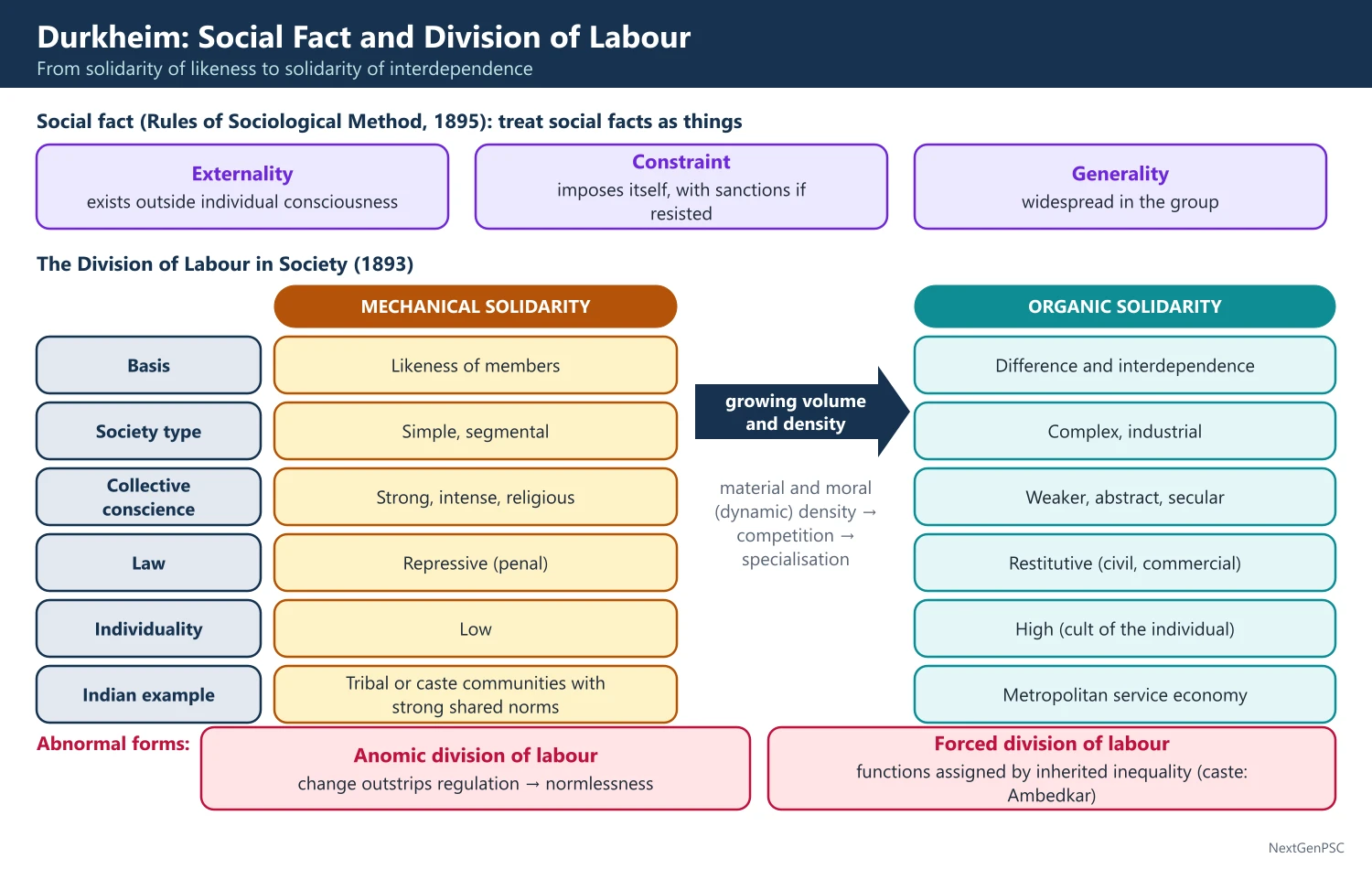
1. Concepts and Definitions
Social fact: in The Rules of Sociological Method (1895) Durkheim described a social fact as any way of acting, fixed or not, capable of exerting external constraint on the individual, and general throughout a society while existing in its own right independent of individual manifestations (paraphrase).
Three features: externality (exists outside individual consciousness), constraint (imposes itself, with sanctions if resisted) and generality (widespread in the group).
Material and non-material social facts: material ones include population density, architecture and legal codes; non-material ones include morality, collective conscience and collective representations (a distinction stressed by George Ritzer).
Collective conscience (conscience collective): the totality of beliefs and sentiments common to average members of a society, forming a determinate system with a life of its own.
Collective representations: shared symbols and ideas, such as a flag or a sacred river, that express collective life.
Division of labour: the specialisation of tasks and functions in society, which for Durkheim is above all a moral phenomenon producing solidarity.
2. Rules of Sociological Method
Treat social facts as things: study them from outside, through observable indicators, setting aside prenotions.
Define by external characteristics: for example define crime as any act that provokes punishment.
Normal and pathological: a fact is normal if it is general for a society at a given stage; crime is normal because it exists in all societies, marks moral boundaries and can foreshadow change (Socrates was a ‘criminal’ in Athens).
Explanation: the cause of a social fact must be sought among preceding social facts, not individual states of consciousness; causal explanation (why it arose) must be separated from functional explanation (what need it serves).
Comparative method: the method of concomitant variation is the main tool of sociological proof.
Sui generis reality: society is more than the sum of individuals, as water has properties not found in hydrogen and oxygen separately.
3. The Division of Labour in Society (1893)
Research question: how can society hold together when individuals become more autonomous and different?
Mechanical solidarity: found in simple, segmental societies; based on likeness of members; a strong, intense collective conscience; little individuality; property often communal.
Organic solidarity: found in advanced societies; based on difference and interdependence, like organs of a body; a weaker, more abstract collective conscience; cult of the individual.
Law as indicator: since solidarity cannot be seen directly, Durkheim used law as its visible index; repressive (penal) law punishes offences against the collective conscience; restitutive (civil, commercial, administrative) law restores relations to normal.
Cause of the division of labour: growth in the volume and in the material and moral (dynamic) density of society increases competition, and specialisation allows people to coexist; he rejected the economists’ claim that it arose to increase happiness.
Against Spencer: Spencer saw industrial society held together by individual contracts; Durkheim replied that every contract rests on non-contractual elements (shared rules and morality) enforced by society.
Occupational groups: in the preface to the second edition (1902) Durkheim proposed professional or occupational associations as new moral bodies to regulate economic life.
4. Abnormal Forms of the Division of Labour
Anomic division of labour: when rapid industrial change outstrips regulation, as in commercial crises and conflict between labour and capital, producing normlessness.
Forced division of labour: when people are assigned to functions by inherited inequality rather than ability; ‘spontaneous’ division of labour requires equal external conditions.
Poorly coordinated division of labour: a third form, where functions are badly organised and activity is insufficient, so workers lack a sense of contributing to a whole.
Anomie: literally ‘without norms’; for Durkheim a state of deregulation where social rules fail to limit desires and coordinate functions.
5. Criticism
Legal evidence: anthropologists such as Bronisław Malinowski (Crime and Custom in Savage Society, 1926) found much restitutive, reciprocal law in simple societies; Richard Schwartz and James Miller (1964) found the sequence of legal development did not match Durkheim’s.
Reification: interactionists and Weberians argue that Durkheim treats society as a thing with its own will, ignoring how individuals create meanings.
Functionalism and conservatism: Lewis Coser and Robert Nisbet saw a conservative concern with order; Marxists argue that what he calls ‘abnormal’ (forced, anomic) is the normal state of capitalism.
Evolutionism: the neat shift from mechanical to organic solidarity is too linear; modern societies keep strong collective sentiments (nationalism, religion).
Neglect of power: Dahrendorf and conflict theorists argue that the division of labour also creates domination, not only solidarity.
Positivism debate: the claim that social facts can be studied like things is contested by Weber, Schutz and Garfinkel (see Chapter 3).
6. Indian Examples and Studies
Social facts in India: caste endogamy, dowry, rules of commensality, and norms such as purdah are external, constraining and general in many communities, showing Durkheim’s concept clearly.
Caste as forced division of labour: occupational assignment by birth fits Durkheim’s forced division of labour; B.R. Ambedkar (Annihilation of Caste, 1936) argued that caste is a division of labourers based on birth, not choice.
Jajmani interdependence: the village system of service relations (Wiser, 1936) shows interdependence, but within hierarchy, which some sociologists contrast with Durkheim’s organic solidarity of equals.
Urbanisation and anomie: rapid migration to cities such as Delhi, Mumbai and Bengaluru loosens village norms; studies of migrant workers and of rising divorce and loneliness in cities are often read through anomie.
Collective conscience and law: public outrage after the Delhi gang rape of December 2012 led to the Criminal Law (Amendment) Act 2013, an example of repressive law expressing collective sentiment.
Restitutive turn: the Bharatiya Nyaya Sanhita 2023, in force from 1 July 2024 in place of the IPC, introduced community service as a punishment for some minor offences, a shift Durkheim would read as restitutive.
Persistence of mechanical solidarity: khap panchayats, caste associations and religious congregations show that strong collective conscience coexists with organic solidarity in India.
7. Linking Thinkers
Durkheim and Tönnies: Tönnies saw Gesellschaft as a loss of community; Durkheim reversed the value judgement, seeing organic solidarity as a normal, even higher, form.
Durkheim and Marx: both analysed the division of labour; Durkheim saw solidarity and anomie, Marx saw class exploitation and alienation; Durkheim’s forced division of labour is the closest he comes to Marx.
Durkheim and Merton: Merton extended anomie to the gap between cultural goals and institutional means (1938).
Durkheim and Parsons: Parsons built his theory of the social system and normative order on Durkheim.
8. Using it in the Exam
10 marks: define social fact with its three features and two Indian examples.
15 marks: mechanical versus organic solidarity in a table, with law as indicator and an Indian example.
20 marks: context (order in modern society) → social facts and rules of method → mechanical and organic solidarity → causes → abnormal forms → critics → Indian relevance (caste as forced division of labour, urban anomie, BNS) → conclusion.
Diagram idea: a two-column table, mechanical solidarity (likeness, repressive law, strong collective conscience, segmental) versus organic solidarity (difference, restitutive law, weak collective conscience, interdependence), with an arrow labelled ‘volume and density’ between them.
Useful rule: ‘the determining cause of a social fact must be sought among the social facts preceding it and not among the states of the individual consciousness’ (Durkheim, The Rules of Sociological Method, 1895).
| Point | Mechanical solidarity | Organic solidarity |
|---|---|---|
| Basis | Likeness of members | Difference and interdependence |
| Society type | Simple, segmental | Complex, industrial |
| Collective conscience | Strong, intense, religious | Weaker, abstract, secular |
| Law | Repressive (penal) | Restitutive (civil, commercial) |
| Individuality | Low | High (cult of the individual) |
| Indian example | Tribal or caste communities with strong shared norms | Metropolitan service economy |
Mains points
- Typical angles: ‘Explain the concept of social fact’, ‘mechanical and organic solidarity’, ‘abnormal forms of division of labour and their relevance in India’.
- Always give the three features of social facts and the rule ‘treat social facts as things’.
- Explain law as the index of solidarity; it is the most tested detail.
- Use caste as forced division of labour (with Ambedkar) and urban anomie as Indian applications.
- Give critics: Malinowski and Schwartz and Miller on law, interactionists on reification, Marxists on abnormal forms.
- Common mistake: saying organic solidarity has no collective conscience; it is weaker and more abstract, not absent.
Did you know?
- Durkheim argued that a society of saints would still have ‘crime’, because even small faults would be treated as serious offences: crime is normal.
- Memory trick: Mechanical = Me-too (likeness); Organic = Organs (interdependence).
Emile Durkheim: Suicide, and Religion and Society
In Suicide (1897) Durkheim showed that suicide rates are social facts explained by levels of social integration and moral regulation, giving four types: egoistic, altruistic, anomic and fatalistic. In The Elementary Forms of Religious Life (1912) he defined religion through the sacred and profane, studied Australian totemism, and argued that in worshipping the sacred people worship society itself, which religion integrates through rituals and collective effervescence.
In simple words
Suicide feels like the most private act, yet Durkheim showed that rates differ steadily between groups, so society shapes it.
Think of a rope: too loose (too little belonging or too few rules) or too tight (too much belonging or too many rules), and people break.
He also said religion is society celebrating itself, as at a Kumbh Mela where millions feel part of something larger.
UPSC asks about the four types of suicide, the sacred and profane, the functions of religion, and their Indian relevance.
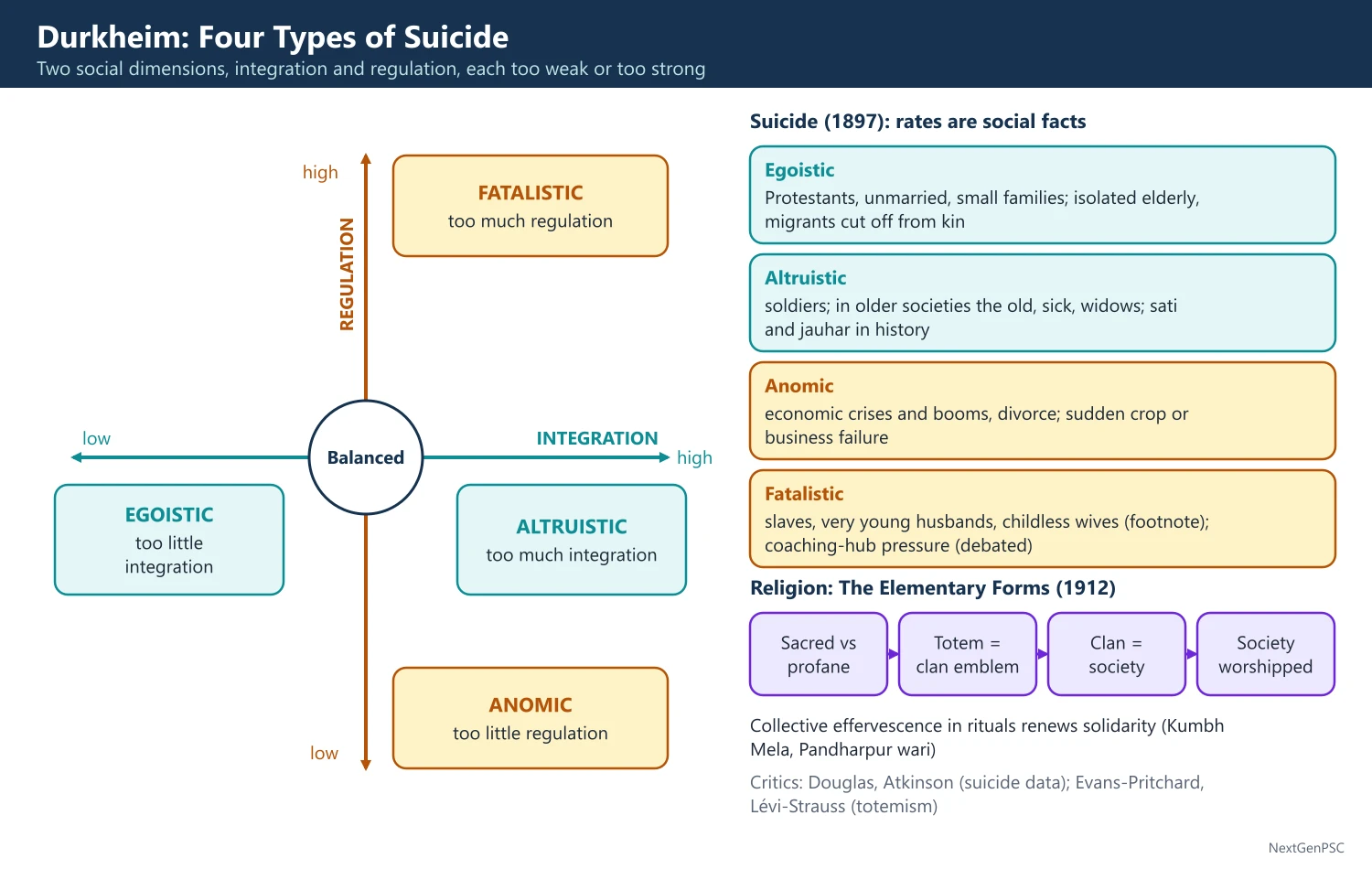
1. Suicide: Concepts and Method
Definition: Durkheim defined suicide as all cases of death resulting directly or indirectly from a positive or negative act of the victim himself, which he knows will produce this result (Suicide, 1897).
Suicide rate as a social fact: individual suicides have personal causes, but the rate of a society is stable over time and differs between groups, so it needs a social explanation.
Rejecting other explanations: he argued that insanity, heredity, race, climate and imitation could not explain the variation in rates.
Two dimensions: social integration (how strongly individuals are attached to groups) and moral regulation (how far society limits and guides desires).
Data: he used official statistics from several European countries, comparing religion, marital status, family size, political crisis and economic change.
2. Four Types of Suicide
Egoistic suicide: too little integration; the individual is detached from groups; higher among Protestants than Catholics and Jews, among the unmarried than the married, and in small families; rates fall during wars and political crises that unite people.
Altruistic suicide: too much integration; the individual’s self counts for little; examples include soldiers (higher rates in the army), and in older societies the old and sick, or widows who followed husbands.
Anomic suicide: too little regulation; desires are not limited; rates rise in sudden economic crises and also in sudden booms; ‘conjugal anomie’ with divorce raises male suicide.
Fatalistic suicide: too much regulation; futures pitilessly blocked; Durkheim mentioned it only in a footnote, giving slaves, very young husbands and childless married women as examples.
Logic: the four types form a 2 × 2 scheme: integration too low (egoistic) or too high (altruistic); regulation too low (anomic) or too high (fatalistic).
3. Criticism of Suicide
Data quality: Jack Douglas (1967) and J. Maxwell Atkinson (1978) argued that official suicide statistics depend on coroners’ judgements, families’ wish to hide suicide, and religious stigma, so Catholic rates may be under-recorded.
Maurice Halbwachs (Les causes du suicide, 1930): argued that rural-urban differences in ways of life explained more than religion.
Ecological fallacy: W.S. Robinson (1950) showed that correlations between group-level rates need not hold for individuals; critics apply this to Durkheim’s use of regional data.
Overlap of types: egoism and anomie, and altruism and fatalism, are hard to separate empirically.
Defence and revival: Jack Gibbs and Walter Martin (Status Integration and Suicide, 1964) tried to operationalise integration; Steve Taylor (1982) gave a realist re-reading; Durkheim’s study remains the model of sociological explanation.
4. Religion and Society: The Elementary Forms (1912)
Definition: a religion is a unified system of beliefs and practices relative to sacred things, that is, things set apart and forbidden, which unite into one single moral community called a Church all those who adhere to them.
Sacred and profane: the sacred is set apart, protected by prohibitions and treated with awe; the profane is ordinary, everyday life; the distinction is absolute and universal for Durkheim.
Why the simplest religion: he studied totemism among Australian Aboriginal groups such as the Arunta (Arrernte), relying on the ethnography of Baldwin Spencer and Francis Gillen, believing the simplest case reveals the essence.
Totem: an animal or plant emblem of a clan; it is sacred because it symbolises the clan; therefore the god of the clan is the clan itself, transfigured.
Collective effervescence: during periodic gatherings (such as corroborees), intense shared emotion makes individuals feel a force greater than themselves, which they interpret as sacred power.
Rites: negative rites (taboos, ascetic practices that separate sacred and profane), positive rites (sacrifice, imitative and commemorative rites that renew bonds), and piacular rites (mourning and expiation).
Functions of religion: social cohesion, discipline, revitalisation of shared values, and euphoric support in times of loss; religion also gives the basic categories of thought, such as time, space and causality (sociology of knowledge, developed with Marcel Mauss in Primitive Classification, 1903).
Future of religion: Durkheim believed that the forms of religion would change but its essence would endure; modern societies would create new sacred symbols, such as the nation or the individual.
5. Criticism of Durkheim on Religion
Ethnographic doubt: E.E. Evans-Pritchard (Theories of Primitive Religion, 1965) and others argued that totemism among the Arunta was not typical and that Durkheim generalised from one case.
Sacred-profane dichotomy: W.E.H. Stanner and others showed that many societies do not draw so sharp a line.
Claude Lévi-Strauss (Totemism, 1962): treated totemism as a classificatory system of thought, not an early religion.
Neglect of conflict: religion can divide groups as well as unite them, as in sectarian and communal conflicts; Marx saw it as ideology and ‘the opium of the people’ (1844).
Reductionism: believers and phenomenologists of religion reject the idea that religion is nothing but society worshipping itself.
6. Indian Examples and Studies
Suicide data: NCRB’s Accidental Deaths and Suicides in India 2023 recorded 1,71,418 suicides (rate 12.3 per lakh), with daily wage earners the largest occupational group (47,170, about 27.5 percent).
Farmer suicides: debt, crop failure and indebtedness in states such as Maharashtra, Karnataka and Telangana are often analysed as anomic (sudden loss) or fatalistic (blocked futures); this classification is debated.
Student suicides: cases in coaching hubs such as Kota can be read through fatalistic pressure and weak integration away from family.
Altruistic forms: sati and jauhar in history, and the Roop Kanwar sati at Deorala (1987) that led to the Commission of Sati (Prevention) Act 1987.
Law and policy: the Mental Healthcare Act 2017 presumed severe stress in attempted suicide; the Bharatiya Nyaya Sanhita 2023 has no general offence of attempted suicide; India’s first National Suicide Prevention Strategy (2022) aims to cut suicide mortality by 10 percent by 2030.
Collective effervescence: the Maha Kumbh at Prayagraj (January–February 2025), the Pandharpur wari and Durga Puja show mass rituals renewing collective sentiment.
Srinivas on Coorgs: M.N. Srinivas (Religion and Society among the Coorgs of South India, 1952) used a structural-functional approach to ritual and first used the term Sanskritisation.
Civil religion in India: Robert Bellah’s ‘civil religion’ (1967), a Durkheimian idea, can be applied to Republic Day parades and national symbols; Lokmanya Tilak’s public Ganeshotsav (from 1893) fused ritual with nationalism.
Purity and the sacred: Louis Dumont’s purity and pollution parallels Durkheim’s sacred and profane; T.N. Madan (‘Secularism in Its Place’, 1987) argued that religion remains central to Indian life, questioning secularisation.
7. Linking Thinkers
Durkheim and Marx on religion: Durkheim saw integration, Marx saw ideology masking exploitation.
Durkheim and Weber on religion: Durkheim stressed function and ritual; Weber stressed meaning and its effect on economic action (Protestant ethic).
Durkheim and Merton: Merton’s anomie theory (1938) grew out of Durkheim’s anomic suicide.
Durkheim and Radcliffe-Brown: Radcliffe-Brown developed Durkheim’s functional view of ritual, which influenced Srinivas.
8. Using it in the Exam
10 marks (suicide): definition, integration and regulation, the four types in a 2 × 2 table, one Indian data point.
10 marks (religion): definition with sacred and profane, totem as society, one function, one Indian example.
20 marks: suicide as a social fact → four types → critiques (Douglas, Atkinson, Halbwachs) → Indian data (NCRB 2023) → or religion: definition → totemism → collective effervescence → rites and functions → critiques (Evans-Pritchard, Lévi-Strauss, Marx) → Indian examples → conclusion.
Diagram idea: a 2 × 2 grid with integration (low/high) on one axis and regulation (low/high) on the other: egoistic and altruistic on the integration axis, anomic and fatalistic on the regulation axis.
Useful quotation: Durkheim’s definition of religion as a unified system of beliefs and practices relative to sacred things that unite adherents into one moral community called a Church (The Elementary Forms, 1912).
| Type | Cause | Durkheim’s examples | Possible Indian illustration |
|---|---|---|---|
| Egoistic | Too little integration | Protestants, unmarried, small families | Isolated elderly in cities; migrants cut off from kin |
| Altruistic | Too much integration | Soldiers; in older societies the old, sick, widows | Sati and jauhar in history |
| Anomic | Too little regulation | Economic crises and booms; divorce | Sudden crop or business failure |
| Fatalistic | Too much regulation | Slaves, very young husbands, childless wives (footnote) | Pressure in coaching hubs; bonded labour (debated) |
| Point | Durkheim | Marx | Weber |
|---|---|---|---|
| Key work | The Elementary Forms (1912) | Critique of Hegel’s Philosophy of Right, introduction (1844) | The Protestant Ethic (1904–05) |
| Essence | Society worshipping itself | Ideology; ‘opium of the people’ | System of meaning shaping action |
| Main function | Integration and solidarity | Legitimises exploitation, consoles the oppressed | Can drive social change |
| Method | Functional, one simple case | Historical materialist | Comparative, interpretive |
Mains points
- Typical angles: ‘Durkheim’s Suicide as a model of sociological method’, ‘relevance of Durkheim’s typology of suicide for India’, ‘sacred and profane’, ‘religion as society worshipping itself’.
- Present the four types of suicide in a 2 × 2 table and include fatalistic suicide, often forgotten.
- Use NCRB 2023 data and Indian cases (farmers, students, sati) with care; mark classifications as debated.
- Give methodological critiques (Douglas, Atkinson, Halbwachs) for suicide, and ethnographic and Marxist critiques for religion.
- Compare Durkheim with Marx and Weber on religion in a table.
- Bring Indian religious examples: Kumbh, Pandharpur, Ganeshotsav, Srinivas’s Coorg study, Madan on secularism.
Did you know?
- Durkheim’s nephew Marcel Mauss helped him compile the suicide statistics, and together they later wrote Primitive Classification (1903).
- Memory trick for suicide: ‘E-A-A-F’ — Egoistic and Altruistic (integration), Anomic and Fatalistic (regulation).
UPSC Previous Year Questions: Sociological Thinkers: Marx and Durkheim
From 2014 to 2026 UPSC asked 28 question parts worth 410 marks on Marx and Durkheim in Paper I: 15 on Marx and 13 on Durkheim. The most-asked topics are Durkheim’s suicide and religion (9 parts) and Marx’s alienation and class struggle (8 parts), followed by historical materialism and mode of production (7). Every question below has a model answer written to the UPSC word limit.
In simple words
First read the question and write your own answer in the time limit: about 7 minutes for a 10-mark part and 11–12 minutes for a 20-mark part.
Then read the approach line and the model answer, and check whether you defined the concept with the right thinker and work, gave criticism and added an Indian example.
Note what you missed, revise that topic in the notes, and rewrite the answer once more after a few days.
1. Karl Marx: Historical Materialism and Mode of Production
Example 1 (UPSC 2026, 20 marks): Describe the impact of capitalist mode of production on society.
Paper and question: Paper I, Q2(a)
Approach: Describe the effects of capitalism on economy, class, work, culture and the global order using Marx’s Manifesto and Capital, add Indian examples, and close with criticism and a balanced view.
For Marx, the capitalist mode of production is a system in which the bourgeoisie owns the means of production and propertyless workers sell their labour power for wages; goods are produced for profit and exchange, not for use. In The Communist Manifesto (1848) and Capital (1867) he traced how it reshapes the whole of society.
Economy and class: capitalism develops productive forces as never before, but profit comes from surplus value, the value workers create beyond their wages. Society polarises into bourgeoisie and proletariat, artisans and peasants sink into wage labour, and crises of overproduction and a reserve army of the unemployed recur.
Work and relationships: the worker is alienated from product, process, species-being and fellow workers (Economic and Philosophic Manuscripts, 1844); ties become a cash nexus, and commodity fetishism makes relations between people look like relations between things.
Superstructure and world: law, state and ideas come to serve the ruling class, and capitalism expands into colonies; Andre Gunder Frank and Immanuel Wallerstein later described this as dependency and a world-system.
Flow chart: private ownership → wage labour → surplus value → polarisation and alienation → crises → class struggle
India: Marx (1853) wrote that British rule broke the self-sufficient village; the Green Revolution spread wage labour and commercial farming in Punjab; the Economic Survey 2018–19 estimated about 93 percent of workers as informal; Singur and Nandigram (2006–07) showed dispossession, and gig workers now face algorithmic control.
Assessment: Weber saw rationalisation, not only class, at the core of capitalism, and the welfare state and a growing middle class softened polarisation. Still, rising inequality and precarious work keep Marx’s account a powerful description of capitalism’s social impact.
Example 2 (UPSC 2026, 20 marks): Critically analyse the mode of production debate from different perspectives.
Paper and question: Paper I, Q6(b)
Approach: Explain the concept, then analyse the debate from several perspectives: the classical transition debate, the dependency versus production debate, the Indian agrarian debate, and feminist and other critiques, ending with an assessment.
A mode of production, in Marx’s sense, is the combination of the forces of production (labour, tools, technology) and the relations of production (ownership and control). The mode of production debate asks which mode characterises a given society and how one mode gives way to another.
Classical transition debate: Maurice Dobb (Studies in the Development of Capitalism, 1946) traced the decline of feudalism to internal class struggle between lords and peasants, while Paul Sweezy (1950) stressed the external force of trade and towns; Robert Brenner (1976) later gave primacy to agrarian class relations.
Circulation versus production: Andre Gunder Frank argued that Latin America was capitalist because it had long been tied to the world market; Ernesto Laclau (1971) replied that capitalism must be defined by free wage labour in production, not by trade, so feudal relations could coexist with world capitalism.
Indian agrarian debate: from about 1969 to the late 1970s, in the Economic and Political Weekly, Ashok Rudra, Utsa Patnaik, Paresh Chattopadhyay, Jairus Banaji, Hamza Alavi and Amit Bhaduri debated whether Indian agriculture was feudal, semi-feudal or capitalist; Bhaduri (1973) argued that landlord-moneylenders blocked investment, while others cited Green Revolution wage labour and capitalist farmers in Punjab.
Other perspectives: Althusserian Marxists spoke of an articulation of several modes in one social formation; feminists added unpaid domestic labour; Indian historians such as Irfan Habib rejected the Asiatic mode as Eurocentric; caste scholars warned against reducing caste to class.
Assessment: the debate never closed, but it showed that India combines capitalist growth with bonded labour, tenancy and informality, so most scholars now accept a mixed, articulated formation rather than one pure mode.
Example 3 (UPSC 2025, 20 marks): Highlight the main features of historical materialism as propounded by Marx. How far is this theory relevant in understanding contemporary societies? Explain.
Paper and question: Paper I, Q2(b)
Approach: First list the main features of historical materialism from Marx’s 1859 Preface and the Manifesto; then judge its relevance today with Indian and world examples, noting its limits.
Historical materialism is Marx’s theory that the way people produce their material life shapes the rest of society and drives history. Its classic statement is the Preface to A Contribution to the Critique of Political Economy (1859): social being determines consciousness, not the reverse.
Main features: (i) the economic base, made of forces and relations of production, conditions the superstructure of law, politics, religion and ideas; (ii) history passes through modes of production, primitive communist, ancient, feudal and capitalist, with socialism to follow; (iii) change comes when growing forces clash with old relations; (iv) this contradiction appears as class struggle, the motor of history.
Flow chart: forces of production grow → clash with relations of production → class struggle → revolution → new mode of production
Relevance today: the theory still explains much. Thomas Piketty’s work shows wealth concentrating in capital; platform capitalism controls dispersed workers through ownership of apps; and climate change is read through John Bellamy Foster’s idea of a metabolic rift. In India, the Green Revolution created capitalist farmers and landless labourers, and agrarian distress and gig work show how economic change reshapes family, politics and culture.
Limits: Weber showed that ideas such as the Protestant ethic can shape the economy; revolutions came in peasant Russia and China, not industrial Britain; the welfare state and a large middle class blunted polarisation; and caste, gender, religion and identity politics in India cannot be reduced to class.
Conclusion: read as a method that starts from material conditions, not a fixed law, historical materialism remains highly relevant for contemporary societies.
Example 4 (UPSC 2023, 20 marks): What is historical materialism? Examine its relevance in understanding contemporary societies.
Paper and question: Paper I, Q2(b)
Approach: Define historical materialism with its components, then examine its relevance to contemporary societies, weighing strengths against criticism with Indian examples.
Historical materialism, developed by Marx and Engels in The German Ideology (1845–46) and the 1859 Preface, holds that material production is the foundation of social life. People enter into relations of production that match a stage of the forces of production; together they form the economic base, on which rises a superstructure of law, state, religion and ideas.
History moves through modes of production, from primitive communism through ancient and feudal society to capitalism, as productive forces outgrow existing relations and class struggle overturns them.
Relevance: (i) inequality: the World Inequality Lab and Piketty show wealth concentrating at the top, as Marx expected; (ii) work: gig and platform labour and India’s large informal workforce show the commodification of labour; (iii) ideology: media and consumer culture shape consciousness, a point Gramsci developed as hegemony; (iv) agrarian change: the Green Revolution produced capitalist farmers, wage labourers and new farmer politics.
Limits: economic determinism is challenged by Weber’s Protestant Ethic; Karl Popper called its laws of history unfalsifiable; predicted revolutions failed in industrial societies; post-industrial service economies (Daniel Bell) and a large middle class complicate the two-class model; and caste, gender and ethnicity, central in India, have their own logic, as Ambedkar and feminist scholars argued.
Flow chart: material conditions → base → superstructure → contradiction → class struggle → change
Conclusion: later Marxists such as Gramsci and Althusser gave the superstructure relative autonomy; read this way, historical materialism remains a valuable lens for contemporary societies, though not a complete explanation.
Example 5 (UPSC 2021, 20 marks): Critically examine the dialectics involved in each mode of production as propounded by Karl Marx.
Paper and question: Paper I, Q3(b)
Approach: Explain Marx’s dialectical method, take each mode of production in turn showing its classes and internal contradiction, then critically examine the scheme with criticism and Indian evidence.
Marx adopted Hegel’s dialectic, change through the conflict of opposites, but grounded it in material life. In each mode of production the forces of production develop until they clash with the existing relations of production; this contradiction appears as conflict between an owning and a labouring class and gives birth to the next mode.
Primitive communism: no classes and common property; the growth of surplus and private property ends it. Ancient (slave) society: masters against slaves, as in the revolt led by Spartacus in Rome. Feudalism: lords against serfs; within it, towns, trade and merchants grow into a bourgeoisie that breaks feudal bonds through revolutions such as 1789 in France.
Capitalism: bourgeoisie against proletariat; production becomes social while ownership stays private, producing crises of overproduction, a reserve army of labour and growing class consciousness, which Marx expected to end in socialist revolution. Communism would end classes and so this form of dialectic.
Flow chart: primitive communism → slavery → feudalism → capitalism → socialism → communism, each driven by forces versus relations
Critical examination: the scheme is criticised as unilinear and Eurocentric; Marx himself placed India in an unchanging Asiatic mode, which Irfan Habib and R.S. Sharma rejected by showing trade, towns and change in pre-colonial India, while D.D. Kosambi applied the method to Indian history. Revolutions came in peasant Russia and China, and in his 1881 letter to Vera Zasulich Marx accepted that Russia might not follow the Western path.
Conclusion: the dialectic is best read as a method for locating contradictions in each society, not as a fixed ladder of stages.
Example 6 (UPSC 2017, 20 marks): Analyse Marxian conception of historical materialism as a critique of Hegelian dialectics.
Paper and question: Paper I, Q3(b)
Approach: Explain Hegel’s idealist dialectic, then analyse how Marx, via Feuerbach, inverted it into historical materialism, with its key claims, an Indian illustration and an assessment.
G.W.F. Hegel saw history as the self-unfolding of Spirit or Idea (Geist) through a dialectic: each stage contains contradictions that are overcome in a higher stage, so that consciousness and ideas drive history, culminating in the rational state.
Marx accepted the dialectical method but rejected its idealism. Drawing on Ludwig Feuerbach’s materialist critique of religion (The Essence of Christianity, 1841), he argued in The German Ideology (1845–46) that life is not determined by consciousness, but consciousness by life. In the afterword to Capital (1873) he wrote, in substance, that Hegel’s dialectic stood on its head and had to be turned right side up.
The materialist inversion: the starting point is real people producing their means of life; contradictions lie between forces and relations of production, not between ideas; their bearers are classes, so class struggle, not Spirit, moves history; and the Prussian state, for Hegel the realisation of reason, becomes for Marx an instrument of the ruling class.
Flow chart: Hegel: Idea → contradiction in thought → higher Idea; Marx: material production → class contradiction → new mode of production
Marx also criticised Feuerbach for a passive materialism: the eleventh thesis on Feuerbach (1845) says philosophers have only interpreted the world, while the point is to change it. Hence praxis joins theory and action.
Indian illustration and assessment: where Hegel read India as static, A.R. Desai explained Indian nationalism through the new classes created by colonial capitalism. Critics such as Weber and Popper call the inversion economic determinism, but it made sociology study material conditions.
Example 7 (UPSC 2016, 10 marks): Evaluate Marx's ideas on mode of production.
Paper and question: Paper I, Q1(d)
Approach: Explain the concept and its elements briefly, show its use with an Indian example, then evaluate strengths and weaknesses.
For Marx, a mode of production is the unity of the forces of production (labour power, tools, technology) and the relations of production (ownership and control). It forms the economic base that shapes the superstructure, and history moves through primitive communist, ancient, feudal and capitalist modes as forces outgrow relations.
Strengths: it links economy to class, state and ideology, and explains change through internal contradiction. In India the 1970s mode of production debate in Economic and Political Weekly (Utsa Patnaik, Amit Bhaduri, Jairus Banaji) used it to ask whether agriculture was semi-feudal or capitalist.
Weaknesses: it is economically deterministic (Weber); the sequence is unilinear and the Asiatic mode Eurocentric, as Irfan Habib showed; and it neglects caste and gender, which Ambedkar and feminists stressed.
Evaluation: later Marxists such as Althusser gave the superstructure relative autonomy, making it a useful analytical tool rather than a law of history.
2. Karl Marx: Alienation and Class Struggle
Example 8 (UPSC 2024, 10 marks): Critically explain the salient features of 'alienation' as propounded by Karl Marx.
Paper and question: Paper I, Q3(c)
Approach: Explain the four dimensions of alienation and their cause, give an Indian example, then add criticism briefly.
In the Economic and Philosophic Manuscripts (1844), Marx described alienation as the condition in which workers lose control over their labour and its products under capitalism, and so become estranged from their own human nature, or species-being.
Salient features: workers are alienated (i) from the product, which belongs to the capitalist; (ii) from the process of work, which is forced and monotonous; (iii) from species-being, the free creative activity that makes us human; and (iv) from other people, as relations become competitive and market-based. Its root is private property and wage labour, so only communism can end it.
Indian example: assembly-line workers at Manesar and app-based delivery riders controlled by algorithms show alienation from process.
Criticism: Robert Blauner (1964) found that alienation varies with technology; Melvin Seeman (1959) treated it as subjective; and the early Marx’s concept is seen as philosophical rather than testable.
Example 9 (UPSC 2022, 20 marks): What characterizes degradation of work in capitalist society according to Marx?
Paper and question: Paper I, Q4(a)
Approach: Explain from Capital how capitalism degrades work through division of labour, machinery, deskilling, intensification and control, link it to alienation and Braverman, and give Indian examples.
For Marx, work, or conscious creative labour, is what makes humans human. Under capitalism, labour power becomes a commodity bought for a wage, and the capitalist’s aim of maximising surplus value steadily degrades the quality of work.
Features of degradation: (i) detail division of labour in manufacture breaks a craft into small repetitive tasks, crippling the worker’s skills; (ii) with machinery the worker becomes an appendage of the machine, as the Manifesto (1848) puts it; (iii) deskilling makes labour cheap, allowing women and children to replace skilled men; (iv) absolute surplus value is raised by lengthening the working day and relative surplus value by intensifying work; (v) conception is separated from execution, with control passing to the capitalist and his managers; (vi) a reserve army of unemployed keeps wages low.
These conditions produce alienation from product, process, species-being and fellow workers, described in the 1844 Manuscripts.
Flow chart: profit motive → division of labour and machinery → deskilling and intensification → loss of control → alienation
Later work: Harry Braverman (Labor and Monopoly Capital: The Degradation of Work in the Twentieth Century, 1974) showed Taylorism deepening deskilling in offices and factories. Critics such as Andrew Friedman (1977) noted that managers also use responsible autonomy, and Blauner found automation could reduce alienation.
India: the Bombay textile strike (1982–83), the Maruti Manesar conflict (2012), call-centre scripts and gig riders timed by apps show degraded, monitored work, while about 93 percent of workers are informal (Economic Survey 2018–19). Marx’s analysis thus remains relevant to work in India.
Example 10 (UPSC 2020, 10 marks): Critically assess the Marxian theory of 'Alienation'.
Paper and question: Paper I, Q7(c)
Approach: Briefly state the theory, then assess its strengths and weaknesses with critics and an Indian example.
Marx’s theory of alienation (Economic and Philosophic Manuscripts, 1844) holds that under capitalism workers are estranged from the product, the labour process, their species-being and other people, because private property and wage labour take control of work away from them.
Strengths: it gives a structural, not merely psychological, account of discontent at work, links economy to human nature, and inspired later studies such as Harry Braverman’s on deskilling (1974) and Arlie Hochschild’s on emotional labour (1983). Gig workers in India managed by apps illustrate it.
Weaknesses: (i) it is philosophical and hard to test, so Melvin Seeman (1959) turned it into measurable feelings of powerlessness and meaninglessness; (ii) Robert Blauner (1964) found that alienation varies with technology; (iii) Weber argued that bureaucracy would alienate even under socialism; (iv) Althusser saw the early concept as humanist and pre-scientific.
Thus the theory remains a powerful critique, though it needs empirical refinement.
Example 11 (UPSC 2020, 20 marks): How does Marx view social conflict as an essential element in social change?
Paper and question: Paper I, Q8(a)
Approach: Explain how, for Marx, conflict arising from contradictions in the mode of production drives change, through class consciousness and revolution, then give Indian examples and criticism.
Marx and Engels opened The Communist Manifesto (1848) with the claim that the history of all hitherto existing society is the history of class struggles. For Marx, social conflict is not a disorder but the engine of change, because it springs from contradictions built into every class society.
Source of conflict: in each mode of production one class owns the means of production and appropriates the surplus of another, freemen and slaves, lords and serfs, bourgeoisie and proletariat. Their interests are opposed, so conflict is structural.
Mechanism of change: as the forces of production develop they clash with the relations of production; the exploited class moves from a class in itself to a class for itself (The Poverty of Philosophy, 1847) as it gains consciousness and organisation; revolution then replaces the old relations and the superstructure changes with the base.
Flow chart: contradiction of forces and relations → exploitation → class consciousness → class struggle → revolution → new mode of production
India: the Tebhaga (1946–47) and Telangana (1946–51) struggles and the Naxalbari uprising (1967) pressed land reform and tenancy rights, analysed by D.N. Dhanagare; trade union struggles such as the Bombay textile strike (1982–83) won labour laws.
Criticism: Ralf Dahrendorf (1959) located conflict in authority rather than property; Lewis Coser (1956) showed that conflict can also integrate groups; functionalists stress consensus; and revolutions did not occur in advanced capitalism. Still, Marx made conflict central to the sociology of change.
Example 12 (UPSC 2019, 10 marks): What is the Marxist concept of 'fetishism of commodities'?
Paper and question: Paper I, Q1(c)
Approach: Define the concept from Capital, explain how it arises and what it hides, and give an Indian example and its later use.
In Capital, Volume I (1867), Marx described commodity fetishism as the way in which, under capitalism, social relations between producers appear as relations between things. A commodity seems to have value in itself, as if by nature, when its value actually comes from the human labour that made it.
Every commodity has a use-value and an exchange-value; in the market only prices are seen, so the labour and exploitation behind goods are hidden, much as a religious fetish seems to have powers that people have given it.
Indian example: a branded smartphone or a meal ordered on a delivery app is valued for its brand and convenience, while the factory workers and riders who produce and deliver it remain invisible.
Georg Lukács developed the idea into reification (1923), and the Frankfurt School applied it to consumer culture. It shows how ideology works through everyday market life.
Example 13 (UPSC 2018, 20 marks): According to Marx, how are human beings alienated from their human potential and what does he suggest to change this?
Paper and question: Paper I, Q4(a)
Approach: Explain species-being and the four forms of alienation from human potential, then Marx’s remedy of abolishing private property through revolutionary praxis and communism, with an Indian example and criticism.
For Marx, human beings have a species-being: they realise their potential through free, conscious and creative labour, shaping nature and themselves together with others. In the Economic and Philosophic Manuscripts (1844) he argued that capitalism turns this labour into a mere means of survival.
How alienation occurs: since the means of production are owned by capitalists and workers sell labour power for a wage, workers are alienated (i) from the product, which stands against them as an alien power; (ii) from the activity of labour, which is forced, not free; (iii) from species-being, as creative activity is reduced to physical existence; (iv) from other people, as relations become competitive. The division of labour and commodity fetishism deepen this.
Flow chart: private property → wage labour → loss of control over product and process → estrangement from species-being and others
Marx’s remedy: alienation is social, not natural, so it can be abolished. Workers must gain class consciousness and through revolutionary praxis overthrow private property; under communism the division of labour would be overcome, people could develop all-round abilities (The German Ideology), and distribution would follow the principle from each according to his ability, to each according to his needs (Critique of the Gotha Programme, 1875).
India: repetitive assembly work at Manesar and gig work managed by algorithms show alienation, while producer cooperatives such as Amul suggest that control by producers can reduce it.
Criticism: Weber held that bureaucracy would alienate even under socialism, and the record of Soviet states bears this out; Blauner showed alienation varies with technology. Yet the idea of unrealised human potential remains a strong critique of modern work.
Example 14 (UPSC 2014, 20 marks): Identify the similarities and differences between Marx's theory of 'alienation' and Durkheim's theory of 'anomie'.
Paper and question: Paper I, Q2(b)
Approach: Define both concepts with their sources, then set out the similarities and the differences (cause, view of human nature, scope, remedy), using a comparison flow chart line and Indian examples.
Marx’s alienation (Economic and Philosophic Manuscripts, 1844) is the estrangement of workers from product, process, species-being and fellow humans under capitalism. Durkheim’s anomie (The Division of Labour in Society, 1893; Suicide, 1897) is a state of normlessness, when social regulation of desires and relations breaks down.
Similarities: both diagnose the malaise of modern industrial society; both are structural, rooted in society, not in individual psychology; both arise from the division of labour and rapid economic change; and both criticise the utilitarian view that free markets produce harmony.
Differences: (i) cause: for Marx, private property and capitalist relations of production; for Durkheim, weak moral regulation in periods of rapid change; (ii) human nature: Marx saw humans as creative beings frustrated by capitalism, while Durkheim saw desires as limitless and needing restraint by society, a contrast Steven Lukes (1967) drew; (iii) status: alienation is built into capitalism, while anomie is an abnormal, temporary form of the division of labour; (iv) remedy: Marx proposed revolution and communism, Durkheim moral regulation through occupational groups and moral education.
Flow chart: Marx: private property → loss of control → alienation → revolution; Durkheim: rapid change → deregulation → anomie → occupational groups
Indian examples: gig riders under algorithms show alienation, while migrants in fast-growing cities and the stresses behind farmer suicides are often read as anomie; the two often occur together.
Conclusion: Merton later linked anomie to blocked opportunities, bringing the two close; together they offer complementary views of discontent.
Example 15 (UPSC 2014, 10 marks): For Marx, class divisions are outcomes of 'exploitation'. Discuss.
Paper and question: Paper I, Q5(a)
Approach: Explain how Marx defines class by relation to the means of production and exploitation through surplus value, give an Indian example and add criticism.
For Marx, class is defined not by income or status but by relation to the means of production: owners and non-owners. Class division arises because owners appropriate the surplus produced by others, which is exploitation.
In Capital (1867) he explained that the worker sells labour power for a wage equal to its value, but works longer than needed to produce that value; the extra, surplus value, becomes the capitalist’s profit. Slaves, serfs and wage workers were exploited in different forms, so exploitation makes class interests opposed and leads to class struggle.
Indian examples: semi-feudal sharecropping and debt, analysed by Amit Bhaduri (1973), and bonded labour, abolished by law in 1976, show exploitation creating agrarian classes.
Criticism: Weber saw class as market situation, alongside status and party; Dahrendorf stressed authority; and Erik Olin Wright refined exploitation to explain middle classes. In India, caste also shapes division.
3. Emile Durkheim: Social Fact and Division of Labour
Example 16 (UPSC 2024, 10 marks): Describe various characteristics of a 'social fact'. How is rate of suicide a social fact according to Durkheim?
Paper and question: Paper I, Q5(a)
Approach: Define a social fact and list its characteristics from The Rules, then show why the suicide rate, not the individual suicide, is a social fact, with Indian data.
In The Rules of Sociological Method (1895), Durkheim defined social facts as ways of acting, thinking and feeling that exist outside individuals and exercise constraint over them; examples are law, language, morals and religious beliefs.
Characteristics: (i) externality: they exist before and outside any individual; (ii) constraint: they impose themselves, with sanctions for deviation; (iii) generality: they are spread through a group, independent of their individual expressions; and (iv) they must be explained by other social facts, not by psychology.
Suicide rate as a social fact: in Suicide (1897) Durkheim showed that each society has a stable rate that differs by religion, family status and economic conditions. Since the rate persists while individuals change, it reflects levels of social integration and regulation, not individual motives.
India: NCRB’s 2023 report records a suicide rate of 12.3 per lakh, highest among daily wage earners, showing a social pattern.
Example 17 (UPSC 2022, 10 marks): Durkheim argued that society is more than the sum of individual acts. Discuss.
Paper and question: Paper I, Q1(d)
Approach: Explain Durkheim’s idea of society as a reality sui generis with his analogy and concepts (collective conscience, collective representations), give Indian examples and add criticism.
Durkheim held that society is a reality sui generis, of its own kind, and not merely the sum of individual actions. When individuals associate, their interaction produces something new, just as, in his chemical analogy, the properties of bronze are not found in copper or tin taken separately.
This emergent reality appears as the collective conscience, the beliefs and sentiments common to members of a society, and as collective representations such as law, morality and religion. These social facts are external to individuals and constrain them, so they must be explained by other social facts. His proof was Suicide (1897): stable rates that vary with integration and regulation cannot be summed from individual motives.
Indian examples: caste endogamy, dowry norms and festivals such as the Kumbh persist across generations whatever individuals think.
Criticism: Weber’s methodological individualism and interactionists such as Blumer argue that society is created through meaningful action, and Durkheim risks reifying it.
Example 18 (UPSC 2021, 10 marks): Explain whether Durkheim's theory of Division of Labour is relevant in the present day context.
Paper and question: Paper I, Q1(d)
Approach: Summarise the theory briefly, then test its relevance today with current Indian examples of organic solidarity and of the abnormal forms, ending with limits.
In The Division of Labour in Society (1893), Durkheim argued that societies move from mechanical solidarity, based on likeness and a strong collective conscience with repressive law, to organic solidarity, based on specialisation, interdependence and restitutive law.
Relevance today: (i) global supply chains and India’s service economy show deep interdependence, as the 2020 lockdown revealed when migrant workers left cities; (ii) the growth of contract, labour and consumer law fits restitutive law, and the Bharatiya Nyaya Sanhita (2023) adds community service; (iii) his abnormal forms remain visible: anomic division in labour unrest and gig precarity, and forced division in caste-based occupations, which Ambedkar called a division of labourers.
Limits: the shift is not linear, since khap panchayats, caste associations and nationalism show strong mechanical solidarity; and Marxists and Dahrendorf stress power and exploitation.
Thus the theory remains relevant as a framework for solidarity and its breakdowns.
Example 19 (UPSC 2020, 10 marks): What are the problems in observing social facts in Durkheim's views?
Paper and question: Paper I, Q5(c)
Approach: State Durkheim’s rules for observing social facts and then explain the problems they raise, including his own answers and later criticism.
In The Rules of Sociological Method (1895), Durkheim’s first rule was to consider social facts as things. Observation, he said, faces problems that the rules try to solve.
Problems: (i) social facts such as solidarity or collective conscience cannot be seen directly, so they must be studied through external indicators, as he used types of law for solidarity and suicide rates for integration; (ii) the observer carries prenotions, common-sense ideas that must be systematically set aside; (iii) facts must be defined by external characteristics and studied where they are detached from individual manifestations; (iv) distinguishing the normal from the pathological is difficult.
Later criticism: Jack Douglas (1967) and J. Maxwell Atkinson (1978) showed that official statistics are themselves social constructions; Weber and Alfred Schutz argued that meanings cannot be observed as things.
Indian example: under-reporting of suicides and of caste atrocities in police records shows how hard it is to observe social facts accurately.
4. Emile Durkheim: Suicide, and Religion and Society
Example 20 (UPSC 2026, 10 marks): How does Emile Durkheim conceptualize religion as a 'social fact'? Explain.
Paper and question: Paper I, Q3(c)
Approach: Explain how religion meets the criteria of a social fact (external, constraining, general, collective in origin) using The Elementary Forms and his definition, with Indian examples and a brief critique.
Durkheim treated religion as a social fact: a collective phenomenon, external to and constraining on individuals, to be explained sociologically. In The Elementary Forms of the Religious Life (1912) he defined it as a unified system of beliefs and practices relative to sacred things, set apart and forbidden, which unite adherents into one moral community, a Church.
Why a social fact: (i) beliefs and rites exist before the individual and are learnt, not invented; (ii) they constrain through taboos and sanctions; (iii) they are shared by the group; (iv) their source is society itself: studying the totemism of the Arunta, he argued that the totem symbolises the clan, so in worshipping the sacred people worship society, renewed through collective effervescence in ritual.
Indian examples: caste rules of purity, life-cycle rites and festivals such as Durga Puja are binding collective practices.
Critique: Evans-Pritchard questioned his ethnography, and believers reject reducing religion to society.
Example 21 (UPSC 2022, 10 marks): Critically examine the relevance of Durkheim's views on religion in contemporary society.
Paper and question: Paper I, Q5(a)
Approach: Outline Durkheim’s view briefly, then critically examine its relevance today: where it still applies (civil religion, rituals, cohesion) and where it fails (conflict, pluralism, secularisation), with Indian examples.
In The Elementary Forms of the Religious Life (1912), Durkheim argued that religion divides the world into sacred and profane, that ritual creates collective effervescence, and that by worshipping the sacred a group worships and integrates itself.
Relevance: mass rituals such as the Maha Kumbh at Prayagraj (2025) and the Pandharpur wari renew collective sentiment; Robert Bellah’s civil religion (1967) appears in Republic Day and national symbols; and new sacred objects such as the flag and the Constitution fit his expectation of new forms, as does the cult of the individual in human rights.
Limits: in plural societies religion often divides, as in communal riots, and Marx saw it as ideology; secularisation and individual spirituality weaken one shared moral community; and religion has been revived as political identity, not only as social cement.
Hence the theory is relevant for understanding cohesion and ritual, but must be combined with conflict perspectives.
Example 22 (UPSC 2020, 20 marks): Critically analyse Durkheim's views on elementary forms of religious life and role of religion. Also discuss the consequences of religious revivalism in contemporary society.
Paper and question: Paper I, Q3(b)
Approach: First analyse the arguments and the functions of religion in The Elementary Forms with criticism; then discuss the positive and negative consequences of religious revivalism today, with Indian and world examples.
In The Elementary Forms of the Religious Life (1912), Durkheim studied the totemism of the Arunta of central Australia, using the ethnography of Spencer and Gillen, to find the essence of religion in its simplest form. Religion divides the world into sacred and profane; the totem is the emblem of the clan, so the sacred force people feel is the power of society itself.
Role of religion: rites, negative, positive and piacular, discipline members, bind them into a moral community, revive shared sentiments through collective effervescence, and console them in loss. Religion also gave the first categories of thought, such as time and space.
Criticism: E.E. Evans-Pritchard doubted that Arunta totemism was typical; Lévi-Strauss read totemism as classification; and Marx and conflict theorists note that religion legitimises inequality and divides groups.
Religious revivalism is the renewed assertion of religion in public life, which Peter Berger (1999) called the desecularisation of the world and José Casanova (1994) the deprivatisation of religion.
Consequences: positively, it can give identity, community and welfare, as in faith-based service; negatively, it can produce communalism, majoritarian politics and violence, as in the Ram Janmabhoomi mobilisation, the Babri Masjid demolition (1992) and the Khalistan movement of the 1980s, and globally after the Iranian Revolution (1979). It also strains secular constitutional values; T.N. Madan argued that secularism must take religion seriously in India.
Conclusion: revivalism thus shows Durkheim’s point that religion integrates the in-group, but also that this solidarity can sharpen boundaries against others.
Example 23 (UPSC 2018, 20 marks): Explain Durkheim's basic arguments on suicide. Can you analyse high suicide rates of contemporary Indian society with Durkheim's theory?
Paper and question: Paper I, Q2(b)
Approach: Explain Durkheim’s argument in Suicide (social fact, integration and regulation, four types), then apply it to suicide patterns in India with NCRB data, noting where the theory fits and where it falls short.
In Suicide (1897), Durkheim argued that even the most personal act has social causes. Rejecting explanations from insanity, heredity, climate and imitation, he showed that suicide rates are stable and vary with two social forces: integration (bonds to groups) and regulation (control of desires by norms).
Four types: too little integration gives egoistic suicide (Protestants, the unmarried); too much gives altruistic suicide (soldiers, ritual sacrifice); too little regulation gives anomic suicide (economic crises and booms, divorce); too much gives fatalistic suicide (slaves, oppressive discipline).
Flow chart: integration low → egoistic, high → altruistic; regulation low → anomic, high → fatalistic
India: NCRB’s Accidental Deaths and Suicides in India 2023 recorded 1,71,418 suicides, a rate of 12.3 per lakh, with daily wage earners the largest group. Farmer suicides linked to debt and crop failure in Maharashtra, Karnataka and Telangana can be read as anomic, from sudden loss, or fatalistic, from blocked futures; student suicides in coaching hubs such as Kota reflect intense pressure and weak integration away from family; migrant workers in cities face anomie; and historical sati, as at Deorala (1987), was altruistic.
Limits: family disputes and illness, major causes in NCRB data, need psychological and economic analysis too; Jack Douglas and J. Maxwell Atkinson warned that official statistics under-record suicide because of stigma; and the types overlap.
Conclusion: Durkheim’s theory explains much of the social pattern of Indian suicides and supports policy such as the National Suicide Prevention Strategy (2022), but must be combined with other approaches.
Example 24 (UPSC 2018, 10 marks): In what way did Durkheim perceive religion as functional to society?
Paper and question: Paper I, Q8(c)
Approach: Explain the functions Durkheim saw in religion (integration, discipline, revitalisation, euphoria, cognition) with Indian examples, and note the criticism briefly.
For Durkheim, religion is functional because it binds individuals into a moral community. In The Elementary Forms of the Religious Life (1912) he argued that in worshipping the sacred, symbolised by the totem, people actually worship their own society.
Functions: (i) cohesive: shared beliefs and rites create solidarity; (ii) disciplinary: taboos and ascetic rites train self-control and respect for rules; (iii) revitalising: periodic rituals produce collective effervescence that renews shared values; (iv) euphoric: rites of mourning console people and restore confidence; (v) cognitive: religion provided the first categories of thought, such as time and space.
Indian examples: the Pandharpur wari, Durga Puja and the Kumbh renew collective sentiment, and M.N. Srinivas’s study of the Coorgs (1952) showed ritual reinforcing group structure.
Criticism: Marx saw religion as ideology, and communal conflict shows that religion can also be dysfunctional.
Example 25 (UPSC 2017, 20 marks): Discuss distinct sociological method adopted by Emile Durkheim in his study of 'suicide'.
Paper and question: Paper I, Q3(a)
Approach: Describe the steps of Durkheim’s method in Suicide: definition, use of statistics, elimination of extra-social causes, comparative method of concomitant variation, typology, and explanation by social facts; then evaluate it with critics and an Indian application.
Suicide (1897) was Durkheim’s demonstration that the rules of sociological method could explain even the most individual act. He chose a subject that seemed purely psychological to prove that social facts must be explained by other social facts.
Steps of the method: (i) objective definition: suicide as death resulting directly or indirectly from the victim’s own act, which he knows will produce this result; (ii) official statistics from several European countries, treating the suicide rate, not individual cases, as the social fact; (iii) elimination of extra-social explanations such as insanity, race, heredity, climate and imitation, by showing they do not vary with rates.
(iv) the comparative method of concomitant variation: rates were correlated with religion, marital status, family size, political crises and economic cycles, and he held some variables constant, an early form of multivariate analysis; (v) a typology, egoistic, altruistic, anomic and fatalistic, built from causes rather than motives; (vi) explanation by the social forces of integration and regulation.
Flow chart: definition → statistics → eliminate non-social causes → concomitant variation → types → causal explanation
Evaluation: the study became a model of positivist, quantitative sociology. But Jack Douglas (1967) argued that statistics reflect how officials and families define deaths, and J. Maxwell Atkinson (1978) studied how coroners categorise suicide; W.S. Robinson’s ecological fallacy (1950) warns against inferring individual behaviour from group rates; Halbwachs (1930) stressed rural-urban ways of life.
Indian application: NCRB data on occupation, gender and state are used in a similar way, though stigma leads to under-reporting.
Example 26 (UPSC 2017, 10 marks): Give an assessment of Durkheimian notion of 'sacred' and 'profane' in sociology of religion.
Paper and question: Paper I, Q5(c)
Approach: Explain the dichotomy and its role in Durkheim’s theory, show its use in Indian sociology, then assess it with criticism.
In The Elementary Forms of the Religious Life (1912), Durkheim made the division of the world into the sacred, things set apart and forbidden, surrounded by awe and taboo, and the profane, ordinary everyday things, the defining feature of religion. The sacred is not defined by gods but by its separation, and it represents the power of society.
Contribution: it moved the study of religion from belief in spirits to collective classification and ritual, and influenced Radcliffe-Brown, Mary Douglas on purity, and Indian sociology: Louis Dumont’s purity and pollution parallels it, and M.N. Srinivas used a structural-functional approach to Coorg ritual (1952).
Criticism: W.E.H. Stanner and E.E. Evans-Pritchard showed that many peoples, including Australian Aborigines, do not draw so sharp a line; in Hindu practice the sacred permeates the everyday, such as cooking, the hearth and the field; and the dichotomy ignores conflict.
Thus it is a useful analytical tool, but not a universal empirical divide.
Example 27 (UPSC 2015, 10 marks): Elaborate the views of Durkheim on "The Elementary Forms of Religious Life".
Paper and question: Paper I, Q8(c)
Approach: Elaborate the main arguments of the book: aim, definition, totemism, origin of the sacred in society, rites and functions, then add a brief assessment with an Indian example.
The Elementary Forms of the Religious Life (1912) is Durkheim’s study of religion through the totemism of the Arunta of central Australia, which he took as the simplest religion, to find what is essential to all religions.
Main views: (i) religion is a unified system of beliefs and practices relative to sacred things, uniting adherents into a moral community; (ii) the totem is the emblem of the clan, so the sacred force people feel is the power of society; (iii) gatherings produce collective effervescence, from which the idea of the sacred arises; (iv) rites, negative, positive and piacular, renew solidarity; (v) religion is the source of basic categories of thought, such as time and space.
Indian example: collective rituals such as the Pandharpur wari and the Kumbh show effervescence renewing group sentiment.
Assessment: Evans-Pritchard and Lévi-Strauss criticised his ethnography and reading of totemism, but the work founded the functional sociology of religion.
Example 28 (UPSC 2014, 10 marks): "According to Durkheim, the essence of religion in modern society is the same as religion in primitive society." Comment.
Paper and question: Paper I, Q5(e)
Approach: Explain why Durkheim studied the simplest religion to find the essence of all religion, show how that essence (sacred, ritual, integration) persists in modern society in new forms, then comment critically.
Durkheim studied Arunta totemism in The Elementary Forms of the Religious Life (1912) because he believed that the simplest religion reveals the essential elements common to all religions. That essence is the division into sacred and profane, beliefs and rites shared by a moral community, and the worship of society itself through its symbols.
In modern society, he argued, the gods may change but this essence remains: there is something eternal in religion, since every society needs to reaffirm its collective sentiments. New sacred objects emerge, such as the festivals of the French Revolution and the cult of the individual, which he defended in ‘Individualism and the Intellectuals’ (1898).
Indian examples: Republic Day, the national flag and reverence for the Constitution, as well as mass rituals such as the Kumbh, show collective sentiment renewed, close to Bellah’s civil religion.
Comment: secularisation, pluralism and religious conflict show that modern religion also divides, so the claim holds for its social function more than its content.
Mains points
- Durkheim on religion has been asked almost every other year (2014, 2015, 2017, 2018, 2020, 2022, 2026): know the definition, Arunta totemism, sacred and profane, collective effervescence, functions and the critics (Evans-Pritchard, Lévi-Strauss, Marx).
- Relevance questions (historical materialism 2023 and 2025, division of labour 2021, religion 2022, suicide in India 2018) reward a short theory section followed by current Indian evidence such as NCRB suicide data, gig work, the Kumbh and labour codes.
- Examiners expect each concept in the thinker’s own terms and work: species-being and the four alienations (1844 Manuscripts), base and superstructure (1859 Preface), social facts as things (Rules, 1895), integration and regulation (Suicide, 1897).
- Comparison questions such as alienation versus anomie score well with a clear similarities and differences structure and one flow chart line contrasting cause, view of human nature and remedy.
- Always add criticism by named sociologists (Weber, Popper, Dahrendorf, Blauner, Douglas, Atkinson) and an Indian study (Desai, Bhaduri, Dhanagare, Srinivas, Dumont) even in 10-mark answers.
Did you know?
- Durkheim built his whole theory of religion on the Arunta of central Australia without ever visiting them, using the ethnography of Baldwin Spencer and F.J. Gillen.
Sociology Optional: All chapters
- Exam Pattern, Syllabus and Strategy
- Sociology: The Discipline
- Sociology as Science
- Research Methods and Analysis
- Sociological Thinkers: Marx and Durkheim
- Sociological Thinkers: Max Weber
- Sociological Thinkers: Parsons, Merton and Mead
- Stratification and Mobility
- Works and Economic Life
- Politics and Society
- Religion and Society
- Systems of Kinship
- Social Change in Modern Society
- Perspectives on the Study of Indian Society
- Impact of Colonial Rule on Indian Society
- Rural and Agrarian Social Structure
- Caste System
- Tribal Communities in India
- Social Classes in India
- Kinship, Family and Religion in India
- Visions of Social Change in India
- Rural and Agrarian Transformation in India
- Industrialisation and Urbanisation in India
- Politics and Society in India
- Social Movements in Modern India
- Population Dynamics
- Challenges of Social Transformation