
Sociology Optional · UPSC Notes
Caste System — UPSC Sociology Optional Notes
Free, exam-focused notes for UPSC Prelims and Mains, with Prelims tips and Mains points for every topic. 4 topics.
Open in the interactive reader: bookmarks, progress tracking and read-aloud.
Perspectives on Caste: Ghurye, Srinivas, Dumont and Béteille
Four classic perspectives explain caste differently: Ghurye lists its features and traces its Brahmanic origin; Srinivas studies it in the village through dominant caste and Sanskritisation; Louis Dumont sees it as an ideology of hierarchy based on the opposition of purity and impurity; and André Béteille shows caste, class and power moving from cumulative to dispersed inequality. Critics such as Berreman, Dipankar Gupta and Dirks add power, multiple hierarchies and colonial history.
In simple words
Caste is a system in which people are born into groups that marry among themselves and are ranked as higher or lower.
Four scholars looked at it like four people describing an elephant: one read old books, one lived in a village, one studied the idea of purity, and one counted land and votes.
Together they show that caste is about ritual, power and money at once.
UPSC asks you to compare these views and judge which explains caste today.
1. Basic terms
Varna: the four-fold textual scheme (Brahmin, Kshatriya, Vaishya, Shudra) found in the Rig Veda’s Purusha Sukta and the Dharmashastras; untouchables fell outside it.
Jati: the actual, local, endogamous, hereditary group, usually linked with an occupation; there are thousands of jatis, grouped regionally.
Célestin Bouglé (Essays on the Caste System, 1908) defined caste by three principles: repulsion (separation in marriage and contact), hierarchy and hereditary specialisation; Dumont built on this.
Weber: caste is a closed status group whose closure is backed by religious ideas of ritual purity, karma and dharma (The Religion of India, 1916).
2. G.S. Ghurye: the Indological view
Six features (Caste and Race in India, 1932): segmental division, hierarchy, restrictions on feeding and social intercourse, civil and religious disabilities and privileges, lack of free choice of occupation, and restrictions on marriage.
Origin: a Brahmanic product of Indo-Aryan culture in the Gangetic plain, spread to other regions; endogamy is the most important feature and the sub-caste is the real unit.
Assessment: a useful descriptive list, but it describes the textual ideal, gives less weight to power and regional variation, and treats caste as a uniquely Hindu institution.
3. M.N. Srinivas: the field view
Caste in the village: jati, not varna, is the working unit; the order of castes in the middle range is often vague and disputed, which allows mobility.
Dominant caste: local power rests on numbers, land, political power and education rather than ritual rank alone (Okkaligas of Rampura).
Sanskritisation and Westernisation: processes of positional mobility within caste.
Caste in modern India (1962): he observed that caste was losing its ritual and occupational base but gaining strength in politics, with horizontal solidarity (caste associations across villages) growing as vertical ties within villages weakened.
4. Louis Dumont: caste as hierarchy
Homo Hierarchicus (French 1966; English 1970) treats caste as a system of ideas and values, not just of groups.
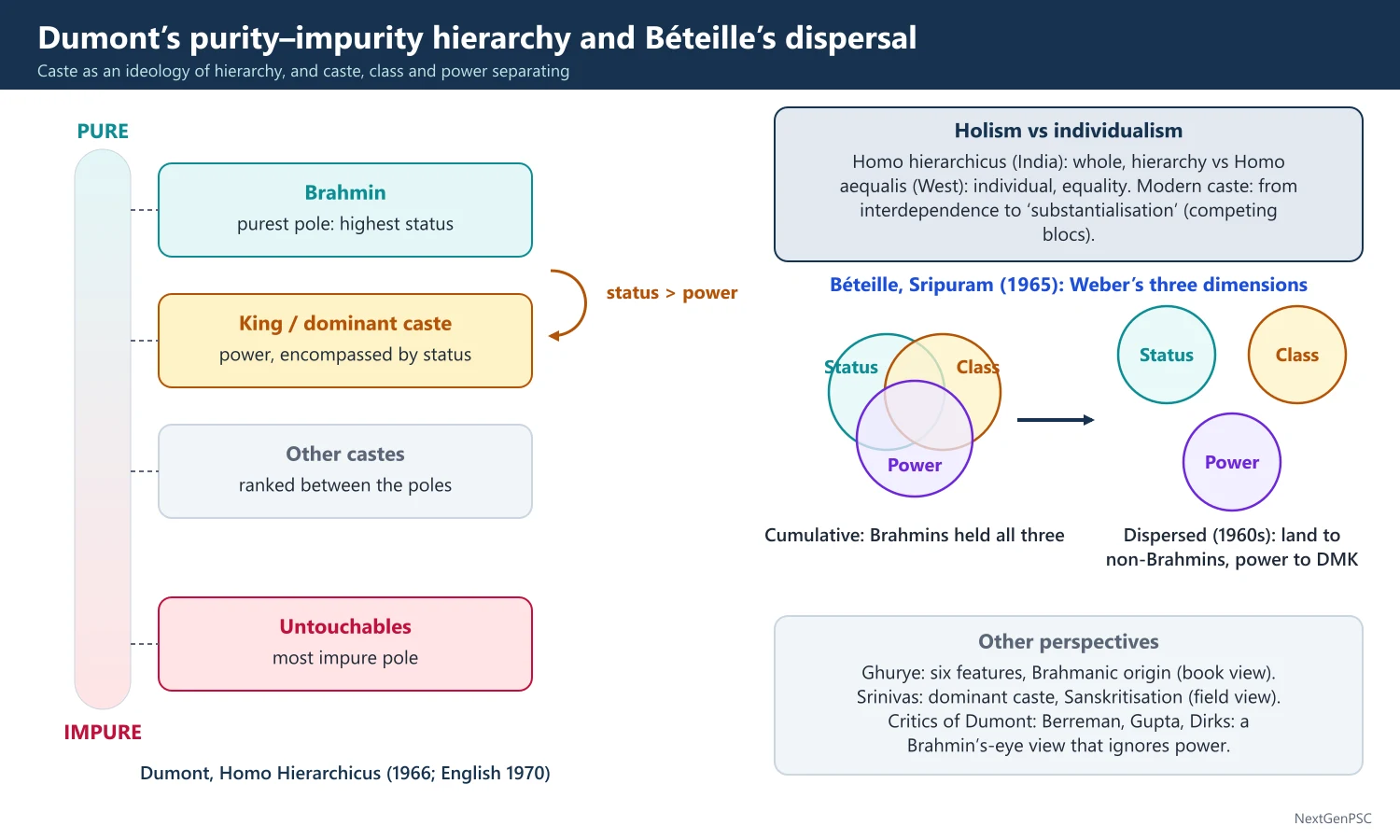
Structuralism: following Lévi-Strauss, he locates the basic principle in a binary opposition, the pure versus the impure; Brahmins (purest) and untouchables (most impure) are the two poles, and all castes are ranked between them.
Hierarchy as encompassment: the higher encompasses the lower, as the whole encompasses its parts.
Status and power separated: in India status (Brahmin) is ranked above power (king or dominant caste); power is ‘encompassed’ by status, unlike in the West.
Holism versus individualism: Indian society (Homo hierarchicus) values the whole and hierarchy; modern Western society (Homo aequalis) values the individual and equality.
Change: he saw modern caste moving from a structural system of interdependence to ‘substantialisation’, where each caste behaves like a separate, competing substance or block.
5. Critiques of Dumont
Gerald Berreman (‘Caste in India and the United States’, 1960; Hindus of the Himalayas, 1963) argued that caste is a system of power and exploitation like racial stratification, and that low castes do not accept their position.
Dipankar Gupta (Interrogating Caste, 2000) argued that there is no single agreed hierarchy; each caste has its own origin myth claiming high status, so there are multiple hierarchies, and caste identity is like ethnic identity.
Gloria Goodwin Raheja (The Poison in the Gift, 1988) found in a north Indian village that the dominant landowning caste, not the Brahmin, was at the centre of ritual exchange.
Nicholas Dirks (Castes of Mind, 2001) argued that the king was central in pre-colonial south India and that colonial rule, through the census and ethnography, made the Brahmin-centred hierarchy look universal.
McKim Marriott proposed a transactional approach: castes are ranked by who gives and accepts food and services from whom, not by an abstract purity scale.
Béteille and others said Dumont ignores the empirical role of land and power and offers a Brahmin’s-eye view.
6. André Béteille: caste, class and power
Caste, Class and Power (1965): in Sripuram (Tanjore) he used Weber’s three dimensions (status, class, party) to study stratification.
Cumulative to dispersed inequality: earlier, Brahmins held high status, most land and political power together; by the 1960s land was passing to non-Brahmins and political power to non-Brahmin parties (DMK), so the three dimensions were separating.
Caste and class: class cuts across caste; within one caste there are rich and poor, and one class contains many castes, so caste and class are distinct but interlinked.
Later work: Castes: Old and New (1969) and essays on equality argued that the ritual side of caste is declining while caste persists in politics and in the competition for reserved benefits.
7. Other views to cite
Ambedkar: caste as endogamy imposed on exogamy (1916) and as graded inequality (1936).
Edmund Leach (Aspects of Caste, 1960): caste as a system of interdependence where castes do not compete; when castes start competing as political groups, the caste system in the strict sense ends.
Marxists (Gough, Omvedt, Meillassoux): caste as a form of class exploitation and labour control.
8. Relevance today
Dumont’s substantialisation and Gupta’s ethnicisation fit today’s caste blocs in elections and demands for quotas; Béteille’s dispersed inequality fits the rise of Dalit and OBC elites; Srinivas’s dominant caste fits Jats, Marathas and Patidars.
The Bihar caste survey (2023) found Extremely Backward Classes 36.0%, Backward Classes 27.1%, Scheduled Castes 19.7%, Scheduled Tribes 1.7% and unreserved 15.5% of the state’s population; caste is to be counted in Census 2027 (population enumeration with reference date 1 March 2027).
9. Using it in the exam
10 marks: explain one perspective (often Dumont) with its key terms and two criticisms.
15 marks: compare two perspectives (Dumont versus Béteille, or Ghurye versus Srinivas).
20 marks: compare all four in a table, add critics (Berreman, Gupta, Dirks, Ambedkar), and conclude on which best explains caste today.
Diagram idea: Dumont’s vertical axis from pure (Brahmin) to impure (untouchable) with the king placed below the Brahmin; beside it, Béteille’s three overlapping circles of caste, class and power drifting apart.
Useful line: Dumont held that the opposition of the pure and the impure underlies the hierarchy of castes (paraphrase of Homo Hierarchicus).
| Scholar | Approach | Key idea | Main criticism |
|---|---|---|---|
| G.S. Ghurye | Indological, historical | Six features; Brahmanic origin | Book view; static |
| M.N. Srinivas | Structural-functional, fieldwork | Dominant caste, Sanskritisation | Upper-caste bias; positional change only |
| Louis Dumont | Structuralist, ideological | Purity–impurity; status over power | Brahmin’s-eye view; ignores power (Berreman, Gupta, Dirks) |
| André Béteille | Weberian, empirical | Caste, class, power: cumulative to dispersed | Based on one village; underplays ideology |
Mains points
- Define caste with at least two definitions (Ghurye’s features, Bouglé’s principles or Ambedkar’s endogamy).
- For Dumont, explain all key terms (purity–impurity, encompassment, status over power, holism, substantialisation) before criticising.
- Use Béteille’s Sripuram as the bridge between caste and class.
- A four-column comparison table scores well in 20-mark questions.
- Bring current evidence: Bihar caste survey 2023, Census 2027 caste count, dominant-caste quota agitations.
- Avoid presenting any one view as the whole truth; conclude that caste combines ideology, power and economy.
Did you know?
- Memory trick: Ghurye = Grammar of caste (features), Srinivas = Street view (village), Dumont = Dharma of purity (ideas), Béteille = Bank, Ballot and Brahmin (class, power, status).
Features of the Caste System and Caste Change
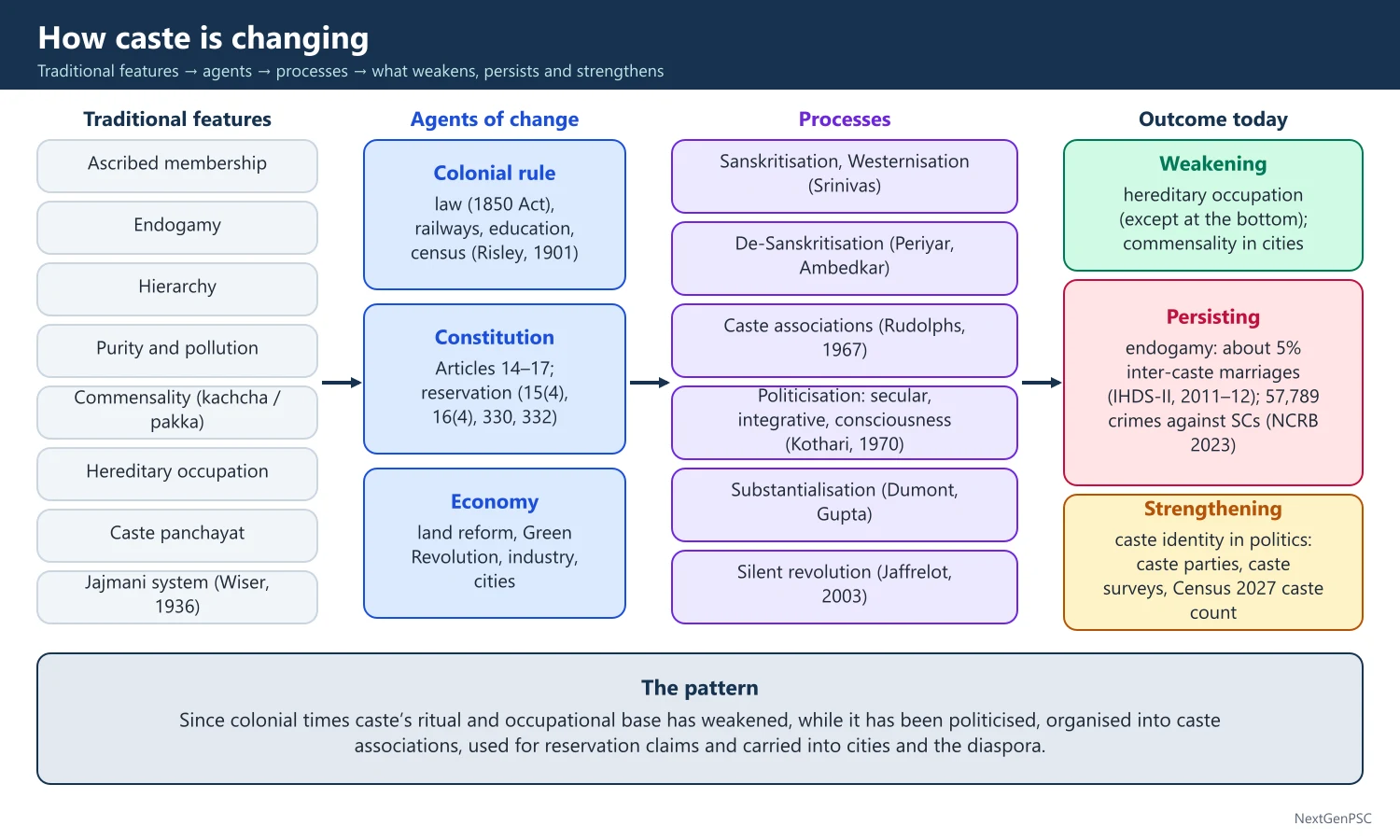
The classic features of caste are birth-based membership, endogamy, hierarchy, rules of purity and pollution, restrictions on food and contact, hereditary occupation and the jajmani exchange of services. Since colonial times caste has changed: its ritual and occupational base has weakened, while it has been politicised, organised into caste associations, used for reservation claims and carried into cities and the diaspora.
In simple words
Traditionally, your caste fixed whom you could marry, what work you did and whose food you could eat.
Today many of these rules have loosened, much as a strict school rule fades when students move to a big city college.
Yet caste remains strong in marriage, elections and reservation, so it has changed its form rather than disappeared.
UPSC asks about the features of caste and whether caste is weakening or adapting.
1. Features of the caste system
Ascribed membership: one is born into a caste and cannot normally leave it.
Endogamy: marriage within the caste or sub-caste, combined with gotra and village exogamy in many regions; Ambedkar called endogamy the essence of caste.
Hierarchy: castes are ranked, broadly by ritual purity, with Brahmins at the top and untouchable castes at the bottom; the middle ranks are often disputed.
Purity and pollution: contact with ‘polluting’ substances (death, birth, leather, refuse) or with lower castes is believed to defile, governing touch, food, water and space.
Commensality rules: distinction between kachcha food (cooked in water, more restricted) and pakka food (fried in ghee, more widely accepted).
Hereditary occupation: each caste traditionally linked with a craft or service (potter, barber, washerman, leatherworker).
Caste panchayat: councils enforced caste rules through fines and outcasting.
Jajmani system: William Wiser (The Hindu Jajmani System, 1936, Karimpur) described long-term hereditary ties in which service castes (kamins) served landowning patrons (jajmans) for annual shares of grain; functionalists saw reciprocity, while critics (Harold Gould, Kathleen Gough, Jan Breman) saw exploitation.
2. Caste beyond Hindus
Caste-like divisions exist among Muslims (ashraf, ajlaf, arzal; Imtiaz Ahmad, Caste and Social Stratification among Muslims in India, 1973), Sikhs (Jat Sikhs, Mazhabi Sikhs), Christians (Dalit Christians in Kerala and Tamil Nadu) and Buddhists.
This weakens the view that caste is purely a Hindu religious institution; it is also a social structure of South Asia.
3. Agents of change
Colonial rule: courts and law (Caste Disabilities Removal Act 1850), railways and urban life, English education, new occupations and the census, which ranked castes (Risley, 1901) and encouraged caste associations to petition for higher status.
Constitution: equality (Articles 14–16), abolition of untouchability (Article 17), reservation in education, jobs and legislatures (Articles 15(4), 16(4), 330, 332).
Economy: land reform, the Green Revolution, industrialisation and urbanisation weakened jajmani ties and hereditary occupations.
4. Processes of caste change
Sanskritisation and Westernisation (Srinivas): mobility by adopting upper-caste practices or modern education and lifestyles.
De-Sanskritisation: rejection of Brahmanical values by non-Brahmin and Dalit movements (Periyar, Ambedkar), and pride in one’s own caste identity.
Caste associations: the Rudolphs (The Modernity of Tradition, 1967) showed that associations such as the Nadar Mahajana Sangam and the Vanniyar Kula Kshatriya Sangam became vehicles for democratic participation.
Politicisation: Rajni Kothari (Caste in Indian Politics, 1970) described three aspects: the secular aspect (castes as interest groups), the integrative aspect (caste leaders becoming political leaders) and the aspect of consciousness (caste identity sharpened by politics).
Substantialisation and ethnicisation: Dumont and Dipankar Gupta noted that castes now act as separate, competing identity blocs rather than as parts of one ranked whole.
Silent revolution: Christophe Jaffrelot (India’s Silent Revolution, 2003) described the rise of lower-caste parties and legislators in north India after Mandal.
5. Reservation and the backward classes
Mandal Commission (report 1980) recommended 27% reservation for Other Backward Classes, implemented in central jobs in 1990; the Supreme Court in Indra Sawhney (1992) upheld it with a 50% ceiling and a creamy-layer exclusion.
EWS quota: the 103rd Amendment (2019) gave 10% reservation to economically weaker sections outside existing quotas; upheld 3:2 in Janhit Abhiyan (November 2022).
Sub-classification: the Rohini Commission on OBC sub-categorisation submitted its report in 2023; in State of Punjab v. Davinder Singh (1 August 2024) a seven-judge bench ruled 6:1 that states may sub-classify Scheduled Castes.
Dominant castes seeking backward status: Jat, Maratha and Patidar agitations; the Supreme Court struck down the separate Maratha quota in 2021.
6. Continuity: what has not changed
Marriage: the India Human Development Survey (IHDS-II, 2011–12) found only about 5% of marriages were inter-caste; matrimonial advertisements and sites still sort by caste.
Violence: so-called honour killings punish inter-caste couples; NCRB recorded 57,789 cases of crimes against Scheduled Castes in 2023.
Occupation and wealth: manual scavenging and sanitation work remain mostly done by Dalits; upper castes remain over-represented among business owners, the media and senior professions.
Satish Deshpande (Contemporary India: A Sociological View, 2003) argued that upper castes have turned caste privilege into ‘caste-less’ capital (education, networks), so caste appears invisible to them while lower castes are marked by caste.
7. Caste in cities and abroad
Urban caste persists in housing segregation, marriage and networks; caste-based residential discrimination has been documented in studies of rental housing.
Diaspora: Seattle became the first US city to ban caste discrimination (February 2023), while California’s state bill was vetoed in October 2023, showing caste travelling with migration.
8. Linking thinkers
Weber: caste as closed status group; mobility through usurpation of status symbols matches Sanskritisation.
Parsons: the move from ascription to achievement is incomplete: achievement in jobs, ascription in marriage.
Bourdieu: cultural and social capital explain Deshpande’s argument about invisible upper-caste privilege.
9. Using it in the exam
10 marks: list features with thinkers (Ghurye, Bouglé), add one line on change.
15 marks: show which features have weakened (occupation, commensality) and which persist (endogamy, hierarchy in villages).
20 marks: analyse change through Srinivas, Kothari, the Rudolphs, Dumont, Gupta and Deshpande, with data (IHDS, NCRB, Bihar survey) and current law (EWS, sub-classification).
Diagram idea: a two-column chart ‘weakening’ versus ‘persisting or strengthening’ features of caste.
Useful line: Kothari argued that it is not politics that gets caste-ridden but caste that gets politicised (paraphrase of Caste in Indian Politics).
| Feature | Trend | Evidence |
|---|---|---|
| Hereditary occupation | Weakening, except at the bottom | New jobs; Dalits still in sanitation work |
| Commensality | Largely weakened in cities | Hotels, canteens, mixed workplaces |
| Endogamy | Persisting | About 5% inter-caste marriages (IHDS-II, 2011–12) |
| Caste identity in politics | Strengthening | Caste parties, caste surveys, Census 2027 caste count |
| Untouchability and violence | Persisting in new forms | 57,789 crimes against SCs (NCRB 2023) |
Mains points
- Give features with their sources (Ghurye, Bouglé, Ambedkar) rather than an unattributed list.
- Argue that caste is adapting rather than dying, with concepts (politicisation, substantialisation, caste associations).
- Use legal and policy milestones with years: Mandal, Indra Sawhney 1992, EWS 2019 and 2022, sub-classification 2024.
- Use data with sources and years (IHDS-II, NCRB 2023, Bihar caste survey 2023).
- Mention caste among non-Hindus to show depth.
- A common mistake is to say caste has disappeared in cities; show urban and diaspora persistence.
Did you know?
- The 1931 Census was the last full caste count in India; Census 2027 will be the first in almost a century to count all castes.
Untouchability: Forms and Perspectives
Untouchability is the practice of treating certain castes as permanently polluting and excluding them from touch, water, temples, housing and dignity. Its forms range from ritual and spatial exclusion to occupational stigma (manual scavenging), economic boycott and violence, and new urban forms. Perspectives include Ambedkar (religious sanction and graded inequality), Gandhi (a sin to be removed by reform), Dumont (structural pole of impurity), Moffatt (consensus) and Marxist and Dalit views of exploitation and humiliation.
In simple words
Untouchability means some people are treated as if their touch, shadow or food makes others ‘impure’, only because of the caste they were born into.
It shows up as separate cups at tea shops, bans on temple entry or using a village well, or forcing people into cleaning sewers.
The Constitution abolished it in 1950, yet it continues in many forms.
UPSC asks about its forms, why it persists and how different thinkers explain it.
1. Meaning
Untouchability: a set of practices that treat members of certain castes as ritually polluting by birth, leading to exclusion, segregation and humiliation; it is the extreme end of the purity–pollution hierarchy.
Names: colonial ‘depressed classes’, Gandhi’s ‘Harijan’ (rejected by many Dalits), the constitutional ‘Scheduled Castes’ (Government of India Act 1935 and Article 341), and the self-chosen ‘Dalit’ (broken, oppressed), popularised by the Dalit Panthers (1972).
Scale: Census 2011 counted 20.14 crore Scheduled Caste persons, 16.6% of India’s population.
2. Forms of untouchability
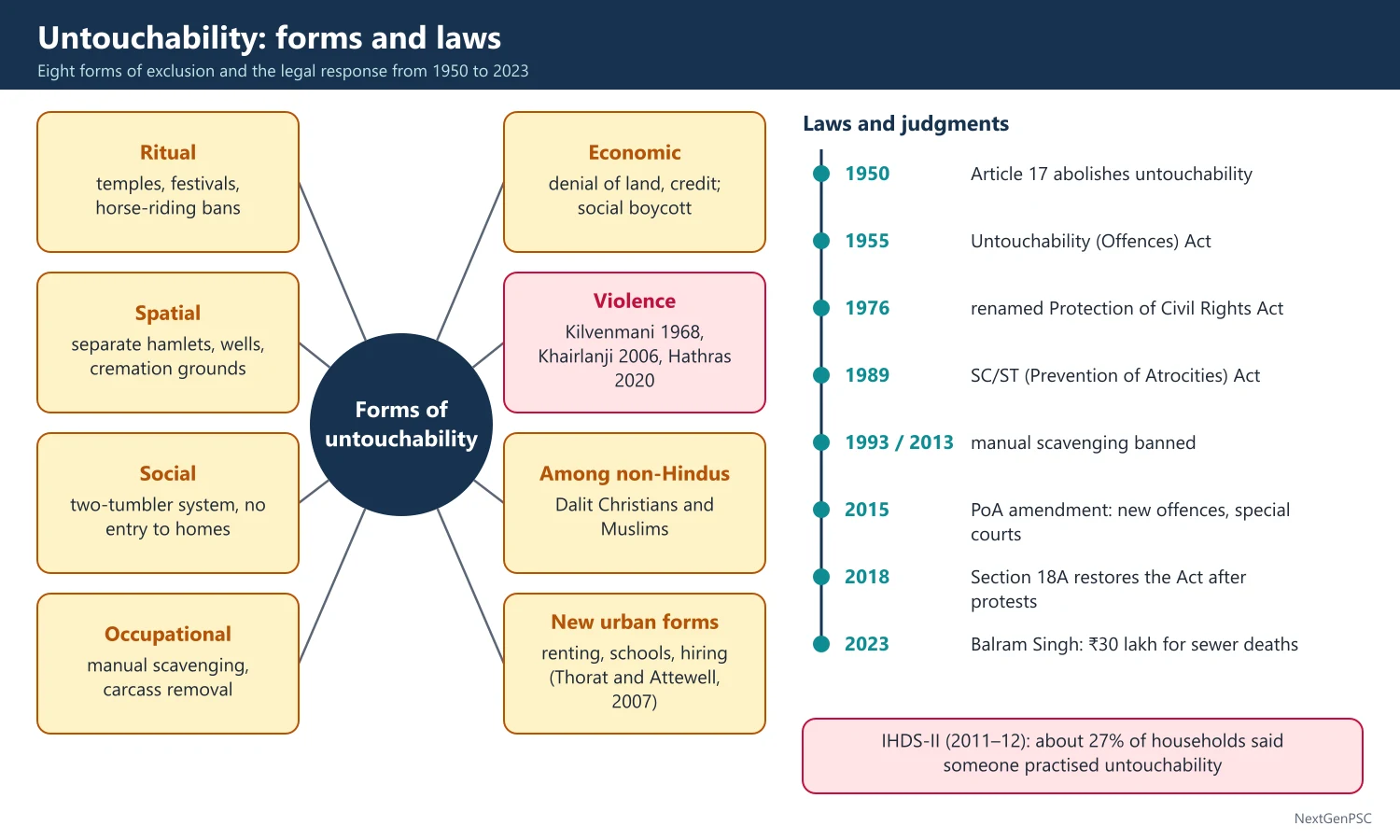
Ritual: exclusion from temples, festivals and priestly services; bans on Dalit grooms riding horses in processions.
Spatial: separate hamlets (cheri in Tamil Nadu, wada or basti elsewhere), separate wells, cremation grounds and seating.
Social: the two-tumbler system at tea stalls, refusal to share food, refusal of entry into homes, denial of services by barbers and washermen.
Occupational: forced association with ‘polluting’ work: manual scavenging, sewer cleaning, carcass removal, leather work and funeral drumming.
Economic: denial of land, credit and markets; social boycott when Dalits assert rights.
Violence: atrocities, sexual violence against Dalit women, and collective attacks such as Kilvenmani (1968), Karamchedu (1985), Khairlanji (2006) and the Hathras case (2020).
Among non-Hindus: Dalit Christians and Dalit Muslims report separate churches, burial grounds and seating; they are not included in the Scheduled Caste list under the Constitution (Scheduled Castes) Order 1950, which covers only Hindus, Sikhs (1956) and Buddhists (1990).
New and urban forms: discrimination in renting homes, in schools (separate seating at mid-day meals) and in hiring; Sukhadeo Thorat and Paul Attewell (‘The Legacy of Social Exclusion’, 2007) found fewer job call-backs for applicants with Dalit and Muslim names than for equally qualified upper-caste Hindu names.
Extent: in the India Human Development Survey (IHDS-II, 2011–12), about 27% of households said someone in the household practised untouchability.
Gendered untouchability: Dalit women face caste and gender oppression together, which feminist scholars such as Sharmila Rege called the need to ‘write caste, write gender’ (2006).
3. Perspectives
Ambedkar: untouchability is rooted in Hindu religious sanction and graded inequality; it cannot end without destroying the authority of the scriptures; in The Untouchables (1948) he traced its origin to ‘broken men’ who remained Buddhist and ate beef (a thesis historians debate).
Gandhi: untouchability is a sin and a corruption of Hinduism, not part of it; caste Hindus must remove it through a change of heart (Harijan Sevak Sangh, 1932; temple-entry campaigns).
Dumont: untouchability is structurally necessary to caste: the purity of the Brahmin requires the impurity of the untouchable at the other pole.
Michael Moffatt (An Untouchable Community in South India, 1979): untouchables in Endavur village replicated the caste hierarchy among themselves, suggesting consensus with the system.
Critics of consensus: Joan Mencher and Gerald Berreman argued that untouchables comply out of power and poverty, not belief; Dalit movements show active resistance.
Marxist view: untouchability secures a cheap, bound labour force for landowners; caste and class overlap at the bottom.
Dalit sociology: Gopal Guru (Humiliation: Claims and Context, 2009) sees humiliation as the core experience; Kancha Ilaiah (Why I Am Not a Hindu, 1996) offers a Dalit-Bahujan critique; Sukhadeo Thorat documents economic exclusion.
4. Laws and policies
Article 17 abolishes untouchability and makes its practice an offence; Article 15 bars discrimination in access to shops, wells and public places.
Untouchability (Offences) Act 1955, renamed the Protection of Civil Rights Act in 1976.
SC/ST (Prevention of Atrocities) Act 1989: special offences, special courts; amended in 2015 to add new offences (such as garlanding with footwear and social boycott) and exclusive special courts.
2018 episode: in Subhash Kashinath Mahajan (March 2018) the Supreme Court allowed preliminary inquiry and anticipatory bail; after nationwide Dalit protests (2 April 2018), Parliament inserted Section 18A (August 2018) to restore the Act’s rigour, upheld in Prithvi Raj Chauhan (2020).
Manual scavenging: banned by the 1993 Act and the Prohibition of Employment as Manual Scavengers and their Rehabilitation Act 2013; in Balram Singh (October 2023) the Supreme Court raised compensation for sewer deaths to ₹30 lakh; the NAMASTE scheme (2023) targets mechanised sanitation.
Data: NCRB Crime in India 2023 recorded 57,789 cases of crimes against Scheduled Castes (up 0.4% over 2022); conviction rates and pendency remain serious problems.
5. Dalit movements and assertion
Colonial-era struggles (Mahad 1927, Kalaram 1930), Ambedkar’s conversion (1956), the Dalit Panthers (1972), the Bahujan Samaj Party (Kanshi Ram, 1984) and Mayawati’s governments in Uttar Pradesh mark the shift from reform to assertion.
Dalit literature (Namdeo Dhasal, Omprakash Valmiki’s Joothan, 1997), the Una protest in Gujarat (2016) and the Bhima Koregaon commemoration show cultural and political assertion.
Eleanor Zelliot (From Untouchable to Dalit, 1992) and Gail Omvedt (Dalits and the Democratic Revolution, 1994) analysed this movement.
6. Why it persists
Landlessness and economic dependence of Dalits in villages; weak enforcement and low conviction; backlash when Dalits gain education and assert rights; religious beliefs about purity; caste endogamy that keeps groups separate.
7. Linking thinkers
Durkheim: the sacred–profane distinction parallels purity–pollution.
Goffman: stigma as a spoiled identity fits the experience of caste stigma; Weber: social closure.
Gramsci: hegemony explains Moffatt’s consensus; counter-hegemony explains Dalit movements.
8. Using it in the exam
10 marks: define untouchability and list its forms with examples.
15 marks: compare Ambedkar, Gandhi and Dumont on its causes.
20 marks: explain forms, perspectives (including Moffatt and critics), laws with years, data (NCRB 2023, IHDS) and Dalit assertion, and conclude on why it persists.
Diagram idea: a wheel of forms (ritual, spatial, social, occupational, economic, violent, urban) around the centre ‘purity–pollution plus power’.
Useful line: Article 17 declares that untouchability is abolished and its practice in any form is forbidden.
| Perspective | Cause | Remedy |
|---|---|---|
| Ambedkar | Religious sanction, graded inequality | Annihilation of caste, law, conversion, political power |
| Gandhi | Corruption of Hinduism, a sin | Change of heart, temple entry, service |
| Dumont | Structural pole of impurity | Ends only with the end of hierarchy |
| Moffatt | Shared cultural consensus | Cultural change |
| Marxist and Dalit | Labour exploitation, humiliation, power | Land, economic independence, assertion |
Mains points
- Classify forms clearly (ritual, spatial, social, occupational, economic, violent, urban) with Indian examples.
- Present at least four perspectives, including the Moffatt–Mencher debate.
- Give laws with years and the 2018 Atrocities Act episode.
- Use recent data: NCRB 2023, IHDS-II untouchability figure, Census 2011 SC population.
- Show new urban forms (housing, hiring) to prove persistence.
- Conclude with Dalit assertion as both a result of and answer to untouchability.
Did you know?
- The word ‘Dalit’ was used by Phule and Ambedkar, but it became a proud self-name only after the Dalit Panthers adopted it in Bombay in 1972.
UPSC Previous Year Questions: Caste System
From 2014 to 2026 UPSC asked 29 question parts carrying 380 marks from this chapter in Paper II. The most-asked topics are Features of the Caste System and Caste Change (12 parts) and Perspectives on Caste: Ghurye, Srinivas, Dumont and Béteille (11 parts). Every question below has a model answer written to the UPSC word limit: about 150 words for 10 marks and 250 words for 20 marks.
In simple words
First read the question and write your own answer in the time UPSC gives (about 7 minutes for 10 marks and 11 minutes for 20 marks).
Then compare it with the model answer: check the approach, the thinkers and studies used, the Indian data and the conclusion.
Note what you missed and revise that topic in the notes before trying the next question.
1. Perspectives on Caste: Ghurye, Srinivas, Dumont and Béteille
Example 1 (UPSC 2026, 10 marks): How do Louis Dumont and André Beteille differ in their approaches in understanding caste system in India? Explain.
Paper and question: Paper II, Q5(d)
Approach: Compare Dumont and Béteille on method, focus, view of hierarchy and change, with their works, and conclude.
Louis Dumont and André Béteille offer contrasting approaches to caste: one structuralist and ideological, the other empirical and Weberian.
On method, Dumont in Homo Hierarchicus (1966) combined Indology with Lévi-Strauss's structuralism, while Béteille in Caste, Class and Power (1965) relied on fieldwork in Sripuram and Weber's three dimensions of stratification. On focus, Dumont studied the ideology of purity and impurity behind caste; Béteille studied the relations between caste, class and power on the ground.
On hierarchy, Dumont saw it as a unique holistic value in which status encompasses power; Béteille treated caste as one form of inequality comparable with others. On change, Dumont stressed continuity, while Béteille showed a shift from cumulative to dispersed inequality and from harmonic to disharmonic structures.
Read together, Dumont explains why caste is legitimised and Béteille how it changes in practice.
Example 2 (UPSC 2023, 10 marks): Analyse the differences between the attributional and interactional approach in studying the caste system.
Paper and question: Paper II, Q1(c)
Approach: Define both approaches (attributional: Hutton, Ghurye; interactional: Marriott 1959), contrast them on basis, method and view of rank, and conclude.
The distinction was drawn by McKim Marriott in his 1959 essay on interactional and attributional theories of caste ranking.
The attributional approach, used by scholars such as J.H. Hutton and G.S. Ghurye, ranks a caste by its own attributes: its occupation, diet (vegetarian or meat-eating), dress and customs such as widow remarriage. A caste that is vegetarian and follows Brahmanical customs ranks higher.
The interactional approach, developed by Marriott from his work in Kishangarhi, ranks castes by their transactions with each other: who accepts cooked food, water or services from whom. A caste that gives food to many but accepts from few ranks high. This approach is relational and empirical, measuring rank through observed exchanges.
The attributional view is static, while the interactional view shows rank as negotiated. Both, however, stay within ritual hierarchy and neglect power and economy.
Example 3 (UPSC 2023, 20 marks): Contextualize Louis Dumont's concept of 'binary opposition' with reference to caste system in India.
Paper and question: Paper II, Q3(a)
Approach: Explain binary opposition in Lévi-Strauss's structuralism, then show how Dumont uses it for caste (pure/impure, status/power, hierarchy/equality, holism/individualism, renouncer/man-in-the-world) with Indian examples, and evaluate.
Binary opposition is a central idea of Claude Lévi-Strauss's structuralism: human thought organises the world through pairs of opposites, such as raw and cooked or nature and culture, and social institutions express these deep structures. Louis Dumont applied this method to caste in Homo Hierarchicus (1966).
The basic opposition is between the pure and the impure. The Brahmin, associated with purity, and the untouchable, associated with impurity through work with death, dirt and leather, are the two poles; all other castes are ranked between them. This single opposition generates the three features Dumont saw in caste: separation in marriage and contact, interdependent division of labour, and hierarchy.
Dumont built further oppositions. Status versus power: the Brahmin's ritual status encompasses the king's political power, so the king is ranked below the priest. Hierarchy versus equality, and holism versus individualism, contrast Homo hierarchicus of India with Homo aequalis of the modern West. The renouncer versus the man-in-the-world explains how sects such as Buddhism and Bhakti arose outside caste, through the individual who leaves society.
Flow chart: Pure ↔ impure → separation, division of labour, hierarchy; status encompasses power; holism ↔ individualism; renouncer ↔ man-in-the-world.
Indian examples fit the scheme: rules about accepting food and water, the impurity of death and birth (sutak), and the exclusion of castes doing scavenging or leatherwork. Yet critics question it. Berreman and Dalit scholars say it presents the Brahmin's ideology as everyone's; Dipankar Gupta shows multiple hierarchies; and Dirks, Raheja and Quigley argue that the king and power, not the priest alone, were central to caste.
Dumont's binary scheme thus gives an elegant model of caste ideology, but it should be read alongside evidence of power, economy and Dalit resistance.
Example 4 (UPSC 2022, 10 marks): In the context of the changing Indian society, how do you view Andre Beteille's conceptions of harmonic and disharmonic social structures?
Paper and question: Paper II, Q1(d)
Approach: Explain Béteille's harmonic (values and structure consistent) and disharmonic (egalitarian values with hierarchical structure) concepts, apply to changing India with examples, and conclude.
André Béteille distinguished harmonic social structures, where the dominant values and the actual structure of inequality are consistent, from disharmonic ones, where they contradict each other.
Traditional Indian society was harmonic: caste hierarchy was unequal, but it was also justified by religious values of purity, karma and dharma, so inequality was accepted as legitimate. Since independence, India has become disharmonic. The Constitution declares equality, abolishes untouchability (Article 17) and provides reservations, yet inequality of caste, class and gender persists in practice.
This gap explains much of present-day tension: Dalit assertion against atrocities, demands for reservation by groups such as Marathas and Jats, and debates on the caste count in Census 2027.
Béteille's concepts remain useful because they show that inequality in modern India is contested rather than accepted.
Example 5 (UPSC 2021, 10 marks): Caste system studies in India have been dominated by the “book-view” initially. How did the entry of “field-view” bring about a balance in the study of Indian caste system? Discuss.
Paper and question: Paper II, Q1(a)
Approach: Explain the book-view (texts, varna, Indologists) and the field-view (Srinivas, village studies), show what the field-view added, and how the two now balance each other.
M.N. Srinivas distinguished the book-view of caste, drawn from the Dharmashastras and Indologists such as Max Müller and Ghurye, from the field-view, drawn from direct observation of village life.
The book-view presented caste as the fourfold varna system, fixed by birth and sanctioned by religion, with Brahmins always at the top. The field-view, from village studies of the 1950s, showed thousands of local jatis, regional variation, ambiguity in the middle ranks, and mobility through Sanskritisation. It revealed the dominant caste, whose power came from land and numbers rather than ritual rank, and the importance of economic interdependence through the jajmani system.
The two views now complement each other: texts explain the ideology that legitimises caste, as Dumont showed, while fieldwork shows how it actually works and changes.
This balance gave Indian sociology a fuller and more realistic picture of caste.
Example 6 (UPSC 2020, 10 marks): How do you justify Dumont's deliberate stress on ideology that produced intellectualized account of Indian society?
Paper and question: Paper II, Q1(c)
Approach: Present Dumont's own justification for stressing ideology (understanding a society through its values, holism, comparison with individualism), then show the costs of the intellectualised account, and give a balanced verdict.
Louis Dumont's Homo Hierarchicus (1966) deliberately focused on ideology, the system of values and ideas, rather than on economic or political facts. This produced a highly intellectualised account of caste built on the opposition of pure and impure.
His stress can be justified on three grounds. First, a civilisation is best understood through its own categories, and Dumont said Indian sociology must stand at the confluence of sociology and Indology. Second, ideology explains why caste persisted across regions and centuries despite changes in rulers and economies. Third, contrasting Indian holism with Western individualism gave a powerful comparative insight into modernity itself.
But the costs are real. Berreman, Gupta and Dalit scholars note that it takes the Brahmin's view as the view of all; Dirks shows the neglect of power; and field studies show economic interests shaping caste.
So the stress on ideology is justified as one level of analysis, but it must be combined with power, economy and lived experience.
Example 7 (UPSC 2020, 20 marks): “Indian caste system is unique and has been unhealthy for the growth of sociology of India.” How far do you agree with this view?
Paper and question: Paper II, Q2(a)
Approach: Two claims to assess: (1) caste is unique to India (Dumont, Leach vs Berreman, Cox and universalists); (2) the focus on caste has been unhealthy for Indian sociology (neglect of class, gender, tribes; colonial and Brahmanical bias), with counterpoints; then conclude.
The statement makes two claims: that caste is unique to India, and that the preoccupation with it has harmed the growth of sociology in India. Both need to be weighed.
The uniqueness thesis is held by Louis Dumont, for whom caste rests on a religious ideology of purity and impurity found only in India, and by Edmund Leach, who saw caste as a specifically Indian system of structured interdependence. Against them, universalists such as Gerald Berreman, comparing India with the American South, and O.C. Cox treated caste as an extreme form of birth-based stratification found in many societies. Caste-like features among the Burakumin of Japan support this view.
There is truth in the charge that caste has been unhealthy for Indian sociology. Colonial ethnography and the census made caste the master key to India, as Nicholas Dirks and Bernard Cohn argued. Sociology then focused on caste and village while neglecting class, gender, tribes, cities, industry and the state. The textual view privileged Brahmanical ideas, and Dalit scholars such as Gopal Guru criticised the hierarchy within the discipline itself.
Flow chart: Colonial census and Orientalism → caste as India's essence → sociology centred on caste and village → neglect of class, gender, tribes, city → later correction by Marxist, feminist and Dalit sociology.
But the charge is overstated. The study of caste produced some of Indian sociology's most original concepts, Sanskritisation, dominant caste and harmonic and disharmonic structures, and helped India contribute to world sociology. Caste also remains a real force in marriage, politics and discrimination, so studying it is necessary. Since the 1970s, sociology has broadened to class, gender, tribes and cities.
I therefore agree only in part: caste has distinctive Indian features but shares traits with other birth-based systems, and an exclusive focus on it limited sociology for a time, though its study has also been one of the discipline's strengths.
Example 8 (UPSC 2020, 20 marks): Discuss Whitehead's contention that caste has potential to displace class and colonial contradiction.
Paper and question: Paper II, Q2(b)
Approach: Explain the contention attributed to Whitehead in the question (caste identity can displace class consciousness and the anti-colonial contradiction), show how this happened in colonial and post-colonial India, give the counter-view, and conclude.
The contention attributed to Whitehead in the question is that caste can displace two other contradictions in Indian society: the class contradiction between owners and workers, and the colonial contradiction between the Indian people and British rule. In Marxist language, caste can become the dominant axis of identity and conflict, pushing class and anti-colonial struggles into the background.
The colonial period offers evidence. The census and Risley's ranking of castes in 1901 encouraged caste associations to petition the state for higher status, making caste rather than class the language of claims. Non-Brahmin movements such as the Justice Party (1916) often saw Brahmin dominance as a greater enemy than British rule and cooperated with the colonial government. Ambedkar argued that political freedom without social freedom would only transfer power to upper castes.
After independence, caste displaced class in politics as well. Rajni Kothari's Caste in Indian Politics (1970) showed caste becoming a political resource. The Mandal politics of the 1990s and the rise of the BSP mobilised voters by caste, while Left parties based on class weakened outside a few states. Rural labourers often divided along caste lines rather than uniting as a class.
Flow chart: Colonial census and caste petitions → caste as language of claims → non-Brahmin and Dalit politics prioritise caste over anti-colonial and class struggle → caste-based mobilisation after independence → class solidarity weakened.
The counter-view is that caste and class overlap rather than displace each other. Marxists such as A.R. Desai saw caste as a form through which class exploitation operates, and Gail Omvedt argued that anti-caste movements were also struggles against economic exploitation. Peasant movements such as Tebhaga and Telangana united castes on class lines, and the national movement did mobilise across castes.
Thus caste has the potential to displace class and colonial contradictions, but in practice it more often interlocks with them, which is why caste–class analysis is needed.
Example 9 (UPSC 2019, 10 marks): Write a note on Ghurye's conception of caste in India.
Paper and question: Paper II, Q1(d)
Approach: State Ghurye's conception: Indological and historical-diffusionist, the six features of caste, its Indo-Aryan origin; add criticism.
G.S. Ghurye, in Caste and Race in India (1932), studied caste through texts, history and census data. He held that caste was so complex that no single definition would do, so he described it through its features.
He gave six features: segmental division of society; hierarchy; restrictions on feeding and social intercourse; civil and religious disabilities and privileges of different sections; lack of unrestricted choice of occupation; and restrictions on marriage, that is, endogamy. He saw endogamy as the most important feature.
On origin, he argued that caste was a product of Brahmanic culture of the Indo-Aryans in the Gangetic plain and spread by diffusion to other regions. He also noted that British rule strengthened caste consciousness through the census.
Critics found the racial theory dated and the view textual and static, as Srinivas's field studies showed. Still, his features remain the standard starting point for describing caste.
Example 10 (UPSC 2016, 20 marks): Discuss Andre Beteille's account of the relationship between caste, class and power as a change from symmetrical to asymmetrical one.
Paper and question: Paper II, Q2(b)
Approach: Explain Béteille's Sripuram study: the earlier symmetry (congruence) of caste, class and power, the forces that made the relationship asymmetrical (dispersed), with examples; then evaluate.
André Béteille's Caste, Class and Power (1965), based on fieldwork in Sripuram, a Tanjore village, used Max Weber's three orders of stratification: status (caste), class (land and wealth) and party (power). His central finding was a change in the relationship among them from a symmetrical or congruent pattern to an asymmetrical one.
In the traditional order the three were symmetrical. Brahmins stood highest in ritual status, owned most of the land, and controlled village affairs; non-Brahmins were tenants, and Adi-Dravidas (Dalits) were landless labourers at the bottom on all three counts. Caste, class and power were cumulative.
Several forces broke this symmetry. Western education and urban jobs drew Brahmins to towns, and they sold land to non-Brahmins. The market in land and new occupations allowed mobility independent of caste. Adult franchise and Panchayati Raj gave power to numerically strong non-Brahmins, and the Dravidian movement and parties shifted political control. Adi-Dravidas gained some voice through reservations.
Flow chart: Symmetry: Brahmins high in caste + class + power → education, land market, adult franchise, Dravidian politics → asymmetry: Brahmins keep ritual status, non-Brahmins gain land and power, Dalits gain some rights.
The result was asymmetry: ritual rank no longer predicted land or power. Yet Béteille noted that caste still shaped class and politics, for instance through caste-based voting. Critics observe that Sripuram, a Brahmin-dominated village, may be untypical, and Kathleen Gough found sharper class conflict in Tanjore.
Béteille's account remains a classic demonstration that modernisation separates the dimensions of stratification, a trend visible across rural India.
Example 11 (UPSC 2015, 10 marks): Louis Dumont's perspective on Indian caste system
Paper and question: Paper II, Q1(c)
Approach: Explain Dumont's structuralist and ideological perspective from Homo Hierarchicus: purity–impurity, hierarchy and encompassment, status over power, holism; add criticism.
Louis Dumont, in Homo Hierarchicus (1966; English 1970), studied caste as a system of ideas. Influenced by Lévi-Strauss's structuralism and Indology, he held that caste must be understood through the ideology that orders it.
For Dumont, the single principle behind caste is the opposition of the pure and the impure. It produces separation (rules on marriage and contact), division of labour and hierarchy. Hierarchy here means the encompassing of the lower by the higher, and religious status (the Brahmin) encompasses political power (the king). Indian society is holistic, valuing the whole over the individual, unlike modern Western individualism.
Critics such as Gerald Berreman said this is the view from the top, ignoring Dalits' rejection of hierarchy. Dipankar Gupta showed that each caste has its own view of rank, and Nicholas Dirks argued that political power was central in pre-colonial kingdoms.
Still, Dumont gave the most systematic theory of caste as an ideological system.
2. Features of the Caste System and Caste Change
Example 12 (UPSC 2024, 10 marks): What, according to you, are the factors responsible for the continuance of caste system in India? Explain.
Paper and question: Paper II, Q1(a)
Approach: Explain the factors that sustain caste (endogamy, politics, reservations and enumeration, associations, economic overlap, religion and culture, discrimination) with data, and conclude.
Despite education, urbanisation and constitutional equality, caste continues in India. In my view, several factors are responsible.
First, endogamy: the India Human Development Survey (2011–12) found only about 5% of marriages inter-caste, and matrimonial sites sort by caste. Second, politics: as Rajni Kothari showed, caste is a vote bank and mobilising resource, and parties choose candidates by caste arithmetic. Third, the state's categories: reservations, caste certificates, the Bihar caste survey of 2023 and caste enumeration in Census 2027 keep caste identity salient.
Fourth, caste associations and networks provide jobs, credit and support. Fifth, caste overlaps with class: land is held by dominant castes, while most manual scavengers are Dalits. Sixth, religious and cultural sanction, and seventh, discrimination in jobs and housing, documented by Thorat and Attewell (2007).
Caste thus continues by adapting: ritual hierarchy weakens, but identity, marriage and politics sustain it.
Example 13 (UPSC 2023, 10 marks): Critically examine the concept of Sanskritization with suitable illustrations.
Paper and question: Paper II, Q3(c)
Approach: Define Sanskritisation with illustrations, then critically examine it (Brahmanical bias, positional change, gender, Dalit critique, other models), and conclude.
Sanskritisation, a concept of M.N. Srinivas first presented in his Coorg study (1952), is the process by which a lower caste or tribe adopts the customs, rituals and beliefs of a higher caste to claim a higher position, usually over a generation or two.
Illustrations include the Coorgs adopting Brahmin customs, Kurmis and Yadavs claiming Kshatriya status in the early 20th-century censuses, and the Jatavs of Agra, who, as Owen Lynch showed, first Sanskritised and later turned to Ambedkarite Buddhism. Models can also be Kshatriya or trader castes.
The concept has limits. It brings only positional change, leaving the hierarchy intact. It treats upper-caste culture as superior, and adopting it often meant more restrictions on women, such as ending widow remarriage. Dalit scholars and Yogendra Singh note that groups now prefer assertion to imitation.
Sanskritisation remains useful for explaining mobility within caste, but not for structural change.
Example 14 (UPSC 2022, 20 marks): Elaborate on the changing nature of caste system with suitable illustrations.
Paper and question: Paper II, Q2(b)
Approach: Elaborate the changing nature of caste with illustrations across ritual, occupation, jajmani, politics, mobility, assertion and marriage, show continuity, and conclude.
Caste in India has moved from a closed, ritually ranked system tied to occupation and village to a more open system of identity and interest. The changes can be illustrated in several spheres.
Ritual and commensality: purity rules have weakened in cities, restaurants, trains and workplaces. Occupation: the link between caste and work has loosened; the jajmani system gave way to cash wages, and Sikh and Dalit entrepreneurs, IT professionals and civil servants from all castes are common.
Politics: caste has become a resource for mobilisation. Srinivas saw it gaining strength through democracy, Kothari described its politicisation, and the Mandal Commission's implementation in 1990, the rise of OBC and Dalit parties, the Bihar caste survey of 2023 and the decision of April 2025 to include caste enumeration in Census 2027 show its continuing political weight. Mobility: Sanskritisation has been joined by reservations, which created a Dalit middle class.
Assertion: Dalits and backward castes reject hierarchy rather than imitate it, from Ambedkarite Buddhism to movements such as the Bhim Army. The Supreme Court's decision of 1 August 2024 in State of Punjab v. Davinder Singh, allowing sub-classification of Scheduled Castes, reflects differentiation within the Dalit category itself.
Flow chart: Ritual hierarchy and jajmani → education, urbanisation, markets, democracy, reservations → caste as identity, interest group and political bloc → endogamy and discrimination continue.
Continuity remains in marriage, where matrimonial sites still sort by caste, and in atrocities and untouchability. The changing nature of caste is thus a transformation from hierarchy to difference, not its disappearance.
Example 15 (UPSC 2021, 10 marks): Caste-like formations are present in Non-Hindu religious communities as well. Discuss with examples.
Paper and question: Paper II, Q1(e)
Approach: Discuss caste-like stratification among Muslims, Sikhs and Christians with examples and studies (Imtiaz Ahmad, Sachar), and explain why it persists.
Although Islam, Sikhism and Christianity preach equality, their Indian followers show caste-like formations: hereditary, often endogamous groups ranked in status. Imtiaz Ahmad's edited volume Caste and Social Stratification among Muslims in India (1973) documented this.
Muslims are divided into Ashraf (claimed foreign descent, such as Sayyids and Pathans), Ajlaf (converted occupational groups such as weavers, the Ansaris) and Arzal (those doing ‘unclean’ work). The Pasmanda movement represents backward Muslims. Among Sikhs, Jat Sikhs dominate land, while Mazhabi and Ravidasia Sikhs face discrimination and have their own gurdwaras. Among Christians, Syrian Christians of Kerala keep distance from Dalit converts, and some churches have separate seating or cemeteries.
These persist because converts carried their caste identity and occupation, and endogamy continued.
This shows that caste is a social structure of the subcontinent rather than only a Hindu religious institution.
Example 16 (UPSC 2021, 20 marks): Is Indian society moving from “Hierarchy” towards “differentiation”? Illustrate your answer with suitable examples.
Paper and question: Paper II, Q2(b)
Approach: Define hierarchy (Dumont) and differentiation (Gupta's difference; functional differentiation), show the movement with examples from occupation, politics, identity and law, then show where hierarchy persists, and conclude.
Hierarchy, as Louis Dumont argued, ranks groups on a single scale of purity and impurity, with each caste knowing its place. Differentiation means that groups become distinct and specialised without being ranked on one scale; Dipankar Gupta describes caste today as a system of difference, where castes are separate identities competing as equals.
There is clear movement towards differentiation. In occupation, the jajmani system has declined and people choose jobs by education and market; Dalits work as teachers, engineers and entrepreneurs, as the Dalit Indian Chamber of Commerce and Industry (2005) shows. In politics, castes act as separate interest groups and no caste accepts subordination; parties build coalitions of castes. In law, the Constitution treats all citizens as equals, and untouchability is a crime.
In identity, castes celebrate their own histories rather than seeking a place in a Brahmanical order. M.N. Srinivas noted the decline of ritual hierarchy and the rise of caste as a political and economic group, while Béteille showed caste, class and power separating.
Flow chart: Hierarchy (purity scale, jajmani, ritual rank) → education, market, democracy, law → differentiation (separate identities, interest groups, occupational choice) → but hierarchy persists in marriage, untouchability, atrocities.
Yet hierarchy has not disappeared. Endogamy remains strong, inter-caste couples face honour killings, untouchability survives in rural India, and NCRB recorded 57,789 crimes against Scheduled Castes in 2023. Most sanitation workers still come from Dalit castes, showing a link between caste and degrading work.
Indian society is therefore moving towards differentiation in public life, while hierarchy persists in the private spheres of marriage and community.
Example 17 (UPSC 2018, 20 marks): What do you understand by discrete castes and muddled hierarchies? Substantiate your answer with suitable illustrations.
Paper and question: Paper II, Q3(a)
Approach: Explain Dipankar Gupta's concepts (from ‘Continuous Hierarchies and Discrete Castes’ 1984 and Interrogating Caste 2000): castes as discrete groups with their own origin myths and multiple, contested hierarchies; illustrate; contrast with Dumont; evaluate.
The ideas of discrete castes and multiple or muddled hierarchies come from Dipankar Gupta, first in his essay ‘Continuous Hierarchies and Discrete Castes’ (1984) and later in Interrogating Caste (2000). They challenge Louis Dumont's view of caste as a single, agreed hierarchy based on purity.
Discrete castes means that each caste is a distinct, bounded group with its own identity, origin myth and sense of honour. Castes are not points on one continuous ladder but separate units. Many castes claim a glorious origin: Jats and Yadavs claim Kshatriya descent, the Nadars of Tamil Nadu claimed to be ancient rulers, and several Dalit groups trace descent from kings or from the original inhabitants of the land.
Muddled hierarchies follow from this. Since each caste places itself high, there is no single agreed order but many competing hierarchies. A caste's rank differs depending on who is asked, and in the middle range ranks are ambiguous and disputed. Gupta argues that what holds is not consensus on hierarchy but power: dominant castes enforce their version.
Flow chart: Dumont: one hierarchy of purity, accepted by all. Gupta: discrete castes → each with own origin myth and honour → multiple competing hierarchies → order maintained by power, not consensus.
Present-day illustrations are many. Politics shows castes acting as separate blocs with their own pride, such as the Marathas, Jats and Patidars demanding OBC status while also claiming high status. Dalit movements celebrate their own icons and histories instead of seeking a place in the Brahmanical order. Earlier, the 1901 census saw many castes petitioning for higher rank, showing how contested the order was.
Critics note that Gupta may understate how strongly purity norms still operate, as untouchability shows. Still, his concepts explain caste as identity and competition better than the single-ladder model.
Example 18 (UPSC 2017, 10 marks): Which is more significant, the principle of 'hierarchy' or the principle of 'difference', in intercaste relations in the present day?
Paper and question: Paper II, Q1(b)
Approach: Explain the two principles (Dumont's hierarchy; Gupta's difference/discrete castes), show with present-day examples where each operates, and judge which is more significant today.
The principle of hierarchy, stressed by Louis Dumont, ranks castes on a single scale of purity and impurity. The principle of difference, stressed by Dipankar Gupta in Interrogating Caste (2000), sees castes as discrete groups, each with its own pride and its own view of rank, competing rather than accepting one order.
Today difference appears more significant in public life. Castes mobilise as political blocs, demand reservations and celebrate their own heroes, such as Dalit commemoration of Bhima Koregaon. Few castes now accept a lower rank; each claims honour.
Yet hierarchy has not gone. Untouchability, honour killings over inter-caste marriage and atrocities on Dalits show ranked relations persisting, especially in villages and marriage.
So difference is more significant in politics and public life, where castes compete as equals, while hierarchy survives in the intimate spheres of marriage, food and ritual, especially in villages. Both principles must be read together to understand intercaste relations today.
Example 19 (UPSC 2017, 10 marks): What are the changes in the cultural and structural aspects of the caste system since independence?
Paper and question: Paper II, Q2(c)
Approach: Separate cultural changes (ritual, purity, Sanskritisation, identity) and structural changes (occupation, jajmani, politics, reservations, dominant castes, endogamy) since 1947, with examples.
Following Yogendra Singh's distinction, changes in caste since independence can be divided into cultural changes, in values and rituals, and structural changes, in relations and institutions.
Culturally, rules of purity and commensality have weakened in cities and public places. Sanskritisation continued, but alongside de-Sanskritisation and pride in non-Brahmin identities. Dalits increasingly reject Hindu hierarchy through Ambedkarite Buddhism and assertion.
Structurally, the jajmani system has given way to cash wages; caste and occupation are less linked. Land reform and the Green Revolution raised dominant peasant castes, and reservations created a Dalit and OBC middle class. Caste has become a political resource through associations and parties.
Yet endogamy persists, and NCRB data on atrocities show that hierarchy still matters. Caste has thus changed in form, from ritual rank to political identity, while continuing as a basis of marriage and community.
Example 20 (UPSC 2016, 20 marks): How has B.R. Ambedkar identified the features of caste system? How is it different from the mainstream treatment of caste features?
Paper and question: Paper II, Q2(a)
Approach: Two parts: explain Ambedkar's features of caste (from Castes in India 1916 and Annihilation of Caste 1936): endogamy as essence, mechanisms controlling women, graded inequality, division of labourers, religious sanction; then contrast with mainstream treatments (Risley, Ghurye, Hutton, Srinivas, Dumont).
B.R. Ambedkar analysed caste in his Columbia paper Castes in India: Their Mechanism, Genesis and Development (1916) and in Annihilation of Caste (1936). Unlike most sociologists of his time, he wrote as a member of an untouchable caste and as a reformer.
Ambedkar held that the one essential feature of caste is endogamy; other features follow from it. Caste arose when endogamy was superimposed on exogamous clans, and the Brahmins were the first to enclose themselves, others following by imitation. To maintain endogamy, society controlled women through sati, enforced widowhood and child marriage, so caste and the subordination of women are linked.
In Annihilation of Caste he added that caste is not a division of labour but a division of labourers, fixed by birth and not by aptitude. It is a system of graded inequality, in which each caste is above some and below others, which prevents the lower castes from uniting. And it rests on the religious sanction of the shastras, so it cannot be reformed without rejecting that authority.
Flow chart: Mainstream: list of features (Ghurye), racial origin (Risley), functional interdependence (Srinivas), purity ideology (Dumont). Ambedkar: endogamy → control of women → graded inequality → religious sanction → annihilation needed.
This differs from mainstream treatment in four ways. First, Risley and partly Ghurye linked caste to race, which Ambedkar rejected. Second, Ghurye listed several features as equal, whereas Ambedkar made endogamy the single mechanism. Third, functionalists such as Srinivas and Dumont described caste as an integrated or ideological system, while Ambedkar saw it as domination and exploitation from the standpoint of the oppressed. Fourth, he linked caste with gender, anticipating feminist scholars such as Uma Chakravarti.
Ambedkar's account is now recognised as a foundational sociology of caste, giving the view from below that the mainstream lacked.
Example 21 (UPSC 2015, 20 marks): Is caste system changing, weakening or disintegrating in India?
Paper and question: Paper II, Q2(a)
Approach: Weigh the three possibilities with evidence: aspects that are weakening (ritual, occupation, commensality), aspects that are changing and even strengthening (politics, associations, identity), and why it is not disintegrating (endogamy, discrimination); give a clear verdict.
Whether caste is changing, weakening or disintegrating is one of the central debates of Indian sociology. The evidence suggests that caste is changing: some of its features are weakening, others are taking new forms, and it is far from disintegrating.
Several features are clearly weakening. Rules of purity and commensality have relaxed in cities, trains and offices. The link between caste and occupation has loosened with education and industry. The jajmani system has declined with cash wages and markets. Untouchability is illegal under Article 17 and the Protection of Civil Rights Act, 1955, and the ritual authority of Brahmins has fallen, as Béteille's Sripuram study showed.
Other aspects are changing and even strengthening. M.N. Srinivas observed that caste became stronger in politics after independence. Rajni Kothari showed that caste was politicised, while caste associations act as interest groups. Dominant peasant castes such as Jats, Patidars and Marathas demand reservations, and Dalit and OBC identities have become sources of assertion. Dipankar Gupta calls this a shift from hierarchy to difference.
Flow chart: Weakening: ritual purity, jajmani, occupational fixity → Changing: caste associations, politicisation, identity assertion → Persisting: endogamy, discrimination, atrocities → caste transformed, not disintegrated.
Caste is not disintegrating. Endogamy remains strong; the India Human Development Survey of 2011–12 found only about 5% of marriages to be inter-caste. Discrimination persists in jobs and housing, as the Thorat and Attewell study of job applications (2007) showed, and NCRB recorded 57,789 crimes against Scheduled Castes in 2023.
The best verdict is that caste is being transformed: its ritual hierarchy is weakening, but it survives as a system of identity, marriage and political mobilisation.
Example 22 (UPSC 2015, 10 marks): How far Srinivas' Sanskritization is modernizing force or traditionalizing force in understanding the changes in caste system?
Paper and question: Paper II, Q5(e)
Approach: Define Sanskritisation, show its modernising side (mobility, aspiration, education) and its traditionalising side (reinforces hierarchy and Brahmanical values, positional change), and conclude it is both.
Sanskritisation, defined by M.N. Srinivas, is the process by which a low caste changes its customs, rituals, ideology and way of life in the direction of a high, often twice-born, caste and claims a higher position.
It has a modernising side. It shows that caste was never fully closed and allowed mobility. It often followed economic gains and went with education, as with the Nadars of Tamil Nadu or the Kurmis and Yadavs who claimed Kshatriya status. It created aspiration and organisation through caste associations.
But it is also traditionalising. It accepts the Brahmanical model, reinforcing values of purity, vegetarianism and control over women, such as giving up widow remarriage. Srinivas called it positional rather than structural change, since the hierarchy itself remains.
So Sanskritisation is both: modern in its mobility, traditional in its values, as Yogendra Singh noted in calling it an orthogenetic change.
Example 23 (UPSC 2014, 10 marks): Features of caste system
Paper and question: Paper II, Q1(d)
Approach: Define caste, list its main features (Ghurye's six plus jajmani and purity–pollution), and note how they are changing.
Caste (jati) is a hereditary, endogamous group with a traditional occupation and a ranked place in a local hierarchy. G.S. Ghurye, in Caste and Race in India (1932), described it through six features rather than a single definition.
These are: segmental division, where membership is by birth; hierarchy; restrictions on food and social intercourse; civil and religious disabilities and privileges; restricted choice of occupation; and endogamy. Louis Dumont added that all rest on the opposition of purity and impurity, and village studies showed the jajmani system, an exchange of services and grain between castes.
Most features have weakened with urbanisation, education, the Constitution and markets: food restrictions and occupational fixity have declined, the jajmani system has largely given way to cash payment, and Article 17 has abolished untouchability.
Endogamy and caste identity in politics persist, showing that caste is adapting rather than disappearing.
3. Untouchability: Forms and Perspectives
Example 24 (UPSC 2024, 10 marks): What are the different forms of untouchability still practised in India? Discuss with suitable illustrations.
Paper and question: Paper II, Q4(c)
Approach: Discuss the forms still practised today with illustrations and data (IHDS, NCRB, manual scavenging, two-tumbler, temple bans, housing, online), and the response.
Seventy-five years after Article 17 abolished it, untouchability is still practised. The India Human Development Survey (2011–12) found about 27% of households admitting to it, and NCRB recorded 57,789 crimes against Scheduled Castes in 2023.
The forms still practised include: the two-tumbler system in tea stalls in parts of Tamil Nadu and elsewhere; denial of temple entry and objections to Dalit grooms riding horses in wedding processions; separate seating or cooks in some mid-day meal schemes; and bans on Dalits using common wells, crematoria or village roads.
Economic forms persist in manual scavenging and sewer cleaning, largely by Dalits, despite the 2013 Act and the NAMASTE scheme (2023). Urban forms include refusal to rent homes to Dalits and casteist abuse online.
Ending these needs strict use of the Atrocities Act, social campaigns and economic independence for Dalits.
Example 25 (UPSC 2022, 10 marks): Explain different forms of untouchability in India.
Paper and question: Paper II, Q3(c)
Approach: Explain the forms of untouchability in a classified way (ritual and social, economic, political, institutional, new forms) with examples and the legal frame.
Untouchability rests on the idea that certain castes are permanently polluting. Abolished by Article 17 and punishable under the Protection of Civil Rights Act, 1955 and the SC/ST (Prevention of Atrocities) Act, 1989, it survives in different forms.
The ritual and social forms include bans on entering temples and upper-caste homes, separate utensils, the two-tumbler system and denial of access to wells and burial grounds. Economic forms include occupational confinement to manual scavenging, prohibited by the 2013 Act yet continuing, lower wages and boycott of Dalit shops.
Political forms include obstruction of Dalit sarpanches; institutional forms include discrimination in schools, such as separate seating in mid-day meals, and in hostels. New forms appear in rental housing and online caste abuse.
These show untouchability shifting from open ritual to subtler forms, still requiring strict enforcement.
Example 26 (UPSC 2021, 10 marks): What are the various forms of untouchability in India? Critically examine.
Paper and question: Paper II, Q4(c)
Approach: Classify forms of untouchability (social, religious, economic, political, new and urban forms) with data and studies, and critically examine their persistence despite law.
Untouchability is the practice of treating certain castes as polluting and excluding them from social life. Though abolished by Article 17, it persists. The India Human Development Survey (2011–12) found about 27% of households admitting to practising it in some form.
Its forms are several. Social: separate seating, the two-tumbler system in tea shops, bans on entering homes, and denial of wells. Religious: barring from temples and festivals. Economic: lower wages, refusal to buy milk from Dalits, and confinement to scavenging and leatherwork. Political: pressure on Dalit panchayat heads. The survey by Shah, Mander, Thorat, Deshpande and Baviskar, Untouchability in Rural India (2006), recorded such practices across eleven states.
New forms include discrimination in urban housing rentals, caste abuse on social media and violence over inter-caste marriage.
Laws exist, but weak enforcement and social sanction keep these practices alive; change needs both law and social movements.
Example 27 (UPSC 2017, 10 marks): How have the struggles against untouchability changed their forms and perspectives from Gandhian to Ambedkarite positions?
Paper and question: Paper II, Q1(d)
Approach: Contrast the Gandhian position (moral reform, change of heart, Harijan uplift within Hinduism) with the Ambedkarite one (rights, self-respect, law, political power, conversion), and show how later struggles moved to the latter.
The struggle against untouchability shifted from a Gandhian approach of moral reform from above to an Ambedkarite approach of rights and self-assertion from below.
Gandhi saw untouchability as a sin of caste Hindus to be removed by a change of heart. His methods were temple entry, the Harijan Sevak Sangh (1932) and the dignity of scavenging work, while keeping varna and Hinduism. Ambedkar saw it as a product of the caste system itself and sought education, organisation and agitation, legal rights, separate political representation and finally conversion to Buddhism in 1956.
After independence the Ambedkarite position prevailed: the Dalit Panthers (1972), Kanshi Ram's BSP (1984), the SC/ST (Prevention of Atrocities) Act (1989) and today's Dalit organisations stress self-respect, rights and political power rather than charity.
The change marks a move from treating Dalits as objects of reform to recognising them as agents of their own liberation.
Example 28 (UPSC 2015, 10 marks): How far Gandhi was trusted by the untouchables?
Paper and question: Paper II, Q1(d)
Approach: Assess the extent of untouchables' trust in Gandhi: reasons for trust (Harijan campaign, temple entry, Congress support), reasons for distrust (Poona Pact, varna, Ambedkar's critique), and conclude.
Gandhi made the removal of untouchability part of the national movement, but untouchables were divided in their trust in him.
Many trusted him. He called them Harijans, founded the Harijan Sevak Sangh (1932), toured the country for temple entry and lived in a sweepers' colony. Dalit Congress leaders such as Jagjivan Ram and many voters supported the Congress for decades.
Many others, led by Ambedkar, distrusted him. Gandhi's fast against separate electorates forced the Poona Pact (1932), which gave more reserved seats (148) but under joint electorates, so Dalit representatives depended on caste Hindu votes. He defended varna while opposing untouchability, and relied on a change of heart among caste Hindus. Ambedkar's What Congress and Gandhi Have Done to the Untouchables (1945) called this paternalism.
So Gandhi was trusted as a moral reformer by many, but not as a representative of Dalit rights by the Ambedkarite movement, whose view dominates today.
Example 29 (UPSC 2014, 10 marks): Write some of the important social reforms in India for the removal of untouchability.
Paper and question: Paper II, Q3(c)
Approach: List the important reform efforts against untouchability: colonial-era social reformers and movements, Gandhi and Ambedkar, then constitutional and legal measures.
Untouchability, the exclusion of certain castes as ritually polluting, has been fought through social reform movements and law.
In the colonial period, Jyotirao Phule's Satyashodhak Samaj (1873) opened schools and wells to untouchables; Narayana Guru's SNDP (1903) built temples for Ezhavas; and the Vaikom satyagraha (1924–25) and Travancore's Temple Entry Proclamation (1936) opened roads and temples. Ambedkar led the Mahad satyagraha (1927) for access to water and the Kalaram temple entry movement (1930). Gandhi founded the Harijan Sevak Sangh (1932) and campaigned for temple entry.
After independence, Article 17 abolished untouchability; the Untouchability (Offences) Act, 1955, renamed the Protection of Civil Rights Act in 1976, and the SC/ST (Prevention of Atrocities) Act, 1989, punished it; and the 2013 Act prohibited manual scavenging.
These reforms ended its legal basis, though social practice persists in many villages.
Mains points
- Caste is the most-asked chapter of Paper II: expect at least two or three parts every year, many of them 10-mark notes on a single thinker or concept.
- Know each perspective in its own terms: Ghurye's six features, Srinivas's field-view and Sanskritisation, Dumont's purity–impurity and encompassment, Béteille's caste–class–power, Marriott's attributional and interactional theories, Gupta's discrete castes.
- ‘Is caste changing, weakening or disintegrating?’ type questions need a balanced verdict: ritual hierarchy weakens, endogamy and political identity persist; support it with IHDS, NCRB and the caste count in Census 2027.
- Untouchability questions reward current forms (two-tumbler practice, manual scavenging, housing and digital discrimination) and the legal frame: Article 17, PCR Act 1955, SC/ST (PoA) Act 1989 and its 2015 and 2018 amendments.
- Bring in Ambedkar's view of caste alongside the mainstream sociologists; examiners increasingly ask how his account differs.
Did you know?
- Srinivas first called the process ‘Brahminisation’ in his 1952 Coorg book and later renamed it ‘Sanskritisation’ because non-Brahmin models such as Kshatriyas and traders were also imitated.
Sociology Optional: All chapters
- Exam Pattern, Syllabus and Strategy
- Sociology: The Discipline
- Sociology as Science
- Research Methods and Analysis
- Sociological Thinkers: Marx and Durkheim
- Sociological Thinkers: Max Weber
- Sociological Thinkers: Parsons, Merton and Mead
- Stratification and Mobility
- Works and Economic Life
- Politics and Society
- Religion and Society
- Systems of Kinship
- Social Change in Modern Society
- Perspectives on the Study of Indian Society
- Impact of Colonial Rule on Indian Society
- Rural and Agrarian Social Structure
- Caste System
- Tribal Communities in India
- Social Classes in India
- Kinship, Family and Religion in India
- Visions of Social Change in India
- Rural and Agrarian Transformation in India
- Industrialisation and Urbanisation in India
- Politics and Society in India
- Social Movements in Modern India
- Population Dynamics
- Challenges of Social Transformation