
Sociology Optional · UPSC Notes
Rural and Agrarian Social Structure — UPSC Sociology Optional Notes
Free, exam-focused notes for UPSC Prelims and Mains, with Prelims tips and Mains points for every topic. 3 topics.
Open in the interactive reader: bookmarks, progress tracking and read-aloud.
The Idea of the Indian Village and Village Studies
Colonial officials such as Charles Metcalfe and Henry Maine described the Indian village as a self-sufficient little republic; Gandhi idealised it, Ambedkar condemned it. From the 1950s sociologists and anthropologists produced detailed village studies (Rampura, Shamirpet, Kishangarhi, Sripuram, Rampur) that showed villages as unequal but linked to the wider world, and debated whether the village is a valid unit of study at all.
In simple words
For a long time people imagined the Indian village as a small, peaceful world that needed nothing from outside.
When sociologists actually lived in villages, they found landlords and labourers, caste quarrels, weekly markets and links to towns, like a branch connected to a much bigger tree.
These village studies became the base of Indian sociology.
UPSC asks about the idea of the village, the main studies and how villages are changing today.
1. Images of the Indian village
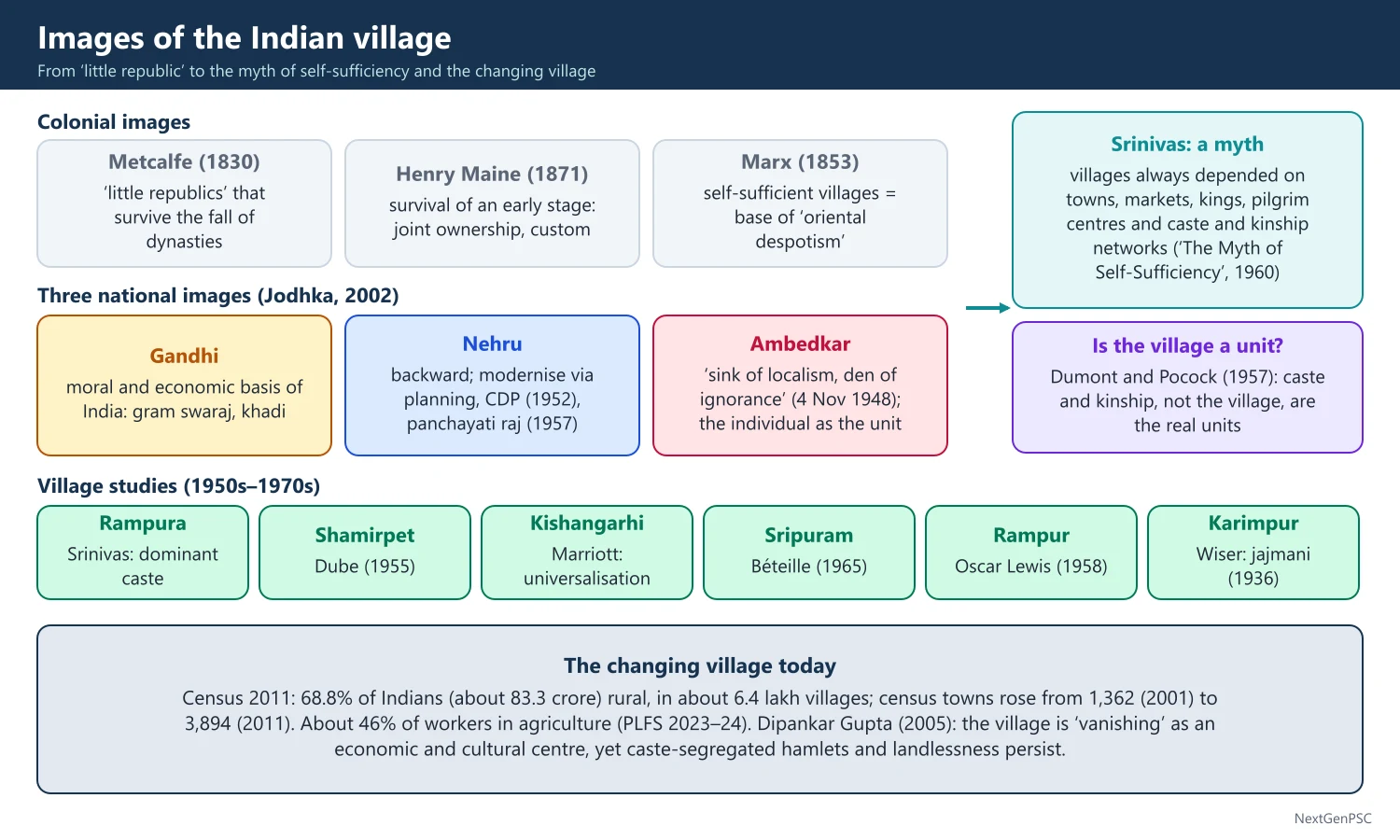
Little republics: Charles Metcalfe (1830, in evidence to a parliamentary Select Committee published in 1832) described village communities as little republics with nearly everything they want within themselves, surviving the fall of dynasties.
Henry Maine (Village Communities in the East and West, 1871) saw the Indian village as a survival of an early stage of social evolution, based on joint ownership and custom.
Marx (‘The British Rule in India’, 1853) saw self-sufficient villages as the base of ‘oriental despotism’ and stagnation, which British rule was breaking.
Baden-Powell (B.H., The Indian Village Community, 1896) distinguished raiyatwari villages from joint or landlord villages.
Gandhi: the village as the moral and economic basis of India; gram swaraj, self-reliant village republics and khadi (Hind Swaraj, 1909; Village Swaraj, compiled 1962).
Ambedkar: in the Constituent Assembly (4 November 1948) he called the village a sink of localism and a den of ignorance, narrow-mindedness and communalism, and welcomed the individual rather than the village as the unit of the Constitution.
Nehru: saw the village as backward and in need of modernisation through planning, community development (1952) and panchayati raj (Balwantrai Mehta Committee, 1957).
Surinder Jodhka (‘Nation and Village’, 2002) showed how these three images of Gandhi, Nehru and Ambedkar shaped policy.
2. The myth of self-sufficiency
M.N. Srinivas (‘The Myth of Self-Sufficiency of the Indian Village’, 1960) argued that villages always depended on towns, markets, kings, pilgrim centres and caste and kinship networks spread over many villages.
Village exogamy in north India, regional caste councils and weekly markets (haats) all show that the village was never a closed unit.
Village as a unit of study: Louis Dumont and David Pocock (Contributions to Indian Sociology, 1957) argued that the village is not a sociological reality in itself; caste and kinship, which cut across villages, are the real units.
Srinivas and Dube replied that the village has a real identity for its people (village loyalty, boundaries, common deities and the village panchayat), so it is a valid unit though not an isolated one.
3. The village studies (1950s–1970s)
Why then: after independence planners needed knowledge of rural India for community development; anthropologists trained in fieldwork turned from tribes to peasants.
Edited volumes (1955): Village India (ed. McKim Marriott), India’s Villages (ed. M.N. Srinivas) and Rural Profiles (ed. D.N. Majumdar).
Rampura (Srinivas): dominant caste, Sanskritisation, patron–client ties; The Remembered Village (1976).
Shamirpet: S.C. Dube, Indian Village (1955), a complete picture of a village near Hyderabad, with its castes, family, economy and ritual; India’s Changing Villages (1958) studied community development.
Kishangarhi (McKim Marriott, 1955): Aligarh district; universalisation and parochialisation between little and great traditions.
Rampur (Oscar Lewis, Village Life in Northern India, 1958): a Jat-dominated village near Delhi; village exogamy and factions.
Sripuram (André Béteille, Caste, Class and Power, 1965): Tanjore; caste, class and power, once overlapping under Brahmin dominance, were becoming separate.
Karimpur (William Wiser, The Hindu Jajmani System, 1936): the jajmani system of exchange of services between castes; revisited by Susan Wadley (1994).
Wangala and Dalena: T. Scarlett Epstein (1962) compared an irrigated village with a dry village in Karnataka to show how irrigation changed economy and social ties.
Others: F.G. Bailey (Bisipara, Odisha, 1957), Adrian Mayer (Ramkheri, Madhya Pradesh, 1960), Kathleen Gough (Kumbapettai, Thanjavur) and Jan Breman (Patronage and Exploitation, 1974, on Halpati labourers in south Gujarat).
4. Contributions of village studies
They established fieldwork and participant observation as the core method of Indian sociology and replaced the book view with the field view.
They produced key concepts: dominant caste, Sanskritisation, jajmani system, factions, universalisation and parochialisation.
They documented social change: land reform, adult franchise, panchayats, education and migration.
5. Criticism of village studies
Functionalist bias: many studies stressed harmony and integration through jajmani ties and ignored exploitation; Marxists (Desai, Gough) and Breman showed patronage as domination.
Upper-caste, male viewpoint: researchers relied on dominant-caste male informants; women and Dalits were seen through others’ eyes (Leela Dube and feminist critics).
Representativeness: a single village cannot stand for India; the studies were small, scattered and hard to generalise.
Ahistorical snapshots: most studies captured one moment; revisits (Epstein’s return to Wangala and Dalena, Wadley’s Karimpur) showed how much had changed.
6. The changing village today
Census 2011: 68.8% of Indians (about 83.3 crore) lived in rural areas, in about 6.4 lakh villages; the number of census towns rose from 1,362 (2001) to 3,894 (2011), showing villages turning semi-urban.
Agriculture’s declining hold: about 46% of workers were in agriculture in PLFS 2023–24, but its share of output is far smaller, and rural households depend more on non-farm work, wages and remittances.
Dipankar Gupta (‘Whither the Indian Village’, 2005) argued that the village is ‘vanishing’ as an economic and cultural centre: young people want to leave farming, and caste hierarchy weakens as dependence on the dominant landowner falls.
Policies reshaping villages: the 73rd Amendment (1992) with one-third (in many states one-half) seats for women in panchayats; PMAY-Gramin housing; SVAMITVA property cards (launched 24 April 2020); and the VB-G RAM G Act 2025, which replaced MGNREGA from 1 July 2026 with a 125-day work guarantee.
Continuing inequality: caste-segregated hamlets, atrocities on Dalits (57,789 cases of crimes against SCs in NCRB Crime in India 2023) and landlessness show the old hierarchy has not vanished.
7. Linking thinkers
Tönnies and Redfield: the village as gemeinschaft or folk society; Redfield’s Peasant Society and Culture (1956) called peasant society a ‘part society’ linked to a wider civilisation, which fits Srinivas’s critique of self-sufficiency.
Marx: the stagnant village thesis is contested by village studies showing constant change and market links.
Wallerstein and Frank: villages as peripheries supplying labour and raw materials to cores, a frame used to study migration from villages to cities.
8. Using it in the exam
10 marks: contrast the colonial and Gandhian images with Ambedkar’s and Srinivas’s critique of self-sufficiency.
15 marks: name four village studies with their concepts, then the Dumont–Pocock versus Srinivas debate.
20 marks: assess the contribution and limits of village studies and show today’s changing village with Census 2011 and PLFS data and Dipankar Gupta’s argument.
Diagram idea: concentric circles showing the village linked outward to caste networks, market town, district, state and global economy.
Useful line: Srinivas argued that the self-sufficiency of the Indian village was a myth, since villages were always tied to wider networks (paraphrase).
| Village (region) | Scholar, work (year) | Key finding or concept |
|---|---|---|
| Rampura (Mysore) | M.N. Srinivas, The Remembered Village (1976) | Dominant caste, Sanskritisation |
| Shamirpet (Hyderabad) | S.C. Dube, Indian Village (1955) | Holistic account of village structure |
| Kishangarhi (Aligarh) | McKim Marriott (1955) | Universalisation and parochialisation |
| Sripuram (Tanjore) | André Béteille, Caste, Class and Power (1965) | Caste, class and power separating |
| Rampur (Delhi) | Oscar Lewis, Village Life in Northern India (1958) | Factions, village exogamy |
| Karimpur (Uttar Pradesh) | William Wiser, The Hindu Jajmani System (1936) | Jajmani exchange of services |
Mains points
- Begin with contrasting images (Metcalfe, Gandhi, Ambedkar, Nehru) and then show how sociology tested them in the field.
- Name village studies accurately with scholar, village and year; a table is the quickest way.
- Present the debate on the village as a unit of study (Dumont–Pocock versus Srinivas–Dube).
- Criticise the studies from Marxist, feminist and Dalit angles, and note the value of revisits.
- Bring current data: Census 2011 rural share and census towns, PLFS 2023–24 agricultural workforce, NCRB 2023 atrocities.
- Conclude with Dipankar Gupta’s ‘vanishing village’ and the rise of rurban areas.
Did you know?
- Ambedkar’s ‘den of ignorance’ remark about the village caused uproar in the Constituent Assembly, yet Article 40 (organising village panchayats) was added as a Directive Principle as a compromise with the Gandhian view.
Agrarian Social Structure: Land Tenure and Land Reforms
British rule created three land tenure systems (zamindari, ryotwari and mahalwari) that commercialised land and strengthened landlords and moneylenders. After 1947 land reforms abolished intermediaries, regulated tenancy, imposed ceilings and consolidated holdings, but outcomes were uneven: zamindari abolition succeeded broadly, while tenancy and ceiling laws were weakened by loopholes, except in states such as Kerala and West Bengal.
In simple words
Land tenure means the rules about who owns land, who farms it and who takes the rent.
The British made landlords collect revenue, so tillers often paid heavy rent, like a tenant paying a middleman more than the flat is worth.
After independence land reforms tried to give land to the tiller, with mixed success.
UPSC asks how land tenure evolved, why land reforms only partly succeeded and how they changed rural class and caste.
1. Concepts
Agrarian social structure: the pattern of relations among groups based on control of land and labour: landlords, owner-cultivators, tenants, sharecroppers and agricultural labourers.
Land tenure: the legal and customary rights by which land is held, used and transferred, and the obligations (rent, revenue) attached.
Land reform: state action to redistribute rights in land, usually to the tiller, through abolition of intermediaries, tenancy reform, ceilings and redistribution, and consolidation.
2. Pre-colonial and colonial land systems
Pre-colonial: the king had a share of the produce; rights were layered (cultivators, village headmen, revenue intermediaries); land was not a freely saleable commodity in most areas.
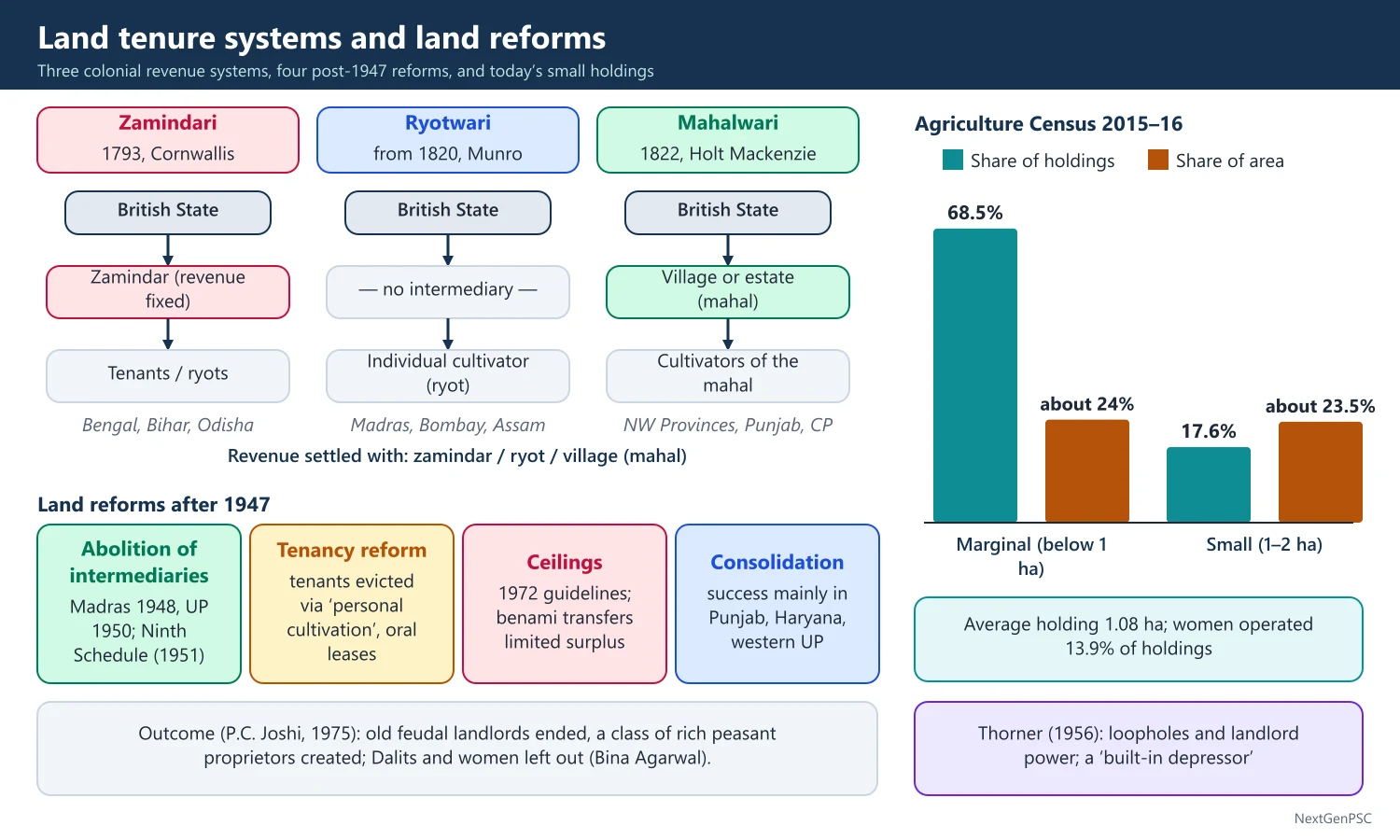
Zamindari (Permanent Settlement, 1793, Lord Cornwallis): in Bengal, Bihar and Odisha zamindars became owners who paid a fixed revenue; they raised rents freely and sub-infeudation created many layers of intermediaries.
Ryotwari (Thomas Munro, Madras, from 1820; also Bombay): revenue settled directly with the cultivator (ryot), but high assessments drove many into debt and land loss to moneylenders.
Mahalwari (Holt Mackenzie, 1822; North-Western Provinces, Punjab): revenue settled with the village or estate (mahal) as a whole.
Inams and jagirs: revenue-free grants to temples, officials and nobles formed another layer of intermediaries, abolished after 1947.
Effects: land became a commodity; commercialisation of crops (indigo, cotton, jute); rise of absentee landlords and moneylenders; growth of tenancy, sharecropping and landless labour; famines (Bengal 1943 as a late case).
Caste and land: upper and dominant castes held land, while Dalits were largely landless labourers, often in bonded relations; tribals lost land to outsiders.
3. Land reforms after independence
Abolition of intermediaries: beginning with the Madras Estates (Abolition and Conversion into Ryotwari) Act 1948 and the Uttar Pradesh Zamindari Abolition and Land Reforms Act 1950; largely completed by the 1960s; the First Amendment (1951) created the Ninth Schedule to protect these laws from court challenge.
Tenancy reform: security of tenure, regulation of rent (often not more than one-fourth or one-fifth of produce) and ownership rights for tenants; many landlords evicted tenants by claiming ‘personal cultivation’ or pushed tenancy underground as oral leases.
Ceiling on holdings: first round of laws in the late 1950s and 1960s; national guidelines of 1972 lowered ceilings (roughly 10–18 acres of irrigated land); benami transfers, family partitions and exemptions for orchards and ‘efficient farms’ limited the surplus.
Consolidation of holdings: successful mainly in Punjab, Haryana and western Uttar Pradesh, helping the Green Revolution.
Bhoodan and Gramdan: Vinoba Bhave’s voluntary land-gift movement began at Pochampally, Telangana, in 1951; much donated land was poor or never distributed.
Reasons for limited success: weak political will, landlord control of local politics and the bureaucracy, poor land records, court challenges and weak organisation of the rural poor.
4. Success stories
Kerala: the Kerala Land Reforms (Amendment) Act 1969, implemented from 1970, abolished tenancy and gave ownership to lakhs of tenants and homestead rights to kudikidappukars (hutment dwellers), backed by strong peasant mobilisation.
West Bengal: Operation Barga (from 1978) recorded sharecroppers (bargadars), giving them security and a fixed share of the crop.
Jammu and Kashmir: the Big Landed Estates Abolition Act 1950 transferred land to tillers without compensation.
Struggle from below: the Telangana armed struggle (1946–51) and later Naxalite movements forced land redistribution onto the political agenda.
5. Sociological assessment
Daniel Thorner (The Agrarian Prospect in India, 1956) showed how loopholes and landlord power blunted reform; he described a ‘built-in depressor’ in the agrarian structure that discouraged investment by both landlords and tenants.
Joshi (P.C.) (Land Reforms in India, 1975) argued that reforms ended the old feudal landlords but created a class of rich peasant proprietors.
Green Revolution: new technology from the mid-1960s turned many rich peasants into capitalist farmers, raised demand for wage labour and widened class and regional inequality (Francine Frankel, India’s Green Revolution, 1971).
Rise of middle and dominant peasant castes: Jats, Yadavs, Kurmis, Marathas, Patidars, Vokkaligas and Reddys gained ownership and later political power (Srinivas’s dominant caste; Charan Singh’s politics).
Dalits and women left out: Dalits remained mostly landless labourers; Bina Agarwal (A Field of One’s Own, 1994) showed that women rarely gained independent land rights.
Political economy: Marxists (A.R. Desai) argued the state served landed interests; Gunnar Myrdal (Asian Drama, 1968) called India a ‘soft state’ unable to enforce reform.
6. Agrarian structure today (data)
Agriculture Census 2015–16: about 14.6 crore operational holdings; marginal holdings (below 1 hectare) were 68.5% of holdings on about 24% of the area; small and marginal together 86.2%; average holding 1.08 hectares (down from 1.15 in 2010–11); women operated 13.9% of holdings. Results of the 2021–22 census were not yet fully published at the time of writing.
Situation Assessment Survey (NSS 77th round, 2019): average monthly income of an agricultural household was about ₹10,218, and about half (50.2%) of agricultural households were in debt.
Distress: NCRB’s Accidental Deaths and Suicides in India 2023 recorded 10,786 suicides in the farm sector (4,690 farmers or cultivators and 6,096 agricultural labourers).
Women and land: NFHS-5 (2019–21) found that 43.3% of women aged 15–49 owned a house or land alone or jointly, but sole ownership of farm land by women remains rare.
Newer policy: NITI Aayog’s Model Agricultural Land Leasing Act (2016) to legalise tenancy; Digital India Land Records Modernisation Programme; SVAMITVA (2020) for rural homestead records; PM-KISAN (2019) income support of ₹6,000 a year to landholding families, which leaves out tenants.
7. Linking thinkers
Marx: primitive accumulation and the separation of producers from land; the mode of production debate on whether Indian agriculture became capitalist after the Green Revolution.
Weber: class as market situation; tenants and labourers with weak bargaining power in local land and labour markets.
Barrington Moore: India’s failure to carry out a thorough agrarian revolution explains persistent rural poverty within a democracy (Social Origins of Dictatorship and Democracy, 1966).
8. Using it in the exam
10 marks: outline the three colonial tenure systems and their social effects.
15 marks: list the four components of land reform with laws and years, and judge the outcome of each.
20 marks: analyse how land reform changed caste and class (rise of dominant peasant castes, continued Dalit landlessness, gender gap), with Thorner, Joshi and Bina Agarwal and the latest data.
Diagram idea: a ladder of agrarian classes before and after reform: zamindar → (abolished); tenant → owner-cultivator; labourer → still labourer.
Useful line: Thorner saw a built-in depressor in Indian agriculture, where landlords lived on rent and usury rather than investment (paraphrase).
| System | Introduced (by whom) | Revenue settled with | Main regions |
|---|---|---|---|
| Zamindari | 1793, Cornwallis (Permanent Settlement) | Zamindar | Bengal, Bihar, Odisha |
| Ryotwari | From 1820, Thomas Munro | Individual cultivator (ryot) | Madras, Bombay, Assam |
| Mahalwari | 1822, Holt Mackenzie | Village or estate (mahal) | North-Western Provinces, Punjab, Central Provinces |
| Size class | Share of holdings | Share of operated area |
|---|---|---|
| Marginal (below 1 ha) | 68.5% | about 24% |
| Small (1–2 ha) | 17.6% | about 23.5% |
Mains points
- Trace the evolution: pre-colonial layered rights → colonial systems → post-1947 reforms → present tenancy and fragmentation; examiners want this sequence.
- Treat land reform sociologically: who gained (middle peasant castes) and who did not (Dalits, women, tribals), not only as economic policy.
- Use Kerala and West Bengal as success cases and explain why (political will, peasant mobilisation, records).
- Quote Thorner, P.C. Joshi and Bina Agarwal; mention the mode of production debate for depth.
- Give current data with years: Agriculture Census 2015–16, NSS SAS 2019, NCRB ADSI 2023.
- Avoid the common mistake of saying land reforms failed completely; zamindari abolition largely succeeded.
Did you know?
- The first donation of Bhoodan came on 18 April 1951 at Pochampally, when V. Ramachandra Reddy offered 100 acres to Vinoba Bhave for landless Dalit families.
UPSC Previous Year Questions: Rural and Agrarian Social Structure
From 2014 to 2026 UPSC asked 18 question parts carrying 250 marks from this chapter in Paper II. The most-asked topics are The Idea of the Indian Village and Village Studies (11 parts) and Agrarian Social Structure: Land Tenure and Land Reforms (7 parts). Every question below has a model answer written to the UPSC word limit: about 150 words for 10 marks and 250 words for 20 marks.
In simple words
First read the question and write your own answer in the time UPSC gives (about 7 minutes for 10 marks and 11 minutes for 20 marks).
Then compare it with the model answer: check the approach, the thinkers and studies used, the Indian data and the conclusion.
Note what you missed and revise that topic in the notes before trying the next question.
1. The Idea of the Indian Village and Village Studies
Example 1 (UPSC 2026, 20 marks): Examine the challenges of applying micro-level village studies to macro-level village structure of Indian society.
Paper and question: Paper II, Q3(a)
Approach: Examine the micro–macro problem: the value of micro village studies, then the challenges of generalising (diversity, representativeness, wider structures, change, method), with critics, and suggest ways to bridge micro and macro.
Indian village studies are micro-level accounts of single villages based on intensive fieldwork, such as Srinivas's Rampura or Dube's Shamirpet. Their value lies in depth: they show how caste, kinship, power and ritual actually operate. The challenge is to move from such cases to a macro-level picture of rural India's structure.
The first challenge is diversity. India has over six lakh villages (Census 2011) that differ by region, ecology, caste composition, tenure history and tribal or non-tribal character. A Brahmin-dominated Tanjore village and a Jat village in Haryana show very different structures.
Second, villages are shaped by forces beyond them: markets, the state, caste and kinship networks, and migration. Dumont and Pocock argued that the village was not a sociological reality in itself, since caste and kinship extend across villages. Third, representativeness: most classic studies chose accessible, multi-caste villages, often seen through the eyes of the dominant caste.
Fourth, time: findings from the 1950s may not hold after land reform, the Green Revolution, liberalisation and digital connectivity. Fifth, method: qualitative data from one site cannot be added up statistically, while macro surveys miss meanings.
Flow chart: Micro village study (depth) → limits: diversity, external links, bias, time → bridging: comparative and multi-sited studies, restudies, linking with Census, NSS and NFHS data → macro picture.
These challenges can be met by comparative studies across regions, as in Marriott's Village India, restudies over time, and by combining fieldwork with large surveys. Micro and macro are complementary: village studies explain the mechanisms that national data can only measure.
Example 2 (UPSC 2025, 20 marks): Who is said to be the pioneer of village studies in India? Illustratively describe contributions of some Indian sociologists on village studies. How their approaches are distinct from each other?
Paper and question: Paper II, Q4(a)
Approach: Three parts: identify the pioneers (early economic surveys of Mann and Slater; in sociology Srinivas and Dube), describe contributions of several sociologists with their villages and concepts, then compare their distinct approaches.
The earliest systematic village surveys were economic: Harold Mann's Land and Labour in a Deccan Village (1917) and Gilbert Slater's Some South Indian Villages (1918). In sociology, M.N. Srinivas is generally regarded as the pioneer of village studies, through his Rampura fieldwork (1948) and the volume India's Villages (1955), along with S.C. Dube, whose Indian Village (1955) was among the first full monographs by an Indian sociologist.
Srinivas studied Rampura near Mysore with a structural-functional approach, giving the concepts of dominant caste and Sanskritisation and, later, The Remembered Village (1976). Dube's Shamirpet study was holistic and descriptive, and his India's Changing Villages (1958) applied sociology to evaluate community development.
André Béteille's Sripuram study, Caste, Class and Power (1965), used a Weberian framework to show the shift from cumulative to dispersed inequality. Kathleen Gough's studies of Kumbapettai in Tanjore took a Marxist view of class conflict. Among foreign scholars, McKim Marriott's Kishangarhi gave universalisation and parochialisation, and Oscar Lewis's Rampur stressed factions and kinship.
Flow chart: Srinivas: structure and function → dominant caste. Dube: holistic description + applied evaluation. Béteille: Weberian caste, class, power. Gough: Marxist class conflict. Marriott: cultural interaction of great and little traditions.
Their approaches differ in focus and theory. Srinivas emphasised integration and caste mobility; Dube, the village's links with the state and planning; Béteille, the multiple dimensions of stratification; Gough, exploitation; and Marriott, cultural processes. Together they show that the same village can be read as a system of harmony, of hierarchy, of class or of culture, and the best analysis combines them.
Example 3 (UPSC 2023, 10 marks): “The decade of 1950s was the golden period of village studies in Indian Sociology.” Explain the statement.
Paper and question: Paper II, Q1(b)
Approach: Explain why the 1950s are called the golden period: the major monographs and collections, the reasons (new nation, planning, anthropology's influence) and their contribution, with a line on limits.
The 1950s are called the golden period of village studies because a remarkable number of influential village monographs appeared in that decade, making the village the main site of Indian sociology.
In 1955 alone came S.C. Dube's Indian Village, M.N. Srinivas's edited India's Villages and McKim Marriott's edited Village India. These were followed by F.G. Bailey's Caste and the Economic Frontier (1957), Oscar Lewis's Village Life in Northern India (1958), Dube's India's Changing Villages (1958) and Adrian Mayer's Caste and Kinship in Central India (1960).
The reasons were the new nation's interest in rural development and the Community Development Programme (1952), the influence of British and American social anthropology, and funding for fieldwork. These studies gave the field-view, concepts such as dominant caste and Sanskritisation, and data on change.
Their functionalist bias was later criticised, but they remain the foundation of Indian rural sociology.
Example 4 (UPSC 2023, 20 marks): Do you agree with the view of Andre Beteille that India's villages are representative of Indian society's basic civilizational values? Present a sociological overview.
Paper and question: Paper II, Q2(a)
Approach: Give a sociological overview: present the view that villages embody civilisational values (hierarchy, holism, little and great tradition links) with Béteille, Srinivas, Marriott and Redfield, then the counter-views (Dumont, Ambedkar, Marxists, change), and take a balanced position.
The view that India's villages are a microcosm of its civilisation holds that the basic values of Indian society, such as hierarchy, caste interdependence, religious ritual and family, are visible in miniature in village life. André Béteille, studying Sripuram, showed how the village reflected the wider hierarchy of caste, though he also showed it changing.
There is support for this view. Robert Redfield saw the village as a part-society carrying a little tradition linked to the great tradition. McKim Marriott in Kishangarhi showed universalisation, where local deities and rites are absorbed into Sanskritic Hinduism, and parochialisation, where great-tradition elements take local forms. Srinivas's Rampura displayed the jajmani system, purity and pollution, and the authority of elders, all core civilisational themes.
Flow chart: Great tradition (texts, values) ↔ little tradition (village rites) through universalisation and parochialisation → village as a part-society reflecting civilisational values → but also shaped by region, class and the state.
There are strong counter-arguments. Louis Dumont and David Pocock held that caste and kinship, not the village, carry Indian values, since they extend across villages. Ambedkar saw the village as the site of caste oppression rather than civilisational virtue. Marxists such as Kathleen Gough stressed class exploitation. And India's diversity, with tribal, coastal and urban forms, means no single village can stand for all.
Change has also weakened the claim. Migration, non-farm work, Panchayati Raj and media mean that today's villages, as restudies such as Surinder Jodhka's show, are less bounded and less governed by ritual hierarchy.
I therefore agree only partly: villages do reveal core civilisational values, but as one level of a larger society that is plural, unequal and changing.
Example 5 (UPSC 2022, 10 marks): Discuss the challenges during village studies in India.
Paper and question: Paper II, Q4(c)
Approach: Discuss the challenges of village studies: access and the insider–outsider problem, dominant-caste and gender bias, representativeness, changing villages, ethics and time; end with remedies.
Village studies rely on long participant observation in one village, and their challenges are recorded in reflections such as The Fieldworker and the Field (1979), edited by Srinivas, Shah and Ramaswamy.
First, access and identity: a researcher's caste, gender and class shape whom they can meet. Srinivas lived among the dominant Okkaligas, and André Béteille, as an outsider, faced suspicion in Sripuram. Second, bias: the view from the dominant caste can hide the voices of Dalits and women. Third, representativeness: one village cannot represent a diverse country. Fourth, villages are no longer bounded, because migration, markets and media link them to cities, so a village-only frame misses much.
There are also ethical issues of consent and privacy, factional pressure, and the long time and cost that fieldwork demands.
These can be reduced through team research, restudies, multi-sited work and combining fieldwork with surveys.
Example 6 (UPSC 2021, 10 marks): Critically examine briefly the phrase “Little Republics” as used to denote India's villages.
Paper and question: Paper II, Q1(d)
Approach: Explain the origin of the phrase (Metcalfe, 1830) and its use by Maine, Marx and Gandhi, then critically examine it with evidence from village studies and Ambedkar.
The phrase ‘little republics’ comes from Sir Charles Metcalfe's minute of 1830, which described Indian villages as self-sufficient communities that survived the fall of dynasties unchanged. Henry Maine and Karl Marx used the same image of a static village community, and Gandhi idealised it as the basis of gram swaraj.
The image is misleading. Villages paid revenue to states, traded in regional markets and were linked by caste, kinship and pilgrimage networks, as Srinivas, Dube and Marriott showed. Dumont and Pocock argued the village was not a self-contained social unit. Internally, the village was not a republic of equals but a hierarchy dominated by landowning castes.
Ambedkar, in the Constituent Assembly in November 1948, called the village a sink of localism and a den of ignorance and communalism.
The phrase thus reflects a colonial and romantic construction rather than reality, though the 73rd Amendment (1992) has revived the idea of village self-government in a democratic form.
Example 7 (UPSC 2020, 10 marks): “Indian rural society is a faction-ridden society.” Discuss.
Paper and question: Paper II, Q2(c)
Approach: Explain factions (vertical, multi-caste groups based on kinship and patronage) with village studies (Lewis, Dube, Srinivas), their causes and functions, and qualify the statement.
A faction is a loosely organised, vertical group led by a patron and held together by kinship, economic dependence and political interest, competing with rival groups for power and prestige. Unlike caste, factions usually cut across caste lines.
Village studies found factions widespread. Oscar Lewis in Rampur near Delhi (1958) described factions as the basic political units within the Jat caste. Srinivas in Rampura and Dube in Shamirpet noted disputes over land, inheritance and honour that split villages. After 1959, Panchayati Raj elections and later party politics sharpened factional rivalry.
Yet ‘faction-ridden’ is an overstatement. Factions coexist with cooperation in festivals, labour exchange and crises, and as F.G. Bailey and Ralph Nicholas showed, they also link villagers to wider politics.
So factionalism is an important but not the only feature of rural society.
Example 8 (UPSC 2019, 20 marks): Critically examine Dube's contributions to the study of Indian villages.
Paper and question: Paper II, Q2(a)
Approach: Critically examine: describe Dube's Indian Village (Shamirpet, 1955) and India's Changing Villages (1958) and his main contributions, then the criticisms, and conclude on his place in village studies.
S.C. Dube (1922–1996) was among the first Indian sociologists to write a full monograph on a village. His Indian Village (1955) studied Shamirpet near Hyderabad as part of a multidisciplinary project of Osmania University, and his India's Changing Villages (1958) studied the impact of community development in western Uttar Pradesh.
His first contribution was a holistic description of village life: its social structure of Hindu and Muslim castes, economy, ritual, family and the life cycle. He showed that the village had a distinct identity and that intercaste relations were governed by both hierarchy and mutual dependence.
Second, he stressed that the village was not isolated. Shamirpet was linked to Hyderabad city through markets, administration and communication, challenging the colonial image of self-sufficient republics. Third, he was a pioneer of applied sociology: India's Changing Villages showed that community development benefited richer, upper-caste farmers more, that officials were seen as outsiders, and that change depended on the cultural fit of programmes. His concept of a gap between the village and officials influenced planning.
He also wrote on modernisation and development, later criticising Western models in Modernization and Development: The Search for Alternative Paradigms (1988).
The criticisms are that his descriptive, functionalist approach underplayed conflict and exploitation; that a single village cannot represent India; and that the views of women and Dalits received less space. Marxists such as A.R. Desai saw community development itself as strengthening rural elites.
Even so, Dube's work set the template for holistic and policy-relevant village studies and remains a key source on rural change.
Example 9 (UPSC 2018, 10 marks): Give a critical analysis of Andre Beteille's study of Tanjore village.
Paper and question: Paper II, Q1(b)
Approach: Summarise Béteille's Caste, Class and Power (1965) on Sripuram: its argument on cumulative to dispersed inequality, then give a critical assessment.
André Béteille's Caste, Class and Power: Changing Patterns of Stratification in a Tanjore Village (1965) studied Sripuram in Tamil Nadu, using Weber's three dimensions of caste (status), class and power.
He found that in the past these were cumulative: Brahmins held ritual rank, land and power together. With land sales, education, new occupations and adult franchise, they became dispersed. Brahmins moved to towns, non-Brahmins bought land, and non-Brahmin parties and leaders took over the village panchayat. The relationship between caste, class and power thus changed from congruence to separation, though caste still influenced both.
The study was praised for its Weberian multi-dimensional method. Critics note that Sripuram, a Brahmin-dominated village, may not represent India; that Adi-Dravida labourers received less attention; and that Kathleen Gough found sharper class conflict in nearby Tanjore villages.
Still, it remains the best account of how democracy and markets separated caste from class and power.
Example 10 (UPSC 2016, 10 marks): Significance of Village Studies in Indian Sociology
Paper and question: Paper II, Q1(b)
Approach: State why village studies matter: they gave the field-view, key concepts, data on caste, class and change, and policy inputs; add a line on limits.
Village studies, intensive fieldwork-based accounts of single villages, flourished in the 1950s with works such as S.C. Dube's Indian Village (1955), Srinivas's edited India's Villages (1955) and Marriott's Village India (1955).
Their significance is fourfold. They replaced the book-view with the field-view, showing how caste works in practice. They produced key concepts: Sanskritisation and dominant caste (Srinivas), universalisation and parochialisation (Marriott), and the shift of power from caste to class (Béteille). They recorded change after independence, such as the effects of land reform, adult franchise and community development. And they gave planners data on rural life.
Critics noted a functionalist bias and doubtful representativeness of single villages.
Even so, village studies made fieldwork the foundation of Indian sociology, and restudies of the same villages today allow us to measure long-term change.
Example 11 (UPSC 2014, 10 marks): What is the idea of 'Indian village'? Explain.
Paper and question: Paper II, Q4(c)
Approach: Explain the different ideas of the Indian village (colonial little republic, Gandhi, Ambedkar, sociological village studies) and conclude with the modern view.
The ‘idea of the Indian village’ refers to the images through which the village has been understood as the basic unit of Indian society. It has been imagined in very different ways.
Colonial administrators such as Charles Metcalfe (1830) called villages little republics, self-sufficient and unchanging; Henry Maine and Marx built on this image of a static village community. Gandhi idealised the village as the basis of swaraj and gram swaraj, while Ambedkar called it a sink of localism and a den of ignorance and communalism.
Village studies of the 1950s by M.N. Srinivas, S.C. Dube and McKim Marriott showed the village as a real social unit with identity, but linked to markets, castes and the wider civilisation through the great and little traditions. Dumont and Pocock argued that caste and kinship, not the village, were the real units.
Today the village is seen as an open, changing unit shaped by migration, markets and the state, not an isolated republic.
2. Agrarian Social Structure: Land Tenure and Land Reforms
Example 12 (UPSC 2026, 10 marks): When land reform was a paradigm shift, then what type of land reforms would you recommend to make India a more equitable society?
Paper and question: Paper II, Q3(c)
Approach: Note briefly why land reform was a paradigm shift, then recommend a set of new land reforms for equity (records and titling, tenancy, women's rights, landless and Dalits, tribals, collectives), with reasons.
Post-1947 land reform was a paradigm shift because it ended zamindari and made land the right of the tiller. But fragmentation, landlessness and gender gaps remain, so a second generation of reforms is needed.
I would recommend, first, conclusive land titling based on digitised records, building on the Digital India Land Records Modernisation Programme and SVAMITVA, to cut disputes and benami holdings. Second, legal and recorded tenancy on the lines of the Model Agricultural Land Leasing Act (2016), so that sharecroppers can access credit and insurance.
Third, joint titles for women and enforcement of the Hindu Succession (Amendment) Act 2005. Fourth, homestead land for landless Dalits, as Kerala did. Fifth, full implementation of the Forest Rights Act 2006 for tribals. Sixth, cooperative farming and Farmer Producer Organisations to overcome small holdings.
Together these would shift land reform from redistribution alone to secure and equal access to land.
Example 13 (UPSC 2024, 20 marks): Identify different forms of inequalities associated with agrarian social structure in India.
Paper and question: Paper II, Q8(b)
Approach: Identify the forms of inequality in agrarian structure (land, caste, class and labour, tenancy, gender, credit and technology, region) with data and studies (Thorner, Béteille), and conclude.
The agrarian social structure is the pattern of relations among groups based on land ownership, control and labour. Daniel Thorner classified rural India into maliks (landowners), kisans (working peasants) and mazdoors (labourers), and André Béteille showed how caste and class overlap. Several forms of inequality mark this structure.
First, land inequality: the Agriculture Census 2015–16 found that marginal and small farmers held about 86% of holdings but only about 47% of the area. Second, landlessness: SECC 2011 found about 56% of rural households owned no land, and Census 2011 counted more agricultural labourers than cultivators.
Third, caste: land is concentrated among dominant peasant castes, while Dalits are mostly labourers; Dalits and tribals still face land disputes and atrocities over land. Fourth, tenancy: informal sharecroppers lack records and cannot access credit, insurance or PM-KISAN benefits easily. Fifth, gender: women do much farm work but held only about 14% of operational holdings in 2015–16.
Sixth, credit and technology: the NSS Situation Assessment Survey 2019 found about half of agricultural households indebted, with small farmers more dependent on moneylenders, while the benefits of the Green Revolution went mainly to larger irrigated farmers. Seventh, regional inequality between irrigated Punjab and rain-fed eastern and central India.
Flow chart: Unequal land ownership → caste overlap (dominant castes vs landless Dalits) → tenancy and gender exclusion → unequal access to credit, technology and schemes → cumulative rural inequality.
These inequalities reinforce each other. Reducing them needs secure tenancy, women's land rights, credit for small farmers and non-farm jobs.
Example 14 (UPSC 2023, 10 marks): Discuss the main features of Land Reforms in post-independence India.
Paper and question: Paper II, Q1(e)
Approach: List the main features of post-independence land reforms (objectives, four components, constitutional support, waves) briefly, with examples, and a one-line evaluation.
Land reforms in post-independence India aimed at land to the tiller, removing exploitation and raising productivity. Land being a state subject, states passed the laws, guided by the Five-Year Plans.
Their main features were: first, abolition of zamindari and other intermediaries, largely completed in the 1950s, as under the UP Zamindari Abolition and Land Reforms Act, 1950. Second, tenancy reform, giving security, regulated rent and ownership rights. Third, ceilings on holdings, revised under national guidelines in 1972, with surplus land given to the landless. Fourth, consolidation of fragmented plots, most successful in Punjab and Haryana.
The laws were protected by the Ninth Schedule from the First Amendment (1951), and supported by movements such as Bhoodan and by Operation Barga in West Bengal.
Overall, zamindari abolition succeeded but ceilings and tenancy reform were weakly enforced.
Example 15 (UPSC 2022, 20 marks): Explain how land reforms brought about desired agrarian transformation.
Paper and question: Paper II, Q4(b)
Approach: Explain the intended agrarian transformation, show where land reforms succeeded (end of zamindari, rise of owner-cultivators, Kerala and West Bengal) and where they fell short (ceilings, tenancy, landless, gender), and conclude on partial transformation.
The desired agrarian transformation after independence was to replace a semi-feudal structure of landlords, tenants and bonded labourers with a system of owner-cultivators, greater equality and higher productivity. Land reforms were the main instrument.
They brought real change in several ways. Zamindari abolition in the early 1950s ended intermediaries over most of India and gave ownership to millions of tenants. This created a strong class of owner-cultivators from middle castes, which, with the Green Revolution, invested in irrigation and technology. Srinivas called such groups dominant castes, and their rise shifted rural power, as seen in the farmers' movements of the 1980s.
In some states the transformation went further. Kerala's Land Reforms (Amendment) Act of 1969 abolished tenancy and gave homestead rights to labourers, contributing to its social development. West Bengal's Operation Barga (1978) gave sharecroppers recorded rights and a secure share of the crop, and Jammu and Kashmir's 1950 reform redistributed land without compensation.
Flow chart: Semi-feudal structure → zamindari abolition + tenancy and ceiling laws → owner-cultivators and dominant castes (success); evictions, benami land, landless Dalits (failure) → partial transformation.
But the transformation was incomplete. Ceiling laws yielded little surplus land; tenancy went underground; and the landless, mostly Dalits and tribals, gained little. Women own a small share of land; the Agriculture Census 2015–16 found only about 14% of operational holdings held by women. Fragmentation has also grown, with average holdings falling to 1.08 hectares in 2015–16.
Land reforms thus brought about a partial transformation: they ended feudalism and created a capitalist peasantry, but did not achieve the equality they promised.
Example 16 (UPSC 2019, 10 marks): Examine the changing initiatives of the land tenure system in India.
Paper and question: Paper II, Q1(c)
Approach: Trace the changing initiatives in land tenure: colonial systems, post-1947 reforms, and recent initiatives (leasing law, digital records, SVAMITVA, FRA), with a short assessment.
Land tenure refers to the terms on which land is held and used. In India it has changed through three phases of policy.
The colonial phase created the zamindari (Permanent Settlement, 1793), ryotwari and mahalwari systems, making land private property and producing landlordism and tenancy. After 1947, states abolished zamindari, passed tenancy and ceiling laws, and encouraged consolidation; the First Amendment (1951) placed these laws in the Ninth Schedule. Vinoba Bhave's Bhoodan movement (1951) sought voluntary gifts of land.
Recent initiatives shift from redistribution to security and markets: NITI Aayog's Model Agricultural Land Leasing Act (2016) to legalise tenancy, the Digital India Land Records Modernisation Programme, SVAMITVA (2020) property cards for rural homes, and the Forest Rights Act (2006) for forest dwellers.
Critics fear that the market-oriented shift may favour larger owners, so tenure security for tenants and women remains the key test.
Example 17 (UPSC 2016, 10 marks): Analyse the major components of Land Reform Acts. Show their effectiveness in curbing rural inequality.
Paper and question: Paper II, Q2(c)
Approach: List the components of land reform acts briefly and assess their effectiveness in reducing rural inequality with examples and data.
Land reform acts passed by states after 1950 had four major components: abolition of intermediaries (zamindari), tenancy reform (security of tenure, fair rent, ownership rights), ceilings on landholdings with distribution of surplus land, and consolidation of holdings.
Their effectiveness in curbing inequality was mixed. Zamindari abolition ended feudal landlordism and benefited occupancy tenants. Tenancy reform succeeded mainly in Kerala and West Bengal (Operation Barga); elsewhere evictions and concealed tenancy followed. Ceilings yielded little surplus land because of benami transfers and loopholes.
Inequality remains high. The Agriculture Census 2015–16 found marginal and small farmers held about 86% of holdings but only about 47% of the operated area, and SECC 2011 found about 56% of rural households owned no land.
Land reforms thus replaced feudal inequality with a new one centred on rich peasants, as Béteille and Thorner noted.
Example 18 (UPSC 2014, 20 marks): Describe the impact of land reforms on the peasants of Indian society.
Paper and question: Paper II, Q4(b)
Approach: Describe the components of land reform and their impact on different classes of peasants (tenants, owner-cultivators, rich peasants, sharecroppers, landless), with regional examples and studies; conclude on the mixed outcome.
Land reforms after independence aimed to end intermediaries and give land to the tiller. They had four components: abolition of zamindari in the early 1950s, tenancy reform, ceilings on holdings with redistribution of surplus land, and consolidation of fragmented holdings.
The impact on peasants was uneven. Zamindari abolition was the most successful: it removed a parasitic layer and made millions of occupancy tenants owners. The main gainers were upper and middle tenant castes such as Jats, Kurmis, Yadavs, Patidars and Reddys, who became owner-cultivators and, with the Green Revolution, a class of rich capitalist farmers. Daniel Thorner and P.C. Joshi noted that the reforms strengthened this rural middle stratum.
Tenancy reform often backfired. Landlords evicted tenants by claiming land for ‘personal cultivation’, and much tenancy went underground as oral leasing, leaving sharecroppers insecure. Exceptions were West Bengal's Operation Barga (1978), which recorded about 1.5 million sharecroppers, and Kerala's 1969 amendment, which abolished tenancy and gave hutment rights to labourers.
Ceiling laws had the weakest impact because of high limits, benami transfers and delays, so little land reached the landless, mostly Dalit labourers. Census 2011 found agricultural labourers (14.4 crore) outnumbering cultivators (11.9 crore).
Flow chart: Zamindari abolition → tenants become owners → rise of dominant peasant castes; weak tenancy and ceiling laws → eviction, concealed tenancy → landless remain poor.
Overall, land reforms transformed the agrarian structure by ending feudal landlordism, but, as Gunnar Myrdal and others observed, they benefited the middle peasantry more than the poorest.
Mains points
- Village-study questions recur almost every year: know the 1950s monographs by author, village and year (Srinivas's Rampura, Dube's Shamirpet, Marriott's Kishangarhi, Béteille's Sripuram, Lewis's Rampur, Mayer's Ramkheri, Bailey's Bisipara).
- The ‘idea of the village’ debate (Metcalfe's little republics, Maine, Marx, Gandhi vs Ambedkar, Dumont and Pocock) is the core of conceptual questions.
- Land reform answers need the four components (zamindari abolition, tenancy reform, ceilings, consolidation) with examples such as Operation Barga and Kerala, and data from the Agriculture Census and SECC.
- Examiners reward linking land reform to class and caste (Thorner, Béteille, rise of dominant peasant castes) rather than a purely economic answer.
- Recent questions ask for recommendations: end with current measures such as digitised land records, SVAMITVA, land leasing law and women's land rights.
Did you know?
- Srinivas's field notes on Rampura were burnt in a fire at Stanford in 1970, so he wrote The Remembered Village (1976) largely from memory.
Sociology Optional: All chapters
- Exam Pattern, Syllabus and Strategy
- Sociology: The Discipline
- Sociology as Science
- Research Methods and Analysis
- Sociological Thinkers: Marx and Durkheim
- Sociological Thinkers: Max Weber
- Sociological Thinkers: Parsons, Merton and Mead
- Stratification and Mobility
- Works and Economic Life
- Politics and Society
- Religion and Society
- Systems of Kinship
- Social Change in Modern Society
- Perspectives on the Study of Indian Society
- Impact of Colonial Rule on Indian Society
- Rural and Agrarian Social Structure
- Caste System
- Tribal Communities in India
- Social Classes in India
- Kinship, Family and Religion in India
- Visions of Social Change in India
- Rural and Agrarian Transformation in India
- Industrialisation and Urbanisation in India
- Politics and Society in India
- Social Movements in Modern India
- Population Dynamics
- Challenges of Social Transformation