
Sociology Optional · UPSC Notes
Rural and Agrarian Transformation in India — UPSC Sociology Optional Notes
Free, exam-focused notes for UPSC Prelims and Mains, with Prelims tips and Mains points for every topic. 4 topics.
Open in the interactive reader: bookmarks, progress tracking and read-aloud.
Rural Development: Community Development, Cooperatives and Poverty Alleviation
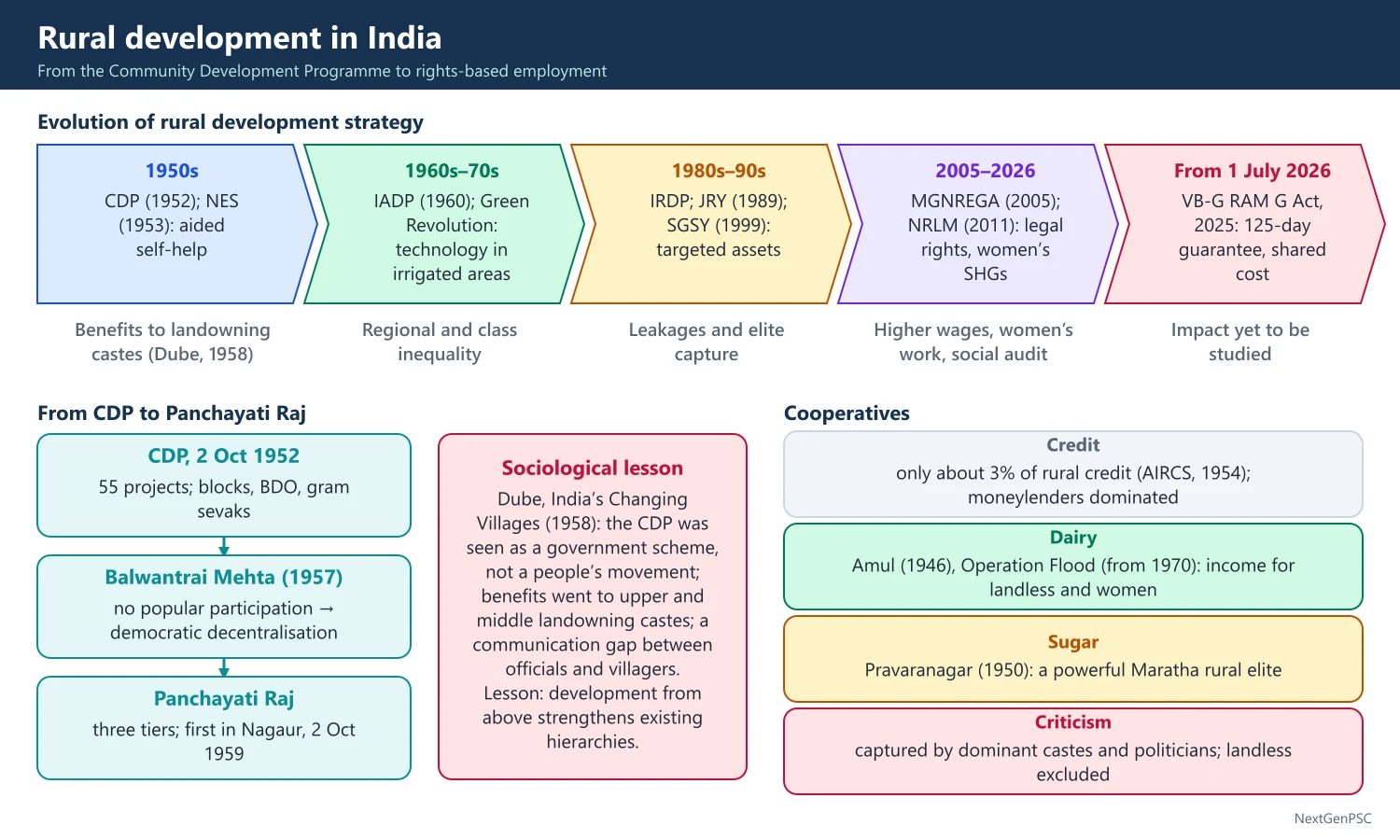
Rural development in India began with the Community Development Programme (1952), moved through cooperatives, the Green Revolution and targeted poverty alleviation schemes, and reached rights-based employment under MGNREGA (2005), now replaced from 1 July 2026 by the VB-G RAM G Act, 2025. Sociologists ask who benefited: village studies show that the dominant castes and richer peasants often captured the gains, while women's self-help groups and wage guarantees opened new spaces for the poor.
In simple words
Rural development means government efforts to improve life in villages: roads, credit, jobs, houses and schools.
Picture a village well dug by the government: if the landlord controls who draws water, the poorest still go thirsty.
That is why sociologists study not just schemes but village power structures, caste and gender, which decide who actually benefits.
UPSC asks you to assess these programmes and their social impact.
1. Concepts and definitions
Rural development: a strategy to improve the economic and social life of the rural poor, including small farmers, tenants and the landless (World Bank's 1975 definition is widely used).
Community development: a method by which people's own efforts are joined with government help to improve village conditions; India's programme was inspired by Albert Mayer's Etawah pilot project (1948) in Uttar Pradesh.
Cooperative: a voluntary association of people who pool resources for mutual benefit on democratic lines (one member, one vote); the Co-operative Credit Societies Act of 1904 began the movement in India.
Poverty alleviation: programmes that raise the incomes or consumption of the poor directly, either by giving assets and credit (self-employment) or by giving work (wage employment) or transfers (food, pensions, cash).
Elite capture: the process by which local elites (dominant castes, rich farmers, officials) appropriate the benefits of programmes meant for the poor.
Self-help group (SHG): a group of 10–20 poor women who save, lend among themselves and link to banks; the SHG–Bank Linkage Programme of NABARD began in 1992.
2. Community Development Programme and its evaluation
Launch: the CDP began on 2 October 1952 with 55 projects, organised by blocks under a Block Development Officer with village-level workers (gram sevaks); the National Extension Service followed in 1953.
Aims: agriculture, health, sanitation, education, roads and cooperatives through 'aided self-help', so that villagers would change attitudes as well as techniques.
Dube's evaluation: in India's Changing Villages (1958), based on two villages in western Uttar Pradesh, S.C. Dube found that the programme was seen as a government scheme, not a people's movement, and that benefits went mostly to upper and middle landowning castes.
Communication gap: Dube stressed the cultural distance between officials and villagers, with officials using urban, bureaucratic language that villagers distrusted.
Balwantrai Mehta Committee (1957): found the CDP had failed to arouse popular participation and recommended democratic decentralisation through a three-tier Panchayati Raj, first adopted in Nagaur, Rajasthan, on 2 October 1959.
Sociological lesson: development imposed from above without changing land and caste relations strengthens existing hierarchies; this anticipates the later concept of elite capture.
3. Cooperatives
Credit cooperatives: the All India Rural Credit Survey (1954) found cooperatives supplied only about 3% of rural credit while moneylenders dominated; it recommended State partnership in cooperatives.
Dairy cooperatives: Amul (Kaira District Cooperative Milk Producers' Union, 1946) and Operation Flood (from 1970) under Verghese Kurien made India the largest milk producer and gave landless and women producers a regular income.
Sugar cooperatives: in western Maharashtra, cooperative sugar factories (the first at Pravaranagar, 1950) created a powerful Maratha rural elite that dominated state politics, a classic case of cooperatives as a base of political power.
Constitutional status: the 97th Amendment (2011) made forming cooperatives a fundamental right (Article 19(1)(c)) and added Part IXB; in 2021 the Supreme Court struck down Part IXB as far as it applied to state cooperatives.
Recent push: a separate Ministry of Cooperation was created in July 2021, and a National Cooperation Policy was released in July 2025, aiming at multipurpose primary agricultural credit societies in every panchayat.
Criticism: cooperatives were often captured by dominant castes and politicians, suffered from defaults and bureaucratic control, and excluded the landless who had no collateral.
4. Poverty alleviation schemes
Self-employment route: IRDP (all-India from 1980) gave subsidised assets to poor households; it was merged into the Swarnajayanti Gram Swarozgar Yojana (1999), which became the National Rural Livelihoods Mission (Aajeevika) in 2011, renamed DAY-NRLM in 2016.
DAY-NRLM: mobilises poor women into SHGs and federations; Kerala's Kudumbashree (1998) is the model, and the 'Lakhpati Didi' campaign aims to raise SHG women's annual household income above ₹1 lakh.
Wage employment route: NREP (1980), RLEGP (1983), Jawahar Rozgar Yojana (1989) and the Food for Work Programme led to MGNREGA (2005), which guaranteed 100 days of work a year to every rural household on demand, with one-third of beneficiaries to be women.
MGNREGA's social effects: studies found higher rural wages, reduced distress migration in some states, higher women's participation (often above 50% of person-days) and social audits pioneered in Andhra Pradesh and by the Mazdoor Kisan Shakti Sangathan in Rajasthan.
VB-G RAM G Act, 2025: the Viksit Bharat – Guarantee for Rozgar and Ajeevika Mission (Gramin) Act received assent in December 2025 and was notified on 11 May 2026; from 1 July 2026 it repealed MGNREGA, raised the guarantee to 125 days per household per year and requires states to share cost (reported as 60:40, and 90:10 for specified states).
Debate on the new Act: supporters stress more days and asset creation for 'Viksit Bharat'; critics, including opposition parties, argue that dropping Gandhi's name and shifting cost to states may weaken the demand-driven right; its outcomes are not yet known.
Transfers and entitlements: the National Social Assistance Programme (1995), the National Food Security Act 2013 (with free grain under PM Garib Kalyan Anna Yojana extended for five years from 1 January 2024), PMAY-Gramin housing (2016) and PM-KISAN income support of ₹6,000 a year (2019).
Outcome data: NITI Aayog's MPI paper (January 2024) estimated multidimensional poverty at 11.28% in 2022–23; HCES 2023–24 shows the urban–rural consumption gap narrowing to about 70% from 84% in 2011–12.
5. Sociological debates
Trickle-down vs direct attack: early planning assumed growth would reach the poor; by the 1970s, the persistence of rural poverty led to direct, targeted programmes; both strategies were criticised for leakages.
Class and caste capture: André Béteille's Caste, Class and Power (1965) on Sripuram, Tamil Nadu, showed that power was shifting from Brahmin landlords to non-Brahmin political brokers, who now mediated access to State programmes.
Gender lens: Bina Agarwal (A Field of One's Own, 1994) argued that rural development ignored women's land rights, which are the key to their bargaining power within the household.
Governmentality: following Foucault, Akhil Gupta (Red Tape, 2012) argued that bureaucratic procedures in poverty programmes produce 'structural violence' by arbitrarily excluding the poor.
Debated point: whether direct benefit transfers and digital delivery (Aadhaar-based payments) reduce leakages or exclude the poorest through authentication failures is debated, with studies from Jharkhand reporting exclusion.
World examples: Bangladesh's Grameen Bank (Muhammad Yunus, 1983) pioneered microcredit; Brazil's Bolsa Família (2003) showed conditional cash transfers; both influenced India's SHG and DBT designs.
6. Linking thinkers
Link to Srinivas's dominant caste (Rampura): the caste that controls land and numbers also controls cooperatives and panchayats, so programmes pass through it.
Link to Weber and Merton: the block office is a bureaucracy whose rule-following (goal displacement) can defeat the goals of development.
Link to Chapter 24 (decentralisation) and Chapter 27 (poverty and inequality) for the political and outcome sides of the same story.
7. Using it in the exam
10 marks: define CDP, give its aim and Dube's verdict in two lines, and end with the Balwantrai Mehta Committee.
15–20 marks: phases (CDP → cooperatives → targeted schemes → rights → VB-G RAM G), social impact on caste, class and gender, elite capture, current data, and a conclusion on participatory and rights-based design.
Thinkers and studies: S.C. Dube, André Béteille, M.N. Srinivas, Bina Agarwal, Akhil Gupta, Jean Drèze on MGNREGA.
Diagram idea: a funnel: scheme funds → block bureaucracy → panchayat and dominant caste → poor households, showing leakage at each level.
Quotation to use: Dube's finding, in paraphrase, that villagers saw community development as the government's programme rather than their own.
| Phase | Main programme (year) | Approach | Key sociological finding |
|---|---|---|---|
| 1950s | CDP (1952); NES (1953) | Aided self-help, extension | Benefits to landowning castes (Dube, 1958) |
| 1960s–70s | IADP (1960); Green Revolution; SFDA | Technology in irrigated areas | Regional and class inequality |
| 1980s–90s | IRDP; JRY (1989); SGSY (1999) | Targeted assets and wage work | Leakages and elite capture |
| 2005–2026 | MGNREGA (2005); NRLM (2011) | Legal rights; women's SHGs | Higher wages, women's participation, social audit |
| From 1 July 2026 | VB-G RAM G Act, 2025 | 125-day guarantee, shared cost | Impact yet to be studied |
Mains points
- Expect questions like 'Evaluate the Community Development Programme' or 'Has MGNREGA changed rural power relations?'; always discuss caste, class and gender effects.
- Cite Dube's India's Changing Villages for CDP; it is the study examiners expect.
- Update the answer: MGNREGA was replaced by the VB-G RAM G Act from 1 July 2026; mention the debate on cost-sharing and rights.
- Use cooperatives (Amul vs Maharashtra sugar) to show both empowerment and elite capture.
- Avoid a list of schemes; group them into self-employment, wage employment and transfers, and evaluate each.
- Bring women's SHGs (Kudumbashree, DAY-NRLM) as the most important social change in rural development since the 1990s.
Did you know?
- The CDP and Panchayati Raj were both launched on Gandhi Jayanti (2 October), in 1952 and 1959.
Green Revolution and Changing Modes of Production
The Green Revolution (from 1965–66) combined high-yielding seeds, irrigation, fertiliser and State support to raise wheat and rice output, mainly in Punjab, Haryana and western Uttar Pradesh. It made India self-sufficient in food but sharpened class, regional and ecological inequalities. Sociologists also debated whether Indian agriculture was semi-feudal or capitalist (the mode of production debate of the 1970s), and now study the crisis of small farmers, feminisation and diversification.
In simple words
The Green Revolution was the use of new high-yield seeds, fertilisers and tube-wells that made Indian fields produce much more wheat and rice from the late 1960s.
It is like giving a faster bicycle to everyone, but only those who already have good roads (irrigation, money) can ride it fast.
So big farmers gained more than small farmers and labourers, and farming became a business for profit, which sociologists call capitalist agriculture.
UPSC asks about its social consequences and about changing agrarian relations.
1. Concepts and definitions
Green Revolution: a term coined by William Gaud of USAID in 1968 for the rapid rise in cereal yields from high-yielding varieties (HYVs) developed by Norman Borlaug in Mexico; in India it was promoted by M.S. Swaminathan and Agriculture Minister C. Subramaniam.
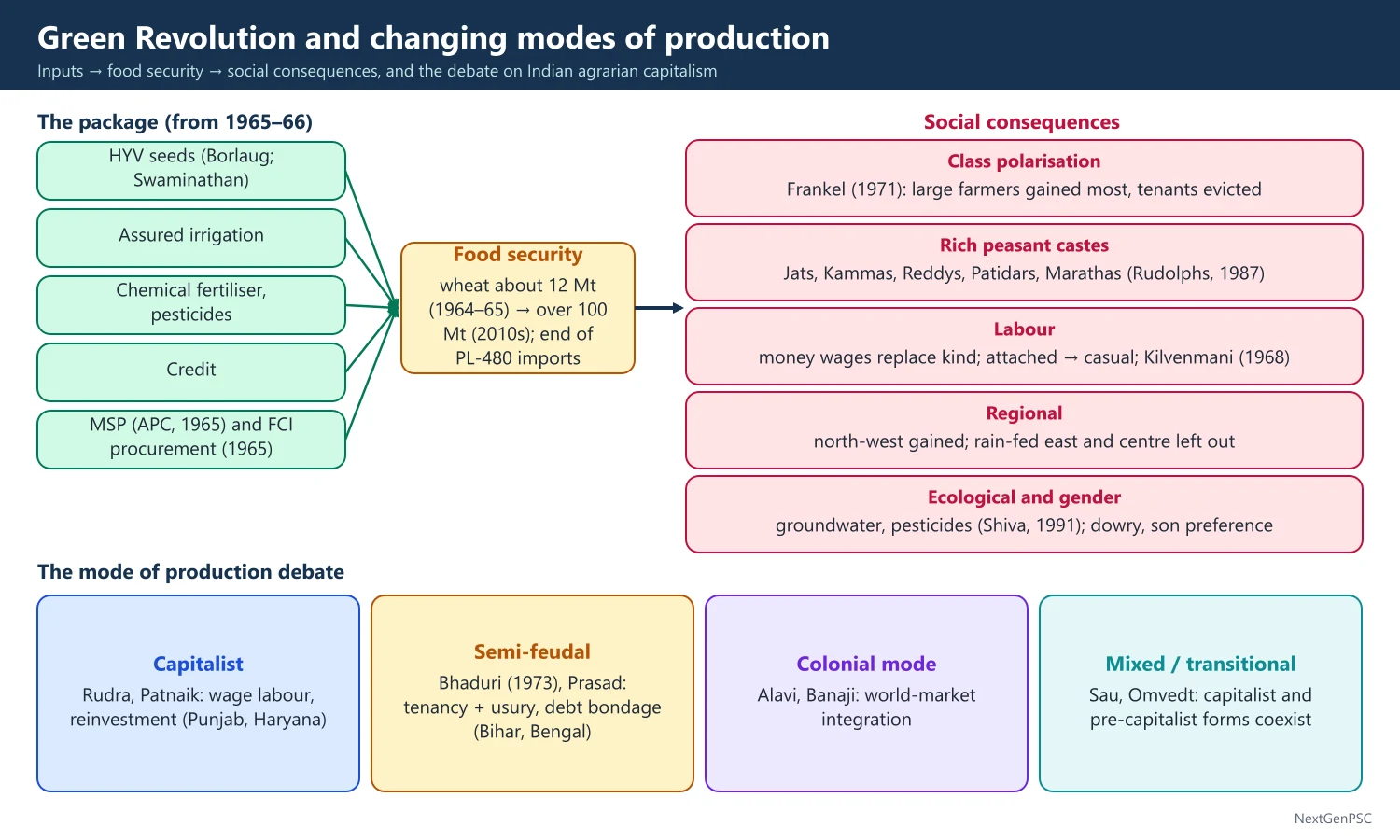
Package approach: HYV seeds plus assured irrigation, chemical fertiliser, pesticides, credit, minimum support prices (Agricultural Prices Commission, 1965) and procurement by the Food Corporation of India (1965).
Mode of production: Marx's term for the combination of forces of production (technology, labour) and relations of production (ownership, control); feudal and capitalist modes differ in how surplus is extracted.
Semi-feudalism: Amit Bhaduri (EPW, 1973) described a system in which the landlord is also the moneylender, so tenants are tied by debt and the landlord has no interest in raising productivity.
Capitalist farming: production for the market using hired wage labour and reinvestment of profit; Utsa Patnaik used the use of wage labour and reinvestment as her criteria.
Thorner's agrarian classes: Daniel Thorner (The Agrarian Prospect in India, 1956) classified rural people as maliks (proprietors), kisans (working peasants) and mazdoors (labourers) by type of income, rights in land and field work done.
Depeasantisation: the process by which small peasants lose land and become wage labourers or migrants, which Lenin described for Russia and which scholars observe in India today.
2. Social consequences of the Green Revolution
Food security: wheat output rose from about 12 million tonnes in 1964–65 to over 100 million tonnes by the 2010s; India ended dependence on PL-480 food imports from the USA.
Class polarisation: Francine Frankel (India's Green Revolution: Economic Gains and Political Costs, 1971) found in her district studies that large farmers gained most, tenants were evicted as land became profitable, and class conflict rose.
Contested finding: G.S. Bhalla and others later showed that small farmers in Punjab also adopted HYVs with a lag, so the technology was 'scale-neutral' but the inputs were not; the degree of polarisation is debated.
Rise of rich peasant castes: Jats in Punjab, Haryana and western UP, Kammas and Reddys in coastal Andhra, Patidars in Gujarat and Marathas in Maharashtra became a 'bullock capitalist' or farmer class with political power, as Lloyd and Susanne Rudolph argued in In Pursuit of Lakshmi (1987).
Agricultural labour: demand for labour rose, and money wages replaced payment in kind; but attached labour gave way to casual labour, and Dalit labourers faced violence when they demanded higher wages, as in Kilvenmani, Tamil Nadu (1968).
Regional inequality: gains concentrated in the north-west and parts of the south; rain-fed eastern and central India, home to many tribals and Dalits, was largely left out.
Ecological costs: groundwater depletion in Punjab and Haryana, soil degradation and pesticide-related illness; Vandana Shiva (The Violence of the Green Revolution, 1991) linked these to the Punjab crisis of the 1980s.
Gender: mechanisation displaced women from some tasks (threshing, weeding with herbicides) while dowry and son preference spread in prosperous Green Revolution regions, linked to falling child sex ratios in Punjab and Haryana.
Contradictions: Harry Cleaver ('The Contradictions of the Green Revolution', 1972) argued that the technology deepened dependence on corporate inputs and generated social unrest, the 'red revolution' some feared.
3. The mode of production debate
Context: from 1969 to the late 1970s, scholars debated in the Economic and Political Weekly whether Indian agriculture was feudal, semi-feudal or capitalist, because the answer decided the strategy of the Left (agrarian revolution or socialist struggle).
Capitalist position: Ashok Rudra and Utsa Patnaik (with differences) found growing use of wage labour and investment by large farmers, signs of capitalist development, especially in Green Revolution areas.
Semi-feudal position: Amit Bhaduri and Pradhan Prasad argued that interlocked land, labour and credit markets in eastern India (Bihar, Bengal) kept agriculture semi-feudal and blocked investment.
Colonial mode: Hamza Alavi and Jairus Banaji argued for a distinct 'colonial mode of production' shaped by integration into the world market, linking the debate to dependency theory.
Outcome: most scholars now agree that Indian agriculture has become predominantly capitalist but with wide regional variation and persistence of unfree labour relations (Jan Breman, Tom Brass).
4. Changing agrarian structure today
Shrinking holdings: the Agriculture Census 2015–16 found 86% of holdings were small or marginal (below 2 hectares) and the average holding was 1.08 hectares.
Workforce: PLFS shows agriculture still employs the largest share of workers, about 46% in 2023–24, while its share of GVA is under one-fifth, which reflects low productivity and disguised unemployment.
Feminisation of agriculture: as men migrate to non-farm work, women form a growing share of the agricultural workforce, though few own land.
Agrarian distress: NCRB's Accidental Deaths and Suicides in India 2022 recorded 11,290 suicides among farmers and agricultural labourers; indebtedness, crop failure and rising input costs are the main causes in studies.
Corporatisation debate: the three farm laws of 2020 (contract farming, private trade outside mandis) were repealed in November–December 2021 after a year-long farmers' protest, showing the political weight of the farmer class.
Diversification: dairy, horticulture and non-farm income now make up a large share of rural household income, and 'rural' no longer means only 'agricultural' (Dipankar Gupta, 'Whither the Indian Village', EPW 2005).
Second-generation reforms: the National Food Security Mission (2007), Bringing Green Revolution to Eastern India (2010–11) and the push for millets (International Year of Millets, 2023) aim to spread gains to rain-fed regions and reduce the ecological cost.
Tenancy today: much tenancy is now informal and concealed; reverse tenancy, in which small owners lease land to larger capitalist farmers, has been observed in Punjab, showing a new direction of agrarian change.
Village studies of change: Kathleen Gough's Kumbapettai (Thanjavur) and Béteille's Sripuram documented how Brahmin landlord dominance weakened as tenants and labourers organised and non-Brahmin castes rose.
World examples: the Green Revolution in Mexico and the Philippines (rice, IRRI, 1960s) showed the same pattern of rising output with uneven gains; Japan, Taiwan and South Korea, by contrast, combined new technology with thorough land reform and achieved more equal outcomes.
Land reform as the missing link: zamindari abolition removed intermediaries, but ceiling laws redistributed little land outside West Bengal (Operation Barga, 1978) and Kerala, so the Green Revolution was layered on an unequal land base.
5. Linking thinkers
Link to Marx's historical materialism and Lenin's differentiation of the peasantry (rich, middle, poor); the Green Revolution fits the Leninist path of capitalist agriculture from above.
Link to Srinivas: rich peasant castes used new wealth for Sanskritisation and political dominance, combining class and caste mobility.
Link to farmers' movements (Chapter 25) and ecological crisis (Chapter 27), both of which grew out of Green Revolution regions.
6. Using it in the exam
10 marks: define the Green Revolution, list two positive and two negative social consequences, and cite Frankel.
15–20 marks: context, consequences by class, caste, region, gender and ecology, the mode of production debate, today's agrarian structure with data, and a conclusion on a second, sustainable Green Revolution.
Thinkers and studies: Daniel Thorner, Francine Frankel, Utsa Patnaik, Amit Bhaduri, Vandana Shiva, the Rudolphs.
Diagram idea: a 2 × 2 table with 'irrigated / rain-fed' and 'large / small farmer', showing who gained most (irrigated, large) and least (rain-fed, small).
Quotation to use: Frankel's title itself, 'economic gains and political costs', sums up the sociological verdict.
| Position | Main scholars | Evidence used | Region emphasised |
|---|---|---|---|
| Capitalist | Ashok Rudra, Utsa Patnaik | Wage labour, reinvestment, market production | Punjab, Haryana |
| Semi-feudal | Amit Bhaduri, Pradhan Prasad | Interlocked tenancy and usury, debt bondage | Bihar, West Bengal |
| Colonial mode | Hamza Alavi, Jairus Banaji | Integration with world market under colonialism | All-India, historical |
| Mixed / transitional | Ranjit Sau, Gail Omvedt | Coexistence of capitalist and pre-capitalist forms | Varied |
| Class | Source of income | Field work |
|---|---|---|
| Malik | Rent and property rights | Does not work on land |
| Kisan | Own cultivation | Works with family labour |
| Mazdoor | Wages | Works for others |
Mains points
- Typical questions: 'Discuss the social consequences of the Green Revolution' and 'Is Indian agriculture capitalist?'; link both.
- Give consequences under clear heads: class, caste, region, gender, ecology and politics.
- Cite the mode of production debate by names; examiners reward knowing who held which position.
- Use current data: small and marginal holdings (Agriculture Census 2015–16), agricultural workforce share (PLFS), farm suicides (NCRB ADSI 2022).
- Mention the debated nature of polarisation (Frankel vs Bhalla) instead of stating it as settled fact.
- End with the farm laws episode (2020–21) as proof of the political power created by the Green Revolution.
Did you know?
- Norman Borlaug, whose wheat varieties fed the Indian Green Revolution, received the Nobel Peace Prize in 1970.
- Memory trick for Thorner: 'M-K-M' — Malik owns, Kisan tills, Mazdoor toils.
Rural Labour, Bondage and Migration
Rural labour in India is mostly landless and Dalit or Adivasi, works on casual daily wages and often depends on debt. Bonded labour, abolished by law in 1976, survives in new forms in brick kilns, quarries and seasonal work. Poverty, drought and the pull of cities drive circular and seasonal migration, which Jan Breman called 'footloose labour'; the COVID-19 lockdown of 2020 exposed how unprotected these migrants are.
In simple words
Rural labourers are people who work on other people's fields or in village jobs for a daily wage, usually without land of their own.
Bonded labour is like being trapped by a loan: a worker borrows a small amount and must work for the lender until it is repaid, which never quite happens.
Many such workers migrate every season to brick kilns, building sites or other states, and they lose their rights at both ends.
UPSC asks about the causes of bondage and migration and their social effects.
1. Concepts and definitions
Agricultural labourer: a person who works on another's land for wages in cash or kind, without the right to lease or supervise the land (Census definition); Census 2011 counted 14.43 crore agricultural labourers, more than the 11.88 crore cultivators.
Bonded labour: under the Bonded Labour System (Abolition) Act 1976, any system of forced or partly forced labour in which a debtor or family member works for a creditor in return for an advance, losing freedom of employment, movement or sale of produce at market value.
Unfree labour: Tom Brass's concept of 'deproletarianisation', in which capitalist employers use debt to restrict workers' freedom and cut wages, showing that unfree labour can coexist with capitalism.
Migration: a change of usual residence across a boundary; Census uses 'place of birth' and 'place of last residence' definitions, and PLFS asks about migration in the reference period.
Circular or seasonal migration: repeated short-term movement between village and work sites without permanent settlement, typical of the rural poor.
Push and pull factors: Everett Lee's theory of migration (1966): push factors at origin (poverty, landlessness, drought, caste oppression) and pull factors at destination (jobs, wages, freedom), filtered by intervening obstacles and personal factors.
2. Rural labour: structure and problems
Caste composition: agricultural labourers are disproportionately Dalits and Adivasis, because landlessness itself was produced by caste (Dalits were barred from owning land in many regions).
Jajmani to wages: William Wiser (The Hindu Jajmani System, 1936) described hereditary service ties in Karimpur; these patron–client ties have largely given way to cash wage relations, which Breman called the shift from patronage to exploitation.
Breman's Gujarat study: in Patronage and Exploitation (1974), Jan Breman showed that the hali system of attached Dubla labourers in south Gujarat lost its protective side, leaving only dependence.
Problems: low and unequal wages (women paid less), seasonal unemployment, indebtedness to employers, lack of social security, exposure to pesticides, and caste violence when labour organises.
Wage legislation: the Minimum Wages Act 1948 was subsumed into the Code on Wages 2019, which came into force with the other Labour Codes on 21 November 2025 and introduces a national floor wage.
Labour struggles: agricultural labour unions grew in Kerala and Thanjavur (Tamil Nadu); the Kerala Agricultural Workers Act 1974 gave security of work, and Kerala has India's highest rural wages.
3. Bonded labour
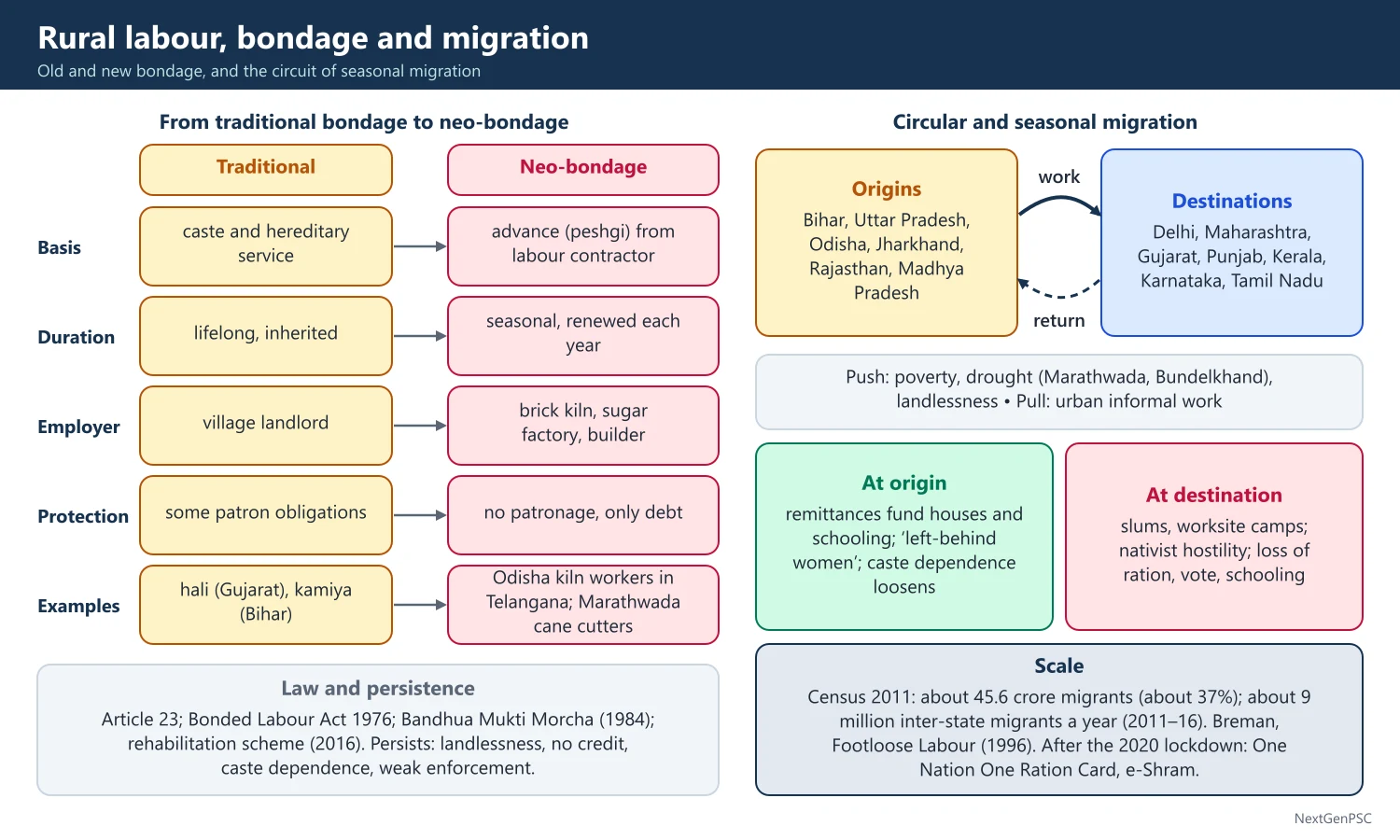
Traditional forms: hali (Gujarat), kamiya (Bihar), jeetha (Karnataka), sagri (Rajasthan) and vetti (Andhra) were caste-based hereditary bonds tied to loans.
Legal abolition: Article 23 bans forced labour; the 1976 Act (first as an ordinance during the Emergency) extinguished bonded debts and made bonded labour a crime with district vigilance committees.
Judicial role: in Bandhua Mukti Morcha v. Union of India (1984), a PIL by Swami Agnivesh's organisation on stone-quarry workers near Delhi, the Supreme Court held that the State must identify, release and rehabilitate bonded labourers.
Rehabilitation: the Central Sector Scheme for Rehabilitation of Bonded Labourers (2016) provides ₹1 lakh for adult males, ₹2 lakh for women and children, and ₹3 lakh for extreme cases such as trafficked women and transgender persons.
New bondage: advance-based recruitment (peshgi) through labour contractors (jamadars, sardars) binds families to brick kilns in Punjab, Telangana and Tamil Nadu, and to sugarcane cutting in Maharashtra and Karnataka; anti-slavery groups estimate large numbers, but official identification counts are far lower, so the scale is debated.
Why bondage persists: landlessness, lack of credit, caste dependence, weak enforcement by local officials who share interests with employers, and workers' fear of losing the only available work.
4. Migration: patterns and consequences
Scale: Census 2011 counted about 45.6 crore migrants by last residence (about 37% of the population), most of them women migrating for marriage; the Economic Survey 2016–17 estimated about 9 million inter-state migrants a year between 2011 and 2016 using railway data.
Corridors: major flows run from Bihar, Uttar Pradesh, Odisha, Jharkhand, Rajasthan and Madhya Pradesh to Delhi, Maharashtra, Gujarat, Punjab, Kerala, Karnataka and Tamil Nadu.
Footloose labour: Jan Breman (Footloose Labour, 1996) showed that circular migrants in Gujarat move between rural and urban informal work without settling, kept cheap by contractors and lack of housing.
Social effects at origin: remittances fund houses and education, men's absence increases women's work and decision-making ('left-behind women'), and migration can loosen caste dependence on village landlords.
Social effects at destination: migrants live in slums or worksite camps, face nativist hostility (for example, attacks on north Indian workers in Maharashtra in 2008), and lose access to ration, voting and schooling.
COVID-19 lockdown (March 2020): millions of migrants walked or travelled home, revealing the absence of data and social protection; in response came One Nation One Ration Card and the e-Shram portal (August 2021), with about 31.89 crore registrations by August 2026 (PIB).
Legal protection: the Inter-State Migrant Workmen Act 1979 was subsumed into the Occupational Safety, Health and Working Conditions Code 2020, in force from 21 November 2025, which widens the definition of inter-state migrant worker.
World comparison: China's hukou system ties welfare to place of registration, creating a 'floating population' similar to India's circular migrants; Arthur Lewis's dual-sector model (1954) predicted labour would move from farm to factory permanently, which has happened only partly in India.
Distress migration from drought regions: Marathwada and Bundelkhand send large seasonal streams of cane cutters and construction workers in drought years; whole families, including children and pregnant women, move with the work.
Gendered migration: women migrate mostly for marriage, but a growing number migrate for work as domestic workers in cities and as garment workers in Tiruppur and Bengaluru, often through agents.
International migration: Kerala's Gulf migration since the 1970s transformed household economies and gender roles; the Kerala Migration Survey series (Centre for Development Studies) is the main source of data on it.
Migration and caste mobility: Dalit labourers from Bihar who migrated to Punjab reported freedom from village humiliation even with hard work, which shows migration as a route out of caste control, not only exploitation.
Child labour link: children of migrant brick-kiln families often drop out of school; seasonal hostels and bridge schools run by states such as Odisha and Maharashtra try to keep them enrolled.
Debated point: whether migration mainly reproduces poverty (Breman) or offers an escape and accumulation route for some households (studies of remittance-funded mobility) remains debated; outcomes differ by caste, skill and destination.
5. Linking thinkers
Link to Marx's reserve army of labour: circular migrants keep wages low in both agriculture and industry.
Link to Srinivas and Béteille: migration and wage labour weakened jajmani and the dominant caste's hold, a form of structural change.
Link to informal sector and slums (Chapter 23) and to child labour, since bonded families often bring children to kilns.
6. Using it in the exam
10 marks: define bonded labour, cite the 1976 Act and Bandhua Mukti Morcha (1984), and explain persistence through brick kilns with Breman or Brass.
15–20 marks on migration: types, causes (push–pull with caste and drought), consequences at origin and destination, COVID-19 as a turning point, Labour Codes and e-Shram, and a conclusion on portable rights.
Thinkers and studies: Jan Breman, Tom Brass, William Wiser, Everett Lee, Arthur Lewis, Daniel Thorner.
Diagram idea: a circle showing village (debt, drought) → contractor's advance → brick kiln or city site → return home for harvest or festival → new advance.
Quotation to use: Breman's phrase 'from patronage to exploitation', which captures the change in rural labour relations.
| Feature | Traditional bondage | Neo-bondage |
|---|---|---|
| Basis | Caste and hereditary service | Advance from labour contractor |
| Duration | Lifelong, inherited | Seasonal, renewed each year |
| Employer | Village landlord | Brick kiln owner, sugar factory, builder |
| Protection | Some patron obligations | No patronage, only debt |
| Examples | Hali (Gujarat), kamiya (Bihar) | Kiln workers from Odisha in Telangana; cane cutters from Marathwada |
Mains points
- Expect 'Why does bonded labour persist despite legal abolition?' and 'Discuss the social consequences of rural–urban migration'.
- Always link labour to caste: landlessness and bondage fall mostly on Dalits and Adivasis.
- Use Breman as the core author for both bondage and migration; add Brass for unfree labour under capitalism.
- Bring COVID-19 (2020), e-Shram and the Labour Codes in force from 21 November 2025 as recent developments.
- Show migration's two faces: exploitation and also escape from caste control and a route to mobility.
- Avoid unverified figures for bonded labour; say that estimates vary widely and official identification is low.
Did you know?
- In Census 2011, for the first time since Independence, agricultural labourers outnumbered cultivators in India.
UPSC Previous Year Questions: Rural and Agrarian Transformation in India
From 2014 to 2026 UPSC asked 23 question parts (340 marks) from this chapter, all in Paper II. The Green Revolution and changing modes of production is the most-asked topic (10 parts), followed by rural development programmes and cooperatives (8 parts) and rural labour, bondage and migration (5 parts, with pandemic-time reverse migration asked three times). Every question below has a model answer written to the UPSC word limit.
In simple words
First write your own answer to a question within the time limit: about 7 minutes for 10 marks and 11 minutes for 20 marks.
Then compare it with the model answer: did you use village studies (Dube, Béteille, Breman, Frankel), agrarian class theory and recent data with year and source?
List what you missed and revise that topic in this chapter's notes before attempting the next question.
1. Rural Development: Community Development, Cooperatives and Poverty Alleviation
Example 1 (UPSC 2025, 10 marks): What are the Indian government's schemes launched for poverty alleviation after the United Nation's Declaration of 'Sustainable Development Goals - 2015'? Briefly describe.
Paper and question: Paper II, Q8(c)
Approach: Briefly describe the major post-2015 poverty-alleviation schemes, grouped by type (livelihood, housing and basic services, income support, food, health), linked to SDG 1, with one line of assessment.
The UN adopted the Sustainable Development Goals in September 2015; SDG 1 aims to end poverty in all its forms by 2030. India's schemes after 2015 treat poverty as multidimensional, the approach of NITI Aayog's MPI.
Livelihood: DAY-NRLM (renamed 2016) organises rural women into self-help groups, with the Lakhpati Didi target; Stand-Up India (2016) and PM SVANidhi (2020) give credit to the weaker sections and street vendors. Housing and basic services: PMAY-Gramin (2016), Ujjwala LPG (2016), Saubhagya electricity (2017) and Jal Jeevan Mission (2019). Income and food: PM-KISAN (2019) pays ₹6,000 a year to farmers, and PM Garib Kalyan Anna Yojana (2020) gives free grain, extended for five years from January 2024.
Health: Ayushman Bharat PM-JAY (2018) covers hospital costs of poor families. Wage employment moved from MGNREGA to the VB-G RAM G Act from 1 July 2026.
NITI Aayog estimated that multidimensional poverty fell from 29.17% (2013–14) to 11.28% (2022–23), though critics note exclusion errors and the risk of welfare replacing secure jobs.
Example 2 (UPSC 2023, 20 marks): Discuss the challenges faced by the cooperative movements in India. Suggest measures to strengthen the movement at the grass-roots level.
Paper and question: Paper II, Q8(b)
Approach: Two parts: challenges (structural, political, financial, social) with Indian cases and studies, then grassroots measures; conclude with the cooperative as a democratic institution.
A cooperative is a voluntary, democratically controlled association (one member, one vote) for mutual economic benefit; India's movement began with the Co-operative Credit Societies Act of 1904 and was made a fundamental right by the 97th Amendment (2011). Successes such as Amul and Operation Flood under Verghese Kurien show its promise.
Challenges: (i) Elite capture: S.C. Dube and later studies found that dominant landowning castes control boards and loans; Maharashtra's sugar cooperatives built a Maratha political elite, as Donald Attwood and others showed. (ii) Politicisation and State control: registrars supersede boards, elections are delayed and cooperatives serve party patronage, so they become what critics call 'government in disguise'. (iii) Financial weakness: high overdues, dependence on refinance and scams in urban cooperative banks (the PMC Bank crisis of 2019). (iv) Low participation: women, Dalits and landless labourers are members on paper only. (v) Market competition from private firms after 1991, and weak professional management.
Measures at the grassroots: computerise and strengthen primary agricultural credit societies (PACS) and make them multipurpose, as the Ministry of Cooperation (2021) and the National Cooperation Policy (2025) intend; build federated producer organisations and FPOs with market links; reserve board seats for women and SCs/STs and train members; ensure regular elections and audits; and learn from women-led models such as SEWA and Kudumbashree.
Cooperatives can be the 'third way' between State and market that Nehru and the Gandhians hoped for, but only when control rests with the ordinary member rather than the rural elite.
Example 3 (UPSC 2022, 10 marks): What role do co-operatives play in poverty alleviation in rural India?
Paper and question: Paper II, Q5(e)
Approach: Explain the mechanisms through which cooperatives reduce rural poverty, with Indian examples, and note their limits.
Cooperatives pool the small resources of many members to gain economies of scale and bargaining power, which helps the rural poor who cannot face markets alone.
Credit: primary agricultural credit societies give cheaper loans and free farmers from moneylenders, whom the All India Rural Credit Survey (1954) found dominant. Markets and income: dairy cooperatives under Amul and Operation Flood give landless and small producers, many of them women, a daily cash income and a fair price. Women's livelihoods: SEWA's cooperatives in Gujarat and Kudumbashree's networks in Kerala give poor women credit, work and voice. Services: cooperatives supply fertiliser (IFFCO), seeds and storage and run fair-price shops.
Their limits are elite capture by dominant castes, politicisation and weak finances, as S.C. Dube and later scholars noted.
Cooperatives reduce poverty most where the poor themselves control them, which is why the National Cooperation Policy (2025) stresses member-centred PACS.
Example 4 (UPSC 2021, 10 marks): Comment on the role of co-operatives in rural development.
Paper and question: Paper II, Q5(b)
Approach: Comment on the role: introduce the cooperative idea, give its economic, social and political roles in rural development with examples, and a critical note.
Nehru saw cooperatives, along with panchayats and schools, as the institutions that would transform the village; the Community Development Programme (1952) relied on them.
Economic role: credit, marketing, input supply and processing; Amul and Operation Flood made India the world's largest milk producer and gave regular income to small producers. Social role: cooperatives cut across caste in some places and give women collective strength, as in SEWA and Kudumbashree. Political role: they train villagers in democratic management, though in Maharashtra sugar cooperatives also became the base of a Maratha political elite.
Critically, Dube's study of the Community Development Programme (1958) and later work show that benefits went mostly to landowning castes, and politicisation, State control and overdues weakened many societies.
With the Ministry of Cooperation (2021), computerised multipurpose PACS and farmer producer organisations, cooperatives can again become a vehicle of inclusive rural development if member control is restored.
Example 5 (UPSC 2020, 20 marks): Do you think MSP (Minimum Support Price) Scheme for agricultural produce can help in rural development? Elaborate your response with suitable examples.
Paper and question: Paper II, Q6(b)
Approach: Give a reasoned opinion: explain MSP, show how it can aid rural development (with Punjab-type examples), then its limits (coverage, regional and class bias, ecology), and suggest how it can serve development; conclude with a qualified view.
The Minimum Support Price is a price announced by the Union government, on the advice of the Commission for Agricultural Costs and Prices (set up as the Agricultural Prices Commission in 1965), at which the State promises to buy crops; it covers 22 mandated crops, and since 2018–19 it has been fixed at least at one and a half times the paid-out cost plus family labour (A2+FL).
How it helps rural development: MSP with assured procurement reduces price risk and encourages investment; it underpinned the Green Revolution in Punjab and Haryana, raised farm incomes, drew farmers into banking and mechanisation, and fed the public distribution system that now supplies free grain under PMGKAY. Assured paddy procurement in Chhattisgarh and Madhya Pradesh in recent years has raised rural purchasing power.
Limits: the Shanta Kumar Committee (2015) found that only about 6% of farmers sold at MSP, mostly larger farmers in a few states; it favours wheat and rice, encouraging water-intensive paddy in Punjab where groundwater is falling; and it does little for landless labourers, tenants and rain-fed farmers. Francine Frankel and the Rudolphs showed how price support strengthened a rich peasant class.
The 2020–21 farmers' movement demanding a legal guarantee for MSP showed its social and political weight; the Swaminathan Commission had suggested pricing at cost plus 50% of comprehensive cost (C2).
MSP can help rural development when extended to pulses, oilseeds and millets with decentralised procurement, linked to crop diversification, and combined with support for small farmers and labourers through FPOs, insurance and employment.
Example 6 (UPSC 2019, 10 marks): Discuss the challenges in implementing the Rural Development Programmes in India.
Paper and question: Paper II, Q5(b)
Approach: Discuss the challenges in implementation under clear heads (bureaucratic, social structure, participation, design, finance), with studies, and a brief way forward.
Rural development programmes, from the Community Development Programme (1952) to MGNREGA, NRLM and PMAY-G, have repeatedly met similar obstacles in implementation.
Social structure: S.C. Dube (1958) found benefits captured by dominant landowning castes, and Béteille's Sripuram study showed brokers mediating access. Bureaucracy: top-down targets, red tape and corruption; Akhil Gupta (Red Tape, 2012) showed how arbitrary procedures exclude the poor, and Rajiv Gandhi's 1985 remark that only about 15 paise of a rupee reached the poor became famous.
Low participation: gram sabhas are weak, and women, Dalits and Adivasis have little voice. Design and finance: delayed wage payments, Aadhaar-related exclusion and poor targeting; states with low capacity spend less.
Social audits (pioneered by MKSS in Rajasthan), direct benefit transfer and strong panchayats under the 73rd Amendment can reduce these gaps.
Example 7 (UPSC 2019, 20 marks): Discuss the implications of 'Swachha Bharat Abhiyan'. Do you think that civil society has a role to play here? Substantiate your answer with examples.
Paper and question: Paper II, Q7(b)
Approach: Two parts: the social, health, gender and caste implications of Swachh Bharat, then the role of civil society with concrete examples; conclude on partnership.
The Swachh Bharat Mission, launched on 2 October 2014, aimed to make India open-defecation free by 2 October 2019 and improve solid-waste management; over ten crore household toilets were built, and rural India was declared open-defecation free in 2019, with Phase II (2020–25) focusing on ODF Plus and waste management.
Implications: (i) Health: sanitation reduces diarrhoea and stunting, a major cause of child under-nutrition. (ii) Gender: toilets give women safety, privacy and dignity, reducing harassment during open defecation at night. (iii) Behaviour and culture: sanitation is a matter of norms, not only hardware; Diane Coffey and Dean Spears (Where India Goes, 2017) showed that purity–pollution ideas made many villagers reluctant to use pit latrines whose emptying is seen as a Dalit task. (iv) Caste: unless sanitation work is mechanised, the mission may reproduce caste-based manual scavenging, banned by the 2013 Act. (v) Urban: waste-picking, landfills and informal workers' livelihoods are affected.
Civil society's role: yes, it is essential. Sulabh International (founded by Bindeshwar Pathak in 1970) built low-cost toilets and freed scavengers; the Safai Karmachari Andolan led by Bezwada Wilson fought manual scavenging; NGOs like WaterAid and community-led total sanitation groups used triggering and peer pressure; and self-help groups, schools and religious leaders spread awareness. Waste-picker organisations such as SWaCH in Pune integrated informal workers into door-to-door collection.
Thus Swachh Bharat is as much a social movement for changing norms as a construction programme, and civil society supplies the persuasion, monitoring and dignity of labour that the State alone cannot.
Example 8 (UPSC 2016, 10 marks): Mahatma Gandhi National Rural Employment Guarantee Scheme for rural development
Paper and question: Paper II, Q5(b)
Approach: Write a short note on MGNREGS: its provisions, its social effects on rural development (wages, women, migration, assets, accountability), its problems, and its 2026 replacement.
The Mahatma Gandhi National Rural Employment Guarantee Act 2005 guaranteed 100 days of unskilled wage work a year on demand to every rural household, with at least one-third women workers, work within 5 km, unemployment allowance and social audit by the gram sabha.
Effects on rural development: it raised rural wages and bargaining power of agricultural labourers; women's share of person-days often exceeded 50%, giving many women their first independent income; it reduced distress migration in several states; it created water-conservation and land-development assets; and social audits, pioneered in Rajasthan and Andhra Pradesh, brought transparency. Jean Drèze saw it as a rights-based shift in welfare.
Problems: delayed wages, fake job cards, rationing of work by officials and capture by local elites limited its impact.
From 1 July 2026 MGNREGA was replaced by the VB-G RAM G Act, 2025, which guarantees 125 days but shares cost with states, a change critics fear may limit demand-driven work.
2. Green Revolution and Changing Modes of Production
Example 9 (UPSC 2025, 10 marks): 'The transfer of land from cultivating to the non-cultivating owners is bringing about transformation in Indian society.' Justify your answer by giving suitable illustrations.
Paper and question: Paper II, Q5(a)
Approach: Justify the statement with illustrations: explain the trend (absentee ownership, leasing, land as asset), give regional examples, and show its social consequences for class, caste, gender and the village.
Land reform aimed at 'land to the tiller', yet today land is increasingly owned by non-cultivating owners: families who have moved to towns or jobs, NRIs, urban investors and real-estate buyers, who lease it out or hold it as an asset.
Illustrations: in Punjab and Kerala, migrant and NRI families keep land and lease it to tenants, often informally; around Gurugram, Pune and Hyderabad, builders and investors have bought farmland; and among Jats, Patidars and Marathas, educated sons take salaried work while land is cultivated by tenants or migrant labour.
Dipankar Gupta ('Whither the Indian Village', 2005) argued that the village is no longer the site of the farmer's aspiration.
Transformation: land becomes a commodity and status asset rather than a basis of community; informal tenancy returns, leaving tenants insecure (NITI Aayog's Model Land Leasing Act, 2016, tried to address this); Dalit and migrant labourers become the actual cultivators; and with men leaving, women increasingly do farm work without owning land, the feminisation of agriculture Bina Agarwal stresses.
Example 10 (UPSC 2023, 10 marks): Critique the victory narratives of Green Revolution in the context of Indian society.
Paper and question: Paper II, Q4(c)
Approach: Critique the success story: state the victory narrative briefly, then challenge it on class, region, caste, gender and ecology with named scholars, and end with a balanced line.
The victory narrative credits the Green Revolution of the late 1960s with ending famine and PL-480 dependence: wheat output rose from about 12 million tonnes in 1964–65 to over 100 million tonnes by the 2010s.
Sociologists question who won. Francine Frankel (1971) found large farmers gained most while tenants were evicted and class conflict sharpened; the Rudolphs showed a 'bullock capitalist' class of Jats, Kammas and Patidars rising to power. Gains concentrated in irrigated Punjab, Haryana and western Uttar Pradesh, widening regional gaps.
Dalit labourers who demanded higher wages faced violence, as at Kilvenmani (1968). Women lost work to machines and gained little control over income. Vandana Shiva (1991) linked it to groundwater depletion, soil degradation and the Punjab crisis, and later farmer suicides and indebtedness reveal its costs.
The Green Revolution was thus a technical victory but a socially uneven one; land reform, rain-fed agriculture and ecological farming were its missing parts.
Example 11 (UPSC 2021, 10 marks): Discuss the role of technology in agrarian change in India.
Paper and question: Paper II, Q5(e)
Approach: Discuss technology's role: list key technologies across phases, show their social effects on class, labour, gender and ecology, and conclude that technology works through social structure.
Technology has been a main driver of agrarian change in India, though its effects depend on who controls land and capital.
The Green Revolution package (HYV seeds, tubewells, fertiliser) raised output and turned many owner-cultivators into market-oriented capitalist farmers, the change Utsa Patnaik and Ashok Rudra debated as the rise of a capitalist mode of production. Tractors and combine harvesters displaced attached labour and women's work, turning labour casual and migrant.
Bt cotton (2002) raised yields but increased dependence on purchased inputs and debt, which some studies link to distress in Vidarbha. Today digital technology (e-NAM 2016, Soil Health Cards, PM-KISAN transfers, drones) connects farmers to markets and the State.
Technology without land reform benefits larger farmers, as Frankel found; its democratic use needs cooperatives, FPOs, custom-hiring centres and extension services that reach small and women farmers.
Example 12 (UPSC 2020, 10 marks): Point out the benefits of 'green chemistry' for agrarian transformation in India.
Paper and question: Paper II, Q5(a)
Approach: Define green chemistry, then point out its benefits for Indian agriculture (ecological, economic, health, social) with Indian examples, and a closing caution.
Green chemistry, defined by Paul Anastas and John Warner through their twelve principles (1998), means designing chemical products and processes that reduce or eliminate hazardous substances; in agriculture it includes bio-fertilisers, bio-pesticides, safer and more efficient fertilisers, and waste-to-input conversion.
Benefits: it addresses the ecological costs of the Green Revolution that Vandana Shiva and others documented, such as soil degradation and pesticide residues in Punjab, and it lowers input costs and so reduces the debt trap behind farmer distress.
It also protects the health of farm workers, many of them women and Dalit labourers who spray chemicals; and it supports sustainable models such as Sikkim's fully organic farming (declared 2016), Andhra Pradesh's community-managed natural farming and the National Mission on Natural Farming (2024), along with nano-urea and neem-coated urea.
Its spread needs research, extension and price support, otherwise only better-off farmers will adopt it.
Example 13 (UPSC 2018, 10 marks): How do the recommendations of Swaminathan Commission (2004–2006) ensure food and nutrition security for the Indian masses?
Paper and question: Paper II, Q2(c)
Approach: Explain the Commission and how its recommendations address food and nutrition security (production, access, absorption), with a note on what was implemented.
The National Commission on Farmers, chaired by M.S. Swaminathan, submitted five reports between 2004 and 2006; it treated farmers' welfare and food and nutrition security as linked.
Production (availability): it recommended land reform and distribution of ceiling-surplus land, assured irrigation, credit at low interest, crop insurance, and a minimum support price at least 50% above the weighted average cost of production, so that farmers keep producing food. Access: it proposed a universal public distribution system and food-for-work and community grain banks, so that the poor can buy or receive food.
Absorption (nutrition): it stressed clean drinking water, sanitation, primary health care and nutrition programmes for women and children, recognising that food becomes nutrition only in a healthy body. It also recommended recognising women farmers.
Many ideas entered the National Policy for Farmers (2007) and the National Food Security Act 2013, though the C2-plus-50% MSP demand remains a farmers' movement issue.
Example 14 (UPSC 2018, 20 marks): Has 'Green Revolution' led to the formation of new power elite in rural India? Elaborate your answer.
Paper and question: Paper II, Q6(b)
Approach: Elaborate whether a new power elite emerged: define power elite (Mills), show the rise of rich peasant castes and their economic, political and social power with studies, add counter-points (Dalit assertion, limits), and conclude.
C. Wright Mills used power elite for the small group whose positions let them dominate key institutions. In rural India, the Green Revolution of the late 1960s created such a group: a class of rich, commercial farmers drawn mainly from the middle peasant castes.
Economic base: HYV technology, tubewells, cheap credit and minimum support prices made land profitable; Frankel (1971) found that larger farmers captured most gains, while tenants were evicted. Jats in Punjab, Haryana and western Uttar Pradesh, Kammas and Reddys in coastal Andhra, Patidars in Gujarat and Marathas in Maharashtra became what the Rudolphs called 'bullock capitalists', and Utsa Patnaik traced the rise of capitalist farmers using hired labour.
Political power: these groups converted wealth into power through cooperatives, panchayats and state politics; Charan Singh's politics and the Bharatiya Kranti Dal (1967) gave them voice, and Srinivas's concept of the dominant caste (numerical strength, land, political power) captures their position. The farmers' movements of the 1980s (Sharad Joshi's Shetkari Sanghatana, Mahendra Singh Tikait's BKU) and the 2020–21 protests show their organised strength.
Social effects: they patronise temples, colleges and caste associations, and their dominance sometimes produces violence against Dalit labourers, as at Kilvenmani (1968).
Counter-points: the elite is not fully new, since many were already dominant landholders; and it faces challenges from fragmented holdings, agrarian distress, quota demands by Jats, Patidars and Marathas (a sign of declining farm incomes), and Dalit political assertion.
The Green Revolution therefore did create a new rural power elite of rich peasant castes, but its dominance is now contested by agrarian crisis and democratic mobilisation from below.
Example 15 (UPSC 2017, 10 marks): Write a short note on 'changing means of production and increased rural poverty.'
Paper and question: Paper II, Q1(e)
Approach: Write a short note linking changes in the means of production (technology, capital, markets, holdings) to rural poverty, with theory and data, and a balanced ending.
For Marx, changes in the means of production reshape class relations; in Indian agriculture, the shift from bullocks, family labour and own seed to tractors, tubewells, hybrid seed and purchased chemicals has changed who gains and who loses.
Mechanisation and capital-intensive farming displaced attached and women labourers, turning them into casual or migrant workers, as Jan Breman's studies of south Gujarat show. Rising input costs and dependence on markets pushed small and marginal farmers, who hold 86% of holdings (Agriculture Census 2015–16), into debt; the NSS 77th round (2019) found about half of agricultural households indebted.
Bt cotton and price shocks have been linked to distress and suicides in Vidarbha. The mode-of-production debate (Patnaik, Rudra, Bhaduri) explained this as capitalist farming growing on a semi-feudal base.
Yet poverty overall fell with higher wages and non-farm work; the poverty that remains is concentrated among the landless, tenants and rain-fed farmers.
Example 16 (UPSC 2017, 20 marks): Indebtedness is one of the serious issues leading to farmers' suicides. Discuss reasons and suggest solutions.
Paper and question: Paper II, Q3(a)
Approach: Discuss reasons for indebtedness leading to suicide (economic, institutional, social, and Durkheim's lens) with data, then give layered solutions; conclude.
NCRB's Accidental Deaths and Suicides in India 2022 recorded 11,290 suicides among farmers and agricultural labourers, concentrated in Maharashtra, Karnataka, Andhra Pradesh and Telangana. Field studies consistently name indebtedness as the leading cause; the NSS 77th round (2019) found about half of agricultural households in debt.
Reasons: (i) Rising costs and falling returns: purchased seed (Bt cotton), fertiliser and pesticides, with volatile prices and crop failure in rain-fed areas. (ii) Institutional gaps: small, tenant and women farmers lack land titles, so they borrow from moneylenders and input dealers at high interest, the interlocked markets Amit Bhaduri described. (iii) Climate risk: droughts and unseasonal rains with weak insurance. (iv) Social pressure: expenditure on dowry, weddings, health and education, and loss of honour when debts become public. (v) Weakening support: nuclear households and the decline of village reciprocity; Durkheim would read this as anomic suicide in a period of rapid change, and as egoistic where the farmer faces risk alone.
Solutions: extend institutional credit to tenants through land leasing laws and Kisan Credit Cards; make crop insurance (PMFBY, 2016) fast and fair; assure remunerative prices and procurement for more crops; promote low-cost natural farming, irrigation and crop diversification; offer debt relief with reform rather than one-off waivers; provide income support (PM-KISAN), rural employment and health insurance; and build counselling and community support, as Maharashtra's Vasantrao Naik mission attempted.
Farmer suicide is thus a social fact rooted in the agrarian structure, and solutions must change the conditions of farming, not merely the size of the loan.
Example 17 (UPSC 2016, 20 marks): Write a note on the uneven impact of 'Green Revolution' on rural society.
Paper and question: Paper II, Q6(a)
Approach: Write a note on the uneven impact: across regions, classes, castes, gender and ecology, each with a study or example, and conclude.
The Green Revolution, begun in 1966–67 with high-yielding varieties, irrigation, fertiliser, credit and minimum support prices, made India self-sufficient in food grains; its impact on rural society, however, was markedly uneven.
Regional: gains concentrated in irrigated Punjab, Haryana, western Uttar Pradesh and parts of Andhra Pradesh and Tamil Nadu, while eastern India and rain-fed central and tribal regions lagged, widening inter-state disparity. Crops: wheat and rice gained, while pulses, oilseeds and millets, the crops of poorer dryland farmers, were neglected.
Class: Francine Frankel (1971) found that large farmers with capital captured most benefits, tenants were evicted as self-cultivation became profitable, and class tensions rose. The mode-of-production debate traced the rise of capitalist farmers using hired labour. Caste: middle peasant castes (Jats, Kammas, Patidars) became a dominant 'bullock capitalist' class (the Rudolphs), while Dalit labourers gained higher cash wages but faced violence when they organised, as at Kilvenmani (1968).
Gender: mechanisation reduced women's work in threshing and weeding, and rising prosperity sometimes increased dowry and withdrawal of upper-caste women from fieldwork. Ecology: groundwater depletion, soil degradation and pesticide pollution, which Vandana Shiva linked to the Punjab crisis.
The uneven impact shows that technology works through existing structures of land and power; land reform and later efforts such as Bringing Green Revolution to Eastern India (2010–11) were attempts to correct it.
Example 18 (UPSC 2016, 20 marks): Bring out the impact of the declining significance of the agrarian economy.
Paper and question: Paper II, Q8(a)
Approach: Bring out the impact of agriculture's declining significance on economy, village, class, caste, gender and politics, with data and studies, and conclude.
Agriculture's share of India's GDP has fallen from over half in 1950–51 to under one-fifth today, yet it still employs about 46% of workers (PLFS 2023–24). This declining significance of the agrarian economy means that land is no longer the main source of income, status and power in rural India.
Rural livelihoods: rural households now depend heavily on non-farm work, wages, remittances and transfers; Dipankar Gupta ('Whither the Indian Village', 2005) argued that the village is 'vanishing' as a self-contained economy and that the young do not want to farm. Agrarian distress: 86% of holdings are small and marginal (Agriculture Census 2015–16), incomes are low and farmer suicides persist.
Class and caste: the dominant landowning castes lose relative position, which explains the reservation agitations of Jats (2016), Patidars (2015) and Marathas; at the same time Dalits become less dependent on landlords, weakening jajmani and attached labour, as Breman noted in Gujarat. Migration: circular migration to towns and the Gulf increases; men move out, leading to the feminisation of agriculture, where women farm without owning land.
Culture and politics: urban consumption styles, education and aspiration replace agrarian values; yet farmers remain politically powerful, as the 2020–21 protests that forced repeal of the three farm laws showed.
The decline of agriculture is thus a structural transformation of rural India, but because the move to secure non-farm jobs is incomplete, it produces insecurity as much as mobility; skill, rural industry and social protection are needed.
3. Rural Labour, Bondage and Migration
Example 19 (UPSC 2024, 10 marks): Despite the efforts of the government, bonded labour still continues in India. Discuss.
Paper and question: Paper II, Q1(e)
Approach: Discuss why bonded labour persists despite law: state the legal framework, then the structural reasons (debt, caste, informality, weak enforcement), with sectors and studies, and a short way forward.
Bonded labour is forced work to repay an advance; Article 23 bans it, the Bonded Labour System (Abolition) Act 1976 extinguished such debts, Bandhua Mukti Morcha (1984) made release and rehabilitation a State duty, and the 2016 scheme provides up to ₹3 lakh for rehabilitation.
It continues because of debt bondage in new forms: advances (peshgi) given by contractors to migrant families for brick kilns, stone quarries, rice mills and sugarcane cutting tie them for a season, which Jan Breman called neo-bondage. Most victims are Dalits and Adivasis, so caste dependence persists.
Workers rarely complain because they lack alternatives, and district vigilance committees seldom meet; officials often treat cases as wage disputes. Distress migration and informality, with over 80% of work informal, keep the supply of vulnerable labour high.
Ending it needs rapid identification, prosecution under the Act and the Bharatiya Nyaya Sanhita, portable welfare for migrants, and secure livelihoods at source.
Example 20 (UPSC 2023, 20 marks): What is 'reverse migration'? Discuss its features, causes and consequences in India.
Paper and question: Paper II, Q7(b)
Approach: Define reverse migration, then discuss its features, causes and consequences in three clear sections with data and theory, using COVID-19 as the main case, and conclude.
Reverse migration is the return of migrants from destinations, usually cities, to their places of origin, usually villages. In India it became a mass phenomenon after the national lockdown of 25 March 2020, when the government told Parliament that over one crore migrant workers had returned home.
Features: it was sudden and distress-driven, not planned; it flowed mainly from Delhi, Mumbai, Surat, Gujarat and the southern states to Uttar Pradesh, Bihar, Odisha, Jharkhand and West Bengal; most returnees were young male informal workers, many of them Dalits, Adivasis and OBCs; and much of it was temporary, as many went back once work resumed. It also occurs in milder forms, such as return of older migrants or Gulf returnees.
Causes: loss of jobs and wages in the informal sector, inability to pay rent, lack of ration cards and social protection at destination, fear of illness, and the security of family, land and community at origin. In Everett Lee's terms, the pull of the city vanished while the village offered a safety net; Jan Breman's 'footloose labour' explains why circular migrants never settled.
Consequences: pressure on rural labour markets and households, which pushed MGNREGA demand to a record in 2020–21; loss of remittances; stigma and quarantine conflicts in villages; labour shortages in cities; and, positively, some returnees started enterprises. Policy responses included the Garib Kalyan Rozgar Abhiyan (2020), One Nation One Ration Card and the e-Shram portal (2021).
Reverse migration exposed the invisibility of migrant workers; secure housing, portable welfare and the new Labour Codes (in force from November 2025) must be made to work for them.
Example 21 (UPSC 2022, 20 marks): Examine whether rural bondage still continues to be a social reality. Give your argument.
Paper and question: Paper II, Q6(a)
Approach: Examine and argue: define bondage, show its legal abolition, then evidence that it continues in new forms (neo-bondage) with studies and sectors, the reasons, and a reasoned conclusion that it persists in changed form.
Rural bondage is a relation in which a labourer, often with family, must work for a creditor or landlord to repay a debt, losing freedom to choose employer, move or sell labour at market rates. Traditional forms included the hali system of south Gujarat, kamiya in Bihar and sagri in Rajasthan.
Legal abolition: Article 23, the Bonded Labour System (Abolition) Act 1976, the Supreme Court's ruling in Bandhua Mukti Morcha (1984) and the rehabilitation scheme of 2016 make bondage illegal, and lakhs of labourers have been released since 1976.
Yet it remains a social reality: Jan Breman showed that the old patronage-based hali system lost its protective side, leaving only dependence, and later described neo-bondage: seasonal advances by jobbers tie migrant families to brick kilns, sugarcane cutting in Maharashtra, stone quarries and rice mills. Rescue operations by NGOs such as International Justice Mission and Bachpan Bachao Andolan regularly find bonded families, mostly Dalits and Adivasis, and trafficked children. Global estimates such as the Global Slavery Index (2023) put the number in forced labour in India in millions.
Why it persists: landlessness and lack of credit, caste dependence, seasonal unemployment, contractor-controlled migration, and weak enforcement, as vigilance committees rarely function and officials deny its existence to avoid responsibility.
Bondage therefore continues, though in a changed, commercialised and migratory form rather than the hereditary feudal form; ending it needs land, credit, secure rural work and strict enforcement.
Example 22 (UPSC 2021, 20 marks): What are the sociological reasons and implication of “reverse migration” during the recent pandemic in India?
Paper and question: Paper II, Q4(a)
Approach: Two demands: sociological reasons (structure of informal work, circular migration, citizenship gaps, kinship and village as safety net) and implications (for migrants, villages, cities, women, policy). Use Breman, Lee and data, and conclude.
During the COVID-19 lockdown from 25 March 2020, India saw a mass reverse migration: by the government's own figure, over one crore migrant workers returned to their home states, many on foot.
Sociological reasons: (i) Informal, footloose labour: Jan Breman showed that circular migrants work without contracts, housing or security, so when work stopped they had no reason or means to stay. (ii) Incomplete urban citizenship: migrants lacked local ration cards, voter identity and welfare access; the city treated them as labour, not as citizens. (iii) Village as safety net: kin, a house, a small plot and caste community at origin offered food and care, which shows the persistence of what M.N. Srinivas called the village as a social reality. (iv) Fear, stigma and uncertainty amplified by the crisis.
Implications: for migrants, loss of income, debt and trauma; for villages, pressure on land and work, a record demand for MGNREGA in 2020–21, and conflicts over quarantine and stigma; for women, added care burden and loss of remittances; for cities, labour shortages that showed how much urban India depends on migrants. Positively, the crisis made migrants visible in policy: One Nation One Ration Card, the e-Shram portal (August 2021) and affordable rental housing schemes followed.
Reverse migration showed that India's development model rests on an invisible, mobile and unprotected workforce; portable entitlements, housing and labour protection under the Labour Codes are needed to make migration a path of mobility rather than vulnerability.
Example 23 (UPSC 2020, 20 marks): Discuss the dynamics of 'migrant workers' in India in the context of Corona pandemic.
Paper and question: Paper II, Q3(b)
Approach: Discuss the dynamics: who migrant workers are and how the system works (contractors, circularity, networks), what the pandemic did to them, how State and society responded, and the lessons.
India has a vast internal migrant population: Census 2011 counted about 45.6 crore migrants by last residence, and the Economic Survey 2016–17 estimated about 90 lakh inter-state migrants a year. Most migrant workers are young men from Uttar Pradesh, Bihar, Odisha, Jharkhand and West Bengal working in construction, factories, brick kilns and services.
Dynamics before COVID: migration is circular and network-based; jobbers and contractors recruit through kin and caste, advance money and control wages, a system Jan Breman called 'footloose labour' and neo-bondage. Migrants live in worksite camps or slums, send remittances home and remain outside urban welfare, while the Inter-State Migrant Workmen Act 1979 was poorly enforced.
The pandemic: the lockdown of 25 March 2020 ended work overnight; without savings, ration or housing, migrants began walking home, and over one crore returned. Tragedies such as the Aurangabad rail accident (May 2020) showed their invisibility. At home they faced quarantine, stigma and limited work.
Responses: Shramik special trains, free grain under PM Garib Kalyan Anna Yojana, the Garib Kalyan Rozgar Abhiyan, high MGNREGA demand, the Supreme Court's suo motu case on migrants, and civil-society kitchens. Later came One Nation One Ration Card, the e-Shram portal (2021) and the Occupational Safety, Health and Working Conditions Code 2020, which widens protection for inter-state migrants.
The pandemic showed that migrants are central to the economy yet marginal in citizenship; portable rights, data, housing and social security are the way forward.
Mains points
- Green Revolution questions want a critique, not praise: use Frankel on class polarisation, the Rudolphs on bullock capitalists, Shiva on ecology and the 'mode of production' debate (Bhaduri, Patnaik, Rudra).
- Programme questions (cooperatives, MGNREGA, MSP, Swachh Bharat) reward a sociological lens: Dube on elite capture, Béteille on brokers, Akhil Gupta on bureaucratic exclusion, and Bina Agarwal on gender.
- Migration and bondage questions became frequent after COVID-19: use Breman's footloose labour, Lee's push–pull, e-Shram and One Nation One Ration Card, and the 1976 Act with Bandhua Mukti Morcha (1984).
- Always update rural employment answers: MGNREGA (2005) was replaced from 1 July 2026 by the VB-G RAM G Act, 2025 (125 days, Centre–state cost sharing mostly 60:40).
- Quote data with source and year: Agriculture Census 2015–16 (86% small and marginal holdings), PLFS 2023–24 (about 46% of workers in agriculture), NSS 77th round (2019) on indebtedness, NCRB ADSI on farmer suicides.
Did you know?
- The term 'Green Revolution' was coined in 1968 by William Gaud of USAID, as a contrast to a 'red' (communist) revolution.
Sociology Optional: All chapters
- Exam Pattern, Syllabus and Strategy
- Sociology: The Discipline
- Sociology as Science
- Research Methods and Analysis
- Sociological Thinkers: Marx and Durkheim
- Sociological Thinkers: Max Weber
- Sociological Thinkers: Parsons, Merton and Mead
- Stratification and Mobility
- Works and Economic Life
- Politics and Society
- Religion and Society
- Systems of Kinship
- Social Change in Modern Society
- Perspectives on the Study of Indian Society
- Impact of Colonial Rule on Indian Society
- Rural and Agrarian Social Structure
- Caste System
- Tribal Communities in India
- Social Classes in India
- Kinship, Family and Religion in India
- Visions of Social Change in India
- Rural and Agrarian Transformation in India
- Industrialisation and Urbanisation in India
- Politics and Society in India
- Social Movements in Modern India
- Population Dynamics
- Challenges of Social Transformation