
Sociology Optional · UPSC Notes
Sociological Thinkers: Max Weber — UPSC Sociology Optional Notes
Free, exam-focused notes for UPSC Prelims and Mains, with Prelims tips and Mains points for every topic. 4 topics.
Open in the interactive reader: bookmarks, progress tracking and read-aloud.
Max Weber: Social Action and Ideal Types
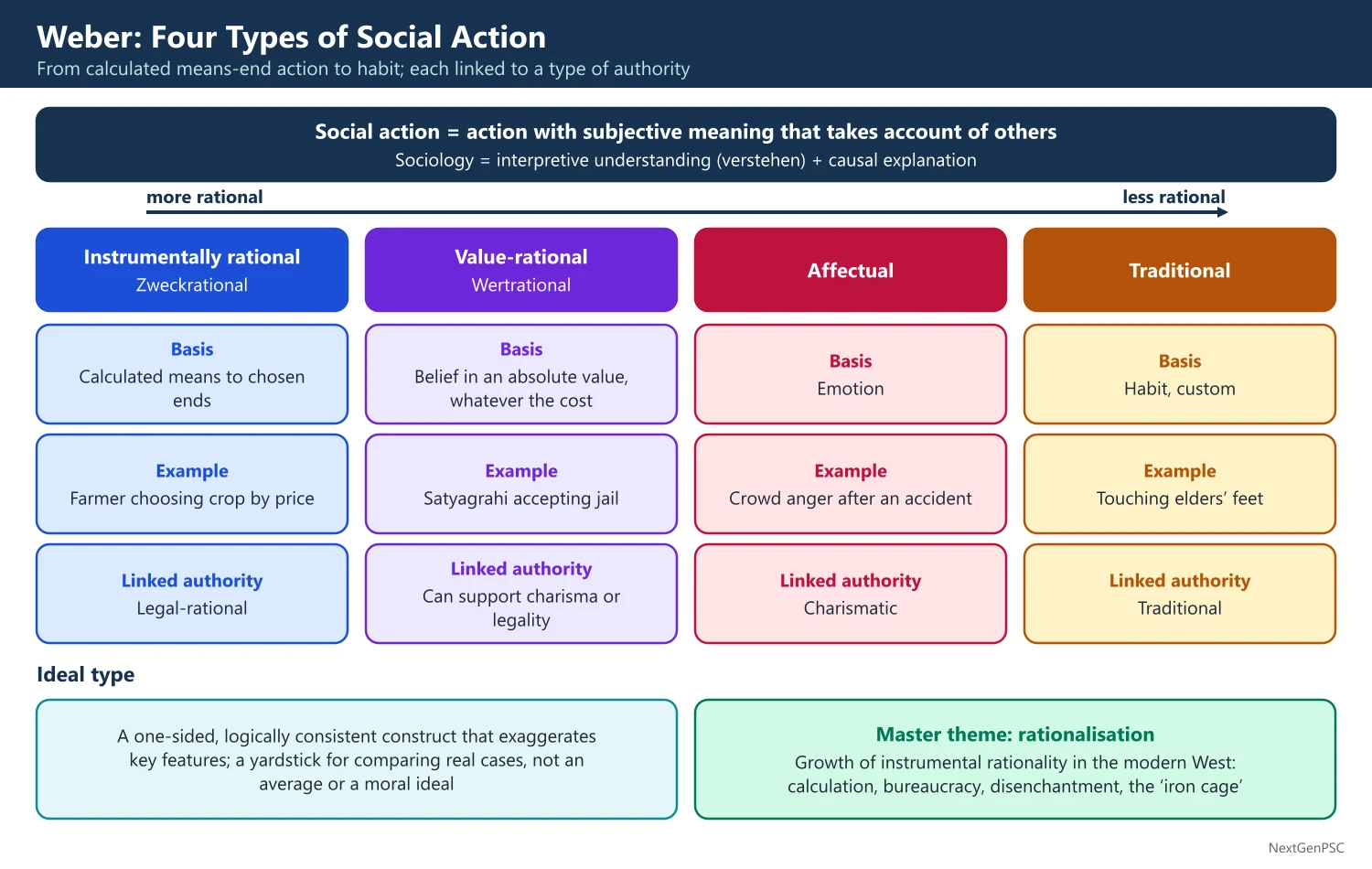
For Weber, sociology is the interpretive understanding of social action, action to which actors attach subjective meaning and which takes account of others. He gave four types: instrumentally rational, value-rational, affectual and traditional, and a method of verstehen (interpretive understanding) combined with causal explanation. His ideal type, a one-sided, logically consistent construct, is a tool for comparing and explaining real cases, and his master theme is the rationalisation of the modern West.
In simple words
Weber said that to explain what people do, we must understand what their action means to them.
Two people may both fast on a Tuesday: one for a religious vow, one to lose weight; the act is the same, but the meaning and type of action differ.
He also used ideal types, clear model pictures such as ‘bureaucracy’, against which real cases are compared, like a map compared with the actual road.
UPSC asks you to explain social action, its four types, verstehen and ideal types, with criticism and Indian examples.
1. Concepts and Definitions
Sociology: Weber defined it as a science concerning itself with the interpretive understanding of social action and thereby with a causal explanation of its course and consequences (Economy and Society, published 1922).
Action: human behaviour to which the acting individual attaches subjective meaning; it may be overt, inward, or a deliberate refraining.
Social action: action that, by its subjective meaning, takes account of the behaviour of others and is thereby oriented in its course.
Weber’s example: a collision of two cyclists is merely a natural event, but their attempt to avoid each other, or the quarrel that follows, is social action.
Not social action: purely reactive or imitative crowd behaviour, such as many people opening umbrellas when it rains, is not social action unless oriented to others.
Methodological individualism: collective concepts such as ‘state’ or ‘nation’ must be understood as patterns of individual actions, not as real actors.
2. Four Types of Social Action
Instrumentally rational (zweckrational): action where ends, means and consequences are rationally weighed; for example a farmer choosing a crop by market price, or a student choosing an optional by scoring trends.
Value-rational (wertrational): action guided by conscious belief in the absolute value of some ethical, religious or aesthetic conduct, regardless of consequences; for example a satyagrahi who accepts jail for truth.
Affectual: action determined by emotions and feelings; for example a crowd’s anger after an accident, or tears at a farewell.
Traditional: action determined by ingrained habit and custom; for example touching elders’ feet or following inherited rituals without reflection.
Ideal types, not boxes: Weber stressed that real action usually combines types; the typology is a measuring tool.
Rationalisation: modern Western history shows the growing dominance of instrumental rationality in economy (capitalism), politics (bureaucracy), law, science, music and even religion.
Disenchantment of the world: in ‘Science as a Vocation’ (1917/1919) Weber described how calculation replaces magic and mystery in modern life.
3. Verstehen and Causal Explanation
Verstehen: interpretive understanding of the meaning of action, drawn from the German hermeneutic tradition (Dilthey) and the neo-Kantians (Rickert).
Direct observational understanding (aktuelles Verstehen): grasping the immediate meaning of an act, such as recognising that a man is chopping wood.
Explanatory understanding (erklärendes Verstehen): grasping the motive behind it, such as chopping wood for a wage, for his own fire or to work off anger.
Adequacy at the level of meaning and causal adequacy: an explanation must make sense of the motive and also be supported by evidence that the sequence regularly occurs.
Empathy and rational reconstruction: one need not ‘be Caesar to understand Caesar’; understanding can be rational (logical reconstruction) or empathic.
4. The Ideal Type
Definition (1904 essay on objectivity): an ideal type is formed by the one-sided accentuation of one or more points of view and by the synthesis of many diffuse, discrete, more or less present and occasionally absent concrete phenomena, arranged into a unified analytical construct.
Features: it is not an average, not a moral ideal and not found in pure form in reality; it is a ‘utopia’ and a heuristic tool against which reality is measured.
Uses: to form clear concepts, to compare cases, to identify deviations that need explaining, and to build hypotheses about causes.
Kinds (as classified by Raymond Aron): ideal types of historical particulars (Western capitalism, the Protestant ethic), of abstract elements of social reality (bureaucracy, types of authority, feudalism), and rationalising reconstructions of particular behaviour (economic theory).
Link to objectivity: because ideal types are stated openly, other scholars can check how they were built, which supports objectivity within value relevance.
5. Criticism
Alfred Schutz (The Phenomenology of the Social World, 1932): praised Weber but argued that he did not clarify how subjective meaning is formed and how we come to know others’ meanings (intersubjectivity).
Positivist critique: verstehen is intuitive and hard to verify; two observers may impute different motives.
Peter Winch (1958): argued from the opposite side that meaningful action cannot be causally explained at all, only understood through rules.
Talcott Parsons: admired Weber but thought ideal types risk being reified into a typological rather than analytical theory.
Structuralist critique: Durkheimians and Marxists argue that methodological individualism neglects structures that shape action.
Classification issues: the four types overlap; much action, such as caste-based voting, mixes tradition, value and instrumental calculation.
6. Indian Examples and Studies
Instrumental and traditional voting: CSDS-Lokniti National Election Studies show both caste loyalty (traditional) and welfare-based choice (instrumental) in Indian voting.
Value-rational action: Gandhian satyagraha and the fasting of leaders for causes illustrate action for absolute values.
Affectual action: mob violence after rumours spread on social media, such as lynchings linked to WhatsApp rumours in 2018, shows emotional collective action.
Traditional action: rituals of marriage, mourning and caste etiquette in villages studied by Srinivas and Dube.
Ideal types in Indian sociology: Louis Dumont’s Homo Hierarchicus (1966) builds an ideal-typical model of caste based on purity and pollution; critics treat it as too textual, similar to criticisms of ideal types.
Weber on India: in The Religion of India (German 1916–17) he used ideal types of Hinduism and Buddhism, arguing that karma, samsara and caste ritualism hindered rational capitalism.
Rationalisation in India: digital public infrastructure (Aadhaar, UPI, DigiLocker) and e-governance show instrumental rationality spreading in administration.
7. Linking Thinkers
Weber and Durkheim: Durkheim treats social facts as things; Weber starts from the meaning of individual action; both sought causal explanation.
Weber and Parsons: Parsons’ voluntaristic theory of action (The Structure of Social Action, 1937) builds on Weber’s idea of meaningful action.
Weber and Schutz, Berger and Luckmann: phenomenological sociology develops Weber’s interpretive method.
Weber and Habermas: Habermas distinguishes instrumental and communicative rationality, extending Weber’s rationalisation thesis.
8. Using it in the Exam
10 marks: define social action with Weber’s definition, give the four types with an Indian example each.
15 marks: ideal type: definition, features, uses, three kinds, one criticism.
20 marks: Weber’s definition of sociology → social action and its types → verstehen (direct and explanatory) → ideal types → rationalisation → critics (Schutz, positivists, Winch, structuralists) → Indian examples → conclusion on his bridge between positivism and interpretivism.
Diagram idea: a four-box table of social action types, with rows for ‘basis’ (means-end, value, emotion, habit) and ‘Indian example’.
Useful definition: ‘action is social insofar as its subjective meaning takes account of the behaviour of others and is thereby oriented in its course’ (Weber, Economy and Society).
| Type | Basis | Example | Linked authority type |
|---|---|---|---|
| Instrumentally rational | Calculated means to chosen ends | Farmer choosing crop by price | Legal-rational |
| Value-rational | Belief in absolute value | Satyagrahi accepting jail | (Can support charisma or legality) |
| Affectual | Emotion | Crowd anger after an accident | Charismatic |
| Traditional | Habit, custom | Touching elders’ feet | Traditional |
Mains points
- Typical angles: ‘Weber’s concept of social action’, ‘ideal type as a methodological tool’, ‘verstehen’, ‘Weber as a bridge between positivism and interpretivism’.
- Quote Weber’s definitions of sociology and social action accurately; they earn marks.
- Give the three kinds of ideal type and stress that an ideal type is neither an average nor a moral ideal.
- Use Indian examples for each type of action (voting, satyagraha, mob violence, rituals).
- Give critics: Schutz, positivists, Winch, structuralists.
- Link to rationalisation, bureaucracy and the Protestant ethic to show the unity of Weber’s work.
Did you know?
- Economy and Society, Weber’s great work, was unfinished at his death in 1920 and was edited and published by his wife Marianne Weber in 1922.
- Memory trick for action types: ‘I-V-A-T’ — Instrumental, Value, Affectual, Traditional — ‘I Value All Traditions’.
Max Weber: Authority and Bureaucracy
Weber distinguished power (imposing one’s will despite resistance) from authority or legitimate domination, which rests on belief in its legitimacy. He gave three ideal types: traditional, charismatic and legal-rational authority; charisma is unstable and becomes routinised. Bureaucracy is the purest form of legal-rational authority: hierarchical, rule-bound, impersonal and expert, technically superior yet threatening an ‘iron cage’; Merton, Gouldner, Blau, Michels and Ritzer have criticised or extended this model.
In simple words
Authority is power that people accept as rightful, like obeying a traffic police officer because of the law, not because he is stronger.
People may obey a king because of custom, a hero because of his special gifts, or an officer because of rules.
Modern states and companies run on the third kind, through bureaucracy: offices, files, rules and trained officials.
UPSC asks about the three types of authority, the features of bureaucracy, its problems and Indian examples.
1. Concepts and Definitions
Power (Macht): the probability that one actor in a social relationship will be in a position to carry out his own will despite resistance (Economy and Society).
Domination (Herrschaft): the probability that a command with a given specific content will be obeyed by a given group of persons; often translated as authority when it is legitimate.
Legitimacy: the belief of those ruled that the order is valid; every system of domination tries to cultivate belief in its legitimacy.
Administrative staff: every system of domination needs a staff; its form differs by type of authority (personal retainers, disciples, officials).
2. Three Types of Legitimate Authority
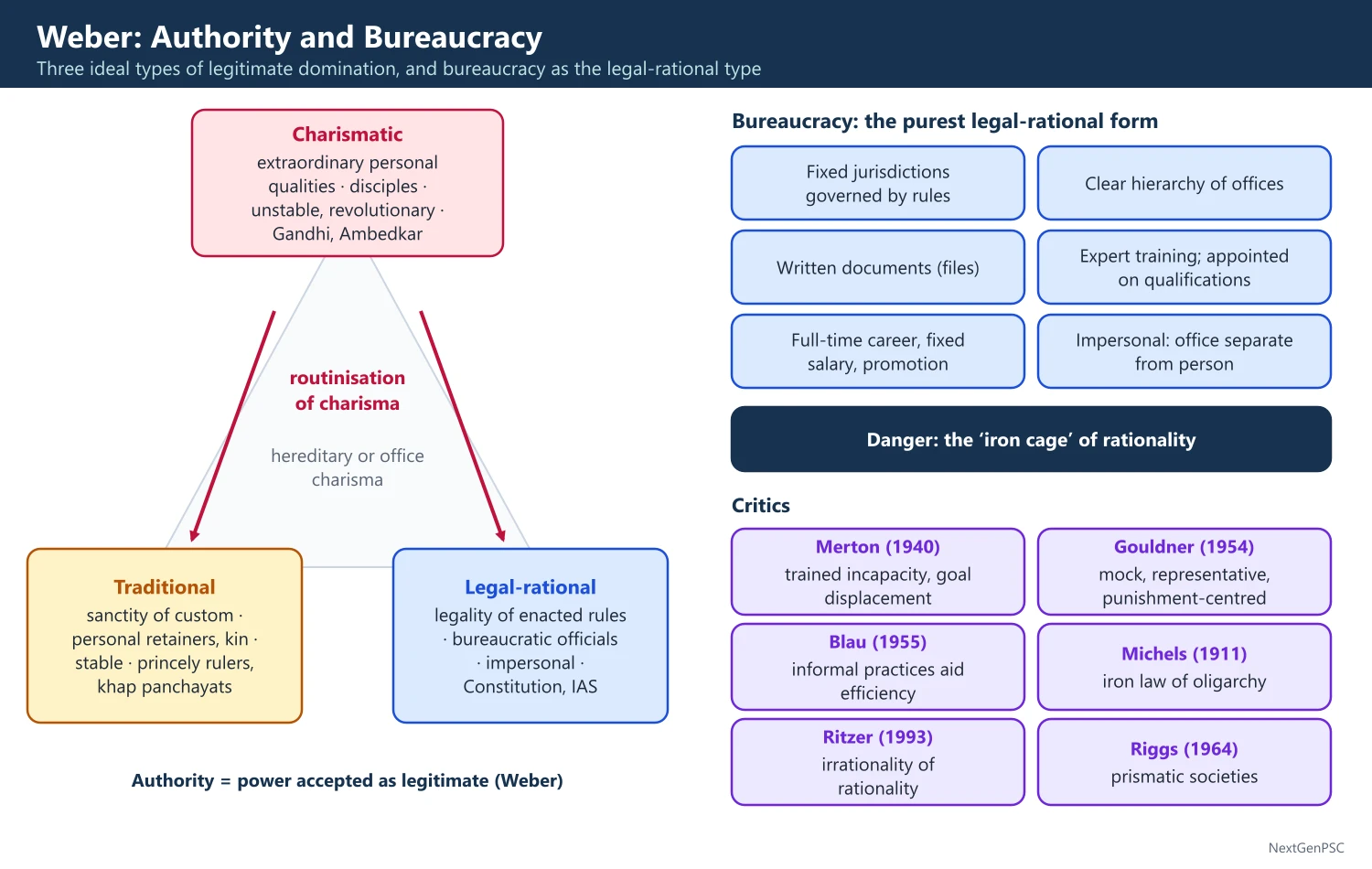
Traditional authority: rests on belief in the sanctity of immemorial traditions and the legitimacy of those exercising authority under them; forms include gerontocracy, patriarchalism, patrimonialism (rule through a personal staff) and feudalism; sultanism is an extreme patrimonial form.
Charismatic authority: rests on devotion to the exceptional sanctity, heroism or exemplary character of an individual; Weber defined charisma as a quality of personality by virtue of which a person is set apart and treated as endowed with supernatural, superhuman or exceptional powers.
Features of charisma: revolutionary, anti-economic, personal, unstable; it must be proved again and again; followers form a community of disciples rather than a bureaucracy.
Legal-rational authority: rests on belief in the legality of enacted rules and the right of those elevated to authority under such rules to issue commands; obedience is owed to the impersonal order, not the person.
Ideal types: real systems mix types; for example a modern prime minister may combine legal office, personal charisma and traditional symbolism.
3. Routinisation of Charisma
Problem of succession: when the charismatic leader dies or fails, the movement must become stable to survive.
Routes: search for a new charismatic person (as in the search for a new Dalai Lama), revelation (oracles, lots), designation by the original leader, designation by the staff, hereditary charisma (charisma passed through the bloodline) and charisma of office (attached to a position, as in priestly ordination).
Result: charisma becomes traditional or legal-rational; the movement acquires rules, offices and finances, which Weber saw as inevitable.
4. Bureaucracy
Ideal type features: fixed official jurisdictional areas governed by rules; a clear hierarchy of offices; management based on written documents (files); expert training for officials; full-time work in the office; administration according to general, learnable rules.
Position of the official: office as a vocation with specialised training; appointed (not elected) on the basis of qualifications; tenure, often for life; fixed salary and pension; a career with promotion by seniority or merit; separation of the office from private property.
Technical superiority: Weber held that fully developed bureaucracy compares with other organisations as a machine with non-mechanical modes of production, offering precision, speed, unambiguity, continuity and reduced friction.
Spread: bureaucracy grows with the money economy, mass democracy, the modern state, the capitalist enterprise and large armies.
Dangers: bureaucracy concentrates power, resists control by elected politicians and threatens freedom; Weber spoke of the ‘iron cage’ (stahlhartes Gehäuse, Parsons’ 1930 translation) of rationality and doubted that socialism would remove it.
Weber’s response: strong parliaments and leaders with charisma and an ‘ethic of responsibility’ (‘Politics as a Vocation’, 1919) were needed to control bureaucrats.
5. Criticism and Extensions
Robert Merton (‘Bureaucratic Structure and Personality’, 1940): showed dysfunctions: ‘trained incapacity’ (a term from Thorstein Veblen), goal displacement where following rules becomes an end, and the ritualism of the ‘bureaucratic personality’.
Alvin Gouldner (Patterns of Industrial Bureaucracy, 1954): in a gypsum plant he identified mock bureaucracy (rules ignored by all), representative bureaucracy (rules agreed by both sides) and punishment-centred bureaucracy (rules imposed by one side).
Peter Blau (The Dynamics of Bureaucracy, 1955): found that informal practices and consultation among officials often improved efficiency, which the formal model ignored.
Philip Selznick (TVA and the Grass Roots, 1949): showed how organisations co-opt local elites and drift from their goals.
Robert Michels (Political Parties, 1911): stated the ‘iron law of oligarchy’, that every organisation, even socialist parties, comes to be ruled by a few.
Tom Burns and G.M. Stalker (The Management of Innovation, 1961): contrasted mechanistic (Weberian) and organic organisations, the latter better suited to changing environments.
George Ritzer (The McDonaldization of Society, 1993): extended rationalisation to efficiency, calculability, predictability and control in fast-food style organisation, with the ‘irrationality of rationality’.
Zygmunt Bauman (Modernity and the Holocaust, 1989): argued that bureaucratic rationality and division of labour made mass killing administratively possible.
Fred Riggs: described developing societies as ‘prismatic’ (Administration in Developing Countries, 1964), where formal rules coexist with personal, kin and caste loyalties.
Feminist critique: Kathy Ferguson (The Feminist Case Against Bureaucracy, 1984) argued that bureaucracy embodies male norms of control.
6. Indian Examples and Studies
Traditional authority: zamindars, princely rulers, caste panchayats and khap panchayats; the elders of a lineage in village disputes.
Charismatic authority: Mahatma Gandhi, B.R. Ambedkar and religious figures; Lloyd and Susanne Rudolph (The Modernity of Tradition, 1967) showed how Gandhi used traditional idioms such as asceticism to build charisma.
Routinisation in India: the Indian National Congress after the freedom movement, the institutionalisation of the Dalit movement into parties, and dynastic politics as hereditary charisma.
Legal-rational authority: the Constitution of India (in force 26 January 1950), the Election Commission and courts; rule of law over person.
The steel frame: the Indian Civil Service was called the ‘steel frame’ of British rule (Lloyd George, 1922); Sardar Patel defended an all-India service in the Constituent Assembly in 1949, leading to the IAS.
Bureaucratic dysfunctions in India: red tape, file-pushing, delays and rigid rule-following match Merton’s goal displacement; the Second Administrative Reforms Commission (2005–09) recommended reforms.
Reforms: Mission Karmayogi (2020) for capacity building, e-governance and the Right to Information Act 2005 aim to make bureaucracy more accountable and citizen-centred.
Prismatic features: caste, kin and patronage networks shaping postings and access illustrate Riggs’ prismatic model and the gap between formal and actual bureaucracy.
7. Linking Thinkers
Weber and Marx: Marx saw the state as a tool of the ruling class; Weber saw bureaucracy as an independent power that would grow under socialism too.
Weber and Merton: Merton’s bureaucratic personality and ritualism (as a mode of adaptation) extend Weber’s model to its dysfunctions.
Weber and Michels, Pareto, Mosca: elite theorists share Weber’s concern with organisation and domination.
Weber and Habermas: Habermas warned of the ‘colonisation of the lifeworld’ by system rationality, echoing the iron cage.
8. Using it in the Exam
10 marks: define authority, give the three types with an Indian example each.
15 marks: features of Weber’s ideal-type bureaucracy and two critiques (Merton, Gouldner).
20 marks: power, domination and legitimacy → three types → routinisation of charisma → bureaucracy as legal-rational → dangers and the iron cage → critiques (Merton, Gouldner, Blau, Michels, Ritzer, Riggs) → Indian bureaucracy (steel frame, 2nd ARC, Mission Karmayogi) → conclusion.
Diagram idea: a triangle with traditional, charismatic and legal-rational authority at its corners and arrows showing charisma routinised into the other two.
Useful quotation idea: Weber compared a fully developed bureaucratic mechanism to a machine, superior to other forms of organisation as machine production is to non-mechanical production (paraphrase of Economy and Society).
| Type | Basis of legitimacy | Staff | Stability | Indian example |
|---|---|---|---|---|
| Traditional | Sanctity of custom | Personal retainers, kin | Stable, slow to change | Princely rulers, caste and khap panchayats |
| Charismatic | Extraordinary personal qualities | Disciples, followers | Unstable, revolutionary | Gandhi, Ambedkar |
| Legal-rational | Legality of enacted rules | Bureaucratic officials | Stable, impersonal | Constitution, IAS, Election Commission |
| Critic | Work | Main point |
|---|---|---|
| Merton | ‘Bureaucratic Structure and Personality’ (1940) | Trained incapacity, goal displacement, ritualism |
| Gouldner | Patterns of Industrial Bureaucracy (1954) | Mock, representative, punishment-centred bureaucracy |
| Blau | The Dynamics of Bureaucracy (1955) | Informal practices aid efficiency |
| Michels | Political Parties (1911) | Iron law of oligarchy |
| Ritzer | The McDonaldization of Society (1993) | Irrationality of rationality |
| Riggs | Administration in Developing Countries (1964) | Prismatic societies mix formal and personal norms |
Mains points
- Typical angles: ‘Weber’s types of authority’, ‘routinisation of charisma’, ‘Weber’s ideal-type bureaucracy and its dysfunctions’, ‘relevance of Weber’s bureaucracy for Indian administration’.
- Distinguish power, domination and authority precisely; many answers blur them.
- Present bureaucracy as an ideal type, then show real dysfunctions with Merton, Gouldner and Blau.
- Bring Indian examples: Gandhi’s charisma (Rudolph and Rudolph), steel frame, 2nd ARC, Mission Karmayogi, RTI Act 2005, Riggs’ prismatic model.
- Add Ritzer’s McDonaldization for a contemporary angle on rationalisation.
- Common mistake: attributing the ‘iron law of oligarchy’ to Weber; it is Michels’.
Did you know?
- The phrase ‘iron cage’ comes from Talcott Parsons’ 1930 English translation; Weber’s German ‘stahlhartes Gehäuse’ is closer to ‘a shell as hard as steel’.
- Memory trick for authority: ‘T-C-L’ — Tradition, Charisma, Law — ‘The Crown, the Charmer, the Clerk’.
Max Weber: The Protestant Ethic and the Spirit of Capitalism
In The Protestant Ethic and the Spirit of Capitalism (1904–05) Weber argued that the ascetic Protestantism of Calvinists and related sects, through the doctrines of predestination and the calling, produced a methodical, disciplined this-worldly asceticism that had an elective affinity with the spirit of modern capitalism. He did not claim religion alone caused capitalism, but showed that ideas can shape economic life; his comparative studies of China and India explained why rational capitalism did not first arise there.
In simple words
Weber asked why modern capitalism first grew in Protestant Europe, and answered that a religious attitude helped.
Imagine people who believe work is a duty to God, spend little on themselves and save and reinvest every rupee; their businesses grow steadily.
Weber called this attitude the Protestant ethic and said it fitted the spirit of capitalism, though many other causes mattered too.
UPSC asks about his argument, its critics, and whether Indian religions hindered or helped capitalism.
1. Concepts and Definitions
Publication: first published as two essays in 1904 and 1905 in the Archiv für Sozialwissenschaft und Sozialpolitik, revised in 1920, and translated into English by Talcott Parsons in 1930.
Modern rational capitalism: distinct from greed or adventurer capitalism found everywhere; based on rational bookkeeping, free wage labour, calculable law, the separation of household and business, and the continuous pursuit of profit as an end in itself.
Spirit of capitalism: an ethos that treats making money through legitimate, methodical work as a moral duty; Weber illustrated it with Benjamin Franklin’s maxims such as ‘time is money’ and ‘credit is money’.
Calling (Beruf): a concept Weber traced to Martin Luther, the idea that fulfilling one’s duty in a worldly occupation is the highest form of moral activity.
This-worldly (inner-worldly) asceticism: disciplined self-control applied to everyday work rather than withdrawal into monasteries.
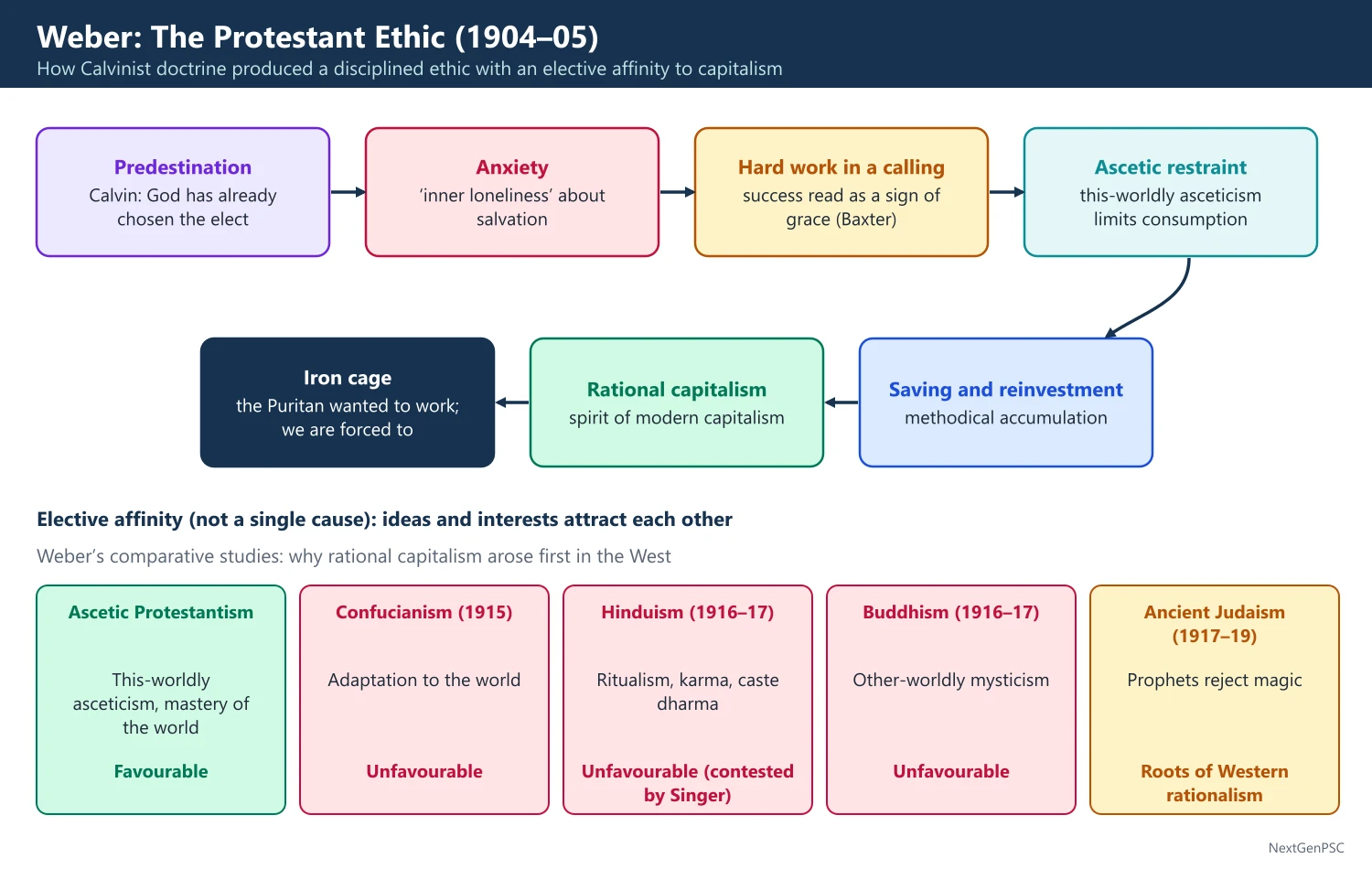
Elective affinity (Wahlverwandtschaft): a mutual attraction between a set of ideas and a set of interests, not a simple cause-effect relation.
2. The Argument Step by Step
Starting observation: Weber cited data (drawn from Martin Offenbacher’s study of Baden) suggesting that Protestants were over-represented among business owners, skilled workers and those in technical and commercial education.
Calvin’s doctrine of predestination: God has already chosen the saved (the elect) and the damned; nothing a person does can change it, which created intense ‘inner loneliness’ and anxiety.
Search for signs of grace: pastoral teaching, as in the Puritan Richard Baxter, encouraged believers to treat success in a calling as a sign of election and to work tirelessly to dispel doubt.
Methodical life: ascetic Protestantism demanded systematic self-control over the whole of life, condemning idleness, luxury and spontaneous enjoyment.
Unintended consequence: hard work plus restraint on consumption led to the accumulation and reinvestment of capital; wealth was acceptable if not enjoyed idly.
Other sects: Pietism, Methodism and the Baptist sects (including Quakers and Mennonites) showed similar ascetic tendencies.
From religion to iron cage: once established, capitalism no longer needs its religious roots; Weber ended with the image of an ‘iron cage’ and of ‘specialists without spirit, sensualists without heart’.
Not monocausal: Weber stated that he did not wish to replace a one-sided materialist interpretation with an equally one-sided spiritualist one (paraphrase); the study shows one causal chain among many.
3. Comparative Studies of World Religions
Purpose: to test the thesis by asking why rational capitalism did not arise in other civilisations that had material preconditions.
The Religion of China (1915): Confucianism promoted adaptation to the world and a literati ethic, while kinship-based trust and magic hindered impersonal rational economy.
The Religion of India (1916–17): Hinduism’s doctrines of karma and samsara, caste ritualism and the dharma of each caste encouraged traditionalism; Buddhism offered other-worldly mysticism; Jains were traders but ritual restrictions limited industrial capitalism.
Ancient Judaism (1917–19): traced the roots of Western rationalism to the prophets’ rejection of magic.
Theodicy: Weber called karma and rebirth the most consistent theodicy ever produced, because it justified each person’s status, which discouraged challenge to the social order.
4. Criticism
R.H. Tawney (Religion and the Rise of Capitalism, 1926): argued that capitalism also shaped Protestantism and that technological and political changes mattered more.
Werner Sombart (The Jews and Modern Capitalism, 1911): gave a rival role to Jewish communities, a thesis itself now criticised.
Kurt Samuelsson (Religion and Economic Action, 1957): disputed Weber’s evidence and the correlation between Protestantism and economic growth.
Historical counter-examples: capitalism flourished earlier in Catholic Italian city-states and Antwerp; Calvinist Scotland developed late, though Gordon Marshall (Presbyteries and Profits, 1980) partly supported Weber for Scotland.
Misreading of Calvin: critics note that Calvin did not teach that success proves election; Weber relied on later Puritan pastoral writings, which he acknowledged.
Marxist critique: ideas follow material change; the bourgeoisie adopted Protestantism because it suited its interests.
Supporting extensions: Robert Bellah (Tokugawa Religion, 1957) found a functional equivalent of the Protestant ethic in Japan; S.N. Eisenstadt (1968) stressed the ‘transformative potential’ of religions.
Colin Campbell (The Romantic Ethic and the Spirit of Modern Consumerism, 1987): added a romantic ethic to explain modern consumption, complementing Weber’s production-side focus.
5. Indian Examples and Debates
Milton Singer (When a Great Tradition Modernizes, 1972): studied Madras industrialists and found that Hindu beliefs did not block entrepreneurship; they compartmentalised ritual and business, challenging Weber’s view.
Business communities: Marwaris (Thomas Timberg, The Marwaris, 1978), Nattukottai Chettiars (David Rudner, Caste and Capitalism in Colonial India, 1994), Jains (James Laidlaw, Riches and Renunciation, 1995), Parsis and Gujarati traders show that Indian religious communities developed strong commercial ethics.
Jain ethic: Laidlaw showed how Jain merchants combine renunciation ideals with wealth, a parallel to Weber’s ascetic Protestants, though in a different form.
Karma as motivation: some scholars argue that karma can encourage disciplined work in one’s duty (the Bhagavad Gita’s nishkama karma), a this-worldly reading that Weber underplayed (debated).
Economic growth after 1991: India’s growth with Hindu, Jain, Sikh and Muslim entrepreneurs suggests that institutions, markets and policy matter more than religious doctrine, a point against strong readings of Weber.
Caste and capitalism: the journalist Harish Damodaran (India’s New Capitalists, 2008) traced how new business groups from non-traditional castes emerged, showing caste networks as resources.
K. William Kapp (Hindu Culture, Economic Development and Economic Planning in India, 1963): argued along Weberian lines that some Hindu cultural values slowed development, a view later contested.
6. Linking Thinkers
Weber and Marx: the study is often read as a reply to Marx, showing that ideas can be causal, though Weber accepted material interests as important.
Weber and Durkheim on religion: Durkheim stressed religion’s integrative function; Weber stressed its role in changing economic conduct.
Weber and modernisation theory: Parsons, McClelland (‘need for achievement’, The Achieving Society, 1961) and Rostow drew on Weber to argue that values drive development; dependency theorists (Frank) rejected this.
Weber and Srinivas or Singer: Indian studies of tradition and modernity test Weber’s thesis on Hinduism.
7. Using it in the Exam
10 marks: define the spirit of capitalism and the Protestant ethic, link through predestination and calling, note that it is not monocausal.
15 marks: argument plus two critics (Tawney, Samuelsson) and one Indian test (Singer).
20 marks: context (dialogue with Marx) → definitions → argument (predestination, calling, worldly asceticism, elective affinity) → comparative studies (China, India) → critics → Indian evidence (Singer, Marwaris, Chettiars, Jains) → conclusion on ideas and interests.
Flow chart idea: predestination → anxiety about salvation → hard work in a calling as sign of grace → ascetic restraint on consumption → saving and reinvestment → rational capitalism → iron cage.
Useful quotation idea: Weber wrote that the Puritan wanted to work in a calling, whereas we are forced to do so (paraphrase of the closing pages, 1904–05).
| Religion | Weber’s work | Orientation to the world | Effect on rational capitalism (Weber’s view) |
|---|---|---|---|
| Ascetic Protestantism | The Protestant Ethic (1904–05) | This-worldly asceticism, mastery of the world | Favourable (elective affinity) |
| Confucianism | The Religion of China (1915) | Adaptation to the world | Unfavourable (traditionalism, kinship) |
| Hinduism | The Religion of India (1916–17) | Ritualism, karma, caste dharma | Unfavourable (traditionalism) — contested by Singer |
| Buddhism | The Religion of India (1916–17) | Other-worldly mysticism | Unfavourable |
| Ancient Judaism | Ancient Judaism (1917–19) | Rejection of magic by prophets | Roots of Western rationalism |
Mains points
- Typical angles: ‘Weber’s thesis on the Protestant ethic’, ‘Is it a refutation of Marx?’, ‘relevance of Weber’s thesis to Indian society and religion’.
- Explain the chain predestination → anxiety → calling → worldly asceticism → accumulation clearly; examiners look for the logic.
- Stress that Weber was not monocausal and used ‘elective affinity’.
- Give critics (Tawney, Sombart, Samuelsson, Marxists) and supporters (Bellah, Marshall, Eisenstadt).
- Use Indian evidence: Singer’s Madras study, Marwaris, Chettiars, Jains (Laidlaw), post-1991 entrepreneurship.
- Common mistake: writing that Weber said Protestantism caused capitalism; he showed one contributing cause.
Did you know?
- Weber quoted Benjamin Franklin’s ‘Advice to a Young Tradesman’ (1748) as a pure example of the capitalist spirit, noting that Franklin himself was a deist rather than a strict Calvinist.
- Memory trick for the chain: ‘P-A-C-A-C’ — Predestination, Anxiety, Calling, Asceticism, Capital.
UPSC Previous Year Questions: Sociological Thinkers: Max Weber
From 2014 to 2026 UPSC asked 9 question parts (120 marks) on Max Weber in Paper I: 6 on authority and bureaucracy, 2 on the Protestant ethic and 1 on ideal types. Every question below has a model answer written to the UPSC word limit (150 words for 10 marks, 250 for 20 marks).
In simple words
Read the question and the approach line, then write your own answer in the time limit (7 minutes for 10 marks, 11 minutes for 20 marks).
Compare it with the model answer: did you define the concept in Weber's own terms, explain the argument, give criticism and an Indian example?
Note the flow charts and key terms in bold, and reuse them in your next answer.
1. Max Weber: Social Action and Ideal Types
Example 1 (UPSC 2020, 10 marks): 'Ideal Types' of Max Weber are mental constructs, they do not correspond to the reality. Give your views.
Paper and question: Paper I, Q1(d)
Approach: Agree that ideal types are mental constructs, then show that this is their purpose: they are measuring rods for real cases, not descriptions; end with criticism and an Indian example.
Max Weber described the ideal type as an analytical construct formed by the one-sided accentuation of one or more points of view and by synthesising many diffuse concrete phenomena into a unified mental picture.
The statement is half right. Weber himself said an ideal type is nowhere found empirically in reality. But this is its strength: it is a heuristic yardstick against which real cases are compared to frame hypotheses and causal explanations.
Ideal types are built from historical reality (authority, bureaucracy, the 'spirit of capitalism'), so they are not arbitrary fictions. In India, Louis Dumont's model of caste as hierarchy based on purity and pollution works like an ideal type; field studies such as Srinivas's Rampura show how real villages depart from it.
Alfred Schutz criticised Weber for not explaining how actors' own typifications relate to the observer's, and positivists find them hard to test. Still, they bridge interpretive understanding and causal analysis.
2. Max Weber: Authority and Bureaucracy
Example 2 (UPSC 2026, 10 marks): How does Max Weber's 'theory of authority' shape bureaucracy? Analyse.
Paper and question: Paper I, Q5(d)
Approach: Link Weber's three types of legitimate authority to the forms of administration they produce, showing that bureaucracy is the staff of legal-rational authority; use Indian examples.
For Max Weber, authority (Herrschaft) is legitimate domination: the probability that a command will be obeyed because those who obey accept it as rightful. Each type of authority has its own administrative staff.
Under traditional authority, the chief rules through personal retainers, kin or vassals, chosen by loyalty (patrimonialism), as in princely states. Charismatic authority has disciples rather than officials, with no salary, hierarchy or rules; this staff is unstable until charisma is routinised into tradition or rules.
Legal-rational authority rests on belief in impersonal, enacted rules, and its purest staff is bureaucracy: offices arranged in a hierarchy, fixed jurisdictions, written files, appointment by merit and qualification, salaried careers and separation of office from the person.
Flow chart: belief in legal rules → impersonal offices → hierarchy, files, merit recruitment → bureaucracy.
In India, the Constitution of 1950 and the UPSC-recruited IAS illustrate this link. Thus authority shapes bureaucracy, and bureaucracy in turn sustains legal-rational authority, though Weber warned of its iron cage.
Example 3 (UPSC 2024, 10 marks): How is 'power' different from 'authority'? Discuss various types of authorities as theorized by Max Weber.
Paper and question: Paper I, Q5(d)
Approach: Define power and authority in Weber's terms, state the difference (legitimacy), then give the three pure types of authority with Indian examples.
Max Weber defined power (Macht) as the probability that an actor in a social relationship will be able to carry out his own will despite resistance. Authority (Herrschaft) is power accepted as legitimate: commands are obeyed because subordinates believe the ruler has a right to issue them.
Power may rest on force or economic pressure, as when a moneylender dominates a debtor; authority rests on belief in legitimacy and is therefore more stable.
Weber identified three pure types of authority. Traditional authority rests on belief in the sanctity of age-old customs, as with a raja or a caste panchayat elder. Charismatic authority rests on devotion to the extraordinary qualities of a leader, as with Mahatma Gandhi in the freedom movement. Legal-rational authority rests on belief in enacted rules and the right of office-holders appointed under them, as with a district collector or the Election Commission.
These are ideal types; real systems mix them, as when charisma is routinised into party or dynastic politics in India.
Example 4 (UPSC 2023, 10 marks): Is Weber's idea of bureaucracy a product of the historical experiences of Europe? Comment.
Paper and question: Paper I, Q3(c)
Approach: Agree partly: Weber built the ideal type from European history, but he also studied non-European bureaucracies; then assess its applicability with Indian and other evidence.
Max Weber's ideal type of bureaucracy (hierarchy, rules, files, merit, salaried career) was drawn largely from the Prussian state, the modern European army, capitalist enterprises and Roman law. It is tied to his thesis of rationalisation of the West, the spread of calculable, rule-bound conduct along with capitalism and the legal-rational state.
In that sense it is a product of European history. Yet Weber also discussed bureaucracies in ancient Egypt and imperial China, and presented the modern form as technically superior and therefore spreading everywhere.
Its applicability outside Europe is debated. In India the colonial ICS, and later the IAS, adopted the Weberian design, but caste, kinship and patronage still shape postings and access, mixing legal-rational and patrimonial features; Fred Riggs called such administrations prismatic.
So the model was born in European experience, but as an ideal type it remains a useful yardstick everywhere.
Example 5 (UPSC 2021, 10 marks): Do you agree with Max Weber's idea that bureaucracy has the potential to become an iron cage? Justify your answer.
Paper and question: Paper I, Q3(c)
Approach: Explain the iron cage idea, agree with it using evidence of over-rationalisation, and qualify it with criticism and the possibility of change.
At the end of The Protestant Ethic and the Spirit of Capitalism (1904–05), Max Weber warned that the rational economic order, once established, binds individuals like an iron cage. Bureaucracy, the most efficient form of administration, is the core of this cage.
There is good reason to agree. Bureaucracy is technically superior but impersonal; rules become ends in themselves. Robert Merton called this goal displacement and the bureaucratic personality. In India, red tape, file-pushing and the plight of citizens without documents in welfare schemes show how rules can trap people.
Yet the cage is not total. Weber himself hoped that charismatic leadership and politics could check bureaucracy. Peter Blau found informal flexibility inside bureaucracies. The Right to Information Act 2005, social audits and digital grievance systems in India show that bureaucracy can be made accountable.
Hence the danger is real, but it is a tendency, not a fate.
Example 6 (UPSC 2015, 10 marks): Which concepts did Weber use to analyse the forms of legitimate domination?
Paper and question: Paper I, Q1(d)
Approach: List and explain the concepts Weber used to analyse legitimate domination: power, domination, legitimacy, the three pure types, administrative staff and routinisation.
Max Weber analysed political order in Economy and Society through linked concepts.
First, power (Macht): the chance of carrying out one's will despite resistance. Second, domination (Herrschaft): the probability that a command with a given content will be obeyed by a given group. Third, legitimacy: the belief of the ruled that the order is rightful, which turns domination into authority and makes it stable.
On the basis of the grounds of legitimacy he built three ideal types: traditional (sanctity of custom), charismatic (devotion to an exceptional person) and legal-rational (belief in enacted rules). For each he examined the administrative staff: patrimonial retainers, disciples, or a bureaucracy of officials.
He also used the concept of routinisation of charisma, by which charismatic authority becomes traditional or legal-rational after the leader's death, as with movements turning into parties in India. Real regimes, such as Indian politics, combine these ideal types.
Example 7 (UPSC 2014, 20 marks): How does Weber use the notion of 'ideal types' in his theory of bureaucracy?
Paper and question: Paper I, Q4(a)
Approach: Explain Weber's method of ideal types, then show how he built the ideal type of bureaucracy, its features and uses, and conclude with its criticism and Indian relevance.
For Max Weber, sociology must understand social action and explain it causally. His main tool was the ideal type: an analytical construct formed by the one-sided accentuation of selected features of reality into a logically consistent model. It is not an average or a moral ideal; it is a yardstick against which real cases are compared.
Weber's bureaucracy, set out in Economy and Society, is the clearest example. He drew together features of the Prussian state, modern armies, the Church and large firms, and exaggerated them into a pure type: (1) fixed official jurisdictions governed by rules; (2) a hierarchy of offices; (3) management based on written documents (files); (4) trained, expert officials; (5) full-time salaried careers with promotion by seniority or merit; (6) separation of office from personal property; and (7) impersonal application of rules.
Flow chart: concrete bureaucracies → accentuation of rational features → pure model → comparison with real cases → explanation of deviation.
The ideal type serves three purposes. It links bureaucracy to legal-rational authority, it allows comparison with patrimonial administrations, and it shows the technical superiority of bureaucracy, as precise and calculable as a machine compared with non-mechanical modes of production.
Using the type, one can measure how far a real administration deviates. In India, the IAS is formally Weberian, recruited by open competition, but studies of administration point to political transfers, caste networks and discretion, which depart from the model.
Critics such as Merton (dysfunctions and goal displacement), Gouldner (his study of a gypsum plant showing different patterns of bureaucracy) and Blau (informal organisation) argued that Weber ignored the informal side. Yet this criticism itself uses Weber's ideal type as the benchmark, which shows its value.
3. Max Weber: The Protestant Ethic and the Spirit of Capitalism
Example 8 (UPSC 2024, 20 marks): Describe the main idea of Max Weber's book, 'The Protestant Ethic and the Spirit of Capitalism' as a critique of Marxism.
Paper and question: Paper I, Q3(b)
Approach: Set out Marx's materialist view, then present Weber's thesis on Calvinism and the spirit of capitalism as an answer that adds ideas to material causes; note criticisms and Indian debates.
Karl Marx treated religion and ideas as part of the superstructure, shaped by the economic base; capitalism arose from changes in the forces and relations of production. Max Weber's The Protestant Ethic and the Spirit of Capitalism (1904–05) was in part an argument with this one-sided materialism.
Weber observed that in Germany business leaders, owners of capital and skilled labour were disproportionately Protestant. He asked why modern rational capitalism, the methodical pursuit of profit through rational organisation of free labour, arose first in the West.
His answer lay in the spirit of capitalism: an ethos that treats making money as a duty and a calling, illustrated by Benjamin Franklin's maxims. Its roots lay in Calvinism: the doctrine of predestination created deep anxiety about salvation; worldly success in a calling came to be seen as a sign of grace; and worldly asceticism forbade spending wealth on luxury, so profits were saved and reinvested.
Flow chart: predestination → salvation anxiety → calling and worldly asceticism → saving and reinvestment → rational capitalism.
This was a critique of Marxism in three ways. Ideas can be causally significant, so the superstructure is not merely a reflection. Causation is multiple and probabilistic, not determined by one factor. And Weber said he did not wish to replace a one-sided materialist interpretation with an equally one-sided spiritualist one.
Critics such as R.H. Tawney and Kurt Samuelsson argued that capitalism existed before Calvinism or that the evidence was weak. In India, Weber's The Religion of India argued that karma and caste discouraged capitalism, but the success of Marwari, Chettiar and Jain business communities, and growth after 1991, challenge this, while showing that both values and material conditions matter.
Example 9 (UPSC 2015, 20 marks): Discuss the role of Calvinist ethic in the development of Capitalism.
Paper and question: Paper I, Q2(a)
Approach: Explain what Weber meant by the Calvinist ethic and how it gave rise to the spirit of capitalism, then assess its role with the comparative studies, criticism and Indian evidence.
In The Protestant Ethic and the Spirit of Capitalism (1904–05), Max Weber argued that a particular religious ethic, ascetic Protestantism and above all Calvinism, helped create the ethos that made modern rational capitalism possible in the West.
Calvinism taught predestination: God has already chosen the elect, and nothing a person does can change this. This produced intense anxiety. Pastoral advice urged believers to regard themselves as chosen and to work tirelessly in a calling; success in one's calling came to be read as a sign of election. At the same time worldly asceticism condemned idleness, luxury and spontaneous enjoyment.
Flow chart: predestination → anxiety → work in a calling as a sign of grace → saving, not spending → accumulation and reinvestment → rational capitalism.
The result was a methodical, disciplined way of life: continuous work, honest dealing, accounting and saving. Profits could not be spent on pleasure, so they were reinvested. This 'spirit of capitalism', which Weber illustrated with Benjamin Franklin's maxims, gave capitalism its moral legitimacy and its disciplined workforce. Weber supported the argument with comparative studies of China and India, where, in his view, the religious ethic did not favour such rationalisation.
Critics questioned the role he gave Calvinism. R.H. Tawney stressed the interplay of religion and economic change, Kurt Samuelsson disputed the evidence, and others noted capitalism in Catholic Italian cities. In India, Marwari and Jain traders combined piety, thrift and enterprise, as James Laidlaw's study of Jains shows, suggesting functional equivalents of the Protestant ethic. Weber's thesis is best read as showing that the Calvinist ethic was one important, not sole, factor in the rise of capitalism.
Mains points
- Authority and bureaucracy dominate: types of authority, power versus authority, the iron cage and the European origin of bureaucracy recur almost every second year.
- Examiners reward Weber's own terms (Herrschaft, legitimacy, ideal type, rationalisation, routinisation of charisma) defined precisely before the argument.
- Link concepts: ideal type with bureaucracy, legal-rational authority with bureaucracy, Protestant ethic with Marx's base and superstructure, iron cage with Merton's goal displacement.
- Bring in criticism by named sociologists (Merton, Gouldner, Blau, Tawney, Samuelsson, Schutz) and Indian examples (IAS, Gandhi's charisma, RTI 2005, Marwari and Jain business communities).
- End with a balanced judgement: Weber's types are yardsticks, not descriptions, and real cases mix them.
Did you know?
- The phrase 'iron cage' is Talcott Parsons's 1930 English translation of Weber's 'stahlhartes Gehäuse', which literally means a shell as hard as steel.
Sociology Optional: All chapters
- Exam Pattern, Syllabus and Strategy
- Sociology: The Discipline
- Sociology as Science
- Research Methods and Analysis
- Sociological Thinkers: Marx and Durkheim
- Sociological Thinkers: Max Weber
- Sociological Thinkers: Parsons, Merton and Mead
- Stratification and Mobility
- Works and Economic Life
- Politics and Society
- Religion and Society
- Systems of Kinship
- Social Change in Modern Society
- Perspectives on the Study of Indian Society
- Impact of Colonial Rule on Indian Society
- Rural and Agrarian Social Structure
- Caste System
- Tribal Communities in India
- Social Classes in India
- Kinship, Family and Religion in India
- Visions of Social Change in India
- Rural and Agrarian Transformation in India
- Industrialisation and Urbanisation in India
- Politics and Society in India
- Social Movements in Modern India
- Population Dynamics
- Challenges of Social Transformation