
Sociology Optional · UPSC Notes
Works and Economic Life — UPSC Sociology Optional Notes
Free, exam-focused notes for UPSC Prelims and Mains, with Prelims tips and Mains points for every topic. 4 topics.
Open in the interactive reader: bookmarks, progress tracking and read-aloud.
Social Organisation of Work: Slave, Feudal and Industrial Societies
Work is organised differently in each type of society. In slave society the worker is owned as property; in feudal society the serf is tied to the land and owes labour or rent to the lord; in industrial capitalist society the worker is legally free but must sell labour power for a wage. Marx, Weber and Durkheim, and later Taylor, Braverman and Blauner, explain how these forms shape control, skill and alienation, with Indian parallels in agrestic slavery, begar, jajmani and bonded labour.
In simple words
Who controls the worker and how? A slave is owned like cattle, a serf is tied to the lord's land, and a factory worker is free to leave but must work for wages to survive.
Think of three people: a Roman slave, a medieval serf and a worker in a Pune car plant.
Each society also sets how skilled, controlled and alienated work feels; sociologists call this the social organisation of work.
UPSC asks you to compare these three types and relate them to India.
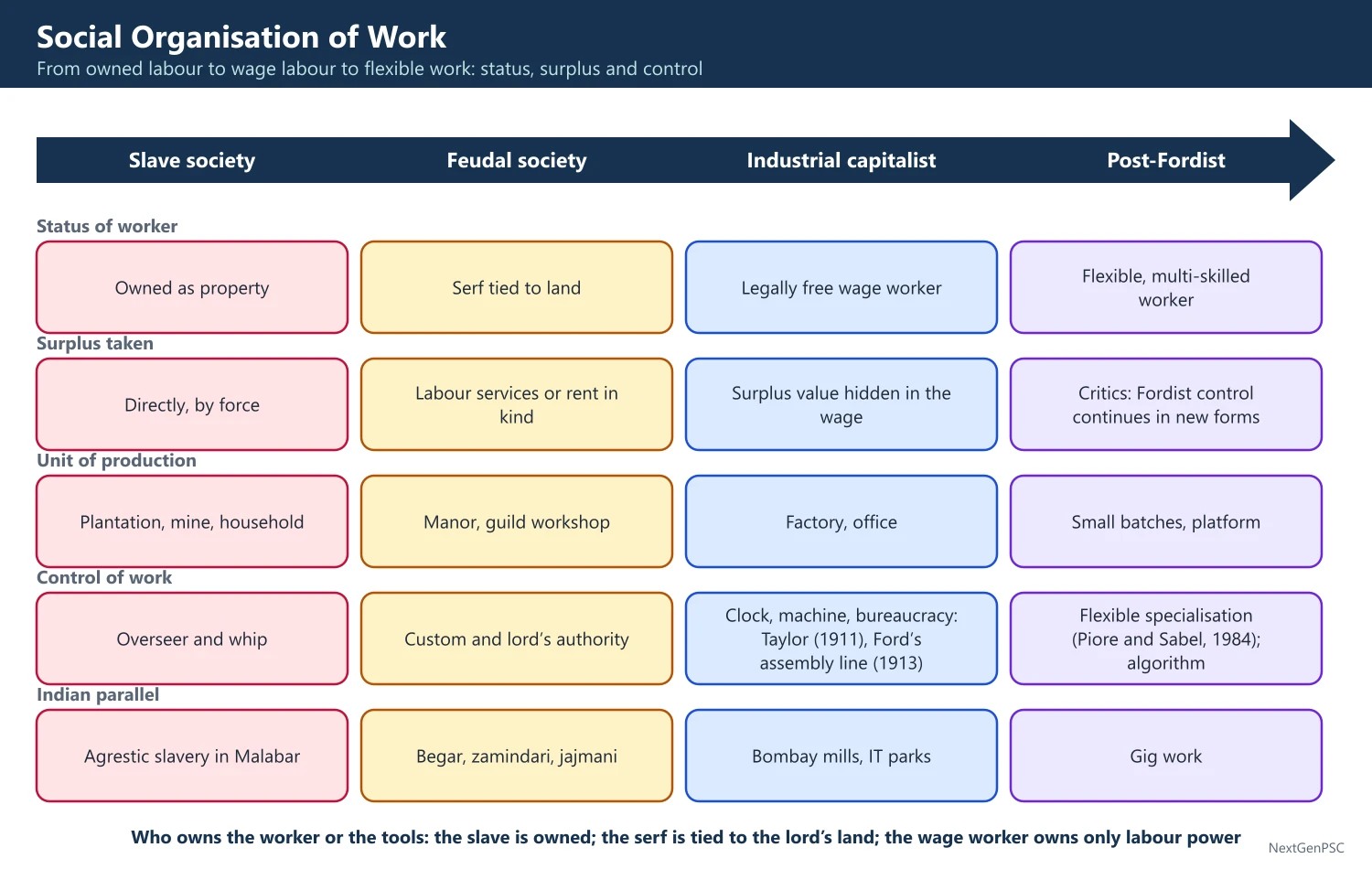
1. Concepts and Definitions
Work: Anthony Giddens defines work, paid or unpaid, as carrying out tasks that require mental and physical effort with the aim of producing goods and services for human needs; housework and care are work even when unpaid.
Division of labour: Adam Smith's pin factory example in The Wealth of Nations (1776) showed productivity gains from specialisation; Durkheim (The Division of Labour in Society, 1893) saw it as the source of organic solidarity.
Mode of production: Marx's term for the combination of forces of production (tools, skills, technology) and relations of production (ownership and control); history moves through primitive communism, ancient (slave), feudal and capitalist modes, with the Asiatic mode as a special case.
Slavery: Orlando Patterson (Slavery and Social Death, 1982) defined it as the permanent, violent domination of natally alienated and generally dishonoured persons; the slave has no recognised kin or social existence of his own.
Feudalism: Marc Bloch (Feudal Society, 1939–40) described a system of personal bonds between lord and vassal, the fief (land granted for service), the manor and the serf bound to the soil.
Serf vs slave: the serf is not owned and has some customary rights and a family plot, but cannot leave the land and owes labour services (corvée) or rent in kind.
Capitalism: production for profit by owners of capital using formally free wage labour; Weber stressed rational capital accounting and formally free labour as its defining features (General Economic History, 1923).
Labour as fictitious commodity: Karl Polanyi (The Great Transformation, 1944) argued that labour, land and money are not produced for sale, so treating them as commodities disrupts society and provokes a protective 'double movement'.
Industrial society: a society where most work is done in factories with machine technology; Saint-Simon and Comte first used the idea, and Clark Kerr and colleagues (Industrialism and Industrial Man, 1960) predicted that all industrial societies would converge.
2. Slave Society
Genuine slave societies: Moses Finley (Ancient Slavery and Modern Ideology, 1980) argued that only a few societies were true slave societies where slaves did most productive work: classical Athens and Rome, and later Brazil, the Caribbean and the US South.
Work organisation: gang labour on plantations and mines under overseers, coercion by the whip, no wage, and the owner's control over the slave's body, family and children.
Marx's view: the slave owner owns both the means of production and the worker; surplus is taken openly by force, unlike the hidden exploitation of wage labour.
Weber's view: in The Agrarian Sociology of Ancient Civilizations (1909) he argued slave economies were limited because slaves had to be bought and fed even when idle and could not easily be motivated.
Scale and abolition: about 12.5 million Africans were shipped across the Atlantic between the 16th and 19th centuries; Britain abolished slavery in its colonies in 1833 and the USA by the 13th Amendment (1865).
India: ancient texts mention dasa labour; agrestic slavery of castes such as Pulayas and Cherumas in Malabar and Travancore persisted into the 19th century, until the Indian Slavery Act, 1843 withdrew legal recognition of slavery.
Modern slavery: the ILO, Walk Free and IOM Global Estimates (2022) counted about 50 million people in modern slavery in 2021, including about 28 million in forced labour; bonded labour in brick kilns and agriculture is India's main form.
Indian law: Article 23 bans traffic in human beings and forced labour (begar); the Bonded Labour System (Abolition) Act, 1976 abolished debt bondage.
3. Feudal Society
Manorial organisation: the lord's demesne was worked by serfs who also farmed their own strips; work followed the agricultural calendar and custom, not the clock.
Guilds: in towns, craft guilds controlled entry, prices and quality; the master–journeyman–apprentice system combined training with hierarchy.
Ideology: the Church sanctified the three orders of those who pray, those who fight and those who work, legitimising the feudal hierarchy.
Transition debate: Maurice Dobb (1946) traced the decline of feudalism to internal class struggle between lords and peasants, while Paul Sweezy (1950) stressed the external effect of trade and towns; the Dobb–Sweezy debate remains a classic.
Indian feudalism debate: R.S. Sharma (Indian Feudalism, 1965) argued that land grants to Brahmins and officials produced feudalism in early medieval India; Harbans Mukhia ('Was There Feudalism in Indian History?', 1981) disagreed, citing peasant control over production; debated.
Begar and zamindari: forced unpaid labour for landlords and the state continued under colonial zamindari, abolished by state laws in the early 1950s.
Jajmani system: William Wiser (The Hindu Jajmani System, 1936), a study of Karimpur village in Uttar Pradesh, described hereditary exchange of services between patron (jajman) and service castes (kamin) for grain shares; critics such as Harold Gould and Kathleen Gough saw it as exploitative.
Semi-feudalism: Amit Bhaduri (1973) argued that landlord-moneylenders in eastern India kept sharecroppers in debt and resisted technical change, part of the Indian mode of production debate in the EPW in the 1970s (Utsa Patnaik, Ashok Rudra, Jairus Banaji).
4. Industrial and Capitalist Society
Factory system: separation of home and work, clock time (E.P. Thompson, 'Time, Work-Discipline and Industrial Capitalism', 1967), wage payment, supervision and machine pacing.
Marx's view: capitalism turns labour power into a commodity; the worker is alienated from the product, the process, species-being and fellow workers (Economic and Philosophic Manuscripts, 1844).
Weber's view: capitalism rests on rational bureaucratic organisation, calculable law and disciplined labour; he feared an 'iron cage' of rationality.
Scientific management: F.W. Taylor (The Principles of Scientific Management, 1911) separated planning from doing, used time-and-motion studies and paid by piece rate.
Fordism: Henry Ford's moving assembly line (1913) combined Taylorism with mass production of standard goods and high wages for mass consumption.
Deskilling: Harry Braverman (Labor and Monopoly Capital, 1974) argued that capitalism degrades work by stripping workers of skill and control; critics say he ignored worker resistance and reskilling.
Technology and alienation: Robert Blauner (Alienation and Freedom, 1964) found alienation lowest in craft work, highest in assembly-line work (car industry) and lower again in automated process industries (chemicals), an inverted U.
Post-Fordism: Piore and Sabel (The Second Industrial Divide, 1984) described flexible specialisation, small batches and multi-skilled workers; critics argue Fordist control continues in new forms.
Post-industrial and service work: Daniel Bell (The Coming of Post-Industrial Society, 1973) saw knowledge workers rising; George Ritzer (The McDonaldization of Society, 1993) showed Weberian rationalisation in fast food; Arlie Hochschild (The Managed Heart, 1983) described emotional labour.
India: the Bombay textile mills recruited labour through caste and village-based jobbers (Rajnarayan Chandavarkar, The Origins of Industrial Capitalism in India, 1994); Carol Upadhya (Reengineering India, 2016) studied control and culture in Bengaluru's IT industry.
5. Linking Thinkers
Marx's modes of production link to Thorner's agrarian classes and the Indian mode of production debate (Paper II).
Durkheim's organic solidarity and abnormal forms of division of labour link to anomie in industrial work.
Weber's bureaucracy and rationalisation link to Taylorism and Ritzer's McDonaldization.
Patterson's social death links to untouchability as ritual dishonour, though caste is not slavery.
6. Using It in the Exam
10 marks: contrast two forms (slave vs serf, or feudal vs capitalist) on ownership, control, freedom and surplus, with an Indian example.
15 or 20 marks: compare all three with a table, then add the changing organisation of industrial work (Taylor, Fordism, post-Fordism) and India's semi-feudal and informal realities.
Thinkers examiners look for: Marx, Weber, Durkheim, Patterson, Bloch, Braverman, Blauner, Wiser, Bhaduri.
Diagram idea: a timeline arrow from slave to feudal to capitalist to post-Fordist work, with 'who owns the worker or the tools' written under each stage.
Quotation: Marx and Engels, Communist Manifesto (1848): 'The history of all hitherto existing society is the history of class struggles.'
| Feature | Slave society | Feudal society | Industrial capitalist society |
|---|---|---|---|
| Status of worker | Owned as property | Serf tied to land | Legally free wage worker |
| How surplus is taken | Directly, by force | Labour services or rent in kind | Surplus value hidden in the wage |
| Main unit of production | Plantation, mine, household | Manor, guild workshop | Factory, office, platform |
| Control of work | Overseer and whip | Custom and lord's authority | Clock, machine, bureaucracy, algorithm |
| Indian parallel | Agrestic slavery in Malabar | Begar, zamindari, jajmani | Bombay mills, IT parks, gig work |
Mains points
- Questions compare work in pre-industrial and industrial societies; organise the answer by ownership, control, freedom, skill and solidarity.
- Bring Marx (modes of production), Weber (formally free labour, rationalisation) and Durkheim (division of labour) together; one-thinker answers score lower.
- Use Indian cases: agrestic slavery and the 1843 Act, begar and jajmani (Wiser), bonded labour and the 1976 Act, semi-feudalism (Bhaduri).
- For changes within industrial work, show the path from Taylorism and Fordism to post-Fordism and platform work, with Braverman and Blauner.
- Avoid saying slavery has ended; cite modern slavery estimates (2022) and bonded labour in India.
- Mark the Indian feudalism debate (Sharma vs Mukhia) as debated.
Did you know?
- Henry Ford doubled his workers' pay to five dollars a day in 1914 partly to stop the very high turnover caused by boring assembly-line work.
- Memory trick: 'Own, Bind, Hire' — the slave is owned, the serf is bound, the worker is hired.
Formal and Informal Organisation of Work
The phrase has two meanings. Inside a workplace, formal organisation is the official structure of rules and positions (Weber, Taylor), while informal organisation is the network of friendships, norms and practices that grows among workers (Hawthorne studies, Barnard, Blau). In the economy, the formal sector is regulated and protected, while the informal sector (Keith Hart, 1971) is unregistered and unprotected; in India over nine-tenths of workers are informal.
In simple words
Every office has an organisation chart, but also a lunch group that decides who gets help and how fast work is done. The chart is the formal organisation; the lunch group is the informal one.
In the economy, a bank clerk with a contract and pension is in the formal sector, while a street vendor or delivery rider with no contract is in the informal sector.
Most Indian workers are informal, so this topic matters greatly.
UPSC asks about the Hawthorne studies, informal sector theories and gig work.
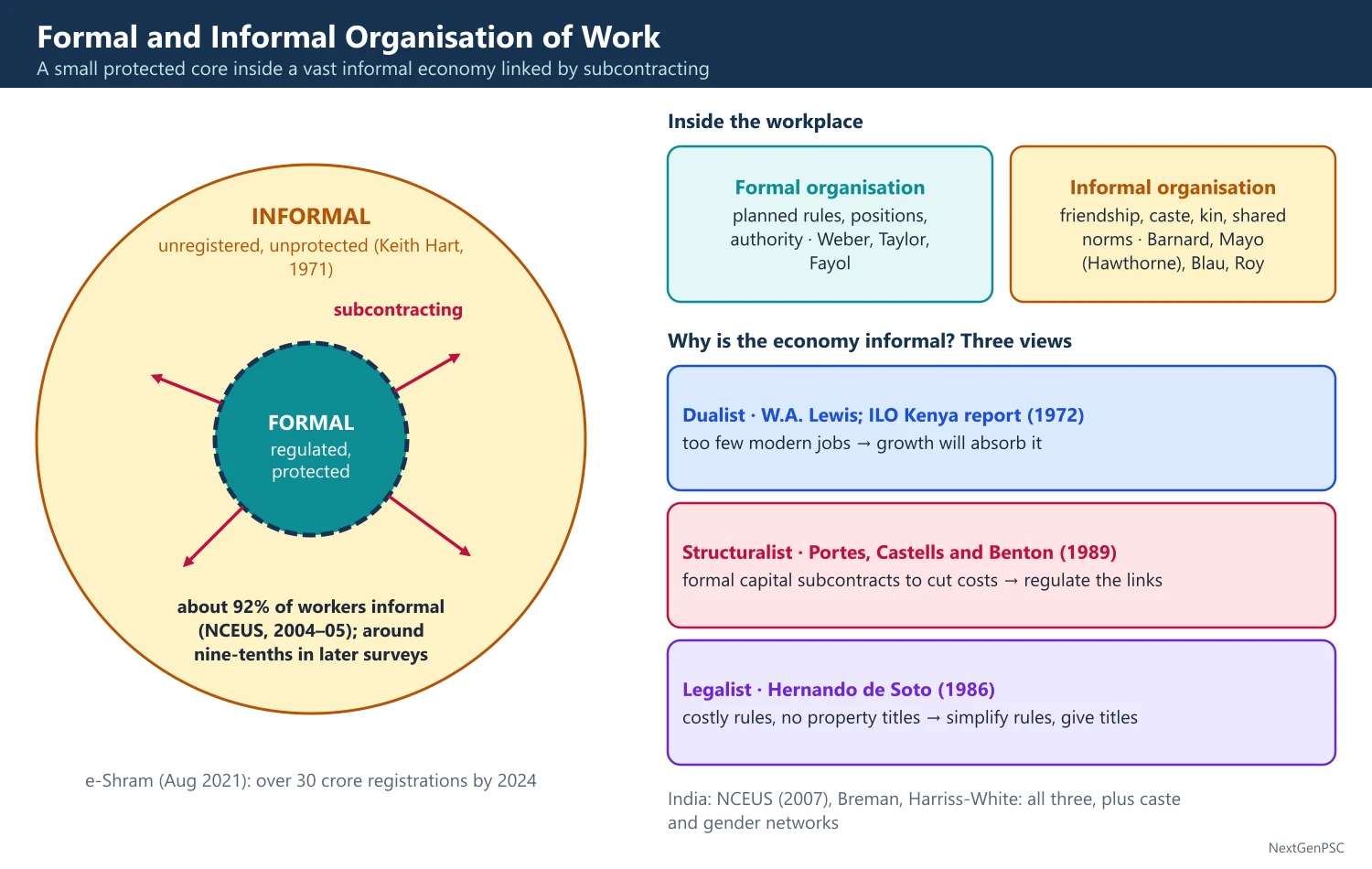
1. Formal and Informal Organisation in the Workplace
Formal organisation: a deliberately designed structure of positions, rules, authority and communication to achieve goals; Weber's legal-rational bureaucracy (Economy and Society, 1922) is its ideal type, and Henri Fayol (1916) gave principles of administration.
Classical management: Taylor's scientific management treated the worker as an economic individual motivated by pay and controlled by precise instructions.
Informal organisation: Chester Barnard (The Functions of the Executive, 1938) defined it as the personal contacts and interactions not governed by the formal structure, which nonetheless make cooperation possible.
Hawthorne studies: conducted at the Western Electric Hawthorne Works near Chicago (1924–1932), led by Elton Mayo (The Human Problems of an Industrial Civilization, 1933) and reported by Roethlisberger and Dickson (Management and the Worker, 1939).
Illumination and relay assembly tests: output rose whatever the change in lighting or rest breaks, suggesting that attention and group feeling mattered more than physical conditions, later called the Hawthorne effect.
Bank wiring observation room: fourteen men set their own output norm and punished deviants: 'rate-busters' who worked too hard, 'chiselers' who worked too little and 'squealers' who told supervisors.
Human relations school: from these studies came the idea that workers are social beings, that informal groups shape productivity and that managers need social skills.
Peter Blau (The Dynamics of Bureaucracy, 1955): in a state employment agency, officials developed informal practices of consultation that broke rules but improved efficiency.
Alvin Gouldner (Patterns of Industrial Bureaucracy, 1954): in a gypsum plant he found mock, representative and punishment-centred bureaucracy, depending on who supported the rules.
2. Debates on Workplace Organisation
Critique of Hawthorne: Alex Carey (1967) argued that the studies were methodologically weak and that discipline and the Depression explained output; Marxists saw human relations as a subtler means of control.
Merton's bureaucratic personality: strict rule-following becomes an end in itself (goal displacement), a dysfunction of formal organisation (1940).
Burns and Stalker (The Management of Innovation, 1961): mechanistic organisations suit stable conditions, organic ones suit change and innovation.
Workers' games: Donald Roy's 'banana time' (1959) showed informal rituals that made monotonous work bearable; Michael Burawoy (Manufacturing Consent, 1979) showed that the game of 'making out' on piece rates led workers to consent to their own exploitation.
Japanese model: lifetime employment, quality circles and teamwork (Ronald Dore, British Factory – Japanese Factory, 1973) challenged the convergence thesis.
Post-bureaucratic organisation: flatter hierarchies, project teams and digital monitoring; critics argue that control is now exercised by algorithms and self-discipline.
Indian factory: N.R. Sheth (The Social Framework of an Indian Factory, 1968) found that caste, kinship and patron–client ties shaped recruitment and relations in a Gujarat factory, so the informal organisation mirrored wider society.
3. The Informal Sector: Concepts and Theories
Origin: Keith Hart coined the term in a 1971 paper on Accra, published in 1973 ('Informal Income Opportunities and Urban Employment in Ghana'); the ILO's Kenya mission report (1972) spread it.
Dualist school: following W.A. Lewis's dual economy model (1954), the informal sector is a traditional, marginal sector that will shrink as modern industry grows.
Structuralist school: Portes, Castells and Benton (The Informal Economy, 1989) argued that informal enterprises are subordinated to formal capital through subcontracting, lowering its labour costs.
Legalist school: Hernando de Soto (The Other Path, 1986) argued that heavy regulation pushes entrepreneurs into informality; simpler property titles would free their energy.
ILO definitions: the informal sector concept (15th ICLS, 1993) refers to unregistered enterprises; informal employment (17th ICLS, 2003) covers jobs without social protection, including inside formal firms.
Informalisation of formal work: contract labour, casual staff and outsourcing inside factories and government offices; Martha Chen and the WIEGO network document this worldwide.
Indian definition: the NCEUS (2007) defined the unorganised sector as unincorporated private enterprises owned by individuals or households with fewer than ten workers, and informal workers as those without employment or social security.
Fortress metaphor: Mark Holmström (Industry and Inequality, 1984) described organised workers as living in a citadel, while the mass outside was insecure; he later noted the walls were porous.
4. Indian Data and Examples
Size: the NCEUS estimated that about 92% of India's workforce was informally employed in 2004–05; later surveys continue to show around nine-tenths informal.
Vulnerability: the NCEUS also found that about 77% of the population lived on less than Rs 20 a day in 2004–05, mostly informal workers.
e-Shram: the national database of unorganised workers launched in August 2021 crossed 30 crore registrations by 2024.
Gig and platform workers: NITI Aayog's report India's Booming Gig and Platform Economy (June 2022) estimated 77 lakh gig workers in 2020–21 and projected 2.35 crore by 2029–30.
Law: the Code on Social Security, 2020 recognises gig and platform workers; it came into force with the other three labour codes on 21 November 2025; Rajasthan passed a Platform Based Gig Workers (Registration and Welfare) Act in 2023.
Social regulation of informality: Barbara Harriss-White (India Working, 2003) showed that the informal economy is governed not by the state but by caste, gender, religion and local associations.
Footloose labour: Jan Breman (Footloose Labour, 1996) described circular migrants in Gujarat moving between brick kilns, construction and agriculture without security.
Organising the informal: SEWA, founded by Ela Bhatt in Ahmedabad in 1972, organised self-employed women such as vendors and home-based workers as a trade union.
Women: a large share of women workers are self-employed or unpaid helpers in family enterprises, so formal statistics understate their work.
Algorithmic control: app-based delivery and ride-hailing workers face ratings, incentives and deactivation, a new mix of formal control and informal employment status.
5. Linking Thinkers
Weber's bureaucracy and Merton's bureaucratic personality explain formal organisation; Blau and Gouldner show its informal side.
Marx's reserve army of labour helps explain the informal sector; Polanyi's double movement explains demands for social protection of gig workers.
Durkheim's anomie fits insecure informal work without norms of fair contract.
6. Using It in the Exam
10 marks: define formal and informal organisation with Barnard and Hawthorne, and give one Indian factory example (Sheth).
15 or 20 marks: explain the dualist, structuralist and legalist views of the informal sector, then use NCEUS, e-Shram, NITI Aayog and the labour codes.
Thinkers examiners look for: Weber, Barnard, Mayo, Blau, Gouldner, Hart, Portes, de Soto, Breman, Harriss-White, Holmström.
Diagram idea: two concentric circles: an inner fortress of formal, protected workers and a large outer ring of informal workers, with arrows of subcontracting from inner to outer.
Quotation: Barnard's idea, paraphrased: informal organisation is the web of personal contacts without which formal organisation cannot function.
| School | Key thinkers | Cause of informality | Policy view |
|---|---|---|---|
| Dualist | W.A. Lewis; ILO Kenya report (1972) | Too few modern jobs for a growing labour force | Growth will absorb it; support livelihoods meanwhile |
| Structuralist | Portes, Castells and Benton (1989) | Formal capital cuts costs by subcontracting | Regulate links between formal and informal firms |
| Legalist | Hernando de Soto (1986) | Costly regulation and lack of property titles | Simplify rules, give titles |
| Indian evidence | NCEUS (2007), Breman, Harriss-White | All three, plus caste and gender networks | Social security codes, e-Shram, SEWA-type organising |
| Point | Formal organisation | Informal organisation |
|---|---|---|
| Origin | Planned by management | Grows spontaneously among workers |
| Basis | Rules, positions, authority | Friendship, caste, kin, shared norms |
| Key thinkers | Weber, Taylor, Fayol | Barnard, Mayo, Blau, Roy |
| Indian example | Government office hierarchy | Caste and kin ties in Sheth's Gujarat factory |
Mains points
- Clarify both meanings of 'formal and informal organisation' at the start; many candidates write only about the informal sector.
- Hawthorne studies are a must for workplace questions; add their critique (Carey) and Burawoy's consent argument.
- For the informal sector, present the three schools and then Indian evidence (NCEUS, e-Shram, NITI Aayog 2022, labour codes in force from 21 November 2025).
- Use Indian ethnographies: Sheth's factory, Breman's footloose labour, Harriss-White's India Working, Holmström's fortress.
- Discuss gig work as a new hybrid: formally 'partners', informally controlled by algorithms.
- Conclude with policy: social security, collective organising (SEWA) and portable benefits.
Did you know?
- The term 'Hawthorne effect', meaning people change behaviour because they are being observed, was coined later (by Henry Landsberger in 1958), not by Mayo himself.
- Keith Hart, who coined 'informal sector', got the idea while living among migrants in a poor district of Accra, Ghana.
Labour and Society
Labour is not just an economic input but a social relation that shapes identity, family, community and politics. Marx's alienation and labour process, Durkheim's anomic and forced division of labour, Weber's rationalisation, Braverman's deskilling, Goldthorpe and Lockwood's affluent worker, Hochschild's emotional labour and Standing's precariat explain how work shapes society. In India, caste, gender, migration, child and bonded labour, trade unions and the new labour codes define the labour question.
In simple words
Your job decides more than your income: it shapes your friends, your sense of worth, your health and even your politics.
A factory worker who repeats one task all day may feel like a machine; Marx called this alienation.
In India, who does which work is still linked to caste and gender, and most workers have no job security.
UPSC asks how labour affects society, about trade unions, and about new forms such as gig and emotional labour.
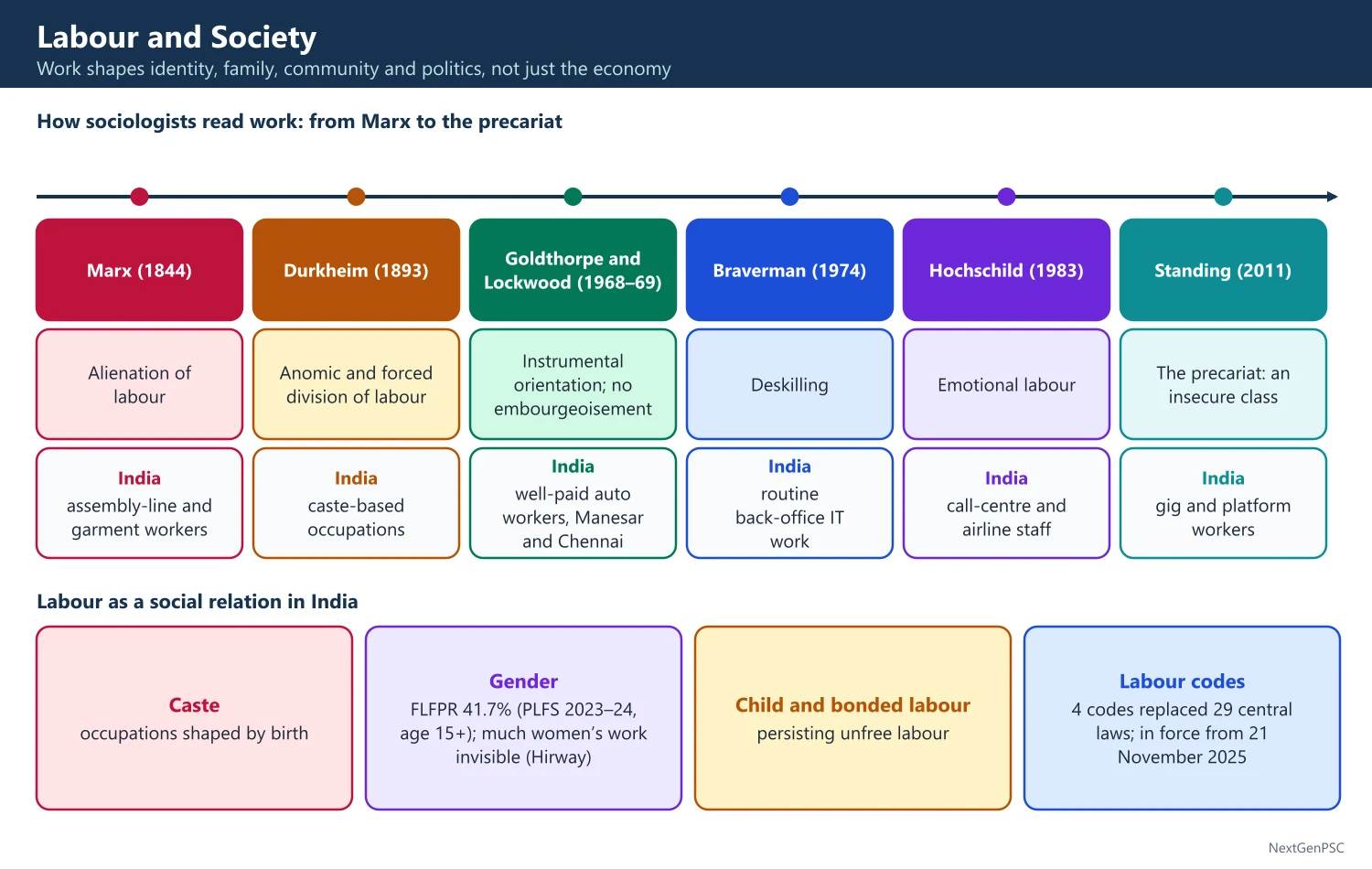
1. Concepts and Definitions
Labour vs labour power: Marx distinguished labour (the activity) from labour power (the capacity to work) that the worker sells; profit comes from the gap between the value labour power creates and its wage.
Alienation: Marx's four forms in the Economic and Philosophic Manuscripts (1844): from the product, from the act of production, from species-being and from other humans.
Labour process: the organisation and control of work under capitalism; labour process theory grew from Braverman (1974) and was developed by Andrew Friedman (responsible autonomy vs direct control, 1977) and Richard Edwards (simple, technical and bureaucratic control, 1979).
Anomic division of labour: Durkheim's abnormal form where rapid industrial change outpaces regulation, causing crises and class conflict; the forced division of labour arises when people are placed in jobs by inherited inequality, not talent.
Emotional labour: Arlie Hochschild (The Managed Heart, 1983) studied flight attendants who had to manage their own feelings to produce a required emotional state in customers.
Precariat: Guy Standing (The Precariat: The New Dangerous Class, 2011) describes workers with insecure jobs, incomes and identities.
Trade union: Sidney and Beatrice Webb (The History of Trade Unionism, 1894) defined it as a continuous association of wage earners for maintaining or improving the conditions of their working lives.
Industrial relations: the system of rules and institutions that govern relations among workers, employers and the state (John Dunlop, Industrial Relations Systems, 1958).
2. Theories of Labour and Society
Marx: labour is the essence of being human; under capitalism it becomes forced and alienated, and the shared experience of exploitation can create class consciousness and revolution.
Durkheim: occupational groups (professional associations) could provide the moral regulation that industrial society lacks (preface to the second edition of The Division of Labour, 1902).
Weber: the Protestant calling turned work into a moral duty; modern work became rationalised and disciplined.
Affluent Worker study: John Goldthorpe, David Lockwood and colleagues studied well-paid car and chemical workers in Luton (published 1968–69) and found an instrumental orientation to work and a privatised family life, but rejected the embourgeoisement thesis that they had become middle class.
Deskilling vs upskilling: Braverman's degradation thesis versus Blauner's and Bell's view that technology can raise skill; evidence is mixed and debated.
End of work and class? André Gorz (Farewell to the Working Class, 1980) argued that automation dissolves the traditional working class; Ulrich Beck (The Brave New World of Work, 2000) predicted a 'Brazilianisation' of Western work, meaning the spread of insecure, informal jobs.
Corrosion of character: Richard Sennett (The Corrosion of Character, 1998) argued that flexible capitalism undermines long-term commitment, trust and a coherent life story.
Feminist views: unpaid domestic labour is work that reproduces the labour force (Ann Oakley, The Sociology of Housework, 1974); Hochschild's The Second Shift (1989) showed employed women doing a second shift at home.
Institutionalisation of conflict: Ralf Dahrendorf argued that collective bargaining channels industrial conflict and prevents revolution.
Union oligarchy: Robert Michels's iron law of oligarchy (Political Parties, 1911) applies to unions whose leaders become distant from members; Lipset, Trow and Coleman's Union Democracy (1956) studied a printers' union as an exception.
3. Trade Unions and Labour Movements in India
Early history: N.M. Lokhande formed the Bombay Mill Hands Association in 1890; the All India Trade Union Congress (AITUC) was founded in 1920; the Trade Unions Act, 1926 gave registration and legal protection.
Party-linked federations: INTUC (1947, Congress), BMS (1955, linked to the RSS family), CITU (1970, CPI(M)); E.A. Ramaswamy and others noted that political unionism divided workers.
Great Bombay textile strike (1982–83): led by Datta Samant, it involved over two lakh workers, failed and hastened the closure of mills; the land later became malls and towers.
Informal sector organising: SEWA (1972), the National Alliance of Street Vendors, domestic workers' unions and app-based workers' unions represent new forms beyond the factory.
Labour codes: four codes (Code on Wages 2019; Industrial Relations Code 2020; Code on Social Security 2020; Occupational Safety, Health and Working Conditions Code 2020) replaced 29 central labour laws and came into force on 21 November 2025.
Debate on codes: the Industrial Relations Code raised the threshold for prior government permission for lay-off, retrenchment and closure from 100 to 300 workers; employers welcome flexibility, while central trade unions call it a dilution of protection.
Farmers and workers: the 2020–21 farmers' protest saw joint action by peasant and labour groups, showing alliances across sectors.
4. Labour, Caste and Gender in India
Caste and occupation: traditional occupations linked to caste persist in sanitation, leather and scavenging; manual scavenging is banned by the Prohibition of Employment as Manual Scavengers and their Rehabilitation Act, 2013.
Women's work: female labour force participation rose to 41.7% in 2023–24 (PLFS, age 15+), largely through self-employment and unpaid family work in rural areas; Indira Hirway and others note that much women's work remains invisible.
Child labour: Census 2011 counted about 1.01 crore working children aged 5–14; the Child and Adolescent Labour (Prohibition and Regulation) Act (amended 2016) bans employment of children under 14 and of adolescents (14–18) in hazardous work.
Bonded labour: abolished by the 1976 Act but persists in brick kilns, quarries and agriculture, often among Dalit and Adivasi migrants.
Migrant labour: the COVID-19 lockdown of March 2020 led to a mass return of migrant workers, exposing the lack of records and social security; the Inter-State Migrant Workmen Act, 1979 is now subsumed in the OSH Code.
Gig work: delivery and cab drivers face long hours and rating-based control; their protests over pay and safety show new labour politics.
Care work: paid domestic workers, mostly women migrants, have no central law of their own; several states cover them under welfare boards.
Agricultural labour: landless labourers, largely Dalit, depend on seasonal wage work; rural employment guarantee schemes since 2005 raised rural wages and women's earnings according to several studies.
5. Linking Thinkers
Marx's alienation links to Blauner's technology and alienation and to Hochschild's emotional labour.
Durkheim's forced division of labour describes caste-based occupation; Ambedkar wrote that caste is a division not just of labour but of labourers (Annihilation of Caste, 1936).
Michels's oligarchy links to Indian unions controlled by party leaders.
6. Using It in the Exam
10 marks: define one concept (alienation, emotional labour, precariat) with its thinker and give an Indian example.
15 or 20 marks: discuss how labour shapes society (identity, class, family, politics) with Marx, Durkheim, Goldthorpe and Hochschild, then Indian realities: caste, women's work, child and bonded labour, labour codes.
Thinkers examiners look for: Marx, Durkheim, Braverman, Goldthorpe and Lockwood, Hochschild, Standing, Ambedkar, Breman.
Diagram idea: a pyramid of India's workforce with a thin formal tip, a wide informal middle and a base of unpaid care work done mainly by women.
Quotation: Ambedkar: caste is not merely a division of labour, it is a division of labourers (Annihilation of Caste, 1936).
| Thinker | Work | Key idea | Indian application |
|---|---|---|---|
| Marx | Economic and Philosophic Manuscripts (1844) | Alienation of labour | Assembly-line and garment workers |
| Durkheim | The Division of Labour in Society (1893) | Anomic and forced division of labour | Caste-based occupations |
| Braverman | Labor and Monopoly Capital (1974) | Deskilling | Routine back-office IT work |
| Goldthorpe and Lockwood | The Affluent Worker (1968–69) | Instrumental orientation; no embourgeoisement | Well-paid auto workers in Manesar and Chennai |
| Hochschild | The Managed Heart (1983) | Emotional labour | Call-centre and airline staff |
| Standing | The Precariat (2011) | Insecure class | Gig and platform workers |
Mains points
- Treat labour as a social relation: link it to identity, family, class consciousness and politics, not only economics.
- Classical thinkers (Marx, Durkheim, Weber) plus at least two modern ones (Braverman, Goldthorpe, Hochschild, Standing) make a strong answer.
- Use Indian data and laws with years: PLFS 2023–24, Census 2011 child labour, Bonded Labour Act 1976, Manual Scavengers Act 2013, labour codes in force from 21 November 2025.
- Bring Ambedkar's 'division of labourers' when discussing caste and occupation; examiners value it.
- Mention gender: unpaid care work, the second shift, invisible women's work.
- For trade union questions, cover history, party links, decline after 1991, the Bombay textile strike and new unions of informal and gig workers.
Did you know?
- Hochschild noticed that flight attendants were trained to think of passengers as guests in their living room so that smiling would feel natural, a key example of emotional labour.
- Memory trick for Marx's alienation: 'P-P-S-O' = Product, Process, Species-being, Others.
UPSC Previous Year Questions: Works and Economic Life
From 2014 to 2026 UPSC asked 27 question parts worth 410 marks from Works and Economic Life (13 parts of 10 marks and 14 of 20 marks). The most-asked topic is formal and informal organisation of work (10 parts, mostly on informalisation and women in the informal sector), followed by labour and society (9 parts on gig work, migration, labour codes and feminisation) and the social organisation of work in slave, feudal and capitalist societies (8 parts). Every question below has a model answer written to the UPSC word limit.
In simple words
Read the question and write your own answer first, keeping to about 150 words for 10 marks and 250 words for 20 marks.
Then read the approach and model answer, and check whether you used the right thinker (Marx, Braverman, Hart, Breman), an Indian example and a clear conclusion.
Note the points you missed in the margin of your notes and revise the matching topic of this chapter before trying the next question.
1. Social Organisation of Work: Slave, Feudal and Industrial Societies
Example 1 (UPSC 2026, 10 marks): Compare the social organisation of work in industrial capitalism and platform capitalism.
Paper and question: Paper I, Q7(c)
Approach: A comparison on who controls work, how labour is hired and how it is supervised: Fordist industrial capitalism (Marx, Taylor, Braverman) against platform capitalism (Srnicek, algorithmic management, Standing), ending with the Indian gig case.
Both rest on the sale of labour power for a wage, but organise it differently. Nick Srnicek (Platform Capitalism, 2017) describes platforms as digital infrastructures that match users and extract data while owning few assets.
Industrial capitalism gathered workers in one factory under clock time (E.P. Thompson), permanent contracts and visible supervisors. Taylorism and the assembly line fragmented tasks, and Braverman showed control passing to management. Concentrated workers could unionise, as in the Bombay mills.
Platform capitalism disperses workers, calls them 'partners' rather than employees, pays per task and controls them through ratings, incentives and deactivation, a form of algorithmic management. Risks of fuel, tools and illness shift to the worker, creating Guy Standing's precariat.
In India, NITI Aayog (2022) estimated 77 lakh gig workers in 2020–21; delivery workers' strikes and the Code on Social Security, 2020 show new labour politics.
Flow chart: factory → wage contract → supervisor and union | app → piece-rate 'partner' → algorithm and ratings → individualised risk.
Platforms thus replace bureaucratic control with flexible, invisible control, extending capitalist discipline rather than ending it.
Example 2 (UPSC 2024, 10 marks): Describe the differing principles of work organization in feudal and capitalist societies.
Paper and question: Paper I, Q5(c)
Approach: Contrast feudal and capitalist work on recruitment, control, extraction of surplus and legitimation, using Marx, Bloch, Maine and Weber, with Indian jajmani and semi-feudal examples.
For Marx each mode of production combines forces and relations of production differently, so feudal and capitalist work follow different principles.
Feudal principle: Marc Bloch described personal bonds of lord and vassal and a manor worked by serfs tied to the land. Serfs owned tools and plots but owed labour services or rent, taken openly through custom, law and force. Work followed the agricultural calendar, guilds ran crafts and the Church legitimised the orders.
Capitalist principle: the free worker sells labour power in a market, and surplus is extracted hiddenly through the wage, enforced by economic need. Weber stressed rational accounting and bureaucratic discipline; Thompson showed clock time replacing task time. Maine's movement 'from status to contract' sums up the change.
India shows mixtures: Wiser's Karimpur study described hereditary jajmani ties, and Amit Bhaduri found semi-feudal landlord-moneylenders binding sharecroppers through debt.
Feudal work rests on status and personal dependence, capitalist work on contract and market dependence, though bonded labour shows they can coexist.
Example 3 (UPSC 2023, 20 marks): What is Taylorism? Analyze its merits and demerits.
Paper and question: Paper I, Q8(a)
Approach: Define Taylorism with its principles from Taylor (1911), then weigh merits (productivity, standardisation, Fordism) against demerits (deskilling, alienation, neglect of informal groups) with Braverman, Mayo, Blauner, Ritzer and Indian examples.
Taylorism or scientific management is the system set out by F.W. Taylor in The Principles of Scientific Management (1911). He held that there is 'one best way' to do every task, which management can discover through time-and-motion study.
Its principles were: study each task scientifically; select and train the right worker; separate planning (management) from doing (worker); and pay by output through a differential piece rate. Taylor assumed the worker is an economic individual motivated mainly by money.
Merits: productivity rose sharply, costs fell and output became standardised and predictable. Combined with Ford's assembly line (1913) it made mass production and mass consumption possible, and it gave rise to industrial engineering and quality control. Its logic still raises efficiency in hospitals, logistics and fast food.
Demerits: Harry Braverman (Labor and Monopoly Capital, 1974) argued that Taylorism deskills workers by transferring their knowledge to management. Marx's alienation fits its repetitive tasks, and Robert Blauner found alienation highest on assembly lines. Elton Mayo's Hawthorne studies showed that informal groups and recognition, not pay alone, shape output. It also provoked strikes and high labour turnover.
George Ritzer's McDonaldization extends the critique to services, where efficiency and control produce an 'irrationality of rationality'. Taylor and Bain (1999) described call centres as 'an assembly line in the head'.
In India, Taylorist methods shape garment export units, automobile assembly lines and BPOs, where scripts and timers regulate every call, and delivery apps time each order by algorithm.
Flow chart: time study → task fragmentation → planning separated from doing → piece rate → higher output → deskilling and alienation → human relations and post-Fordist reactions.
Taylorism raised efficiency but treated workers as machines; human relations and post-Fordist teamwork tried to correct this, though digital Taylorism shows its logic persists.
Example 4 (UPSC 2018, 20 marks): Discuss the nature of social organisation of work in capitalist society with reference to the 'Limits of the working day'.
Paper and question: Paper I, Q6(a)
Approach: Explain Marx's chapter 'The Working-Day' in Capital Vol. I: labour power, surplus value, absolute and relative surplus value, struggle over the working day and the Factory Acts; then apply it to Indian working hours and recent debates.
In Capital, Volume I (1867), Marx's chapter 'The Working-Day' shows that the length of work under capitalism is not natural but the outcome of class struggle. The capitalist buys the worker's labour power for a day and seeks to use it as long as possible.
The day has two parts: necessary labour time, in which the worker reproduces the value of his wage, and surplus labour time, which yields surplus value. Lengthening the day raises absolute surplus value; intensifying work with machines raises relative surplus value. The upper limit is set by the body and by social and moral norms.
Using British factory inspectors' reports, Marx described children and adults working 12 to 16 hours. Between the equal rights of buyer and seller, 'force decides', so workers' agitation produced the Factory Acts, including the Ten Hours Act of 1847.
Once the day was limited, capital turned to intensification: Taylorism, which Braverman linked to relative surplus value, along with shifts, overtime and clock discipline (E.P. Thompson). The eight-hour day became the central demand of labour movements, marked by May Day.
In India the Factories Act, 1948 fixed a 48-hour week, and the OSH Code, 2020 keeps an eight-hour day. Yet the frontier is contested: Tamil Nadu put on hold its 2023 amendment allowing 12-hour shifts after union protests, and N.R. Narayana Murthy's 2023 call for a 70-hour week sparked debate.
In the informal sector, about nine-tenths of the workforce, brick-kiln workers, domestic workers and gig riders often work 12 hours or more without limits, as Jan Breman's studies show.
Marx's insight stands: the working day remains a frontier of conflict between capital and labour, now stretched by 'always-on' digital work.
Example 5 (UPSC 2017, 20 marks): Trace the changing nature of organisation of work in capitalist society over the years.
Paper and question: Paper I, Q6(a)
Approach: Trace stages chronologically: putting-out and early factory, Taylorism and Fordism, post-Fordist flexibility, service work and platforms, with a thinker for each stage (Marx, Thompson, Taylor, Braverman, Piore and Sabel, Atkinson, Bell, Srnicek) and an Indian parallel.
Capitalism has always rested on wage labour and profit, but its organisation of work has changed with technology, markets and class struggle, each stage answering the previous stage's problems of control and profit.
Early capitalism: the putting-out system gave raw materials to rural households; then the factory brought workers under one roof, separating home from work. Marx saw labour power become a commodity, and E.P. Thompson showed clock time replacing task-oriented rhythms.
Taylorism and Fordism: Taylor's scientific management (1911) separated planning from doing, and Ford's assembly line (1913) added mass production and high wages. Braverman (1974) called this the degradation of work through deskilling; Blauner (1964) found alienation highest on assembly lines.
Post-Fordism: after the 1970s crisis, Piore and Sabel (1984) described flexible specialisation and multi-skilled teams inspired by Japanese lean production. John Atkinson's flexible firm (1984) split a secure core from a temporary periphery, and David Harvey called this flexible accumulation.
Service and platform work: Daniel Bell (1973) predicted knowledge workers, Hochschild (1983) identified emotional labour, and Sennett (1998) argued flexibility corrodes commitment. Since the 2010s apps organise dispersed workers through algorithms (Srnicek, 2017), creating Standing's precariat.
India layers these stages: jobber-recruited Bombay mills (Chandavarkar), the Maruti assembly line, contract workers in factories, IT and BPO work, and an estimated 77 lakh gig workers in 2020–21 (NITI Aayog, 2022), all within a mainly informal economy.
Flow chart: putting-out → factory → Taylorism/Fordism → post-Fordist flexible firm → services → platforms.
The trend is from direct, collective control to flexible, individualised and digital control; security has declined even as skills and technology advanced.
Example 6 (UPSC 2016, 10 marks): Describe the nature of social organization of work in industrial society.
Paper and question: Paper I, Q5(a)
Approach: Describe the defining features of work in industrial society (factory, wage labour, division of labour, bureaucracy, time-discipline, unions) through Durkheim, Marx, Weber and Kerr, with Indian factory studies.
An industrial society is one where most production uses machines and wage labour in factories; Clark Kerr and colleagues (1960) predicted all such societies would converge.
Features: work leaves the household for the factory; workers sell labour power for wages; a detailed division of labour creates specialised occupations; clock time and shifts replace seasonal rhythms (E.P. Thompson); and Weber's legal-rational bureaucracy governs work through rules and hierarchy.
Durkheim saw this producing organic solidarity, though anomic and forced forms caused conflict. Marx saw alienation and class polarisation, while Blauner found alienation varied with technology. Workers formed unions, and Dahrendorf saw collective bargaining institutionalising class conflict.
In India, Chandavarkar showed Bombay mills recruiting through caste and village jobbers, and N.R. Sheth found caste and kinship shaping a Gujarat factory, so industrial work did not dissolve traditional ties.
Industrial work is thus formal, rational and collective, though in India it coexists with a vast informal sector.
Example 7 (UPSC 2015, 10 marks): Distinguish between the social organization of work in feudal society and in capitalist society.
Paper and question: Paper I, Q5(a)
Approach: A point-wise distinction (ownership, labour relation, coercion, time, legitimation) between feudal and capitalist work, framed by Marx and Weber, ending with India's semi-feudal survivals.
For Marx, feudalism and capitalism are successive modes of production whose relations of production organise work differently.
Ownership: the lord owns land and the serf, bound to it, owns tools and a plot; the capitalist owns the means of production and the free worker owns only labour power.
Surplus: serfs give labour services or rent openly through custom and force (Marc Bloch); capitalists take surplus value hiddenly through the wage contract, enforced by economic need.
Organisation: feudal work is household- and village-based, follows the agricultural calendar and guild rules; capitalist work is concentrated in factories under clock time, a detailed division of labour and Weber's rational bureaucratic discipline.
Legitimation: the Church sanctified inherited feudal orders; capitalism rests on contract and the ideology of achievement, Maine's movement from status to contract.
In India, jajmani ties (Wiser) and semi-feudal bondage of sharecroppers (Bhaduri) survived into capitalist agriculture, showing that transitions are uneven.
Example 8 (UPSC 2014, 10 marks): What are the distinctive features of social organization of work in slave society? How is it different from feudal society?
Paper and question: Paper I, Q5(b)
Approach: Two parts: first the features of slave work (Patterson, Finley, Marx, Weber), then a contrast with feudal serfdom on ownership, rights and coercion, with Indian agrestic slavery and bonded labour.
Orlando Patterson (Slavery and Social Death, 1982) defined slavery as the permanent, violent domination of natally alienated and dishonoured persons, a condition of social death.
Features of slave work: the owner holds the worker as property, can sell him and takes the whole product, giving only subsistence. Work is gang labour on plantations and in mines under overseers and the whip. Moses Finley noted that few societies, such as Athens, Rome and the American South, were genuine slave societies. Weber argued slave economies stagnated because slaves had no incentive to innovate.
Difference from feudalism: the serf is not owned and cannot be sold apart from the land; he has a family, plot, tools and customary rights, and owes fixed labour services or rent (Marc Bloch). Coercion is customary rather than total, and subsistence farming gives some autonomy.
India had agrestic slavery among Pulayas and Cherumas in Malabar into the 19th century; today bonded labour, abolished by the 1976 Act, resembles both forms.
2. Formal and Informal Organisation of Work
Example 9 (UPSC 2026, 10 marks): Critically examine the position of women in the informal economy.
Paper and question: Paper I, Q1(b)
Approach: Critically examine: show women's concentration and disadvantage in informal work (home-based, domestic, unpaid family labour) with Mies, Harriss-White and Indian data, then note agency through SEWA and the limits of law.
The informal economy, a term Keith Hart introduced in 1973, covers unregistered work without contracts or social security. Women are over-represented in its most insecure layers.
Position: most Indian women workers are self-employed, unpaid helpers in family enterprises, home-based piece-rate workers or domestic workers. PLFS shows female labour force participation rising to 41.7% in 2023–24, but largely through such work. Maria Mies's study of the lacemakers of Narsapur (1982) showed how home-based work is defined as 'leisure', a process she called housewifisation, which justifies low pay.
Women also carry the double burden: the Time Use Survey 2019 found women spending 299 minutes a day on unpaid domestic work against 97 for men. Barbara Harriss-White showed that caste and gender norms regulate informal markets, lowering women's wages.
Yet women are not passive: SEWA (1972) organised vendors and home-based workers, and street vendors won the 2014 Street Vendors Act.
Informality thus both offers women flexible income and reproduces patriarchal subordination; recognition of care work and portable social security are needed.
Example 10 (UPSC 2025, 10 marks): Critically analyze the sociological significance of informal sector in the economy of developing societies.
Paper and question: Paper I, Q4(c)
Approach: Critically analyse: define the informal sector (Hart), present its significance through the dualist, structuralist and legalist schools, add Indian evidence, then note its costs.
Keith Hart (1973), studying Accra, coined the term informal sector for self-employment and casual work outside state regulation. The ILO (2018) estimated that about 61% of the world's employed work informally, most of them in developing societies.
Significance: it absorbs surplus labour from agriculture and migration, cushions shocks such as the 2020 lockdown, and supplies cheap goods and services to cities. The dualist school (after W.A. Lewis) saw it as a temporary traditional sector; the structuralist school of Portes, Castells and Benton (1989) showed it is subordinated to formal capital through subcontracting; Hernando de Soto's legalist view saw informal entrepreneurs escaping heavy regulation.
Sociologically it is embedded in social ties: Barbara Harriss-White showed caste, gender and religion regulating India's informal economy, and Jan Breman described footloose circular migrants.
Critically, it means low productivity, insecurity and lost taxes; NCEUS (2007) linked it to the poverty of most Indians. It is thus a structural feature of peripheral capitalism, not a passing stage.
Example 11 (UPSC 2025, 10 marks): Do you think that the formal workspaces are free of gender bias? Argue your case.
Paper and question: Paper I, Q5(c)
Approach: Argue a case: formal workplaces are not free of gender bias; use Kanter, Acker and Hochschild for the theory, Indian evidence and laws for the counterpoint, and conclude with a balanced view.
Formal workplaces promise impersonal, merit-based rules in Weber's sense, but feminist sociologists show that bias is built into their structure.
Joan Acker (1990) argued that organisations are gendered: the 'ideal worker' is imagined as a man free of care duties. Rosabeth Moss Kanter (Men and Women of the Corporation, 1977) showed that women as a small minority become 'tokens' under heavy scrutiny. Arlie Hochschild found women expected to do emotional labour, and a glass ceiling limits their promotion.
India shows this: women remain few in senior management despite the Companies Act, 2013 requiring a woman director on certain boards; the 2018 #MeToo wave and Kerala's Hema Committee report (released 2024) on the Malayalam film industry exposed harassment; and many women leave after childbirth.
Laws have improved matters: the Vishaka guidelines (1997), the POSH Act, 2013 and 26 weeks of maternity leave under the 2017 amendment. Formal workplaces are therefore less biased than informal ones, but not free of bias.
Example 12 (UPSC 2021, 20 marks): How has the idea of 'Work From Home' forced us to redefine the formal and informal organisation of work?
Paper and question: Paper I, Q4(b)
Approach: Show how work from home after the 2020 lockdown blurred the formal–informal line: formal structure (Weber, Taylorist control) moved online, informal organisation (Barnard, Hawthorne) weakened, and home and gender roles were redrawn (Hochschild); end with a redefinition.
Formal organisation is the designed structure of rules, roles and authority that Weber described as bureaucracy; informal organisation is, in Chester Barnard's sense, the web of personal contacts and norms that grows within it, revealed by the Hawthorne studies. Both assumed a shared physical workplace, which the COVID-19 lockdown of March 2020 disrupted.
Formal organisation redefined: authority and coordination moved to digital platforms, video meetings and dashboards. Supervision shifted from presence to output, and monitoring software extended Taylorist control into the home, a form of digital surveillance. Office hours dissolved into 'always-on' availability. Indian IT firms such as TCS announced hybrid models, and the government relaxed rules for other service providers in 2020 to allow remote work.
Informal organisation redefined: corridor talk, lunch groups and peer norms, which Mayo saw as central to morale, became thinner and moved to chat groups. Newcomers found it harder to learn tacit rules, and loneliness rose, a problem Durkheim would see as weakened integration.
Home and gender: the boundary between the public workplace and private home, created by industrialisation, blurred. Arlie Hochschild's 'second shift' intensified for women, who juggled paid work, childcare and domestic chores; the Time Use Survey 2019 had already shown women doing about three times men's unpaid domestic work. Home-based informal work, long performed by women in India, now resembled formal professional work.
Class divide: only a minority of formal white-collar workers could work from home; informal workers such as domestic workers, vendors and construction labourers lost income, showing that WFH was a privilege.
Flow chart: lockdown → remote work → formal control by software and output → informal ties move online and thin → home–work boundary blurs → hybrid organisation.
WFH has thus produced a hybrid organisation in which formal control is digital and informal ties are virtual, demanding new norms on the right to disconnect and equal sharing of care.
Example 13 (UPSC 2021, 10 marks): Explain the emerging challenges in establishing gender equality in the informal sector.
Paper and question: Paper I, Q5(a)
Approach: Explain the challenges to gender equality in informal work (invisibility, wage gaps, care burden, harassment, weak legal coverage, digital divide) with feminist theory and Indian evidence, then suggest a way forward.
Most Indian women workers are in the informal sector as home-based workers, domestic workers, agricultural labourers and unpaid family helpers, where equality laws barely reach.
Invisibility: unpaid and home-based work is undercounted, and Maria Mies's idea of housewifisation explains why such work is treated as non-work and paid less. Care burden: the Time Use Survey 2019 recorded 299 minutes of daily unpaid domestic work by women against 97 by men, restricting their choice of jobs.
Weak protection: maternity benefits and equal-pay provisions depend on an employer and records, which informal workers lack; Local Committees under the POSH Act, 2013 are often not functional. Caste compounds disadvantage, as Dalit women dominate sanitation and farm labour.
New challenges: platform work and the digital divide, as fewer women own smartphones; and the 2020 lockdown hit women's jobs hardest.
The way forward lies in collective organisation like SEWA, universal social security through the Code on Social Security, 2020 and e-Shram, and recognising care work.
Example 14 (UPSC 2020, 20 marks): Capitalism has brought increasing informalisation of work in society. Substantiate your answer.
Paper and question: Paper I, Q3(a)
Approach: Substantiate with theory and evidence: flexible accumulation and the structuralist school (Harvey, Atkinson, Portes and Castells), informalisation inside formal firms and through subcontracting, Indian data and studies (NCEUS, Breman, Holmström); then a brief counterpoint and conclusion.
Informalisation means the spread of work without secure contracts, social security or legal protection, both through growth of the informal sector and through casualisation inside formal enterprises.
Early theories expected the opposite: W.A. Lewis's dualist model and modernisation theory assumed that capitalist growth would absorb traditional informal work. Instead, Portes, Castells and Benton (The Informal Economy, 1989) showed that capital deliberately uses informal labour through subcontracting to cut costs and weaken unions.
After the crisis of Fordism in the 1970s, David Harvey described a shift to flexible accumulation, and John Atkinson's flexible firm (1984) kept a small secure core and a growing periphery of temporary, part-time and outsourced workers. Guy Standing calls the result the precariat, and global value chains push production to home-workers in the South.
India shows this clearly. The NCEUS (2007) estimated about 92% of the workforce informally employed in 2004–05 and found that the growth of formal-sector jobs was largely informal. Contract labour expanded in factories and even government offices; the 2012 unrest at Maruti's Manesar plant was rooted partly in contract workers' grievances. Jan Breman's 'footloose labour' and Mark Holmström's 'fortress' of protected workers, whose walls became porous, describe the same trend.
Platform capitalism adds a new layer: gig workers are classed as 'partners', not employees, and NITI Aayog (2022) estimated 77 lakh of them in 2020–21.
Critics add nuance: in India informality predates capitalism, rooted in caste and household production (Harriss-White), and recent steps such as e-Shram and the Code on Social Security, 2020 seek partial formalisation.
Overall, capitalism has not eliminated informality but reproduced and deepened it as a source of flexible, cheap labour, as the structuralist school argued.
Example 15 (UPSC 2019, 20 marks): What is 'informal labour'? Discuss the need for and challenges in regulating informal labour in the post-industrial society.
Paper and question: Paper I, Q7(a)
Approach: Three parts: define informal labour (Hart, ILO 2003), explain the need to regulate it in post-industrial society (precarity, Standing, Beck), and the challenges (invisibility, platforms, mobility, state capacity), with Indian laws and schemes.
Informal labour is work without a written contract, social security or legal protection. Keith Hart (1973) introduced the concept, and the 17th International Conference of Labour Statisticians (2003) defined informal employment to include unprotected jobs even inside formal enterprises. In India the NCEUS (2007) estimated about 92% of workers to be informal.
Need for regulation: Daniel Bell's post-industrial society was expected to bring secure knowledge work, but it has also expanded insecure service, platform and contract jobs. Guy Standing describes a growing precariat, and Ulrich Beck spoke of the 'Brazilianisation' of Western work, meaning the spread of informal, insecure work into rich countries. Without regulation, workers face low wages, long hours, unsafe conditions and no old-age security, while the state loses revenue and social cohesion weakens, which Polanyi would see as a call for a 'double movement' of social protection.
Challenges: informal workers are scattered, mobile and invisible in records; many have several employers or none; platforms classify workers as independent 'partners'; small enterprises fear compliance costs, the point stressed by de Soto's legalist view; unions are weak; and the state lacks inspection capacity. Barbara Harriss-White shows that informal markets are regulated by caste and kinship rather than law.
India's response: the Unorganised Workers' Social Security Act, 2008; PM Shram Yogi Maan-dhan pension (2019); the e-Shram database (2021); and the Code on Social Security, 2020, which recognises gig and platform workers. Globally, ILO Recommendation 204 (2015) guides the transition from informal to formal economy, and SEWA shows the value of organising.
Regulation must therefore be portable, universal and based on registration rather than employer-linked status, combining state protection with workers' collective voice.
Example 16 (UPSC 2017, 10 marks): What do you understand by 'informalisation of labour'? Write your answer with special reference to India.
Paper and question: Paper I, Q5(a)
Approach: Define informalisation of labour, then show its Indian forms (unorganised sector, contractualisation in the formal sector, home-based and gig work) with NCEUS data and Breman, Holmström and Harriss-White.
Informalisation of labour is the process by which work loses secure contracts, social security and legal protection, through both growth of unorganised enterprises and casualisation within formal ones.
In India the NCEUS (2007) estimated that about 92% of workers were informally employed in 2004–05 and that most new jobs in the organised sector were informal. Liberalisation after 1991 encouraged subcontracting, fixed-term and contract labour, even in public enterprises.
Mark Holmström described organised workers as a protected 'fortress' whose walls became porous, while Jan Breman's 'footloose labour' captures circular migrants moving between brick kilns, construction and agriculture. Barbara Harriss-White showed caste, gender and religion regulating this economy.
Informalisation is gendered, pushing women into home-based piece work, and new forms include an estimated 77 lakh gig workers in 2020–21 (NITI Aayog, 2022).
India's policy response includes e-Shram (2021) and the Code on Social Security, 2020, but informality remains the norm of Indian work.
Example 17 (UPSC 2016, 20 marks): "Globalization has pushed the labour into informal organization of work." Substantiate your answer with suitable examples.
Paper and question: Paper I, Q6(a)
Approach: Substantiate with examples: explain how globalisation (liberalisation, global value chains, flexible production) informalised labour, with theory (Harvey, Portes and Castells, Standing) and examples from India and the world, then add a balancing note.
Globalisation is the growing integration of economies through trade, capital flows and production networks. Since the 1980s it has coincided with a shift from Fordist secure employment to flexible accumulation (David Harvey), in which informal labour plays a central role.
Mechanisms: first, global value chains let brands outsource production to subcontractors and home-workers in the South, so that the structuralist argument of Portes, Castells and Benton (1989) about informal labour subordinated to formal capital applies globally. Second, competition for investment led states to relax labour laws. Third, technology allowed dispersed, part-time and platform work.
Indian examples: after the 1991 reforms, contract labour spread in manufacturing; Tiruppur's knitwear cluster relies on piece-rate migrant and women workers; garment exports depend on home-based embroidery; and the NCEUS (2007) found that most new organised-sector jobs were informal. Jan Breman described footloose migrants servicing this economy.
World examples: the 2013 Rana Plaza collapse in Bangladesh, which killed over 1,100 garment workers, exposed the unsafe informal base of global fashion. Guy Standing describes a global precariat, and Naila Kabeer's work on Bangladeshi garment workers shows that such jobs bring both income and exploitation for women.
Balance: informality in India predates globalisation, as over nine-tenths of work was informal earlier too, and globalisation also created formal IT and service jobs. Its effect was to make formal work more informal rather than to create informality from nothing.
Flow chart: global competition → outsourcing and subcontracting → flexible labour laws → contract, home-based and platform work → informalisation.
Globalisation has therefore deepened and globalised informal work, which calls for global labour standards and portable social security.
Example 18 (UPSC 2015, 20 marks): The increasing importance of the tertiary sector has weakened the formal organization of work in recent times. Examine the statement.
Paper and question: Paper I, Q7(b)
Approach: Examine the statement: explain how the rise of services (Bell) weakened Weberian formal organisation through flexibility, outsourcing and part-time work, then show the counter-trend of intensified formal and digital control (Ritzer, Taylor and Bain), with Indian service-sector examples.
Formal organisation of work, in Weber's sense, means a hierarchy of offices, written rules, permanent careers and a fixed workplace, typical of the Fordist factory and the government office. Daniel Bell's The Coming of Post-Industrial Society (1973) predicted that services and knowledge work would become dominant, as they have in output: in India the tertiary sector produces over half of national output.
How services weaken formal organisation: service work is often small-scale, customer-facing and irregular, so it fits poorly into Fordist hierarchy. Firms adopt flexible, project-based teams and Castells' 'network enterprise', and outsource cleaning, security and catering to contractors. John Atkinson's flexible firm keeps a small core and a large periphery of temporary staff. Retail, hospitality, delivery and domestic work in India are dominated by informal, contract and gig workers, where unions are weak. Richard Sennett argued that such flexibility erodes long-term careers and loyalty.
The counter-argument: services have not ended formal control but changed its form. George Ritzer's McDonaldization shows fast-food work governed by rigid scripts and rules, and Taylor and Bain (1999) described call centres as 'an assembly line in the head'. Indian IT and BPO firms are highly bureaucratic, with appraisal systems and digital monitoring. Arlie Hochschild showed that even feelings are regulated as emotional labour. Platforms exercise strict algorithmic control over gig workers.
Further, formal sectors such as banking and public services remain bureaucratic, and in India informality was already the norm before the service boom.
The statement is thus partly valid: the tertiary sector has weakened the stable, collective, career-based form of formal organisation, but control has become more individualised and technological rather than disappearing.
3. Labour and Society
Example 19 (UPSC 2026, 20 marks): Evaluate the socio-economic impacts of migration on rural households.
Paper and question: Paper I, Q4(b)
Approach: Evaluate both positive and negative impacts: frame with theories of migration (Lewis, the new economics of labour migration, Breman), then economic impacts (remittances, debt, labour shortage) and social impacts (left-behind women, elderly, children, social remittances), with Indian data and studies, ending with a balanced judgement.
Census 2011 counted about 45.6 crore internal migrants in India, around 37% of the population, and the Economic Survey 2016–17 estimated roughly 90 lakh inter-state migrants a year. W.A. Lewis saw migration as surplus rural labour moving to industry, while the new economics of labour migration (Stark and Bloom, 1985) treats it as a household strategy to diversify risk.
Economic impacts: remittances raise consumption, repay debts and finance housing, education and land, as Kerala's Gulf migration shows in the Kerala Migration Surveys led by S. Irudaya Rajan. Yet Jan Breman's study of circular migrants in Gujarat found that seasonal migration often only helps households survive; advances from labour contractors can create debt bondage, as in Odisha's brick-kiln migration. Sending villages may face labour shortages, which raise wages for those who stay.
Social impacts: men's out-migration leaves women heading households and doing more farm work, part of the feminisation of agriculture; this can expand their decision-making but also their burden. The elderly may be left without care, and children's schooling is disrupted when they accompany parents to brick kilns or construction sites. Migrants also bring back new ideas, aspirations and practices, what Peggy Levitt called social remittances, which can weaken caste dependence on village landlords.
Vulnerability: the 2020 lockdown showed the fragility of this strategy, as over a crore migrants returned home and rural households lost incomes at once.
Flow chart: rural distress → migration → remittances and new ideas → better consumption and status | debt, care gaps and feminised farm work.
Overall, migration is a lifeline that diversifies rural livelihoods and loosens traditional hierarchies, but without portable social security and decent urban work it often reproduces poverty rather than ending it.
Example 20 (UPSC 2024, 20 marks): Define the concept of 'gig' economy and discuss its impact on labour market and workers' social security net.
Paper and question: Paper I, Q4(b)
Approach: Define the gig economy, then discuss its impact on the labour market (flexibility, entry, fragmentation) and on workers' social security (misclassification, algorithmic control, gaps), with Srnicek, Standing, Indian data and the Code on Social Security, 2020.
The gig economy is a labour market of short-term, task-based work arranged through digital platforms, where workers are paid per 'gig' rather than a regular wage. India's Code on Social Security, 2020 defines a gig worker as one who earns outside a traditional employer–employee relationship, and a platform worker as one who works through an online platform. Nick Srnicek calls the wider system platform capitalism.
Impact on the labour market: it offers easy entry, flexible hours and income to youth, migrants and women, and NITI Aayog (2022) estimated 77 lakh gig workers in 2020–21, projected to reach 2.35 crore by 2029–30. But it fragments work into tasks, shifts costs such as fuel and vehicles to workers, and replaces supervisors with algorithmic management through ratings, incentives and deactivation. Guy Standing sees such workers as part of the precariat, insecure in jobs, income and identity.
Impact on social security: classified as independent 'partners', gig workers fall outside provident fund, health insurance, maternity benefit and minimum wage laws designed for employees. Accidents and income shocks fall on them alone; Fairwork India ratings have repeatedly found weak standards of pay and conditions.
Responses: the Code on Social Security, 2020, in force with the other labour codes since 21 November 2025, provides for welfare schemes funded partly by aggregator contributions; Rajasthan passed a Platform Based Gig Workers Act in 2023; and the Union Budget 2025–26 announced e-Shram registration and health cover under PM-JAY for platform workers. Delivery workers' strikes show a new collective voice.
The gig economy thus widens opportunity but individualises risk; extending portable social security and fair algorithms is essential to make it decent work.
Example 21 (UPSC 2024, 10 marks): Critically assess the impact of technological advancement and automation on the nature of work and employment.
Paper and question: Paper I, Q4(c)
Approach: Critically assess: contrast the pessimistic view (Marx, Braverman, job loss) with the optimistic view (Blauner, Bell, new jobs), add Indian evidence, and conclude on policy.
Technology has always reshaped work; Marx saw machinery in Capital turning the worker into an appendage of the machine and swelling the reserve army of labour.
Pessimistic view: Harry Braverman argued that technology under capitalism brings deskilling. Frey and Osborne (2013) estimated that about 47% of US jobs were at high risk of automation, and artificial intelligence now threatens routine white-collar tasks such as coding support and customer service, which matter for India's IT-BPM sector. Digital monitoring intensifies control.
Optimistic view: Robert Blauner found that automated process industries reduced alienation, Daniel Bell foresaw a rise of knowledge workers, and Shoshana Zuboff showed that computers can 'informate' work by giving workers more information. New jobs emerge in data, design and platforms.
The likely result is job polarisation: high-skill and low-skill service jobs grow while routine middle jobs shrink; India also faces 'jobless growth' in capital-intensive manufacturing.
The impact therefore depends on institutions: reskilling through Skill India, social security and fair sharing of productivity gains.
Example 22 (UPSC 2023, 20 marks): Explain how economic globalization has brought changes in the patterns of employment in the 21st century.
Paper and question: Paper I, Q7(a)
Approach: Explain the mechanisms of economic globalisation and the resulting employment patterns (offshoring, flexibility and informalisation, feminisation, services and platforms, polarisation, migration), using Castells, Harvey, Standing and Sennett, with Indian and world examples, then a balanced conclusion.
Economic globalisation is the integration of markets through trade, foreign investment, global value chains and digital technology. Manuel Castells describes the resulting 'network society', in which capital moves globally while labour remains largely local.
Offshoring and the new international division of labour: manufacturing moved to Asia and services were offshored; India's IT-BPM industry and global capability centres employ millions of educated young people, while deindustrialisation hit workers in Western industrial regions.
Flexibility and informalisation: David Harvey's 'flexible accumulation' replaced Fordist lifetime jobs with contract, part-time and outsourced work. Guy Standing calls the insecure workforce the precariat, and Richard Sennett argues that short-term work corrodes loyalty and coherent careers. In India, NCEUS (2007) found most new organised-sector jobs informal.
Feminisation: Standing also identified the 'global feminisation' of flexible labour; export garment and electronics units prefer young women, as Naila Kabeer's Bangladesh study and Tiruppur's mills show.
Services, platforms and polarisation: growth is concentrated in services, with well-paid knowledge jobs at the top and low-paid delivery, care and retail jobs at the bottom. Platform work, estimated at 77 lakh workers in India in 2020–21 (NITI Aayog, 2022), is the newest form.
Migration: globalisation drives internal migration to cities and international migration, such as Indian workers to the Gulf, making India the largest recipient of remittances in recent years.
Globalisation has thus created new opportunities for skilled workers while making most employment more flexible and insecure; national social security and global labour standards must catch up.
Example 23 (UPSC 2022, 10 marks): Explain the implications of feminization of work in the developing societies.
Paper and question: Paper I, Q5(c)
Approach: Define feminisation of work (Standing), then explain its implications in developing societies, positive (income, autonomy) and negative (low wages, double burden, housewifisation), with Elson and Pearson, Mies, Kabeer and Indian evidence.
Guy Standing (1989) used feminisation of work for two trends: more women entering paid work, and jobs taking on features once typical of women's work, namely low pay, insecurity and flexibility.
Why it happens: export industries prefer young women seen as docile and dexterous, the 'nimble fingers' stereotype analysed by Diane Elson and Ruth Pearson (1981). Male out-migration also feminises agriculture.
Positive implications: Naila Kabeer's study of Bangladeshi garment workers (The Power to Choose, 2000) found that wages increased women's bargaining power and delayed marriage. In India, female labour force participation rose to 41.7% in 2023–24 (PLFS).
Negative implications: women are concentrated in insecure, home-based and piece-rate work; Maria Mies called this housewifisation. The Sumangali scheme in Tamil Nadu's spinning mills tied young women to lump-sum payments for dowry. Paid work adds to the double burden of unpaid care.
Feminisation thus brings both empowerment and new exploitation; decent-work standards and shared care decide which dominates.
Example 24 (UPSC 2021, 20 marks): Elucidate the main problems and challenges faced by the migrant labourers in the recent 'Lockdown period'.
Paper and question: Paper I, Q6(a)
Approach: Describe the problems migrant workers faced in the 2020 lockdown (income, food, shelter, transport, stigma, invisibility), explain them sociologically (Breman, Standing, Marx, Durkheim) and the policy challenges and responses, ending with lessons.
The nationwide lockdown announced on 24 March 2020 to contain COVID-19 left lakhs of inter-state migrant workers stranded in cities without work. The government later told Parliament that over a crore migrant workers had returned to their home states.
Problems: sudden loss of daily wages and unpaid dues; hunger, as many lacked ration cards valid outside their home states; eviction from rented rooms and worksite shelters; absence of transport, which forced thousands to walk hundreds of kilometres, with tragedies such as the Aurangabad rail accident of May 2020; police harassment, quarantine and stigma as 'carriers' in both cities and villages; and debt and unemployment after return.
Sociological explanation: Jan Breman's 'footloose labour' describes such circular migrants who belong fully neither to city nor village. They are part of Guy Standing's precariat, and Marx's reserve army of labour, hired and discarded as needed. Their invisibility was institutional: the Inter-State Migrant Workmen Act, 1979 was poorly enforced, so no one knew how many migrants there were. Durkheim would see the crisis as the breakdown of the moral regulation of an anomic division of labour.
Responses: Shramik Special trains from May 2020; free grain under PM Garib Kalyan Anna Yojana; extension of One Nation One Ration Card; Garib Kalyan Rozgar Abhiyaan and expanded rural employment for returnees; and, after a Supreme Court order in 2021, the e-Shram portal launched in August 2021. Civil society groups and the Stranded Workers Action Network filled gaps.
The lockdown exposed migrants as essential yet unprotected; portable entitlements, registration, housing and the OSH Code's provisions for inter-state workers are the lasting lessons.
Example 25 (UPSC 2020, 20 marks): Discuss the new labour codes and their impact on formal and informal labour in India.
Paper and question: Paper I, Q6(a)
Approach: Outline the four labour codes and their main provisions, then assess their impact separately on formal labour (flexibility, unions, job security) and informal labour (minimum wages, social security, gig workers), with Polanyi, Standing and Breman, ending with a balanced view; note that the codes came into force in November 2025.
India consolidated 29 central labour laws into four labour codes: the Code on Wages, 2019; the Industrial Relations Code, 2020; the Code on Social Security, 2020; and the Occupational Safety, Health and Working Conditions (OSH) Code, 2020. They were passed by Parliament in 2019–20 and came into force on 21 November 2025.
Impact on formal labour: the Industrial Relations Code raised the threshold for prior government permission for lay-offs, retrenchment and closure from 100 to 300 workers, allowed fixed-term employment and extended notice requirements for strikes to all establishments. Employers welcome this flexibility as a spur to investment and formal hiring. Central trade unions call it a dilution of job security and collective bargaining, and held a nationwide strike in November 2020.
Impact on informal labour: the Code on Wages extends minimum wages to all workers, not only scheduled employments, and provides for a national floor wage. The Code on Social Security recognises gig, platform and unorganised workers and provides for welfare funds and registration, linked to e-Shram. The OSH Code covers inter-state migrant workers and allows women to work night shifts with consent and safeguards. These are steps towards what Karl Polanyi called the protective 'double movement'.
Limits: many benefits depend on rules framed by states and on registration; small units below thresholds remain outside most provisions; and enforcement capacity is weak. Jan Breman's and Barbara Harriss-White's work shows that informal labour is governed by caste, kinship and contractor networks that law reaches with difficulty.
The codes thus simplify law and widen formal coverage on paper, but shift the balance of power in the formal sector towards employers; their real impact on informal workers depends on implementation.
Example 26 (UPSC 2019, 10 marks): What is 'reserve army of labour'? Present the position of feminist scholars on this.
Paper and question: Paper I, Q2(c)
Approach: Two parts: define Marx's reserve army of labour and its forms, then present feminist positions (Beechey, Bruegel, Mies) with their criticism and an Indian illustration.
In Capital, Volume I (1867), Marx described the reserve army of labour, or relative surplus population, as the unemployed and underemployed whom capitalism creates through mechanisation. It exists in floating, latent and stagnant forms, is drawn in during booms and expelled in slumps, and keeps wages down and workers disciplined.
Feminist positions: Veronica Beechey (1977) argued that married women form a flexible reserve army: because they are seen as dependent on a husband's wage, employers can pay them less and dismiss them easily. Irene Bruegel (1979) tested this in 1970s Britain and found that women in manufacturing did lose jobs faster, but job segregation protected women in the growing service sector, so the thesis held only partly.
Maria Mies extended the idea globally through housewifisation: women's labour is defined as supplementary, making it a cheap, disposable resource for capital.
Critics note that the thesis ignores gendered occupational segregation. In India, women's distress entry into work during agrarian crises and exit when household incomes rise show both reserve-army and cultural dynamics.
Example 27 (UPSC 2018, 20 marks): What is labour commitment? Discuss it with reference to studies of manufacturing industry.
Paper and question: Paper I, Q7(b)
Approach: Define labour commitment (Kerr and colleagues, Moore and Feldman), present the 'uncommitted Indian worker' thesis (Myers) and the studies that challenged it (Morris, Lambert, Sheth, Holmström, Chandavarkar), then a critical conclusion.
Labour commitment refers to the extent to which workers accept the norms of industrial life, such as regular attendance, time-discipline, permanent residence near the factory and dependence on wage work, and give up ties to land and village. The idea came from modernisation theorists such as Clark Kerr and colleagues (Industrialism and Industrial Man, 1960) and from Wilbert Moore and Arnold Feldman's edited volume Labor Commitment and Social Change in Developing Areas (1960).
The uncommitted-worker thesis: Charles Myers (Labor Problems in the Industrialization of India, 1958) and colonial reports argued that Indian factory workers were uncommitted, citing high absenteeism, turnover and periodic return to villages, and blamed their caste and rural ties.
Studies that challenged it: Morris David Morris (The Emergence of an Industrial Labor Force in India, 1965), studying Bombay cotton mills, found that instability arose from employers' policies such as the jobber and badli (substitute) systems, not from workers' attitudes; where jobs were secure, workers stayed. Richard Lambert's study of Poona factories (1963) found workers keen on permanent jobs. N.R. Sheth (1968) showed that caste and kinship ties in a Gujarat factory coexisted with stable industrial work, and Mark Holmström's Bangalore study (1976) found workers valued a permanent factory job as a 'citadel' of security. Rajnarayan Chandavarkar argued that village links were a rational safety net in an insecure labour market.
Critique: the concept was ethnocentric, treating Western factory norms as universal and tradition as an obstacle, as Yogendra Singh and others noted of modernisation theory. Commitment depends on job security, wages and housing.
Today, with contract and gig work, it is employers who show low commitment to workers, so the question is better framed as mutual commitment within the employment relationship.
Mains points
- Informalisation is the single most repeated theme (2015, 2016, 2017, 2019, 2020, 2025, 2026): always define the informal sector (Hart, ILO, NCEUS), use the dualist, structuralist and legalist schools, and add Breman, Harriss-White and Holmström.
- Questions on slave, feudal and capitalist work reward a point-wise comparison on ownership, coercion, surplus extraction and legitimation (Marx, Bloch, Patterson, Weber), ending with Indian jajmani, semi-feudal or bonded labour.
- Recent papers ask about current changes: gig and platform work, work from home, automation, labour codes and the 2020 migrant crisis; examiners reward Srnicek, Standing and algorithmic management with Indian data (NITI Aayog 2022, e-Shram, Code on Social Security 2020, codes in force from 21 November 2025).
- Gender is a recurring lens: use Mies (housewifisation), Beechey and Bruegel (reserve army), Elson and Pearson, Kabeer, Acker and Kanter, with PLFS 2023–24 and the Time Use Survey 2019.
- Classic theory still scores: Taylor, Braverman, Blauner, Mayo's Hawthorne studies and Marx's working day; link them to Indian studies such as Morris, Sheth, Holmström and Chandavarkar.
Did you know?
- The term 'informal sector' was born in Africa, not India: Keith Hart coined it from his fieldwork in Accra, Ghana, in a 1971 paper published in 1973.
Sociology Optional: All chapters
- Exam Pattern, Syllabus and Strategy
- Sociology: The Discipline
- Sociology as Science
- Research Methods and Analysis
- Sociological Thinkers: Marx and Durkheim
- Sociological Thinkers: Max Weber
- Sociological Thinkers: Parsons, Merton and Mead
- Stratification and Mobility
- Works and Economic Life
- Politics and Society
- Religion and Society
- Systems of Kinship
- Social Change in Modern Society
- Perspectives on the Study of Indian Society
- Impact of Colonial Rule on Indian Society
- Rural and Agrarian Social Structure
- Caste System
- Tribal Communities in India
- Social Classes in India
- Kinship, Family and Religion in India
- Visions of Social Change in India
- Rural and Agrarian Transformation in India
- Industrialisation and Urbanisation in India
- Politics and Society in India
- Social Movements in Modern India
- Population Dynamics
- Challenges of Social Transformation