
Sociology Optional · UPSC Notes
Tribal Communities in India — UPSC Sociology Optional Notes
Free, exam-focused notes for UPSC Prelims and Mains, with Prelims tips and Mains points for every topic. 4 topics.
Open in the interactive reader: bookmarks, progress tracking and read-aloud.
Tribes: Definitional Problems and Geographical Spread
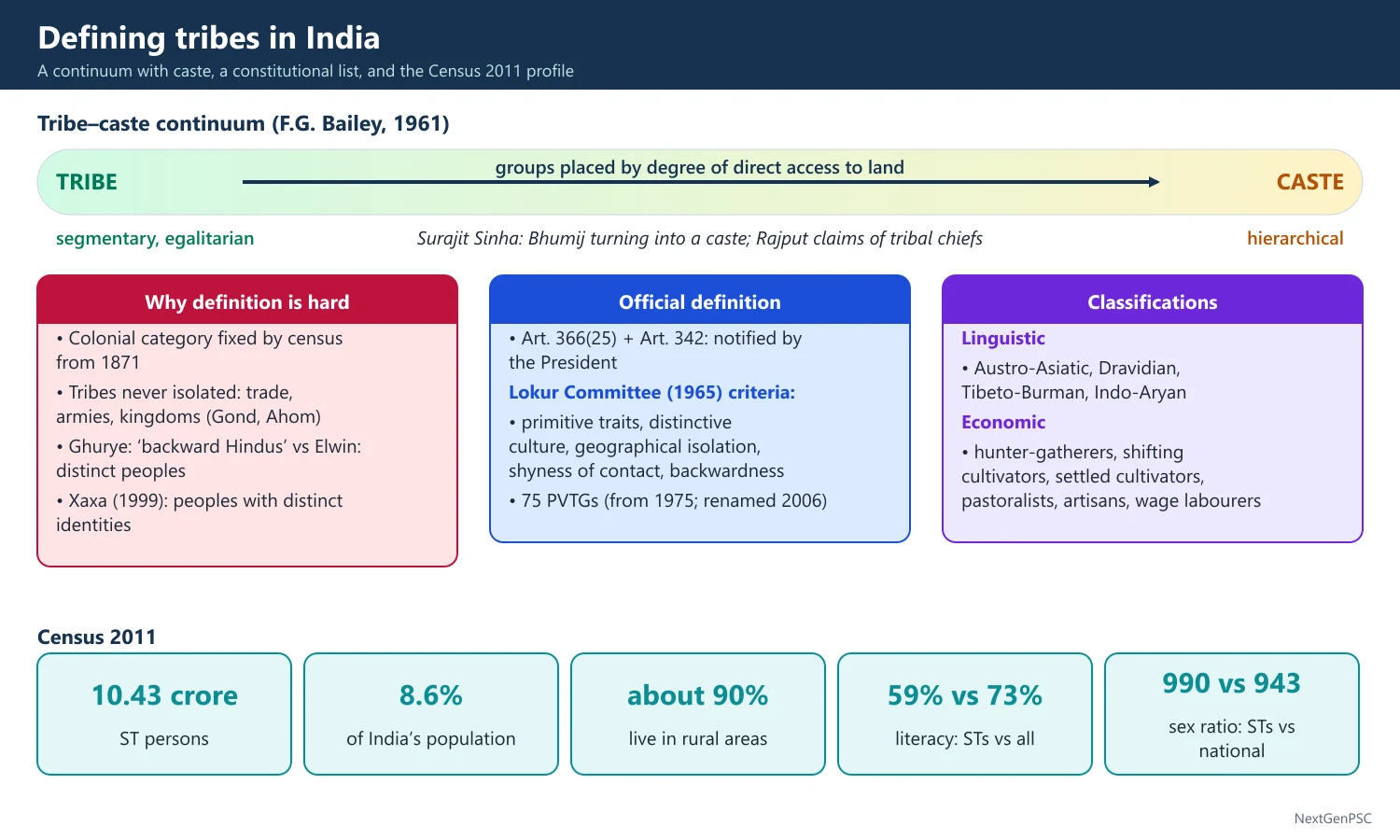
There is no agreed sociological definition of tribe in India: the category was shaped by colonial census and ethnography, and Indian tribes have long been in contact with caste society, forming a tribe–caste continuum. The Constitution leaves the matter to notification under Article 342, using the Lokur Committee’s criteria. Census 2011 counted 10.43 crore Scheduled Tribe persons (8.6%), spread over the north-east, the central Indian belt, the west, the south and the islands, including 75 Particularly Vulnerable Tribal Groups.
In simple words
A tribe is usually described as a community with its own name, territory, language, customs and close ties to land and forest.
In India it is hard to draw a clear line, because many tribes farm, trade, follow Hindu or Christian practices and live near caste villages, like neighbours whose gardens have grown into each other.
So the government simply lists Scheduled Tribes by law.
UPSC asks why defining tribe is difficult and where tribes live.
1. Classic definitions
Imperial Gazetteer of India (1911): a tribe is a collection of families bearing a common name, speaking a common dialect, occupying or claiming a common territory, and usually endogamous.
Majumdar (D.N.) (Races and Cultures of India) stressed a common name, territory, language, taboos on marriage and occupation, and a well-assessed system of reciprocity.
Evolutionist view: nineteenth-century writers such as Lewis Henry Morgan placed tribes at an early stage of ‘savagery’ or ‘barbarism’; this view is now rejected as ethnocentric.
2. Why definition is a problem in India
Colonial construction: the category ‘tribe’ (animist, forest-dwelling, ‘primitive’) was fixed through the census from 1871 and through ethnography by Risley and Hutton; it reflected administrative needs more than sociological reality.
No isolation: Indian tribes have traded, served in armies, paid revenue and borrowed religious ideas for centuries; some formed kingdoms (the Gond kingdoms of Garha-Mandla and Chanda, the Ahom kingdom).
Tribe–caste continuum: F.G. Bailey (‘The Scheduled Castes and Tribes’, 1961) proposed a continuum from segmentary, egalitarian tribe to hierarchical caste, with groups placed by their degree of direct access to land.
Surajit Sinha studied the Bhumij of Manbhum as a case of tribes turning into castes, and described Rajput claims by tribal chiefs (state formation and Rajputisation).
André Béteille (‘The Concept of Tribe with Special Reference to India’, 1986) argued that in India tribes were best seen as communities that stood outside the state and the Hindu civilisation, but that the boundary was always porous.
Ghurye versus Elwin: Ghurye called tribes ‘backward Hindus’; Verrier Elwin saw them as distinct peoples with their own cultures.
Virginius Xaxa (‘Transformation of Tribes in India: Terms of Discourse’, 1999) argued that tribes should be seen not as stages of evolution or as castes-in-the-making but as peoples with distinct identities who are being absorbed into a wider society while asserting identity.
Features usually listed (debated): kinship-based organisation, weak internal hierarchy, collective control of land, own dialect, nature-based religion and a largely self-sufficient economy; in India each feature has many exceptions.
Indigenous or not: many groups call themselves Adivasi (original inhabitants); India voted for the UN Declaration on the Rights of Indigenous Peoples (2007) but holds that all Indians are indigenous, so the term is officially avoided.
3. The constitutional and administrative definition
Article 366(25) defines Scheduled Tribes as those notified under Article 342; the President notifies them state by state and Parliament can amend the list.
Lokur Committee (1965) criteria: primitive traits, distinctive culture, geographical isolation, shyness of contact with the community at large, and backwardness; critics call these outdated and stigmatising.
Revision attempts: an official task force in 2014 called the Lokur criteria obsolete, but no new criteria have been adopted, so inclusion still depends on state recommendations and political bargaining.
PVTGs: the Dhebar Commission (1960–61) noted inequality among tribes; from 1975 the most vulnerable were identified as Primitive Tribal Groups (renamed PVTGs in 2006) on criteria of pre-agricultural technology, stagnant or declining population, very low literacy and subsistence economy; there are 75 PVTGs.
Inclusion politics: demands for ST status by groups such as the Meiteis of Manipur, Kurmis of Jharkhand and some groups in Assam show that the category is now a political resource; the Meitei demand was a trigger of the 2023 Manipur conflict.
Denotified tribes: communities labelled ‘criminal’ under the Criminal Tribes Act 1871 were denotified in 1952 after its repeal (1949), but stigma continues; the Renke (2008) and Idate (2017) commissions studied them.
4. Classifications of Indian tribes
Racial: B.S. Guha (1930s) proposed Negrito, Proto-Australoid, Mongoloid and others; race classification is now considered scientifically weak.
Linguistic: Austro-Asiatic (Munda, Santhal, Ho, Khasi), Dravidian (Gond, Oraon, Toda), Tibeto-Burman (Naga, Mizo, Bodo) and Indo-Aryan speakers (Bhil).
Economic: hunter-gatherers (Chenchu, Birhor), shifting cultivators (jhum in the north-east; podu in Odisha and Andhra), settled cultivators (Gond, Santhal, Bhil), pastoralists (Toda, Gaddi, Bakarwal), artisans, and wage labourers (tea-garden Adivasis of Assam).
5. Geographical spread (Census 2011)
Size: 10.43 crore Scheduled Tribe persons, 8.6% of India’s population; about 90% live in rural areas; over 700 individually notified ST groups.
Largest numbers: Madhya Pradesh (about 1.53 crore), followed by Maharashtra, Odisha, Rajasthan, Gujarat, Jharkhand and Chhattisgarh.
Highest share: Lakshadweep (about 95%), Mizoram (about 94%), Nagaland and Meghalaya (about 86%); no notified STs in Punjab, Haryana, Delhi, Chandigarh and Puducherry.
Regions: (1) north-eastern (Naga, Mizo, Khasi, Garo, Bodo), (2) central Indian belt from Gujarat to Odisha and Jharkhand (Bhil, Gond, Santhal, Munda, Oraon, Ho), (3) western (Bhil, Warli), (4) southern (Toda, Chenchu, Irula, Kurumba), (5) Himalayan (Gaddi, Bhotia, Tharu), (6) islands (Great Andamanese, Onge, Jarawa, Sentinelese, Shompen, Nicobarese).
Largest tribes: the Bhil and the Gond are the most numerous, followed by the Santhal.
Religion: Census 2011 recorded most STs as Hindus, large Christian populations in the north-east and Jharkhand, and about 79 lakh people under ‘other religions and persuasions’, many of them followers of Sarna and other tribal faiths.
Social indicators (Census 2011): ST literacy about 59% against 73% for all; ST sex ratio 990, higher than the national 943.
Census 2027 (population enumeration with reference date 1 March 2027) will give the first new count of Scheduled Tribes since 2011.
6. Linking thinkers
Durkheim: mechanical solidarity and the totemism of Australian tribes (The Elementary Forms of Religious Life, 1912) fed early images of tribes.
Redfield: folk–urban continuum parallels the tribe–caste continuum.
Malinowski and Radcliffe-Brown: functionalist anthropology of ‘simple societies’ shaped how tribes were first studied in India, often as closed, static wholes.
Social construction: the ‘tribe’ category illustrates how state classification creates social groups (compare the census and caste).
7. Using it in the exam
10 marks: give two definitions and three reasons why defining tribe is difficult in India.
15 marks: discuss the tribe–caste continuum (Bailey, Sinha, Béteille, Xaxa) and the Lokur criteria.
20 marks: combine definitional debates with geographical spread, Census 2011 data, PVTGs and current ST-status demands.
Diagram idea: a horizontal line from ‘tribe’ (segmentary, egalitarian, direct access to land) to ‘caste’ (hierarchical, dependent), with Bhumij and Gond placed along it; and a sketch map of the six tribal regions.
Useful line: Béteille held that the distinction between tribe and caste in India is one of degree rather than of kind (paraphrase).
| Region | Main tribes | Features |
|---|---|---|
| North-east | Naga, Mizo, Khasi, Garo, Bodo | Tribal-majority states; Sixth Schedule; jhum; Christianity widespread |
| Central belt | Gond, Bhil, Santhal, Munda, Oraon, Ho | Largest numbers; Fifth Schedule; mining and displacement |
| Western | Bhil, Warli, Dubla | Settled farming, labour migration |
| Southern | Toda, Chenchu, Irula, Kurumba | Small groups, several PVTGs, Nilgiris |
| Himalayan | Gaddi, Bhotia, Tharu, Gujjar | Pastoralism and trans-border trade |
| Islands | Great Andamanese, Onge, Jarawa, Sentinelese, Shompen, Nicobarese | Very small, isolated PVTGs; Lakshadweep largely ST |
Mains points
- State clearly that there is no universal definition and explain why (colonial construction, contact with caste society, internal variation).
- Use the tribe–caste continuum with named scholars: Bailey, Surajit Sinha, Béteille, Xaxa.
- Give the constitutional route (Articles 342, 366(25), Lokur criteria) and its critique.
- Present geographical spread with Census 2011 figures and the six regions.
- Mention PVTGs, denotified tribes and the indigenous-people debate to show depth.
- Bring current politics of ST status (Meitei, Kurmi) as evidence that the category is contested.
Did you know?
- The Sentinelese of North Sentinel Island are among the world’s last uncontacted peoples; India’s policy since the 1990s is ‘eyes on, hands off’.
Colonial Policies and Tribes
Colonial rule ended the relative autonomy of tribal areas. Forest laws (1865, 1878, 1927) made forests state property, land revenue systems and courts brought in outsider landlords and moneylenders (dikus), and missionaries spread Christianity and education. In response the British followed a policy of exclusion (Scheduled Districts 1874, Excluded and Partially Excluded Areas 1935) and passed protective tenancy laws, while tribes rose in repeated revolts.
In simple words
Before the British, many tribes used forests and land by custom without written papers.
The British declared forests government property and brought in revenue officers, traders and moneylenders, so tribes lost land and forest rights, like a family suddenly told its ancestral home now belongs to the state.
Tribes revolted again and again, and the British then created special excluded areas.
UPSC asks how colonial policies changed tribal society and shaped today’s laws.
1. Tribes before colonial rule
Many tribal areas were loosely linked to regional kingdoms through tribute; tribal chiefs and village heads (for example the Munda-Manki system of the Mundas and Hos) managed land and disputes by custom.
Land was often held collectively by the clan that cleared it (khuntkatti rights among the Mundas); forests were used for food, fuel, shifting cultivation and ritual.
2. Land and revenue policies
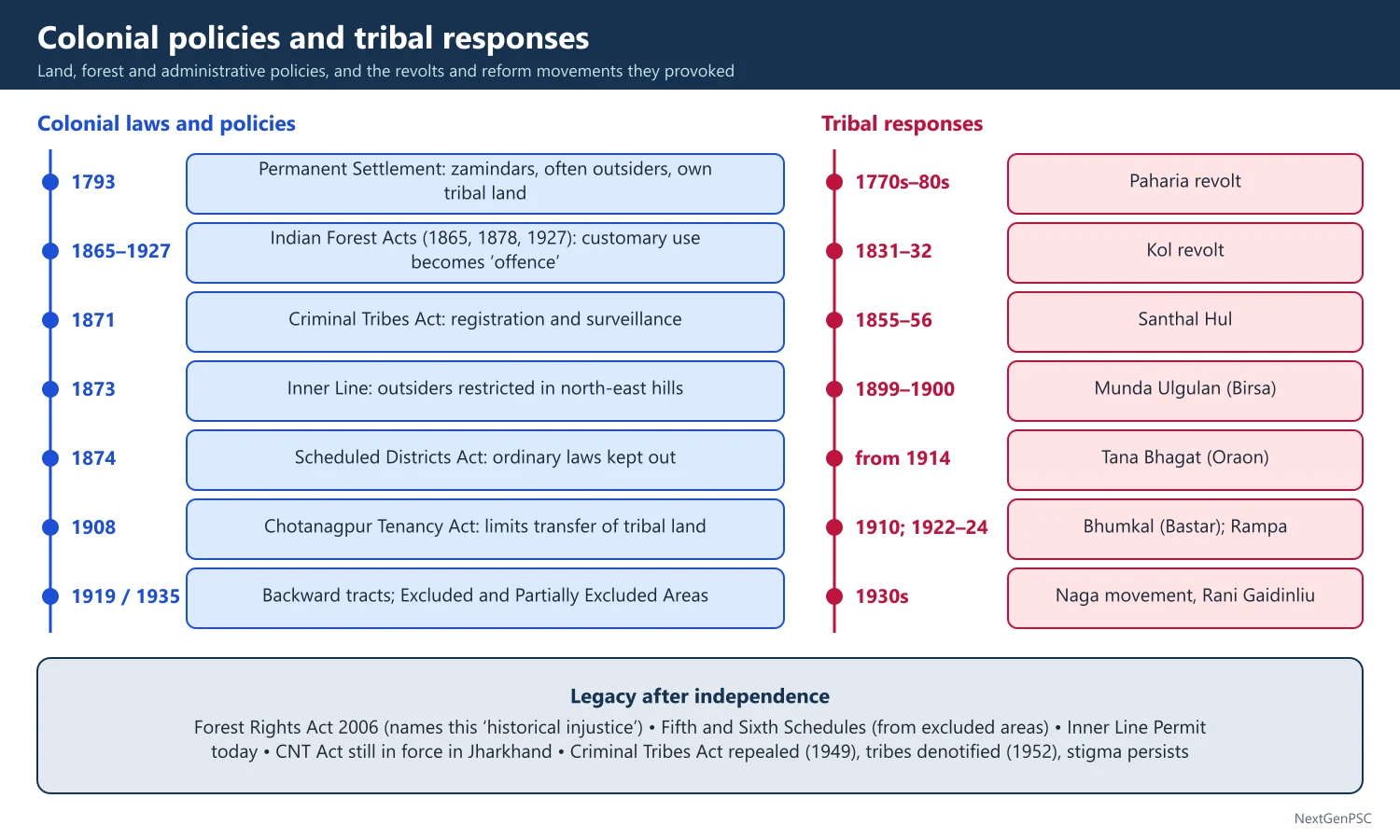
The Permanent Settlement (1793) and later settlements treated land as private property and recognised zamindars, often outsiders, as owners of tribal land.
Courts, written records and cash rents favoured literate outsiders; moneylenders and traders (dikus) acquired land through debt.
Forced labour (beth begari) and new taxes added to the burden, leading to alienation of land and growth of landless tribal labour.
Example: in Chotanagpur, khuntkatti villages passed to outside thikadars (revenue farmers) in the nineteenth century, a key grievance behind the Sardari Larai and later Birsa’s movement.
3. Forest policy
Indian Forest Acts of 1865, 1878 and 1927 created reserved and protected forests owned by the state, restricted shifting cultivation, grazing and collection, and turned customary use into ‘offences’.
The aim was timber for railways, ships and revenue; Madhav Gadgil and Ramachandra Guha (This Fissured Land, 1992) call this the start of conflict between the state and forest communities.
Shifting cultivation: officials saw jhum and podu as wasteful and banned or restricted them, though ecologists now see them as adapted to hill conditions.
Labour: tribals became labour for forest departments, plantations and the tea gardens of Assam, to which Adivasis from Chotanagpur were recruited from the 1860s.
This ‘historical injustice’ is named in the preamble of the Forest Rights Act 2006, which sought to recognise rights denied since colonial times.
4. Administrative policy: exclusion and protection
Non-regulation areas: after revolts, areas such as the South-West Frontier Agency (1833) and the Kolhan (Wilkinson’s rule, 1837) were governed through simplified rules and local heads.
Scheduled Districts Act 1874: allowed the government to keep ordinary laws out of specified tribal districts.
Inner Line: the Bengal Eastern Frontier Regulation 1873 restricted outsiders’ entry into hill areas of the north-east; the Inner Line Permit continues today in Arunachal Pradesh, Nagaland, Mizoram and Manipur.
Backward tracts (1919) and Excluded and Partially Excluded Areas (Government of India Act 1935): these areas were kept outside the elected provincial legislatures and placed under the Governor; they became the base of the Fifth and Sixth Schedules.
Protective tenancy laws: the Chotanagpur Tenancy Act 1908 (after the Munda Ulgulan) restricted transfer of tribal land to non-tribals.
Criminal Tribes Act 1871: labelled many nomadic and forest communities as hereditary criminals, subjecting them to registration and surveillance.
5. Missionaries, education and ethnography
Christian missions in Chotanagpur (from 1845) and the north-east brought schools, hospitals and literacy, created a tribal educated class and new identities; they also helped tribes in land cases (Jesuit Father Constant Lievens in Chotanagpur).
Conversion also created divisions between Christian and non-Christian tribals that continue in debates over ST benefits for converts.
Language: missionaries produced the first grammars and Roman-script writing for languages such as Mundari and Khasi, helping literate tribal elites emerge.
Ethnography: S.C. Roy (The Mundas and Their Country, 1912), J.H. Hutton (The Angami Nagas, 1921; Census 1931) and Verrier Elwin (The Baiga, 1939) documented tribal life; colonial ethnography also fixed stereotypes of ‘primitive’ peoples.
6. Tribal responses: revolts and reform
Revolts: Paharia (1770s–80s), Kol (1831–32), Santhal Hul (1855–56), Munda Ulgulan (1899–1900), Bhumkal in Bastar (1910), Rampa (1922–24), Naga movement under Rani Gaidinliu (1930s).
Reform movements: Tana Bhagat (Oraon, from 1914) and Birsa’s teachings mixed religious reform (abstinence, monotheism) with protest, showing what K.S. Singh (Birsa Munda and His Movement, 1966) called millenarian features.
Sanskritisation and Hinduisation: some tribes adopted Hindu customs and claimed Rajput or Kshatriya status (Bhumij, Raj Gonds), as Surajit Sinha showed.
7. The isolation versus assimilation debate
Elwin (The Loss of Nerve, 1941) argued that contact had demoralised tribes and proposed protection through a ‘national park’ approach, later softened.
Ghurye (1943) argued for assimilation into Hindu society, calling isolation a colonial strategy to divide Indians.
Nationalists such as Thakkar Bapa (Bharatiya Adimjati Sevak Sangh, 1948) promoted welfare and gradual integration.
Ramachandra Guha (Savaging the Civilized, 1999) gives a balanced account of Elwin and this debate.
8. Legacy in present-day India
Excluded areas became the Fifth Schedule (ten states) and the Sixth Schedule (Assam, Meghalaya, Tripura, Mizoram); the CNT Act still governs land in Jharkhand, and attempts to amend it in 2016 were withdrawn after protests (the Pathalgadi movement of 2017–18 also drew on these claims).
Forest conflict continues: by 31 October 2025 about 25.1 lakh forest-rights titles had been distributed out of about 51.6 lakh claims, and about 36% of claims had been rejected (Ministry of Tribal Affairs).
Colonial instruments are being reused: the Inner Line Permit was extended to Manipur in December 2019, and Ladakh groups have demanded Sixth Schedule status since 2019.
9. Linking thinkers and using it in the exam
Links: Marx’s primitive accumulation (separating producers from land and forest); Foucault’s governmentality (census, maps, criminal tribes); Wallerstein’s periphery; the Subaltern view of tribal insurgency (Ranajit Guha).
10 marks: list three colonial policies (forest, land, exclusion) and one effect of each.
15 marks: link the policies to revolts with years and to protective laws.
20 marks: show continuity from colonial policy to the Fifth and Sixth Schedules, PESA and FRA, with the Elwin–Ghurye debate and current FRA data.
Useful line: the Forest Rights Act 2006 states in its preamble that forest rights were not adequately recognised in the consolidation of state forests during the colonial period and after independence, resulting in historical injustice (paraphrase).
| Colonial policy (year) | Effect on tribes | Post-independence legacy |
|---|---|---|
| Indian Forest Acts (1865, 1878, 1927) | Loss of customary forest rights | Forest Rights Act 2006 |
| Permanent Settlement and land records | Land alienation to dikus | Land transfer regulations, Samatha judgment (1997) |
| Scheduled Districts Act 1874; Excluded Areas 1935 | Separate administration | Fifth and Sixth Schedules |
| Inner Line (1873) | Restricted outsiders in north-east hills | Inner Line Permit today |
| Chotanagpur Tenancy Act 1908 | Protection of Munda and Ho land | Still in force in Jharkhand |
| Criminal Tribes Act 1871 | Stigma and surveillance | Denotified (1952) but stigma persists |
Mains points
- Organise the answer by policy area (land, forest, administration, religion and education) rather than by revolt.
- Show the dual nature of colonial policy: disruptive (forest, land) and protective (exclusion, tenancy laws).
- Link to present laws: Fifth and Sixth Schedules, PESA 1996, FRA 2006.
- Use ethnographers and historians: S.C. Roy, Elwin, K.S. Singh, Gadgil and Guha.
- Mention the Criminal Tribes Act as a case of colonial labelling.
- End with current FRA data to show the unfinished legacy.
Did you know?
- S.C. Roy, a Ranchi lawyer who began studying the Mundas to defend them in land cases, is often called the father of Indian ethnography.
Issues of Integration and Autonomy
After independence India rejected both isolation and forced assimilation in favour of integration, guided by Nehru’s tribal Panchsheel. Tools include constitutional safeguards, the Fifth and Sixth Schedules, reservation, PESA 1996 and the Forest Rights Act 2006. Yet displacement by dams and mines, land alienation and weak implementation have fuelled autonomy and identity movements, from the Jharkhand statehood movement to Naga, Bodo and Maoist-affected areas and the 2023 Manipur conflict.
In simple words
Integration means bringing tribes into national life, with schools, roads, jobs and votes, while letting them keep their land, language and customs.
Autonomy means tribes governing their own affairs, through their gram sabhas or their own councils.
The balance is like letting a guest join the family dinner without forcing him to change his clothes and food.
UPSC asks how well India has struck this balance.
1. Three approaches
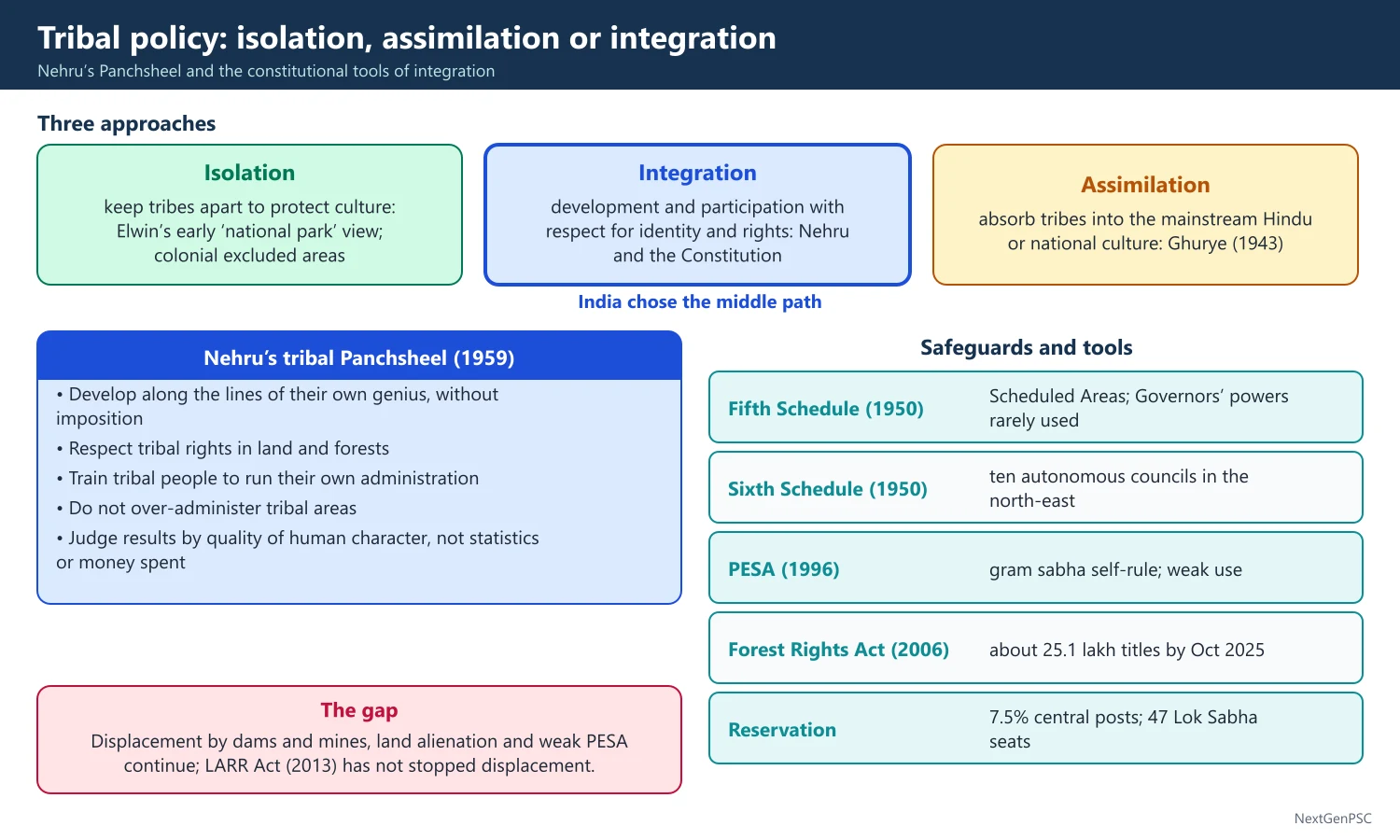
Isolation: keep tribes apart to protect their culture (Elwin’s early view; colonial excluded areas).
Assimilation: absorb tribes into the mainstream Hindu or national culture (Ghurye).
Integration: development and participation with respect for tribal identity and rights; adopted by Nehru and the Constitution.
Dhebar Commission (1960–61) reviewed Scheduled Areas and tribal welfare and recommended a gradual, protective approach to development.
2. Nehru’s Panchsheel for tribes
Set out in his foreword to the second edition of Elwin’s A Philosophy for NEFA (1959): (1) people should develop along the lines of their own genius, without imposition; (2) tribal rights in land and forests should be respected; (3) tribal people should be trained to run their own administration; (4) tribal areas should not be over-administered; (5) results should be judged by the quality of human character, not by statistics or money spent.
3. Constitutional and legal framework
Safeguards: Article 15(4) and 16(4) (reservation in education and jobs; 7.5% for STs in central posts), Article 46 (promotion of educational and economic interests), Articles 330 and 332 (reserved seats), Article 275(1) (grants), Article 338A (National Commission for Scheduled Tribes, created by the 89th Amendment, 2003).
Political reservation: 47 Lok Sabha seats are reserved for Scheduled Tribes after the 2008 delimitation.
Fifth Schedule: Scheduled Areas in ten states (including Jharkhand, Chhattisgarh, Odisha, Madhya Pradesh, Maharashtra, Gujarat, Rajasthan); the Governor can modify laws and a Tribes Advisory Council advises; critics say Governors rarely use these powers.
Sixth Schedule: autonomous district councils with legislative, judicial and financial powers in Assam, Meghalaya, Tripura and Mizoram (ten councils); demands exist to extend it to Ladakh and Manipur hill areas.
PESA 1996 (Panchayats (Extension to Scheduled Areas) Act, following the Bhuria Committee, 1995): gives gram sabhas in Fifth Schedule areas powers over minor forest produce, minor minerals, land alienation, money-lending, village markets and consultation before acquisition; many states framed rules late and implementation is weak.
Forest Rights Act 2006 (in force from 1 January 2008): recognises individual and community forest rights of STs and other traditional forest dwellers; by 31 October 2025 about 25.1 lakh titles (about 23.9 lakh individual and 1.2 lakh community) had been distributed.
Courts: Samatha v. State of Andhra Pradesh (1997) barred transfer of tribal land in Scheduled Areas to private mining companies; in the Niyamgiri case (Orissa Mining Corporation, 2013) the Supreme Court let the Dongria Kondh gram sabhas decide on bauxite mining, and all the consulted gram sabhas rejected it.
4. Development policy
Planning: Multipurpose Tribal Blocks (1950s), the Tribal Sub-Plan (from the Fifth Plan, 1974–75), Integrated Tribal Development Projects, and Eklavya Model Residential Schools.
Forest incomes: minimum support prices for minor forest produce (from 2013–14) and Van Dhan Vikas Kendras (2018) aim to raise earnings from forest collection.
Education: ST literacy was about 59% in 2011 and dropout rates in tribal areas remain high; Eklavya schools are planned for every block with over 50% ST population and at least 20,000 tribal persons.
Recent schemes: PM-JANMAN (launched November 2023, about ₹24,104 crore for 2023–24 to 2025–26) for the 75 PVTGs; Dharti Aaba Janjatiya Gram Utkarsh Abhiyan (launched 2 October 2024) for about 63,000 tribal-majority villages; the National Sickle Cell Anaemia Elimination Mission (2023).
Xaxa Committee (2014) found STs lagging in health, education and livelihood and recommended stronger implementation of PESA and FRA and safeguards against displacement.
5. Displacement and development
Dams, mines, industries and protected areas have displaced large numbers of tribals; Walter Fernandes estimated that tribals, under a tenth of the population, form around 40% of those displaced by development projects since 1947 (an estimate, debated).
Examples: Sardar Sarovar on the Narmada (Narmada Bachao Andolan from 1985), Hirakud, Bhakra, Koel-Karo (resisted), Polavaram, POSCO and Vedanta projects in Odisha.
Rehabilitation failures: studies of dam oustees show loss of common lands and forests, quick spending of cash compensation and breakdown of community ties, which cash alone does not repair.
Law: the Right to Fair Compensation and Transparency in Land Acquisition, Rehabilitation and Resettlement Act 2013 requires social impact assessment and gram sabha consent in Scheduled Areas.
6. Autonomy and identity movements
Statehood: the Jharkhand movement (Jaipal Singh’s Jharkhand Party, 1950; later the JMM) led to Jharkhand (15 November 2000); Chhattisgarh was formed on 1 November 2000; Nagaland (1963), Meghalaya (1972) and Mizoram (1987) were created for tribal populations.
North-east: the Naga movement (ceasefire with NSCN-IM 1997, Framework Agreement 2015), the Mizo Accord (1986), the Bodo accords (2003 and the Bodoland Territorial Region accord of January 2020).
Manipur (from May 2023): violence between Meiteis and Kuki-Zo groups after a High Court order on ST status for Meiteis; NCRB recorded 3,339 crimes against STs in Manipur in 2023, driving a 28.8% national rise in such crimes (12,960 cases).
Left-wing extremism: Maoist insurgency in tribal central India grew from land and forest grievances; the state combined security operations (intensified in Bastar in 2024–25, with a declared target of ending LWE by March 2026) with development schemes. Nandini Sundar (The Burning Forest, 2016) criticised Salwa Judum, which the Supreme Court ordered disbanded in 2011.
Cultural identity: the Sarna religion code demand (Jharkhand Assembly resolution, November 2020), Pathalgadi (2017–18), and language recognition (Santali in the Eighth Schedule, 2003).
Ladakh: after becoming a Union Territory (2019), groups led by the Leh Apex Body and the Kargil Democratic Alliance demanded Sixth Schedule protection and statehood; protests in Leh turned violent in September 2025.
Representation: Droupadi Murmu, a Santhal from Odisha, became the first tribal President of India in July 2022.
7. Sociological assessment
Uneven integration: a small educated tribal middle class (often from the north-east and from Christian or Meena communities) has gained most from reservation, while PVTGs and remote groups lag; this is debated as a ‘creamy layer’ issue among STs.
Internal colonialism: some scholars describe tribal regions as resource colonies whose minerals benefit outsiders, a view close to dependency theory (Frank) and world-systems theory (Wallerstein).
Gender: tribal women often have more freedom of movement and marriage choice than caste Hindu women, but customary law usually denies them land inheritance, and the Hindu Succession Act does not apply to STs (Section 2(2)).
Xaxa’s view: integration has meant absorption into the lowest rungs of the economy without recognition of tribes as distinct peoples; autonomy demands are a response.
8. Linking thinkers and using it in the exam
Links: Weber on the state and legitimacy; new social movements (identity, environment) in Melucci’s sense; Gramsci’s hegemony and counter-hegemony; displacement as a case of Marx’s primitive accumulation.
10 marks: state the three approaches and Nehru’s Panchsheel.
15 marks: assess PESA and FRA with data and cases (Samatha, Niyamgiri).
20 marks: analyse the tension between integration and autonomy through displacement, statehood, north-east accords, Manipur 2023 and LWE, and conclude with a rights-based, gram-sabha-centred path.
Diagram idea: a spectrum from isolation (Elwin 1940s) to integration (Nehru, Constitution) to assimilation (Ghurye), with laws placed along it and arrows for autonomy movements pushing back.
| Tool (year) | Purpose | Record |
|---|---|---|
| Fifth Schedule (1950) | Protection in Scheduled Areas | Governors’ powers rarely used |
| Sixth Schedule (1950) | Autonomous councils in the north-east | Real autonomy, but demands for extension |
| PESA (1996) | Gram sabha self-rule | Late state rules, weak use |
| Forest Rights Act (2006) | Recognise forest rights | About 25.1 lakh titles; about 36% claims rejected (Oct 2025) |
| LARR Act (2013) | Fair compensation, consent | Displacement continues |
| PM-JANMAN (2023) | Basic services for 75 PVTGs | Ongoing |
Mains points
- Frame the answer as a debate: isolation versus assimilation versus integration, then autonomy.
- Quote Nehru’s Panchsheel accurately; it is the standard yardstick.
- Use laws and cases with years: Fifth and Sixth Schedules, PESA 1996, FRA 2006, Samatha 1997, Niyamgiri 2013, LARR 2013.
- Bring current data and events: FRA titles (October 2025), NCRB 2023 crimes against STs, Manipur, PM-JANMAN.
- Avoid treating all tribes as one: distinguish the north-east, central India and PVTGs.
- Conclude with Xaxa’s argument and a balanced, rights-based way forward.
Did you know?
- Nehru wrote that he was alarmed by people who wanted to turn tribes into ‘second-rate copies’ of others; his Panchsheel was meant to prevent this (paraphrase).
UPSC Previous Year Questions: Tribal Communities in India
From 2014 to 2026 UPSC asked 18 question parts carrying 260 marks from this chapter in Paper II. The most-asked topics are Issues of Integration and Autonomy (9 parts) and Colonial Policies and Tribes (5 parts). Every question below has a model answer written to the UPSC word limit: about 150 words for 10 marks and 250 words for 20 marks.
In simple words
First read the question and write your own answer in the time UPSC gives (about 7 minutes for 10 marks and 11 minutes for 20 marks).
Then compare it with the model answer: check the approach, the thinkers and studies used, the Indian data and the conclusion.
Note what you missed and revise that topic in the notes before trying the next question.
1. Tribes: Definitional Problems and Geographical Spread
Example 1 (UPSC 2026, 10 marks): Where would you locate the tribal community in the Varna system of India? Discuss.
Paper and question: Paper II, Q8(c)
Approach: Locate tribes in relation to varna: outside varna in the classical scheme, absorption into the lower varnas, Kshatriya claims (Sinha's Bhumij), Bose's Hindu method of absorption, Ghurye vs Elwin, and conclude on a continuum.
In the classical varna scheme, tribes had no fixed place. Forest peoples such as the Nishadas and Shabaras of the epics were described as outside the four varnas, living beyond settled Brahmanical society.
Over time many tribes were absorbed into the caste system. N.K. Bose called this the Hindu method of tribal absorption: tribes adopted Hindu deities and rituals and became castes, usually at the Shudra level. Some ruling lineages claimed Kshatriya status; Surajit Sinha showed the Bhumij of Manbhum claiming Rajput descent, and the Gond rajas did the same.
G.S. Ghurye therefore called tribes ‘backward Hindus’, while Verrier Elwin insisted they were distinct peoples outside the Hindu order. Many tribes, such as Christian Nagas and Mizos, never entered varna at all.
Tribes are best located on a tribe–caste continuum: outside varna in origin, partly absorbed into its lower and Kshatriya ranks over time.
Example 2 (UPSC 2024, 20 marks): What are the definitional problems involved in identifying tribes in India? Discuss the main obstacles to tribal development in India.
Paper and question: Paper II, Q2(b)
Approach: Two parts: discuss definitional problems (constitution, Lokur criteria, continuum, diversity, politics of listing) with data; then the main obstacles to tribal development (land alienation and displacement, forest rights, education and health gaps, poor implementation, conflict), and conclude.
Census 2011 counted 10.4 crore Scheduled Tribe members, 8.6% of India's population, in 705 notified groups. Yet identifying who is a tribe has always been difficult, and this affects development policy.
The definitional problems are several. The Constitution (Articles 342 and 366(25)) gives no definition, leaving it to notification. The Lokur Committee (1965) criteria, primitive traits, distinct culture, isolation, shyness of contact and backwardness, rest on colonial evolutionist ideas. Tribes vary from hunter-gatherer PVTGs to settled peasant and urban communities. Scholars such as Surajit Sinha and N.K. Bose show a tribe–caste continuum, with many tribes absorbed into Hindu society. Listing also varies by state and has become political.
The main obstacles to development are, first, land alienation and displacement: tribals are a large share of people displaced by dams, mines and industry, as Walter Fernandes's studies show. Second, weak implementation of the Forest Rights Act 2006 and PESA 1996, with many claims rejected. Third, gaps in education and health: ST literacy was about 59% in Census 2011 against about 73% overall.
Fourth, a top-down model of development that ignores tribal culture and language, as the Xaxa Committee (2014) noted. Fifth, exploitation by moneylenders and traders, and conflict, including Left-wing extremism in central India and ethnic violence in the North-East, such as in Manipur since 2023.
Flow chart: Unclear definition → uneven listing and benefits → land loss, displacement, weak FRA and PESA → poor education and health → discontent and conflict.
Recent schemes such as PM-JANMAN (2023) and the Dharti Aaba Janjatiya Gram Utkarsh Abhiyan (2024) seek to close gaps, but development will work only with tribal self-governance and respect for identity, as Nehru's Panchsheel envisaged.
Example 3 (UPSC 2020, 10 marks): Explain the definitional problems concerning the tribal communities in India.
Paper and question: Paper II, Q1(d)
Approach: Explain the definitional problems: no constitutional definition, Lokur criteria and their weaknesses, caste–tribe continuum, diversity, ‘indigenous’ debate, political listing; conclude.
India has 705 notified Scheduled Tribes, 8.6% of the population in Census 2011, but no agreed definition of a tribe. Article 342 lets the President notify tribes, without defining them.
The Lokur Committee (1965) used five criteria: primitive traits, distinctive culture, geographical isolation, shyness of contact and backwardness. These are problematic: ‘primitive’ is a colonial and evolutionary label, many tribes are no longer isolated, and groups like the Meenas or Gonds differ hugely in development.
Sociologists such as F.G. Bailey and Surajit Sinha saw a tribe–caste continuum rather than a clear line, and Ghurye called tribes backward Hindus. India also rejects the term ‘indigenous’, and listing has become political, as with demands by Meiteis in Manipur.
The Xaxa Committee (2014) called for revised criteria based on distinct identity and marginality.
Example 4 (UPSC 2017, 10 marks): Why have we started using another category of tribes called the Particularly Vulnerable Tribal Groups (PVTGs)? Why are they so called?
Paper and question: Paper II, Q8(c)
Approach: Explain why the PVTG category was created (unequal development within STs), its origin (Dhebar Commission, 1975 list, 2006 renaming), criteria and examples, and current schemes.
Scheduled Tribes are not equally developed. Some groups remained far behind others, so the Dhebar Commission (1960–61) recommended special attention for the least developed. In 1975 the government identified Primitive Tribal Groups, renamed Particularly Vulnerable Tribal Groups (PVTGs) in 2006; there are now 75 such groups.
They are so called because they meet four criteria of vulnerability: pre-agricultural technology such as hunting and gathering, very low literacy, a stagnant or declining population, and a subsistence economy. Examples are the Jarawa and Sentinelese of the Andamans, the Bonda of Odisha, the Baiga of Madhya Pradesh, the Birhor of Jharkhand and the Toda of the Nilgiris. Odisha has the largest number.
The separate category allows targeted protection, such as habitat rights under the Forest Rights Act 2006 and PM-JANMAN (2023) for housing, roads, water and health in PVTG habitations.
Critics object to the old label ‘primitive’ and to uneven listing across states, but the category recognises inequality within tribes.
2. Colonial Policies and Tribes
Example 5 (UPSC 2026, 10 marks): Why was the category of 'criminal tribe' created by law during the colonial period in India? Discuss its implications.
Paper and question: Paper II, Q6(c)
Approach: Explain why the Criminal Tribes Act 1871 was created (colonial ideas of hereditary criminality, control of mobile groups, 1857, caste theories), then discuss its implications then and now (stigma, denotification 1952, Habitual Offenders Acts, commissions, police bias).
The Criminal Tribes Act of 1871 allowed the colonial government to notify entire communities as ‘criminal tribes’, register their members, restrict their movement and confine them in settlements.
It was created for several reasons. Colonial officials believed, drawing on ideas of caste as hereditary occupation, that some groups were criminal by birth. Nomadic and itinerant groups such as pastoralists, entertainers and traders were hard to tax and control, and after 1857 the state feared mobile, ungoverned populations. The Act was extended in 1911 and consolidated in 1924.
The Act was repealed in 1949 and the groups were denotified in 1952, but Habitual Offenders Acts replaced it in many states, and stigma and police harassment continue, as the custodial death of Budhan Sabar in 1998 showed.
Commissions headed by Balkrishna Renke (2008) and Bhiku Ramji Idate (2017) documented their poverty, and the SEED scheme (2022) offers support, but their inclusion remains incomplete.
Example 6 (UPSC 2025, 10 marks): How did Colonial Policies for the tribes affected their socio-economic conditions in India? Discuss.
Paper and question: Paper II, Q1(d)
Approach: Discuss the socio-economic effects of colonial policies (forest laws, land revenue and private property, entry of outsiders, isolation, criminalisation) with examples and revolts.
Colonial policies transformed tribal life by bringing tribes under the state, the market and new forms of property.
First, forest laws of 1865, 1878 and 1927 declared forests state property, restricting shifting cultivation, grazing and collection of forest produce, the base of tribal livelihoods. Second, land revenue and private property in land brought moneylenders, traders and landlords (dikus) into tribal areas, leading to land alienation and debt bondage. Third, railways, mines and tea plantations drew tribals into wage labour and migration, as with Santhals and Oraons sent to Assam tea gardens.
These pressures provoked revolts such as the Santhal Hul (1855–56) and Birsa Munda's Ulgulan (1899–1900), leading to protective laws like the Chotanagpur Tenancy Act (1908). The Criminal Tribes Act of 1871 stigmatised several communities.
Colonial rule thus impoverished tribes and created the land and forest grievances that persist today.
Example 7 (UPSC 2020, 20 marks): Examine the colonial policy of segregation of tribes under the Government of India Act, 1935.
Paper and question: Paper II, Q3(a)
Approach: Examine the segregation policy of the 1935 Act: background (1874 Act, 1919 backward tracts, Simon Commission), provisions (excluded and partially excluded areas, Sections 91–92, Governor's discretion), motives, effects, criticism and legacy in the Fifth and Sixth Schedules.
The Government of India Act 1935 formalised the colonial policy of keeping tribal areas apart from the rest of British India. It built on the Scheduled Districts Act of 1874 and the ‘backward tracts’ of the 1919 Act, and on the Simon Commission's (1930) recommendation that these areas need special administration.
Under Sections 91 and 92 the Act created two categories. Excluded areas, such as the Naga Hills, Lushai (Mizo) Hills and North-East Frontier tracts, were administered directly by the Governor in his discretion, and no act of the federal or provincial legislature applied unless he directed. Partially excluded areas, such as parts of Chotanagpur, the Central Provinces and Orissa, were under ministers but the Governor could modify or bar laws.
The stated motive was protection of tribal land and custom from moneylenders, traders and landlords, a view held by officials such as J.H. Hutton. But the policy also served colonial aims: it kept frontier regions under direct control, kept tribes away from the nationalist movement after the Congress's mass campaigns, and allowed missionary activity while the state retained control over forests.
Flow chart: Scheduled Districts Act 1874 → backward tracts 1919 → Simon Commission 1930 → 1935 Act: excluded and partially excluded areas under Governor → Fifth and Sixth Schedules of the Constitution (1950).
Its effects were mixed. It slowed land alienation in some areas and preserved customary institutions in the hills. But tribes remained without representation and development, and separation deepened a sense of distinct identity that later fed Naga and Mizo nationalism. G.S. Ghurye condemned the policy as creating ‘national parks’ for tribes and dividing them from Hindu society, while Verrier Elwin initially supported protection.
The policy's legacy is visible in the Constitution: the partially excluded areas became the basis of the Fifth Schedule and the excluded hill areas of Assam the basis of the Sixth Schedule, now transformed from colonial segregation into protective autonomy.
Example 8 (UPSC 2017, 20 marks): What is the nature of religious change among tribal communities? Illustrate with two examples from colonial and post independence times.
Paper and question: Paper II, Q4(b)
Approach: Explain the nature of religious change among tribes (Christianisation, Hinduisation, revitalisation movements, assertion of tribal religions), with one colonial and one post-independence example each, and sociological explanations.
Tribal religions in India were traditionally centred on nature, ancestors, clan deities and village spirits, often described as animism or, in Jharkhand, Sarna worship of the sacred grove. Religious change among tribes has taken three main forms: conversion to Christianity, absorption into Hinduism, and revitalisation or assertion of indigenous faith.
In the colonial period, Christianisation spread among the Mundas and Oraons of Chotanagpur and the Nagas, Mizos and Khasis of the North-East. Missions brought schools, hospitals and literacy in tribal languages, and some converts sought protection from landlords. At the same time, revitalisation movements arose. Birsa Munda founded a new faith in the 1890s, rejecting both Christianity and landlord exploitation, and the Tana Bhagat movement among the Oraons (from 1914) adopted vegetarianism and rejected spirits while resisting rent and forced labour.
After independence, two opposing trends grew. Hinduisation spread through Sanskritisation and the work of Hindu organisations among tribes of central and western India, while Christian growth continued in the North-East, where Nagaland and Mizoram are now Christian-majority states. In reaction, tribes asserted their own religion: the demand for a separate Sarna religion code in the census in Jharkhand, and the Donyi-Polo revival in Arunachal Pradesh and Seng Khasi in Meghalaya.
Flow chart: Traditional tribal faith → colonial missions and exploitation → Christianisation and revitalisation (Birsa, Tana Bhagat) → after 1947: Hinduisation, continued Christian growth → assertion of indigenous religion (Sarna code, Donyi-Polo).
Sociologically, religious change reflects contact, exploitation and identity. K.S. Singh saw many tribal movements as combining religious reform with agrarian protest, while Anthony Wallace's idea of revitalisation explains how stressed societies create new faiths. Conversion has also divided communities, as tensions between Christian and Sarna tribals in Jharkhand show. Religious change among tribes is thus both cultural adaptation and a form of political assertion.
Example 9 (UPSC 2016, 10 marks): 'Isolationism' as a dominant feature of colonial tribal policy
Paper and question: Paper II, Q1(c)
Approach: Explain the colonial policy of isolation: its laws (1874, 1919, 1935, Inner Line), reasons (administrative control, revenue, protection), effects, and critique.
Colonial tribal policy was marked by isolationism: tribal areas were kept apart from the general administration and from mainland Indian society.
This was done through the Scheduled Districts Act of 1874, the Inner Line Regulation of 1873 in the North-East, the ‘backward tracts’ under the Government of India Act 1919, and the excluded and partially excluded areas of the 1935 Act. Officials such as J.H. Hutton, Census Commissioner in 1931, argued that tribes needed protection from exploitation by moneylenders and landlords.
The isolation was partial and self-serving: the same state took over forests through the Forest Acts of 1865 and 1878, opened areas to missionaries and plantations, and kept tribes away from nationalist influence after revolts such as the Santhal Hul (1855–56) and Birsa Munda's Ulgulan (1899–1900).
Its legacy survives in the Fifth and Sixth Schedules, while Ghurye criticised it as dividing tribes from the nation.
3. Issues of Integration and Autonomy
Example 10 (UPSC 2023, 20 marks): Analyse the perspectives of Isolation, Assimilation and Integration in understanding the trajectories of Indian Tribal Development.
Paper and question: Paper II, Q4(a)
Approach: Analyse the three perspectives (isolation, assimilation, integration) with their exponents, policy expressions and criticisms, trace how tribal development moved through them, and conclude with the rights-based turn.
Indian tribal development has moved through three perspectives, isolation, assimilation and integration, each with a different answer to how tribes should relate to the wider society.
The isolation perspective dominated colonial policy. Through the Scheduled Districts Act (1874), the Inner Line, and the excluded and partially excluded areas of the 1935 Act, tribal areas were kept apart. Verrier Elwin's early work supported protection to save tribes from exploitation. It preserved customs in some areas but left tribes without development and served colonial control.
The assimilation perspective, voiced by G.S. Ghurye, held that tribes were backward Hindus to be absorbed into the mainstream. N.K. Bose described the long historical absorption of tribes into caste. Critics argued that it denied tribal identity and, in practice, opened tribal land to outsiders.
The integration perspective became official after 1947 through Nehru's Tribal Panchsheel: development according to tribal genius, respect for land and forest rights, tribal self-government and no imposition. It produced the Fifth and Sixth Schedules, reservations, the Tribal Sub-Plan (1974–75) and ITDPs.
Flow chart: Isolation (colonial, Elwin) → Assimilation (Ghurye, Bose) → Integration (Panchsheel, Schedules, TSP) → Rights-based autonomy (PESA 1996, FRA 2006, PM-JANMAN 2023).
In practice integration was often undermined by displacement and top-down planning, so tribal development has taken a rights-based turn with PESA (1996) and the Forest Rights Act (2006), and targeted schemes such as PM-JANMAN (2023). Scholars such as B.K. Roy Burman and Virginius Xaxa see integration with autonomy, rather than isolation or assimilation, as the only just trajectory.
Example 11 (UPSC 2022, 10 marks): Elucidate the challenges of integration for tribal communities in India.
Paper and question: Paper II, Q1(c)
Approach: Elucidate the challenges of integration: displacement and land, cultural assimilation, uneven development and inequality within tribes, weak laws' implementation, conflict and identity politics; conclude.
Integration, as envisaged in Nehru's Tribal Panchsheel, means including tribes in national development while respecting their identity and rights. Several challenges stand in the way.
First, development projects such as dams and mines have caused displacement, making integration feel like dispossession. Second, schooling in dominant languages and religious conversion campaigns threaten cultural identity. Third, benefits of reservations have gone mainly to more advanced groups, leaving PVTGs behind. Fourth, the Fifth Schedule, PESA and the Forest Rights Act are weakly implemented, as the Xaxa Committee (2014) observed.
Fifth, conflict, including Left-wing extremism in central India and ethnic clashes in the North-East, such as between Kukis and Meiteis in Manipur since 2023, disrupts trust.
Meeting these challenges needs consent-based development with fair rehabilitation, mother-tongue education in early schooling, and genuine self-governance through gram sabhas, so that integration does not become assimilation.
Example 12 (UPSC 2021, 20 marks): Discuss the main features of the debate between G. S. Ghurye and V. Elwin on tribal development.
Paper and question: Paper II, Q4(b)
Approach: Discuss the Ghurye–Elwin debate: context (1930s–40s), Elwin's protectionist position, Ghurye's assimilationist reply, their points of difference (identity, Hinduism, development, policy), and the outcome in Nehru's Panchsheel and present policy.
The debate between Verrier Elwin and G.S. Ghurye in the late colonial period was about the future of tribes: should they be protected as distinct peoples or absorbed into the Hindu mainstream? It shaped tribal policy after independence.
Elwin, from his fieldwork among the Baiga and Gond, argued in The Baiga (1939) and The Loss of Nerve (1941) that contact with Hindu moneylenders, traders and officials had led to land loss, debt and cultural decline. He supported protected areas, in line with the colonial excluded areas, where tribes could govern themselves and change slowly.
Ghurye replied in The Aborigines So-Called and Their Future (1943) that tribes were backward Hindus, long linked to Hindu society through worship, trade and caste, and that isolation would keep them backward and serve colonial divide-and-rule. He favoured assimilation through education, economic development and full citizenship.
They differed on four features: identity (distinct peoples vs part of Hindu society), the effect of Hinduisation (destructive vs natural), development (slow and protective vs rapid and integrative), and policy (protected areas vs mainstreaming). Critics called Elwin's approach a ‘museum’ or ‘national park’ view, and Ghurye's an upper-caste nationalism that ignored exploitation.
Flow chart: Elwin: contact → exploitation → protect (isolation). Ghurye: tribes = backward Hindus → isolation harms → assimilate. Synthesis: Nehru's Panchsheel → integration with respect → Schedules, PESA, FRA.
The debate ended in a middle path. Elwin himself moved towards integration as adviser for NEFA, and Nehru's Tribal Panchsheel combined development with respect for tribal rights and culture. Today's laws, PESA 1996 and the Forest Rights Act 2006, reflect Elwin's concern for protection, while reservations and development schemes reflect Ghurye's concern for inclusion.
Example 13 (UPSC 2019, 10 marks): Comment on the growing assertion of tribal community for autonomy in India.
Paper and question: Paper II, Q1(e)
Approach: Comment on the growing assertion for autonomy: forms (statehood, Sixth Schedule, PESA and gram sabha power, ethno-nationalism), causes, examples, and a balanced comment.
Tribal communities increasingly assert autonomy, meaning control over their land, resources, institutions and identity. The demand rests on constitutional promises in the Fifth and Sixth Schedules and on Nehru's Panchsheel, which spoke of tribal self-government.
This assertion takes several forms: statehood, as in Jharkhand and Chhattisgarh (2000); Sixth Schedule councils, such as the Bodoland Territorial Council (2003); gram sabha power under PESA 1996, used at Niyamgiri in 2013; the Pathalgadi movement in Jharkhand (2017–18), which erected stone plaques declaring gram sabha sovereignty; and ethno-nationalist demands in the North-East.
The causes are land alienation and displacement, weak implementation of protective laws, growing education and a tribal middle class that articulates identity. Sociologists such as K.S. Singh and Virginius Xaxa see these movements as a shift from protest against exploitation to claims of rights and recognition.
Autonomy within the constitutional frame strengthens democracy, though elite capture within councils and inter-tribal conflict are risks.
Example 14 (UPSC 2019, 20 marks): What is ethno-nationalism? Examine the critical factors responsible for tribal discontent in India.
Paper and question: Paper II, Q3(a)
Approach: Define ethno-nationalism with North-East examples, then examine the critical factors of tribal discontent (land and displacement, forests, exploitation, development failure, identity and immigration, governance and insurgency), with data and studies.
Ethno-nationalism is a form of nationalism in which a group defines the nation by shared ethnicity, language, culture and territory, and seeks political recognition, autonomy or even a separate state. In India it is seen most clearly in the North-East: the Naga movement since the 1940s, the Mizo National Front's revolt (1966) ending in the Mizo Accord (1986), and the Bodo movement leading to accords in 2003 and 2020.
Several factors explain tribal discontent. First, land alienation and displacement: tribals form a large share of those displaced by dams, mines and industry, as Walter Fernandes's estimates show, often with poor rehabilitation. Second, forests: colonial and post-colonial forest laws restricted access to livelihoods until the Forest Rights Act (2006), whose implementation remains uneven.
Third, exploitation by moneylenders, traders and contractors, and the weak enforcement of land transfer laws in Fifth Schedule areas. Fourth, development deficits: ST literacy was about 59% in Census 2011, and tribal areas lag in health and incomes. Fifth, identity fears from immigration and demographic change, as in Tripura and Assam, and from cultural assimilation.
Flow chart: Land loss, displacement, forest restrictions + exploitation + development gaps + identity threat → discontent → peaceful movements (Jharkhand, Pathalgadi) or armed conflict (Naxalism, NE insurgency) → accords, new states, PESA, FRA.
Sixth, governance: the Xaxa Committee (2014) noted the poor working of the Fifth Schedule and PESA, and in central India this vacuum allowed Left-wing extremism to recruit among tribals. Tribal discontent is thus rooted in loss of resources and voice, and is best addressed by implementing protective laws, consent-based development and genuine self-governance.
Example 15 (UPSC 2016, 20 marks): How is the tribal question related with the issues of integration and autonomy in modern India?
Paper and question: Paper II, Q4(a)
Approach: Explain how the tribal question (identity, land, development) leads to the integration–autonomy debate in modern India: constitutional framework, developmental integration and its costs, autonomy movements, recent laws; conclude on balance.
The tribal question in modern India is how communities with distinct cultures, customary institutions and dependence on land and forests can share in national development without losing their identity and resources. This question is directly about the balance between integration and autonomy.
The Constitution combined both. For integration, it gave reservations in legislatures, jobs and education, and the Tribal Sub-Plan. For autonomy, the Fifth Schedule gave Governors and Tribes Advisory Councils powers to protect tribal land in central India, and the Sixth Schedule created Autonomous District Councils in Assam, Meghalaya, Tripura and Mizoram. Nehru's Panchsheel tried to reconcile the two.
In practice integration came through development projects that often harmed tribes. Dams such as Sardar Sarovar, mining in Odisha and Jharkhand and industrial corridors displaced large numbers of tribals, and forest laws limited access to resources. These experiences produced autonomy movements: the Jharkhand movement, culminating in the state in 2000; Bodo and other Sixth Schedule demands; Naga and Mizo nationalism in the North-East; and resistance at Niyamgiri, where in 2013 the Supreme Court let gram sabhas decide on bauxite mining.
Flow chart: Distinct identity + land and forest dependence → development-led integration (dams, mines, forest laws) → displacement and alienation → autonomy movements → PESA 1996, FRA 2006, new states and councils.
The state responded with the Panchayats (Extension to Scheduled Areas) Act 1996, giving gram sabhas control over minor forest produce and consultation on land acquisition, and the Forest Rights Act 2006. Virginius Xaxa argues that real integration requires recognising tribes as distinct peoples with rights. The tribal question is thus answered best by integration through autonomy and consent rather than assimilation.
Example 16 (UPSC 2015, 10 marks): Verrier Elwin's views on freedom for the tribals
Paper and question: Paper II, Q1(a)
Approach: Explain Elwin's views on tribal freedom: from early protectionism (The Loss of Nerve) to the NEFA philosophy and Panchsheel; add criticism.
Verrier Elwin (1902–1964), who lived among the Gonds and Baigas of central India, championed the freedom of tribals to live according to their own culture.
In The Baiga (1939) and The Loss of Nerve (1941), he argued that contact with Hindu traders, moneylenders, missionaries and officials had robbed tribals of land, dignity and confidence, causing a ‘loss of nerve’. He proposed protected areas where tribals could govern themselves, free from exploitation and forced cultural change.
Later, as adviser for NEFA, he moved towards integration in A Philosophy for NEFA, accepting development but at the tribes' own pace and on their own terms, which Nehru expressed in the Tribal Panchsheel.
Ghurye criticised him for wanting to keep tribes in ‘museums’, but his idea of freedom shaped PESA and the Forest Rights Act.
Example 17 (UPSC 2015, 10 marks): Main objectives of Tribal Sub-Plan (TSP)
Paper and question: Paper II, Q5(b)
Approach: State the origin of the Tribal Sub-Plan (Fifth Plan, 1974–75), its objectives, strategy (ITDPs, MADA, earmarked funds) and its later renaming and assessment.
The Tribal Sub-Plan (TSP) was introduced in the Fifth Five-Year Plan (1974–75), on the recommendation of an expert committee chaired by S.C. Dube, to ensure that tribal areas received a fair share of development funds.
Its main objectives were: socio-economic development of Scheduled Tribes to narrow the gap with the rest of the population; protection against exploitation such as land alienation and moneylending; and earmarking of plan funds in proportion to the ST population of each state.
It worked through Integrated Tribal Development Projects (ITDPs) in tribal-majority areas, Modified Area Development Approach (MADA) pockets, clusters and schemes for PVTGs. Since 2017–18 it has been called the Scheduled Tribe Component or Development Action Plan for STs.
Its weakness has been diversion and under-use of funds, but it institutionalised targeted tribal development.
Example 18 (UPSC 2014, 20 marks): Analyse the different views on integration and autonomy of tribes in India.
Paper and question: Paper II, Q2(a)
Approach: Analyse the three views (isolation: Elwin; assimilation: Ghurye; integration: Nehru's Panchsheel) and the autonomy perspective (Schedules, PESA, statehood movements), with criticisms, and conclude.
The relationship of tribes with the Indian nation has been debated between three positions, isolation, assimilation and integration, and a growing demand for autonomy.
The isolationist view, associated with Verrier Elwin's early writings such as The Loss of Nerve (1941), held that contact with outsiders destroyed tribal culture and economy, so tribes needed protected areas. Critics called this a ‘national park’ approach that would keep tribes backward.
The assimilationist view of G.S. Ghurye, in The Aborigines So-Called and Their Future (1943), saw tribes as backward Hindus who should be absorbed into the mainstream, a process already underway through Hinduisation. Critics said this would erase tribal identity and expose tribes to exploitation.
The integrationist view, Nehru's Tribal Panchsheel set out in his foreword to Elwin's A Philosophy for NEFA, sought development along the lines of tribal genius: respect for land and forest rights, self-governance, avoiding over-administration and judging results by the quality of human character rather than money spent. It shaped the Fifth and Sixth Schedules, reservations and the Tribal Sub-Plan.
Flow chart: Isolation (Elwin: protect) ↔ Assimilation (Ghurye: absorb) → Integration (Nehru's Panchsheel: develop with respect) → Autonomy (Schedules, PESA, statehood).
In practice integration often became assimilation through dams, mines and displacement, which strengthened demands for autonomy: the Jharkhand movement leading to the state in 2000, Sixth Schedule councils such as Bodoland, and PESA (1996) and the Forest Rights Act (2006). B.K. Roy Burman and Virginius Xaxa argue that autonomy with participation is the best form of integration.
Mains points
- The isolation–assimilation–integration debate (Elwin, Ghurye, Nehru's Panchsheel) is the single most-asked theme of this chapter; know each position, its context and its policy legacy.
- Definition questions need Article 342, the Lokur Committee (1965) criteria, the caste–tribe continuum (Bailey, Sinha, Bose) and Census 2011 data (705 groups, 8.6% of population).
- Colonial-policy questions reward specific laws: Scheduled Districts Act 1874, Government of India Acts 1919 and 1935 (excluded and partially excluded areas), forest laws, Criminal Tribes Act 1871 and the Chotanagpur Tenancy Act 1908.
- For autonomy and discontent, use the Fifth and Sixth Schedules, PESA 1996, FRA 2006, the creation of Jharkhand and Chhattisgarh (2000), North-East accords and PM-JANMAN (2023).
- Avoid treating tribes as a single block: give regional examples from central India and the North-East, and note internal differentiation.
Did you know?
- Verrier Elwin, once a missionary, married a Gond woman, became an Indian citizen in 1954 and served as Nehru's adviser for tribal affairs in NEFA.
Sociology Optional: All chapters
- Exam Pattern, Syllabus and Strategy
- Sociology: The Discipline
- Sociology as Science
- Research Methods and Analysis
- Sociological Thinkers: Marx and Durkheim
- Sociological Thinkers: Max Weber
- Sociological Thinkers: Parsons, Merton and Mead
- Stratification and Mobility
- Works and Economic Life
- Politics and Society
- Religion and Society
- Systems of Kinship
- Social Change in Modern Society
- Perspectives on the Study of Indian Society
- Impact of Colonial Rule on Indian Society
- Rural and Agrarian Social Structure
- Caste System
- Tribal Communities in India
- Social Classes in India
- Kinship, Family and Religion in India
- Visions of Social Change in India
- Rural and Agrarian Transformation in India
- Industrialisation and Urbanisation in India
- Politics and Society in India
- Social Movements in Modern India
- Population Dynamics
- Challenges of Social Transformation